

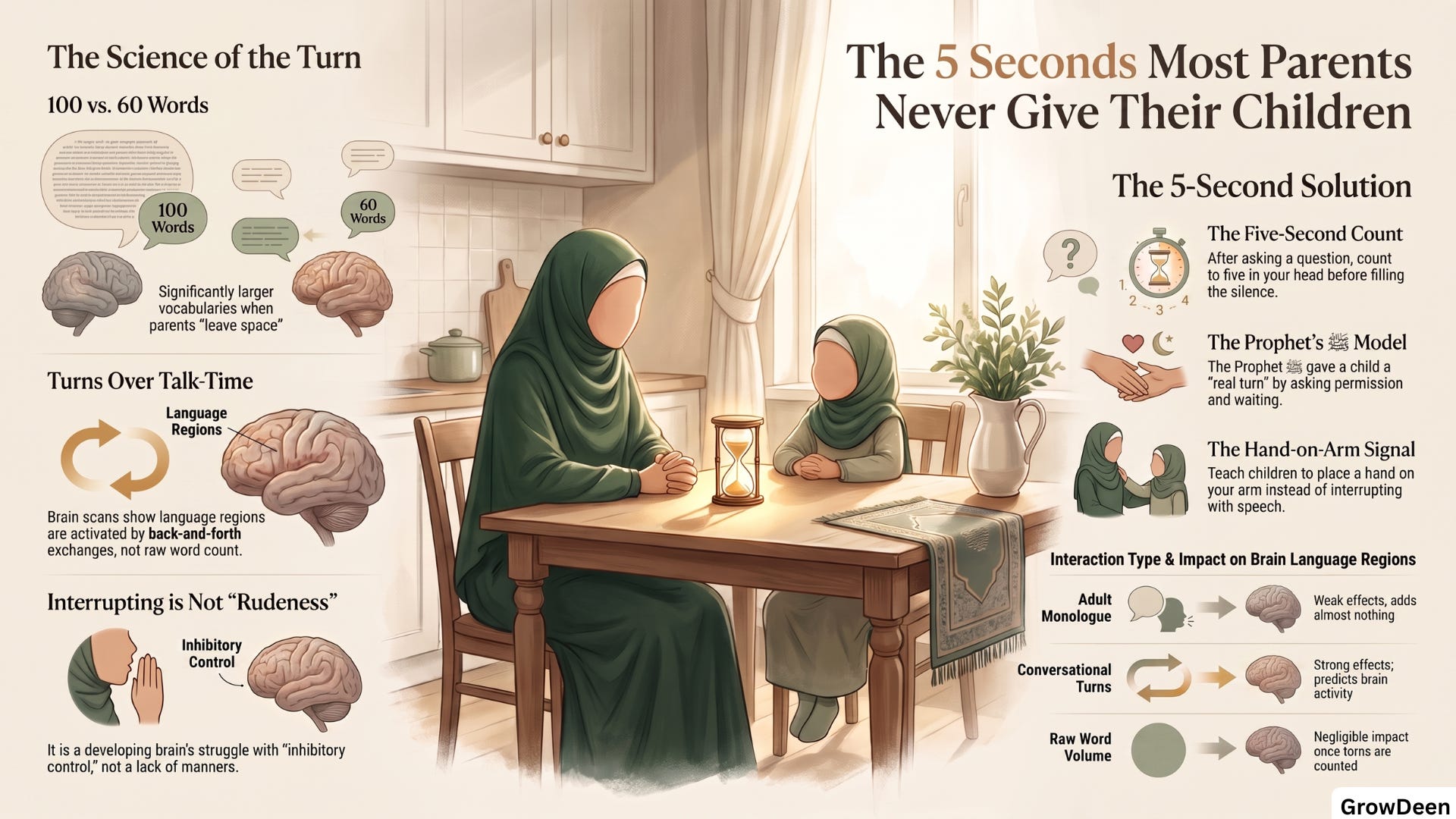
Researchers coached one group of parents to leave more space in conversation with their babies. By 18 months those children knew around 100 words. The uncoached group knew about 60. [1] Here is what the coaching actually taught them, and the five-second version you can start using tonight.
The gathering was going fine until your child spoke.
Cut straight across your aunt, mid-sentence, about something involving a lizard. You said their name in that low warning voice. They said it louder.
And you did everything the books tell you to do. You crouched down. You said “we don’t interrupt” calmly, at eye level, without shame. Then your child interrupted again forty seconds later, and now three relatives are looking at you, and you can feel your ears going hot.
Here is the part nobody tells you: the crouching and the reminding were never going to work, because interrupting is not a manners problem. Not at that age. And the thing that does work does not look like teaching at all.
When I went through the University of Washington’s randomised controlled trial on this, the numbers stopped me. Researchers coached one group of parents in something small: how to leave space and let the back-and-forth actually happen. By 18 months, the coached families’ children had vocabularies of roughly 100 words. The control group sat around 60. [1] A follow-up found the gap was still there a full year after the coaching had ended. [2]
Nobody taught those children manners. Somebody taught their parents to wait.
What Makes This Different From Generic Advice on Children’s Manners
Built on trial evidence, not opinion. Every claim here comes from peer-reviewed work published between 2006 and 2023, including a randomised controlled trial and a brain-imaging study.
Rooted in the Sunnah, not decorated with it. The Prophet ﷺ modelled the exact skill the research points to, in a narration most parents have never read as a parenting text.
You get a tool, not just an explanation. The free Real Turns Pack breaks conversation into its seven parts so you can find the one your child is actually stuck on, instead of correcting the wrong thing for another year.
The 7 Things Your Child Is Doing at Once
Watch a five-year-old cross a room to say something to an adult, and slow it down.
She has to notice her aunt is already speaking. Hold her own thought in memory while she waits. Override the urge to just start, which is by far the hardest part. Then find an opening other people recognise as an opening. Hold eye contact for roughly the right length. Judge whether this topic is interesting to her aunt or only to her. Listen to whatever comes back well enough to respond to it.
Seven jobs. Running at the same time. In a brain that is four years from finishing primary school.
You do all of that without noticing, which is exactly why it is so hard to teach. You cannot break down a skill you no longer experience as one.
This is why “be polite” fails. Politeness is the output. What your child is missing is one specific piece underneath, and until you can name which piece, you are correcting a symptom and wondering why nothing changes.
Which brings me to the question I want you to hold onto for the rest of this article. Why does your child talk non-stop at home, but the moment other adults walk in, become either a chatterbox who cannot stop or a statue who will not start? Those look like opposite problems. They are not. I will come back to it.
But first, the thing the research got wrong for about thirty years.
Why Talking More at Your Child Doesn’t Work
For decades the advice was volume. Narrate everything. More words in, more words out.
That turned out to be about half right, and the wrong half stuck.
A team at MIT scanned the brains of four to six year olds and paired the scans with recordings of talk at home. What predicted activity in the brain’s language regions was the number of genuine back-and-forth exchanges. Once turns were counted, the raw quantity of adult words added almost nothing. [3] A large study of families with children under four had already found the same thing: adult monologue showed weak effects, turns showed strong ones. [4]
So a parent talking constantly at a child is doing less than a parent who says half as much and then stops.
Here is what that means at your kitchen table. You ask “how was school?” and your child says “fine,” and you fill the silence with the next question. Try leaving it. Count to five in your head. Most of the time, something comes.
The pause is the lesson.
The Cup, the Boy, and the Question: What the Prophet ﷺ Modelled
We tend to look to Islamic guidance for what our children should say. There is something older and more useful sitting right there: how they should be spoken to.
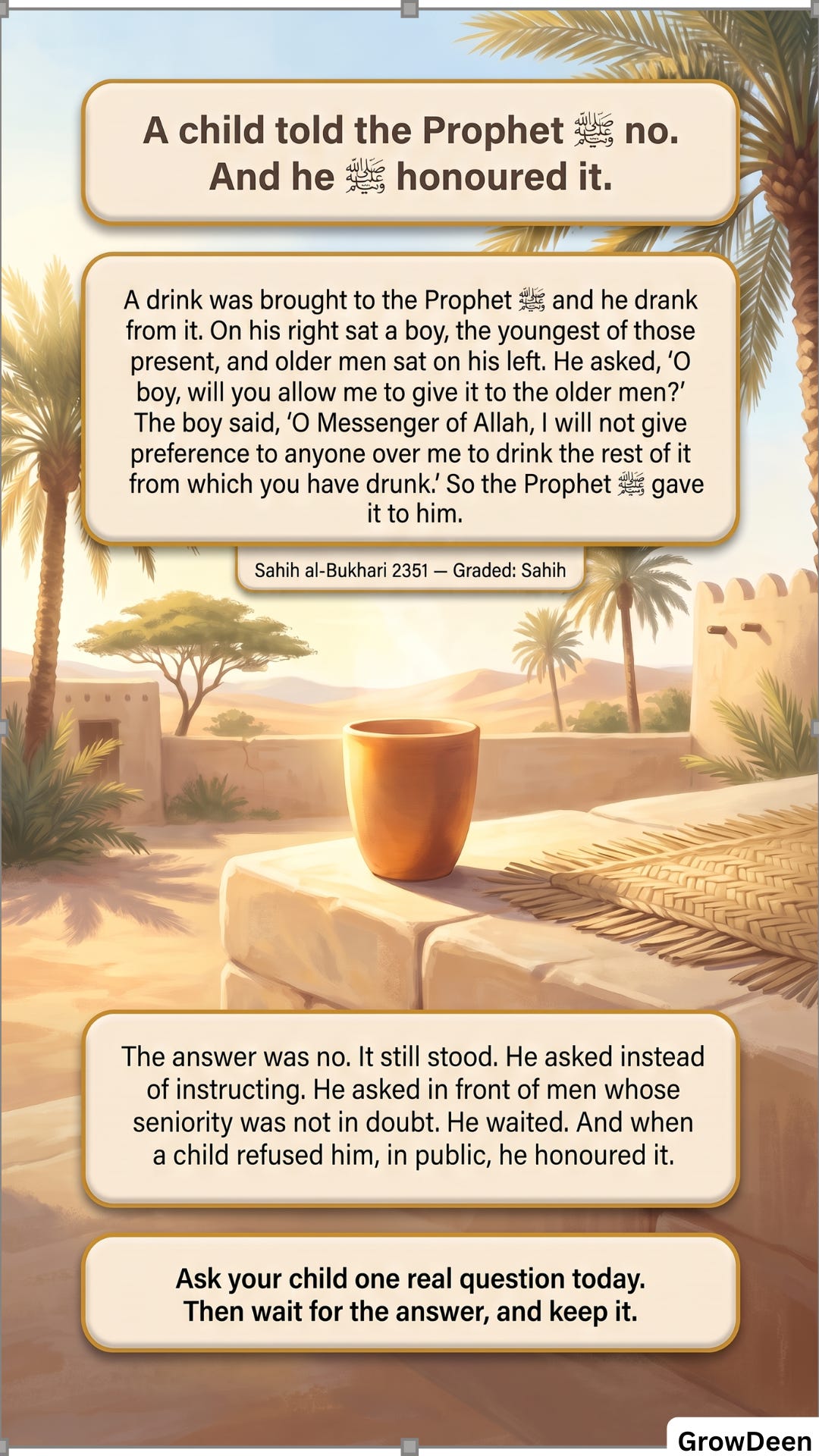
A drink was brought to the Prophet ﷺ. He drank from it. On his right sat a boy, the youngest person present. On his left sat a group of older men, and by the Sunnah of the right side, the cup was the child’s next.
He turned to the boy and asked, “O boy, will you allow me to give it to the old men?” The boy answered that he would not give anyone preference over his own share from him. So the Prophet ﷺ placed the cup in his hand. [12]
Sit with what he did there. He asked instead of instructing, though he could easily have instructed. He asked a question with a genuinely open answer, in front of adults. He waited. And when the answer came back as no, from a child, in company, he honoured it.
That boy was learning something no lecture transmits: a question put to him was real, his words carried weight, speaking up was safe.
Fourteen centuries later, researchers with audio recorders and brain scanners arrived at the same place. Give the child a real turn. Then wait.
I know this is a lot to hold in your head at 8pm on a Tuesday with three children and a sink full of dishes. That is why I put together a free printable called the Real Turns Pack, and the first page alone is the bit I would want if I were you: a one-page grid that breaks conversation into its seven parts so you can circle the one your child is genuinely stuck on. Keep reading and you can download it at the end.
Support Muslim Parenting Lab ❤️
Is there someone you have lost who you would still like to send a reward to? Give in their name with the button below.
Asked whether he could give charity for his late mother, the Prophet ﷺ said: yes, give on her behalf. (Sahih al-Bukhari 2760)
The Child Who Can’t Stop, and the Child Who Can’t Start
Back to that question I left with you.
Interrupting and freezing look like opposite problems. Underneath, they are the same problem wearing different clothes: a child whose regulation has not caught up with a social situation that has become suddenly harder.
The child who can’t stop. Interrupting is an inhibitory control problem long before it is a manners problem. The brain system that holds a thought while suppressing the urge to say it is among the slowest to develop, and it is not fully mature until well into adulthood. [6] Your child is not being rude. Your child is four.
So stop aiming to eliminate it. Build a bridge instead. Teach the hand signal: your child places a hand on your arm, you place your other hand on top to say received, and you keep talking. This works from around two and a half, far earlier than “excuse me,” because it does not require producing speech while excited.
Then reward it fast. If your child waits correctly and you leave them standing for four minutes, you have just taught them that waiting does not work.
The child who can’t start. Now here is the one most articles skip, and the one I would least want you to miss.
There is a real difference between a shy child who warms up slowly and a child who consistently cannot speak in certain settings while speaking normally at home. That second pattern has a name. Selective mutism is classified as an anxiety disorder, and the word “selective” misleads almost everyone. These children are not choosing silence. They are unable to speak in those settings, and it gets read as extreme shyness and left alone for years. [7][8]
This matters more for our families than most people realise. Bilingual, multilingual and immigrant children are heavily overrepresented in referrals, with prevalence estimated around 2.2% in immigrant and language-minority children, roughly three times the rate in the general child population. [9] Being multilingual does not cause it. But a child carrying Urdu or Arabic or Somali at home, English at school and Qur’an class at the weekend has more rooms in which speaking feels exposed.
Timing matters here. Outcomes are considerably better when children are identified young, and delaying past around seven makes resolution during the early primary years much less likely. [8]
What not to do: pressure them to speak, ask them a question in front of others and wait, or explain their silence to an adult while they stand there listening. Each one raises the anxiety that is producing the silence in the first place.
When Your Child Answers Back
Your child will answer back. Usually in the exact second you set a limit, and usually in a tone engineered to get a reaction.
Do not match it. Everything else follows from that.
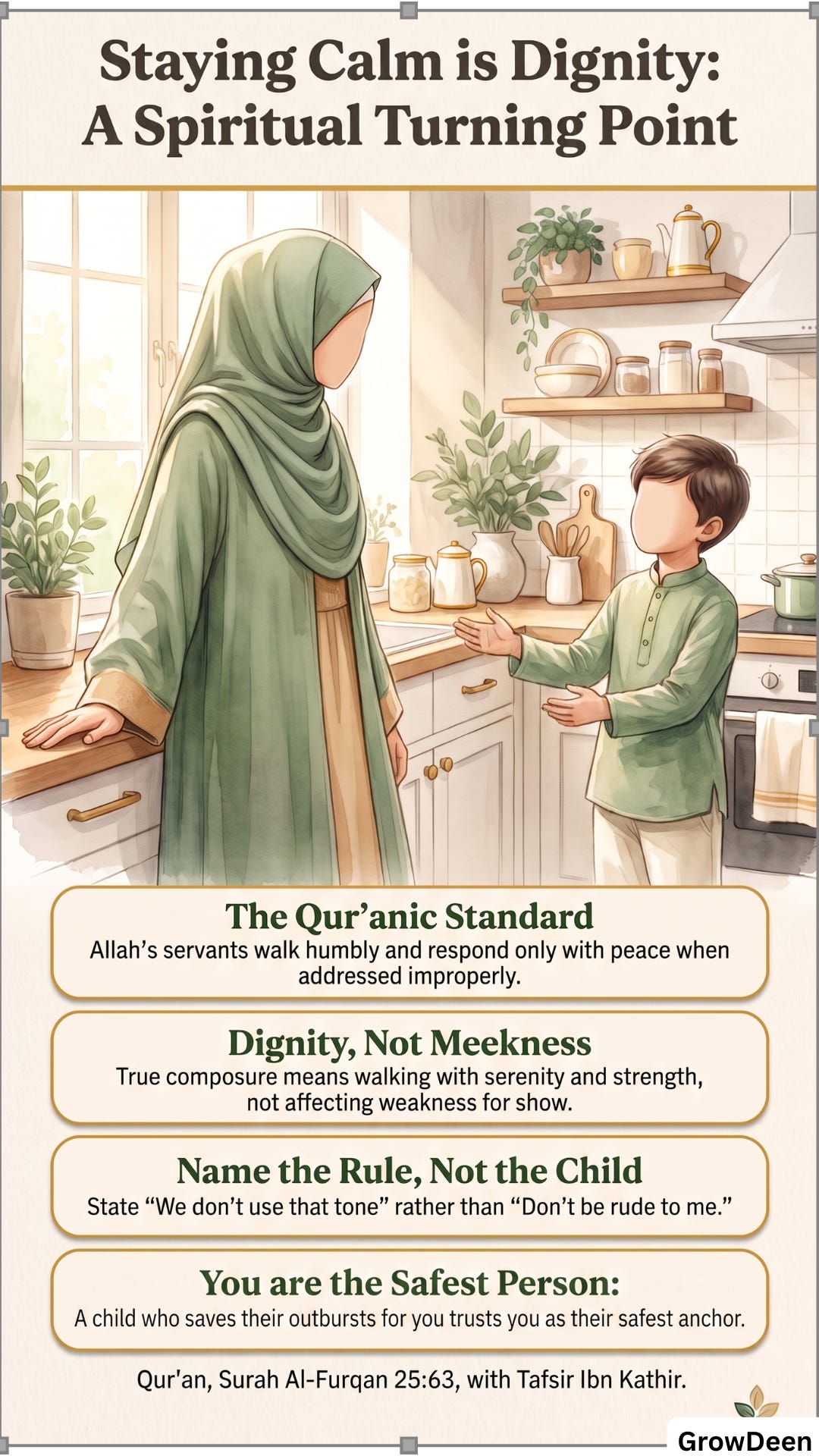
Allah describes the servants of the Most Merciful as “those who walk on the earth humbly, and when the foolish address them improperly, they only respond with peace.” [13] According to Tafsir Ibn Kathir, walking hawna means walking with dignity and humility rather than arrogance and pride, and he is careful to add that this does not mean walking like a sick person putting on a show of meekness. What is meant, he writes, is serenity and dignity. On the second half he says that when the ignorant address them with bad words they do not answer in kind, but forgive, overlook, and say nothing but good. And then this: the more ignorant the people, the more patient he ﷺ would be.
Read that standing in your kitchen while an eight-year-old says something calculated to land, and it rearranges something. The verse is not describing a person with no self-respect. It describes someone carrying enough of it that a rude tone cannot drag them down to its level.
Practically, three things. Name the rule, not the child: “we don’t speak to each other in that tone in this house” lands better than “don’t be rude to me,” because the first is a standard and the second is an accusation. Separate the tone from the content, because sometimes the argument buried under the rudeness is a decent argument, and a child who learns that being right is never acknowledged stops bothering to be right. And if it continues, give a consequence aimed at the rudeness specifically, never an increase in volume from you, because that models the exact thing you are trying to remove.
One more thing worth holding. A child who answers back to you and to nobody else is telling you that you are the safest person in their world. Correct it. Also notice it.
When to Speak to a Professional
Talk to your doctor or paediatrician, and ask about a referral to a speech and language therapist, if you notice any of the following:
Very few words, or no two-word combinations, by around two
Speech that adults outside the family cannot understand by around three to four
Stuttering that lasts beyond six months, worsens, or comes with visible facial tension
Loss of language or social skills your child previously had, at any age
Consistent inability to speak in specific settings, such as school, while speaking freely at home, lasting more than a month
Ongoing difficulty with the back-and-forth of conversation despite steady support at home
Early support beats later support in nearly every one of these. Asking is not an admission of failure. It is taking the means, which is what Islam asks of us before we hand the outcome to Allah.
This article is general education. It does not replace assessment by a professional who has actually met your child.
Get the Real Turns Pack (Free)
If you have read this far, you are the kind of parent who wants to understand what is actually going on with your child rather than just get them to behave in front of relatives. That tells me something.
Inside the Real Turns Pack (one PDF, 3 pages):
Page 1: The Seven Skills Finder — a single-page diagnostic grid that breaks conversation into its seven component parts, with a column to mark which one your child is genuinely stuck on and one specific thing to try for each. Designed to sit on the fridge, so you stop correcting the wrong skill.
Page 2: The Family Signal Agreement — a fill-in page your family completes together at a calm moment: the hand-signal protocol for interrupting, the short list of times interrupting is always allowed, and three blank lines for your own house rules on how people speak to each other. Takes fifteen minutes and settles arguments you would otherwise have for years.
Page 3: The Cup and the Question — an Islamic reflection card built on the narration of Sahl ibn Sa’d and the description of the servants of the Most Merciful in Surah Al-Furqan, with the two lines from Tafsir Ibn Kathir that reframe what dignity in speech actually means for a parent holding their temper.
This isn’t a PDF to download and forget. It’s designed to live on your fridge, where the conversations actually happen.
This Real Turns Pack is what every subscriber receives with each article. We cover the full journey of raising Muslim children from birth through the early school years, all backed by peer-reviewed research and rooted in authenticated Islamic guidance.
Do This Tonight
The next time your child answers a question with one word, do not fill the silence. Count to five in your head and let it sit.
That’s it. That’s the practice. Five seconds is where the turn happens.
May Allah ﷻ grant our children tongues that speak truth, hearts that listen well, and words that bring people closer to Him.
Share This With Someone Who Needs It
Think of one person right now: the sister at the masjid whose four-year-old talks over every adult in the room and who apologises for him three times per visit. The friend whose bright, funny daughter goes completely silent at school and has been told for two years that she’ll grow out of it. The cousin who snapped at her son’s tone last week and has been quietly sick about it since.
This article could change how they read their own child. Send it to them today, not as advice, but as company. Sometimes the kindest thing we can do is tell someone that what they are seeing has a name.
Frequently Asked Questions
Q: At what age should a child stop interrupting?
A: There isn’t a clean cutoff, and I’d be suspicious of anyone who gives you one. The brain system that lets a person hold a thought while suppressing the urge to blurt it is still maturing well into adulthood. [6] Most children can manage a short wait by around five or six if they’ve been given a workable signal. Before three, expect very little.
Q: How do I teach my child to say “excuse me”?
A: Start earlier and lower with the hand-on-arm signal, because producing words while excited is much harder than making a gesture. Once that’s reliable, layer “excuse me” on top around four or five. See “The Child Who Can’t Stop” above for the full protocol.
Q: My child talks fine at home but won’t speak at school. Is this just shyness?
A: Possibly, but it’s worth taking seriously rather than waiting it out. Consistent inability to speak in specific settings while speaking normally at home, lasting over a month, is the pattern of selective mutism, which is an anxiety condition and not defiance or shyness. [7] It’s also notably more common in multilingual and immigrant families. [9] Please speak to your doctor rather than waiting.
Q: How should Muslim parents deal with a child talking back?
A: Don’t match the tone, name the rule rather than the child, and separate the rudeness from the content, because sometimes the argument underneath is a reasonable one. Qur’an 25:63 sets the standard, and Ibn Kathir’s reading of it makes clear that responding calmly is a mark of dignity, not weakness. [13]
Q: Does talking more to my child improve their language?
A: Less than you’d think. Back-and-forth turns predict language-region brain activity, while the raw count of adult words does not once turns are accounted for. [3] Quality of exchange beats quantity of words, so the pause matters more than the paragraph.
Q: Is being bilingual bad for my child’s speech?
A: No. Growing up multilingual doesn’t cause speech or language disorders. What the data does show is that multilingual and immigrant children are referred for selective mutism at roughly three times the general rate, [9] which is about the number of settings where speaking feels exposed, not about the languages themselves.
References
[1] Ferjan Ramírez, N., Lytle, S.R., & Kuhl, P.K. (2020). Parent coaching increases conversational turns and advances infant language development. Proceedings of the National Academy of Sciences, 117(7), 3484–3491. https://doi.org/10.1073/pnas.1921653117
[2] Huber, E., Ferjan Ramírez, N., Corrigan, N.M., & Kuhl, P.K. (2023). Parent coaching from 6 to 18 months improves child language outcomes through 30 months of age. Developmental Science, 26(5), e13391. https://doi.org/10.1111/desc.13391
[3] Romeo, R.R., Leonard, J.A., Robinson, S.T., West, M.R., Mackey, A.P., Rowe, M.L., & Gabrieli, J.D.E. (2018). Beyond the 30-million-word gap: Children’s conversational exposure is associated with language-related brain function. Psychological Science, 29(5), 700–710. https://doi.org/10.1177/0956797617742725
[4] Zimmerman, F.J., Gilkerson, J., Richards, J.A., Christakis, D.A., Xu, D., Gray, S., & Yapanel, U. (2009). Teaching by listening: The importance of adult-child conversations to language development. Pediatrics, 124(1), 342–349. https://doi.org/10.1542/peds.2008-2267
[5] Casillas, M., & Frank, M.C. (2017). The development of children’s ability to track and predict turn structure in conversation. Journal of Memory and Language, 92, 234–253. https://doi.org/10.1016/j.jml.2016.06.013
[6] Diamond, A. (2013). Executive functions. Annual Review of Psychology, 64, 135–168. https://doi.org/10.1146/annurev-psych-113011-143750
[7] American Speech-Language-Hearing Association. Selective Mutism (Practice Portal), summarising DSM-5-TR criteria (American Psychiatric Association, 2022). https://www.asha.org/practice-portal/clinical-topics/selective-mutism/
[8] Muris, P., & Ollendick, T.H. (2021). Current challenges in the diagnosis and management of selective mutism in children. Psychology Research and Behavior Management, 14, 159–167. https://doi.org/10.2147/PRBM.S274538
[9] Elizur, Y., & Perednik, R. (2003). Prevalence and description of selective mutism in immigrant and native families: A controlled study. Journal of the American Academy of Child & Adolescent Psychiatry, 42(12), 1451–1459. https://doi.org/10.1097/00004583-200312000-00012
[10] Landry, S.H., Smith, K.E., & Swank, P.R. (2006). Responsive parenting: Establishing early foundations for social, communication, and independent problem-solving skills. Developmental Psychology, 42(4), 627–642. https://doi.org/10.1037/0012-1649.42.4.627
[11] McDaniel, B.T., & Radesky, J.S. (2018). Technoference: Parent distraction with technology and associations with child behavior problems. Child Development, 89(1), 100–109. https://doi.org/10.1111/cdev.12822
[12] Sahih al-Bukhari 2351, narrated by Sahl ibn Sa’d (RA) — Graded: Sahih (Muttafaqun ‘Alayhi; also Sahih Muslim 2030) — https://sunnah.com/bukhari:2351
[13] Qur’an, Surah Al-Furqan 25:63 — https://quran.com/25/63 — with Ibn Kathir. Tafsir Ibn Kathir, Surah Al-Furqan 25:63 commentary — https://quran.com/al-furqan/63/tafsirs/en-tafisr-ibn-kathir