

Reading trouble runs in families. In one large review, about 45% of children with a dyslexic parent or sibling had dyslexia themselves, against just under 12% of other children. [1]
Print it before the next school meeting.
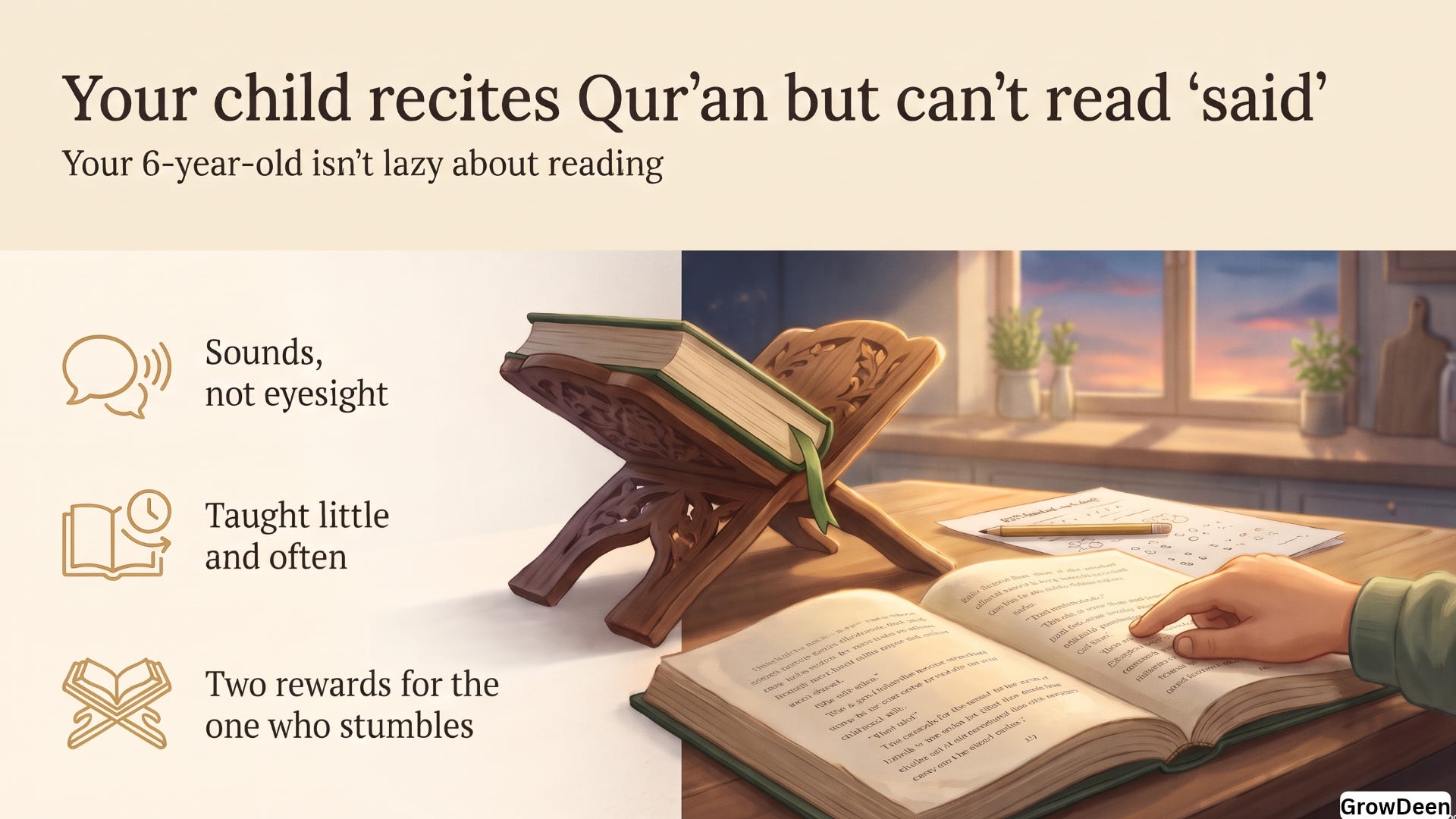
Maryam knows Surah al-Mulk by heart. All thirty verses, word perfect, learned by listening to her grandfather recite it in the car on the way to school. Tonight she is sitting at the kitchen table with her school reader, and the word “said” has beaten her for the fourth time on the same page.
Her parents have done everything they were told to do. They read with her every night and signed her up for an extra Qur’an class on Saturdays. She has only become slower and more upset. When her mother points at the word one more time, Maryam pushes the book away and says, quietly, “I’m just stupid.”
You may have heard a version of that sentence at your own table, and felt it land somewhere under your ribs.
So how does a child hold thirty verses in memory and still lose a four-letter word? The answer changes almost everything about how to help her, and it comes near the end of this guide, once the pieces are in place. Until then, keep one thing in mind. The enemy in Maryam’s story is the try-harder myth, the belief that reading trouble means laziness or a slow mind and that more pressure will fix it. Maryam is neither lazy nor slow.
What Makes This Approach Different
Every point rests on named sources, from NHS guidance and the American Academy of Pediatrics to peer-reviewed reading research published from 2009 to 2026.
The Islamic guidance here speaks to the hour many families dread most, the struggling child at the Qur’an table, with a promise from the Prophet ﷺ made for exactly that child.
You already have the free Reading Clues Pack from the top of this page, so everything below can turn into notes you carry into the next meeting with a teacher.
Is My Child Lazy, Or Could It Be Dyslexia?
The fear most parents carry into this question is rarely said out loud. Maybe you didn’t read to them enough as a baby. Maybe the second language at home confused things. Maybe, and this one keeps people awake, your child simply isn’t very bright and everyone is being polite about it.
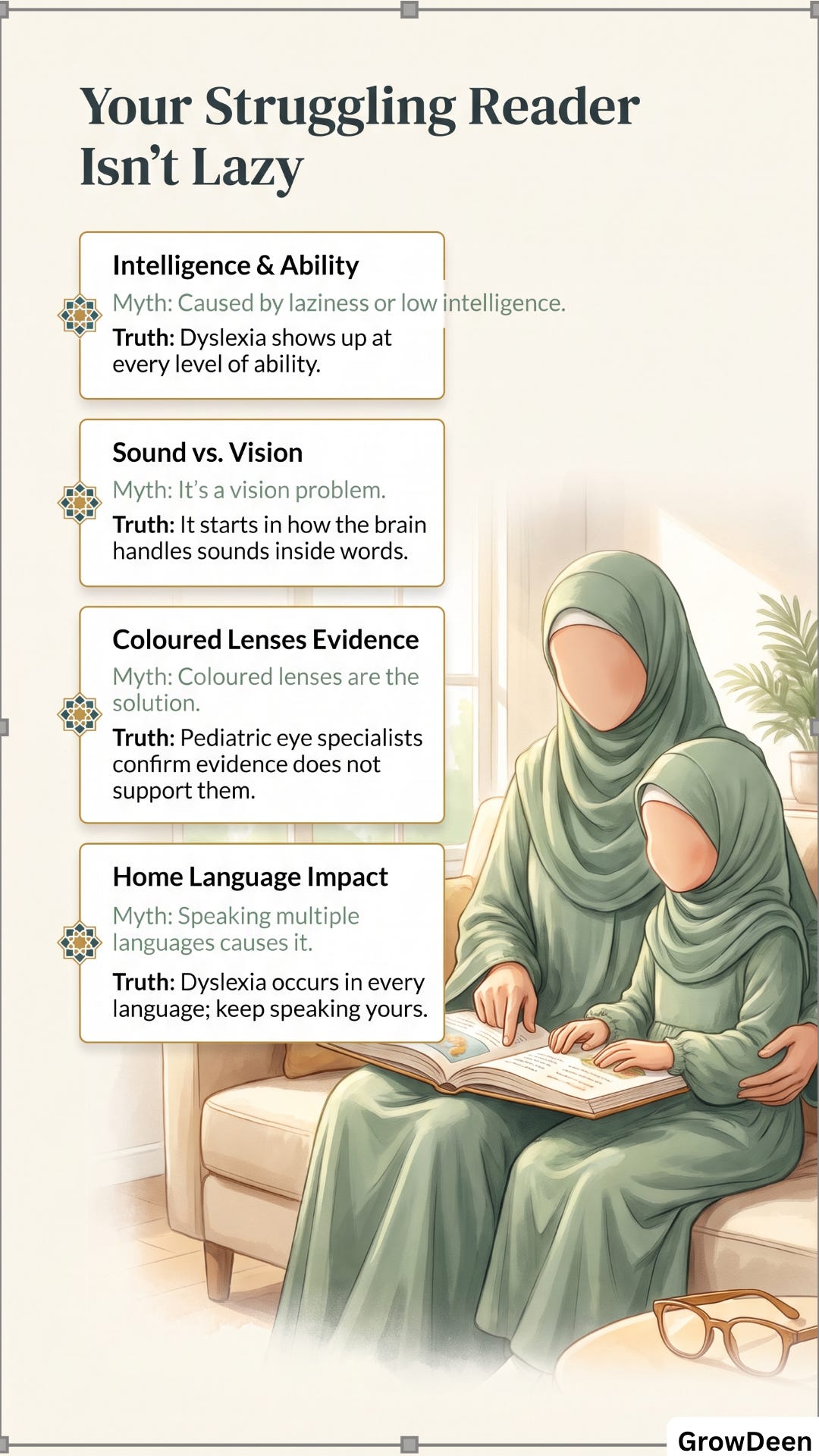
None of those fears fits what dyslexia actually is. Dyslexia is a difference in how the brain pulls apart the sounds inside spoken words and connects those sounds to letters on a page, so a child struggles to read words accurately and fluently, and spells unpredictably, even after good teaching and real effort. [2][3] Specialists treat it as a language-based difficulty. The old picture of a child “seeing letters backwards” because of faulty eyesight doesn’t hold up against the evidence. [4][5]
It isn’t rare. In the UK, up to 1 in 10 people are thought to have some degree of dyslexia. [6] Intelligence is a separate matter. Dyslexia appears in children of every ability, and plenty of dyslexic children are strong at creative thinking and problem solving. [6]
It is lifelong, which sounds heavier than it is. The way a dyslexic brain handles sounds doesn’t switch off, but with the right teaching a child can become a capable reader and go on to do well at school and at work. [6] Some children also have trouble understanding and holding on to information, with numbers, or with planning and organising. [7] And between a quarter and two fifths of children with dyslexia also meet the criteria for ADHD, so a thorough assessment looks at attention as well as reading. [8]
The first useful step costs nothing. Stop saying “try harder” at home, and start saying “let’s find out what’s making this hard”.
The Clues That Show Up Before Reading Does, And After
Most parents notice something long before they can name it. Perhaps your three-year-old never caught on to rhyming games the way a cousin did. Perhaps your seven-year-old reads a sentence perfectly tonight and can’t read the same words tomorrow. Those small, nagging observations matter, because dyslexia leaves clues in four places, and they shift as a child grows.
Sounds and speech. The earliest clues live in spoken language, since dyslexia grows from the way a child processes sound. [2][9] In the preschool years watch for late talking, scrambled sounds in long words (such as “hecilopter” for “helicopter”), trouble hearing that “pen”, “hen” and “ten” rhyme, and little interest in learning letter names and sounds. [10] A child who can’t repeat back a long word or sentence, or who muddles sequences like the days of the week, belongs in the same picture.
Print. Once formal reading starts, the signs usually become much easier to see. [6] A school-age child might guess from the first letter or the picture instead of sounding a word out, forget words met many times before, or keep writing “b” for “d” long after classmates have stopped. [10] Many find it hard to pick out single sounds, such as the first sound in “map”, and to blend sounds together, so d-o-g never quite turns into “dog”. [11]
Memory and organisation. Instructions with several steps slip away. Left and right get confused. Times tables won’t stick, and planning schoolwork feels impossible. [7] A weak short-term memory can belong to the same profile, which is why some young children take months to hold on to short daily phrases like the words said before sleep. [10] That has nothing to do with how much a child loves Allah.
Feelings. By the pre-teen and teenage years the emotional signs often speak loudest. Frustration is common, and it can come out as disruptive behaviour or as quiet withdrawal, at school and at home. [7] Learning disabilities raise the risk of emotional and psychological difficulties, [4] and an older child may hide their reading behind messy handwriting or quietly decide that they are “thick”.
One sign on its own tells you very little. A cluster that sticks around for weeks is worth writing down.
Why Family History And Home Languages Change The Picture
Picture a father at a parents’ evening, quietly remembering how he hid at the back of the classroom whenever reading aloud began. If reading was a battle for you or your spouse, it belongs in this conversation. The figure at the top of this guide comes from a large review of children with a dyslexic parent or sibling, and the same work found that children at family risk often show slower language development as toddlers, years before reading lessons start. [1] A family history raises the likelihood without settling the matter, so mention it early to the teacher and the doctor.
Languages at home add a second layer. Many Muslim children speak one language at school and another at home, such as Urdu, Somali, Bengali or Arabic, and then learn Qur’anic Arabic at the masjid as well. That is a gift, and it doesn’t cause dyslexia, which occurs in every culture and every language. [12] The risk is a different one: in a bilingual child the signs are easily put down to “still learning English”, so dyslexia tends to be identified late even though the signs appear on time. [13][12]
If your child is bilingual, ask whether the difficulty shows up in both languages, because dyslexia will, and ask for an assessment that looks at both where possible. [13] Keep speaking your home language. The idea that parents should drop it to help a child’s English is a myth, [14] and the structured teaching that helps dyslexic children works for bilingual children too. [13]
One more piece of help is waiting at the top of this page.
Keeping track of all of this across weeks of homework and two different teachers is a lot for any parent to hold. That’s why the free Reading Clues Pack exists: a four-week log for the signs above, a sheet for meetings with the class teacher and the Qur’an teacher, and a reflection page for the evenings when it all feels heavy. The download button is at the top of this page, and there’s a full description of what’s inside it below.
What To Do Now, And What Comes Next
Many parents sit on their worry for months, because raising it can feel like admitting something is wrong with their child. The sooner dyslexia is identified, the more effective the help tends to be, [6][2] and waiting to see whether a child catches up costs time they can’t easily get back. Taking these steps sits comfortably alongside trusting Allah. Booking the appointment is the effort, and the du’a you make on the way there belongs to the same act of care.
This week. Talk to the class teacher. Ask what they see during reading lessons and whether the school’s special educational needs staff can run a screening check. [7] Start writing down the clues you notice at home, with dates.
This month. See your doctor or paediatrician, who can look for other explanations and refer you on. Ask for a hearing check and a full eye examination, so that any hearing or vision problem gets treated. [4][15] Poor eyesight can get in the way of learning and is worth ruling out, even though dyslexia itself is a language difficulty.
This term. Ask for a formal assessment, usually carried out by an educational psychologist or a specialist teacher rather than a doctor. [7] A speech and language therapist can help a great deal as well, especially for younger children whose talking is slow to develop. [4] Meanwhile, the school doesn’t need a formal diagnosis before starting extra literacy support, and it shouldn’t hold back while you wait. [16]
Rules on school support differ between countries. In the UK, for example, schools and colleges must offer support to students with a specific learning difficulty such as dyslexia. [6] Wherever you live, ask what adjustments apply, and keep a written note of everything agreed.
Don’t wait for the term to run out if your child’s speech is clearly behind other children’s, or if they keep falling further behind despite extra help. Arrange an appointment promptly, too, for a child who seems anxious, low, withdrawn or angry about school, or who talks about themselves as worthless.
What happens once the assessment is done depends on the kind of teaching your child receives next, and the research on that is clearer than most parents expect.
The Teaching That Changes Reading, And The Detour To Avoid
Imagine the relief of watching your child sound out a word they couldn’t read last month, slowly, finger under each letter, and then read it again the next day. That moment is what good dyslexia teaching is built to produce.
The evidence favours explicit, systematic teaching of the sounds of language and how they link to letters, delivered in a planned order, “little and often”, with plenty of repetition and with more than one sense involved at a time, so that a child sees a word and says it aloud while writing it. [17][18][19] Children come to recognise words instantly by linking each word’s sounds to its letters, which is why sounding out serves a child better over time than memorising the shape of a word. [11] Good support also starts from what a child already does well. The builder, the artist, the footballer and the storyteller all need that strength noticed, because the confidence carries over.
Depending on where you live, support at school might include small-group reading programmes with a trained teacher, one-to-one sessions with a specialist, extra time in tests or questions read aloud, and assistive technology such as text-to-speech, spell-checkers, word prediction and voice typing.
Then there is the detour. Eye exercises, behavioural vision therapy and special tinted lenses or filters are promoted to worried parents, but they are not supported by scientific evidence, and paediatric and eye specialists recommend against them. [4] Long reading sessions that end in tears are a detour too. Short, regular practice works better. [17]
Qur’an Class Without Shame
For many dyslexic children the hardest hour of the week isn’t at school at all. It’s at the masjid, where learning the Arabic letters and their vowel marks means cracking a second writing system, often in front of other children. In one study of Muslim primary pupils in Malaysia, about four in five of the children with dyslexia also had difficulty reading the Qur’an, and the researchers concluded that support for dyslexic Muslim children should include Qur’an reading. [20]
Talk to the Qur’an teacher as you would to the class teacher. Ask whether shorter portions with plenty of repetition are possible, and whether your child can be spared from reading aloud in front of the class until they feel ready. Alongside slow, structured work on the letters, let your child learn short surahs by ear from a reciter they love, and praise progress by ear as warmly as progress on the page.
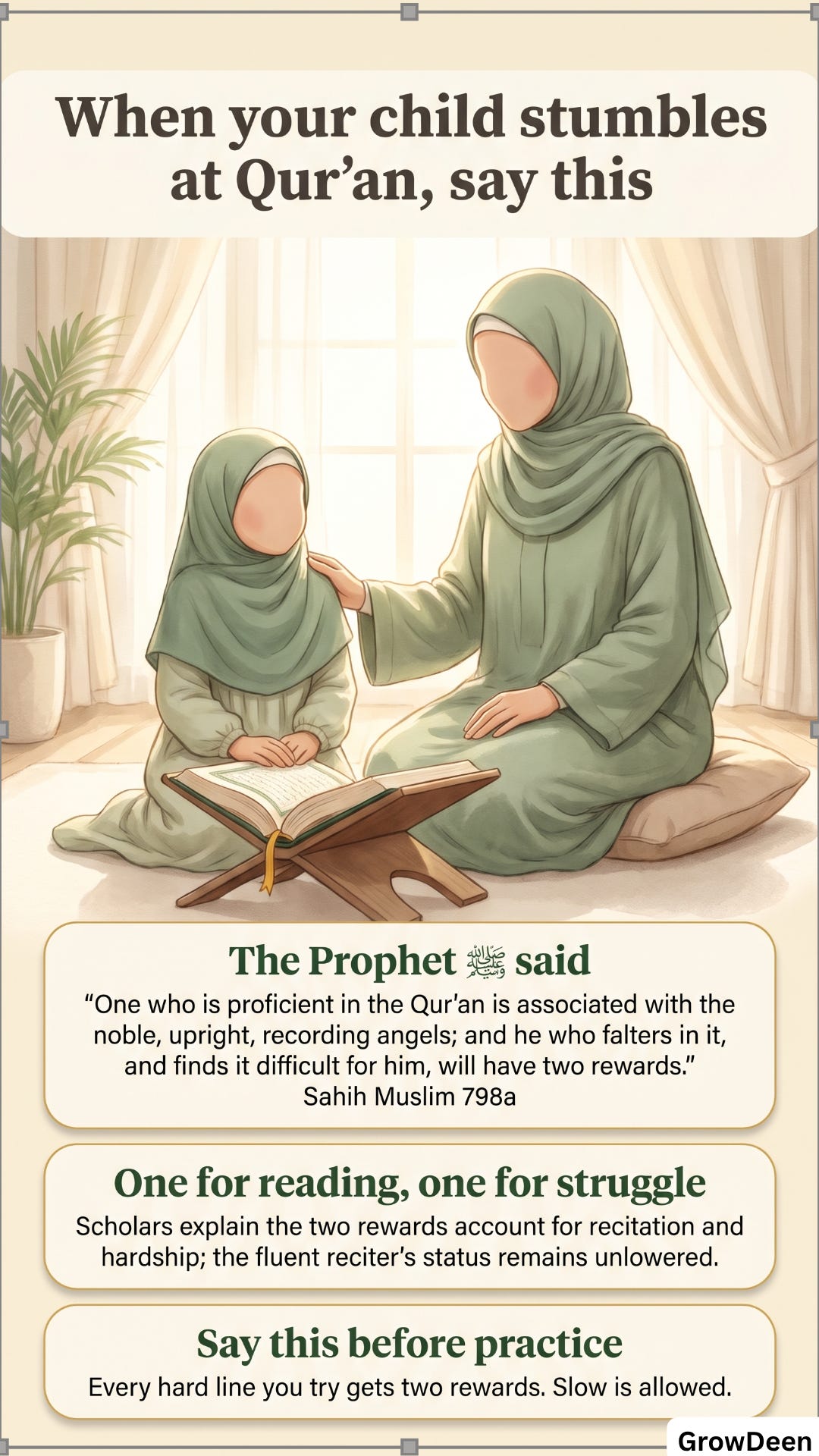
Most of all, tell your child what the Prophet ﷺ said about the reciter who stumbles. The words are quoted in full below, and they say plainly that the struggle itself is rewarded. Every faltering line still counts.
Support Muslim Parenting Lab ❤️
Would you like a deed that keeps earning for you after you die? Start one in a few seconds with the button below.
The Prophet ﷺ named ongoing charity and beneficial knowledge among the three things that keep counting after death. (Sahih Muslim 1631)
What The Prophet ﷺ Promised The Child Who Stumbles
A parent sitting beside a child who reads one line of Qur’an in the time a sibling reads a page often feels the weight of comparison before anything else. The Qur’an lifts that weight. Allah says, “So fear Allah as much as you are able.” [21] Ibn Kathir explains the phrase as meaning as much as you are able and can bear, and he cites alongside it the hadith of the Two Sahihs in which the Prophet ﷺ said that when he commanded something, people should “do of it as much as you can”. [21][22] Obligation follows ability, so a dyslexic child’s targets belong to that child’s ability today.
Then comes the promise. The Prophet ﷺ said, “One who is proficient in the Qur’an is associated with the noble, upright, recording angels; and he who falters in it, and finds it difficult for him, will have two rewards.” [23] Scholars explain the two rewards as one for the recitation and one for the hardship endured, while noting that this doesn’t rank the struggling reciter above the proficient one, whose company is with the angels. [24]
The structured, patient teaching that reading research recommends and this promise from the Prophet ﷺ point a parent in the same direction: steady effort, sized to the child.
Evenings At Home: Patience, Reading Aloud And The Words You Choose
So what does this look like at 7pm on a school night, with dinner half made and a reader on the table?
Homework can stretch a parent’s patience like little else. A loud sigh or a sharp “we only just did this word!” teaches a child that reading is where they get hurt, while a calm voice teaches them that trying again is safe. Model each sound slowly and clearly, and let your child say it back as many times as they need. That patience is seen. Allah says, “Indeed, the patient will be given their reward without account [i.e., limit].” [25] In his tafsir, Ibn Kathir records Al-Awza’i explaining that the reward of the patient will not be weighed or measured, and that they will be given an immense reward. [25]
Keep reading aloud to your child long after they can manage easy books alone. Oral language, the vocabulary and understanding a child builds through conversation and stories, is one of the strongest foundations for reading, and it keeps growing even while decoding lags behind. [9] When your child reads to you, choose books that use the spelling patterns they have already been taught, and set aside pages crowded with words they can’t yet decode. Ten calm minutes after Asr, every day, achieves more than a long struggle at the weekend.
Make home a place where nobody is laughed at for how they read. If a sibling sniggers at a mispronounced word, step in gently and every single time. Praise effort as warmly as results, and notice success away from books, in football, art, building with blocks or kindness to a younger sibling. Help your child find an activity they love, and make room for physical activity, since exercise can lift mood and self-confidence. [7]
Give dyslexia a name your child can carry. For a young child something like this works: “Your brain is brilliant at lots of things. It finds the sounds in words tricky, so we’re going to learn them in a special way.” And make du’a for their learning out loud, by name, where they can hear you. A child who hears a parent ask Allah to make reading easier knows the difficulty is taken seriously and that they aren’t facing it alone.
So How Can Maryam Recite A Surah But Not Read “Said”?
Go back to the kitchen table. Maryam learned Surah al-Mulk through her ears, by hearing it again and again until the whole surah was hers. Reading “said” asks for something her ears never had to do: linking the separate sounds of a word to the letters that stand for them, quickly and automatically, and that link is exactly the part dyslexia disrupts. [2][11] Her intelligence isn’t the problem, and neither is her love for the Qur’an. [6] The bridge between sound and print has to be built on purpose, with structured teaching, while her ears keep carrying her Qur’an forward.
That is why the try-harder myth fails. More flashcards and longer evenings push on the part of reading that is hardest for her, and they turn the struggle into shame. The right teaching and a patient voice at home change the picture entirely, especially once the Qur’an teacher knows what is going on too. And on the days when a single line of Qur’an takes her five attempts, she can be told the truth: every faltering line still counts.
Your Reading Clues Pack
If you’ve read this far, you’re taking your child’s reading seriously and choosing patience over pressure. That matters more than any single strategy in this guide.
Inside the Reading Clues Pack (one comprehensive PDF, 3 pages):
Page 1: The Four-Week Reading Clue Log: every sign from this guide grouped into sounds and speech, print, memory and organisation, and feelings, with a tick box for each week and space for family history and home languages, designed as a fridge sheet you can keep in the kitchen and carry to appointments.
Page 2: The Two-Teacher Meeting Sheet: the questions to ask the class teacher and the Qur’an teacher, with a checklist of adjustments to request and lines to record what was agreed, so you can walk into a meeting prepared in under 15 minutes.
Page 3: Two Rewards: A Reflection Card: the hadith of the reciter who falters and the verse “So fear Allah as much as you are able”, in English with their sources, plus words you can say to your child before Qur’an practice, so the struggle at the Qur’an table is met with hope.
This isn’t just a PDF to download and forget. It’s a tool designed to stay on your fridge and travel in your bag to school meetings, where you’ll use it when you need it most.
This Reading Clues Pack is what every subscriber receives with each article. Muslim Parenting Lab covers raising Muslim children from the first weeks of life through learning, behaviour, health and tarbiyah, all backed by scientific research and rooted in the Qur’an and Sunnah.
One Thing To Do In The Next Five Minutes
Before you put this down, open your phone’s notes and write today’s date and one reading clue you noticed this week, exactly as it happened. That single line is the start of the log a teacher or assessor will want to see.
May Allah make reading easy for your child and reward every faltering line, and every patient evening you give it.
Share This With Someone Who Needs It
Think of one person right now: the mother at the masjid whose son goes quiet whenever it’s his turn to read, or the sister who keeps saying her daughter “just needs to try harder”.
This guide could give them a name for what they are seeing and a first step to take. Share it with them today as care, not as advice, because sometimes the most loving thing to pass on is a reason to stop blaming a child.
Frequently Asked Questions
Q: What are the early signs of dyslexia in a preschooler?
A: Look for late talking, scrambled sounds in long words, trouble hearing rhymes, and little interest in letters and their sounds. [10] A pattern that lasts matters more than one sign, and “The Clues That Show Up Before Reading Does, and After” above has the full list.
Q: Can a child with dyslexia learn to read well?
A: Yes. Dyslexia is lifelong, but with explicit, systematic teaching of sounds and letters, delivered little and often, dyslexic children can become capable readers. [6][17] Help that starts early tends to work best.
Q: Is dyslexia caused by vision problems, and do coloured lenses help?
A: Vision problems don’t cause dyslexia, and eye exercises, vision therapy and tinted lenses or filters aren’t supported by evidence. [4] A full eye examination is still sensible so that any vision problem gets treated.
Q: Does speaking two languages at home cause dyslexia or delay it?
A: No, dyslexia occurs in every language and growing up bilingual doesn’t cause it. [12] The signs can be identified late in bilingual children, so ask whether the difficulty shows up in both languages and request an assessment that considers both. [13]
Q: Does dyslexia make learning to read the Qur’an harder?
A: Often, yes. In one Malaysian study about four in five dyslexic Muslim pupils also struggled to read the Qur’an. [20] The Prophet ﷺ promised two rewards to the one who falters in recitation and finds it difficult, [23] so short portions, repetition and learning by ear are all worth asking the Qur’an teacher about.
Q: Who diagnoses dyslexia, and does school support have to wait for a diagnosis?
A: An educational psychologist or a specialist teacher usually carries out the assessment, rather than a doctor. [7] Schools don’t need a formal diagnosis before starting extra literacy support. [16]
Q: Is dyslexia linked to ADHD?
A: The two often travel together. Between a quarter and two fifths of children with dyslexia also meet the criteria for ADHD, [8] so ask for an assessment that looks at attention as well as reading.
This guide gives general information and doesn’t replace advice from your child’s doctor, teacher, speech and language therapist or a qualified assessor.
References
[1] Snowling, M.J., & Melby-Lervåg, M. (2016). Oral language deficits in familial dyslexia: A meta-analysis and review. Psychological Bulletin, 142(5), 498-545.
[2] International Dyslexia Association. Definition of dyslexia (2002 definition and revised definition adopted by the IDA Board of Directors, 22 October 2025), as presented in: What is dyslexia? Dyslexia Help, University of Michigan.
[3] Snowling, M.J., Hulme, C., & Nation, K. (2020). Defining and understanding dyslexia: Past, present and future. Oxford Review of Education, 46(4).
[4] American Academy of Pediatrics, Section on Ophthalmology, Council on Children with Disabilities; American Academy of Ophthalmology; American Association for Pediatric Ophthalmology and Strabismus; American Association of Certified Orthoptists. (2009). Joint statement: Learning disabilities, dyslexia, and vision. Pediatrics, 124(2), 837-844.
[5] Snowling, M.J. (2014). Dyslexia: A language learning impairment. Journal of the British Academy, 2, 43-58.
[6] NHS 111 Wales. Dyslexia.
[7] NHS. Dyslexia in children. NHS website, page last reviewed 11 March 2026.
[8] Slaby, R.J., Arrington, C.N., Malins, J., Sevcik, R.A., Pugh, K.R., & Morris, R. (2023). Properties of white matter tract diffusivity in children with developmental dyslexia and comorbid attention deficit/hyperactivity disorder. Journal of Neurodevelopmental Disorders, 15, 25.
[9] Snowling, M.J., & Hulme, C. (2021). Annual research review: Reading disorders revisited, the critical importance of oral language. The Journal of Child Psychology and Psychiatry, 62(5), 635-653.
[10] NHS. Dyslexia: Symptoms.
[11] Kilpatrick, D.A. (2015). Essentials of assessing, preventing, and overcoming reading difficulties. Wiley.
[12] Georgia Department of Education. (2024). Considerations for English Learners at Risk for Dyslexia (resource guide).
[13] Understood.org. FAQs about bilingualism and dyslexia.
[14] National Academies of Sciences, Engineering, and Medicine. (2017). Promoting the educational success of children and youth learning English. Report brief: Dual language learners and English learners with disabilities.
[15] American Association for Pediatric Ophthalmology and Strabismus & American Academy of Ophthalmology. (2022). Joint policy statement: Vision screening for infants and children.
[16] Healthier Together, NHS Hampshire and Isle of Wight. Dyslexia.
[17] Rose, J. (2009). Identifying and teaching children and young people with dyslexia and literacy difficulties: An independent report from Sir Jim Rose to the Secretary of State for Children, Schools and Families.
[18] Al Otaiba, S., Rouse, A.G., & Baker, K. (2018). Elementary grade intervention approaches to treat specific learning disabilities, including dyslexia. Language, Speech, and Hearing Services in Schools, 49(4), 829-842.
[19] Petscher, Y., Cabell, S.Q., Catts, H.W., Compton, D.L., Foorman, B.R., Hart, S.A., Lonigan, C.J., Phillips, B.M., Schatschneider, C., Steacy, L.M., Terry, N.P., & Wagner, R.K. (2020). How the science of reading informs 21st-century education. Reading Research Quarterly, 55(S1), S267-S282.
[20] Ramli, S., Omar, K., El Baki, M.A., & Surat, S. (2016). Do children with dyslexia have difficulty in reading the Quranic verses too? Creative Education, 7, 1018-1023.
[21] Quran, Surah At-Taghabun 64:16. Saheeh International translation. Tafsir Ibn Kathir on 64:16.
[22] Sahih al-Bukhari 7288 (Book 96, Hadith 19). Graded: Sahih (by inclusion in Sahih al-Bukhari).
[23] Sahih Muslim 798a (Book 6, Hadith 290). Graded: Sahih (by inclusion in Sahih Muslim).
[24] Encyclopedia of Translated Prophetic Hadiths (HadeethEnc). Explanation of Sahih Muslim 798.
[25] Quran, Surah Az-Zumar 39:10. Saheeh International translation. Tafsir Ibn Kathir on 39:10.
We combine scientific research with Qur’an and authentic Sunnah, and we cite our sources. Even so, this is general guidance and no substitute for a doctor who can examine your child.