

A 2024 systematic review drawing on 50 years of child development research found that family routines are among the most consistent predictors of children’s emotional security, physical health, and social competence. [1] This guide shows you how to build one — starting with what Islam has already given you.
Picture this: it’s 7:30 on a weeknight. One child is melting down. Another needs help with homework they forgot to mention until now. Dinner isn’t ready. And somewhere underneath every hard evening is the same quiet question: Am I doing this right?
Most of that chaos isn’t a parenting failure. It’s a structure problem.
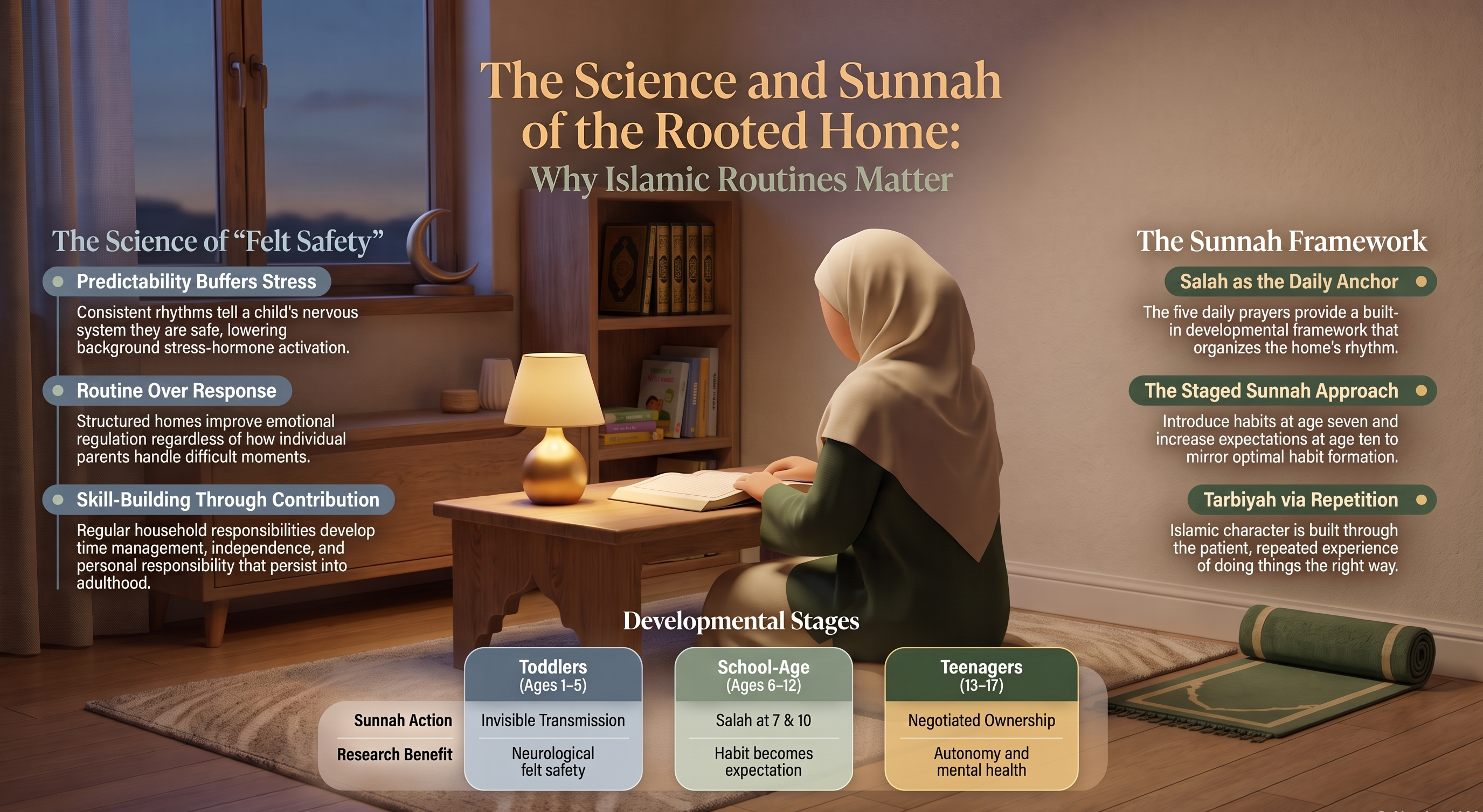
I know that’s not what we usually say. We talk about patience, about the right response, about staying calm. And all of that matters. But here’s what the research actually shows: children who live in predictably structured homes experience genuinely lower stress and stronger emotional regulation — regardless of how individual parents handle the hard moments. [1, 2] The structure itself does work that individual responses simply cannot.
And here’s what stopped me when I studied this seriously: Islam built that structure in fourteen centuries ago.
Why This Guide Is Different From Generic Parenting Advice
Every recommendation is grounded in peer-reviewed research from 2019–2025, including a landmark 2024 systematic review spanning over 50 years of family routine studies. [1]
This isn’t a productivity guide — it’s a tarbiyah guide. You’ll see exactly how the five daily prayers, the Sunnah of teaching children salah, and the rhythm of a Muslim home map directly onto what child development research identifies as the most beneficial family structures.
You’ll get a free Muslim Family Routine Pack at the end — a printable three-page PDF that brings the science and the Sunnah together in one place you’ll actually use.
What Routines Do for Children: The Research Is Clearer Than You’d Think
The protective effect of family routines isn’t primarily about efficiency. It’s about something more fundamental: a child’s nervous system.
Young children live in a world that is only partially understood and frequently surprising. A consistent daily rhythm tells their bodies: you can relax. You know what comes next. That felt safety — not the concept of it, but the lived neurological experience of it — frees up mental and emotional energy for everything else: curiosity, learning, kindness, resilience. [1]
This matters most during hard transitions. A new school, a new sibling, a house move, a parent’s illness. When the COVID-19 pandemic disrupted daily life across millions of families, researchers tracked something revealing: households with established routines reported significantly lower stress and better child wellbeing — even when the content of those routines had to change. [2] The predictability was the buffer. Not any specific activity.
But emotional security isn’t the only benefit. Here’s what often gets skipped.
Routines build skills and a sense of contribution. When a child has a consistent role in the family — setting the table, folding their clothes, helping younger siblings at bath time — they are learning something that goes far beyond the task itself. Research consistently finds that children with regular household responsibilities develop stronger time management, greater independence, and a more developed sense of personal responsibility — gains that persist measurably into adolescence and young adulthood. [7, 8] In the Islamic framework, this is tarbiyah: not a lecture, but the patient, repeated experience of doing things the right way until it becomes who they are.
Routines shape physical health and the body clock. Regular mealtimes, consistent handwashing habits, predictable sleep schedules — when these are embedded in daily routine rather than depending on daily reminders, they are more reliably maintained and produce real health outcomes. [1, 5] Sleep routines in particular tell the brain when to release melatonin, when to wind down, when to rest. This becomes especially important in early adolescence, when the natural shift in the body clock can push teenagers’ sleep later — a consistent bedtime routine is one of the few evidence-based tools that continues to support healthy sleep even then. [1] And lower chronic stress — which stable, predictable routines produce — benefits children’s immune systems directly. Predictability reduces background stress-hormone activation. Calm homes build stronger bodies.
What Routines Do for Parents: They Return the Time
I want to be honest: building routines takes effort upfront. The first two weeks of a new bedtime sequence can feel harder than having no bedtime at all.
But the investment compounds.
Once a routine is genuinely embedded — in the family’s muscle memory, not just on a whiteboard — it starts returning the time and energy that chaos was consuming. Parents in households with consistent routines report lower stress, greater confidence in their parenting, and more time for what replenishes them. [1, 4] The routine does work the parent was previously doing manually, with effort, every single day.
Routines also reduce conflict. When everyone knows that screens wait until homework is done, that phones disappear at dinner, that there is a consistent expectation about bedtime — the routine becomes the authority. Parents can step back from the daily role of enforcer.
For Muslim parents specifically: routines protect the things we say we value. The family that always means to read Qur’an together. The one that keeps planning to have dinner without phones. Intention stays intention until it is given structure.
What Makes a Good Routine: Four Qualities That Make Them Stick
Not all routines are equal. Four qualities separate the ones that work from the ones that collapse in week two.
Well-planned. A good routine has been thought through intentionally — not assembled under pressure. It fits the actual shape of your family’s life: your prayer times, your work schedule, your children’s needs. As children grow, involving them in planning reduces resistance and builds ownership. [1]
Clear. Everyone understands their role. A routine works when children know what is expected without being reminded daily — because it has become familiar. Clarity also means fairness: responsibilities distributed appropriately by age and capacity.
Regular. Good routines are embedded in everyday life, not reserved for good days. The family that prays Maghrib together most evenings, eats dinner together most nights, does homework before screens most afternoons — has built something qualitatively different from the family that does these things occasionally. Frequency is what converts good intention into formed habit.
Predictable. Things happen in the same order, at the same time. Children — especially young ones — feel most secure when the sequence of their day is reliable. Predictability is not monotony. It is the scaffold within which children can be curious and creative, because they always know where home base is.
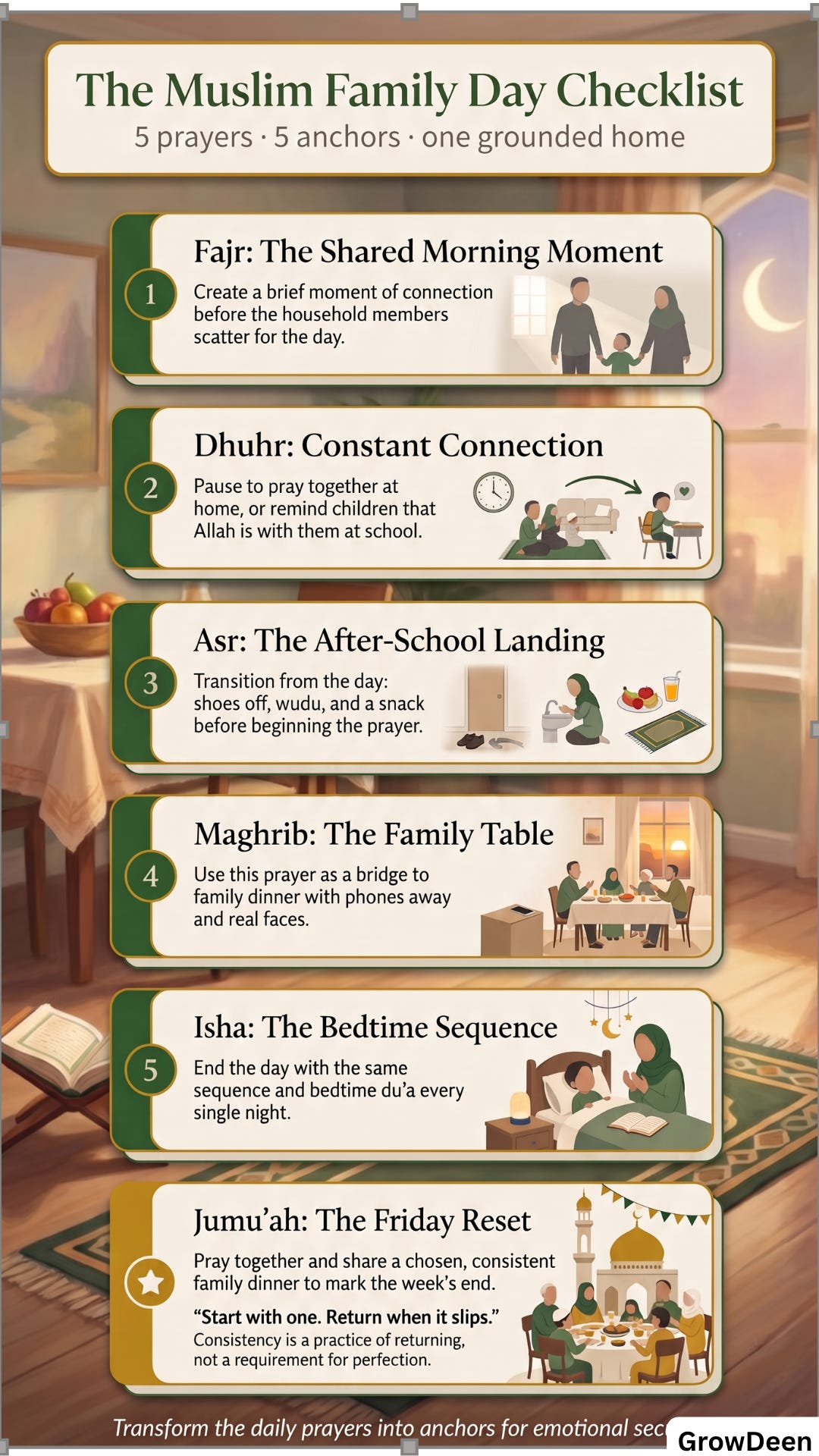
I know this is a lot to hold — especially when you are already managing everything that comes with raising children. That is exactly why I made the free Muslim Family Routine Pack — a printable three-page PDF with an age-by-age routine builder, a weekly planner, and a Sunnah family prayer card. Keep reading to download it at the end.
The Islamic Framework for Family Routines: Built Into the Design of the Deen
When I reflect on the verse where Allah says, “Command your family to prayer and be steadfast in it” [Qur’an 20:132] [10], I am struck by the word that often gets lost in translation: wastabirhā — be patient, persistent, steadfast. This is not a one-time instruction. It is a command to sustain a practice. According to Tafsir Ibn Kathir, ‘Umar ibn al-Khattab would walk through his household waking his family for night prayer, reciting this verse as he went. He was building a family routine. The verse was operational for him — not theoretical.
The Prophet ﷺ gave us the practical framework: “Command your children to pray when they are seven years old, and be firm with them about it when they reach ten, and separate their sleeping arrangements.” [Sunan Abi Dawud 495 — Hasan] [11]
Here’s what I find remarkable about that hadith: it is a developmentally staged routine prescription. Introduce the habit at seven. Increase expectation at ten. Graduated, age-appropriate, built across years. It mirrors precisely what modern child development research now calls optimal habit formation — begin early, be consistent, increase expectation gradually with age. Islam said this fourteen centuries before developmental psychology confirmed it.
Building Routines Across the Ages: Where to Start at Each Stage
Support Muslim Parenting Lab ❤️
Would you like the most rewarded kind of charity there is? Use the button below now, while you are well, rather than later.
Asked which charity is best, the Prophet ﷺ said the one given while you are healthy, not deferred until death is near. (Sahih al-Bukhari 1419)
Toddlers and Preschoolers (Ages 1–5): The Foundation Years
This is when the most important transmission happens — without any formal teaching at all.
Toddlers cannot follow a written schedule. But they absorb rhythm deeply. They feel when the morning is predictable, when the afternoon has a familiar shape, when bedtime follows the same sequence every night. The two-year-old who watches their parent make wudu tries to splash water on their own face. The three-year-old who hears Bismillah before every meal begins saying it unprompted. The four-year-old who sits beside their parent during salah is learning the postures, the feel of the prayer mat, the smell of the moment — without a word of formal religious instruction.
This invisible transmission is tarbiyah at its most powerful. Do not underestimate it.
Practical anchors for this age:
A consistent morning sequence: wake, gentle face wash, Bismillah before breakfast, getting ready in the same order every day
Daily outdoor time — even a short walk — to breathe, move, and notice Allah’s creation
A nap or quiet rest at consistent times
A warm, unhurried bedtime sequence: bath, pyjamas, a short story from the prophets or the Qur’an, bedtime du’a together, sleep — same order, same time, same warmth, every night
School-Age Children (Ages 6–12): Habit Becomes Expectation
Children at this age are old enough for real household roles and young enough that habits form easily. This is also when the salah routine deepens — the Prophet ﷺ specified age seven as when parents introduce the habit intentionally, and age ten for firmer expectation. [11]
Key anchors: morning salah together before school, a consistent after-school landing routine (snack, wudu, movement, then homework before screens), family dinner most nights with phones away, and age-appropriate household responsibilities that are expected and non-negotiable.
Teenagers (Ages 13–17): Ownership Over Compliance
Teenagers are developmentally designed to push for autonomy. This is not a failure of routine — it is what healthy adolescence looks like. The key shift is from routines that are imposed to routines that are negotiated. When a teenager has input into shaping the family’s expectations, they show up. Research confirms that family routines continue to predict positive outcomes well into young adulthood — including better mental health, stronger academic engagement, and lower rates of risky behaviour. [7, 8]
Key anchors: morning and evening adhkar as a personal owned practice, family meals several times a week (non-negotiable but negotiated in timing), meaningful household responsibilities, and a consistent enough sleep schedule that the body clock is maintained.
A Note on Balance: Routines Without Rigidity
There is a version of this that goes wrong — the family so scheduled that there is no room for spontaneity, free play, or simply being together without an agenda. Research notes explicitly that over-structured family lives crowd out the creative exploration and genuine rest that children also need. [1]
The goal is not a timetable. It is a culture.
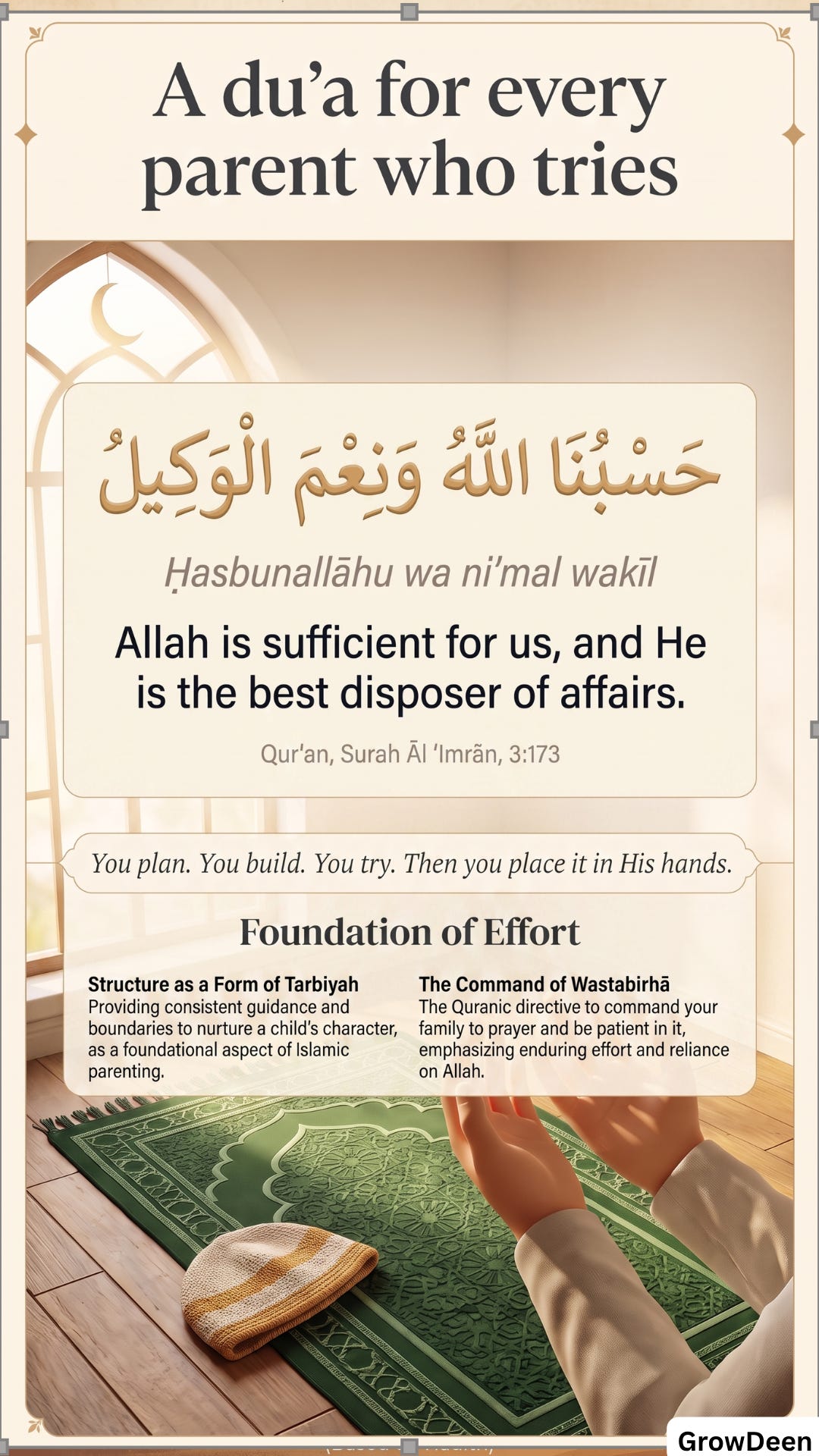
Tawakkul holds this balance. We plan. We build the conditions for what we want our family to become. And then we hold the plan with open hands, trusting that Allah orders what He wills, and that our effort itself is the act of worship.
When Routines Need to Change
Routines should evolve. The bedtime sequence that worked at four needs updating at nine, and again at thirteen. New school years, new siblings, moves, illness — all are moments when routines may need rebuilding rather than simply maintaining.
Research on family resilience finds that households able to re-establish routines after disruption recover more quickly and report stronger cohesion than those who allow structure to collapse entirely during difficulty. [2, 9] The routine is not just a smooth-day tool. It is a post-disruption anchor. Restoring predictability is often the first concrete step toward restoring normality for children after something hard has happened.
When rebuilding: involve your children. Ask what they value in the family’s daily life, what feels grounding, what they want the structure to hold. Then build it together.
Your Five-Minute Action Right Now
Tonight, name one daily anchor in your home. One consistent moment — salah, a shared meal, a bedtime du’a, greeting each other with salām when someone walks through the door.
Write it down. That is the beginning. Everything else can be built from there.
If you’ve read this far, you’re the kind of parent who thinks carefully about the home you’re building. That tells me something beautiful about you.
Inside the Muslim Family Routine Pack (one comprehensive PDF, 3 pages):
Page 1: The Muslim Family Day Builder — an age-by-age grid mapping the five daily prayer anchors to specific routine elements for toddlers, school-age children, and teenagers. A complete visual planner printed, not filed.
Page 2: Our Family Routine Planner — a one-week visual grid with the five prayer-time windows as rows and each day of the week as columns, with a built-in weekly review prompt to help your family assess what’s working and adjust what isn’t.
Page 3: The Sunnah Family Prayer Routine Card — the Prophet’s ﷺ instruction for building salah into children’s lives, with the full Arabic text and transliteration of Sunan Abi Dawud 495, a parent-facing implementation guide for each developmental stage (before 7, ages 7–10, ages 10+), and the Qur’anic command from 20:132 displayed as a reminder for your home.
This is not a PDF to download and forget. It is designed to stay on your fridge, near your prayer mat, or inside your kitchen cupboard — where the routine actually happens.
This Muslim Family Routine Pack is what every subscriber receives with each article from Muslim Parenting Lab. We cover the complete journey of raising Muslim children — from newborns through adolescence — all grounded in peer-reviewed research and Sunnah-rooted wisdom.
Share This With Someone Who Needs It
Think of one person right now: the mother in your family group chat who mentioned her mornings feel like chaos lately, the friend whose children seem unsettled since the move, the sister raising young children far from her extended family with no one to help her anchor the day.
This guide could give her something real. Share it today — not as advice, but as care. Sometimes the most generous thing we do is pass along the thing that helped us.
Frequently Asked Questions
Q: At what age should I start building routines with my child?
A: From birth. Infants respond powerfully to consistent feeding, sleep, and holding patterns even before they can understand them. [1] The benefits begin in the earliest weeks and compound across childhood. Even with a newborn, small consistent rituals — a bedtime du’a every night, Bismillah before feeds — begin building the architecture of a rooted home.
Q: My teenager refuses to follow any routine. Is it too late?
A: Not at all — but the approach shifts. Teenagers whose routines are imposed tend to resist; teenagers who have a voice in designing them tend to buy in. [1] Ask your teenager what they find grounding, what they want family life to look like. Negotiate. Even one consistent family meal a week can maintain genuine connection while respecting their growing need for autonomy.
Q: What is the most important routine to start with if we have none?
A: The bedtime routine. A consistent bedtime sequence produces some of the clearest and most immediate benefits — better sleep quality, reduced night-time anxiety, and a calmer evening for everyone. [1] Start simply: wudu, a short story, the bedtime du’a, consistent lights-out time. Build from there.
Q: How do we maintain routines during Ramadan, school holidays, or travel?
A: The anchor is always the prayer. Even when everything else shifts — sleep times, meal times, travel schedules — the five daily prayers provide a consistent framework. Scale down rather than abandon entirely: one meal together is better than none, one consistent du’a is better than no Islamic structure at all.
Q: What does “command children to pray at seven” look like in practice?
A: It means making salah familiar, normal, and joyful well before age seven — so that at seven, you are not introducing something new, you are naming something already known. Pray in front of them from infancy. Invite them to stand beside you from toddlerhood. Give them a small prayer mat. By seven, the child who has grown up in a praying household knows how salah feels, what the rug smells like, how the body finds the posture. The Sunnah instruction at seven makes the habit conscious and expected. [11]
Q: How do I handle days when the routine completely falls apart?
A: You restart. That is it. Routines do not require perfect execution — they require consistent return. Research on family resilience finds that families who recover most quickly after disruption are not those who never lost their structure; they are the ones who re-established it fastest. [2, 9] The routine is not ruined when you miss a day. It becomes stronger every time you choose to come back.
References
[1] Selman, S.B., & Dilworth-Bart, J.E. (2024). Routines and child development: A systematic review. Journal of Family Theory and Review, 16(2), 272–328. https://doi.org/10.1111/jftr.12549
[2] Bates, C.R., Nicholson, L.M., Rea, E.M., Hagy, H.A., & Bohnert, A.M. (2021). Life interrupted: Family routines buffer stress during the COVID-19 pandemic. Journal of Child and Family Studies, 30(11), 2641–2651. https://doi.org/10.1007/s10826-021-02063-6
[3] Kracht, C.L., Katzmarzyk, P.T., & Staiano, A.E. (2021). Household chaos, family routines, and young child movement behaviors in the U.S. during the COVID-19 outbreak. BMC Public Health, 21, 1–12. https://doi.org/10.1186/s12889-021-10909-3
[4] Harrist, A.W., Henry, C.S., Liu, C., & Morris, A.S. (2019). Family resilience: The power of rituals and routines in family adaptive systems. In B.H. Fiese et al. (Eds), APA Handbook of Contemporary Family Psychology (pp. 223–239). American Psychological Association. https://doi.org/10.1037/0000099-013
[5] Muñiz, E.I., Silver, E.J., & Stein, R.E.K. (2014). Family routines and social-emotional school readiness among preschool-age children. Journal of Developmental & Behavioral Pediatrics, 35(2), 93–99. https://doi.org/10.1097/DBP.0000000000000021
[6] Fiese, B.H., Tomcho, T.J., Douglas, M., Josephs, K., Poltrock, S., & Baker, T. (2002). A review of 50 years of research on naturally occurring family routines and rituals. Journal of Family Psychology, 16(4), 381–390. https://doi.org/10.1037//0893-3200.16.4.381
[7] Abar, C.C., Koban, K., Farnett, S., Mendola, K., & Clark, G. (2020). Profiles of family routines during adolescence associated with profiles of health behaviors in young adulthood. Journal of Health Psychology, 25(5), 629–639. https://doi.org/10.1177/1359105317726149
[8] Barton, A.W., Brody, G.H., Yu, T., Kogan, S.M., Chen, E., & Ehrlich, K.B. (2019). The profundity of the everyday: Family routines in adolescence predict development in young adulthood. Journal of Adolescent Health, 64(3), 340–346. https://doi.org/10.1016/j.jadohealth.2018.08.029
[9] Yang, Y., Bulut, S., Bukhori, B., Piskorz-Ryń, O., & Chikwe, C. (2025). The role of family routines in promoting child mental health: A qualitative study. Journal of Research and Health, 15(2), 175–184. https://doi.org/10.32598/JRH.15.2.2474.1
[10] Qur’an 20:132 (Surah Ta-Ha). https://quran.com/20/132
[11] Sunan Abi Dawud 495 — Graded: Hasan (also classed as Sahih by al-Albani in Sahih al-Jami’ 5868). https://sunnah.com/abudawud:495
We combine scientific research with Qur’an and authentic Sunnah, and we cite our sources. Even so, this is general guidance and no substitute for a doctor who can examine your child.