

Most children have bad dreams. Reviews put the share reporting one in the past month at a quarter to a third. [1]
Printable. For the next 2am doorway.
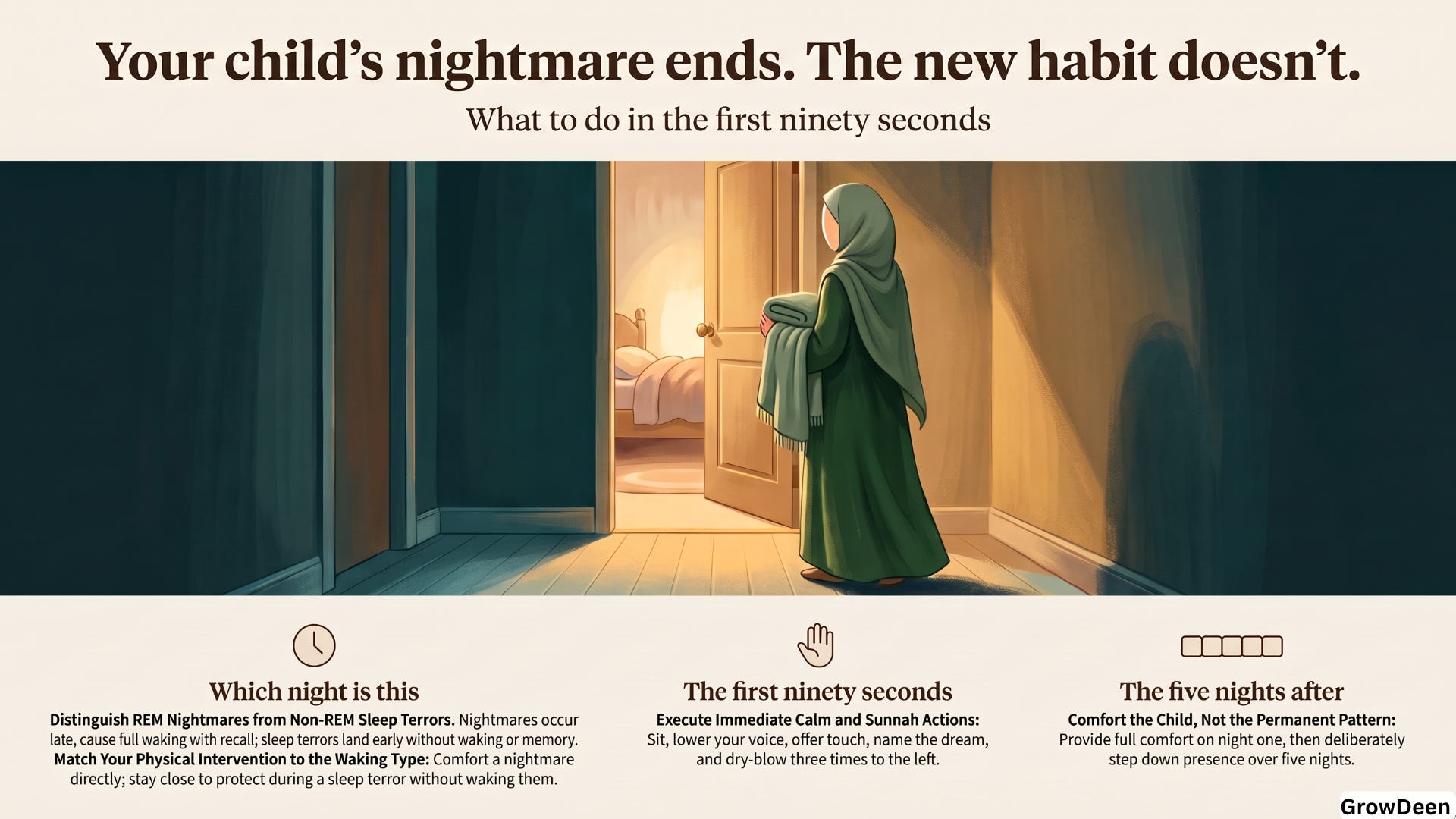
Her door opened at 2:14am.
You did everything the way you were told. You stayed calm, you did not switch the big light on, you lay down beside her until her breathing slowed. It worked. She slept.
Six weeks later she cannot start the night without you lying there, the door open at a measured angle, and a negotiation that eats half an hour. The dream was over in ninety seconds. Whatever replaced it has moved in.
So here is the question worth carrying through the rest of this: why do the instincts that end tonight’s crying sometimes make next month’s bedtime harder? The answer is not that you were too soft. It sits in research on what grows around a nightmare rather than in the nightmare itself, and it arrives further down.
Why This Guide Is Different From A General List Of Sleep Tips
Every claim is traceable. The figures come from sleep medicine journals and the American Academy of Sleep Medicine rather than from parenting forums, and each one is numbered so you can check it.
The Islamic layer is practical, not decorative. The Prophet ﷺ gave a specific response to a bad dream, and this guide shows how to hand it to a three-year-old, a five-year-old and an eight-year-old differently.
You already have the free Night Fear Card from the top of this page, so the parts you need at 2am are on paper by the bed instead of buried in an article you would have to find again in the dark.
The Clock In Your Hallway Tells You Which Night This Is
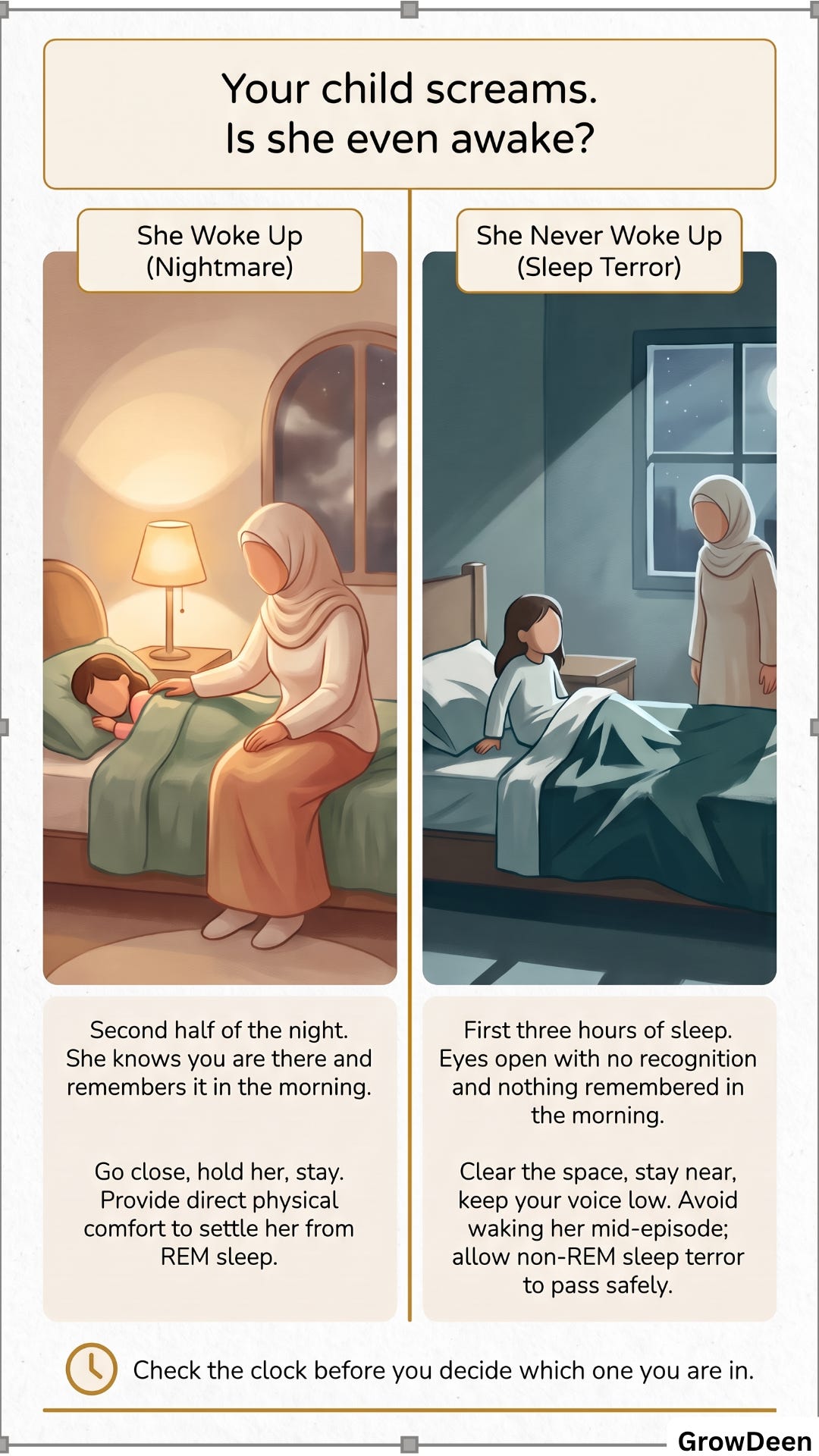
Two in the morning feels like one kind of event to a parent. It is actually two, and they want opposite things from you.
Your child wakes, finds you, grips your sleeve, and within a minute is talking. She can tell you about the thing in the garden. She remembers it at breakfast. That is a nightmare, and it belongs to REM sleep, which is why it landed where it did: deep sleep is loaded into the first third of the night, and dreaming stacks up in the hours before morning. [2]
Now the other one. Forty minutes after bedtime, a scream. She is sitting up, sweating, eyes wide open, and she does not know you are in the room. Nothing you say reaches her. In the morning she has no idea it happened. That is a sleep terror, an incomplete arousal out of deep non-REM sleep, and it usually lands within the first three hours after she goes down. [3]
The handling diverges completely. A nightmare asks you to come close. A sleep terror asks you to move the bedside table, stay near enough to stop a fall, say very little, and let it finish, because trying to wake a child mid-episode tends to stretch the distress rather than end it. [3]
If you cannot tell which one you are dealing with, keep two weeks of notes: the clock time, whether she seemed awake, and whether she remembered anything the next day. Those columns answer it faster than an appointment will.
The First Ninety Seconds, And What To Put In Them
You already know the feeling of standing in the dark trying to decide whether to be gentle or firm. Most of what follows is simpler than that choice makes it sound.
Go in and sit down. Lower your voice below your normal speaking level. Presence lands before explanation does, so hold her first and talk second.
Then name it plainly. It was a dream. Dreams feel completely real while they are happening, and they cannot come into this room. You are here, and so am I.
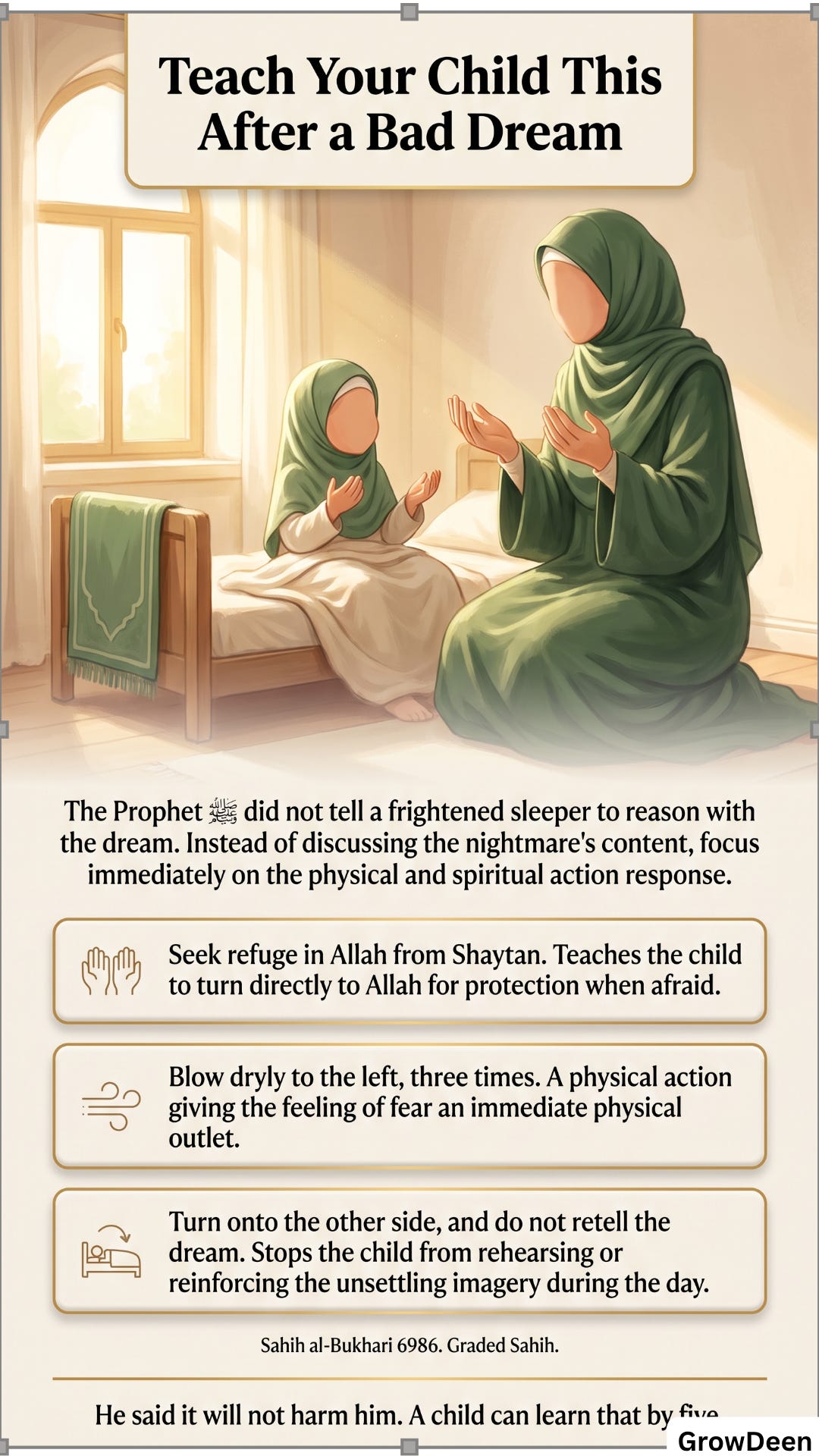
Now give her something to do, because a frightened child with no action available will simply keep being frightened. This is where the Sunnah is unusually practical. The Prophet ﷺ said, “A good dream that comes true is from Allah, and a bad dream is from Satan, so if anyone of you sees a bad dream, he should seek refuge with Allah from Satan and should spit on the left, for the bad dream will not harm him.” (Sahih al-Bukhari 6986) [12] Scholars explain the action as a dry blowing to the left with little or no saliva, three times, alongside seeking refuge in Allah from Shaytan. Other authentic narrations add that the sleeper turns onto the other side, and that he does not go around retelling the dream.
Read what that instruction hands a child. A physical action, so the fear has somewhere to go. A sentence to say, at the moment her own words have gone. A reason not to rehearse the content all day tomorrow. And a verdict from the Messenger of Allah ﷺ himself: this cannot harm you.
It transfers by age, which is the part most parents miss. At two or three, you say and do all of it over her. At four or five, she copies you line by line. By six or seven she runs it half asleep without waking anybody, and what she has actually learned is to turn to Allah first when she is afraid.
Three things to leave out. Do not ask her to describe the creature in detail at 2am, because that rehearses it. Do not say there is nothing to be scared of, because that is heard as a correction rather than as comfort. And do not start a new household rule tonight on the strength of one bad dream.
The Six-Week Question
Here is the part that answers the puzzle from the opening.
A study of 277 clinically anxious children aged 6 to 17 found nightmares in more than three-quarters of them, and found that family accommodation, meaning the adjustments a household makes to manage a child’s distress, sat on the pathway between those nightmares and the child’s wider sleep problems. [10]
Read that carefully, because it is easy to take the wrong lesson from it. Going to your frightened child is right. Holding her is right. What the research points at is the arrangement that quietly assembles itself afterwards, where six weeks later nobody can start the night without two adults, a particular door angle and a long negotiation.
So the instruction is not to withhold comfort. It is to give it fully tonight and then shorten it in stages across the following nights, rather than letting tonight’s emergency become next month’s architecture.
Comfort the child, not the pattern.
There is a measurement problem worth knowing about too. In a study of 7 to 11 year olds, children with an anxiety diagnosis and their mothers recalled more nightmares than comparison families, yet across a week of daily diaries the two groups recorded almost the same number, and what predicted parent-reported nightmares was the child’s sleep-related worry and physical restlessness before sleep rather than the dreams themselves. [6] An anxious house experiences more nightmares than a diary would record. Keeping the diary is often the first intervention.
A Note Before The Harder Nights Arrive
The Night Fear Card exists because none of the above is reachable at 2:14am if it lives in a browser tab. It is three pages, printable, built for the bedside rather than the screen. The download button is at the top of this page, and there is a full description of what is inside it below.
Working Backwards From The Morning Alarm
Most of the useful work happens hours before she wakes you.
Start with the arithmetic, because sleep debt is the most common trigger and the most fixable. The American Academy of Sleep Medicine’s consensus recommendations put three to five year olds at 10 to 13 hours in every 24, including naps, and six to twelve year olds at 9 to 12. [9] Count backwards from the morning alarm and set bedtime where the number actually lands. An overtired child wakes more often, and every extra waking is another chance to surface out of a dream and keep it.
Then make the last hour dull on purpose. Same order every night: dinner, wudu, pyjamas, teeth, du’a, bed. Predictability is what lowers the pre-sleep worry that keeps attaching to nightmares in the research. [6]
Treat frightening evening input as seriously as caffeine. Cartoons with menacing scenes, violent games and adult news running in the background all leave images a young mind keeps processing long after the screen is dark.
Bring them in as the light goes. The Prophet ﷺ said, “When night falls (or it is evening), keep your children close to you for the devils spread out at that time. But when an hour of the night elapses, you can let them free. Close the doors and mention the Name of Allah, for Satan does not open a closed door.” (Sahih al-Bukhari 3304) [13] A settled house at maghrib satisfies the Sunnah and the sleep science at once.
Make the adhkar part of the routine rather than an extra item on it. Ayat al-Kursi anchors it: Abu Hurayrah was told, “Whenever you go to bed, recite Ayat-al-Kursi ... Allah will appoint a guard for you who will stay with you and no satan will come near you till morning,” and the Prophet ﷺ confirmed that the words were true even though the one who said them was a liar. (Sahih al-Bukhari 2311) [14] Surah al-Ikhlas, al-Falaq and an-Nas belong in the same few minutes, and the protective du’a goes over each child: the Prophet ﷺ sought refuge for al-Hasan and al-Husayn with the words, “O Allah! I seek Refuge with Your Perfect Words from every devil and from poisonous pests and from every evil, harmful, envious eye.” (Sahih al-Bukhari 3371) [15]
A’udhu bi kalimat Allah at-tammah, min kulli shaytanin wa hammah, wa min kulli ‘aynin lammah.
For fear itself there is a second supplication the Messenger of Allah ﷺ used to teach: “I seek refuge in Allah’s perfect words from His anger, the evil of His servants, the evil suggestions of the devils and their presence.” (Sunan Abi Dawud 3893, graded Hasan) [16] Teach it to a child old enough to learn it and recite it over one who is not. The practice is recitation; nothing is written out, worn or tied to a child.
Support Muslim Parenting Lab ❤️
Would you like a share in every good thing that comes from what you fund? Support it with the button below, at any level you choose.
The Prophet ﷺ said whoever sets a good precedent earns its reward and the reward of everyone who follows it. (Sahih Muslim 1017a)
When The Same Dream Keeps Coming Back
Recurring nightmares respond to a technique sleep medicine calls imagery rehearsal, which is the only behavioural treatment the American Academy of Sleep Medicine’s position paper on nightmare disorder recommends outright, with hypnosis, relaxation and general cognitive behavioural therapy a tier below and the drug options weaker still. [8] That paper covers adults. For children the evidence is thinner and points the same way: in a small Canadian trial, children aged nine to eleven who had been having a nightmare or more every week for six months had fewer of them after learning the method, and the gain was still there nine months on. [7]
The method fits at a kitchen table in daylight. The child tells you the dream. Then she chooses a different ending, out loud, and runs the new version in her head for a few minutes a day.
With a younger child, use paper instead of conversation. Let her draw the dream, then draw the second picture: the door shuts, help arrives, the enormous thing turns out to be the size of a cat. Keep the second drawing where she can see it.
This does not compete with the Sunnah response. That instruction governs the night and closes the matter there. The redrawing handles the residue that follows her into the afternoon. Both land in the same place, which is a child who stops believing the dream has any power.
While you work on the dream, look at the days feeding it. A new teacher. A clip on an older cousin’s phone. An argument she overheard. A grandparent in hospital. Children rarely name these, and the dreams turn up instead.
Safety From Fear Is Named As A Favour
A child who is afraid in the dark is not a small matter in Islam, and the Qur’an says so in a place most parents would not think to look.
Describing His favour on the people of Makkah, Allah calls Himself the One “Who has fed them, [saving them] from hunger and made them safe, [saving them] from fear.” (Qur’an, Surah Quraysh 106:4) [11] According to Tafsir Ibn Kathir, the verse presents safety and gentleness as a direct favour from Allah, given alongside food, and as grounds for worshipping Him alone; Ibn Kathir adds that whoever accepts this command is given security in this life and the next.
Hunger and fear sit side by side in that verse. Both are needs. When you settle a frightened child at 2am, you are meeting the second one, and you are the means through which Allah is providing it.
That is also why the Prophet ﷺ drew such a firm line around frightening people at all. He said, “It is not lawful for a Muslim that he frightens a Muslim.” (Sunan Abi Dawud 5004, graded Sahih) [17] The narration is about grown men playing a joke on a sleeping companion, which makes the application at home easier rather than harder. Threatening a child with jinn, or with what waits in a dark room, buys one quiet evening at the price of years.
Keeping fear out of your child’s night is not soft parenting. It is the household version of a favour Allah names as His own.
When To Call Someone
Speak to a doctor or a qualified child mental health professional if:
the nightmares come most nights, or she is now frightened of falling asleep
the same dream has repeated for weeks without easing
daytime anxiety, withdrawal, clinginess or irritability has appeared alongside them
the dreams began after an accident, an assault, a hospital stay, a bereavement, a disaster or a lockdown
school, mood or daytime alertness is suffering
episodes involve violent movement, walking out of the house, or any risk of injury
she snores heavily, gasps, or seems to stop breathing in her sleep, which needs assessment in its own right
This article is educational and is not medical advice. A clinician who can examine your child will see what no article can.
The Night Fear Card: What Is Inside It
If you have read this far, you are the kind of parent who takes a child’s night-time fear seriously rather than waiting for her to grow out of it. That is worth something at 2am, and it is worth something to her.
Inside the Night Fear Card (one comprehensive PDF, 3 pages):
Page 1: The 2am Response Card — the first ninety seconds in order, from what to say when you sit down, through the Sunnah response in a form a three, five or eight year old can each manage, to the three things to leave out, designed as a card for the bedside table where the moment actually happens.
Page 2: The Two-Week Night Log and Step-Down Plan — a printable log that separates a nightmare from a sleep terror by clock time and morning recall, with a five-night step-down plan on the reverse half, so you can give full comfort tonight and still shorten it deliberately rather than by accident.
Page 3: Words for a Frightened Child — the protective du’a of the Prophet ﷺ for al-Hasan and al-Husayn and the supplication he taught for fear, both in Arabic, transliteration and English, with the bedtime recitation order set out as a short checkable sequence.
This is not a PDF to download and forget. It is built for the drawer of the bedside table, where you can reach it without opening a screen in a dark room.
The Night Fear Card is what every subscriber receives with each article. Muslim Parenting Lab covers the whole span of raising young Muslim children, with every piece built on current research and rooted in the Qur’an and Sunnah.
Before You Close This Tab
Set tonight’s bedtime by the arithmetic rather than by habit. Open the clock, count back from the morning alarm, and move bedtime by however many minutes the number demands. It takes under a minute and it is the single change most likely to reduce what happens at 2am.
May Allah guard your children through the night and count every broken hour of your own sleep in your favour.
Share This With Someone Who Needs It
Think of one person right now: the sister at the masjid who mentioned that her four-year-old has started screaming at night, the cousin whose WhatsApp messages at midnight say more than she realises, the friend who has been sleeping on her son’s floor for a month and has stopped mentioning it.
Send it to her today. Not as advice, and not because you are correcting anything she is doing, but because she is standing in a dark hallway tonight and nobody has told her which of the two nights she is in.
Frequently Asked Questions
Q: What is the difference between a nightmare and a night terror? A: Timing, awareness and memory. A nightmare comes in the second half of the night, your child wakes properly, can describe it, and often still remembers it at breakfast. A sleep terror usually lands within three hours of bedtime, your child stays asleep through it even with her eyes open, and remembers nothing the next day. [2] [3] The section on your hallway clock above sets the two side by side.
Q: Should you wake a child who is having a night terror? A: No. Attempts to wake a child mid-episode tend to extend the distress rather than end it. [3] Clear anything she could knock into, stay close enough to stop a fall, say very little, and let it run its course.
Q: Is it alright to let your child sleep in your bed after a bad dream? A: For one night, it is comfort and it costs nothing. The thing to watch is the arrangement that settles in over the following weeks, since research on anxious children links family accommodation to wider sleep problems. [10] Give full comfort tonight, then shorten it in deliberate stages rather than letting it become the new normal.
Q: What age do nightmares start and when do they stop? A: Most children have their first somewhere between three and six, with the frequent years following after that, and the great majority leave them behind without any treatment at all. [1] Around 5% of school-aged children have them weekly [5], and a smaller share again meets the criteria for nightmare disorder, which needs the dreams to be repeated, well remembered and disruptive to daily life. [4] Weekly is the point at which deliberate steps are worth taking.
Q: What du’a should your child say after a nightmare? A: The Prophet ﷺ taught seeking refuge in Allah from Shaytan, with a dry blowing to the left three times, turning onto the other side, and not retelling the dream, with the promise that it will not harm. (Sahih al-Bukhari 6986) [12] For fear more generally, the supplication in Sunan Abi Dawud 3893 is on Page 3 of the Night Fear Card in Arabic, transliteration and English. [16]
Q: Can you stop nightmares completely? A: Not entirely, and a child who never had one would be unusual. What you can change is how often they come and what they cost: enough sleep for her age [9], a dull predictable last hour, no frightening input in the evening, and imagery rehearsal for a dream that keeps returning. [7] [8]
References
[1] American Academy of Sleep Medicine. Treating nightmares in children with imagery rehearsal therapy. Sleep Education.
[2] The Royal Australian College of General Practitioners. Kids that go bump in the night. Australian Family Physician.
[3] Leung, A.K.C., Leung, A.A.M., Wong, A.H.C., & Hon, K.L. (2020). Sleep terrors: An updated review. Current Pediatric Reviews, 16(3), 176-182.
[4] El Sabbagh, E., Johns, A.N., Mather, C.E., & Cromer, L. (2023). A systematic review of nightmare prevalence in children. Sleep Medicine Reviews, 71, 101834.
[5] Li, S.X., et al. (2011). Frequent nightmares in children: Familial aggregation and associations with parent-reported behavioral and mood problems. Sleep, 34(4), 487-493.
[6] Reynolds, K.C., & Alfano, C.A. (2016). Things that go bump in the night: Frequency and predictors of nightmares in anxious and nonanxious children. Behavioral Sleep Medicine, 14(4), 442-456.
[7] St-Onge, M., Mercier, P., & De Koninck, J. (2009). Imagery rehearsal therapy for frequent nightmares in children. Behavioral Sleep Medicine, 7(2), 81-98.
[8] Morgenthaler, T.I., et al. (2018). Position paper for the treatment of nightmare disorder in adults: An American Academy of Sleep Medicine position paper. Journal of Clinical Sleep Medicine, 14(6), 1041-1055.
[9] Paruthi, S., et al. (2016). Recommended amount of sleep for pediatric populations: A consensus statement of the American Academy of Sleep Medicine. Journal of Clinical Sleep Medicine, 12(6), 785-786.
[10] Lebowitz, E.R., Shimshoni, Y., & Silverman, W.K. (2019). Family accommodation mediates nightmares and sleep-related problems in anxious children. Journal of Anxiety Disorders, 62, 94-99.
[11] Qur’an, Surah Quraysh 106:4 (Saheeh International) · Tafsir Ibn Kathir.
[12] Sahih al-Bukhari 6986, narrated by Abu Qatadah. Graded: Sahih.
[13] Sahih al-Bukhari 3304, narrated by Jabir ibn Abdullah. Graded: Sahih.
[14] Sahih al-Bukhari 2311, narrated by Abu Hurayrah. Graded: Sahih.
[15] Sahih al-Bukhari 3371, narrated by Ibn ‘Abbas. Graded: Sahih.
[16] Sunan Abi Dawud 3893, narrated by Abdullah ibn Amr ibn al-’As. Graded: Hasan (al-Albani), the grading applying to the Prophetic wording.
[17] Sunan Abi Dawud 5004, narrated by Abd ar-Rahman ibn Abi Layla from the Companions. Graded: Sahih (al-Albani).
We combine scientific research with Qur’an and authentic Sunnah, and we cite our sources. Even so, this is general guidance and no substitute for a doctor who can examine your child.