

Your latch is wrong.
Three pages. Keep it in your feeding corner.
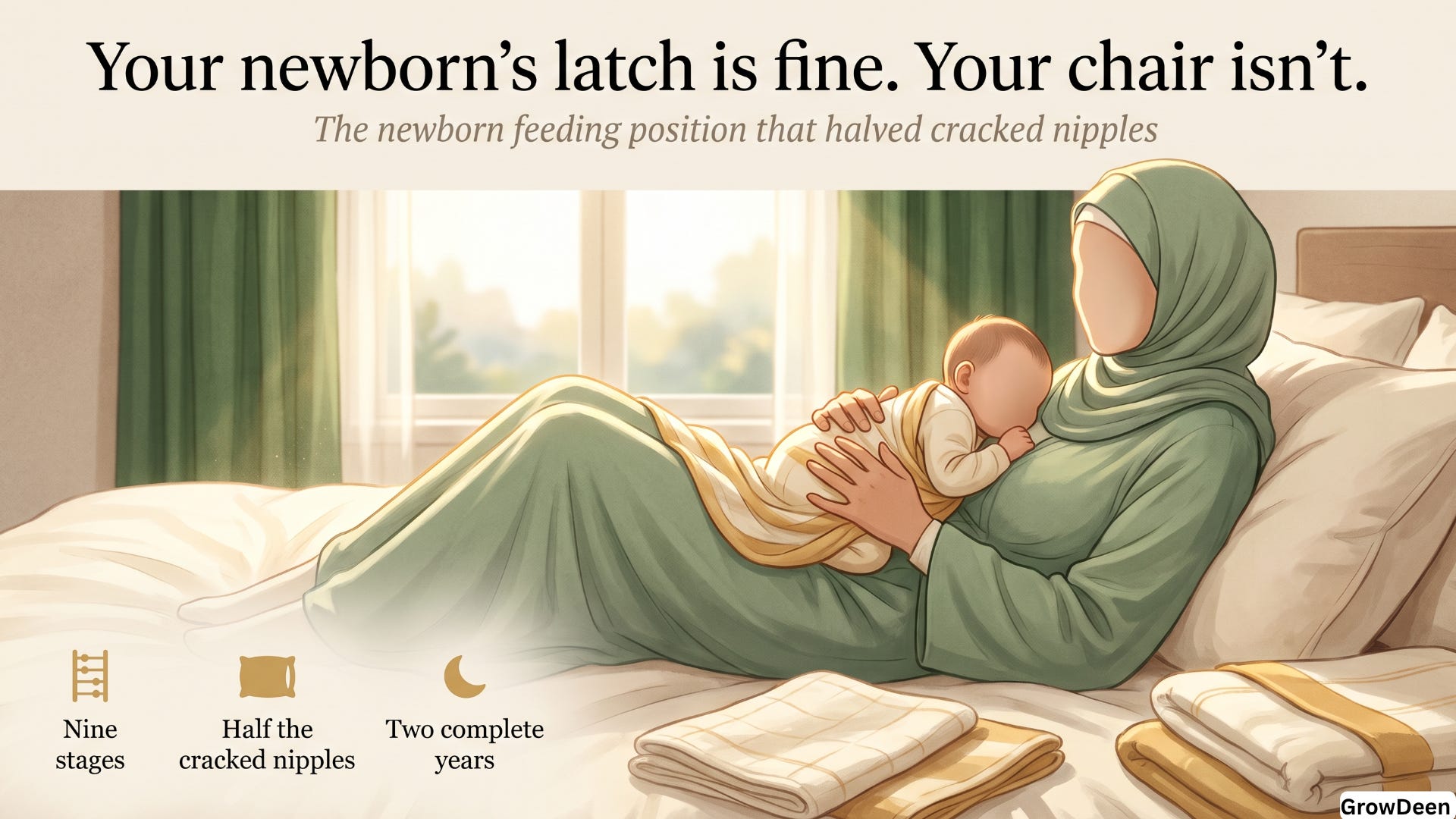
Somebody says it on day two, in a bright room, while you are still bleeding and have not slept. A hand arrives on the back of your baby’s head and presses her toward you. She arches away. You are told to try again, with the arm higher, the body closer, the mouth wider.
You do exactly what you were shown. It hurts more.
What almost nobody says in that room is that the instruction itself may be the problem. Not your body, and not your effort. The upright hold and the steering hand are a technique, and there is a trial showing that mothers who were supported differently finished the week with roughly half as many cracked and sore nipples [6].
So what are you supposed to do instead? The answer is stranger than a better hold, and it takes most of this article to explain properly. It starts with the fact that nobody taught your daughter any of this, and she already knows.
Why This Guide Is Different From A Standard Latch Tutorial
Every recommendation here is traced to a named source and year, including a 2025 Cochrane review of 69 randomised trials and an Italian randomised controlled trial of 188 mothers, with the limitations stated rather than hidden [2,6].
This is written for Muslim mothers, so it carries what Islam says about nursing, which turns out to be considerably more than most parents realise. Rada’ah creates kinship, and the hours you spend feeding are weighted accordingly [11,12].
You already have the free First Latch Pack from the top of this page, three printable pages covering the stages your baby moves through, a laid-back set-up card, and two Islamic reflection cards.
The Instruction That Is Working Against You
Picture the hold you were taught. You sit up straight. You bring the baby across your body, support her head in your hand, and guide her on.
Now notice what your arms are doing. They are fighting gravity. In an upright position the baby’s weight pulls away from your body, so you brace to hold her there, and because she keeps slipping you press her head forward to keep contact [5].
That pressing is the part that backfires. A newborn needs to tip her head back, not forward, so that she leads with her chin and opens wide. A palm on the back of her skull makes the movement she needs physically impossible.
Colson and colleagues filmed forty mother-and-baby pairs through the first month and catalogued around twenty primitive neonatal reflexes at work during feeding, grouped into endogenous, motor, anti-gravity and rhythmic families [5]. Their finding was that maternal posture decides whether those reflexes help the baby or get overridden. Lean back, and the same reflexes become purposeful movement. Sit upright and steer, and they are cancelled by your own arms.
Lean back. Let her lead.
Which raises an obvious question. If she is leading, where does she think she is going?
What She Is Actually Trying To Do
She is running a sequence, and researchers have numbered it.
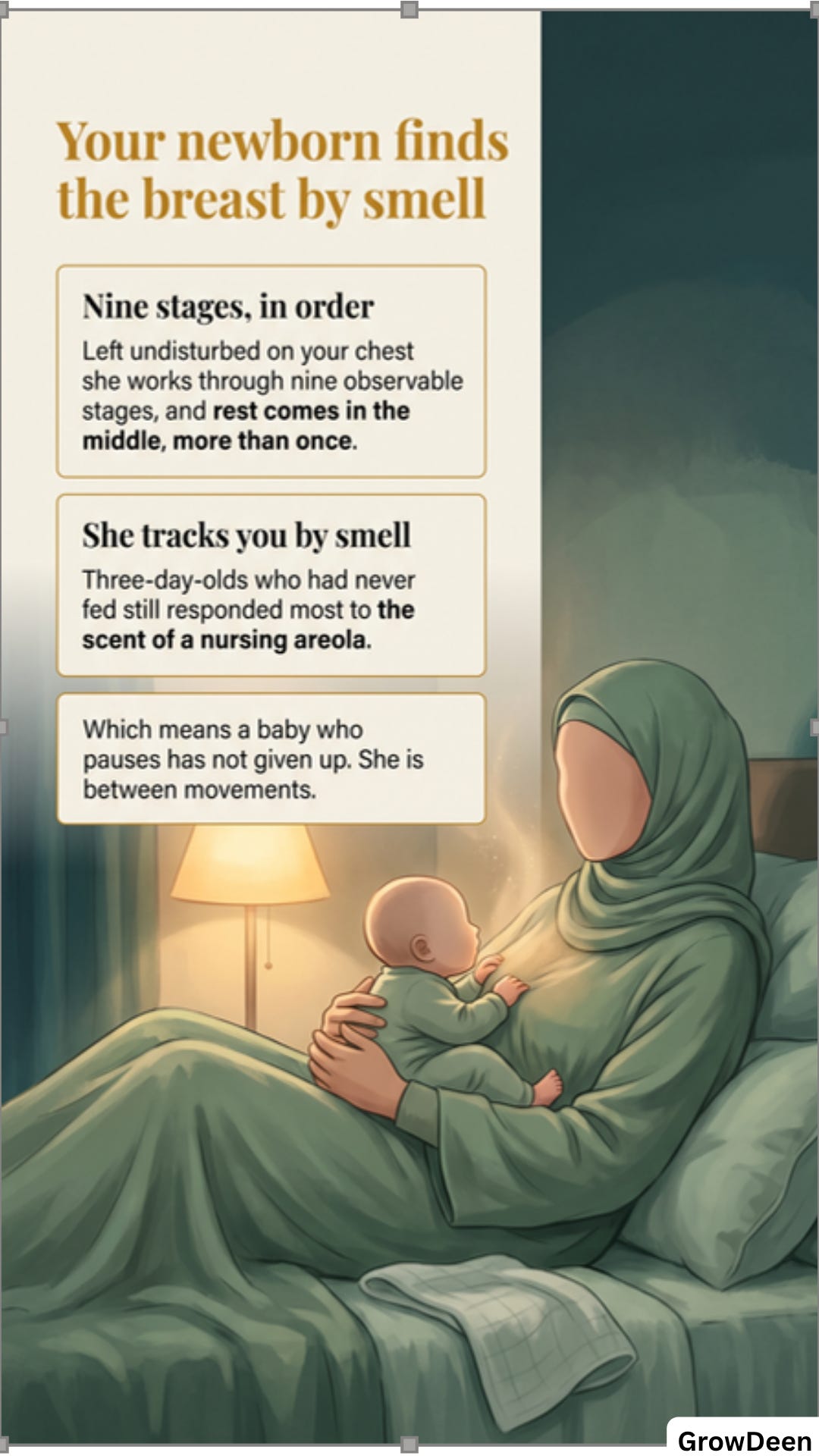
Placed skin to skin and left undisturbed, a healthy newborn moves through nine observable stages: the birth cry, stillness, awakening, a spell of larger movement, rest, crawling, familiarisation at the nipple, suckling, and sleep [3]. Rest turns up repeatedly in the middle, which is why a baby who appears to have given up usually has not. Pooled data from Sweden, Italy, Japan and the United States place the suckling stage at roughly one hour to ninety minutes after birth [4].
She is also steering by smell. In a French study, three-day-old newborns were exposed to secretions from the areolar glands of lactating women they had never met, alongside seven comparison odours. The breast secretion raised their breathing rate and their mouthing and sucking responses more than any other stimulus tested, and the effect did not appear to depend on any previous experience of a breast or of milk [9]. Nineteen infants were analysed, at an average age of around seventy-four hours.
The small raised bumps on your areola that you have probably never thought about are broadcasting. She is tracking a smell toward its source, which is why a hand on her head is not just unhelpful but actively in the way.
Allah gave her this before you met her. That is worth sitting with for a moment, because most of the anxiety of the early weeks comes from believing that feeding is something you have to construct out of nothing.
What Changed When One Hospital Stopped Teaching The Hold
Between March and December 2018, researchers at IRCCS Burlo Garofolo in Trieste randomly assigned 208 pregnant women who intended to breastfeed to one of two kinds of support. One group received the hospital’s usual care, built on the WHO and UNICEF twenty-hour course. The other was supported to feed in a relaxed, reclined position with the baby lying prone against them. One hundred and eighty-eight women entered the analysis, 90 and 98 [6].
At discharge the reclined group had around half the risk of breast problems, a relative risk of 0.56 with a 95% confidence interval of 0.40 to 0.79. Cracked nipples fell to 0.42 and sore nipples to 0.59. The advantage was still measurable at 120 days, at 0.51. The number needed to treat at discharge was 4, so roughly one mother in four was spared a breast problem she would otherwise have had [6].
Two things about that trial matter if you are planning to ask for this on a postnatal ward. The staff needed a six-hour course and minor adjustments to ordinary hospital beds, and no adverse events occurred [6]. It is not a specialist intervention.
The enthusiastic version of this leaves out the second finding. The same trial measured exclusive breastfeeding rates at discharge, one week, one month and four months, and found no statistically significant difference at any point, though the numbers leaned consistently in favour of the reclined approach [6]. The honest claim is narrower than “it makes breastfeeding work”. It makes breastfeeding hurt less, and pain is one of the commonest reasons mothers stop before they wanted to.
What Skin-To-Skin Is Doing Underneath All Of This
A 2025 Cochrane review pooled 69 randomised trials covering 7,290 mother-and-baby pairs. Immediate or early skin-to-skin probably increases exclusive breastfeeding at discharge to one month, with a relative risk of 1.36, and again at six weeks to six months at 1.38. It probably raises infant blood glucose by around 10 mg/dL and may improve cardiorespiratory stability [2].
Temperature is the claim most often inflated in parenting content. Axillary temperature did rise, by an average of 0.28 degrees Celsius, which the reviewers recorded as real and judged too small to matter clinically [2]. Dry her, put a hat on her, and lay a warm blanket over her back while she rests against you, which is how skin-to-skin is described in the trials themselves [2].
One limitation deserves saying out loud, particularly for an audience spread across the Muslim world. Thirty-two of those trials ran in high-income countries and twenty-five in upper-middle-income countries, with none in low-income settings [2]. WHO and UNICEF nonetheless already treat immediate skin-to-skin and a first feed inside the first hour as the standard of care [1].
And when researchers finally looked at what mothers were missing, it was not the hold at all. It was the timing.
How To Tell She Is Hungry Before She Cries
The most useful skill of the first fortnight has nothing to do with positioning. It is learning what your baby looks like a few minutes before she is hungry.
The NHS sorts the signals into three bands [8]. Early cues say “I’m hungry”: stirring, mouth opening, head turning and rooting. Mid cues say “I’m really hungry”: stretching, more movement, hand to mouth. Late cues say “calm me, then feed me”: crying, agitated movement, colour going red.
Crying is last, not first. By then her body has stiffened and the instincts that would have carried her to the breast are buried under the upset, which is why a screaming baby is so hard to latch and why it is never a fair test of the method.
Miss the window and nothing is lost. Hold her against your skin, let her settle, wait for the cues to come round again. The settling is part of the feed.
A newborn’s stomach is roughly the size of a walnut, which is why the cues come so often in the early days [8]. Frequent feeding is how the system is built, and it tells you nothing about whether your milk is sufficient.
That is a lot to hold in your head at 3am on four hours of broken sleep, which is why I put together the free First Latch Pack, three printable pages with the nine stages and a set-up card you can prop against a lamp. The download button is at the top of this page, and there is a full description of what is inside it below.
Support Muslim Parenting Lab ❤️
Worried that giving will leave you with less? Give an amount you will not feel, with the button below.
The Prophet ﷺ said charity does not decrease wealth. (Sahih Muslim 2588)
Setting Up A Laid-Back Feed Tonight
Settle yourself before you settle her. A bed or armchair where you can recline with pillows behind your shoulders and lower back, so no muscle is holding you up. Not flat. Not upright. Wherever your body stops bracing.
Say Bismillah. A mother who opens every feed with the name of Allah is laying the first stone of a habit years before her child can repeat it back to her, eight or more times a day.
Uncover as much skin as you comfortably can and lay her tummy down on your chest, facing you, her head just above the level of your breasts. Then stop doing things.
She will lift and bob her head. As she travels, hug her bottom in close and support her neck and shoulders with your hand and wrist, and leave her head free. She will nuzzle, lick, mouth the nipple, lose it, come back. When it is right she anchors with her chin, opens wide, draws the nipple deep and begins to suck. You will hear swallowing.
Say Alhamdulillah afterwards. Gratitude suits a feed that went well, and on the nights it does not go well, the words are no less true.
When She Still Will Not Latch
Often she will not, at least not the first time, and it is not a verdict on you.
One cause deserves naming separately because positioning will never fix it. A tongue-tie restricts how far the tongue can move, and a baby who cannot extend her tongue may fail to latch deeply however well she is placed. Pain that does not improve once the position is right should be assessed rather than endured.
A caesarean is not a barrier to reclining. Recline as you otherwise would and bring her up across your chest on the side away from the incision, with a pillow guarding the wound so none of her weight rests on it. The Cochrane review covered caesarean births as well as vaginal ones [2].
Labour medication has been studied directly, with Brimdyr and colleagues examining synthetic oxytocin, epidural anaesthesia and intravenous fentanyl against newborn behaviour in the first hour [10]. If your birth involved any of it, a baby who takes her time is behaving the way the research would predict.
If the first hour went to stitches or observations or a separation nobody consulted you about, that hour was never your only chance. These instincts stay available for months, and mothers take this up weeks after birth and find it works.
The Sacred Weight Of A Single Feed
Islam does not file nursing under domestic trivia. It files it under kinship.
Allah sets a term: “Mothers may nurse [i.e., breastfeed] their children two complete years for whoever wishes to complete the nursing [period]” [Qur’an 2:233] [11]. According to Tafsir Ibn Kathir, the verse directs mothers to nurse through the full two years for those who wish to complete the term, obliges the father to provide the mother with reasonable food and clothing within his means, and forbids either parent from using the child to injure the other. Weaning earlier is permitted only when both parents agree after consulting one another [11].
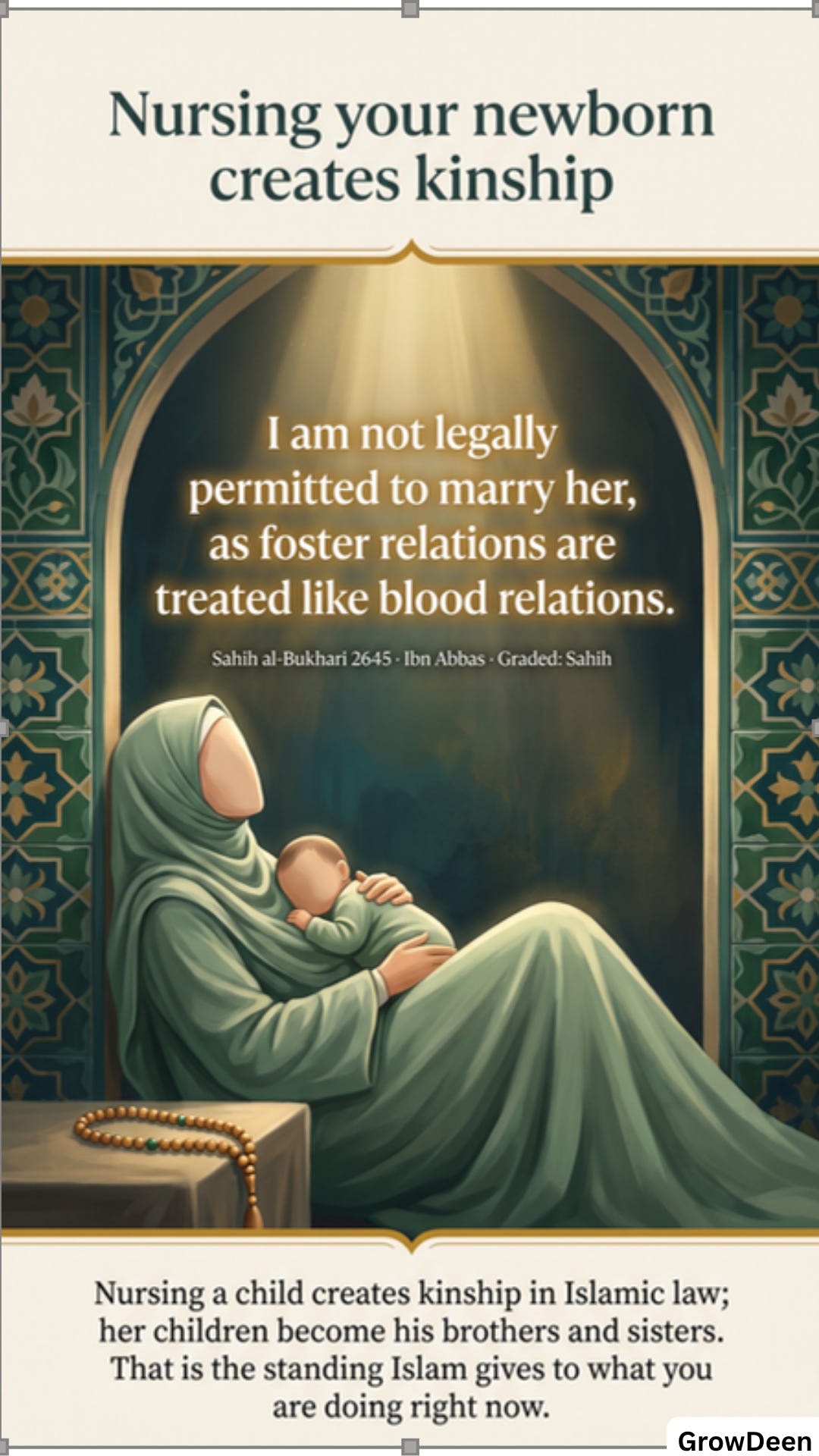
Ibn Kathir notes in the same passage that suckling establishes the prohibition of marriage only inside those first two years [11]. The Prophet ﷺ said of Hamza’s daughter, “I am not legally permitted to marry her, as foster relations are treated like blood relations,” and described her as the daughter of his foster brother [12].
Milk makes family. A woman who nurses a child becomes, in Islamic law, something close to his mother, and her children become his brothers and sisters. That is the standing Islam gives to what you are doing at two in the morning while half asleep, wondering whether any of it registers.
Two Years, And Who Gets To Decide
Most new mothers ask this quietly, within a fortnight.
The Qur’anic term is two complete years, framed as the mother’s right to complete and the child’s right to receive [11]. In 2022 the American Academy of Pediatrics revised its breastfeeding policy for the first time in a decade, and now recommends exclusive breastfeeding for about six months, then continued breastfeeding alongside complementary foods for two years or beyond, as mutually desired by mother and child [7]. WHO says the same [1].
A medical body arrived in 2022 at a figure the Qur’an set out more than fourteen hundred years ago, including the detail that the decision belongs to the parents together. A mother under pressure to wean at twelve months can hold both of those facts in one hand.
Some mothers hear all this as an instruction to refuse expert help, as though calling a lactation consultant were a lapse in tawakkul. Consider Hajar instead, nursing an infant in an empty valley with the water gone. Once she understood the command came from Allah she said, “Then He will not neglect us.” She did not sit down to wait. She ran between Safa and Marwa seven times looking for anyone at all, and the water arrived after the running [13]. Every pilgrim repeats her search. Lean back and let her lead, then book the appointment anyway.
Inside The First Latch Pack
If you have read this far, you are the kind of mother who takes feeding seriously, not as anxiety but as care. That says something about you.
Inside the First Latch Pack (one comprehensive PDF, 3 pages):
Page 1: The Nine Stages Card. The full sequence your newborn moves through from birth cry to sleep, with what each stage looks like and roughly when it happens, designed as a laminated card you can keep taped inside a cupboard door or in your hospital bag.
Page 2: The Laid-Back Set-Up and Cue Ladder. A diagrammed set-up for reclining, a five-point deep-latch self-check, and the early, mid and late cue ladder on one sheet, so you can get a feed started in under two minutes without re-reading anything.
Page 3: Two Reflections on What Nursing Is Worth. The narration on rada’ah and the narration of Hajar in the valley, each with its source and grading, for the feeds that feel like they count for nothing.
This isn’t just a PDF to download and forget. It’s a tool designed to stay in your feeding corner, where you’ll actually use it when you need it most.
This First Latch Pack is what every subscriber receives with each article. We cover the whole of raising Muslim children, all backed by scientific research and rooted in Islamic wisdom.
If you’re a Muslim parent who wants both evidence-based guidance AND Islamic perspective, subscribe for free so future resources arrive in your inbox before you need them.
Subscribe free for parenting resources backed by both science and Sunnah, guidance so unique you literally can’t get it anywhere else. No spam, no clutter, just resources that matter.
One Thing To Do In The Next Five Minutes
Go and build the chair. Put two pillows behind your shoulders and one behind your lower back, sit into it, and lean until your shoulders stop working. That is the position. Leave the pillows there so it is waiting for you at the next feed.
Share This With Someone Who Needs It
Think of one person right now: the sister whose baby is three days old, the friend who told you feeding was agony and she was going to switch, the cousin who is thirty-six weeks and quietly terrified of the first latch.
This article could spare her a fortnight of pain. Send it to her today, not as advice, but because you know what that first week feels like.
Frequently Asked Questions
Q: Can I do baby-led attachment after a caesarean?
A: Yes. Recline as you normally would and bring your baby up across your chest on the side away from the incision, with a pillow guarding the wound so none of her weight rests on it. The Cochrane evidence on early skin-to-skin covers caesarean births too [2]. For more detail, see “When she still will not latch” above.
Q: Is it too late if my baby is already a few weeks old?
A: No. The instincts stay available for months rather than minutes, and plenty of mothers start this weeks after birth and find it works straight away.
Q: Will laid-back breastfeeding increase my milk supply?
A: The trial evidence does not show that. It showed about half the rate of cracked and sore nipples, with no significant difference in exclusive breastfeeding rates [6]. Supply responds to frequent, responsive feeding, which WHO recommends day and night [1].
Q: How do I know my baby is actually getting milk?
A: Listen for swallowing, watch for her jaw moving right back to the ear, and count wet and dirty nappies. If nappies are fewer than expected, if she will not rouse for feeds, or if weight gain stalls, speak to your midwife or doctor promptly.
Q: Is it safe if I fall asleep while feeding like this?
A: Laid-back feeding is for an awake, supported mother. If there is any chance of dozing off, move your baby to a separate safe sleep surface first, and ask your midwife about safer sleep guidance for your situation.
Q: How do I feed modestly when I am out of the house?
A: A top you can lift from the bottom, worn with a wide scarf or light cover draped across your chest, handles most situations with your satr intact, especially with something behind you to recline against. A baby who has done the finding thirty times at home needs far less fuss in public.
Q: How long should a Muslim mother breastfeed?
A: The Qur’an names two complete years for those who wish to complete the term, with earlier weaning permitted by mutual consultation and consent between both parents [11]. The AAP and WHO now recommend the same two-year horizon [1,7].
References
[1] World Health Organization. Infant and young child feeding. Fact sheet, 4 August 2026
[2] Moore ER, Cadwell K, Brimdyr K, et al. Immediate or early skin-to-skin contact for mothers and their healthy newborn infants. Cochrane Database of Systematic Reviews. 2025;10(10):CD003519
[3] Widstrom AM, Lilja G, Aaltomaa-Michalias P, Dahllof A, Lintula M, Nissen E. Newborn behaviour to locate the breast when skin-to-skin: a possible method for enabling early self-regulation. Acta Paediatrica. 2011;100(1):79-85
[4] Brimdyr K, Cadwell K, Svensson K, Takahashi Y, Nissen E, Widstrom AM. The nine stages of skin-to-skin: practical guidelines and insights from four countries. Maternal & Child Nutrition. 2020;16(4):e13042
[5] Colson SD, Meek JH, Hawdon JM. Optimal positions for the release of primitive neonatal reflexes stimulating breastfeeding. Early Human Development. 2008;84(7):441-449
[6] Milinco M, Travan L, Cattaneo A, et al. Effectiveness of biological nurturing on early breastfeeding problems: a randomized controlled trial. International Breastfeeding Journal. 2020;15:21
[7] Meek JY, Noble L; American Academy of Pediatrics Section on Breastfeeding. Policy Statement: Breastfeeding and the Use of Human Milk. Pediatrics. 2022;150(1):e2022057988
[8] NHS Just One Norfolk (Norfolk and Waveney). Feeding cues
[9] Doucet S, Soussignan R, Sagot P, Schaal B. The secretion of areolar (Montgomery’s) glands from lactating women elicits selective, unconditional responses in neonates. PLoS ONE. 2009;4(10):e7579
[10] Brimdyr K, Cadwell K, Widstrom AM, Svensson K, Phillips R. The effect of labor medications on normal newborn behavior in the first hour after birth: a prospective cohort study. Early Human Development. 2019;132:30-36
[11] Qur’an, Surah Al-Baqarah 2:233 (Saheeh International translation). Tafsir Ibn Kathir on 2:233
[12] Sahih al-Bukhari 2645, narrated by Ibn Abbas. Graded: Sahih
[13] Sahih al-Bukhari 3364, narrated by Ibn Abbas. Graded: Sahih
We combine scientific research with Qur’an and authentic Sunnah, and we cite our sources. Even so, this is general guidance and no substitute for a doctor who can examine your child.