

Calendar age mislabels premature babies. In a 2025 analysis, measuring growth that way classed 89.8 per cent of very preterm babies as underweight. [1]
Print it before the next weigh-in.

The health visitor turns the chart towards you.
You came prepared. You answered every question truthfully and mentioned the early arrival, and you still watched a finger land on a line your baby sits well below. Six months on the calendar. Not sitting unsupported. The word that follows is usually monitoring, sometimes referral, and occasionally delayed.
Nobody in that room is doing anything wrong. The chart is accurate, the health visitor is careful, and your baby is fine. One number is simply missing from the conversation, and until somebody puts it in, every appointment will feel like a verdict you have to brace for.
Here is the part that catches parents off guard. That exact weight, that exact baby, on that exact day, can produce two opposite answers depending on which age you measure against. Not a slightly different answer. Opposite.
So which one is right, and why does nobody write it on the chart?
Why This Guide Is Different From A Standard Preemie Milestone List
Every number here is traced to a named source and a year, including a 2025 population study of 52,662 preterm children that most parenting sites have not caught up with yet [4].
The Islamic layer is not decoration. Your child’s formation was decided in a place you could not see, and the Sunnah marks a newborn’s days from the birth itself, which turns out to settle the exact question the milestone chart keeps asking.
You already have the free Corrected Age Card from the top of this page, so you leave with the arithmetic done, the appointment script written, and a reflection card for the comparing days.
What is corrected age, and how do you work it out?
Most parents do this sum badly in their heads, in a corridor, under pressure, while a nurse waits. It deserves better than that.
Corrected age, also called adjusted age, counts your baby’s development forward from the day they were originally due rather than the day they arrived. You take the age the calendar gives you and subtract the number of weeks they came early [3].
A pregnancy is counted to forty weeks. A baby delivered at thirty-two weeks therefore arrived eight weeks early, and that eight never changes. Sixteen weeks after her birth, the calendar calls her four months old. Subtract the eight and her corrected age is two months. So when you watch her neck control, her hands and the way her eyes follow your face, the honest comparison is a two-month-old [3].
The sum runs the other way before your due date arrives. Add the weeks since birth to the weeks of pregnancy you completed. A baby born at thirty weeks who is now eight weeks old has a corrected age of thirty-eight weeks, which means she has not yet reached the point a full-term baby starts from. Nothing is late. The race has not begun.
Subtract the weeks before you worry. Write the number somewhere you will see it, because you will need it more often than you expect.
But knowing the number is only useful once you understand what it does to the chart. That is where the two opposite answers come from.
Why The Same Baby Can Be Underweight And Perfectly Healthy At Once
Any birth before thirty-seven completed weeks is preterm. Under twenty-eight weeks is extremely preterm, twenty-eight to under thirty-two weeks is very preterm, and thirty-two to thirty-seven is moderate to late preterm [2]. Roughly 13.4 million babies arrived early in 2020, close to one birth in ten worldwide [2].
Now the number that should be on every neonatal discharge letter and almost never is.
A 2025 analysis of extremely and very preterm infants plotted the same babies twice. Measured against corrected age at term, they looked like what they were, which is small babies growing as expected. Measured against calendar age, the identical data labelled 72.9 per cent of them stunted and 89.8 per cent underweight [1].
Read that again. Nine babies in ten, flagged as failing, by arithmetic.
That is the answer to the question in the opening. One weight, two verdicts, and the only variable is which age the chart is told to use. The weeks your baby spent outside the womb instead of inside it were weeks of scheduled work: lungs and gut maturing, weight going on, brain wiring being laid down. The work continued. It simply continued somewhere harder, and the schedule moved with it.
Which raises the question that actually governs your week. If development moves to the due date, does everything else move with it?
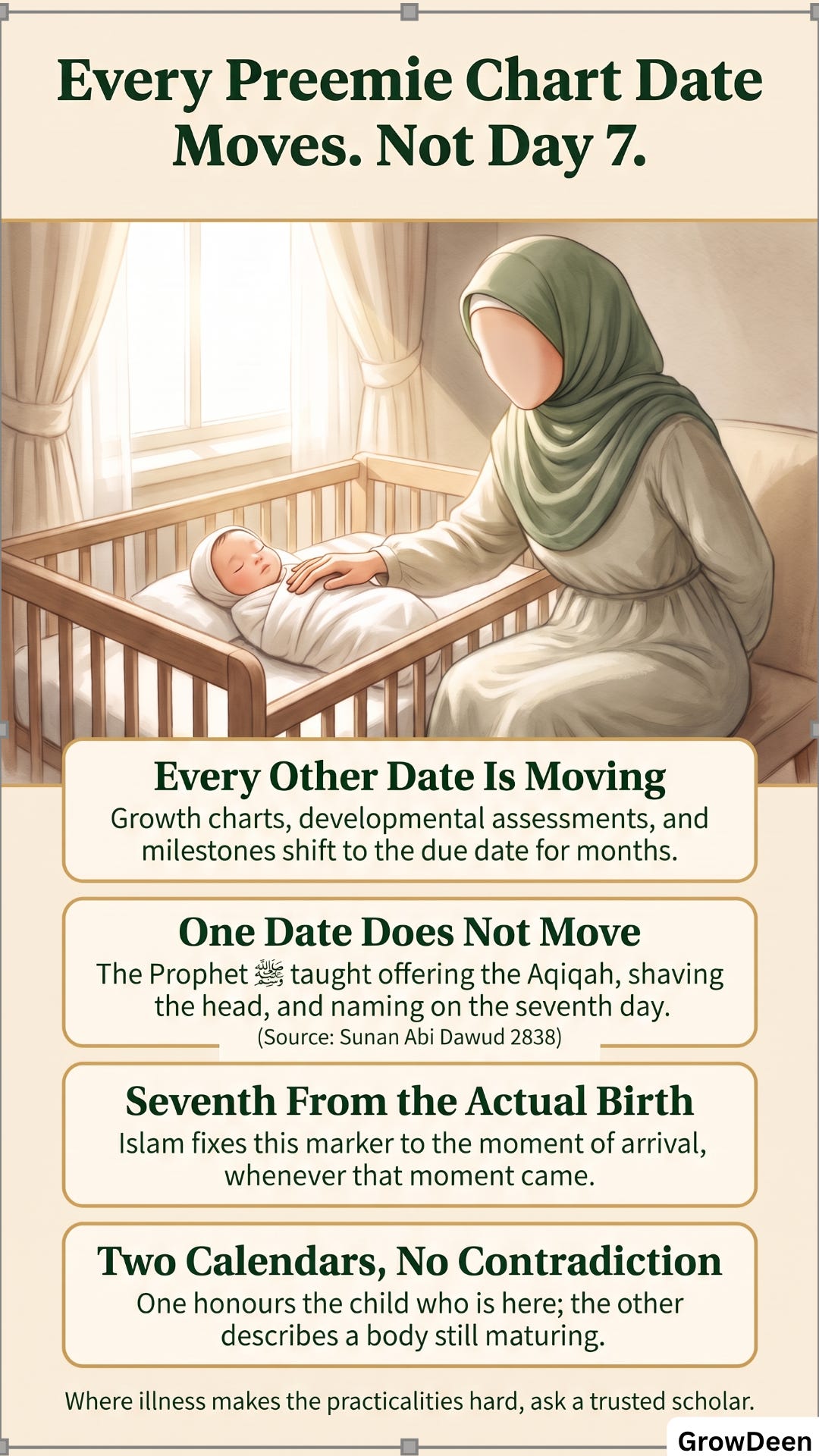
Which Things You Subtract From, And Which You Never Touch
It does not. This is where most of the confusion lives, and the split is cleaner than it looks.
Three things stay on the birth date, with no subtraction at all.
Immunisations come first, and this one surprises nearly everybody. Babies born early are vaccinated at the same chronological age and on the same schedule as babies born at term, whatever their birth weight [5]. Parents reason that a small baby should wait, which feels protective and is the opposite of protective. The schedule is built around how long the immune system has been meeting the outside world, not how mature the baby looks, and preterm babies carry a higher risk from several of the infections involved [5]. One exception comes up often: where a baby weighs under 2kg at birth and the mother is hepatitis B negative, the first hepatitis B dose is commonly held until the baby is a month old or ready for discharge, whichever is sooner [5]. Babies born very early sometimes have their first immunisations on the unit, and a few need an extra dose of certain vaccines later [5].
The birthday stays on the birth date too. You celebrate the day your child arrived, every year, without adjustment [3].
And the seventh day stays there. For Muslim families, the practices that follow a birth are counted from the birth itself. The Prophet ﷺ taught that “A boy is in pledge for his Aqiqah”, with the sacrifice offered on the seventh day and the head shaved and the child named that same day [11]. Seventh from birth, never seventh from the due date. Families with a baby still on the unit ask about this constantly, and the counting does not change. Where illness or intensive care makes the practicalities hard, take your own situation to a trusted scholar rather than turning it over alone at 3am.
Everything about development moves to the due date. Rolling, sitting, reaching, babbling, crawling and walking. The social skills too: the first real smile, the eyes that track you across a room, the head that turns to a familiar voice. Growth belongs here as well, so weight, length and head circumference are all plotted against corrected age [1]. When a professional asks whether your baby is doing something yet, corrected age is the frame they are using, and the answer only means anything inside it [3].
Feeding is the one place parents get the most mixed messages, so put the question directly. When solids come up, ask which age the team is working from and which readiness signs they want you watching. Practice varies, and the answer can move your timing by weeks.
That is the whole split. Three things on one date, everything developmental on the other.
Before You Read On
Nobody remembers a split like that under fluorescent lighting with a baby on their shoulder. The free Corrected Age Card exists for exactly that moment: a pre-filled conversion table so you never do the sum in your head again, the appointment script, and a reflection card for the days when comparing gets loud. The download button is at the top of this page, and there is a full description of what is inside it below.
Which brings up the part of this that no chart can help with.
What The Qur’an Teaches About How Your Child Was Formed
The comparing erodes parents far more than the appointments do. The group chat. The baby at the masjid born the same week who is visibly weeks ahead. You know that pull.
Comparison is asking a question that was answered before your child drew breath. Allah says, “It is He who forms you in the wombs however He wills” [10]. Ibn Kathir explains it plainly: Allah creates people in the wombs as He wills, and that creating covers whether a child is male or female, how they are formed, and what their life will hold. He connects the verse to the description of creation taking place in three veils of darkness [10].
Sit with what that rules out. The forming of this particular child happened where no parent could watch, by a will no parent shares. A pace given to one baby was never the measure set for yours.
The Sunnah carries the same logic into practice. The seventh-day aqiqah, the shaving and the naming are counted from the day the child arrives, whenever that day came [11]. Islam fixes that marker to the birth. Medicine fixes development to the due date. A Muslim parent of a premature baby lives inside both at once, with no contradiction between them.
One honours the child who is here. The other describes a body still catching up. Neither is a verdict.
And neither of them tells you when to stop subtracting, which is the question every parent eventually asks.
Support Muslim Parenting Lab ❤️
Think your amount is too small to matter? Give whatever you have with the button below.
The Prophet ﷺ said to shield yourself from the Fire even with half a date. (Sahih al-Bukhari 1417)
How long do you keep subtracting?
Two years is the common floor, and most health professionals correct at least that far [3].
Growth now has evidence pointing further. That same 2025 analysis found scores based on calendar age stayed significantly below corrected-age scores right out to thirty-six months, and its authors recommend correcting every growth measure to three years for babies born before thirty-two weeks [1]. Developmental assessment splits: cognitive testing is usually corrected to around two years, while language and motor scores are often corrected to three [1].
Whether to correct at all during formal testing has been argued in the research for a decade without resolution [6]. What nobody disputes is that the choice moves the number. One study of children born very preterm found correcting for prematurity shifted cognitive test scores in childhood by a meaningful margin [7]. Another, following children born extremely preterm, deliberately reported its behavioural findings at a corrected age of two and a half rather than the calendar age [8].
Then there is the finding that complicates the comfortable version of this article, and you deserve it rather than a tidier story.
Working with routine surveillance records covering 52,662 preterm and 656,986 term children, researchers found that standard correction removed almost all of the apparent gap for moderate and late preterm children. For very and extremely preterm children it did not. Residual gaps of at least two months in motor development and one month in language and social development survived the correction, leading the authors to conclude that routine correction may understate maturational delay in the most premature group [4].
Two things follow, and they pull against each other on purpose. Correction is the right default, and assessing a preterm baby without it produces parental alarm the data does not support [4]. Correction is also not a guarantee. If your baby came very early and something still looks off at corrected age, that instinct has earned a conversation.
So ask for both numbers every time your child is assessed. A result that reads as concerning on one clock can read as unremarkable on the other, and you are entitled to see the pair before anyone concludes anything.
Nursery And School Run On The Other Clock
Admissions almost everywhere use chronological age, and corrected age is not a category most systems recognise. For a child born near the end of an intake year, a few months changes what a classroom expects of them.
Some families delay entry by a year where a child’s corrected age falls just under the cut-off, buying time for the self-care and social skills school asks for. No single answer fits every child. Talk it through with your child’s doctor and the school before committing, and where a child is assessed for any developmental concern around school entry, ask again for both scores [7].

What To Say When Someone Counts Wrong
So what does this actually look like at the eight-week check, or at your mother-in-law’s kitchen table?
Say it out loud, and say it early. Not as an apology. As the piece of information that lets someone else be useful to your child.
The people who need it are your baby’s doctor and nurses, whoever runs developmental checks, nursery staff, childminders and eventually teachers. Give them two facts: your child was born prematurely, and this many weeks early. The second is the one families forget to pass on, and without it the first cannot be acted on.
One sentence carries it. “She came ten weeks early, so her corrected age is four months.” You will repeat it more times than you can count, and it stops feeling like an announcement faster than you expect.
Relatives need something gentler with the same backbone. “He is doing exactly what a baby due in March should be doing.” Most people adjust there. The ones who keep pressing are usually frightened rather than unkind, and their fear is not yours to absorb.
Watch the word delayed as well. It gets handed around casually, usually by people meaning no harm, and it lodges in a parent far longer than it has any right to.
Scripts handle the people. The baby in front of you tonight needs something different.
What Your Baby Actually Needs Tonight
Pitch everything at corrected age, including the things that feel too small to count.
Skin to skin carries some of the strongest evidence available. The World Health Organization now advises it start immediately after birth for small and preterm babies rather than after a period in an incubator, and recommends babies and families be cared for as a single unit with emotional support for parents built in [9]. Ask your team what is possible today, then ask again next week, because the answer moves as your baby stabilises.
A baby whose corrected age is two months wants a close face and a steady voice, in short visits rather than long ones. Quiet Qur’an recitation while you hold them, adhkar spoken softly, Bismillah before a feed, salaam as you come into the room, a story told in your own voice. None of it costs anything, all of it suits a baby who tires fast, and together it is the first layer of tarbiyah your child will ever receive. No programme is required. Repetition in small doses is.
Then guard the other direction. Bright screens and long stretches of being handed around will flatten a preterm baby faster than a term baby of the same calendar age. Learn the signals of a baby who has had enough: the gaze that slides away, the sudden stillness, a change in colour, sleep arriving mid-feed. Follow those rather than the clock on the wall.
When Subtracting Is Not The Answer
Corrected age explains a great deal. It should never become the reason you talk yourself out of a concern, and the 2025 population data is the reason that sentence is in this article rather than a reassuring one [4].
Contact your baby’s doctor or paediatrician if your child is not reaching milestones for their corrected age, if a skill they had disappears, if feeding stays difficult, if you have any worry about hearing or vision, or if their muscles seem unusually stiff or unusually floppy. Your own observation carries weight. Parents notice first in most cases, and support started early works better than support started late.
Seek urgent medical care if your baby is struggling to breathe, is unusually drowsy or hard to rouse, has a fever, or is feeding far less than usual.
None of this replaces medical advice. Follow the guidance of the team who know your child.
The Corrected Age Card
If you have read this far, you are the kind of parent who would rather understand the number than be soothed about it. That instinct says something good about how your child is being raised.
Inside the Corrected Age Card (one comprehensive PDF, 3 pages):
Page 1: Your Corrected Age Conversion Table. A fill-in panel for your due date, birth date and weeks early, followed by a pre-filled month-by-month table that converts calendar age to corrected age at a glance, plus the subtract-or-not split for immunisations, growth, milestones and the seventh day. Designed as a laminated card for the fridge door or the inside of the changing bag.
Page 2: The Appointment Script Sheet. The exact sentences to use with a health visitor, a paediatrician, a nursery keyworker and a relative, the two questions to ask at every assessment, and a short red-flag list of what to raise regardless of corrected age. So you walk into the eight-week check with your side of the conversation already written.
Page 3: The Verse for the Comparing Days. A reflection card carrying Qur’an 3:6 in English with its source, a short explanation drawn from Tafsir Ibn Kathir, and the seventh-day note that explains why Islam counts your child’s days from their arrival while medicine counts their development from their due date. For the evenings when the group chat gets loud.
This is not a PDF to download and forget. It is built to live on your fridge and in your bag, where you will actually reach for it.
This Corrected Age Card is what every subscriber receives with each article. We cover the full span of raising Muslim children, from the newborn weeks through the school years, all backed by current research and rooted in Islamic guidance.
Do This Before You Close The Tab
Open your phone’s notes app right now and type two things: your baby’s due date, and the number of weeks early they arrived. That second number never changes for the rest of their childhood, and having it saved means you will never again do that sum badly in a corridor while somebody waits.
Sixty seconds. Do it before you keep scrolling.
May Allah place barakah in every gram gained and every skill learned, grant your child strength and wellbeing, and reward the care you are giving in the weeks when nobody seems to notice it.
Share This With Someone Who Needs It
Think of one person right now: the friend whose baby shower turned into a NICU visit, the sister who goes quiet whenever milestones come up in the group chat, the cousin who keeps apologising for her son at family gatherings because he is not doing what his cousins did.
This article could take a weight off them tonight. Send it today. Not as advice, and not as correction. Send it because you know the number they have been missing. Subtract the weeks before you worry is a sentence somebody needs to read before their next appointment.
Frequently Asked Questions
Q: What is corrected age for a premature baby? A: It is your baby’s age counted from their original due date instead of their birth date, used to judge development and growth fairly [3]. For the full calculation with worked examples, see “What is corrected age, and how do you work it out?” above.
Q: How do you calculate corrected age? A: Take your baby’s age on the calendar and subtract the number of weeks they were born early, working from a forty-week pregnancy [3]. A four-month-old born eight weeks early has a corrected age of two months.
Q: How long do you use corrected age for? A: Most health professionals correct until at least two years [3]. For growth, a 2025 analysis recommends correcting to three years for babies born before thirty-two weeks, and language and motor scores are often corrected to three as well [1].
Q: Do premature babies get their vaccines at corrected age? A: No. Preterm babies are vaccinated at the same chronological age and on the same schedule as term babies, whatever their birth weight, with one common exception around the first hepatitis B dose for babies under 2kg [5]. Ask your baby’s doctor to walk you through the schedule.
Q: When should a premature baby sit up? A: Judge it against corrected age, not calendar age. A baby born ten weeks early who sits at eight months on the calendar is sitting at a corrected age of about five and a half months, which is ordinary. Raise any concern with your doctor if the milestone is late for the corrected age [4].
Q: Do you celebrate a premature baby’s birthday on the birth date or the due date? A: The birth date, every year [3]. Many families quietly note the due date too, as the day the developmental clock started, but the birthday itself never moves.
References
[1] Elmrayed, S., Dai, S., Lodha, A., Kumar, M., & Fenton, T. R. (2025). Preterm growth assessment: the latest findings on age correction. Journal of Perinatology, 45(5), 607-615.
[2] World Health Organization. (2023). Preterm birth fact sheet.
[3] American Academy of Pediatrics. Corrected age for preemies. HealthyChildren.org.
[4] Goldshtein, I., Amit, G., Avgil Tsadok, M., Baruch, R., Zimmerman, D. R., Akiva, P., Yardeni, H., & Sadaka, Y. (2025). Age-corrected development of preterm children: a population-based study. Pediatric Research, 97(3), 1001-1008.
[5] Immunize.org. Ask the experts: Vaccination of preterm infants (reflecting CDC guidance).
[6] Harel-Gadassi, A., Friedlander, E., Yaari, M., Bar-Oz, B., Eventov-Friedman, S., Mankuta, D., & Yirmiya, N. (2018). Developmental assessment of preterm infants: Chronological or corrected age? Research in Developmental Disabilities, 80, 35-43.
[7] Wilson-Ching, M., Pascoe, L., Doyle, L. W., & Anderson, P. J. (2014). Effects of correcting for prematurity on cognitive test scores in childhood. Journal of Paediatrics and Child Health, 50(3), 182-188.
[8] Månsson, J., Stjernqvist, K., & Bäckström, M. (2014). Behavioral outcomes at corrected age 2.5 years in children born extremely preterm. Journal of Developmental & Behavioral Pediatrics, 35(7), 435-442.
[9] World Health Organization. (2022). WHO advises immediate skin-to-skin care for survival of small and preterm babies.
[10] Qur’an, Surah Aal-Imran 3:6. Translation: Saheeh International. Tafsir Ibn Kathir for 3:6:
[11] Sunan Abi Dawud 2838. Narrated by Samurah ibn Jundub. Graded: Sahih (al-Albani).
We combine scientific research with Qur’an and authentic Sunnah, and we cite our sources. Even so, this is general guidance and no substitute for a doctor who can examine your child.