

Thirteen point four million babies arrived early in 2020. [1] Most of them were born with bones still waiting for minerals they should have received in the last trimester. [3]
Three pages. Print it before your next visit.
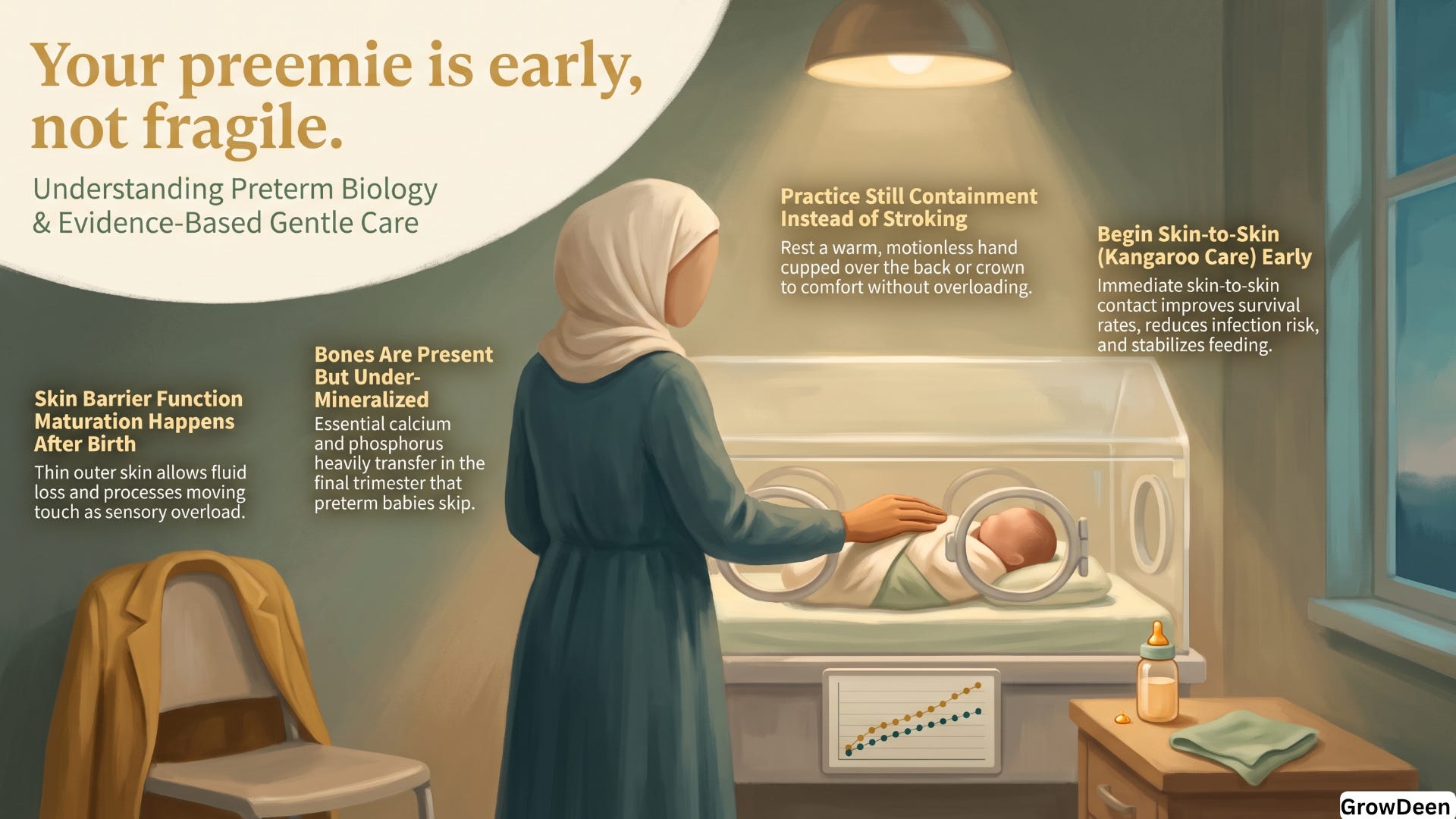
Nobody tells you not to stroke.
You reach through the porthole the way you have reached for every baby you have ever held, with a thumb already moving back and forth across the shoulder, and the nurse says, kindly, hold still. So you freeze. Your hand stays where it is, doing what feels like nothing at all, and the numbers on the monitor settle.
You drove here on four hours of sleep. You have washed your hands until they have split at the knuckles. You have asked three people the same question and been given three different answers, and now you are being told that the one instinctive thing you did was the wrong thing. That is a strange kind of exhaustion, and it is not your fault. The instinct is right. The calibration is off by about twenty weeks.
Which leaves the question that this whole article answers: why does a baby who needs touch more than almost anything need you to keep your hand completely still?
Why This Guide Is Different
Every number here comes from a named source with a year attached, including WHO’s 2022 recommendations for preterm and low-birth-weight care and the American Academy of Pediatrics guidance on preterm bone minerals. [2] [3]
The Islamic layer is not decoration. The Qur’anic description of staged creation maps onto what is physically happening in that incubator, bone before flesh, in the order the tafsir describes. [9]
You already have the free Preemie Touch Card from the button at the top of this page, so the handling steps below are printable and come with you to the unit.
The Body You Are Looking At Is Mid-Sentence
Preterm means born alive before 37 completed weeks. WHO sorts it into three bands: extremely preterm below 28 weeks, very preterm between 28 and 32 weeks, and moderate to late preterm from 32 to 37 weeks. [1]
That range is why advice from another preemie parent can land so badly. A baby born at 35 weeks and a baby born at 25 weeks share a word and almost nothing else.
At around 24 weeks a baby fits along your forearm. The skin can look shiny, translucent, reddish in some babies, because the outer barrier is thin and still being built after birth instead of before it. [6] The eyelids of the earliest babies are sometimes still fused, and they open on their own schedule.
Here is the reframe that changes how the next six weeks feel. None of that is damage. It is a body at precisely the stage its gestational age predicts, doing on the outside what it would otherwise have done unseen.
The unit tracks skin condition next to weight, length and head circumference, and those plotted dots are the actual evidence of growth on the days when nothing looks different to you. [1]
What The Bones Are Waiting For
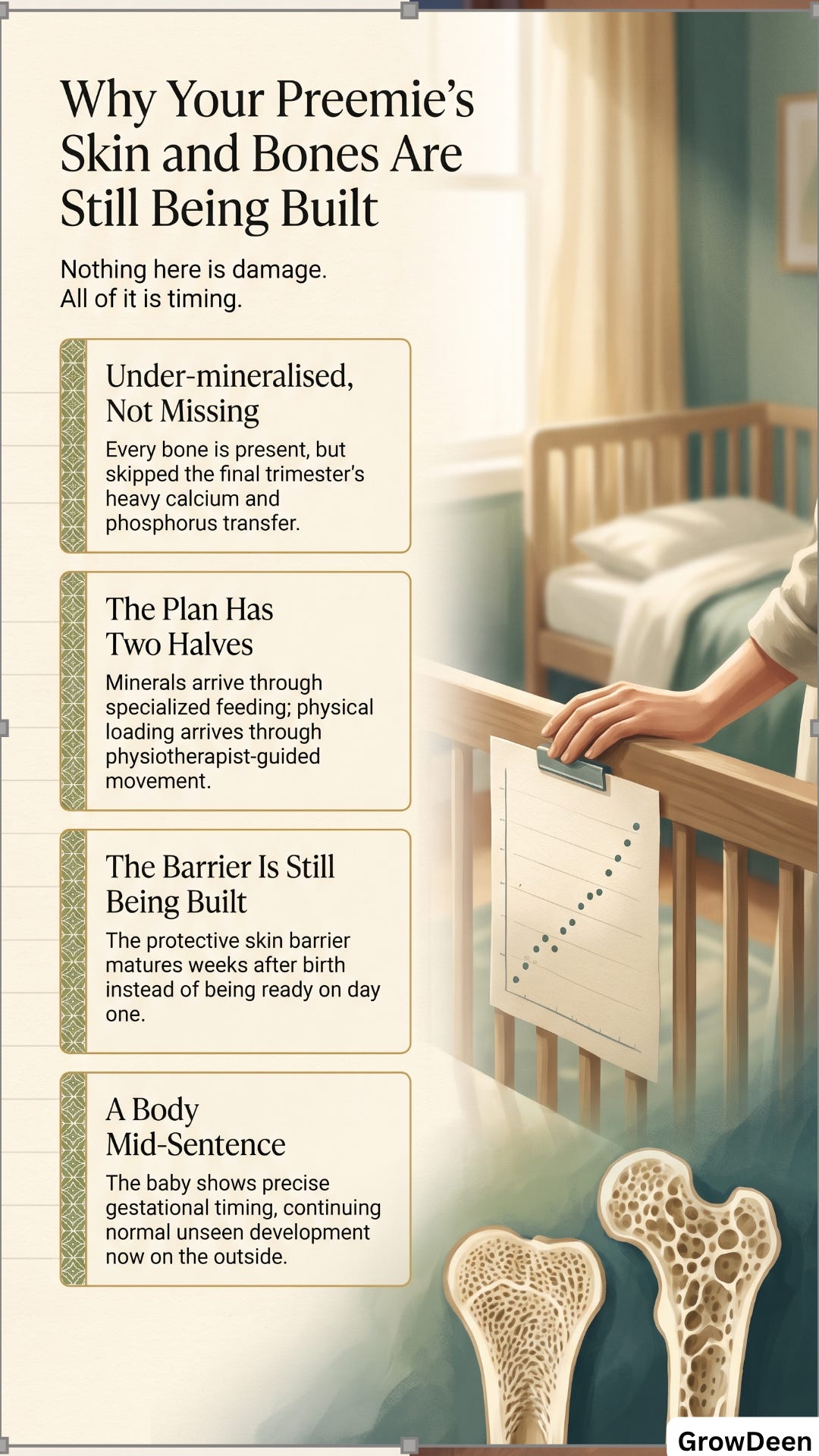
Bones are not missing at birth. They are present and under-mineralised, which is a completely different problem with a completely different fix.
Calcium and phosphorus cross the placenta heavily during the final trimester, exactly the stretch your baby skipped, so paediatric guidance sets preterm intakes far above term newborn levels: roughly 150 to 220 mg of calcium and 75 to 140 mg of phosphorus per kilogram per day, with 200 to 400 IU of vitamin D. [3] Babies under about 1,800 to 2,000 grams are expected to receive fortified human milk or a preterm formula, and the smallest babies have bone mineral status checked by blood work from around four to five weeks. [3]
There is a second thing missing, and almost nobody mentions it. Inside a tight womb, a term baby spends the last weeks bracing and kicking against the uterine wall, and that daily loading is part of how bone hardens. A baby lying still in an incubator does very little of it.
So the plan has two halves. Minerals arrive through feeding. Loading arrives through movement, which is why a physiotherapist eventually becomes part of your baby’s team.
Movement Is The Other Half Of The Prescription
Which raises an obvious question: if loading builds bone, how does a baby who cannot be picked up get any?
Through a programme, run by someone trained. In preterm infants with very low birth weight, a daily physical activity programme in which a trained person flexes, extends and positions the limbs against gentle resistance has been shown to increase bone mineralisation and growth. [4] Separate research on massage and exercise found both improve weight gain in preterm infants, and that they appear to work through different underlying mechanisms rather than one being a weaker version of the other. [5]
These belong inside the medical plan and nowhere else. They are usually introduced as a baby nears their original due date, and only after a specialist physiotherapist has assessed your baby and taught you the exact handling to use. Ask when that assessment is scheduled, because it is easy for it to slip.
Later, at home and with your doctor’s agreement, the same principle turns into ordinary family life. Floor time with free kicking. Slow arm movements while you say Bismillah and Alhamdulillah aloud or recite a short surah you know by heart. A few supervised minutes of tummy time while your baby is awake. Your voice carries the rhythm that other households take from background music, without bringing music into the room.
The Milk, And The Work Nobody Sees
Mother’s own milk is the recommended feed for preterm and low-birth-weight babies because it lowers infection risk compared with formula, donor human milk is the recommended alternative when a mother’s own milk is not available, and nutrient-enriched preterm formula comes next. [2] Fortifier is added to human milk for the smallest babies so the mineral and protein load matches what those bones need. [3]
Now the part that gets said out loud far too rarely. Expressing every three hours beside an incubator, on a body that has just been through surgery or a frightening delivery, is physical labour that almost nobody witnesses or credits. Supply that arrives slowly has physiological causes, and it says nothing about your worth as a mother.
The Qur’an sets the nursing term plainly: “Mothers may nurse [i.e., breastfeed] their children two complete years for whoever wishes to complete the nursing [period]”. [10] For a premature baby that two-year term often starts with a syringe and a nasogastric tube, weeks before a latch is possible at all. The milk is the same milk. Say Bismillah when you sit down to the pump and Alhamdulillah when you cap the bottle, and the session stops being a chore and becomes something with an intention written on it.
Why Your Hand Has To Stay Still
This is the answer to the question from the top of the page.
Your baby reads the world through skin, and touch is also how the attachment between you gets built, which is why nobody actually wants your hands off that cot. The problem is that immature skin processes moving pressure differently. Stroking, rubbing and shifting weight can overload a very preterm baby, while steady, motionless contact does not. [6]
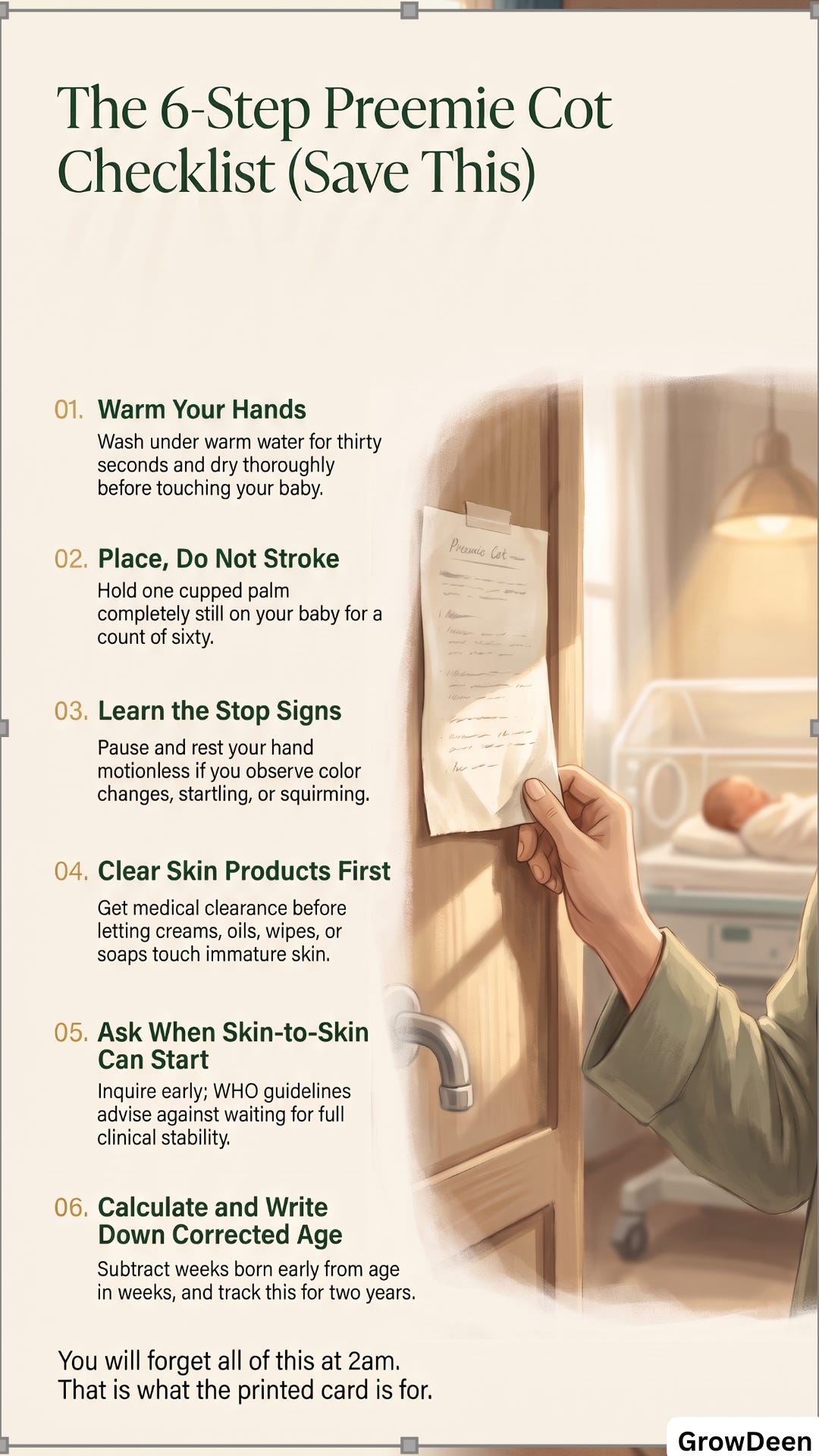
So units teach containment instead. Warm your hands first. Then place one still hand cupped over the back or the crown, holding without moving, letting the weight be constant, while a nurse watches and reads your baby’s signals with you.
That is the whole technique, and it takes about four minutes to learn. Gentle hands are part of the treatment.
Skin-to-skin care goes further than containment. WHO recommends starting kangaroo mother care as soon as possible after birth, without waiting for a baby to be fully stable, because immediate skin-to-skin improves survival, reduces infection and hypothermia, and helps feeding become established. Fathers, partners and other family members can give it when the mother cannot. [2]
If you take one action from this article, take this one. Ask your team today when skin-to-skin can start or be extended, and put the time in your calendar.
The Second Job The Skin Is Doing
In a term baby, skin keeps bacteria and viruses out and keeps heat and fluid in, helped by the fat underneath. In a very premature baby that barrier is incomplete, so infection can pass in and fluid can escape out through the skin itself, and barrier function matures over the weeks after birth rather than being ready on day one. [6]
Everything you see around the cot follows from that one fact, and once you know it, the rules stop feeling arbitrary.
Hand hygiene is not ceremony. Wash before every contact, wash again after you touch a phone or a bag, and ask anyone with a cough or cold to stay away until they are clear. Cleanliness is already woven through how a Muslim lives, and here it is also a physical barrier standing in for one your baby has not finished building.
The incubator is doing the heat and humidity work that the skin cannot yet do, which is also why babies born around 30 to 32 weeks, who have plenty of loose skin and very little fat beneath it, cannot hold a steady temperature on their own.
Dry, flaking, peeling skin in the early weeks is usually the outer layer maturing and shedding while new skin forms underneath. [6] Ask before you put anything on it. Units have their own protocols and their own choice of emollient, and a scented product or a family remedy introduced quietly can undo a careful plan. Soft cotton rather than synthetics or coarse wool, and infrequent bathing in the first weeks.
Support Muslim Parenting Lab ❤️
Would you like a deed that keeps earning for you after you die? Start one in a few seconds with the button below.
The Prophet ﷺ named ongoing charity and beneficial knowledge among the three things that keep counting after death. (Sahih Muslim 1631)
The Calendar To Use For The Next Two Years
One more number, and then the practical part.
Corrected age is your baby’s age in weeks minus the weeks they were born early, and the American Academy of Pediatrics advises using it through roughly the first two years, because it is the fairer basis for judging when developmental goals should arrive. A baby born at 32 weeks was eight weeks early, so at sixteen weeks old their corrected age is eight weeks. [8]
Work it out once, write it on the fridge, and use it every time a relative compares your baby to a cousin born at term.
A Card For The Moments Your Hands Forget
Everything above is simple to understand and surprisingly hard to remember at 2am, in a plastic chair, after a difficult ward round. That is why the free Preemie Touch Card exists: three printable pages covering the containment hold step by step, the skin rules in an ask-first and always format, and a reflection card for the walk from the car park to the unit. The download button is at the top of this page, and there is a full description of what is inside it further down.
Created In Stages: What The Qur’an Says About An Unfinished Body
Sit beside an incubator long enough and the Qur’anic account of human creation stops feeling like an abstraction about embryology.
Allah says: “Then We made the sperm-drop into a clinging clot, and We made the clot into a lump [of flesh], and We made [from] the lump, bones, and We covered the bones with flesh; then We developed him into another creation. So blessed is Allah, the best of creators”. [9]
According to Tafsir Ibn Kathir, the verse sets out an ordered sequence in which bones are formed first and are then given a covering of flesh to cover and strengthen them, and the commentary carries the stages past birth, through infancy and childhood into maturity, citing Ibn Abbas. [9]
Now look at the chart clipped to the end of the cot. Bones waiting on minerals. Too little flesh over them to hold warmth. A body that is mid-sequence, in the exact order described, with the last portion of the work happening in a room with monitors instead of behind the wall of a womb.
Your baby has not fallen outside Allah’s design by arriving early. They are inside a stage of it that most parents never get to watch. That is a heavy thing to be given, and it is also an honour, and both can be true while you sit there frightened.
The Companion Pack
If you have read this far, you are the kind of parent who wants to understand what is happening to your child rather than just endure it. That tells me something about the home this baby is coming back to.
Inside the Preemie Touch Card (one comprehensive PDF, 3 pages):
Page 1: The Still Hands Card. The containment hold in five steps, with the warm-hands rule, where to place your hand at different gestational ages, and the overload signs that mean stop and simply rest your hand. Designed as a laminated card for the hospital bag or taped inside the cot locker.
Page 2: Ask First, Always. The skin protection sheet. Two columns covering what must never touch your baby’s skin without clearance and what should happen every single visit, plus a visitor rule you can forward to a relative without having the conversation yourself. So you can protect an unfinished barrier without memorising anything.
Page 3: Created in Stages. A reflection card carrying the Qur’anic teaching that bones are formed and then covered, with the English translation and its source reference, framed for the walk from the car park into the unit on a day when the news has been bad.
This is not a PDF to download and forget. It is built to live in your hospital bag, which is where this actually happens.
The Preemie Touch Card is what every subscriber receives with each article. We cover the whole arc of raising Muslim children, from the newborn weeks through the early school years, all backed by scientific research and rooted in Islamic wisdom.
If you want both evidence-based guidance and Islamic perspective, subscribe free so future resources arrive in your inbox before you need them.
Subscribe free for parenting resources backed by both science and Sunnah, guidance you will not find anywhere else, with no spam, no clutter, just resources that matter when you need them.
Before You Close This
Do one thing on your next visit, before you touch your baby at all. Run both hands under warm water for thirty seconds, dry them, and then rest one of them still on your baby for a count of sixty.
That is the whole skill. Gentle hands are part of the treatment, and still ones are the gentlest you have.
May Allah strengthen that small body, place barakah in the milk and the hours and the waiting, and bring your family home together.
When To Call For Help
Contact your doctor or the unit promptly if you notice:
A high temperature, or a baby who stays cold despite being wrapped and held.
Feeding that slows or stops, fewer wet nappies, or weight that stalls between checks.
Breathing that is fast, laboured or grunting, or pauses that frighten you.
Unusual floppiness, or crying you cannot settle.
Skin that is broken, weeping, hot or red in a patch.
Swelling, or distress when one arm or leg is moved, which should be assessed given the bone mineral risks in small preterm babies. [3]
Your own sense that something has changed counts too. This guidance sits alongside the plan your medical team has given you and does not replace it, so follow your doctor’s instructions where the two differ.
The Parents Nobody Is Monitoring
Mothers of babies in neonatal units report high levels of stress during the admission, and it is documented well enough that no parent needs to treat their own exhaustion as a character flaw. [7] A parent running on nothing cannot sustain the expressing and the hours at the cot, so your food and your sleep belong inside your baby’s care plan too.
This is where the people around you have a defined role. The Prophet ﷺ reported that Allah will say on the Day of Resurrection that He was sick and was not visited, that He asked for food and was not fed, that He asked for drink and was not given any, and that each was asked on behalf of a servant of His, with the reward of finding Allah there waiting for the one who answered. [11] A family too fragile for visitors still has parents who need meals delivered, lifts to the hospital, laundry done and someone to answer the messages.
Share This With Someone Who Needs It
Think of one person right now: the friend whose baby shower turned into a hospital bag, the cousin posting photographs of one very small hand with no explanation attached, the sister nobody has seen at the masjid for six weeks because she has not left the unit.
She is standing at an incubator being told to keep her hand still and not being told why. Send it to her today, not as advice, but because somebody should have put it in her hands on the first morning.
Frequently Asked Questions
Q: Why does my premature baby’s skin look red and see-through? A: Because the outer barrier layer of the skin is thin and still forming after birth rather than before it, which is typical for babies born very early. [6] It thickens over the weeks that follow. See “The second job the skin is doing” above.
Q: Can I hold my premature baby, or will it hurt them? A: You can, and in most cases you should. What needs adjusting is the kind of touch, since moving pressure like stroking can overload a very preterm baby while steady motionless contact does not. [6] Ask your nurse to teach you the containment hold.
Q: When can kangaroo care start for a premature baby? A: WHO recommends starting skin-to-skin as soon as possible after birth, without waiting for the baby to be fully stable, because it improves survival, reduces infection and hypothermia and helps feeding get established. [2] Ask your unit when yours can begin.
Q: Why does a premature baby need calcium, phosphorus and vitamin D? A: Most of those minerals are transferred in the final trimester, so a baby born early starts with lower stores, and guidance sets preterm intakes well above term levels, with 200 to 400 IU of vitamin D daily. [3]
Q: Is it normal for a premature baby’s skin to peel? A: In the early weeks, usually yes. The first layer matures and sheds while new skin forms underneath. [6] Check with your nurse before applying anything to it, since units have their own emollient protocols.
Q: What is corrected age and how long do I use it? A: It is your baby’s age in weeks minus the number of weeks they were born early, and the American Academy of Pediatrics advises using it for roughly the first two years when judging development. [8]
Q: Can expressed milk really matter that much for a premature baby? A: Mother’s own milk is the recommended feed because it lowers infection risk compared with formula, with donor human milk recommended next when a mother’s own milk is unavailable. [2] Fortifier is often added for the smallest babies. [3]
References
[1] World Health Organization. (2023). Preterm birth: key facts.
[2] World Health Organization. (2022). WHO recommendations for care of the preterm or low-birth-weight infant.
[3] Abrams, S.A., & Committee on Nutrition, American Academy of Pediatrics. (2013). Calcium and vitamin D requirements of enterally fed preterm infants. Pediatrics, 131(5), e1676-e1683.
[4] Moyer-Mileur, L.J., Brunstetter, V., McNaught, T.P., Gill, G., & Chan, G.M. (2000). Daily physical activity program increases bone mineralization and growth in preterm very low birth weight infants. Pediatrics, 106(5), 1088-1092.
[5] Diego, M.A., Field, T., & Hernandez-Reif, M. (2014). Preterm infant weight gain is increased by massage therapy and exercise via different underlying mechanisms. Early Human Development, 90(3), 137-140.
[6] Kanti, V., Bonzel, A., Stroux, A., Proquitte, H., Buhrer, C., Blume-Peytavi, U., & Garcia Bartels, N. (2014). Postnatal maturation of skin barrier function in premature infants. Skin Pharmacology and Physiology, 27(5), 234-241.
[7] Syamsu, A.F., Febriani, A.D.B., Alasiry, E., Erika, K.A., Tahir, A.M., & Sunarno, I. (2021). Maternal stressful experience in giving birth to premature baby in neonatal intensive care unit ward. Open Access Macedonian Journal of Medical Sciences, 19(G), 106-111.
[8] American Academy of Pediatrics. (2018). Corrected age for preemies. HealthyChildren.org, adapted from Understanding the NICU.
[9] Qur’an, Surah Al-Mu’minun 23:14 (Saheeh International), with Tafsir Ibn Kathir on 23:12-14.
[10] Qur’an, Surah Al-Baqarah 2:233 (Saheeh International).
[11] Sahih Muslim 2569. Graded: Sahih (Sahih Muslim, authentic by collection).
We combine scientific research with Qur’an and authentic Sunnah, and we cite our sources. Even so, this is general guidance and no substitute for a doctor who can examine your child.