

One baby in ten arrives early. [1] Of the 13.4 million born preterm in 2020, most parents were never taught to read what their baby was already telling them. [1]
Three pages. Printable. Keep it in your bag.
A nurse walks past, glances at your baby, and slows her hands before she touches him. You did not see what she saw.
That gap is the whole problem. Not your attentiveness, which is already running at a level you cannot sustain, but the fact that nobody sat down and told you what the signs are.
You have been standing at that incubator reading numbers on a screen that were never meant for you, while the person who knows your baby least in that room is the one most confident about what to do next.
Why This Guide Is Different
Current research, named and dated. Every claim here traces to WHO guidance, peer-reviewed paediatrics or a named study, including the places where the evidence is weaker than parents are usually told [1][2][6].
Islamic framework, woven in. Caring for a preterm baby is an amanah carried by both parents, and the Qur’anic guidance on gentleness speaks directly to how hands move at a cot side [12][13].
A tool you already have. The free Preemie Cue Card is waiting at the top of this page, built to be printed and kept in your hospital bag rather than read once and lost.
The Moment Nobody Explains
Picture a parent who has finally been allowed to hold their baby. Ten minutes in, the baby goes quiet and still, eyes closing, body loose. The parent reads it as contentment and keeps going, talking softly, stroking a cheek.
The baby was not settling. The baby had run out of capacity and shut down.
This is the part that catches almost everyone, because every instinct you carry about babies was built for term babies. A full term newborn who has had enough turns their head away, squirms, complains. A preterm baby often cannot do any of those things, so the message comes out through the body instead, and some of it looks like the opposite of what it is.
Which raises the question this article exists to answer, and it is worth holding on to while you read: how do you tell the difference between a baby who is calm and a baby who has given up?
Watch The Baby, Not The Monitor
Monitors measure. They do not interpret. A saturation figure tells you what happened three seconds ago; your baby’s hands tell you what is happening now.
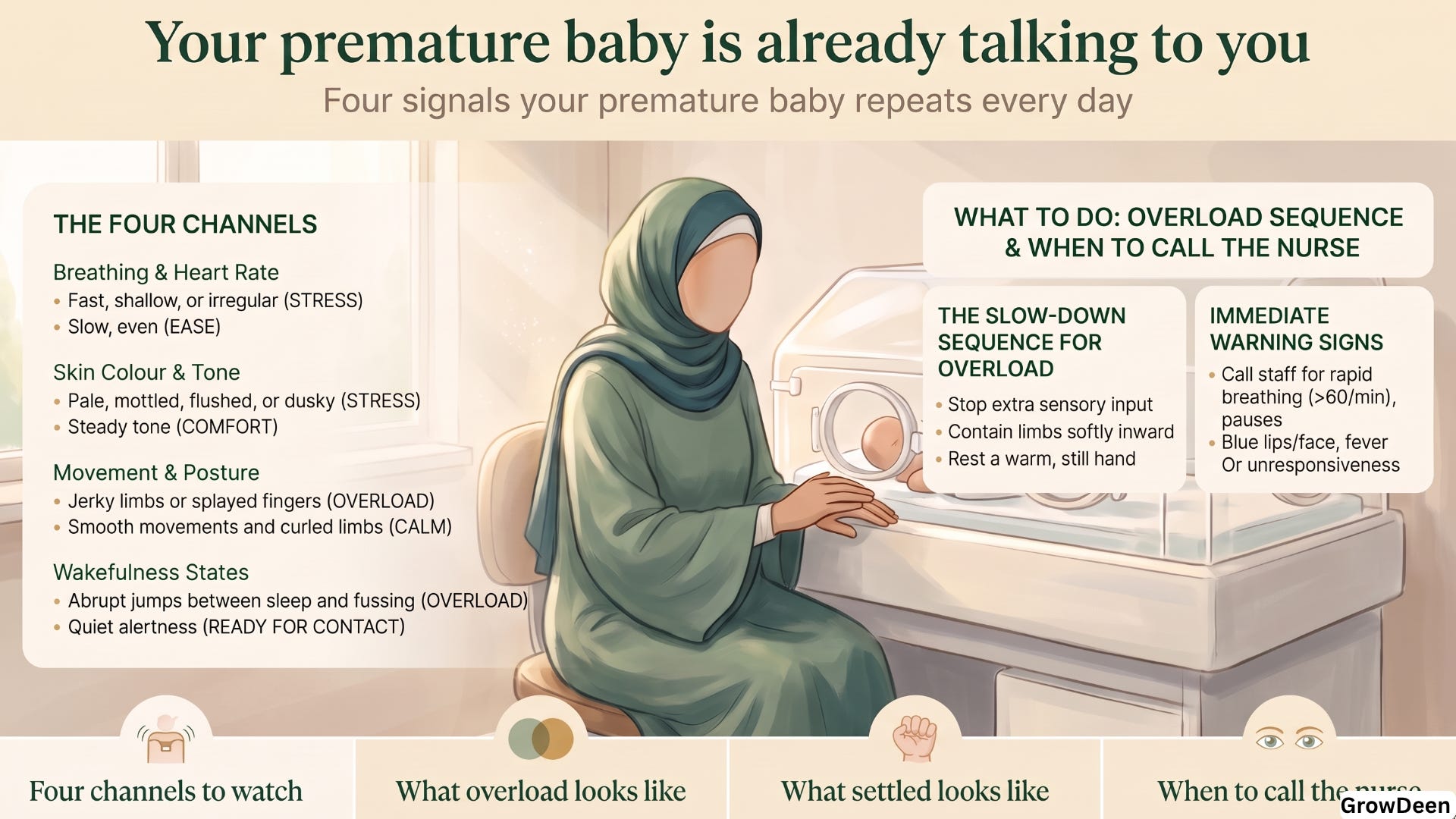
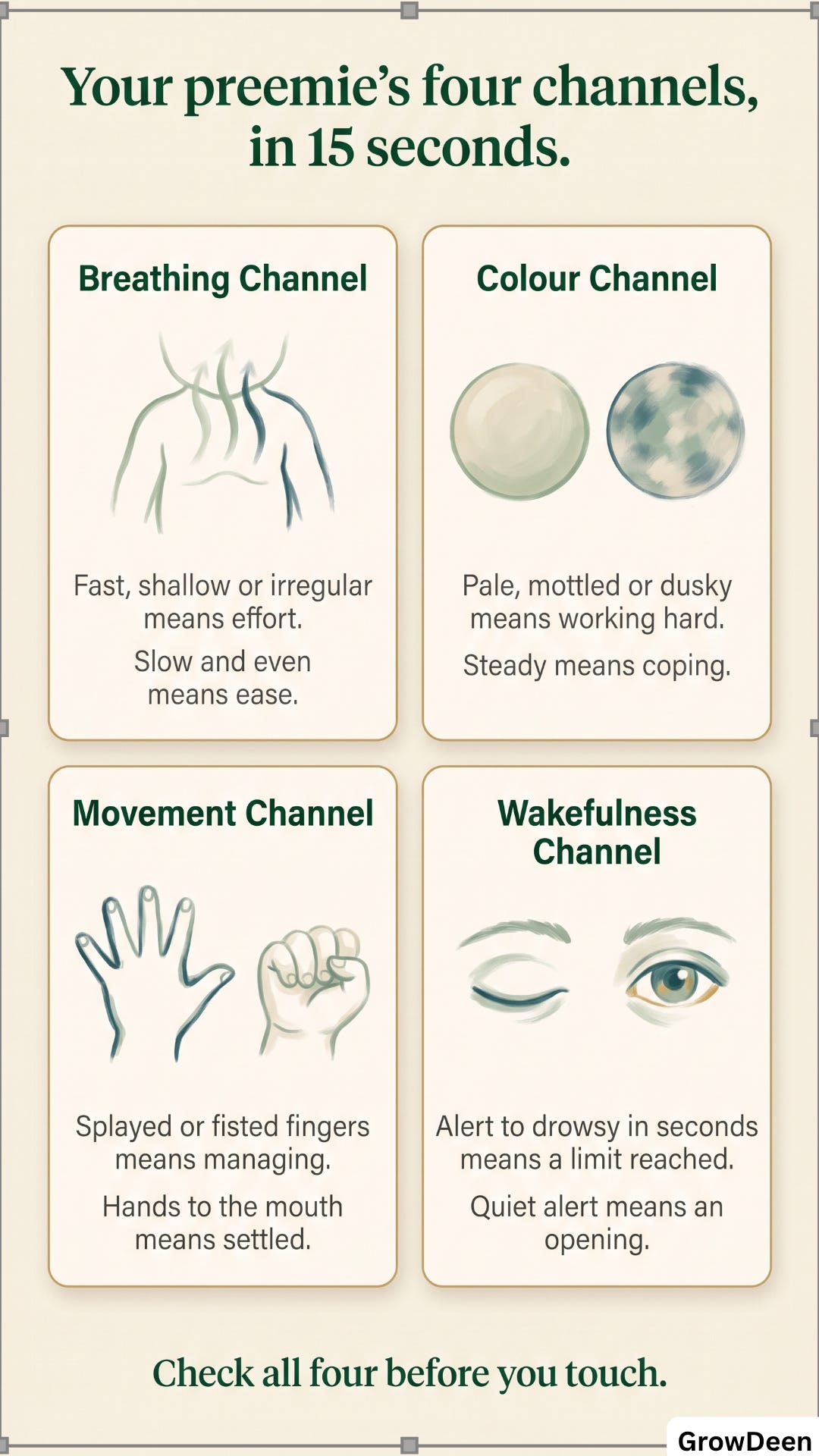
Four channels carry almost everything.
Breathing and heart rate. Fast, shallow or irregular means effort. Slow and even means ease.
Colour. Pale, mottled, dusky or suddenly flushed means the body is working hard. Steady colour means it is coping. Blue around the lips, tongue or face is never something to watch and see.
Movement and posture. Jerky limbs, fingers splayed wide or clenched tight, arching away, a hand flung across the face: a baby managing something. Smooth movement, hands drifting to the mouth, a body curling softly inward: a baby who has found their footing.
Wakefulness. Deep sleep, light sleep, drowsy, quiet alert, fussing, crying. Preterm babies jump between these states without warning, and the jump itself is information.
There is a reason the signals arrive scrambled. Heidelise Als, whose bedside observation work shaped how neonatal units think about infant behaviour, described newborn functioning as several subsystems running at once: the automatic functions of breathing, heart rate and colour; the motor system of tone and posture; the sleep and waking states; and the baby’s own attempts to steady all of it [3]. In a term newborn those hold each other up. In a preterm baby they are still learning to, so one wobble spreads into the others. A nappy change shows up as a dip in oxygen saturation. A long cuddle ends in a sudden deep sleep.
The room makes it harder. The American Academy of Pediatrics advises a maximum sound level of 45 decibels in a neonatal unit, roughly the sound of rain [7]. One study recorded an average just under 59 decibels, with peaks approaching 87 [8]. Your baby is trying to communicate from inside a plastic box in a room louder than a conversation.
The Two Sentences Your Baby Keeps Saying
Strip it back and a preterm baby says one of two things at any moment. Slow down. Or, I have room for you.
Slow down looks like waking and staying upset, sliding from alert into fussy, a creased brow, jerky limbs, splayed or fisted fingers and toes, a hand over the face, faster breathing, a colour change, yawning, sneezing, hiccupping, gagging or spitting up. Crying arrives later, once a baby is mature enough to produce it.
None of it is a verdict on you. It means the dose exceeded this hour’s capacity, and capacity moves hour to hour.
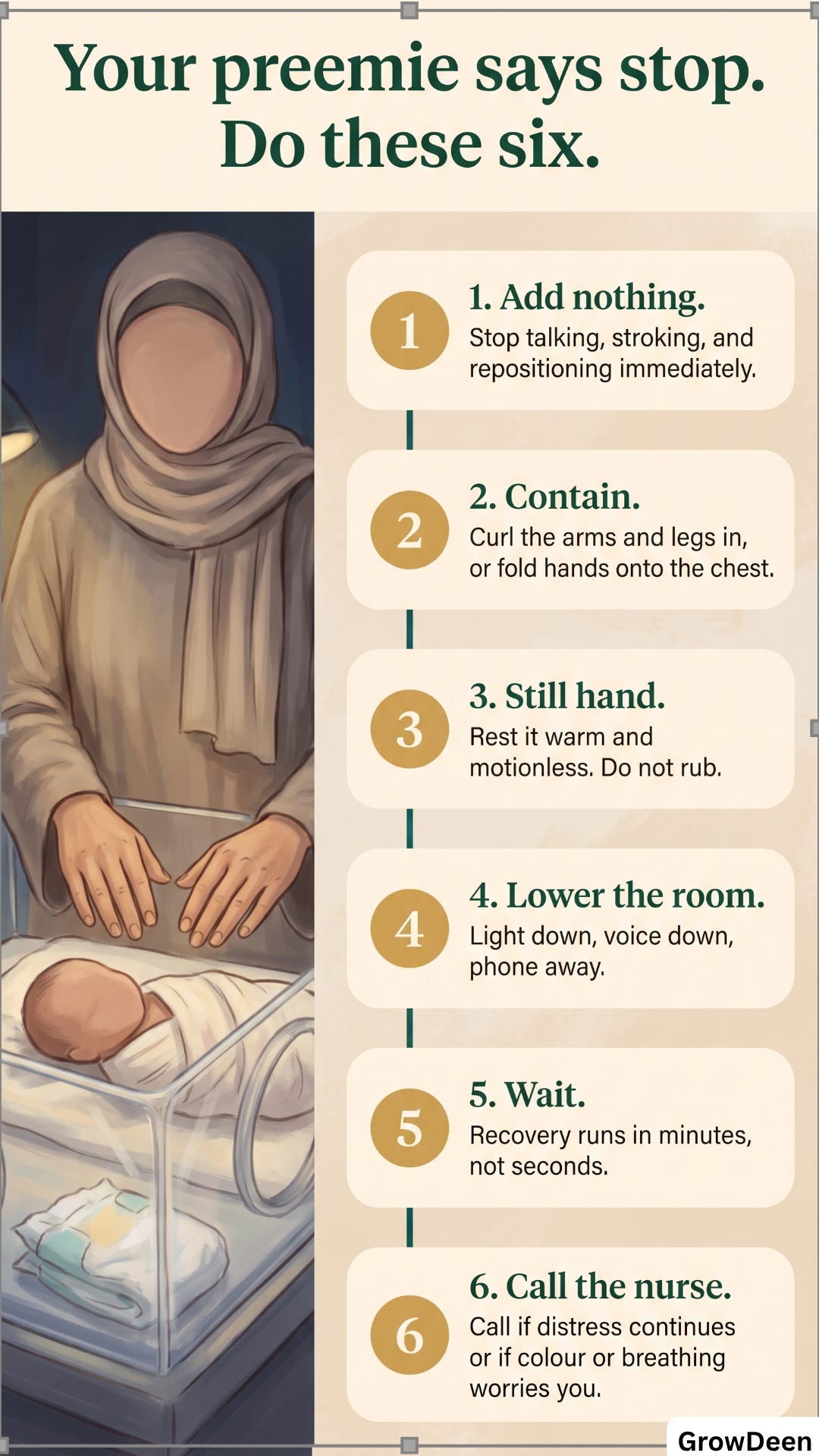
When you see it, work down this sequence:
Add nothing further. No more talking, stroking, repositioning or adjusting.
Contain. Bring the arms and legs into a curled position, or fold their hands softly onto their chest. Containment settles a preterm baby far more reliably than patting does.
Rest a still, warm hand on them rather than rubbing.
Lower what you control: the light, your voice, the phone in your pocket.
Wait. Recovery runs in minutes.
If it continues, or if colour or breathing worries you at all, call the nurse. That is the job, not an interruption of it.
I have room for you looks like unhurried regular breathing, a loose body, movement that has smoothed out, a still and alert face. Sometimes it goes further and your baby looks at you, body quiet, attention held on your face.
Take that gently. One thing at a time rather than talking and touching and shifting them together. Stop at the first sign the window is narrowing, before it closes on its own. A baby who learns that closeness with you ends comfortably comes back to it more readily, and that is the beginning of everything that follows at home.
So, the question from earlier. A settled baby holds the other channels steady: colour even, breathing slow, body loose but not floppy, and they surface again when you speak. A baby who has shut down went quiet suddenly, after a stretch of handling, often with colour or breathing changing just before, and they do not surface. The difference is the sequence, not the stillness.
I know this is a lot to hold in your head at 2am on a ward where you are already running on four hours of sleep. That is why the free Preemie Cue Card exists: a three page printable built to live in your hospital bag, with the four channels on one side and the slow-down sequence on the other. The download button is at the top of this page, and there is a full description of what is inside it below.
What The Evidence Actually Says
Parents of preterm babies get told a great deal with more confidence than the research supports, so here is the honest shape of it.
Keeping you and your baby together has the strongest backing. The World Health Organization now advises that kangaroo mother care, skin to skin contact with a caregiver, should begin as soon as possible after birth rather than after days of stabilisation in an incubator, because starting immediately saves more lives, lowers infection and hypothermia, and improves feeding [2]. That reversed decades of standard practice.
Reading cues matters for a second reason. Als and colleagues reported in Pediatrics that early experience in the neonatal period is associated with differences in brain function and structure in preterm infants [4]. Brummelte and colleagues followed former preterm children to school age and found cortisol levels at that age were predicted by pain-related stress from neonatal procedures [5]. What happens in these weeks does not stay in these weeks.
And the caveat, which matters just as much. A systematic review of eleven trials covering 627 preterm infants found no clear evidence that one widely used structured developmental care programme improved long term neurodevelopmental or short term medical outcomes [6]. Trials of parent sensitivity training, including the programme Milgrom and colleagues reported in Pediatric Research, have examined whether coaching parents to read and respond to cues changes early brain development, and that remains an open research question [9].
So: read your baby because it tells you what they can manage right now and lets you pitch your contact accordingly. Do skin to skin as early as your team allows. Treat anyone promising that a particular programme guarantees a better outcome at five years with polite scepticism.
Support Muslim Parenting Lab ❤️
Is there something in your record you would like wiped? Give any amount today with the button below.
The Prophet ﷺ said charity extinguishes sin as water extinguishes fire. (Jami' at-Tirmidhi 2616, hasan)
The Gentleness That Keeps People Close
As Muslim parents, how we handle what is fragile answers to more than technique, and the Qur’an addresses it directly.
Allah says to the Prophet ﷺ: “So by mercy from Allah, [O Muhammad], you were lenient with them” [Qur’an 3:159] [12]. The verse then names what harshness would have cost him. People would have scattered from around him.
According to Tafsir Ibn Kathir, this gentleness runs deeper than an agreeable temperament. Ibn Kathir asks who could have made the Prophet ﷺ so kind without Allah’s mercy, cites Qatadah’s comment that it was by Allah’s mercy that he became this kind, and relays al-Hasan al-Basri’s description of it as the character Allah sent him with. He defines the severe person as one who utters harsh words and the harsh-hearted as one whose heart has hardened, and explains that Allah instead made him soft so that hearts would gather around him [13].
Sit with that beside an incubator. Hurried hands and raised voices scatter a preterm baby, visibly, in oxygen figures and jerking limbs. Softness keeps them near. Ibn Kathir notes the verse then moves to consultation, and after that to reliance on Allah once the decision is made [13]. Ask the nurses. Then place your trust in Allah, who sees the whole of the baby you can only partly read.
Bismillah before your hand goes in. Alhamdulillah for a gram gained. Du’a in your own words, your palm resting on your child, without waiting until you feel composed enough to deserve it.
The Father, The Grandmother, And The Quiet House
Neonatal units still orbit around the mother, usually without meaning to. Fathers get less teaching and often feel less entitled to handle their own baby.
That gap has been studied. Maliheh and Maryam reported in The Journal of Perinatal Education on a structured programme supporting fathers in a neonatal unit and its effect on fathers’ understanding of preterm infant behaviour [10]. A father who can read the signals becomes a second confident caregiver instead of a visitor.
In a Muslim household this reaches past the ward. Grandmothers, aunts, cousins and older siblings will all handle this baby eventually, often with enormous love and a volume setting built for a sturdy six month old. Teach them the four channels now. A quiet house is not a cold house, and the homecoming goes better when everyone’s hands have already slowed down.
Things worth keeping off the list entirely: stacking talking, touching, rocking and bright light together; conversations held across the cot; waking a sleeping baby for anything other than a medical reason; light stroking in place of firm still containment; music, songs and musical toys, where your voice, Qur’an recited softly and gentle adhkar give your baby the human sound they respond to; and comparing your baby to the one in the next cot.
When To Call Someone Immediately
Some signs call for action rather than observation. Tell staff straight away, or seek urgent medical care if you are at home, if your baby shows any of these [11]:
Stops feeding, or feeds much more poorly than usual
Breathing at 60 breaths a minute or faster, grunting, or the chest drawing in sharply
Pauses in breathing, or any blue colouring of the lips, tongue or face
No spontaneous movement, or unusual difficulty rousing
Temperature of 37.5°C or above, or below 35.5°C
Convulsions
Jaundice in the first 24 hours, or yellow palms and soles at any age
Say what you noticed even when it sounds vague. A parent reporting that something is different today is handing the team real clinical information.
Your Free Preemie Cue Card
If you have read this far, you are the kind of parent who would rather understand their baby than be managed around them. That tells me something about how this child is going to be raised.
Inside the Preemie Cue Card (one comprehensive PDF, 3 pages):
Page 1: The Four Channels Card. A visual reference showing breathing, colour, movement and wakefulness side by side, with the overload signs and the settled signs for each channel set against one another so you can check all four in about fifteen seconds. Designed as a laminated card for your hospital bag or taped inside the cot locker.
Page 2: The Slow-Down Sequence. The six step response printed in order, plus the short list of what to stop doing, plus three sentences you can say to a nurse that get you a useful answer. So you can act in the moment instead of reconstructing advice from memory at 3am.
Page 3: A Reminder for Hard Hands. The Qur’anic teaching on gentleness, with the verse translation and its source reference, framed for the moment you arrive at the cot carrying a bad day in your shoulders. Something to read before you reach in.
This is not a PDF to download and forget. It is built to stay in your hospital bag, where you will actually reach for it when you need it.
The Preemie Cue Card is what every subscriber receives with each article. We cover the whole arc of raising Muslim children, from the newborn weeks through the early school years, all backed by scientific research and rooted in Islamic wisdom.
Before You Close This
Do one thing on your next visit, before you touch your baby at all. Stand still for sixty seconds and name which of the four channels you can see right now. Breathing. Colour. Hands. Eyes.
That is the whole skill, and it starts with a minute of not doing anything.
May Allah place barakah in every gram gained, ease in the long nights, and steadiness in your hands when you reach into that cot.
Share This With Someone Who Needs It
Think of one person right now: the friend whose baby shower turned into a hospital bag, the cousin who has been posting photos of a very small hand without much explanation, the sister at the masjid nobody has seen in six weeks because she has not left the unit.
She is standing at an incubator being told very little. This could be the thing that lets her read her own child. Send it to her today, not as advice, but because somebody should have handed it to her on the first day.
Frequently Asked Questions
Q: What are the signs of stress in a premature baby?
A: Jerky arm and leg movements, fingers splayed wide or clenched into fists, a hand covering the face, faster or irregular breathing, a change in skin colour, yawning, sneezing, hiccupping, gagging or spitting up, and sliding abruptly from alert to drowsy. See “The two sentences your baby keeps saying” above for what to do when you see them.
Q: How do I know if my premature baby is comfortable?
A: Regular unhurried breathing, even skin colour, a relaxed body, movements that are smoother than usual, and a still alert face. Often the clearest sign is simply the absence of the stress signs.
Q: Why does my premature baby splay their fingers?
A: Finger splaying is one of the more reliable overload signals in babies born early, and it tends to appear alongside other signs such as faster breathing or a colour change. It usually means the handling or the surrounding stimulation has gone past what they can manage right now.
Q: Is it normal for a premature baby not to cry?
A: Yes. Crying takes more coordination and energy than very young preterm babies have, so distress shows up in the body instead. Crying usually appears as your baby matures, and it is generally a sign of progress rather than a problem.
Q: Can I hold my premature baby if they are on monitors?
A: Often yes, with your team’s agreement. The World Health Organization advises that skin to skin contact should start as soon as possible after birth rather than after a period of separation in an incubator, because starting early improves survival, infection rates and feeding [2]. Ask your nurse today, and ask again tomorrow if today’s answer was no.
Q: Should I talk to my premature baby in the NICU?
A: Yes, quietly and one thing at a time. Neonatal units are frequently louder than the 45 decibel maximum the American Academy of Pediatrics advises [7][8], and a parent’s low familiar voice is a different kind of sound in that room. Watch the four channels while you speak and stop at the first sign of too much.
References
[1] World Health Organization. (2023). Preterm birth fact sheet.
[2] World Health Organization. (2022). WHO recommendations for care of the preterm or low-birth-weight infant.
[3] Als, H. (2009). Newborn Individualized Developmental Care and Assessment Program (NIDCAP): New frontier for neonatal and perinatal medicine. Journal of Neonatal-Perinatal Medicine, 2(3), 135-147.
[4] Als, H., Duffy, F.H., McAnulty, G.B., Rivkin, M.J., Vajapeyam, S., Mulkern, R.V., Warfield, S.K., Huppi, P.S., Butler, S.C., Conneman, N., Fischer, C., & Eichenwald, E.C. (2004). Early experience alters brain function and structure. Pediatrics, 113(4), 846-857.
[5] Brummelte, S., Chau, C.M.Y., Cepeda, I.L., Degenhardt, A., Weinberg, J., Synnes, A.R., & Grunau, R.E. (2015). Cortisol levels in former preterm children at school age are predicted by neonatal procedural pain-related stress. Psychoneuroendocrinology, 51, 151-163.
[6] Ohlsson, A., & Jacobs, S.E. (2013). NIDCAP: A systematic review and meta-analyses of randomized controlled trials. Pediatrics, 131(3), e881-e893.
[7] American Academy of Pediatrics maximum sound level recommendation of 45 dB for neonatal intensive care units, as reported in: Sound levels in a level III neonatal intensive care unit. PubMed Central.
[8] Washington University School of Medicine. (2017). NICU study highlights need to reduce loud noises, boost beneficial sounds.
[9] Milgrom, J., Newnham, C., Anderson, P.J., Doyle, L.W., Gemmill, A.W., Lee, K., Hunt, R.W., Bear, M., & Inder, T. (2010). Early sensitivity training for parents of preterm infants: Impact on the developing brain. Pediatric Research, 67, 330-335.
[10] Maliheh, K., & Maryam, M.S. (2013). Supporting fathers in a NICU: Effects of the HUG Your Baby Program on fathers’ understanding of preterm infant behavior. The Journal of Perinatal Education, 22(2).
[11] World Health Organization. (2022). WHO recommendations on maternal and newborn care for a positive postnatal experience: newborn danger signs requiring referral.
[12] Qur’an, Surah Aal-Imran 3:159 (Saheeh International).
[13] Ibn Kathir. Tafsir Ibn Kathir, Surah Aal-Imran 3:159 commentary.
We combine scientific research with Qur’an and authentic Sunnah, and we cite our sources. Even so, this is general guidance and no substitute for a doctor who can examine your child.