

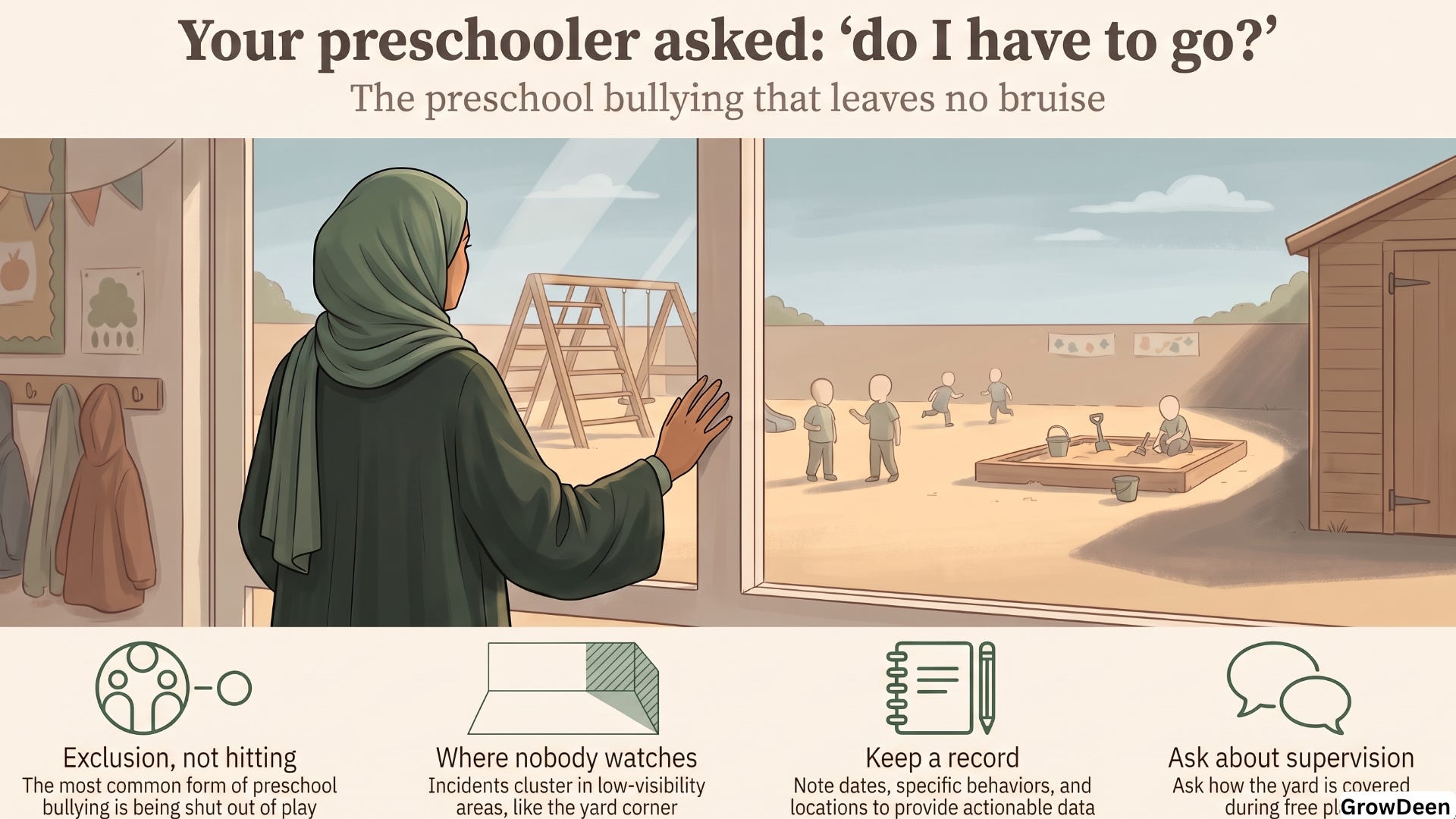
Most preschool bullying leaves no mark. In Finnish day care, 12.6% of three to six year olds were involved in bullying, and the commonest form was being shut out of play. [1]
Three pages. Read it before the next pick-up.
You asked the teacher. She said the morning was fine.
So you went home and told yourself you were overthinking it, and for about four days you managed to believe that. Then the lunch bag came back with a torn seam again, and your four year old asked, from under the duvet, whether she had to go tomorrow.
Nothing in that sequence makes you a careless parent. It makes you a parent who was given accurate information by someone who did not see what happened.
That gap is what this guide is about.
What makes this guide different
It uses the research on children this age, not school-age children. Preschool bullying looks different from playground bullying at eight, and most advice online is written for the older child.
It treats this as zulm, not as a phase. Islam gives the wronged person explicit permission to speak up about a wrong done to them, and places the duty to stop harm on the adults in the room, not on the four year old.
You already have the free Bully Signal Card from the top of this page. Three pages you can read in the car before a parent teacher meeting.
Why the teacher could truthfully say the morning was fine
Start with what the research says about where this happens, because it answers the question you have been carrying since the first page.
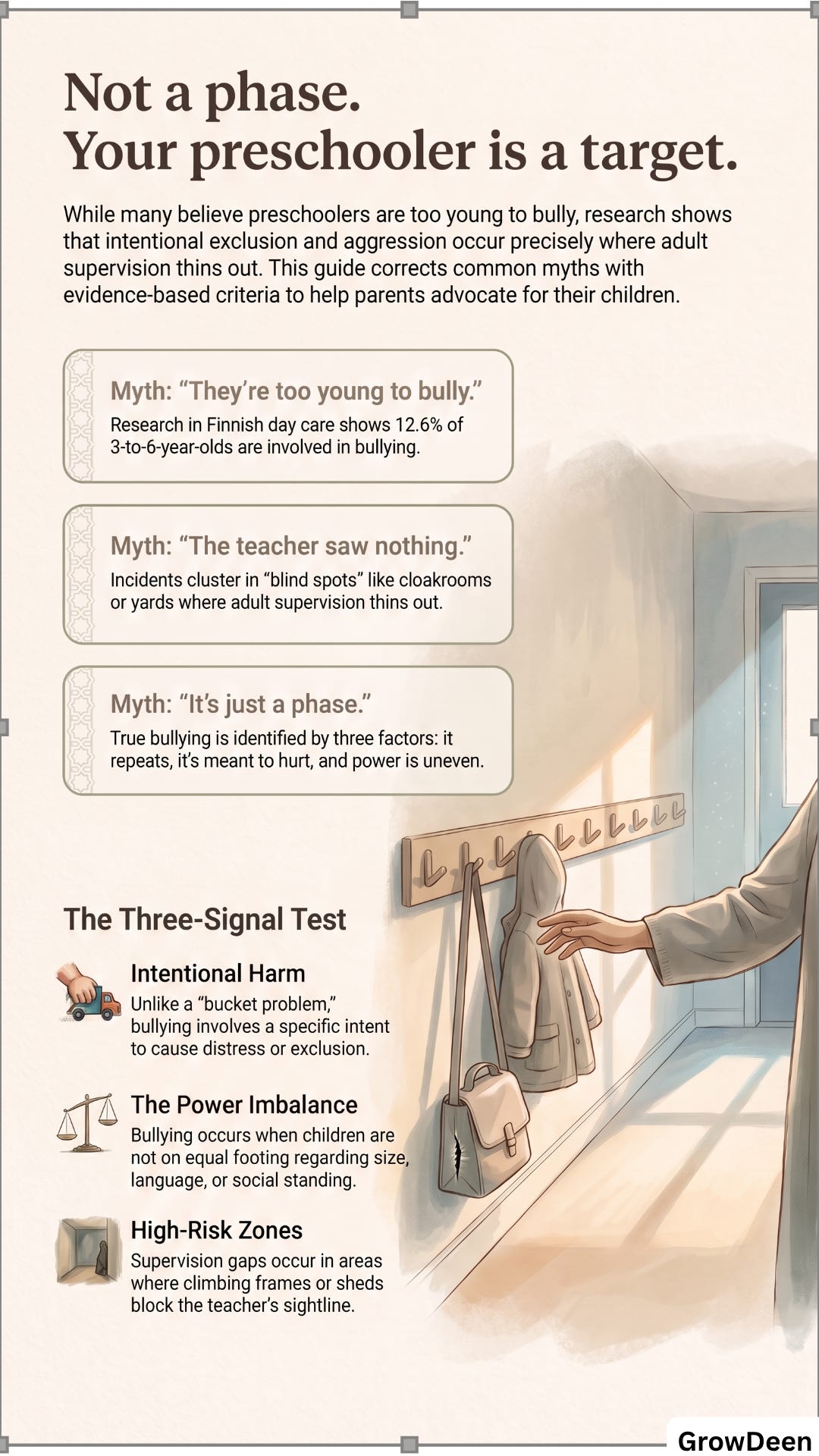
A survey of 246 preschool teachers working with children aged 36 to 72 months found that incidents cluster in the times and places where adult supervision thins out. [2] The yard during free play. The cloakroom at home time. The corner behind the shed where the climbing frame blocks the sightline.
The same study found the two most frequently reported bullying behaviours were refusing to let a classmate join a game, and hitting, slapping, punching, pinching or kicking. [2]
Look at the order of those two.
The commonest one makes no sound. A child is told she cannot play. Nobody shouts and nothing gets broken, and from across a busy room it looks exactly like three children playing while a fourth stands near the sandpit. There is nothing for a teacher to see.
Exclusion leaves no bruise.
So when she told you the morning was fine, she was reporting what the morning looked like. Your daughter was reporting what it felt like. Both of you were telling the truth.
Which means the question you walk into the preschool with cannot be “did you see anything.” It has to be more specific than that.
Why your teacher might also use the word differently
There is a second reason conversations about this stall, and it has nothing to do with attention.
Surveys of early years workers have found real variation in how staff define bullying, and genuine hesitancy about applying the word to children this young. [6] Some are trained to reserve it for school age. Some think naming a four year old a bully is unfair to that child, which is a decent instinct pointed in an unhelpful direction.
So a teacher who flinches at the word is not necessarily dismissing you. Quite often you are both describing the same Tuesday in different vocabulary.
That matters for how you open the conversation. Lead with behaviour, not with the label. “Sami has told the others not to play with Aisha, every week since Ramadan” is harder to disagree with than “Aisha is being bullied.”
The child doing it is probably struggling too
Here is the finding that changes the temperature of the whole thing.Among older children, the one doing the bullying is often socially powerful. Among preschoolers, research suggests the opposite. Children who bully at this age tend not to be popular. [5] Studies of participant roles in preschool bullying find differences in emotion regulation and in the warmth of the child’s relationship with their teacher, on both sides of it. [5]
Picture that for a second. Not a small tyrant with a following. A four year old who is also struggling socially and has found one thing that reliably gets him a reaction from other children.
That does not make it acceptable, and it does not lower the urgency by a single degree. Your child still needs this stopped this week. But it does change what you are asking the preschool to do. You are not asking them to punish a villain. You are asking them to supervise a yard and to work with two children who both need help.
That request is much easier for a teacher to say yes to.
That is a lot to carry into one meeting
You are being asked to hold the three-signal test, the supervision question, the right opening sentence, and a record of dates, all while your child is upset and you are not far off it yourself.
That is why the free Bully Signal Card exists. The download button is at the top of this page, and there is a full description of what is inside it below. It is designed to sit in your bag and be readable in the two minutes before you walk into the room.
Is this bullying, or is this four?
Now the part everyone needs and nobody gets a straight answer on.
Researchers working with this age group look for three things present together: it repeats, it is meant to hurt, and the two children are not on equal footing, whether through size, language, confidence, or standing in the group. [3,4]
Run it against the ordinary stuff. Two children want the same bucket and one grabs it: repeated, no. Intent to hurt, no. That is a bucket problem. A trio closes ranks at ten in the morning and has forgotten about it by lunch: repeated, no. That is four.
Now run it against what your child described. Same child. Same target. Every week. Other children instructed not to play with her.
Three for three.
None of this means the bucket moments get ignored. Aggression that nobody addresses in early childhood does not reliably fade on its own, and part of the work of these years is learning that other children have insides. [3,4] But a bucket problem and a pattern get different responses, and treating them the same is how parents lose credibility at the preschool gate.
Getting that distinction right matters more than it sounds. Parents who have lived through this describe a child’s willingness to walk through the door collapsing, and describe their own paralysis about when to step in. [7] The effects of early bullying do not reliably stop when the preschool year does. [8]
The two conversations that actually move things
Everything up to here has been diagnosis. This is the part you do.
The first conversation is at home, and the hardest rule in it is about you.
Your child is watching to find out what a problem this size does to a grown-up. A parent who erupts has just taught a four year old that the situation is too big to survive, which guarantees you hear less next time, not more. If you feel it rising, change something physical. Stand up and sit down. Go and make wudu. Come back to it after Maghrib.
Then sit on the floor, put the phone in another room, and ask small questions with gaps after them. What happened next. What did you do then. Who else was there. Where were you standing.
Reflect it back in their words: “So you were eating your snack on your own. Then Sami took your lunch box and threw it. And that keeps happening.”
Four things to say, in roughly this order. Permit the feeling: “No wonder you were sad.” Lift the blame: “This didn’t happen because you’re small.” Thank them: “I’m really glad you said that out loud.” Promise action: “I’ll talk to your teacher tomorrow.”
And four to avoid. “Stand up for yourself” hands an adult problem to a child who has no equipment for it. “Just ignore it” teaches them that telling you was pointless. “Hit him back” is explicitly warned against in paediatric guidance, because retaliation escalates and exposes the child to more risk. [12] “Never mind, stay home” feels like rescue and works like proof they cannot cope.The second conversation is at the preschool, and it has a shape.
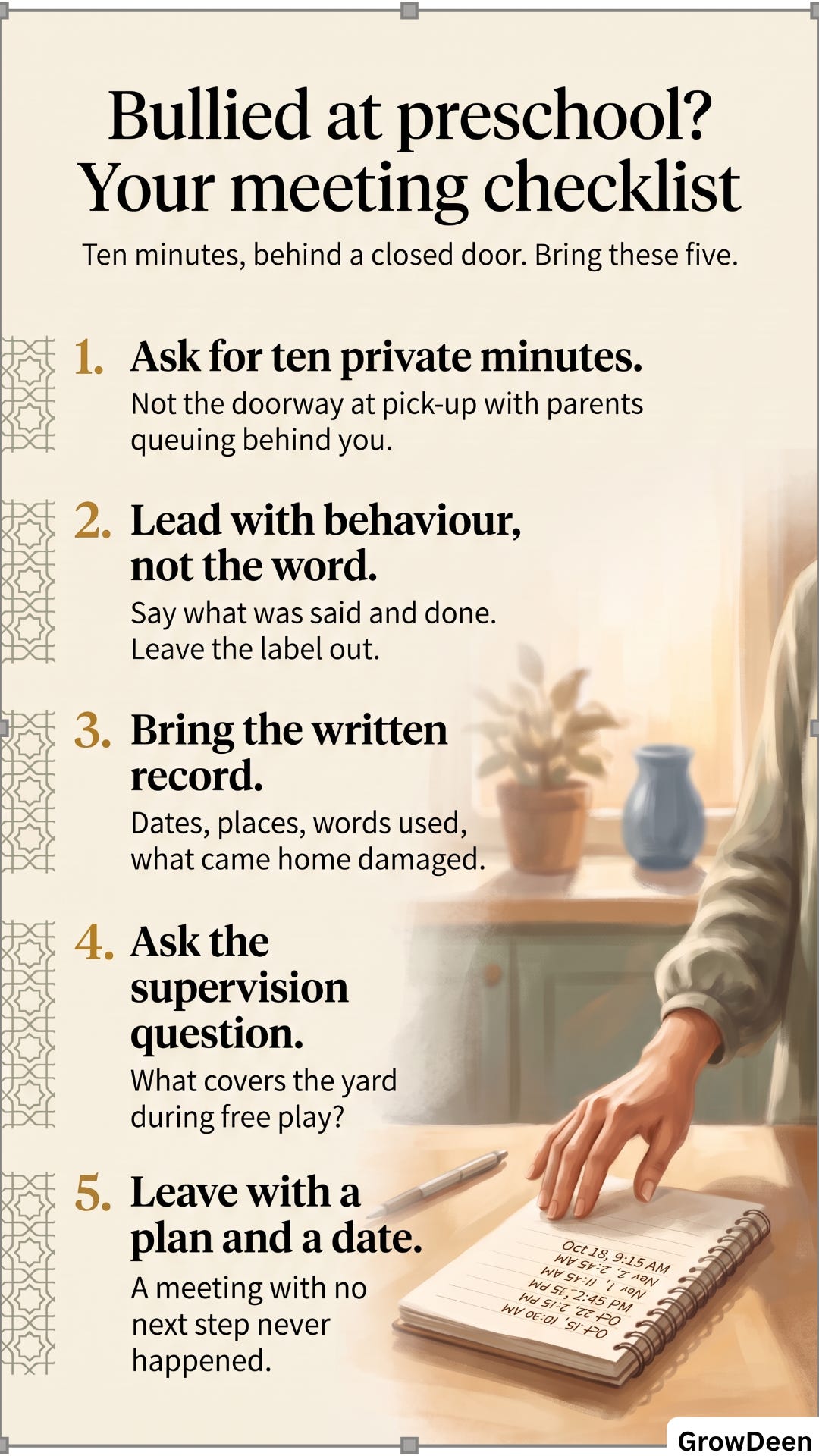
Ask for a private ten minutes. Not the doorway at pick-up with a queue behind you.
Open it as a shared problem, not an accusation: “Aisha has told me Sami is hitting her, calling her names, and telling the other children not to play with her. I’d like your help to work out what’s happening and what we do about it.”
Bring the specifics you have been writing down. Dates, places, what was said, what came home broken, and what has changed at home.
Then ask the supervision question, which is the one most parents never think to ask. What covers the yard during free play? Given what the research actually says about where these incidents happen, it is a fair and precise question rather than an accusing one. [2]
If you are not believed, stay level: “I know children tease each other. I don’t think this was teasing.”
And leave with a plan and a date attached to it. “So you’ll brief the other staff, the climbing frame area gets watched during free play, and we speak again next Tuesday.” A meeting with no next step tends to become a meeting that never happened.
One thing to avoid completely. Do not go to the other child, and do not go to that child’s parents. It is the most satisfying option on the table and it reliably makes life worse for your child. Paediatric guidance and early years practice point the same way, which is through the setting. [12]
But before you walk into that meeting, there is something worth settling in your own chest first.
The Islamic framework for bullying: why the wronged are allowed to speak
Plenty of Muslim parents hesitate here, worried that naming another family’s child to a teacher edges towards backbiting. It is a sincere worry and it keeps good parents quiet for months.
The Qur’an addresses it directly. Allah says, “Allah does not like the public mention of evil except by one who has been wronged. And ever is Allah Hearing and Knowing.” [13]
Tafsir Ibn Kathir titles this passage the permission to utter evil in public, for one who was wronged. He records Ibn ‘Abbas explaining that Allah does not like anyone to invoke Him against another unless that person has been wronged, and that in that case Allah permits it, while adding that patience remains better. He also records al-Hasan al-Basri saying the wronged person should not curse his wrongdoer, but should supplicate: O Allah, help me against him and take my right from him. [15]
So the permission is real, and it arrives with manners attached. That is the ground you stand on at the preschool gate. Raising this is not gossip. It is a right the Qur’an names, exercised inside limits the scholars spelled out.
Then the Prophet ﷺ extended it in both directions at once. He said, “Help your brother, whether he is an oppressor or he is an oppressed one.” Asked how anyone could possibly help an oppressor, he ﷺ answered, “By preventing him from oppressing others.” [14]
Read that against what the research found about the child doing the hurting. Protecting the child being hurt and restraining the child doing the hurting are one instruction, and it was given to the adults.
When the yard still isn’t safe
Behaviour takes time to shift and a week is not a fair test. What should be visible inside a week is evidence that your child is safe and attended to while the work goes on. If that is missing, escalate in order rather than all at once.
Write it down. Date, time, place, what happened, who you told, what they said back. Photograph injuries or damaged belongings.
Put it in writing to the teacher. Short, factual, asking for a written response. Paper changes the pace of things.
Go up a level, to the director of the setting or whoever chairs its management committee.
Ask for the grievance procedure by name. Most settings have one, and requesting it formally is a reasonable step rather than a hostile one.And consider moving, if the setting will not act. A child’s safety is worth more than the disruption. Talk to the current preschool before you decide, and consider asking your doctor for a referral to a qualified child psychologist if the distress is not easing.
Through all of it, tawakkul sits alongside the paperwork rather than instead of it. Take the means, keep the record, make the du’a, leave the outcome with Allah.
What your child can learn, and what they can’t
Choose one strategy. Two at the absolute most. Four will overwhelm a four year old, and one rehearsed until it is automatic beats a list every time. Practise it at home as a game, with you playing the other child, until the words come out without a wobble.
A flat, firm stop, practised as much for the voice as the words: “Stop. I don’t like it when you say that.” Then walk away. Paediatric guidance often frames this as stop, walk away, tell an adult. [12]
Stay where other children are: “If you’re playing near Maryam and Zaynab, he’s more likely to leave you alone, because they’ll see.”
Ask a friend to fetch the teacher, with permission attached: “Your friends are allowed to help you.”
Tell the teacher, with the biggest permission of all: “Telling the teacher isn’t telling tales. And the teacher can help without anyone knowing who said so.”
Now the honest part. Children of three to five are still developing the language and the social reading these strategies assume. They build confidence and they reduce the feeling of powerlessness, and a child this age will still need an adult to step in. [3,12]
Around three, expect almost no verbal defence at all. Put the weight on supervision and on naming feelings at home. Around four, role-play works and a child can usually identify a safe adult. Around five, many children can give you who, where and when accurately, and this is also when they start building a story about themselves, so “this is not your fault” needs saying out loud more than once.
Meanwhile, hold the home steady. Keep five predictable minutes a day for talking and make the question wider than the bullying: best bit of your day, worst bit. A child asked only about the bad thing starts to feel the bad thing is now their identity at home as well as at preschool.
Protect the ordinary rhythms. Qur’an before bed, the bedtime du’as, time on the prayer mat together, and the stories. Tell your child about Yusuf, peace be upon him, treated badly by his own brothers, whose story ends in honour and forgiveness. Children find real relief in learning that a prophet of Allah was treated unfairly and that it said nothing about his worth.
Build the friendships, too. Invite one child over. Go to a masjid class or a family gathering where your child sits somewhere other than the bottom of a pecking order. Peer connection and warm teacher child relationships both show up repeatedly in early years research as protective factors. [5,9,10]
And read about it together. Picture books about friendship, exclusion and standing up for others hand a preschooler language and distance at the same time, and research with this age group supports stories as a route into the subject. [11]
If your child is the one doing it
Harder to hear, and in one respect better news: the younger the child, the more change is possible.
The hadith above cuts in this direction too. Restraining your child from hurting other children is the help they need, not a betrayal of them. [14]
Address the behaviour without labelling the child: “Hitting Idris isn’t allowed. It hurt him. We’re going to fix this.” Look underneath it, because peer rejection, difficulty managing big feelings, and strain in the wider family all turn up as risk factors in the research. [5,10] Work with the setting rather than defending against it. Teach the repair, which means apology, returning what was taken, and something kind afterwards. And notice kindness out loud far more often than you punish unkindness.
If it persists, speak to your doctor. Difficulties with attention, language or impulse control sometimes sit underneath a pattern of aggression and respond well when they are found early.
Contact your doctor or a qualified child psychologist, too, if your child’s distress is not easing once the preschool has acted, if there are lasting changes in sleeping, eating or toileting, if they speak about themselves with real contempt, or if you simply feel out of your depth. Plenty of families reach that point. It usually means the situation has grown bigger than one household can hold on its own.
For Islamic questions specific to your own situation, ask a trusted scholar you have access to locally. This article is general guidance and does not replace advice from your doctor or another qualified professional who knows your child.Exclusion leaves no bruise. That is the whole problem, and it is also the thing you now know to look for.
Your free Bully Signal Card
If you have read this far, you are the kind of parent who would rather be precise than panicked. The next two weeks will reward that.
Inside the Bully Signal Card (one comprehensive PDF, 3 pages):
Page 1: The Three-Signal Sorter. The repeat, intent and power test laid out as three questions, with six real preschool scenarios already sorted for you so you can see where the line actually falls. Designed as a card you can read in the car in ninety seconds before a parent teacher meeting.
Page 2: The Escalation Ladder. Five rungs from first conversation to formal grievance, each with the exact trigger that tells you it is time to climb to the next one, so you never have to guess whether you are overreacting or waiting too long.
Page 3: The Two Things to Say. The Qur’anic permission to speak up about a wrong done to you, and the Prophetic instruction that covers both the child being hurt and the child doing the hurting, each with the exact words to say to a four year old about it. English translation and source reference, formatted to keep on the fridge.
This isn’t just a PDF to download and forget. It’s a tool designed to stay in your bag, where you’ll actually use it when you need it most.
This Bully Signal Card is what every subscriber receives with each article. We cover raising Muslim children from birth onwards, all backed by scientific research and rooted in Islamic wisdom.
If you’re a Muslim parent who wants both evidence-based guidance and Islamic perspective, subscribe for free so future resources arrive in your inbox before you need them.
Subscribe free for parenting resources backed by both science and Sunnah, guidance so specific you can’t get it anywhere else. No spam, no clutter, just resources that matter.
Do this in the next five minutes
Open your notes app. Write today’s date and the one sentence your child actually said. That’s it. You now have the first line of a record, and a record is the single thing that changes how a preschool responds.
May Allah protect your child in the places you cannot see, and put barakah in every door you have to knock on.
Share this with someone who needs it
Think of one person right now: the mother at the masjid whose daughter has started crying at drop-off, your sister who mentioned her son has gone quiet about nursery, a friend who said “it’s probably nothing” in a voice that did not sound like nothing.
This article could get their child out of a yard that isn’t safe. Send it to them today, the way you would want it sent to you four days earlier.
Frequently asked questions
Q: Can a three or four year old really be bullying another child?
A: Yes. Research in Finnish day care found 12.6% of three to six year olds were involved in bullying in some form, and preschool staff in that study described it as a recognisable, systematic pattern rather than ordinary conflict. [1] The test is whether it repeats, whether it is meant to hurt, and whether one child holds more power.
Q: What does bullying look like in preschool?
A: Most often, exclusion. The most frequently reported behaviours in a survey of 246 preschool teachers were refusing to let a classmate join a game, and physical aggression such as hitting, pinching or kicking. [2] The exclusion is the one parents miss, because it leaves nothing to see.
Q: My child’s teacher says she hasn’t seen anything. What now?
A: She may be telling you the truth. Incidents cluster where supervision thins out, so ask what covers the yard during free play rather than asking whether she saw it. [2] See “Why the teacher could truthfully say the morning was fine” above.
Q: Should I talk to the other child’s parents?
A: No. It feels like the direct route and it reliably makes things worse for your child. Paediatric guidance and early years practice both point to working through the setting instead. [12]
Q: Should I tell my child to hit back?A: No. Encouraging a child to retaliate escalates the situation and exposes them to more risk. [12] Teach stop, walk away, tell an adult instead, and rehearse it at home until the words come easily.
Q: Is speaking to the preschool about another child a form of backbiting?
A: No. The Qur’an states that Allah does not like the public mention of evil except by one who has been wronged. [13] Tafsir Ibn Kathir treats this as explicit permission for the wronged person, with the limits that they should not curse or exaggerate. [15]
Q: When should I move my child to a different preschool?
A: When you have escalated through the teacher, the director and the formal grievance procedure, and you still cannot see evidence that your child is safe and attended to. Talk to the current setting before deciding, and consider asking your doctor for a referral to a qualified child psychologist if the distress is not easing.
References
[1] Kirves, L., & Sajaniemi, N. (2012). Bullying in early educational settings. Early Child Development and Care, 182(3-4), 383-400
[2] Tanrikulu, I. (2020). Teacher reports on early childhood bullying: How often, who, what, when and where. Early Child Development and Care, 190(4), 489-501
[3] Ostrov, J.M., Kamper-DeMarco, K.E., Blakely-McClure, S.J., Perry, K.J., & Mutignani, L. (2019). Prospective associations between aggression/bullying and adjustment in preschool: Is general aggression different from bullying behavior? Journal of Child and Family Studies, 28(9), 2572-2585
[4] Saracho, O.N. (2017). Bullying: Young children’s roles, social status, and prevention programmes. Early Child Development and Care, 187(1), 68-79
[5] Camodeca, M., & Coppola, G. (2019). Participant roles in preschool bullying: The impact of emotion regulation, social preference, and quality of the teacher-child relationship. Social Development, 28(1), 3-21
[6] Kovac, V.B., & Cameron, D.L. (2024). Are we talking about the same thing? A survey of preschool workers’ attitudes and beliefs about bullying. Child Care in Practice, 30(2), 141-155
[7] Cameron, D.L., & Kovac, V.B. (2024). Parents’ perspectives on their child’s involvement in bullying in preschool. Child Care in Practice, 1-16
[8] Zych, I., Farrington, D.P., Llorent, V.J., & Ttofi, M.M. (2017). Protecting children against bullying and its consequences. Springer.
[9] Ismail, N.K., Mohamed, S., Effendi, M., Matore, E.M., & Yaccob, N.S. (2025). Tackling bullying through teacher and peer connectedness in early education. Environment-Behaviour Proceedings Journal, 10(SI33), 163-168
[10] Bayram, Z., & Balci, A. (2025). Peer bullying in kindergartens: A meta-synthesis research to identify risk factors. Ondokuz Mayis University Journal of Education Faculty, 44(2)
[11] Rosen, L.H., Scott, S.R., & Higgins, M.G. (2025). Books and bullies: Responses to bullying in preschool students. International Journal of Bullying Prevention
[12] American Academy of Pediatrics. Why bullying hurts all children, and what parents can do about it. HealthyChildren.org
[13] Qur’an, Surah An-Nisa 4:148
[14] Sahih al-Bukhari 2444 — Graded: Sahih
[15] Ibn Kathir. Tafsir Ibn Kathir, Surah An-Nisa 4:148 commentary