

Same toys, three times as many ideas. That is what preschoolers produced once adults stopped directing the play. [1]
Print it. Use it on the floor tonight.
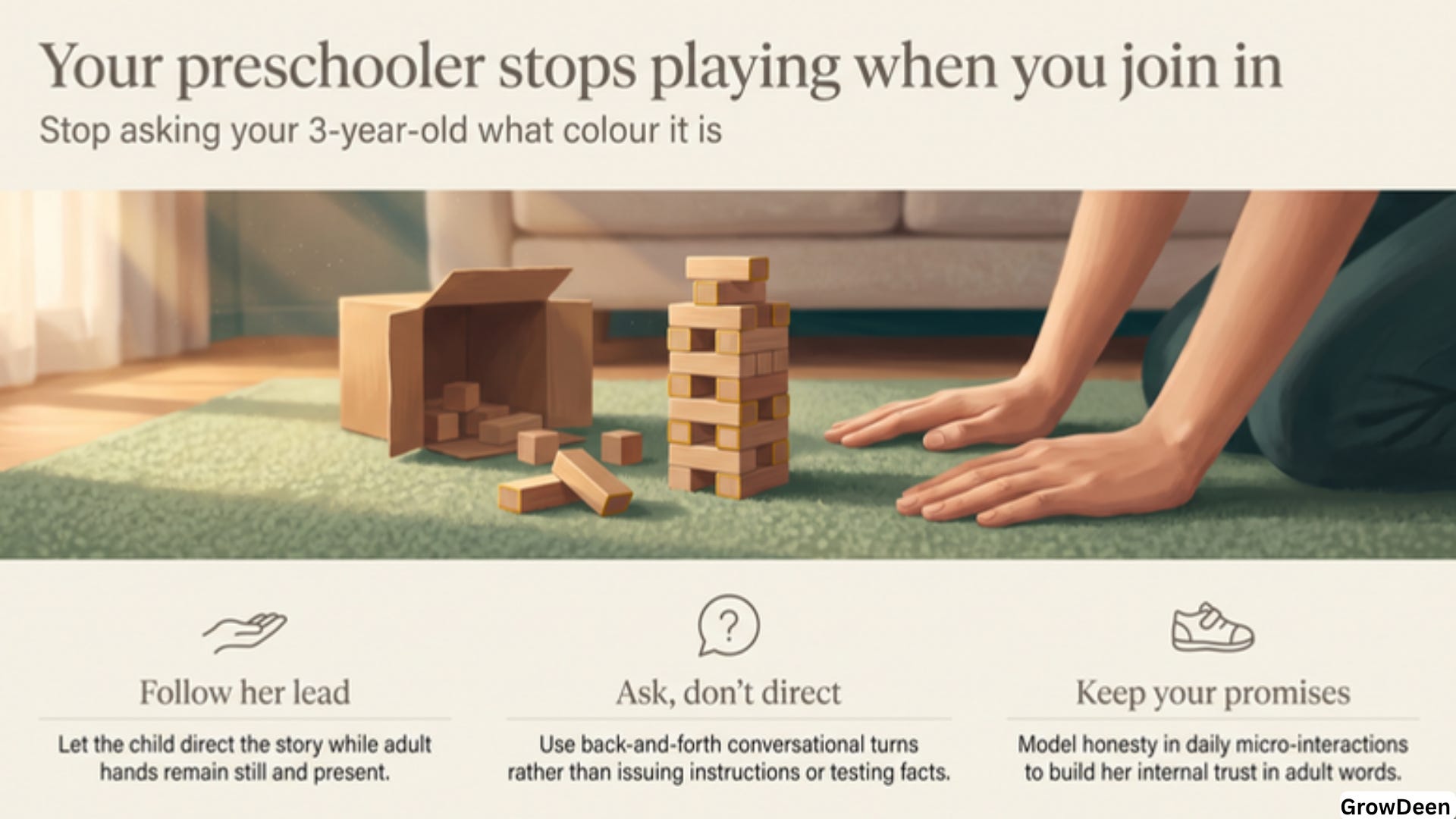
It is 4:40 on a Tuesday and your daughter has been running the same game for twenty minutes.
The bus is broken. It has been broken for twenty minutes. She has explained the breakdown four times, in detail, to a cushion.
You know you are supposed to be doing something here. Joining in, probably. Teaching colours, maybe. The internet has opinions. So you sit down and start asking what colour the bus is, and she looks at you like you have walked into the wrong room, and the game dies.
That reaction is worth paying attention to, because it is telling you something the enrichment industry would rather you did not know.
Why this guide is different from generic play advice
Three things set it apart.
Every claim here is tied to named research with the year attached, including the studies that came out flat or mixed, because a parent deserves to know where the evidence is thin rather than only where it is flattering.
The Islamic layer is not bolted on at the end. The Qur’anic instruction to look closely at what Allah has made, and the teaching of the Prophet ﷺ on where understanding actually comes from, change how the practical advice is framed rather than decorating it.
You already have the free Play Talk Pack from the top of this page, which turns the research into the exact sentences you can use on the floor tonight.
Two children, one box of blocks
Give the same box of blocks to two four year olds in two different houses and, a year later, their thinking will have developed differently.
Not because one box was better. The boxes were identical.
Hold that question for a few minutes, because the answer is not what most parents assume, and it is the reason this article exists.
What is actually under construction
Between three and five, a child is building three capacities that researchers treat as the engine of thinking: holding something in mind while working on it, stopping an impulse partway through, and switching to a new rule when the old one stops working [2].
You have watched all three without naming them. A child balancing cushions into a tower is holding her plan in her head. She is stopping herself from grabbing the cushion her brother is sitting on, with mixed success. When the tower falls for the third time and she widens the base instead of rebuilding it the same way, that is the third capacity arriving, and it is the hardest of them.
At three, she can hold two rules at once but loosely. Ask her to sort cards by colour and she manages it. Ask her to switch to sorting by shape and her hands often keep following the first rule while her mind has taken the second [2]. By five, that switch usually works [2].
By four, most children can name a few colours, tell you what comes next in a story they know well, and draw a person with three or more body parts [8].
Those two years are the window. Almost none of the practice happens in anything that looks like a lesson.
But here is what most parents do not realise about that window.
The talk is the toy
The blocks were never the variable. What got said over them was.
Researchers tracking home language exposure found that the number of back and forth conversational turns between an adult and a child tracked with activity in the language regions of the child’s brain, and that this held independently of how many words the child heard in total and of family income [3]. The children were four to six and the sample was small, so hold it loosely. The direction is the useful part: exchange beat volume. A parent narrating at a child is doing something different from a parent in conversation with one.
There is a second finding, and it is the one worth printing out.
Researchers separate talk about what is physically present from talk about what is not: the past, the future, what might happen, why something works. The second kind has a name, decontextualised talk, and it is precisely what pretend play generates. Parent talk of this kind, measured when children were thirty months old, predicted their vocabulary, sentence structure and storytelling at the start of school, over and above the child’s own earlier language and the family’s circumstances [4]. It mattered most for the children who had started furthest behind [4]. A long follow-up found the same early pattern still showing up in academic language in the teenage years, though in that analysis the child’s own talk carried the statistical weight and the two were too tightly linked to separate cleanly [24].
So the broken bus was an opportunity, and the colour question closed it.
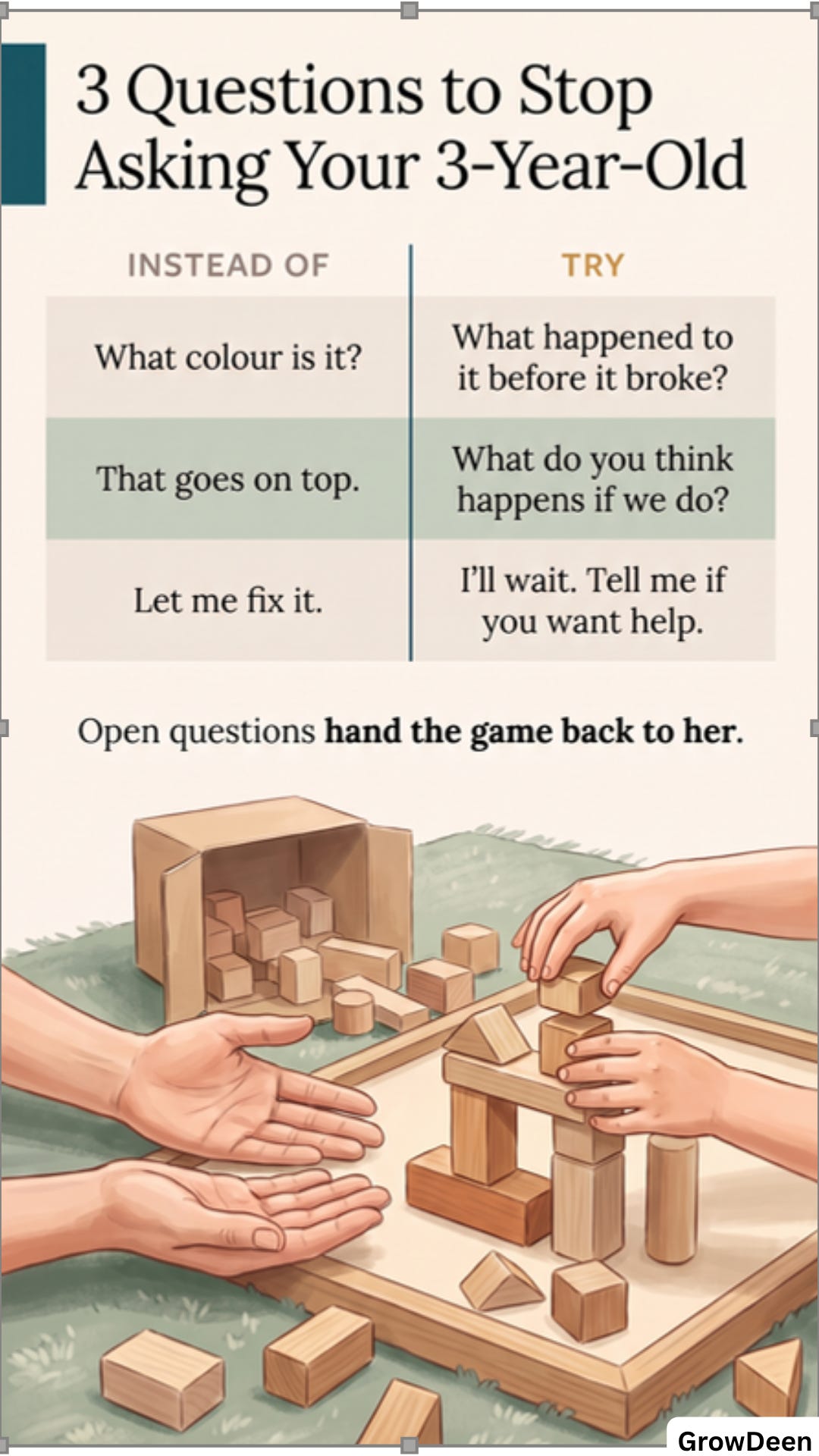
“What colour is the bus” has one answer, lives entirely in the present, and ends the exchange. “What happened to the bus before it broke down” has no right answer, lives in the past, and hands the game back to her.
That is the whole technique. It costs nothing and it does not require you to be clever.
One more finding belongs here, because it takes pressure off. In a study following children from age two to four and a half, the single factor that predicted whose sustained attention improved most was not toys or programmes or screen rules. It was maternal warmth and responsiveness [5]. Harvard’s Center on the Developing Child describes the same pattern under the name serve and return: the child offers something, and the adult answers the thing she actually offered [29].
Your availability is the intervention. That is good news if money is tight and inconvenient news if you were hoping to buy your way out of it.
Why letting her lead is not laziness
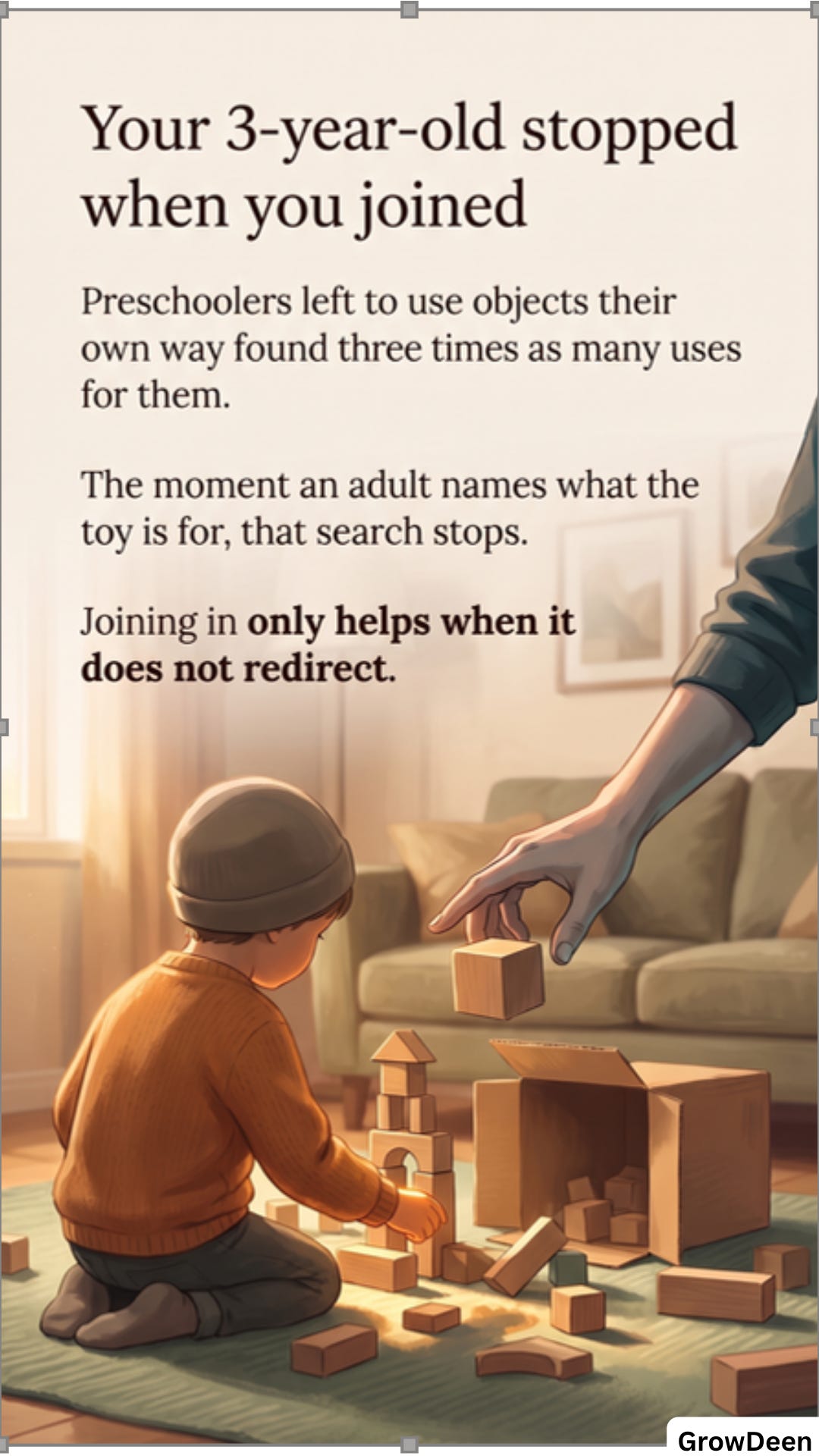
Preschoolers handed objects with almost no adult direction produced roughly three times as many unusual uses for those objects as children told specifically what to do with them [1]. The instruction did not add a skill. It narrowed the field.
That is not permission to disappear. A meta-analysis of thirty-nine studies, most of them covering ages three to six, compared guided play, where the adult supports a child-led activity, against direct teaching. Guided play came out ahead on early maths, shape knowledge and switching between tasks [6]. It made no measurable difference on literacy, vocabulary, inhibitory control or social competence, and the authors say plainly that most of the underlying studies carry a high risk of bias [6].
Anyone promising you that play beats teaching across the board has not read it. What play reliably beats is a four year old being told exactly what to do with a cardboard box.
The AAP report also records that children’s playtime in the United States fell by about a quarter between 1981 and 1997, and that roughly thirty per cent of American kindergarten children no longer get a recess [1]. The pressure to replace play with instruction is real, and it is not coming from the evidence.
Practically: wait before you solve it. She will usually tell you when she needs help. Harvard’s guidance for this age band adds a useful detail, that younger preschoolers tend to need props resembling the real object while older ones can repurpose whatever is nearby, and that the repurposing is itself the flexibility training [7].
I know this is a lot to hold in your head at 4:40 on a Tuesday, when the bus has been broken for twenty minutes and you are mostly thinking about dinner. That is exactly why the free Play Talk Pack exists: a printable set of the swaps, the scripts and one reflection page you can keep where the playing actually happens. The download button is at the top of this page, and there is a full description of what is inside it below.
What the Qur’an Teaches About Looking Closely
A preschooler spends most of her waking hours examining things. A beetle on a paving stone. The same lid, turned forty times. Rain finding its way down a window.
That looking is not a break from the deen. It is the earliest form of something Allah commands directly.
Allah says: “Say, ‘Observe what is in the heavens and the earth.’” [11] Tafsir Ibn Kathir reads this as an instruction to reflect on what Allah has created, and lists what the verse opens onto: the sun and moon, the alternation of day and night, rain that revives dead ground, crops and fruit, animals of different colours and uses, mountains, plains and the sea [12]. These, he says, are signs for people of sound understanding.
The tafsir addresses adults and does not mention children or play, so the connection is at the level of principle rather than subject. Still, a habit of that kind has to start somewhere, and in a three year old it starts on the paving stone.
Two things follow. Helping a child notice created things is building a Qur’anic habit, not borrowing time from tarbiyah. And the Prophet ﷺ said, “I am just a distributor, but the grant is from Allah.” [13] Understanding is given, not manufactured. A parent arranges conditions, offers materials, answers questions and makes du’a. What takes root is from Allah, which should lift a good deal of weight off anyone currently convinced they are not doing enough.
The four sentences that quietly cost you
Playfulness is not a problem. Islam does not ask parents to be solemn with their children, and a house with a four year old in it should have jokes in it. The limit is truthfulness, and preschoolers are the age group least equipped to spot the difference.
Listen to yourself at the park at five o’clock.
“We will come back tomorrow.” “One more minute.” “The swings are closed now.” “If you put your shoes on I will give you something.”
Your preschooler is building her working model of what adult words mean and whether yours can be relied on, and she is building it from exactly these moments. Pretend play is not in this category, because you both know the sand is not soup and saying so out loud is part of the game. A promise made to end a game and then dropped is in this category.
Children copy what is modelled far more than what is explained, which makes honesty with a preschooler a tarbiyah question before it is a tactical one.
Support Muslim Parenting Lab ❤️
Would you rather give a small amount that never stops than a large one you keep postponing? Set a monthly amount you are comfortable with, in a few seconds, using the button below.
The Prophet ﷺ said the deed most beloved to Allah is the most constant, even if little. (Sahih al-Bukhari 6464)
When she asks the hard ones
A child asking why for the fifth time is not stalling. She is running the only research method available to her.
Somewhere around four, the questions get heavier. Where do babies come from. What happens when someone dies. Why did that happen to those people on the news.
Tell the truth at her size. A four year old does not need anatomy. She needs a true sentence she can carry: Allah creates the baby and places it in the mother, where it grows until it is ready. Haya is modesty, not avoidance, and a child met with embarrassment simply takes her question to someone else.
Do not invent. Children handle a clear answer about death better than a vague one. Everyone returns to Allah. We will see them again, in shaa Allah. Then let her have whatever feeling arrives.
Expect the same question next week. Repetition is how a four year old checks whether an answer holds.
Teach her the short du’a asking Allah to increase her in knowledge and say it together before you open a book. Four seconds, and it attaches her curiosity to the One who placed it in her.
What you can stop worrying about
Shared reading is the most dependable thing on any list like this, with one condition. A review of nineteen randomised trials of programmes teaching parents how to share picture books found real gains in children’s expressive and receptive language, with the size of the effect depending on how much of it children actually got [9]. A separate meta-analysis of fifty-four studies found the overall language effect small, and close to zero against an active control, while noting that most interventions ran only six to eight weeks [10]. Read together, those say something precise: six weeks of reading does very little, and years of ordinary nightly reading is the thing that works. Stories of the Prophets and accounts from the Seerah belong in that rotation alongside everything else.
Outdoors, in a nationally representative sample of 10,682 American preschoolers, outdoor play was associated with better school readiness including self-regulation, with more benefit above three hours a day [14]. The design was cross-sectional and cannot show cause. It matches what the World Health Organization recommends for three and four year olds: at least 180 minutes of activity across the day, sixty of them vigorous [15].
Sleep is where the honest answer is narrower than the headlines. The WHO recommends ten to thirteen hours for this age [15]. A pooled analysis of five European birth cohorts found children who slept longer at three and a half had fewer behaviour problems at five, with no reliable association for language or non-verbal reasoning [16]. A study of 133 preschoolers wearing sleep monitors found longer sleep and better sleep efficiency both associated with stronger inhibition and working memory, cross-sectionally [17]. Sleep is clearly tied to behaviour and self-regulation. The link to raw cognitive ability is thin, and sleep quality did as much work as duration.
Screens are neither forbidden nor neutral. The WHO advises no more than an hour of sedentary screen time a day at this age and says less is better [15]. The Canadian Paediatric Society gives the same figure for two to five year olds [18]. The AAP set the same limit in 2016 alongside advice to watch together and talk about what is on the screen [19], and that statement has since been superseded by a 2026 policy statement, with the field moving away from fixed numbers toward what is being watched and who is watching with the child. Co-viewing is the part in your hands. The AAP’s toy guidance favours traditional play materials over electronic ones, on the grounds that the value sits in what happens between parent and child rather than in the device [26].
And pretend play. One intervention study found fantastical pretend play improved working memory more than ordinary play, with no effect on response inhibition [21]. A major review leans against pretend play being causally necessary for thinking skills at all [20]. It is normal, worth protecting and enjoyable. It is not a programme you can fail.
There is also no published figure from any paediatric body for how long a four year old should be able to concentrate. The familiar two-or-three-minutes-per-year rule traces to parenting blogs, not clinical guidance. What research shows is that sustained attention rises through the toddler years, flattens around four, and is measurably better during free play than during structured tasks [25].
If she is about to start preschool
A new building, unfamiliar rules, a day that no longer belongs to her.
Research following young children through the start of childcare found stress hormones climbing through the first fortnight after parents stopped staying, peaking around the ninth day, turning a corner near the third week and largely settling by about four weeks [22]. That study followed toddlers into Norwegian childcare rather than preschoolers, so treat the shape as a guide rather than a timetable. What helped was consistent: a parent present as a secure base for the first days, visits before the start date, early collection in the first weeks, and a named adult who knew the child [22]. A review of children’s own accounts of starting school points the same way, with familiarity easing it and abrupt change making it harder [23]. UNICEF adds steps that cost nothing: a playdate with a future classmate, pretend play at home with your child taking the teacher’s role, the new sleep routine started weeks ahead, and goodbyes kept short, warm and identical every time [27].
Speak to her teacher and to a doctor if she is still distressed after several weeks, or if the learning itself seems hard for her.
So why did the two children end up different
Same blocks. Different sentences said over them.
Not more sentences. Different ones. Questions with no right answer, talk about what is not in the room, and an adult who waited instead of correcting.
The Play Talk Pack
If you have read this far, you are the kind of parent who takes a four year old’s broken bus seriously. That is most of the job already done.
Inside the Play Talk Pack (one PDF, three pages):
Page one, the Play Talk Swap Card. Twelve things parents say during play, each paired with what to say instead and one line on what the swap builds, so you can change the sentence without having to work out the theory first.
Page two, the Hard Questions Script Sheet. Truthful, age-sized wording for the four questions four year olds ask about babies, death, difficult news and unkept promises, with what to avoid saying and why.
Page three, the Noticing Card. An Islamic reflection page anchored on the Qur’anic instruction to observe what is in the heavens and the earth, with a short weekly noticing practice you can do on an ordinary walk.
This is not a PDF to download and forget. It is built to live on the floor where the playing happens, in the kitchen drawer, or photographed on your phone for the school run.
The Play Talk Pack is what every subscriber receives with each article. Muslim Parenting Lab covers the full span of raising young Muslim children, every piece backed by current research and rooted in the Qur’an and Sunnah.
One thing to do in the next five minutes
Find your child. Ask her one question about something that is not in the room: what she thought about at nursery today, or what she thinks will happen to the broken bus tomorrow.
Then stay quiet long enough for her to answer properly. That pause is the hard part.
Share this with someone who needs it
Think of one person right now. The friend who told you she feels guilty that she cannot afford the classes everyone else seems to be doing. The sister whose four year old asks a hundred questions a day and who has started answering on autopilot. The mother at the masjid who said, half joking, that she does not know how to play.
Send it to her today. Not as advice, and not as a correction, but because the most useful thing any of us can pass on is the news that the expensive version was never the necessary one.
Frequently asked questions
Q: How much should I play with my 3 year old each day? A: There is no clinical minimum, and anyone quoting one is guessing. What the evidence supports is that the quality of the exchange matters more than the clock [3]. Twenty unhurried minutes where she leads and you follow will do more than two distracted hours.
Q: Is it bad to let my preschooler play alone? A: Not at all. Solo play builds persistence and gives her room to generate her own ideas, and boredom is where those ideas tend to come from. The research on adult involvement compares guided play with direct teaching, not with solitude [6].
Q: What are the best toys for cognitive development in a 4 year old? A: Open-ended ones. Blocks, boxes, cushions, pots, wooden spoons. The AAP’s toy guidance favours traditional materials over electronic ones because the value sits in the interaction between parent and child rather than in the device [26]. A block-play trial found gains in numeracy and cognitive flexibility, though the main effects did not reach statistical significance [28].
Q: How much screen time is OK for a 3 to 5 year old? A: The WHO and the Canadian Paediatric Society both say no more than about one hour a day of sedentary screen use, less being better [15][18]. The more useful question now is what she is watching and whether you are watching with her, since joint viewing is what turns passive watching into problem solving.
Q: Does pretend play really make children smarter? A: The honest answer is that the evidence is mixed. One intervention study found a working-memory gain and no effect on impulse control [21], and a major review leans against the causal claim altogether [20]. Pretend play is normal, valuable and worth protecting. It is not a guaranteed route to anything.
Q: My 4 year old asks “why” constantly. Should I answer every time? A: Answer as often as you truthfully can, and say so when you do not know. Those exchanges are the back and forth that tracks with language development [3]. “I do not know, shall we find out” is a complete and excellent answer.
Q: How do I know if my preschooler’s development is on track? A: The CDC’s four-year milestones are the clearest free checklist available [8]. If something concerns you, or if she is struggling at preschool after several weeks, speak to her teacher and to a doctor rather than waiting.
References
[1] Yogman, M., Garner, A., Hutchinson, J., Hirsh-Pasek, K., Golinkoff, R. M., Committee on Psychosocial Aspects of Child and Family Health, & Council on Communications and Media. (2018). The Power of Play: A Pediatric Role in Enhancing Development in Young Children. Pediatrics, 142(3), e20182058. Reaffirmed January 2025
[2] National Scientific Council on the Developing Child. (2011). Building the Brain’s “Air Traffic Control” System: How Early Experiences Shape the Development of Executive Function (Working Paper No. 11). Center on the Developing Child at Harvard University
[3] Romeo, R. R., Leonard, J. A., Robinson, S. T., West, M. R., Mackey, A. P., Rowe, M. L., & Gabrieli, J. D. E. (2018). Beyond the 30-Million-Word Gap: Children’s Conversational Exposure Is Associated With Language-Related Brain Function. Psychological Science, 29(5), 700-710
[4] Demir, Ö. E., Rowe, M. L., Heller, G., Goldin-Meadow, S., & Levine, S. C. (2015). Vocabulary, syntax, and narrative development in typically developing children and children with early unilateral brain injury: Early parental talk about the “there-and-then” matters. Developmental Psychology, 51(2), 161-175
[5] Graziano, P. A., Calkins, S. D., & Keane, S. P. (2011). Sustained attention development during the toddlerhood to preschool period: Associations with toddlers’ emotion regulation strategies and maternal behaviour. Infant and Child Development, 20(6), 389-408
[6] Skene, K., O’Farrelly, C. M., Byrne, E. M., Kirby, N., Stevens, E. C., & Ramchandani, P. G. (2022). Can guidance during play enhance children’s learning and development in educational contexts? A systematic review and meta-analysis. Child Development, 93(4), 1162-1180
[7] Center on the Developing Child at Harvard University. Executive Function Activities for 3- to 5-Year-Olds
[8] Centers for Disease Control and Prevention. Milestones by 4 Years. Learn the Signs. Act Early
[9] Dowdall, N., Melendez-Torres, G. J., Murray, L., Gardner, F., Hartford, L., & Cooper, P. J. (2020). Shared Picture Book Reading Interventions for Child Language Development: A Systematic Review and Meta-Analysis. Child Development, 91(2), e383-e399
[10] Noble, C., Sala, G., Peter, M., Lingwood, J., Rowland, C., Gobet, F., & Pine, J. (2019). The impact of shared book reading on children’s language skills: A meta-analysis. Educational Research Review, 28, 100290
[11] Qur’an, Surah Yunus 10:101. Translation: Saheeh International
[12] Ibn Kathir. Tafsir Ibn Kathir, commentary on Surah Yunus 10:101
[13] Sahih al-Bukhari 71, narrated by Mu’awiyah, Book of Knowledge. Graded: Sahih
[14] Zhu, W., Luo, X., Werneck, A. O., Pindus, D., Kramer, L., Kramer, A. F., Hillman, C. H., Herold, F., Zhang, Z., & Zou, L. (2024). Nature and success: Outdoor play is linked to school readiness. Complementary Therapies in Clinical Practice, 57, 101895
[15] World Health Organization. (2019). Guidelines on physical activity, sedentary behaviour and sleep for children under 5 years of age. Geneva: World Health Organization
[16] Guerlich, K., Avraam, D., Cadman, T., Charles, M.-A., Elhakeem, A., Guxens, M., Heude, B., Julvez, J., Lawlor, D. A., Sunyer, J., Koletzko, B., Grote, V., & Plancoulaine, S., et al. (2024). Sleep duration in preschool age and later behavioral and cognitive outcomes: an individual participant data meta-analysis in five European cohorts. European Child & Adolescent Psychiatry, 33(1), 167-177
[17] Merín, L., Nieto, M., Sánchez-Arias, L., Ros, L., & Latorre, J. M. (2025). Actigraphy-assessed sleep duration and quality and executive function in a sample of typically developing preschoolers. European Child & Adolescent Psychiatry, 34(4), 1379-1390
[18] Canadian Paediatric Society. (2025, March). Screen use and young children. Caring for Kids
[19] Council on Communications and Media. (2016). Media and Young Minds. Pediatrics, 138(5), e20162591
[20] Lillard, A. S., Lerner, M. D., Hopkins, E. J., Dore, R. A., Smith, E. D., & Palmquist, C. M. (2013). The impact of pretend play on children’s development: A review of the evidence. Psychological Bulletin, 139(1), 1-34
[21] Thibodeau, R. B., Gilpin, A. T., Brown, M. M., & Meyer, B. A. (2016). The effects of fantastical pretend-play on the development of executive functions: An intervention study. Journal of Experimental Child Psychology, 145, 120-138
[22] Drugli, M. B., Nystad, K., Lydersen, S., & Brenne, A. S. (2023). Do toddlers’ levels of cortisol and the perceptions of parents and professional caregivers tell the same story about transition from home to childcare? A mixed method study. Frontiers in Psychology, 14, 1165788
[23] Degli Esposti, C., & Cigala, A. (2025). Children’s Experience of Transition from Preschool to Primary School: A Scoping Literature Review. Early Childhood Education Journal, 54(6), 4683-4694
[24] Uccelli, P., Demir-Lira, Ö. E., Rowe, M. L., Levine, S., & Goldin-Meadow, S. (2019). Children’s Early Decontextualized Talk Predicts Academic Language Proficiency in Midadolescence. Child Development, 90(5), 1650-1663
[25] Sarid, M., & Breznitz, Z. (1997). Developmental aspects of sustained attention among 2- to 6-year-old children. International Journal of Behavioral Development, 21(2), 303-312
[26] Healey, A., Mendelsohn, A., & Council on Early Childhood. (2019). Selecting Appropriate Toys for Young Children in the Digital Era. Pediatrics, 143(1), e20183348
[27] UNICEF. How to prepare your child for preschool. UNICEF Parenting
[28] Schmitt, S. A., Korucu, I., Napoli, A. R., Bryant, L. M., & Purpura, D. J. (2018). Using block play to enhance preschool children’s mathematics and executive functioning: A randomized controlled trial. Early Childhood Research Quarterly, 44, 181-191
[29] Center on the Developing Child at Harvard University. Serve & Return Interaction Shapes Brain Circuitry
We combine scientific research with Qur’an and authentic Sunnah, and we cite our sources. Even so, this is general guidance and no substitute for a doctor who can examine your child.