

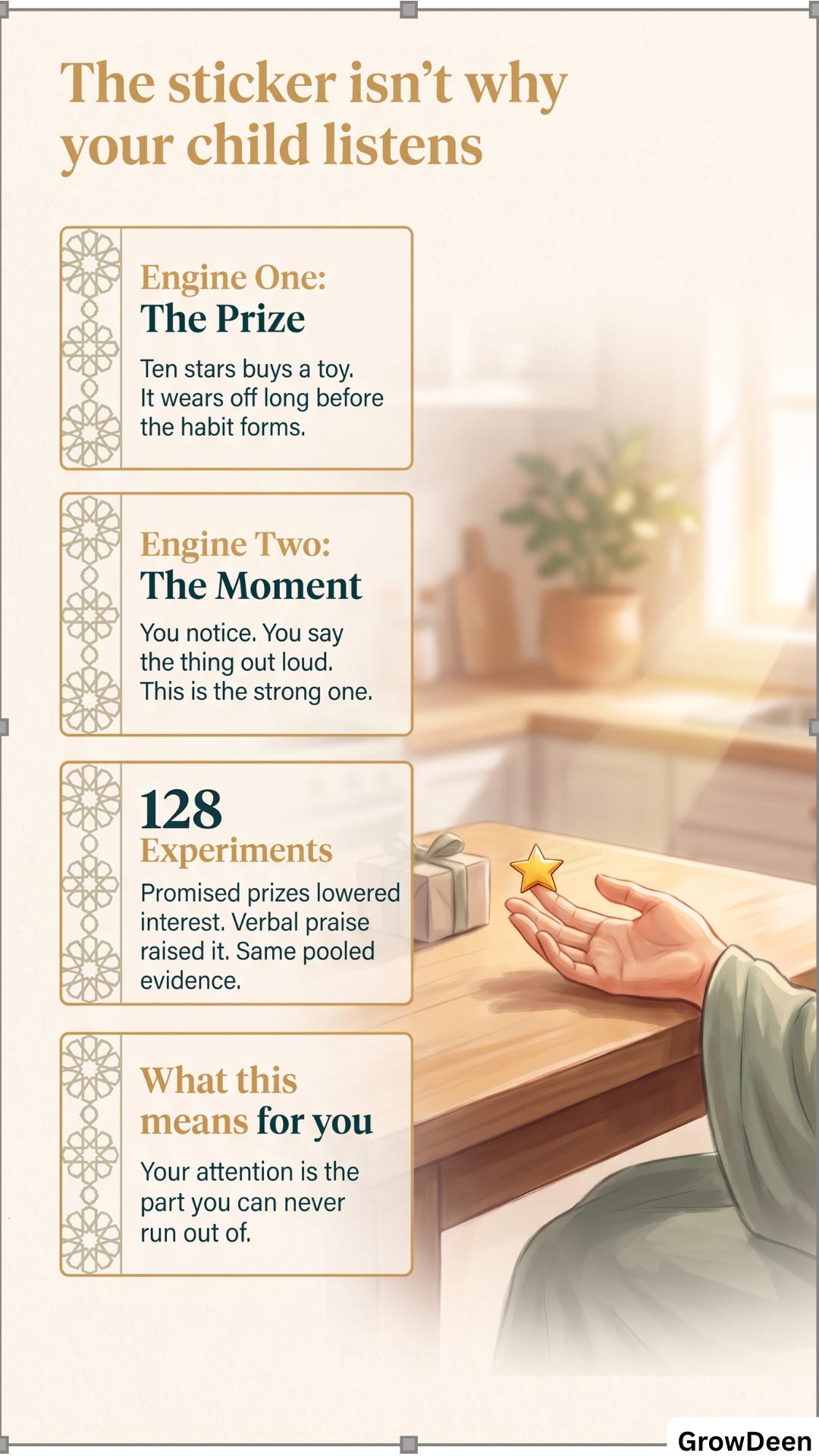
Across 128 experiments, promised tangible rewards reduced people’s own interest in a task, while verbal praise increased it. [1]
Printable. For the day the chart stops working.
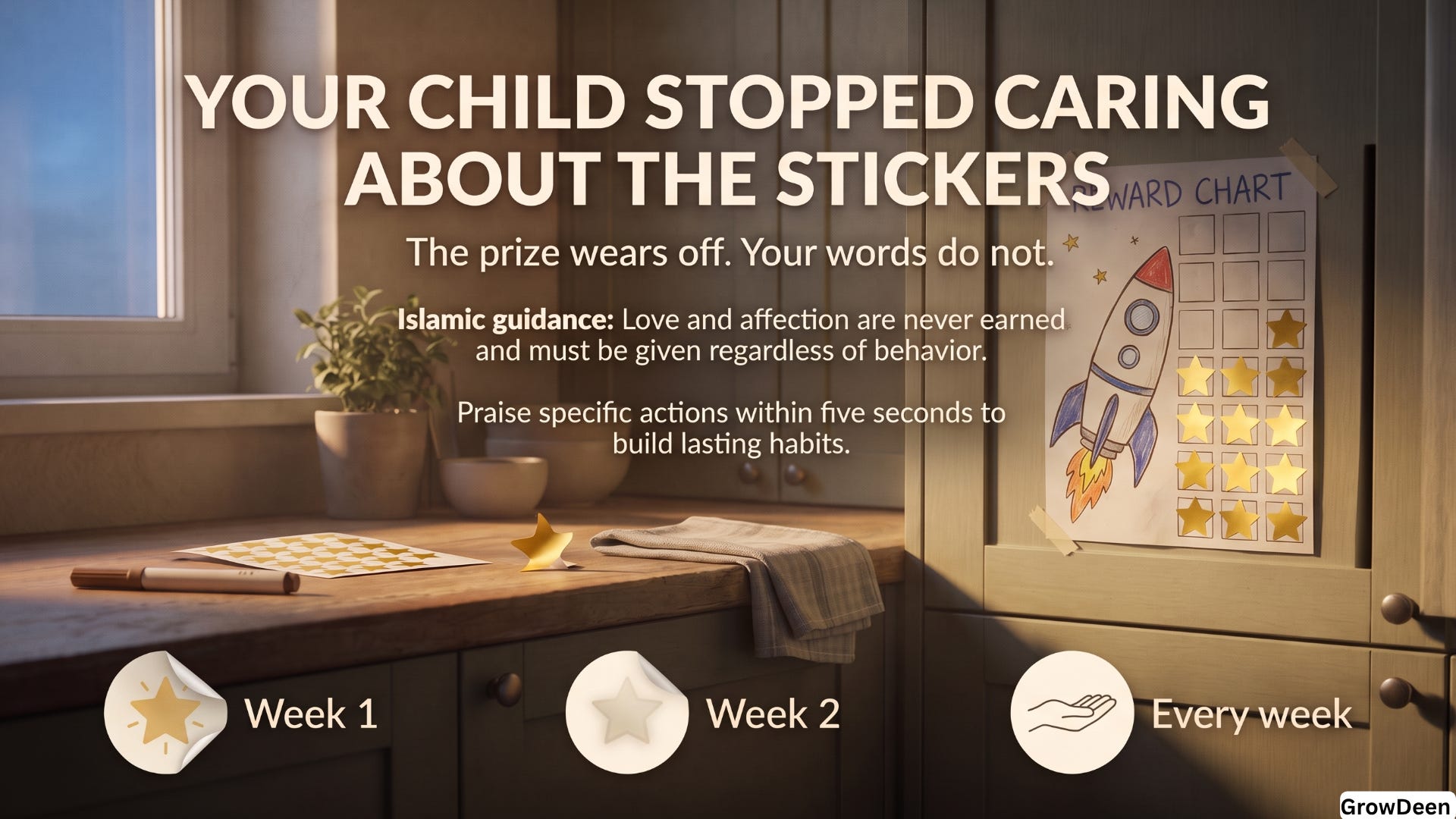
The chart lasted eleven days.
You made it together. Your five year old chose the rocket, coloured it in, picked the stickers. For nine days it was the best thing in the house. Shoes went in the rack. Plates went to the sink. Then on day ten she shrugged at the sticker, and by day twelve the rocket was half-filled and nobody had mentioned it since.
You did everything the guide said. You still ended up here, quietly wondering whether you had just spent a fortnight bribing your own child.
Here’s the part nobody warns you about: the chart probably worked. The prize is what died. When researchers pooled 128 experiments on rewards and motivation, they found that promised tangible rewards actually lowered how much people wanted to do the task afterwards, while verbal praise did the opposite and increased it. [1]
So the sticker was never the engine. You were.
But that raises a question worth carrying through the rest of this, because it is the one every parent asks and almost nobody answers: if praise is the strong part and prizes are the weak part, why do charts collapse in week two even in homes where parents are praising constantly?
Why This Guide Is Different
The evidence cuts both ways, and you get both sides. Two major meta-analyses disagree about how badly prizes undermine motivation, and this guide reports the disagreement instead of picking the tidier answer. [1][5]
The Islamic ruling comes first, not as decoration. Scholars have specifically recommended a star system to Muslim parents, and that fatwa also names what must never be earned. [4]
You already have the free Reward That Doesn’t Run Out Pack from the top of this page — a menu of zero-cost rewards and a four-stage exit plan, because ending a chart well is the part every other guide skips.
The villain is not your child, and it is not the sticker
Somewhere between day nine and day twelve, a very ordinary belief did the damage: that a bigger prize buys better behaviour.
It is a reasonable belief. It is also the thing that kills charts. A prize three weeks out has stopped mattering by the end of week one, because novelty fades faster than a habit forms. So parents respond the only way the belief allows, by raising the stakes. Bigger toy. Longer outing. And the child learns the actual lesson on offer: behaviour has a price, and the price is negotiable.
Notice what happens to you in that spiral. The guilt is not really about stickers. It is the suspicion that you are managing your child rather than raising her.
What 128 experiments found about prizes, and what they found about words
Let’s be precise about this, because the number matters.
Deci, Koestner and Ryan pooled 128 experiments and found that rewards promised in advance for completing a task reduced people’s free-choice interest in that task afterwards, with effects clustering around a third of a standard deviation depending on how the reward was set up. In the same analysis, positive feedback moved in the opposite direction and raised both free-choice engagement and self-reported interest. [1]
Read that again. The toy is the risky part. Your voice is the safe part.
Now, this is not settled science, and you deserve to know that. Cameron and Pierce analysed overlapping evidence and concluded the negative effects are narrow and easily avoided in real-world settings rather than widespread. [5] Reviews of the neuroscience land somewhere in between, finding that what matters is how a reward is framed and delivered rather than whether rewards are used at all. [6] Evidence from school incentive programmes points the same direction: incentives tied to an outcome a child does not know how to reach tend to flop, while incentives tied to a specific action the child can actually perform do considerably better. [7] There is even evidence that rewards attached to clearly explained goals can lift creative effort rather than flatten it. [8]
What survives all that disagreement is one practical instruction: lean on what you say, keep what you buy small and occasional.
The CDC groups the strong stuff under social rewards, and is blunt that these cost little or nothing yet can carry more weight than bought items, with the added advantage that you can give them instantly and as often as you like. [2] Affection. Praise. Time with you.
The American Academy of Pediatrics puts positive reinforcement at the front of its discipline guidance, and is direct about the alternative: corporal punishment, yelling and shaming are minimally effective in the short term and not effective at all in the long term. [3]
The five seconds that decide everything
So what does this actually look like at 8pm on a Tuesday?
Your child takes her plate to the sink without being asked. You have about five seconds.
What you do with them is the whole method. Mark the chart now, not at bedtime, and name the thing out loud while you do it: “You took your plate to the sink. That’s a star.” The naming is the active ingredient. “Good girl” tells your child you are pleased but leaves her guessing which part of the last ten minutes earned it, whereas naming the behaviour tells her exactly what to repeat. [2]
One detail the CDC raises that surprises most parents: not every child wants the hug that comes with the praise. Some would rather have a thumbs up, a wink, a smile from across the room. The praise lands just as hard. [2]
And this is where the Muslim household has something extra already sitting on the counter. Alhamdulillah for the effort. Jazakallahu khayran for the help. Sometimes just your hand on her head and nothing said at all. A child who hears gratitude in these small moments picks up shukr as a reflex rather than a lesson.
Which brings us to something most parents never realise about the whole idea of reward.
The reward that exceeds what was earned
You have probably worried at some point that rewarding a child for good behaviour is close to bribery, and that Islam might frown on it.
It does not. Islam Q&A, answering a mother who was losing patience with a four year old and a two year old, set out a star system as one of its recommended alternatives to hitting or harsh words: stars earned for the behaviour the parents want, an agreed prize at ten, an outing at twenty. The same answer is equally firm about what is never earned, namely daily words of love, appreciation for the smallest efforts, and affection given regardless of behaviour. [4]
There is also the matter of who is really keeping score. Scholars have long held that a child’s good deeds are recorded for them even before puberty while their mistakes are not, with several classical authorities reporting agreement on it. [10] Your four year old praying beside you is already earning with Allah. The fridge has nothing to do with it.
And when you sit with how Allah Himself rewards, the whole transaction model falls apart.
Allah asks in the Qur’an, “Is the reward for good anything but good?” [11] Tafsir Ibn Kathir explains that Allah is declaring that in the Hereafter all that is good is the only fitting reward for those who did good in this life, and then adds something that should stop any parent in their tracks: these blessings cannot be earned by deeds at all, but come from Allah’s own favour and bounty. [12] The reward exceeds the deed. Allah, who owes nothing to anyone, still answers good with good and then gives more than was earned.
That is the model. Not payment. Generosity.
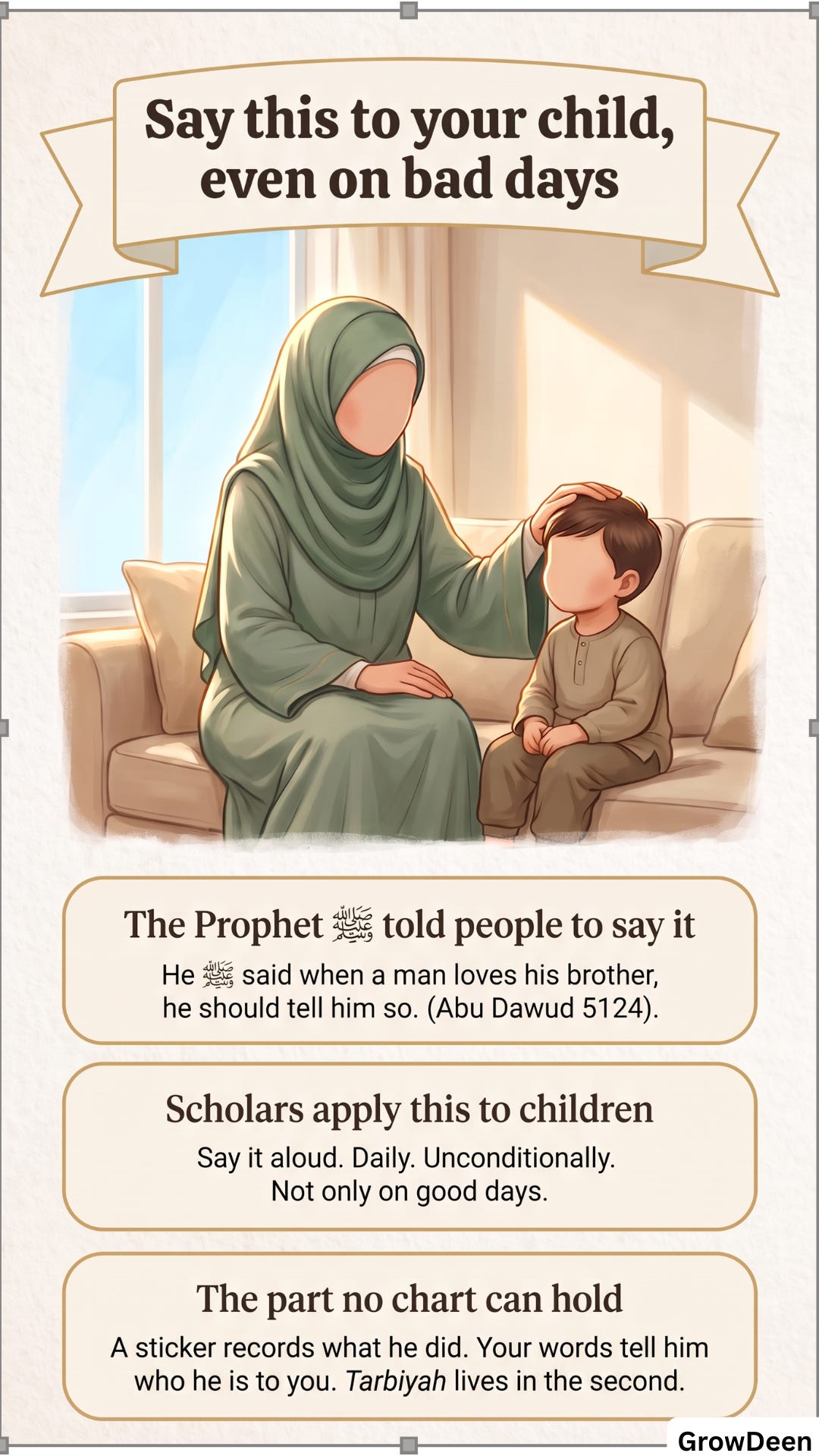
Which is also why the chart can never carry the relationship. The Prophet ﷺ said that when a man loves his brother, he should tell him that he loves him. [13] Islam Q&A cites this narration when telling parents to say the words aloud to their children, daily, unconditionally, and never only on the days a child behaved well. [4]
The sticker is the receipt. You are the reward.
I know this is a lot to hold at 9pm
Remembering which rewards are safe, which words to use, and when to start pulling the chart back is not something you want to reconstruct from memory on a Tuesday night.
That’s why there’s a free Reward That Doesn’t Run Out Pack waiting for you. It’s a printable you can stick inside a cupboard door: a menu of rewards that cost nothing, and a plan for ending the chart on purpose rather than watching it die. The download button is at the top of this page, and there’s a full description of what’s inside it below.
When it stops working, ask three questions
Back to the question planted at the start. Why do charts collapse in week two even in homes full of praise?
Because the praise is usually landing on the wrong thing, or landing too late, or landing on a target the child cannot actually hit. The CDC’s own troubleshooting reduces to three questions, and they are worth asking in this order. [2]
Can she actually do it? A four year old can usually manage please and thank you. A two year old often cannot, and a chart that asks for it is teaching failure. If the target is too high, say so out loud and lower it. Reward picking up the blocks before you ask for the whole floor. Meta-analytic work on parenting programmes finds the components that actually shift difficult behaviour are the concrete, practisable ones rather than the ambitious ones. [9]
Is the behaviour specific enough to see? “Be good at Nani’s house” is an atmosphere. “Keep your hands in your lap when we sit for food” is a picture. Say what you want, not what you are trying to stop.
Does she still want what’s on offer? Children go off rewards as their interests move. Keep a running list of what your child currently wants to earn and change it when it goes stale. [2]
Two more things, quickly, because they sink more charts than anything above. Never take back a sticker she has already earned; rewards earned belong to the child, and clawing them back for a later misbehaviour unpicks the learning. [2] And where a consequence genuinely is needed, keep it bounded. Islam Q&A recommends exactly this restricted form, a few minutes off the game or a small deduction from pocket money, and warns that a child deprived of play for a whole day simply gets used to punishment and stops responding. [4]
One honest note, because sources differ here. That same fatwa describes a star system where stars can also be removed for poor behaviour, while the behavioural guidance says never remove what has been earned. [2][4] Parents who prefer the version with deductions can use it. Both agree on the restriction that matters most: small, immediate, never carried forward as a running debt.
End it on purpose
A chart still on the wall a year later has become furniture.
So plan the ending before you hang it. Once the behaviour holds steady, stretch the interval: every day becomes every second day, with praise and a hug filling the gap, then every fifth day, then nothing at all, because clearing the table is simply what happens after dinner in this house now.
Then stop. Take a break before starting another one, and let everyone enjoy the habit for a few weeks before you point at the next thing.
That is what the eleven-day chart was actually trying to tell you. It had done its job and nobody noticed, because everyone was watching the rocket instead of the child.
Your Reward That Doesn’t Run Out Pack
If you’ve read this far, you’re not looking for a quick trick. You want to raise a child who does good because of who she is becoming, not because of what’s in it for her. That tells me something about you.
Inside the Reward That Doesn’t Run Out Pack (one comprehensive PDF, 3 pages):
Page 1: The Zero-Cost Reward Menu. 24 social rewards sorted by how long they take, from under two minutes to a weekend, so you can always find one you can actually give today. Designed as a cupboard-door card you circle your child’s favourites on and keep in the kitchen.
Page 2: The Four-Stage Chart Exit Plan. The fade-out ladder with the exact signal that tells you it is time to move to the next stage, so you can end a chart deliberately in about fifteen minutes of planning instead of letting it quietly die.
Page 3: Two Reflection Cards. The Qur’anic verse on how Allah answers good with good and gives more than was earned, with Arabic, transliteration and meaning, plus the narration of the Prophet ﷺ on saying the words out loud, framed for the moment you are holding a sticker and about to forget the more important thing.
This isn’t just a PDF to download and forget. It’s built to live inside your kitchen cupboard, where the stickers and the 8pm decisions actually happen.
This pack is what every subscriber receives with each article. Muslim Parenting Lab covers the whole span of raising Muslim children, from newborn sleep to school-age behaviour, all backed by peer-reviewed research and rooted in Qur’an and Sunnah.
If you want both the evidence and the Islamic perspective in one place, subscribe free so the next resource lands in your inbox before you need it.
Subscribe free for parenting resources backed by both science and Sunnah, guidance so specific you will not find it anywhere else. No spam, no clutter, just resources that matter.
Do this before you close the tab
Go and look at your chart. Find the last mark on it, and say out loud to your child what she did to earn it, even if it was three days ago. Then say the other thing, the one that has nothing to do with the chart.
That’s it. Ninety seconds.
May Allah place barakah in your effort, accept your intention, and make the good you answer with greater than the good you receive.
Share This With Someone Who Needs It
Think of one person right now: the sister whose fridge you’ve seen, half-covered in a sticker chart from three months ago that nobody has touched since. The friend who told you at the masjid that nothing works with her five year old anymore. The cousin who just bought a bigger toy because the last one stopped mattering.
This article could save them a fortnight of feeling like they’re failing. Send it to them today, not as advice, but as company. Sometimes the kindest thing is telling someone the part that wasn’t their fault.
Frequently Asked Questions
Q: Do reward charts actually work for children?
A: Yes, for the right age and the right target. What the evidence shows is that the praise and attention around the chart do more work than the prize at the end of it. [1][2] Charts suit roughly ages three to eight; under three, a child can’t hold the link between today’s sticker and Saturday’s prize.
Q: Are reward charts bribery in Islam?
A: No. Islam Q&A recommends a star system to parents as a better alternative to hitting or harsh words, with a prize at an agreed number of stars. [4] The condition worth keeping is that love and affection are never part of the deal.
Q: At what age should you start a reward chart?
A: Around three, once a child can connect a mark today with a reward later. For toddlers under three, immediate praise and affection do the same job with none of the admin.
Q: Should you take stickers away for bad behaviour?
A: The behavioural guidance says never remove what’s already earned, because it unpicks the learning. [2] Islam Q&A does describe a version where stars can be deducted. [4] If you use deductions, keep them small and immediate rather than running a debt.
Q: Why did my child’s reward chart stop working after two weeks?
A: Almost always one of three things: the target is beyond what she can do, the behaviour is too vague to see, or she’s gone off the reward. See “When it stops working, ask three questions” above for how to tell which.
Q: Can you use a reward chart for salah and Qur’an?
A: You can, with care. Pair every mark with the reminder that the real reward for this is with Allah, and fade the material side deliberately rather than letting it run for years. [10] For anything that turns on a specific ruling in your household, ask a scholar you trust.
Q: What rewards work best for a 4 or 5 year old?
A: The ones you can give the same day. Extra minutes with you, choosing the bedtime story, picking the fruit at the shop, standing beside you on the prayer mat. The CDC notes these social rewards often carry more weight than bought items and can be given immediately. [2]
References
[1] Deci, E.L., Koestner, R., & Ryan, R.M. (1999). A meta-analytic review of experiments examining the effects of extrinsic rewards on intrinsic motivation. Psychological Bulletin, 125(6), 627-668.
[2] Centers for Disease Control and Prevention. (2026). Tips for Using Praise and Rewards. Essentials for Parenting Toddlers and Preschoolers. Last reviewed 30 April 2026.
[3] Sege, R.D., & Siegel, B.S.; AAP Council on Child Abuse and Neglect; AAP Committee on Psychosocial Aspects of Child and Family Health. (2018). Effective Discipline to Raise Healthy Children. Pediatrics, 142(6), e20183112.
[4] Islam Q&A. (2023). How to Deal With Stubborn Children in Islam. Fatwa no. 279342.
[5] Cameron, J., & Pierce, W.D. (2002). Rewards and Intrinsic Motivation: Resolving the Controversy. Bergin & Garvey.
[6] Hidi, S. (2016). Revisiting the role of rewards in motivation and learning: Implications of neuroscientific research. Educational Psychology Review, 28(1), 61-93.
[7] Allan, B.M., & Fryer, R.G., Jr. (2011). The Power and Pitfalls of Education Incentives. Discussion paper, The Hamilton Project.
[8] Byron, K., & Khazanchi, S. (2012). Rewards and creative performance: A meta-analytic test of theoretically derived hypotheses. Psychological Bulletin, 138(4), 809-830.
[9] Leijten, P., Gardner, F., Melendez-Torres, G.J., Van Aar, J., Hutchings, J., Schulz, S., Knerr, W., & Overbeek, G. (2019). Meta-analyses: Key parenting program components for disruptive child behavior. Journal of the American Academy of Child & Adolescent Psychiatry, 58(2), 180-190.
[10] Islam Q&A. Will children be rewarded for their good deeds? Fatwa no. 3277, Shaykh Muhammad Salih al-Munajjid.
[11] Quran, Surah Ar-Rahman 55:60.
[12] Ibn Kathir. Tafsir Ibn Kathir, Surah Ar-Rahman 55:54-61 commentary.
[13] Sunan Abi Dawud 5124. Narrated by al-Miqdam ibn Ma’dikarib. Graded: Sahih.