

Sleepwalking runs in families. With one parent affected, 47.4% of children sleepwalk; with both, 61.5%. [1]
Print it before the next 2am wander!
The hallway light was off. Your five-year-old is standing in it, eyes open, looking straight at you and through you at the same time. You say her name. Nothing. You say it louder and take her shoulders, because that is what anyone would do.
And she comes apart in your hands.
That reaction is the part nobody warns you about. The instinct that works for every other night-time problem, waking the child and asking what is wrong, is the one thing that reliably makes a sleepwalking episode longer and harder. You were doing the loving thing. It backfired because her brain is in a state your voice cannot reach.
Which raises a question worth carrying through the rest of this article: why do these episodes cluster in the same stretch of the night, almost every time? The answer decides everything you should and should not do, and it also explains why most of your useful work happens hours before the first footstep.
Why This Guide Is Different From A Generic List Of Sleepwalking Tips
Every figure here comes from peer-reviewed paediatric sleep research and the American Academy of Sleep Medicine, with the year and the source named in the text rather than buried.
The Islamic layer answers the question parents actually ask in the dark, which is whether a child is accountable for this and whether a home where it happens is somehow unprotected.
You already have the free Sleepwalking Pack from the button at the top of this page, which turns the safety work below into a one-minute nightly sweep you can print and stick inside a cupboard door.
The Hour That Decides Everything
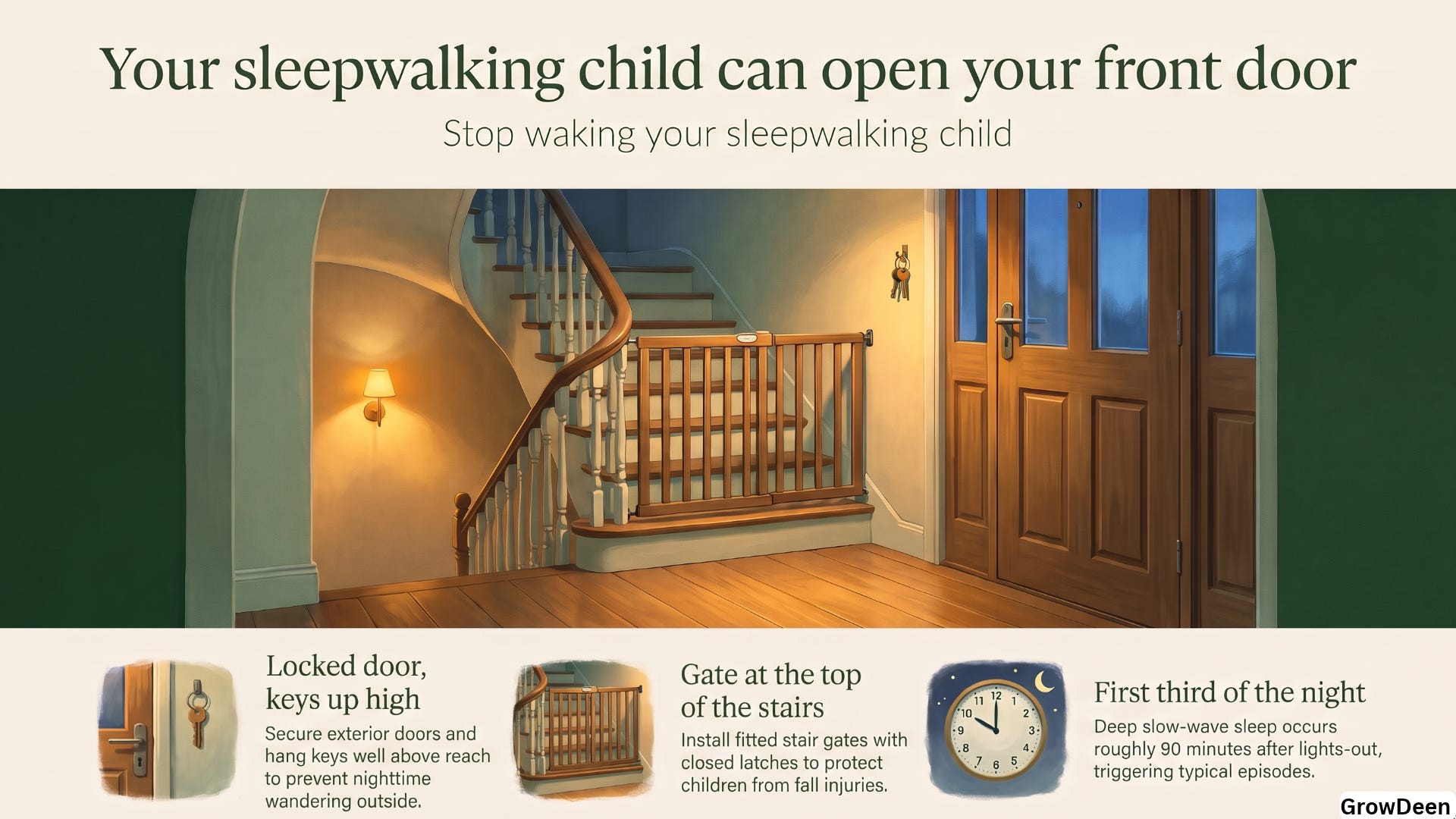
Sleep runs in cycles, and the deepest stage, slow-wave sleep, is loaded into the first third of the night. A sleepwalking episode begins when the arousal systems fire out of that depth and bring only part of the brain with them. Movement and balance switch on. Awareness and memory stay off [3][6].
That single fact explains the timing. It also explains the glassy stare, the slurred half-speech, and the total blank the next morning, which is a defining feature of the condition and not a child covering their tracks [3].
Here is why it matters for you: a child in slow-wave sleep is physically very hard to wake, and dragging them out of it produces confusion that can take an hour to settle [4]. The brain is not refusing to respond. It is simply not there yet.
So the clock is doing you a favour. If episodes start roughly ninety minutes after lights-out, they are almost certainly this and not something else, and you can stop auditing the day for an emotional explanation.
Which brings us to the explanation most parents reach for instead.
The Question You Are Actually Asking At 2am
Nobody says it out loud. Standing in a dark corridor watching your child do something uncanny, the mind goes somewhere older than paediatrics: is something wrong with her, and is something wrong with this house?
The Qur’an frames sleep as something done to a person rather than something they perform. Allah says, “And it is He who takes your souls by night and knows what you have committed by day.” [10] According to Tafsir Ibn Kathir, the taking described here is the minor death of sleep, and the second half of the verse establishes Allah’s knowledge of what people do in their waking hours [11]. The record belongs to the day.
The Prophet ﷺ said the same thing in plainer terms. When the Companions overslept the dawn prayer on a journey and started whispering about their negligence, he told them: “There is no omission in sleeping.” [12] Blame attaches to the person who is awake and chooses to delay.
And the legal principle runs the same way. The Prophet ﷺ taught that the pen is lifted from three, the first being “a sleeper till he awakes.” [13] Nothing a sleeping child does is written against them.
So the child in the corridor is not being defiant, and the episode passes no verdict on your household. Sleepwalking is a developmental feature of how a young brain moves between sleep stages, and the children it happens to are ordinary children. What remains is a sleeping child whose legs are working, and a parent with two jobs.
Job One: The Thirty Seconds In The Corridor
Your first job is smaller than it feels. Four moves, under a minute.
Keep your voice low and your hands gentle. A child mid-episode can look frightened or agitated, and matching that energy stretches the whole thing out.
Steady, do not startle. There is a narration that reads almost like a protocol for this. On a night journey, Abu Qatadah noticed the Prophet ﷺ dozing and tilting on his camel, and steadied him, in his own words, “without awaking him,” three separate times through the night. When the Prophet ﷺ woke and learned what had been going on, he prayed for him: “May Allah protect you, as you have protected His Apostle.” [12] Quiet guarding, praised fourteen centuries before a sleep laboratory confirmed the clinical version of it.
Walk them back. A hand at the shoulder, a slow turn toward the bedroom, a stop at the bathroom if that is plainly what they are after. Most episodes end on their own within minutes and the child returns to sleep with no memory of it [3][6]. Blocking or pinning a child provokes resistance, so move with them instead.
Say nothing in the morning unless they raise it. An older child who finds out and feels humiliated can start dreading bedtime, and bedtime anxiety outlasts the sleepwalking by years.
Lock the door. Let the sleeper sleep. That is the whole of job one, and it takes less than a minute.
Job two is the one that actually changes your nights.
There Is A Reason This Pack Exists
Everything in job two is small, and all of it is the kind of thing that evaporates by Thursday when you are tired. That is exactly why I put the Sleepwalking Pack together: a one-minute nightly safety sweep, a what-to-do-tonight card for the corridor, and a reflection card for the nights when you are the one lying awake. The download button is at the top of this page, and there is a full description of what is inside it below.
Job Two: The Half Hour Before Bed That Does The Real Work
Nothing stops sleepwalking on demand. What you can change is how likely an episode is and how much it can cost when one happens.
Start with the sleep itself, because sleep debt is the most reliably demonstrated trigger there is. Controlled work has shown that sleep deprivation, which drives a rebound of deeper slow-wave sleep, and forced arousals during that deep sleep both increase episodes in people already prone to them [4]. Children aged three to five need roughly ten to thirteen hours a night, older children nine to twelve, and teenagers eight to ten [3]. Moving bedtime twenty minutes earlier is a real intervention with a mechanism behind it [4][7].
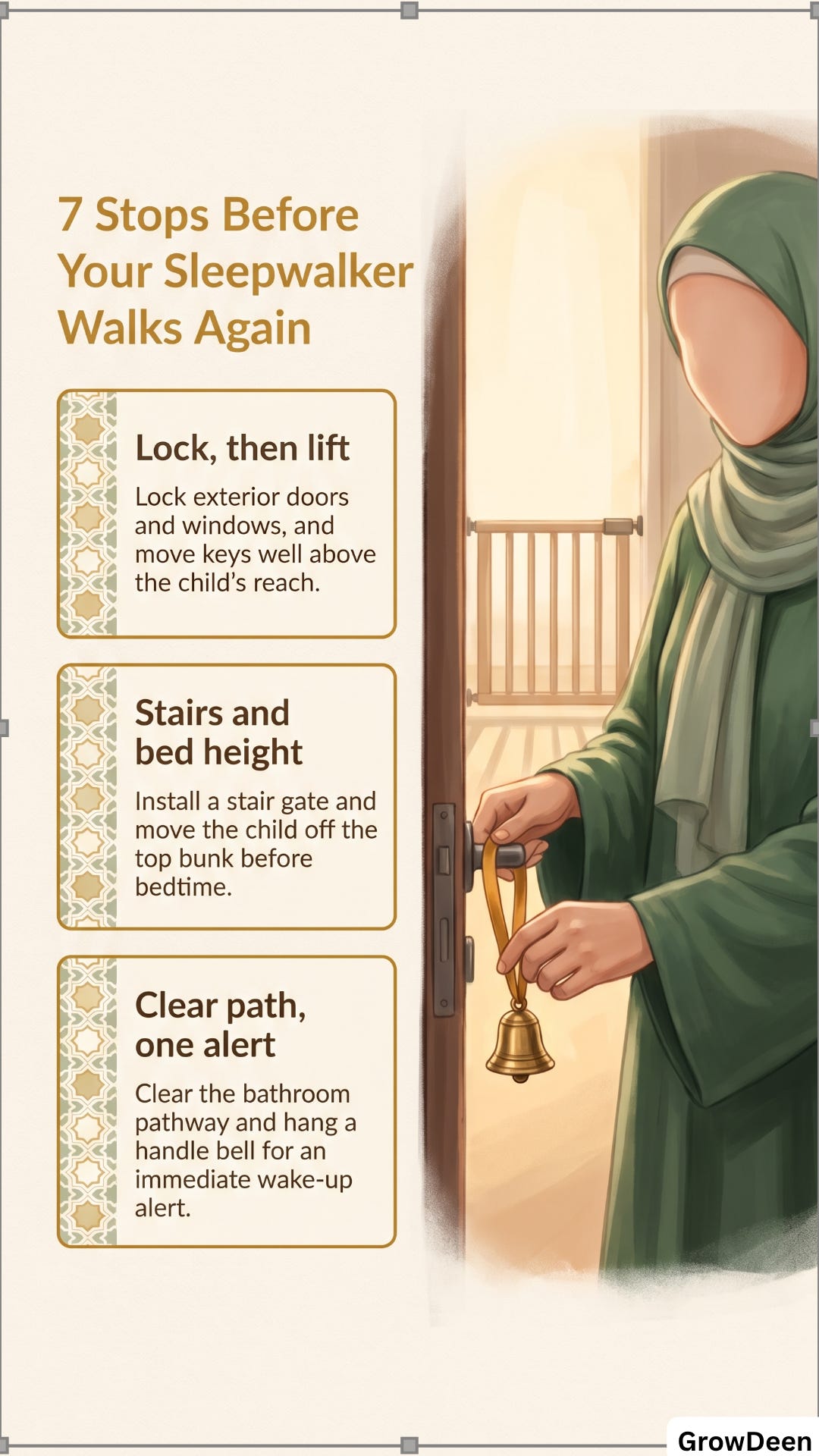
Then the house. Lock the exterior doors and windows and put the keys somewhere a half-asleep child cannot reach [3][8]. Move a sleepwalking child off a top bunk [3]. Fit a gate at the head of the stairs. Clear the floor between the bed and the bathroom, because the injuries that actually happen come from furniture and loose cables rather than from anything dramatic [3]. Put something on the bedroom door that wakes you first: a bell on the handle, or a motion light on the landing.
Here is where the Sunnah and the safety checklist turn out to be the same instruction. The Prophet ﷺ said: “Close the doors and mention the Name of Allah, for Satan does not open a closed door.” [14] The same narration tells parents to keep young children in at nightfall. A household that already locks up at maghrib with Bismillah on the lips has built the single most protective habit available for a child who walks at night, without ever setting out to.

Support Muslim Parenting Lab ❤️
Would you like the reward of every parent who acts on what they read here? Fund it with the button below and it is yours.
The Prophet ﷺ said whoever guides to good has a reward like the one who does it. (Sahih Muslim 1893a)
Building The Night Around The Sunnah
Keep the closing hour quiet and identical. Wudu, pyjamas, teeth, lights down, du’a, bed, in the same order every evening. Fit the adhkar inside that sequence rather than adding them on top, which is the difference between a routine a tired family sustains and one it abandons. Ayat al-Kursi and the three Quls take two minutes. Then say the protective supplication over the child, as the Prophet ﷺ did for al-Hasan and al-Husayn with the words Ibrahim, peace be upon him, used for Isma’il and Ishaq: “O Allah! I seek Refuge with Your Perfect Words from every devil and from poisonous pests and from every evil, harmful, envious eye.” [15]
And if the episodes arrive at a predictable time, there is one more option worth raising with your doctor. Track the start time for several nights. If the interval is consistent, you wake the child gently about fifteen minutes before it, keep them up briefly, then let them drift back [8]. Behavioural approaches of this kind, alongside extending total sleep, are the first line in children, and medication is rarely needed [7][16].
The One Medical Question Worth Asking
If your sleepwalking child also snores most nights, raise it with a doctor even if nothing else worries you.
A Stanford team studied 84 prepubertal children with sleep terrors or sleepwalking. Fifty-one of them had a second sleep disorder, 49 of those sleep-disordered breathing. Forty-three went on to have surgery for it, and at follow-up three to four months later the breathing had resolved in every one and the parasomnia had stopped in all 43. In the six children left untreated, the sleepwalking carried on [5].
The study was small and retrospective, and the authors did not claim causation [5]. The practical point survives that caution. Fragmented breathing produces repeated arousals out of deep sleep, which is the precise condition an episode needs to begin.
Book an appointment as well if episodes happen nightly or several times a night, if your child has been injured or has left the house, if the household is losing sleep, if the movements look stiff and repetitive rather than clumsy and semi-purposeful or the confusion lasts a long time afterwards, since nocturnal seizures can mimic a parasomnia and only a clinician can separate them [6][9]. Also raise it if episodes began soon after a new medicine [8].
Diagnosis is usually made from your description alone, and a sleep study is not routine [6]. Most children stop by adolescence with no treatment at all [3][6].
This article is for information and does not replace advice from your child’s doctor.
Inside The Sleepwalking Pack
If you have read this far, you are the kind of parent who would rather understand the thing than just manage it. That tells me something good about how this child is being raised.
Inside the Sleepwalking Pack (one comprehensive PDF, 3 pages):
Page 1: The One-Minute Night Sweep — A room-by-room tick list covering the front door, the windows, the keys, the stairs, the bed height, the floor path to the bathroom and the door alert, with a space to note which ones your house still needs. Designed as a laminated card you can hang inside a hall cupboard and run in under sixty seconds on your way to bed.
Page 2: Tonight’s Corridor Card and Away-From-Home Slip — The exact wording and sequence for the thirty seconds of an episode, written large enough to read in the dark, plus a tear-off handover slip you can fill in and hand to a grandparent or a sleepover host so they know what to do before the night rather than during it.
Page 3: The Pen Is Lifted — A reflection card carrying the teaching of the Prophet ﷺ that no record is kept of a sleeper’s actions, with its source, alongside the verse describing the soul taken by night, for the nights when you are the one lying awake wondering whether any of this is your fault.
This isn’t just a PDF to download and forget. It’s a tool designed to stay inside your hall cupboard, where you’ll actually use it when you need it most.
The Sleepwalking Pack is what every subscriber receives with each article. We cover the full span of raising Muslim children, from newborn sleep to school-age behaviour, all backed by current research and rooted in Qur’an and Sunnah.
Do This Before You Go To Bed Tonight
Walk to your front door and lock it, then put the key somewhere above a child’s reach. One door, one minute. Do it now, while you are thinking about it, and the rest of the sweep can wait for the morning.
Lock the door. Let the sleeper sleep. That sentence is on the first page of the pack for a reason, and it is the whole of what tonight asks of you.
May Allah place barakah in the care you give these children, keep them safe in the hours you cannot watch them, and make the quiet work of your nights heavier on your scale than it ever feels at the time.
Share This With Someone Who Needs It
Think of one person right now: the cousin who mentioned finding her son standing in the kitchen at midnight and laughed it off, the friend whose four-year-old has started “waking up weird”, the sister who sleepwalked herself as a child and has never connected that to what her daughter is doing now.
Send it to her today. Not as advice, and not as a correction, but because she is probably lying awake tonight inventing explanations that are harsher than the truth.
Frequently Asked Questions
Q: Should you wake a sleepwalking child? A: No. Waking a child out of slow-wave sleep leaves them confused and sometimes distressed, and it can take a long time to settle them again [4]. Guide them back to bed instead, with a low voice and a hand at the shoulder. The full approach is in “Job one” above.
Q: At what age do children sleepwalk most? A: It peaks around age ten, when roughly 13.4% of children are affected [1], and the American Academy of Sleep Medicine puts the childhood rate as high as 17%, peaking between eight and twelve [3]. It can begin as soon as a child can walk.
Q: Is sleepwalking a sign of stress or emotional problems? A: Mostly no. Stress and upheaval can trigger an episode in a child who is already prone, but the liability itself is largely inherited and developmental [1][3]. Sleepwalking on its own is not treated as a marker of psychological difficulty.
Q: Will my child remember sleepwalking in the morning? A: Almost never. Absence of memory is a defining feature of the condition rather than a sign that the child is hiding something [3]. Unless they raise it, there is no need to bring it up.
Q: Can sleepwalking be dangerous? A: The episode itself is harmless; the house is the risk. Children have walked out of front doors and fallen down stairs during episodes [3], which is why locked doors and a stair gate matter more than anything you do mid-episode.
Q: Does my child grow out of sleepwalking? A: Most children stop by adolescence with no treatment at all [3][6]. Prevalence drops from a childhood peak of 13.4% to around 1.5% of adults in any twelve-month period [1][2].
References
[1] Petit, D., Pennestri, M.H., Paquet, J., Desautels, A., Zadra, A., Vitaro, F., Tremblay, R.E., Boivin, M., & Montplaisir, J. (2015). Childhood sleepwalking and sleep terrors: A longitudinal study of prevalence and familial aggregation. JAMA Pediatrics, 169(7), 653-658. https://doi.org/10.1001/jamapediatrics.2015.127
[2] Stallman, H.M., & Kohler, M. (2016). Prevalence of sleepwalking: A systematic review and meta-analysis. PLoS ONE, 11(11), e0164769. https://doi.org/10.1371/journal.pone.0164769
[3] American Academy of Sleep Medicine. (2020). Sleepwalking. Sleep Education. https://sleepeducation.org/sleep-disorders/sleepwalking/
[4] Pilon, M., Montplaisir, J., & Zadra, A. (2008). Precipitating factors of somnambulism: Impact of sleep deprivation and forced arousals. Neurology, 70(24), 2284-2290. https://doi.org/10.1212/01.wnl.0000304082.49839.86
[5] Guilleminault, C., Palombini, L., Pelayo, R., & Chervin, R.D. (2003). Sleepwalking and sleep terrors in prepubertal children: What triggers them? Pediatrics, 111(1), e17-e25. https://pubmed.ncbi.nlm.nih.gov/12509590/
[6] Mainieri, G., Loddo, G., Provini, F., Nobili, L., Manconi, M., & Castelnovo, A. (2023). Diagnosis and management of NREM sleep parasomnias in children and adults. Diagnostics, 13(7), Article 1261. https://doi.org/10.3390/diagnostics13071261
[7] Simon, S.L., & Byars, K.C. (2016). Behavioral treatments for non-rapid eye movement parasomnias in children. Current Sleep Medicine Reports, 2, 152-157. https://doi.org/10.1007/s40675-016-0049-9
[8] Mayo Clinic. (2024). Sleepwalking: Diagnosis and treatment. https://www.mayoclinic.org/diseases-conditions/sleepwalking/diagnosis-treatment/drc-20353511
[9] Proserpio, P., & Nobili, L. (2017). Parasomnias in children. In S. Nevsimalova & O. Bruni (Eds.), Sleep disorders in children (1st ed., pp. 305-335). Springer Cham. https://doi.org/10.1007/978-3-319-28640-2_14
[10] Qur’an, Surah Al-An’am 6:60 (Saheeh International). https://quran.com/6/60
[11] Ibn Kathir. Tafsir Ibn Kathir, Surah Al-An’am 6:60 commentary. https://quran.com/en/6/60/tafsirs/en-tafisr-ibn-kathir
[12] Sahih Muslim 681. Narrated by Abu Qatadah. Graded: Sahih. https://sunnah.com/muslim:681
[13] Sunan Abi Dawud 4398. Narrated by Aisha. Graded: Sahih (Al-Albani). Parallel narration from Ali ibn Abi Talib at Sunan Abi Dawud 4403, also graded Sahih (Al-Albani). https://sunnah.com/abudawud:4398
[14] Sahih al-Bukhari 3304. Narrated by Jabir ibn Abdullah. Graded: Sahih. https://sunnah.com/bukhari:3304
[15] Sahih al-Bukhari 3371. Narrated by Ibn Abbas. Graded: Sahih. https://sunnah.com/bukhari:3371
[16] Limbekar, N., Pham, J., Budhiraja, R., Javaheri, S., Epstein, L.J., Batool-Anwar, S., & Pavlova, M. (2022). NREM parasomnias: Retrospective analysis of treatment approaches and comorbidities. Clocks & Sleep, 4(3), 374-380. https://doi.org/10.3390/clockssleep4030031
We combine scientific research with Qur’an and authentic Sunnah, and we cite our sources. Even so, this is general guidance and no substitute for a doctor who can examine your child.