


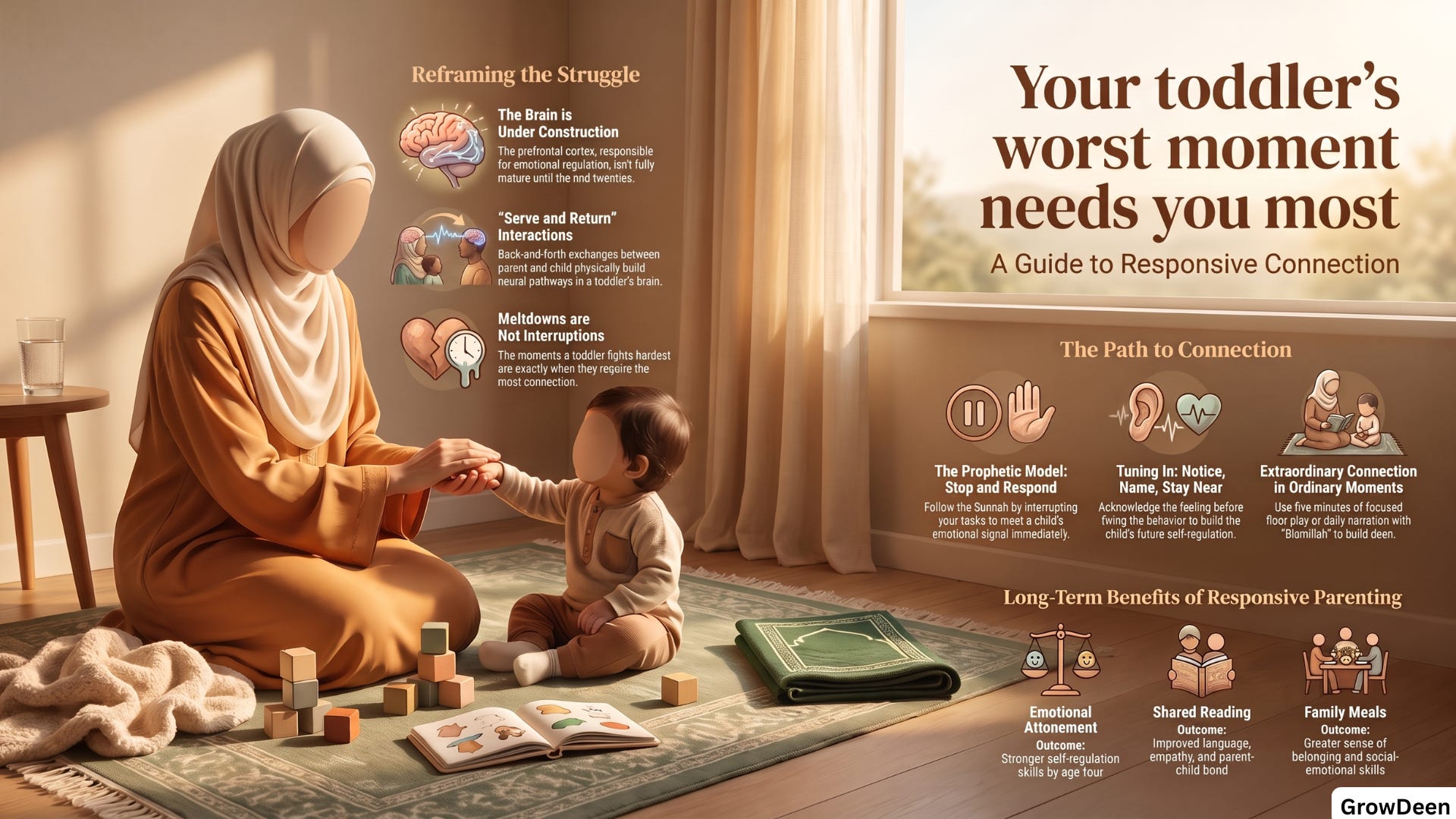
Harvard’s Center on the Developing Child found that the back-and-forth interactions between parent and child, what researchers call “serve and return,” physically build neural pathways in a toddler’s brain. [1] This guide shows you what that looks like during the hardest moments of your day, not just the easy ones.
You got on the floor. You made eye contact. You said exactly what the parenting account told you to say: “I can see you’re really frustrated right now.”
Your toddler screamed louder.
That’s not a failure. But it also isn’t what anyone warned you about, is it? The posts make it look like naming the feeling unlocks something. Like if you crouch down and use the right words, your child will blink, exhale, and calmly explain what’s wrong. In the real version, they throw the cup. Or they go limp. Or they arch their back so hard you can barely hold them.
Here’s what most of those posts leave out: the moment your toddler fights hardest is usually the moment they need you most. And that changes everything about how you think about connection.
Why does the same child who clings to your leg at the front door melt down completely the moment you finally sit down to play with them? That question sat with me for a long time. The answer, when I found it in the research, reframed how I understand toddlers entirely. I’ll come back to it.
Why This Guide Is Different
Every recommendation is backed by peer-reviewed research from 2019 to 2025, including a landmark 2023 study on how parents’ emotional attunement predicts their toddler’s self-regulation skills years later. [3]
The Islamic content isn’t decoration. Qur’an 93:6-8 and a Hasan-graded hadith from Jami’ at-Tirmidhi are woven into the practical advice because Islam has a framework for responsive caregiving that predates modern attachment theory by fourteen centuries.
This is not a tips list. It is a guide to understanding what is happening inside your toddler’s brain and body when they seem impossible to reach, and how the ordinary moments you already share are doing more than you realise.
What Your Toddler Is Actually Doing When They Push You Away
Let’s talk about what’s happening underneath the tantrums, the “NO!”, the going rigid when you try to help.
Your toddler is not rejecting you. They are discovering, with real confusion and intensity, that they are a separate person. They have preferences. They have a will. And their brain is not yet equipped to manage any of it gracefully. [2]
The prefrontal cortex, the part of the brain responsible for impulse control, emotional regulation, and rational thinking, will not be fully mature until your child is in their mid-twenties. [4] Your toddler is running the full spectrum of adult-level emotions on hardware that is still being assembled. When they fall apart, it is not because they are spoiled or because you have done something wrong. Their brain has been overwhelmed, and it has temporarily lost access to the thinking parts.
Let’s be honest. This isn’t just about your child’s behaviour. It’s about the knot in your stomach when you lose your patience. It’s the quiet voice at 10pm that asks: “Am I making this worse? Are they OK? Is something wrong with me?”
Nothing is wrong with you. And nothing is wrong with your child.
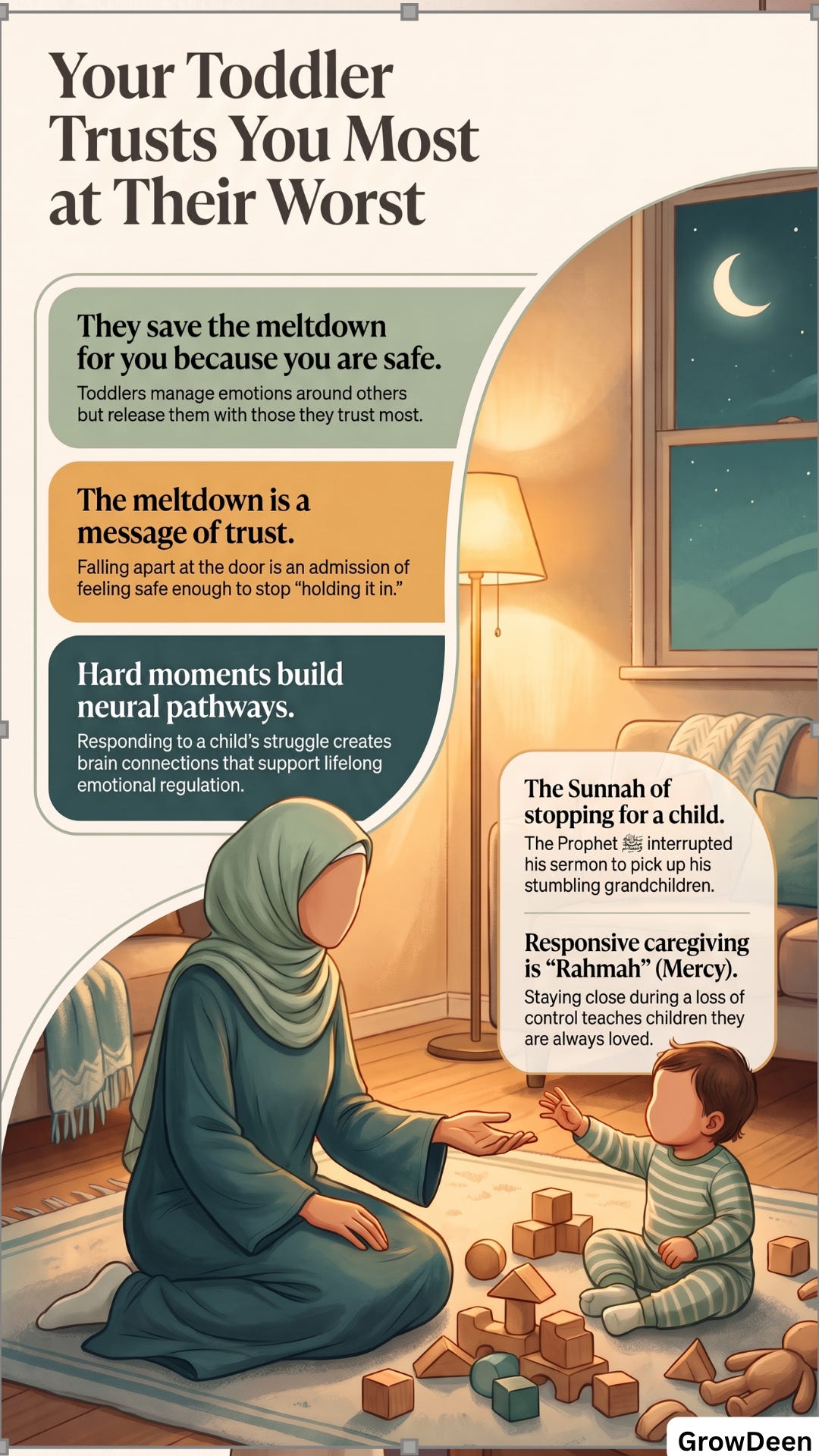
The villain here is not the tantrum. It’s the myth that connection with your toddler only counts when it happens in calm, sweet moments. That bedtime reading and gentle play are the “real” connection, and the meltdowns are the interruptions. They are not interruptions. They are the moments where connection matters most.
Their hardest moments need you most.
The Prophetic Model of Stopping Everything for a Child
Here is something the research supports and the Sunnah demonstrated fourteen centuries ago.
When your toddler stumbles, physically or emotionally, the most powerful thing you can do is stop what you are doing and go to them.
In a narration recorded in Jami’ at-Tirmidhi, the Prophet ﷺ was delivering a sermon from the minbar. The entire congregation was listening. His young grandchildren, al-Hasan and al-Husain, came walking toward him in their small red garments, stumbling the way toddlers do. He paused his speech. He came down from the minbar. He picked them both up. Then he told the congregation: “I saw these two walking and stumbling, and I could not continue until I had picked them up.” (Jami’ at-Tirmidhi 3774, Hasan) [11]
He did not send someone else to get them. He did not finish his point first. He interrupted his most important public role because two small children were struggling, and he could not bear to watch it without responding.
That is responsive parenting in its purest form. And researchers at Harvard call it exactly the same thing the Prophet ﷺ demonstrated: meeting the child’s signal with a response. [1] Every time you do it, you build something in your child’s brain that will last for the rest of their life.
I know remembering all of this during the hard moments feels impossible. That’s exactly why I created a free Toddler Connection Toolkit, a printable PDF with a daily connection quick-reference, a step-by-step guide for responding during meltdowns, and an Islamic reflection card you can keep where you’ll actually see it. Keep reading to find it at the end of this article.
What “Tuning In” Actually Looks Like at 6pm on a Wednesday
A 2023 study on parent-toddler emotional regulation found that parents who noticed and named their toddler’s emotional state, rather than immediately managing the behaviour, raised children with significantly stronger emotional skills by age four. [3]
Tuning in is not magic. It is ordinary. It looks like this:
Your toddler drops their banana and starts crying. Instead of “It’s OK, here’s more banana,” you pause. You say: “Oh no. Your banana broke. That’s really upsetting.” You wait. You let the feeling be there before you fix anything.
That pause is doing something invisible but real. You are teaching your child that their feelings are heard, that they do not have to scream to be noticed, and that someone calm is right there. Over time, this becomes the voice inside their head when they are upset, the steady presence that says “it’s OK, I can handle this.”
Now, back to the mystery from earlier. Why does the child who clings to your leg melt down the moment you sit down to play? Because you are their safe place. They hold it together around everyone else, and then fall apart with you because they trust you enough to do it. That is not a problem. That is the deepest compliment your toddler can pay you. [2]
In Islamic terms, helping your child through that meltdown is rahmah (mercy). You are not rewarding bad behaviour by staying close. You are teaching them that they do not lose your love when they lose control.
Their hardest moments need you most.
5 Ordinary Moments That Build Extraordinary Connection
You do not need a plan. You need presence. Research shows that small, frequent interactions build stronger bonds than occasional big gestures. [1][2]
Get on the floor during play. Follow their lead. If they want to stack and knock down the same tower nine times, you stack and knock down the same tower nine times. When something topples, say “Alhamdulillah!” When you start a new game, say “Bismillah.” They absorb what you live in front of them.
Narrate your life in Islam. “I’m making wudu now.” “We say Bismillah before we eat.” “Let’s say Alhamdulillah, that was yummy!” Every sentence is a serve-and-return exchange that builds both language and deen at the same time. [1][7]
Read together. A 2020 meta-analysis found that regular shared reading between parents and toddlers is linked to improved language, greater empathy, and a stronger parent-child bond. [8] Choose books that reflect your world: stories of the Prophets, Islamic picture books, nature books that invite reflection on Allah’s creation.
Eat together at the table. A 2024 study found that family meals are associated with stronger social-emotional skills and a greater sense of belonging in young children. [2] The family table is your toddler’s first classroom for adab: Bismillah, right hand, Alhamdulillah, sharing.
Prepare them for separations honestly. “I’m going to the shop. Grandma is here with you. I’ll be back after your nap.” Do not sneak away. Research shows that leaving without saying goodbye increases anxiety over time because your child cannot predict when you will disappear. [2] When you return, reconnect warmly: “I’m back! I told you I would come back.”
What Allah Taught Us About Responsive Caregiving
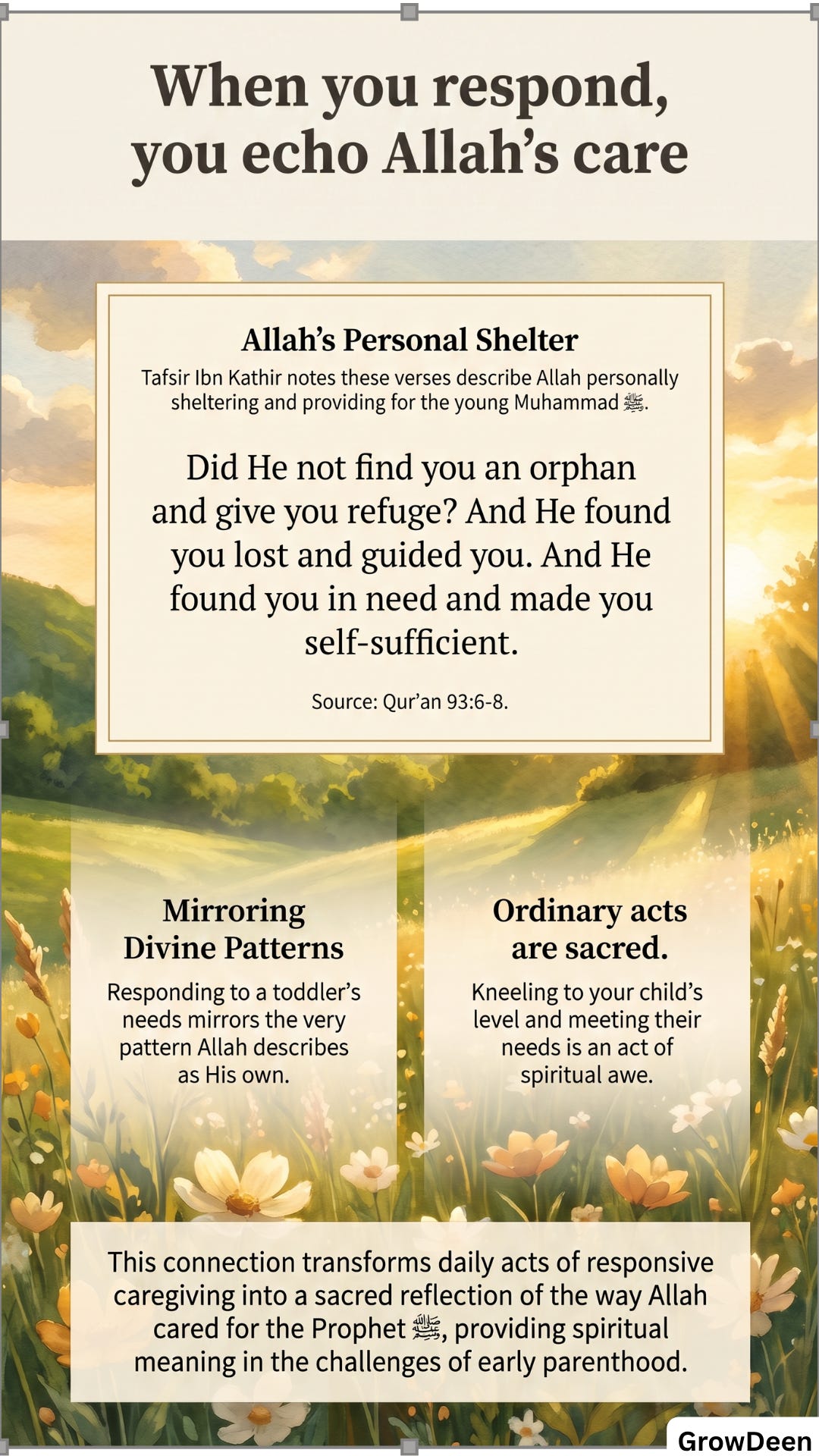
When I reflect on what responsive parenting really means, I keep coming back to three verses in Surah Ad-Duha. “Did He not find you an orphan and give you refuge? And He found you lost and guided you. And He found you in need and made you self-sufficient.” (Qur’an 93:6-8) [10]
According to Tafsir Ibn Kathir, these verses describe Allah’s personal care for the Prophet ﷺ during his early childhood. He was orphaned, and Allah placed him in the guardianship of his grandfather, then his uncle. He was without direction, and Allah guided him. He had nothing, and Allah provided.
This is the divine model of what every toddler needs from their parent. See them. Respond to what they need. Stay close. The research on responsive parenting and these verses are describing the same thing in different languages.
Your Toddler Connection Toolkit
If you’ve read this far, you’re the kind of parent who doesn’t just want to survive the toddler years. You want to build something in them that lasts. That tells me something beautiful about you.
Inside the Toddler Connection Toolkit (one comprehensive PDF, 3 pages):
Page 1: “5 Moments That Build Connection” — A daily quick-reference showing five specific connection micro-moments you can weave into morning, mealtimes, play, transitions, and bedtime, with the exact phrases to use. Designed as a fridge card you will actually see at the moments you need it.
Page 2: “Tuning In When They’re Melting Down” — A 3-step visual flowchart (Notice → Name → Stay Near) for responding to your toddler’s emotional overwhelm. Includes five example scripts for common meltdown triggers so you have the words ready when your brain is too tired to think of them.
Page 3: “He Could Not Continue Until He Had Picked Them Up” — An Islamic reflection card featuring the Tirmidhi 3774 narration of the Prophet ﷺ leaving the minbar for his stumbling grandchildren. A reminder that your child’s need is never an interruption. It is the whole point.
This isn’t just a PDF to download and forget. It’s a tool designed to stay on your fridge or your phone, where you’ll actually use it at 6pm on a Wednesday when it matters most.
This Toddler Connection Toolkit is what every subscriber receives with each article. We cover the full journey of raising Muslim children, from newborns through the early school years, backed by peer-reviewed research and rooted in the Qur’an and Sunnah.
If you’re a Muslim parent who wants both evidence-based guidance and an Islamic framework that goes deeper than “be patient,” subscribe for free so future resources arrive in your inbox before you need them.
Subscribe free for parenting resources backed by both science and Sunnah — guidance so unique, you literally can’t get it anywhere else. No spam, no clutter, just resources that matter.
Your Micro-Action for Tonight
Tonight, at some point before bed, get on the floor with your toddler. Not to teach anything. Not to correct anything. Just to be there, at their level, following their lead. If they hand you a block, take the block. If they run, follow. If they climb on you, let them. Five minutes. That is all. Say Bismillah when you sit down. Say Alhamdulillah when you stand up. Everything in between is connection happening.
May Allah place barakah in every ordinary moment you share with your child, and may He count your patience, your presence, and your love as worship that outlasts you.
Share This With Someone Who Needs It
Think of one person right now: the mother at the masjid whose toddler screams through every gathering and whose face tells you she thinks everyone is judging her. The friend whose WhatsApp messages say “I don’t know what I’m doing wrong.” The sister-in-law who hasn’t had a full conversation in months because her two-year-old needs her every second.
This article could change how they see their hardest parenting moments. Share it with them today. Not as advice. As love.
Frequently Asked Questions
Q: Is it normal for my toddler to have tantrums every day?
A: Completely. Tantrums are a normal, expected part of toddler development, not a sign that something is wrong with your child or your parenting. Their brain is experiencing emotions it does not yet have the wiring to regulate. [4] Most children begin to outgrow frequent tantrums between ages 3 and 4 as their prefrontal cortex matures. For more, see “What Your Toddler Is Actually Doing When They Push You Away” above.
Q: How do I connect with my toddler when they won’t let me comfort them?
A: Stay nearby without forcing contact. Sit on the floor within arm’s reach, keep your voice calm, and let them come to you when they are ready. Research shows that calm, available presence is more regulating for a toddler than physical holding when they are in the peak of overwhelm. [3]
Q: What is “serve and return” interaction?
A: It is the back-and-forth exchange between a parent and child where the child sends a signal (a look, a sound, a gesture) and the parent responds. Harvard’s Center on the Developing Child found that these exchanges physically build neural connections in a child’s brain. [1] Every time you respond to your toddler’s cues, you are literally building their brain.
Q: How can I teach my toddler Islamic values at this age?
A: Through modelling, not instruction. Say Bismillah before meals and activities. Say Alhamdulillah after. Narrate your wudu, your salah preparations, your daily routines as a Muslim. Your toddler absorbs what they see and hear you live, long before they can understand a lesson. [7]
Q: My toddler has terrible separation anxiety. Should I be worried?
A: Separation anxiety typically peaks between 12 and 24 months and is a healthy sign that your child has formed a strong attachment to you. [5] Help them by being specific about when you will return, keeping goodbyes warm and brief, and never sneaking away. It does improve with time and trust.
Q: How much time do I need to spend playing with my toddler each day?
A: Quality matters more than quantity. Research shows that even brief moments of genuine, focused attention, where you are truly present and following their lead, are more powerful than hours of distracted togetherness. [1][2] Five minutes of real presence beats an hour of being in the same room while checking your phone.
References
[1] Harvard Center on the Developing Child (2024). Serve and Return. https://developingchild.harvard.edu/science/key-concepts/serve-and-return/
[2] Kelly, C.L., Slicker, G., & Hustedt, J.T. (2024). Family experiences, parenting behaviors, and infants’ and toddlers’ social-emotional skills. Early Childhood Education Journal, 52(3), 603-615. https://doi.org/10.1007/s10643-022-01425-z
[3] Edvoll, M., Kehoe, C.E., Trøan, A.S., Harlem, T.E., & Havighurst, S.S. (2023). The relations between parent and toddler emotion regulation. Mental Health & Prevention, 30, Article 200266. https://doi.org/10.1016/j.mhp.2023.200266
[4] Peet, S.L., van Bakel, H.J.A., van den Akker, A.L., & Dirks, E. (2025). Parents’ and toddlers’ emotion regulation: The importance of emotion talk. Early Child Development and Care, 195(1-2), 92-107. https://doi.org/10.1080/03004430.2025.2459923
[5] Taintor, A., LaMarr, T., Ruiz, W., Marquez, M., Elam, E., Carnahan, A., & Seegers, A. (2023). Infant and toddler care and development. LibreTexts.
[6] Wagers, K.B., & Kiel, E.J. (2019). The influence of parenting and temperament on empathy development in toddlers. Journal of Family Psychology, 33(4), 391-400. https://doi.org/10.1037/fam0000505
[7] Fields-Olivieri, M.A., Cole, P.M., & Roben, C.K.P. (2020). Toddler emotion expressions and emotional traits: Associations with parent-toddler verbal conversation. Infant Behavior & Development, 61, 101474. https://doi.org/10.1016/j.infbeh.2020.101474
[8] Dowdall, N., Melendez-Torres, G.J., Murray, L., Gardner, F., Hartford, L., & Cooper, P.J. (2020). Shared picture book reading interventions for child language development: A systematic review and meta-analysis. Child Development, 91(2), e383-e399. https://doi.org/10.1111/cdev.13225
[9] DePasquale, C.E., & Gunnar, M.R. (2020). Parental sensitivity and nurturance. Future of Children, 30(2), 53-70. https://doi.org/10.1353/foc.2020.a807761
[10] Qur’an, Surah Ad-Duha 93:6-8 — https://quran.com/93/6
[11] Jami’ at-Tirmidhi 3774 — Graded: Hasan — https://sunnah.com/tirmidhi:3774
[12] Piaget, J. (1952). The Origins of Intelligence in Children. International Universities Press.