

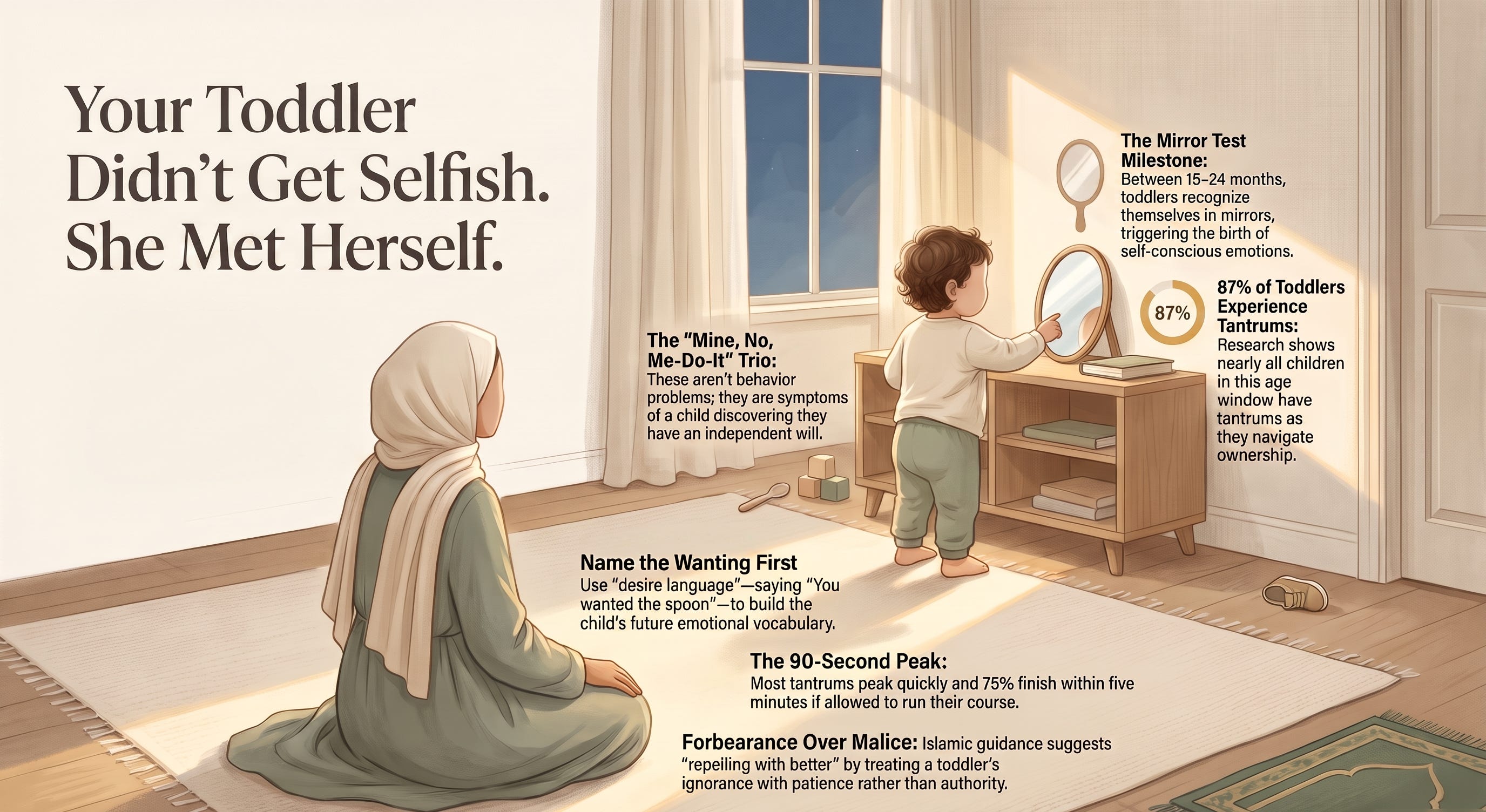
87% of 18 to 24 month olds have temper tantrums, according to a study of 335 children [1]. Here’s what your toddler just discovered about themselves, and the one sentence to say when it happens.
She wanted the spoon.
Not the food. Not the bowl. The spoon she had ignored for the entire meal, the one you were holding while you wiped the tray.
So you did the sensible thing. You crouched down to her level, kept your voice low, and offered her the spoon. And she screamed harder, because now you were holding it wrong, or handing it wrong, or the wrongness had moved somewhere she couldn’t name.
I want to say something to you before anything else: you did not cause this. You are not raising a selfish child. And the thing you are watching is not your parenting failing.
It’s your child arriving.
When researchers analysed parental accounts of tantrums in 335 children, they found that 87% of 18 to 24 month olds have them [1]. Not the difficult ones. Not the poorly-disciplined ones. Nearly all of them, in this exact window, for a reason that has almost nothing to do with the spoon.
Here’s the question I want you to carry through the rest of this article: why does a child who happily handed you her toys last month now clutch a spoon she doesn’t even want?
The answer is not what most parents are told.
Why This Guide Is Different
Built on the actual research, not folklore. Every claim here traces to a named study or clinical guideline, with the year and the numbers attached.
Islamic guidance that fits the moment, not decoration. The verse and hadith here were chosen because they speak directly to what you feel at 6pm, and both are verified: Sahih grading, Tafsir Ibn Kathir checked line by line.
A tool, not just a read. You’ll get the free Mine, No, Me-Do-It Pack to keep on the fridge, so the right words are in front of you before you need them.
The Experiment That Explains Your Entire Month
Let me tell you about a piece of research from the 1970s that I think about constantly.
A parent quietly wipes a spot of rouge onto a toddler’s nose. Then they stand the child in front of a mirror and watch.
Babies under about 15 months reach for the mirror. They see a spot on a nose, but it’s the other baby’s nose, the friendly one who lives in the glass. Somewhere between 15 and 24 months, that changes. The child reaches for their own nose instead [4].
That’s it. That’s the whole experiment. And it marks one of the largest things that will ever happen inside your child’s head.
But here’s the part that gave me chills.
Researchers later sorted toddlers by whether they passed that mirror test, then put both groups into situations built to produce embarrassment. Only the children who recognised themselves became embarrassed. The ones who didn’t, didn’t [3].
Sit with that for a second, because it explains everything.
You cannot feel embarrassed without a self to expose. You cannot feel guilty without a self who did the thing. And you cannot feel possessive without a self that the spoon belongs to.
Mine. No. Me do it.
Those aren’t three behaviour problems that arrived together by coincidence. They’re three symptoms of one event. Your toddler found out they exist.
Which brings us to the thing most parents are never told about those three words.
Three Words, One Discovery
“Mine”
You hand your toddler’s toy to a visiting cousin, and your child, who was across the room and not remotely interested, detonates.
Your stomach drops a little. You think: am I raising a child who doesn’t share?
Let me take that worry off you. Your toddler has just discovered ownership, and they’re doing what any person does with a brand new concept. Testing where its edges are. That’s not greed. It’s research.
Toddlers at this stage also start using “mine,” “me” and their own name, and researchers treat the arrival of that self-referring language as another marker of the same emerging self the mirror test picks up [4][8].
What to say: Name the ownership before you negotiate it. “That’s yours. You want to keep it.” Then, and only then, “Cousin would like a turn after you.”
What to skip: Forcing the handover in the first six seconds. You’ll get the toy back and lose the point.
“No”
This one stings differently, because it sounds like rejection.
It isn’t. “No” is the cheapest test available for a brand new hypothesis: I am a person, separate from you, and my wants are not automatically your wants. Your toddler is running that test twelve times a day because it’s genuinely new information.
What to say: Give the “no” somewhere safe to land. Offer two acceptable options instead of one instruction. “Shoes on the step, or shoes on the mat?” The separateness gets exercised. The shoes still go on.
What to skip: Turning every “no” into a contest of authority. You’ll win most of them and exhaust yourself doing it.
“Me do it”
Your toddler wrestles with a sock for four minutes, gets it halfway on, and howls.
You know the feeling. You reached in to help, and helping made it worse.
Everyday skills sit right at this fault line. Feeding themselves with a spoon or fork, drinking from a cup, pulling off socks and shoes, trying to help with dressing [10]. Each one asks your toddler to run small muscle control, big muscle control and thinking at the same time. That’s why they’re so slow, and it’s exactly why doing it for them removes the actual learning.
Toilet training readiness signs generally show from around two years, though some children show them nearer eighteen months [19]. Readiness belongs to the child, not the calendar.
What to say: “You’re doing it. I’m right here if you want me.”
What to skip: Rescuing at minute two. Rescue at minute five, and ask first.
I know that’s a lot to hold in your head at 6pm, when the sock is halfway on and your patience is halfway gone.
That’s why I put the whole thing on one page. The free Mine, No, Me-Do-It Pack is a printable that translates what your toddler is doing into what it actually means, with the words to say back. Keep reading, it’s yours at the end of this article, and it’s built to live on your fridge door rather than in a downloads folder you never open.
Support Muslim Parenting Lab ❤️
Think your amount is too small to matter? Give whatever you have with the button below.
The Prophet ﷺ said to shield yourself from the Fire even with half a date. (Sahih al-Bukhari 1417)
The One Sentence
And when researchers finally tested what parents say during these moments, what they found surprised me.
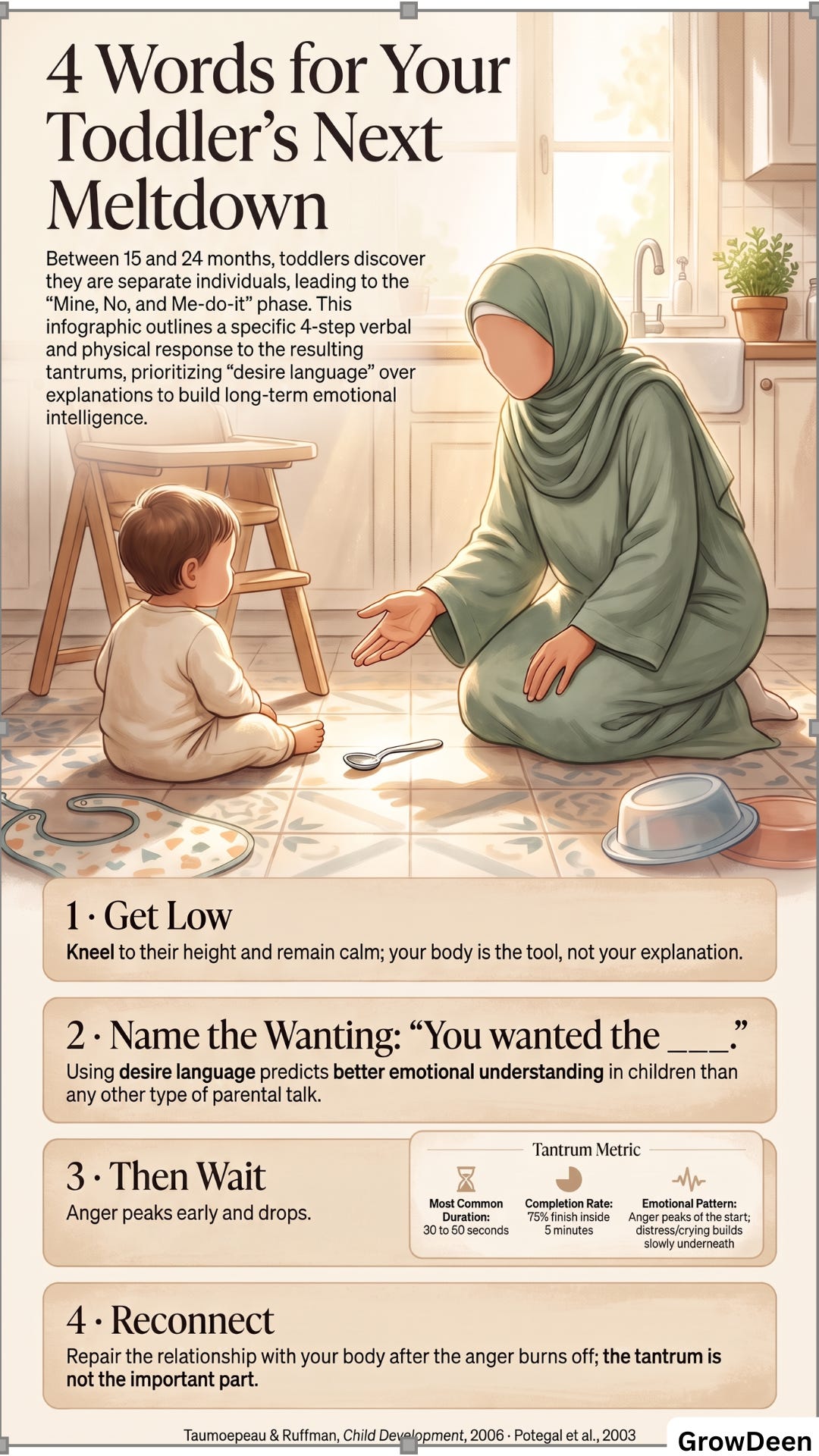
First, the shape of a tantrum. When researchers modelled the actual second-by-second structure of 335 tantrums, they found it isn’t one undifferentiated storm. Anger rises fast, peaks at or near the very beginning, then falls away. Distress, the crying and the wanting-to-be-held, builds slowly underneath and lasts longer [1].
That’s why the child who was rigid and screaming two minutes ago is now soft and climbing into your lap. Nothing was won or lost. The anger simply burned off first.
And most of it is over faster than it feels. The most common tantrum length in that dataset was between 30 and 60 seconds, and 75% finished inside five minutes [2].
So what do you actually say in those ninety seconds?
Here’s what changed my thinking. A 2006 study in Child Development followed 74 mothers and their children from 15 months to 24 months, recording how the mothers talked. One kind of talk stood out. Mothers who used desire language, the “you want” kind of sentence, when their children were 15 months old had children with measurably better emotion understanding and emotion vocabulary nine months later. It held up even after controlling for other explanations [5].
Talking about what the child wanted mattered more at this age than talking about what other people were thinking. That came later.
So the sentence is not a rule. It’s not a warning. It’s this:
“You wanted the spoon.”
That’s the whole thing. Get low, get close, go quiet, and name the wanting.
It sounds far too simple to be doing anything. It’s building the vocabulary your child will use, years from now, to understand feelings at all.
Name the wanting before you name the rule.
Then wait. Keep everyone safe and let it run its course. Reconnect afterwards with your body, not just your voice. The repair is the part that builds the relationship. The tantrum was never the important bit.
One line that isn’t negotiable, and I’d rather say it plainly than leave it out: never shake, hit, or verbally abuse a toddler. If you feel you might hurt your child, put them somewhere safe, leave the room, and breathe. Then call your spouse, a parent, a friend, your doctor, or a parenting support line in your country. That call is not a confession of failure. It’s the most competent thing you’ll do all week.
But there’s something underneath all of this that the research can’t quite reach.
Repel It With Something Better
Let’s be honest about the part nobody posts about. This isn’t only about your toddler’s behaviour. It’s about the knot in your stomach after you snapped, and the quiet fear that a calmer mother would have handled it better.
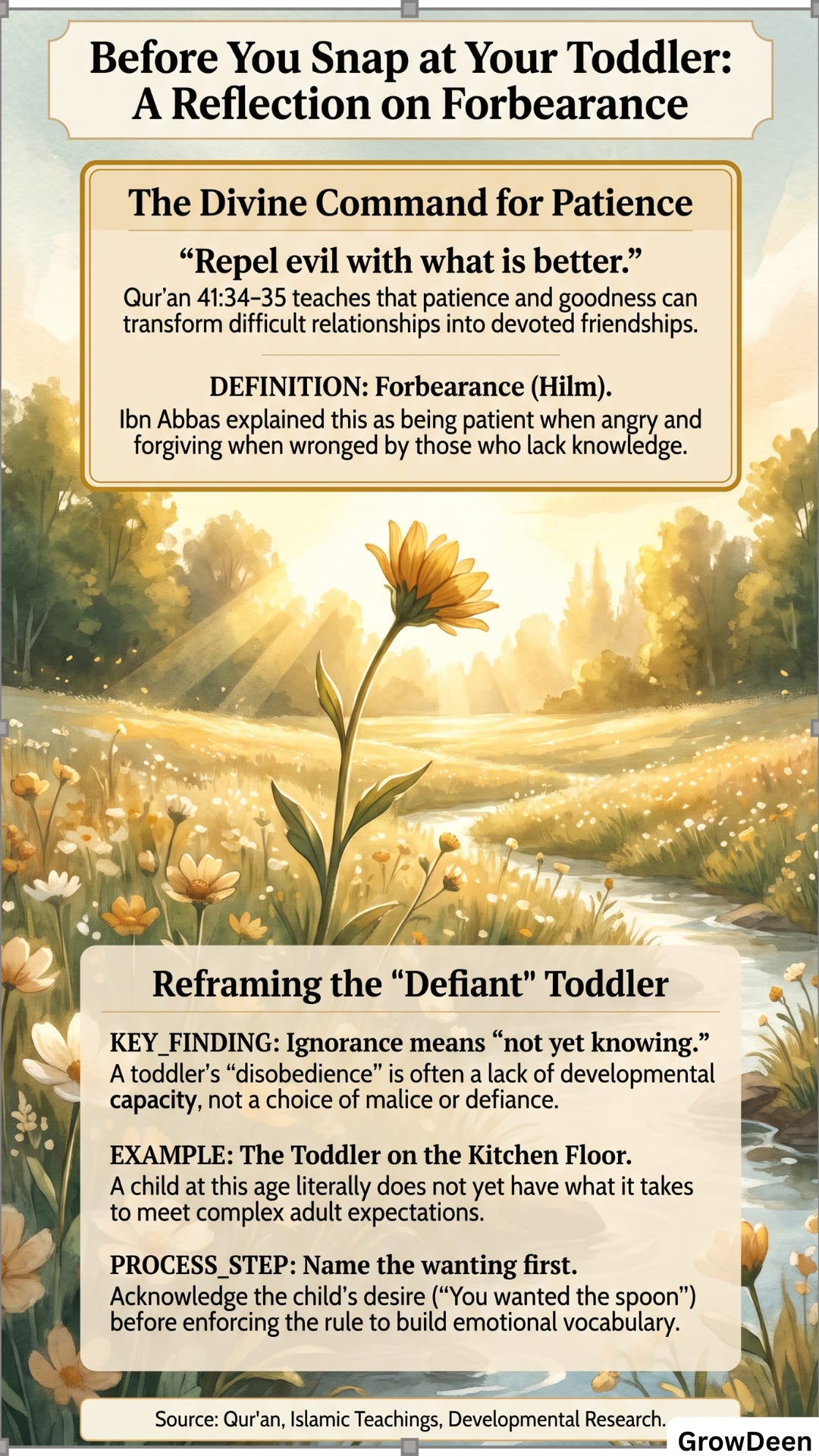
When I sit with that feeling, one verse keeps coming back to me. Allah says, “Good and evil are not equal. Repel evil with what is better, and then the one between whom and you there was enmity will become as though he were a devoted friend. But none is granted it except those who are patient” [17].
The verse isn’t addressed to parents, and your toddler is nobody’s enemy. What I take from it is the principle underneath. According to Tafsir Ibn Kathir, “repel evil with what is better” means that when someone treats you badly, you push it back by treating them well. Then, on the words about patience, Ibn Kathir records Ibn ‘Abbas (may Allah be pleased with him) explaining that Allah is commanding the believer to be patient when angry, forbearing when met with ignorance, and forgiving when wronged [17].
Forbearing when met with ignorance. Not malice. Not defiance. Not-yet-knowing.
I don’t know a more exact description of a twenty month old on a kitchen floor.
And the Prophet ﷺ said, “He who sets a good precedent in Islam has its reward, and the reward of everyone who acts on it after him, without any of their reward being reduced” [18]. He said it about charity, and scholars read it as a principle about starting something good that others carry on.
Your toddler is copying you more faithfully right now than they ever will again. Which means the Bismillah nobody heard still counts.
What This Actually Looks Like at 6pm on a Tuesday
You don’t need a new routine. You need a handful of fixed points and permission to let the rest be messy.
Talk through the boring parts of the day. Then add exactly one word to whatever your toddler gives you. They say “spoon,” you say “little spoon.” Next week, “little green spoon.” That one extra word is how vocabulary and grammar grow together [13]. At eighteen months most toddlers pick up roughly one or two new words a week [7][13]. By two, many are putting two and three words together [8].
Let them copy you on purpose. Pretend play starts in this window, and it runs on imitation. A toddler who’s watched you sweep will sweep, using a stick, with total professional seriousness [11][12]. So unroll the prayer mat where they can see it. Say Bismillah out loud. Drop the coin in the charity box while they’re standing next to you. It costs nothing extra, and it’s going in.
Watch the sound of your home. Plenty of toys sold as Islamic play melodies rather than recitation, so check before you buy. Quiet Qur’an recitation during the slow part of the afternoon does more, and a story you tell yourself beats a recording, because you can stop when your toddler points at something.
Move every day. Global guidance recommends at least 180 minutes of physical activity spread across the day for one and two year olds [20]. Also: childproofing is now a monthly job, not a one-time one. What was out of reach in January is a step-stool situation by June.
Skip the screens. Paediatric guidance recommends avoiding screen media other than video chat with family under 18 to 24 months [14]. Not because screens are sinister, but because a screen can’t respond to your specific child in a specific second, and responsiveness is where the entire value sits [16].
Praise the effort, not the child. Specific, sincere praise for effort supports motivation far better than a vague “good boy” [15]. Say what you actually saw. “You put the shoe on all by yourself.”
And go easy on yourself. Separation anxiety usually peaks near eighteen months and eases toward the second birthday [9]. A depleted parent has less of the exact thing this stage consumes most, which is patience. That’s arithmetic, not character. If you have signs of postnatal anxiety or depression, whether or not you gave birth, speak with your doctor.
When to Call Your Doctor
Most of what you’re seeing is ordinary. Some things are worth a conversation.
At 18 months: No single words. Cannot put two words together, like “More drink.” Doesn’t point, wave or gesture. Doesn’t follow a simple instruction. Doesn’t enjoy eye contact or cuddles. Isn’t showing feelings. Isn’t walking alone. Strongly favours one hand, which usually doesn’t appear until closer to two [7].
At 2 years: Isn’t putting two or more words together. Can’t follow a simple instruction. Isn’t showing feelings. Doesn’t come to you for comfort. Doesn’t copy actions or words. Doesn’t pretend during play. Can’t run, or manage stairs while holding on. Struggles with a crayon. Isn’t scribbling [8].
At any age: if your toddler loses a skill they once had, see a health professional.
Development unfolds in a broadly similar order in most children, but the timing varies more than milestone lists suggest [6][10]. If something feels wrong to you, have it looked at. Nobody has ever regretted asking too soon.
The Companion Pack
If you’ve read this far, you’re the kind of parent who wanted to understand your child before correcting them. That tells me something, and it’s not nothing.
Inside the Mine, No, Me-Do-It Pack (one comprehensive PDF, 3 pages):
Page 1: The Toddler Translator — A two-column decoder card matching eleven things your 18 to 24 month old does (grabbing “mine,” refusing shoes, going limp in the aisle, redoing what you did for them) to what each one actually means developmentally, plus the words to say back. Designed as a fridge card you can read in four seconds while holding a screaming child.
Page 2: Twelve “You Wanted” Sentences — Ready-made desire sentences for the twelve moments that most reliably trigger a meltdown at this age, from the nappy change to the supermarket to leaving the park. Built on the Child Development finding above, so you’re never standing there fumbling for words while the clock runs.
Page 3: The Repel It With Better Reflection Card — Qur’an 41:34 to 35 with Ibn ‘Abbas’s explanation of patience under anger and forbearance in the face of not-yet-knowing, alongside the Prophet’s ﷺ words on setting a good precedent, plus three things to do in front of your toddler this week so their copying works in your favour.
This isn’t a PDF to download and forget. It’s built to stay on your fridge door, at toddler eye level, where the hard moments actually happen.
Do This At The Next Meltdown
Don’t change anything about your routine tonight. Change four words.
The next time your toddler comes apart, get low, go quiet, and say: “You wanted the ___.” Fill in the blank with whatever they were reaching for. Then stop talking.
That’s the whole practice. You can do it in the next five minutes if the timing works out, and honestly, it usually does.
May Allah grant you patience on the days you have none left, and put barakah in every part of this that nobody sees.
Share This With Someone Who Needs It
Think of one person right now: the sister at the masjid who laughed too quickly when she said her two year old is “impossible,” or the friend whose voice notes have gone quiet because she’s embarrassed about how bedtime is going.
She isn’t looking for advice. She’s looking for someone to tell her that her child is normal and she isn’t failing. Send this to her today, not as a correction, but as company.
Frequently Asked Questions
Q: Why does my 18 month old say “mine” about everything all of a sudden?
A: Because they’ve just worked out that they’re a separate person who can own things, and they’re testing where ownership begins and ends. Self-recognition emerges between roughly 15 and 24 months [4], and possessiveness arrives with it. It’s a developmental achievement wearing a very annoying costume.
Q: Are temper tantrums normal at 18 months to 2 years?
A: Yes, and more common than most parents realise. In a study of 335 children, 87% of 18 to 24 month olds had tantrums [1]. If yours does, they are firmly in the majority of children this age.
Q: How long do toddler tantrums usually last?
A: Shorter than they feel. The most common length in that same research was 30 to 60 seconds, and 75% were over within five minutes [2]. Anger peaks near the start and drops away, while the crying builds slowly, which is why the ending is often softer than the beginning [1].
Q: What should I say to my toddler during a tantrum?
A: Say what they wanted, in as few words as possible. “You wanted the biscuit.” Research following 74 mothers and toddlers found that this kind of desire talk at 15 months predicted stronger emotion understanding by 24 months [5]. Reasoning, questions and explanations don’t land mid-tantrum, so save them.
Q: How many words should a 2 year old say?
A: By two, many toddlers use “I,” “you” and “me” and put two or three words together, like “Mummy car” [8]. Understanding always runs ahead of talking, so a child who follows your instructions but says little is doing more than it looks. If your two year old isn’t combining two words at all, that’s worth raising with your doctor.
Q: Is it too early to teach a toddler Islamic manners at 18 months?
A: It’s the ideal window, but through watching rather than instruction. Toddlers at this age learn by copying, and pretend play is essentially imitation of you [11]. Say Bismillah out loud, pray where they can see you, and let their mangled version stand without correction.
References
[1] Potegal, M., & Davidson, R.J. (2003). Temper tantrums in young children: 1. Behavioral composition. Journal of Developmental and Behavioral Pediatrics, 24(3), 140–147. https://doi.org/10.1097/00004703-200306000-00002
[2] Potegal, M., Kosorok, M.R., & Davidson, R.J. (2003). Temper tantrums in young children: 2. Tantrum duration and temporal organization. Journal of Developmental and Behavioral Pediatrics, 24(3), 148–154. https://doi.org/10.1097/00004703-200306000-00003
[3] Lewis, M., Sullivan, M.W., Stanger, C., & Weiss, M. (1989). Self development and self-conscious emotions. Child Development, 60(1), 146–156.
[4] Lewis, M., & Brooks-Gunn, J. (1979). Social cognition and the acquisition of self. Plenum Press.
[5] Taumoepeau, M., & Ruffman, T. (2006). Mother and infant talk about mental states relates to desire language and emotion understanding. Child Development, 77(2), 465–481. https://doi.org/10.1111/j.1467-8624.2006.00882.x
[6] Zubler, J.M., Wiggins, L.D., Macias, M.M., Whitaker, T.M., Shaw, J.S., Squires, J.K., et al. (2022). Evidence-informed milestones for developmental surveillance tools. Pediatrics, 149(3), Article e2021052138. https://doi.org/10.1542/peds.2021-052138
[7] Centers for Disease Control and Prevention. Important milestones: Your child by eighteen months. https://www.cdc.gov/ncbddd/actearly/milestones/milestones-18mo.html
[8] Centers for Disease Control and Prevention. Important milestones: Your child by two years. https://www.cdc.gov/ncbddd/actearly/milestones/milestones-2yr.html
[9] Carter, R.G., & Feigelman, S. (2020). The second year. In R. Kliegman & J.W. St Geme III (Eds), Nelson textbook of pediatrics (22nd edn, pp. 158–163). Elsevier.
[10] Sharma, A., Cockerill, H., & Sanctuary, L. (2022). Mary Sheridan’s from birth to five years: Children’s developmental progress (5th edn). Routledge.
[11] Skolnick Weisberg, D. (2015). Pretend play. WIREs Cognitive Science, 6(3), 249–261. https://doi.org/10.1002/wcs.1341
[12] Yogman, M., Garner, A., Hutchinson, J., Hirsh-Pasek, K., Michnick Golinkoff, R., et al. (2018). The power of play: A pediatric role in enhancing development in young children. Pediatrics, 142(3), Article e20182058. https://doi.org/10.1542/peds.2018-2058
[13] Zero to Three. (2022). Supporting language and literacy skills from 12–24 months. https://www.zerotothree.org/resource/supporting-language-and-literacy-skills-from-12-24-months/
[14] Council on Communications and Media, American Academy of Pediatrics. (2016). Media and young minds. Pediatrics, 138(5), Article e20162591. https://doi.org/10.1542/peds.2016-2591
[15] Henderlong, J., & Lepper, M.R. (2002). The effects of praise on children’s intrinsic motivation: A review and synthesis. Psychological Bulletin, 128(5), 774–795.
[16] Center on the Developing Child at Harvard University. (2017, updated 2021). Three principles to improve outcomes for children and families. https://developingchild.harvard.edu/resources/report/three-principles-to-improve-outcomes-for-children-and-families/
[17] The Noble Qur’an, Surah Fussilat 41:34–35, with Tafsir Ibn Kathir (Ibn Kathir treats 41:33–36 as one block). https://quran.com/en/fussilat/33/tafsirs
[18] Sahih Muslim 1017a, The Book of Zakat. Narrated by Jarir ibn Abdullah al-Bajali (may Allah be pleased with him). Graded Sahih. https://sunnah.com/muslim:1017a
[19] Choby, B.A., & George, S. (2008). Toilet training. American Family Physician, 78(9), 1059–1064.
[20] World Health Organization. (2019). Guidelines on physical activity, sedentary behaviour and sleep for children under 5 years of age. WHO
We combine scientific research with Qur’an and authentic Sunnah, and we cite our sources. Even so, this is general guidance and no substitute for a doctor who can examine your child.