

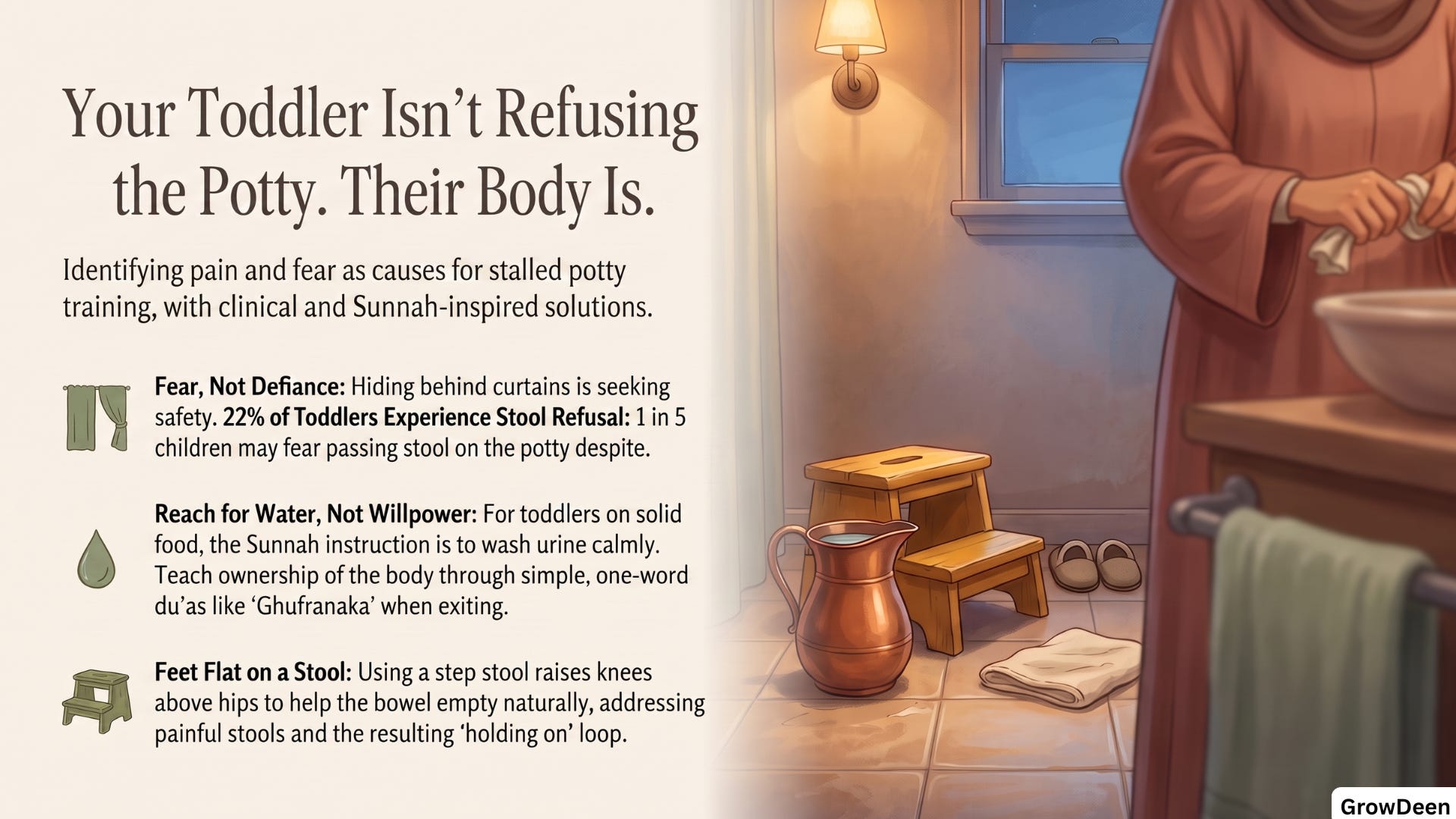
A 1997 Pediatrics study that followed 482 toddlers found 22% of them refused to pass stool anywhere except a nappy, sometimes for a month or longer. [1] This guide shows you the two hidden causes behind almost every stalled potty training, and the one thing the Sunnah tells you to reach for when there’s urine on the floor.
Your toddler is standing in a puddle.
Not a new toddler. This one has been using the potty for three weeks. Wees, no problem, every time you ask. But something changed on Sunday, and now there’s a wet patch spreading across the kitchen floor and a small person looking at you with an expression you cannot read.
You have done everything the guides said. Praise for sitting. No fuss over accidents. A sticker chart on the fridge that you refresh every Monday morning. You have been patient in a way you did not know you could be.
And it is going backwards anyway.
So you start wondering whether this is defiance. Whether a two-year-old can actually be doing this on purpose. That thought arrives with a hot flush of guilt behind it, because you know it is unfair, and you think it anyway at nine o’clock at night with kitchen roll in your hand.
Put that thought down. Almost every stalled potty training in the world comes down to one of two causes, and neither of them is your child’s will. One is a body problem hiding in plain sight. The other is fear, wearing a very convincing costume.
Here’s the question worth holding onto as you read: why will a child who happily wees on the potty walk to the corner of the room, hide behind the curtain, and refuse to poo anywhere except a nappy?
That answer is coming. It changes everything about what you do next.
Why this guide is different from generic potty training advice
Every claim is sourced. The timing evidence comes from a UK birth cohort of more than 8,000 children [7], a case-control study on urge incontinence [8], and a 2020 meta-analysis pooling 24,121 children [9]. No folk wisdom.
The Islamic guidance is verified, not decorative. The one hadith at the centre of this guide is graded Sahih, with the source and grading printed so you can check it yourself in a single click.
You get a tool, not just information. The free Potty Training Reset Pack is a three-page printable designed to hang on the back of your bathroom door, where the decisions actually get made.
The first hidden cause: a pain loop your child can’t explain
Think back to the first time your toddler strained on the potty and their face changed.
Maybe you did not notice. Most parents do not, because it looks like ordinary effort. But if a stool was hard enough to hurt on the way out, your child learned something in that moment that they will not have words for until they are four: the pain has a cause, and holding on prevents it.
So they hold on.
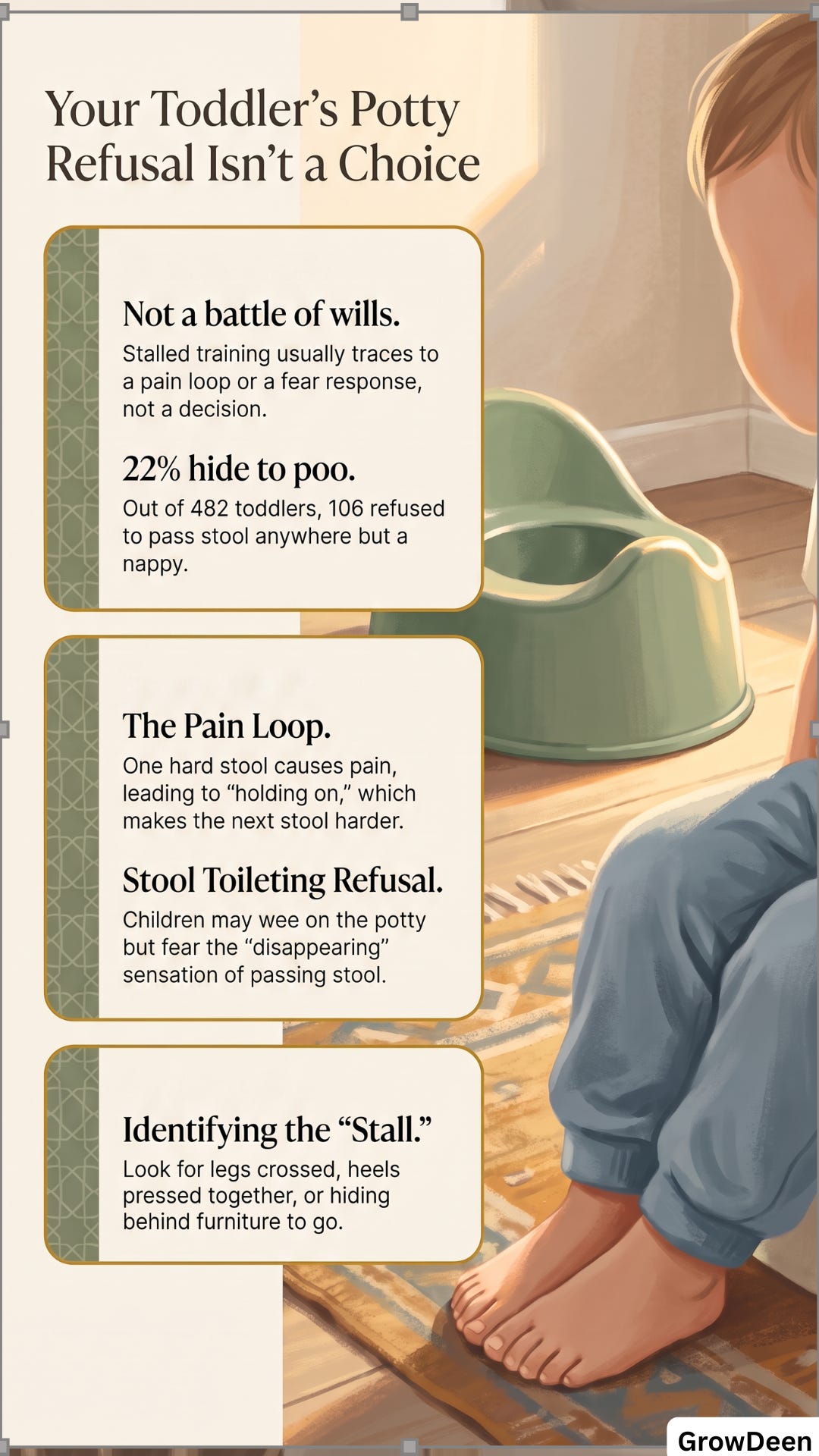
And here’s where it turns into a loop. A stool that sits longer in the bowel loses water. It gets harder. The next one hurts more than the last, which makes the holding on more determined, which makes the one after that harder still. Within a fortnight you have a child who screams at the sight of the potty and a parent who thinks the potty is the problem.
The potty was never the problem.
Clinical guidance on childhood constipation is direct about this: the constipation gets treated first, and toilet training either pauses or runs alongside the treatment. [4] Training laid on top of an untreated pain loop does not work, and pushing harder makes it worse.
What constipation actually looks like in a toddler:
Hard, pellet-shaped, or unusually large stools.
Straining, crying, or standing rigid with legs crossed and heels pressed together.
Fewer than three bowel movements in a week.
Smears in the underwear. This is usually softer stool leaking around a hard mass, not carelessness.
A refusal to sit that arrived suddenly rather than building slowly.
If you recognise two or more of those, speak to your doctor before you change anything else about your approach. Water, fruit, vegetables and whole grains help, but a child who is already impacted needs proper assessment, not a bowl of prunes.
One more practical thing, and it costs about eight pounds: put a step stool under your child’s feet.
Feet dangling in mid-air have nothing to push against. A child who cannot brace cannot generate the pressure the bowel needs to empty. Supported feet, with the knees sitting slightly above the hips, is the position clinical guidance recommends for exactly this reason. [4] Parents are often astonished at how much difference this one object makes.
But constipation only explains half of what you are seeing. The other half is the thing that makes parents cry in the bathroom.
The second hidden cause: the child who wees on the potty but hides to poo
Here’s the answer to the question from the opening.
A child who runs behind the curtain to fill their nappy is not being difficult. They are doing something so common that clinicians gave it a name. It’s called stool toileting refusal, and in that 1997 study of 482 toddlers, 106 of them, or 22%, went through at least a month of it. [1]
Roughly one child in five. In a room of ten toddlers, two are hiding behind the sofa.
Wees and poos are not the same task to a small child. A wee arrives and leaves. A poo involves sitting still, pushing, and then watching something that came out of their own body drop away and disappear with a loud noise. For a two-year-old who is only just learning where their body ends, that is unsettling.
Add any memory of pain to that, and the nappy starts to look like the safe option. Which it is, from their point of view.
What actually helps:
Give them the nappy when they ask for it. No negotiation, no sighing, no bargaining about tomorrow.
Keep the constipation treated. Fear and hard stools feed each other.
Let them stand in the bathroom with the door shut if that is what they need for now. The location can move later.
Praise that it happened at all, not where it happened.
Stop offering rewards for pooing on the potty. Rewards add pressure to the exact moment that already feels unsafe.
Most children move to the toilet on their own once the fear drains out of it. Your job in the meantime is to be the least worried person in the room.
That is a lot to hold in your head at nine at night, tired, with the laundry basket still full. Which is why there is a free printable called the Potty Training Reset Pack waiting at the end of this article, with a decision card that walks you through exactly this. Keep reading and it’s yours.
What the Sunnah does when there’s urine on the floor
Sooner or later, and possibly tonight, there will be urine on a carpet or a prayer mat, and Muslim parents tend to reach for their phone in that moment to find out what the correct response is. The answer is one short, authentic hadith, and it covers every child in your house.
‘Ali ibn Abi Talib (raḍiya Allāhu ‘anhu) narrated that the Messenger of Allah ﷺ said: “The urine of a boy is to be sprinkled with water and the urine of a girl is to be washed.” Qatadah added the clarification that the parent of a toddler needs: “That is if they are not yet eating solid food; if they are eating solid food then their urine is to be washed in both cases.” [Musnad Ahmad 563; graded Sahih (Darussalam)] [13]
Three situations, one report. A nursing boy before solids: sprinkled. A nursing girl before solids: washed. A boy or girl eating meals with the family: washed, both of them, in the ordinary way.
If your child is old enough for potty training, your child eats solid food. Washing is what applies in your kitchen tonight.
But notice the tone as much as the ruling. There’s no scandal in the report, no embarrassment, no lecture attached. A fact about a small body is stated, an instruction follows, and the matter closes.
That is the posture Islam hands you while you stand over a puddle with kitchen roll in your hand. Get water. Deal with it. Say nothing sharp.
Reach for water, not willpower.
The timing window nobody explains properly
Most parents are told to wait until the child is ready and leave it at that. The research is more specific than that, and it points in a direction that surprises people.
Deferring costs something.
A UK birth cohort study following more than 8,000 children found that starting after 24 months was associated with higher odds of persistent daytime wetting, delayed bladder control, and relapse during the school years. The association held even after adjusting for sex, developmental delay, temperament, and maternal depression. [7] A separate case-control study found that starting after 32 months was associated with urge incontinence, and recommended beginning before 32 months for any child already showing readiness. [8] A 2020 meta-analysis pooling 10 studies and 24,121 children found the same direction of effect. [9]
Now, before that turns into a new thing to feel behind on: pushing a child who is nowhere near ready has its own costs, and one clinic-based study found more voiding problems at both ends, in children trained before 24 months as well as after 35 months. [9]
So it’s a window, not a deadline. Roughly two years to two and a half is where the signs usually start showing. [2][3]
What readiness actually looks like:
Nappies dry for two hours or more, and dry after a nap.
Soft, formed stools at roughly predictable times.
Telling you something has happened, by word, gesture, or by going quiet in a corner.
Trousers up and down without help.
Following a two-part instruction.
A loud push for independence, usually including a great deal of “no”.
No single sign predicts success on its own. What matters is the trend across several of them. [2][3]
The situation the research is warning about isn’t the parent whose child isn’t ready yet. It’s the parent whose child has been ready for four months and life keeps getting in the way.
Support Muslim Parenting Lab ❤️
Would you like one parent, somewhere, to be guided because of you? Fund the articles that reach them, with the button below.
The Prophet ﷺ said one person guided through you is better for you than red camels, the greatest wealth of that time. (Sahih al-Bukhari 3701)
The routine that actually works at 8am on a Tuesday
You don’t need a method. You need anchors.
Attach the toilet to things that already happen instead of to a timer. On waking. After breakfast. Before you leave the house. After lunch. Before the nap. Before bed. A child who sits at fixed points isn’t being asked to make a decision each time, and most of the resistance disappears with the decision.
Learn the tells: wriggling, sudden stillness, passing wind, drifting toward a corner, a particular face you’ll recognise long before you could describe it.
When you see one, offer. Offer, don’t carry. A child taken to the potty against their will learns that the potty is something done to them.
For poos, use the body’s own clock. The bowel is most active in the twenty to forty minutes after a meal, so a sit about half an hour after eating catches the system while it’s already working. [12]
Keep sits to three to five minutes. Longer than that and a child starts experiencing the sitting as punishment, and you’ll spend the next week undoing it. [6]
Praise the sitting, not the result. “You sat on the potty all by yourself, mashallah.” The sitting is the only part your child controls, so it’s the only part worth reinforcing.
And dress them for it. Elastic waists, nothing with buttons or belts, nothing that needs adult hands. A child who can’t get their own trousers down in eight seconds will not make it in time.
Two du’as your child will keep for sixty years
This is the part that outlasts the potty, and it costs nothing extra because it happens in the same two minutes.
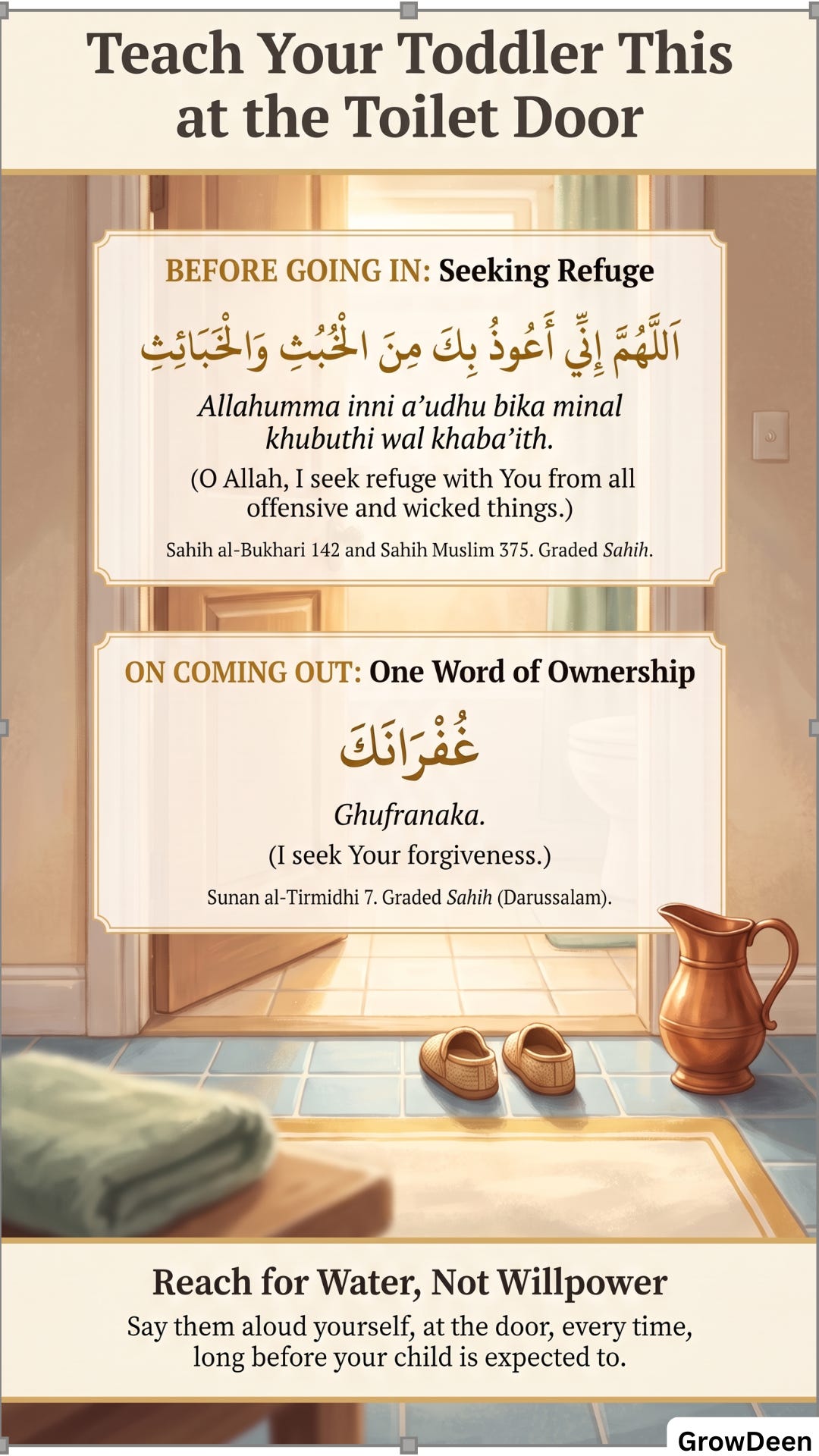
Say them out loud yourself, at the door, every single time, starting before anything at all is expected of your child. A phrase heard two hundred times gets learned without a single lesson.
Going in: Anas ibn Malik (raḍiya Allāhu ‘anhu) reported that whenever the Prophet ﷺ went to relieve himself, he would say: “Allahumma inni a’udhu bika minal khubuthi wal khaba’ith”, meaning “O Allah, I seek refuge with You from all offensive and wicked things.” [14]
Coming out: one word. ‘Aishah (raḍiya Allāhu ‘anhā) said that when the Prophet ﷺ came out of the toilet, he would say: “Ghufranaka”, meaning “I seek Your forgiveness.” [15]
One word. Which is exactly why it’s the first du’a most Muslim children own outright.
Keep the door shut and save the conversation for outside. A child who learns that early carries a quiet ownership of their own body that shows up years later in ways nobody traces back to a potty.
Night dryness is not a training problem
Here’s something that will take pressure off you tonight: staying dry overnight cannot be trained.
Daytime and night dryness are different achievements on different timetables. Overnight dryness depends on bladder capacity increasing, on the hormonal drop in overnight urine production, and on a sleeping brain learning to register a full bladder. None of that responds to effort, encouragement, or reward charts. [10]
So keep night nappies or absorbent bedding for as long as they’re needed, and stop treating it as unfinished business. The signal to try without is a nappy that’s dry first thing in the morning, several mornings running.
Bedwetting stays common well into the school years and usually isn’t a sign of anything wrong. [10]
One thing to avoid: do not restrict drinks to reduce accidents. Concentrated urine irritates the bladder and makes wetting worse, and fluid restriction is specifically advised against in bedwetting guidance. [10]
When to speak to a doctor
Hard or painful stools, or soiling after a period of being clean.
Straining, dribbling, or pain when passing urine.
Fever, an unpleasant smell, or blood in the urine.
Daytime wetting still happening regularly beyond five years.
Bedwetting continuing past five, or returning after a long dry stretch.
Real, persistent fear of the toilet that isn’t shifting.
Any wider worry about your child’s development.
None of this replaces medical advice, and there is nothing to gain by waiting when something feels wrong.
Your free Potty Training Reset Pack
If you’ve read this far, you’re the kind of parent who wanted to understand what was happening before deciding what to do about it. That’s rarer than you think, and your child is lucky to have it.
Inside the Potty Training Reset Pack (one comprehensive PDF, 3 pages):
Page 1: Body Problem or Battle of Wills? The Toddler Toilet Decision Card. A two-column tick-box card that walks you through the eleven signs distinguishing a constipation loop from stool toileting refusal, with the specific next step for each. Designed as a laminated card you can hang on the back of your bathroom door, where the decision actually gets made at 8pm.
Page 2: The Sunnah Bathroom Routine Card. The two authentic bathroom du’as in Arabic, transliteration, and English, alongside a six-step routine card covering water for istinja, wiping direction, and hand washing, so you can teach the full adab in the same two minutes it already takes, without looking anything up.
Page 3: The Water, Not Willpower Reflection Card. The complete hadith of ‘Ali ibn Abi Talib (raḍiya Allāhu ‘anhu) on a child’s urine with Qatadah’s clarification, the source and grading printed in full, and a short reflection tying calm in the bathroom to the amanah of purification. A card for you, not your toddler, for the evenings when your patience is thin.
This isn’t a PDF to download and forget. It’s designed to live on the back of your bathroom door, where you’ll actually reach for it.
This Potty Training Reset Pack is what every subscriber receives with each article. Muslim Parenting Lab covers the full span of raising Muslim children from birth through the early school years, all backed by peer-reviewed research and rooted in Qur’an and Sunnah.
Do this in the next five minutes
Go and look at your bathroom. Is there something solid under your child’s feet when they sit?
If not, that’s tonight’s job. A stack of books works until a step stool arrives. It is the smallest change in this entire article and often the one that moves things.
May Allah place barakah in your patience, accept what you are pouring into these small daily moments, and make the care you give more protective and more rewarded than it feels tonight.
Share this with someone who needs it
Think of one person right now: the sister at the masjid who mentioned her three-year-old is still in nappies and said it too quickly, the cousin whose group messages have gone quiet about potty training, the friend who joked last week that she’s given up.
She is probably somewhere in this article and doesn’t know it yet. Send it to her today, not as advice, but because you have both stood in that kitchen.
Frequently Asked Questions
Q: Does the sprinkling ruling apply to my toddler?
A: No. Sprinkling applies only to a boy who is still nursing and not yet eating solid food. Qatadah’s clarification attached to the same hadith is explicit: once a child eats solid food, the urine of both boys and girls is washed. [13] If your child is old enough for potty training, washing is what applies to you.
Q: At what age should I start potty training?
A: Readiness signs usually appear between two and two and a half years. [2][3] Once they’re clearly there, don’t keep deferring. Starting after 24 months is associated with more daytime wetting later, and starting after 32 months with urge incontinence. [7][8] Watch for the signs, then act on them.
Q: Why does my toddler wee on the potty but poo in their nappy?
A: That’s stool toileting refusal, and roughly 22% of toddlers go through it. [1] It’s fear, not defiance. Give them the nappy when they ask, keep any constipation treated, and stop rewarding poos on the potty. See “The child who wees on the potty but hides to poo” above for the full approach.
Q: How long does potty training usually take?
A: Anywhere from a few days to most of a year, and both are normal. Poos usually take longer than wees. [12] The child-paced approach works as well as faster methods and costs your child considerably less. [5][6]
Q: Should I use a reward chart?
A: For sitting and for wees, praise works well and a simple chart can help. For poos in a child who is refusing, drop the rewards entirely. Rewards add pressure to the moment that already feels unsafe. [1]
Q: My child was dry and has started wetting again. What happened?
A: Regression after illness, travel, a new sibling, or a house move is ordinary and usually short. Hold the routine steady without commentary and it generally passes. If it lasts beyond a few weeks, or your child is straining or in pain, speak to your doctor. [11]
Q: When should I stop night nappies?
A: When the nappy is dry first thing in the morning, several mornings running. Night dryness depends on bladder growth and overnight hormone changes, so it can’t be trained or hurried. [10] Bedwetting past five is worth a conversation with your doctor.
References
[1] Taubman, B. (1997). Toilet training and toileting refusal for stool only: A prospective study. Pediatrics, 99(1), 54-58. https://doi.org/10.1542/peds.99.1.54
[2] Kaerts, N., Van Hal, G., Vermandel, A., & Wyndaele, J.J. (2012). Readiness signs used to define the proper moment to start toilet training: A review of the literature. Neurourology and Urodynamics, 31(4), 437-440. https://doi.org/10.1002/nau.21211
[3] Barutcu, A., Mete, B., Demirhindi, H., Barutcu, S., Kidi, A., & Evliyaoglu, N. (2024). Toilet training readiness scale for 0-5-year-old children: A new measurement tool based on a child-centred approach. Children (Basel), 11(9), Article 1149. https://doi.org/10.3390/children11091149
[4] National Institute for Health and Care Excellence. Constipation in children and young people: diagnosis and management (clinical guideline CG99). https://www.nice.org.uk/guidance/cg99
[5] de Carvalho Mrad, F.C., da Silva, M.E., Moreira Lima, E., Bessa, A.L., de Bessa Junior, J., Netto, J.M.B., & de Almeida Vasconcelos, M.M. (2021). Toilet training methods in children with normal neuropsychomotor development: A systematic review. Journal of Pediatric Urology, 17(5), 635-643. https://doi.org/10.1016/j.jpurol.2021.05.010
[6] Stadtler, A.C., Gorski, P.A., & Brazelton, T.B. (1999). Toilet training methods, clinical interventions, and recommendations. Pediatrics, 103(S3), 1359-1361. https://doi.org/10.1542/peds.103.S3.1359
[7] Joinson, C., Heron, J., Von Gontard, A., Butler, U., Emond, A., & Golding, J. (2009). A prospective study of age at initiation of toilet training and subsequent daytime bladder control in school-age children. Journal of Developmental and Behavioral Pediatrics, 30(5), 385-393. https://pubmed.ncbi.nlm.nih.gov/19827219/
[8] Barone, J.G., Jasutkar, N., & Schneider, D. (2009). Later toilet training is associated with urge incontinence in children. Journal of Pediatric Urology, 5(6), 458-461. https://doi.org/10.1016/j.jpurol.2009.05.012
[9] Li, X., Wen, J.G., Xie, H., et al. (2020). Delay in toilet training association with pediatric lower urinary tract dysfunction: A systematic review and meta-analysis. Journal of Pediatric Urology, 16(3), 352.e1-352.e8. https://doi.org/10.1016/j.jpurol.2020.02.002
[10] National Institute for Health and Care Excellence. Bedwetting in under 19s (clinical guideline CG111). https://www.nice.org.uk/guidance/cg111
[11] American Academy of Pediatrics. Toilet training guidance for parents. HealthyChildren.org. https://www.healthychildren.org
[12] Burns, C.O., & Matson, J.L. (2017). Normal developmental milestones of toileting. In J.L. Matson (Ed.), Clinical guide to toilet training children. Autism and child psychopathology series (pp. 49-62). Springer.
[13] Musnad Ahmad 563. Narrated by ‘Ali ibn Abi Talib (raḍiya Allāhu ‘anhu), with Qatadah’s clarification attached to the reported text. Graded: Sahih (Darussalam). https://sunnah.com/ahmad:563
[14] Sahih al-Bukhari 142 (also Sahih Muslim 375). Narrated by Anas ibn Malik (raḍiya Allāhu ‘anhu). Du’a on entering the toilet. Graded: Sahih (muttafaqun ‘alayh). https://sunnah.com/bukhari:142
[15] Sunan al-Tirmidhi 7. Narrated by ‘Aishah (raḍiya Allāhu ‘anhā). Du’a on exiting the toilet. Graded: Sahih (Darussalam); Imam at-Tirmidhi graded it hasan gharib. https://sunnah.com/tirmidhi:7
We combine scientific research with Qur’an and authentic Sunnah, and we cite our sources. Even so, this is general guidance and no substitute for a doctor who can examine your child.