

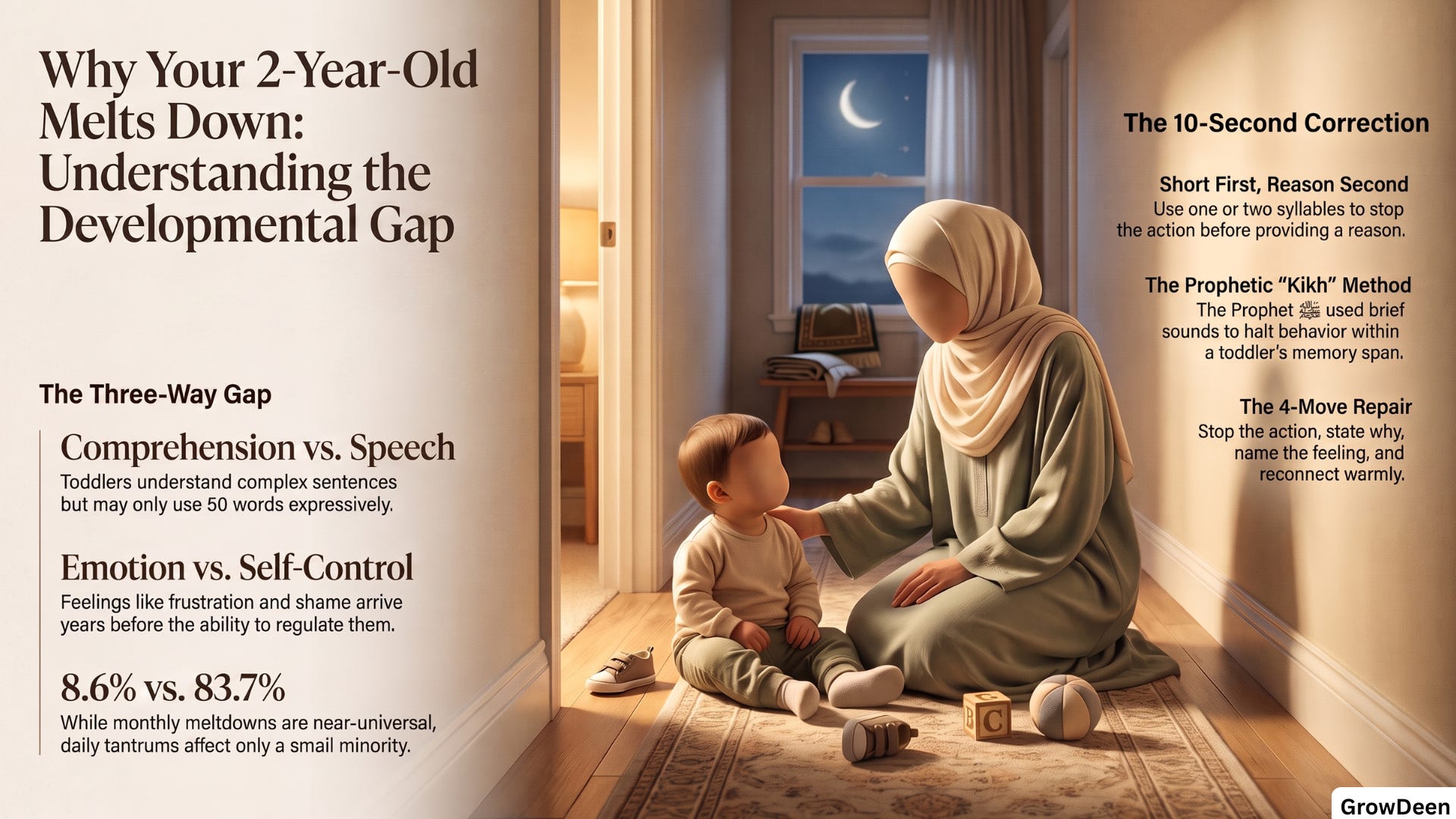
Northwestern researchers surveyed 1,490 preschoolers and found that 83.7% had a tantrum in the past month, but only 8.6% had them daily. [1] This guide explains the one developmental gap behind almost every hard moment between two and three, and what to say in the ten seconds after it opens.
The shoe was finally on.
Four minutes of grunting, of batting your hand away, of “me do it.” Then triumph. Then, about two seconds later, your child is face down on the hallway floor, howling, because the shoe is on.
You did not do anything wrong. You stepped back like the books say. You let them try. You even said the calm sentence in the calm voice.
And here is the part nobody warns you about: they understood every word you said. That is what makes it so maddening. Your child clearly knows what “we’re going to Nana’s” means. So when they collapse anyway, the story that arrives in your head is that this is deliberate.
It isn’t. When I read through the Wakschlag team’s data on nearly 1,500 preschoolers, the number that reframed this for me was not the 83.7% who had tantrums. It was the 8.6% who had them every day. [1] Meltdowns at this age are near-universal and, for most families, not constant. Which means they are almost never a sign of a broken child or a failing parent.
So why does a child who understands you fall apart the moment they get what they asked for?
Hold that question. I’ll come back to it.
What Makes This Guide Different
The research is current and specific. Milestone data from the CDC’s 2022 revision and the Pediatrics evidence-informed milestone study, vocabulary norms from the MacArthur-Bates inventories, and movement guidance from the WHO. [2][4][8][11]
The Islamic layer isn’t decoration. The Qur’an says something precise about why a two-year-old feels guilt before they can control themselves, and the Prophet ﷺ modelled a correction technique that fits a toddler’s memory span almost exactly.
You get a tool, not just an explanation. The free Two-to-Three Decoder Pack turns all of this into three printable pages you can keep on the fridge, including the ten-second script for the moment it goes wrong.
The Gap Nobody Explains to You
Here is the thing that changed how I read this whole stage.
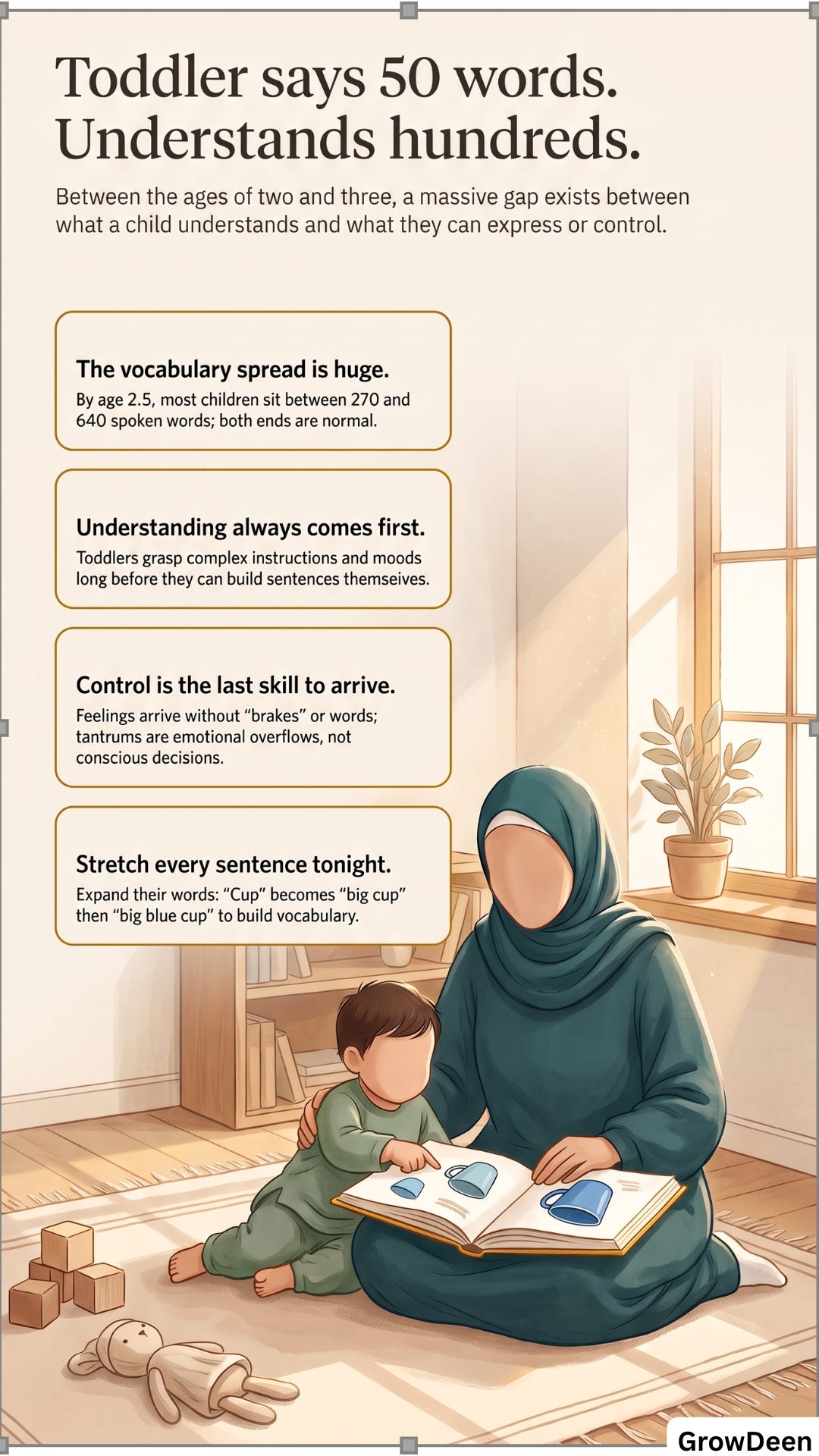
Your child’s comprehension runs far ahead of their speech. [3] They take in far more than they can produce. Around thirty months a typical child uses roughly 50 words in daily conversation and joins two words with an action word inside them, which is where “want milk” and “daddy go” come from. [4] Meanwhile they are following instructions, tracking your mood, and understanding sentences they could not build in a hundred years.
That is one gap. There is a second one running alongside it, and it is bigger.
Your child now feels frustration, anger, embarrassment, guilt and shame. [12] All of them. Often for the first time. And they have no word for a single one, no strategy for any of them, and no ability to pause between the feeling and the floor.
So: understanding arrives first. Speech arrives second. Control arrives last, sometimes years later.
They understand more than they can do.
That sentence is the whole year. The shoe went on, which felt enormous, and enormous feelings have nowhere to go in a body that small. The crying is not about the shoe. The crying is the overflow.
Now here’s what surprised me when I looked at the vocabulary research.
Why “About 50 Words” Is Wildly Misleading
The 50-word figure is a milestone marker, not an average. Norms from the MacArthur-Bates inventories tell a different story about what is actually happening underneath. From roughly eighteen months, children start adding thirty to forty new words a month. By two and a half, the average expressive vocabulary sits near 500 words, with eight in ten children falling somewhere between 270 and 640. [2]
Read that spread again. 270 to 640. Both ends are normal.
By three, sentences stretch to three, four, five words. Conversational turn-taking appears. [5] Your child starts reporting on things that are not in the room, which is a genuine leap. “Grandma at the shops.” That is a dispatch from a place you cannot see, filed by someone who was there.
Storytelling comes last and comes rough. “I go shop.” What did you do at the shop? “Buy milk.” That is the entire story, and by three most of the detail still falls out on the way. [3]
But if understanding runs ahead of speech, your instructions have to be built for the speech end, not the understanding end. Which brings me to something the Prophet ﷺ did with a small child that I cannot stop thinking about.
The Ten-Second Correction the Prophet ﷺ Modelled
Picture your own version first. Your child is about to put something in their mouth that should not go there. What comes out of you is usually a paragraph. “No, put that down, that’s not for eating, we don’t eat that, do you understand me?”
By word six, your toddler has lost the thread.
Abu Hurayrah (may Allah be pleased with him) narrated that al-Hasan ibn Ali, still a small child, took a date from the dates given in charity and put it in his mouth. The Prophet ﷺ said, “Kikh, kikh,” which is a short sound used to stop a small child from putting something unfit in the mouth, so that he would throw it out. Then he asked whether al-Hasan did not know that they do not eat what is given in charity. [14]
Look at the order. One syllable, doubled. Short enough to sit in a toddler’s working memory. The action stops. Then, and only then, the reason.
The reason still gets given. It is just not asked to do the stopping.
That is the design principle for every instruction you give this year. Short first. Reason second. One idea at a time. “Shoes on. We’re going to Nana’s.” Not the whole schedule.
Before We Go Further
I know this is a lot to hold in your head at 4pm with a screaming toddler on the hallway floor. That is exactly why I put the whole thing on paper.
At the end of this article you can download the free Two-to-Three Decoder Pack, a three-page printable that includes the ten-second script, a decoder for the five flashpoints that go wrong most often, and a page you’ll want to keep. It’s built for the fridge door, not the bookshelf.
Keep reading. There’s something in the Qur’an about this stage that I did not expect to find.
The Conscience Allah Placed Before the Control
Something quiet happens around this age that most parents notice without naming it.
Your two-year-old hits a sibling. Then hides behind the door.
Nobody taught them to hide. That flinch is evidence of something already working inside them, and Islam is precise about what it is. Allah swears by the sun, the moon, the day, the night, the sky and the earth, and then swears by something much smaller and much closer:
“And by the soul and He who proportioned it, and inspired it with discernment of its wickedness and its righteousness.” [Qur’an 91:7-8] [13]
According to Tafsir Ibn Kathir, this means Allah showed the soul both its transgression and its God-consciousness, clarified this for it, and guided it toward what was ordained. Ibn Kathir records Sa’id ibn Jubayr’s reading that Allah gave the soul the inspiration to see good and evil, and Ibn Zayd’s reading that Allah placed its fujur and its taqwa within it. [13]
So the conscience is already there. It arrived, like the understanding, ahead of the control.
Which makes your job smaller and more precise than it feels. You are not installing a moral sense in your child this year. You are keeping the room quiet enough that they can hear the one Allah already put inside them, while it is still very faint and very easily drowned out by shouting.
I find that genuinely steadying on the bad days. May Allah make our voices gentle in the moments when gentleness costs us most.
Support Muslim Parenting Lab ❤️
Is there something in your record you would like wiped? Give any amount today with the button below.
The Prophet ﷺ said charity extinguishes sin as water extinguishes fire. (Jami’ at-Tirmidhi 2616, hasan)
The Body Runs Ahead Too
The same gap shows up in muscles.
Your child can now run and mostly stay upright, climb stairs with both feet on each step while holding the rail, kick a ball, jump on the spot, and stand on one leg for about a second, always announced. [6] They can also, for the first time, want to do something they cannot yet do. That combination is why so many of the hardest moments happen near a staircase, a coat zip, or a car seat buckle.
Here’s the part I underestimated for a long time. Their capability genuinely is growing week by week, and they know it. A child who discovers on Tuesday that they can climb higher than they could on Sunday is a child collecting evidence about themselves. [6]
The WHO recommends at least 180 minutes of physical activity across the day for children aged one to four, with screen time held to no more than an hour and less being better. [8] Three hours sounds impossible until you count what you already do. The walk to the shop. Twenty minutes in the garden. The running that happens up and down your hallway whether you approve it or not.
For a Muslim home, this is also where a lot of tarbiyah quietly happens. A child outdoors is a child looking at Allah’s creation at the exact age when everything is astonishing. Point at the moon and say who made it. Point at the ants, the rain, their own fingers. You are not teaching theology. You are attaching Allah’s name to sorting work their brain is doing anyway, at the age when it costs nothing.
The same applies indoors. Your child cannot perform wudu correctly and is not obliged to. They can be handed a small jug and allowed to copy you. They can have a small prayer mat next to yours. Children this age copy the adults they identify with constantly, so a father’s wudu and a mother’s salah are being learned right now whether or not anyone thinks they are teaching.
And when researchers looked at the one activity that seems to close the gap fastest, the answer was not a flashcard.
Pretend Play Is Where the Gap Narrows
When your child feeds a doll, they are holding two facts at once. This is moulded plastic. This is a baby who is hungry.
That double-hold is where abstract thought starts, and pretend play tracks with language, social understanding and flexible thinking. [9] I want to be honest about the limits here, because a major review argued that a lot of the research claiming pretend play drives development is weaker than it’s usually presented. [10] Fair enough. The narrower claim still stands: pretend play is where an enormous amount of your child’s thinking, vocabulary and negotiation actually happens at this age.
Playing with other children is where sharing gets attempted, badly, with help. Your child still needs you close enough to mediate. [9] Expecting unsupervised fairness at two and a half is expecting a skill nobody has built yet.
So get on the floor. Play the game they invented, the one with no rules that changes every ninety seconds. That is not time taken away from raising your child. That is the raising.
One note for a Muslim home: swap music-based play for what serves this age better anyway. Parent-led storytelling. Spoken rhythmic phrases. Islamic picture books. The stories of the Prophets, told in your own words, in two minutes.
So what does all of this actually look like on a Tuesday evening?
What This Looks Like at 8pm
The routine you already have is enough. You just use it on purpose.
Bismillah out loud at dinner, said by both of you, not just recited over the child. Right hand. Eating from what’s in front of them. Alhamdulillah at the end. Your child feeds themselves and also the floor, and the floor is part of the deal.
One chore they can do badly. Sweeping, carrying a cup to the sink, wiping a table. Thank them properly for it. A toddler who has just carried the laundry basket four steps is walking around inside an achievement.
Twenty minutes of floor time on their terms. Stretch every sentence they hand you: “chair” becomes “big chair” becomes “big red chair.” [3] Reply to everything, including the parts you cannot understand.
Then, when it goes wrong, four moves in about ten seconds:
Stop it. One short instruction. Two or three words.
Say why. One short reason, straight after. [14]
Name the feeling. “You’re angry because we had to leave.” You are handing over the word whose absence caused the tantrum.
Repair. Come back warm. Correction lands inside a relationship. Warm relationship, and it reads as information. Cold one, and it reads as noise.
And praise the specific thing. “You waited so nicely for your turn” tells a child what to repeat. “Good girl” does not. [6]
When the Gap Is Too Wide
Most of this year is ordinary. Some of it is worth a phone call.
Speak to your doctor about your two-year-old if they: are not putting two or more words together, cannot follow a simple instruction like “get your shoes,” do not copy actions or words, do not pretend during play, are not showing feelings, do not come to you for comfort, cannot run or manage stairs while holding on, struggle with a pencil or crayon, or have trouble seeing or hearing. [4][6][11]
Speak to your doctor about your three-year-old if they: are not using three-word sentences, do not understand a two-part instruction like “get your shoes and put them in the box,” are often hard for family to understand, do not make eye contact, show no interest in other children, do not pretend during play, trip or sway often when running, or are not drawing simple shapes. [5][6][11]
Also mention it if tantrums are happening every day. That falls outside the typical pattern, and it is worth a conversation rather than a wait. [1]
And if your child has lost a skill they previously had, see a health professional promptly. [11]
Booking that appointment is not a failure of tawakkul. Taking the means and then relying on Allah is the pattern Islam teaches everywhere else. A referral is a means.
The Part Nobody Puts in the Milestone Charts
Let’s be honest about something. This isn’t only about your child’s behaviour.
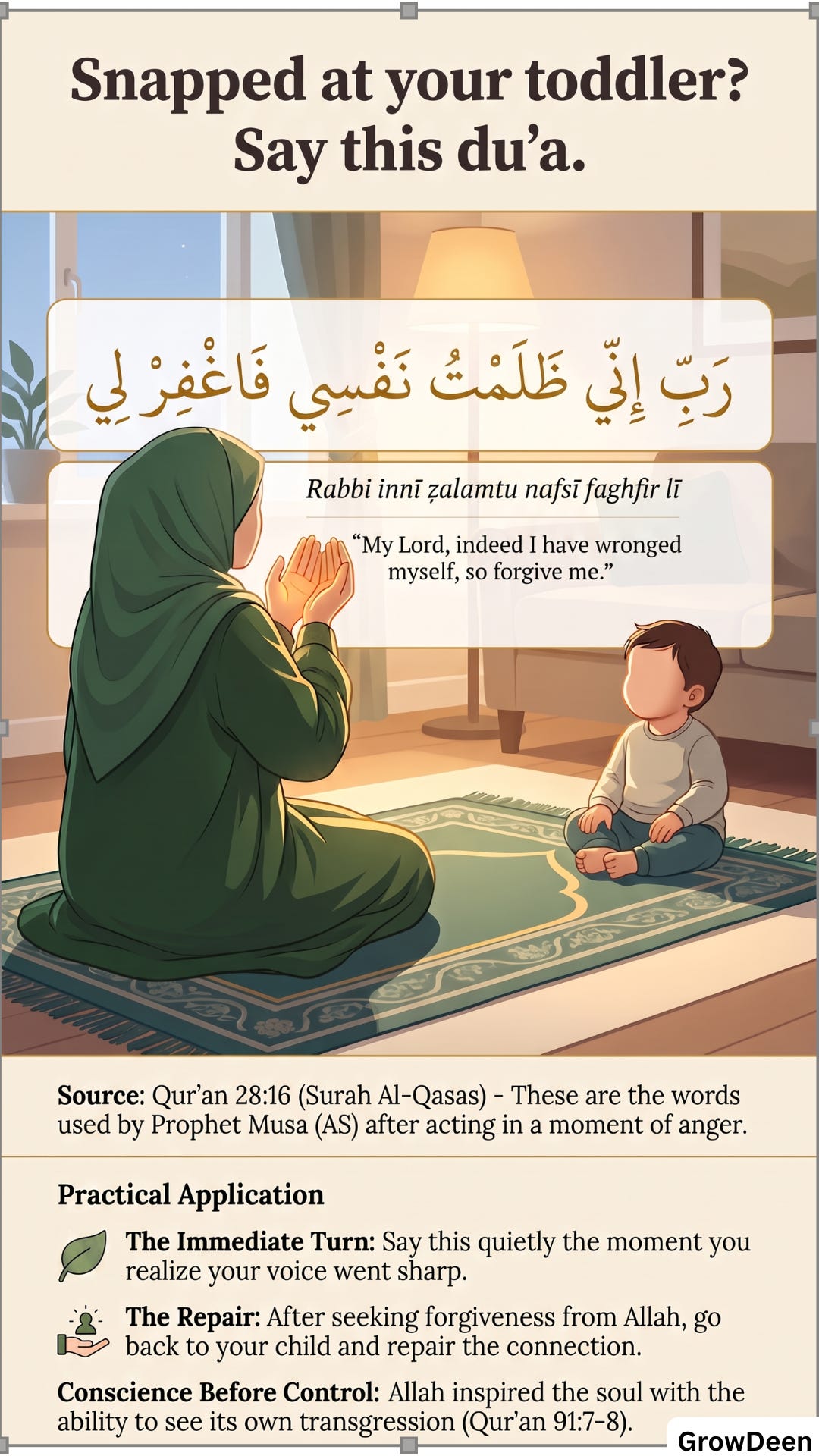
It’s about the knot in your stomach at 5pm when you hear your own voice go sharp. It’s the guilt afterwards, sitting in the dark, thinking you should be better at this by now.
You are not failing. You are running a nervous system that has been on since 6am, opposite a person who has just discovered they have opinions.
A young child’s development rests on the quality of the relationships around them, and those relationships depend on the state of the adults inside them. [7] More than a million new neural connections form every second in these earliest years, and they form fastest when a child does something and gets a warm response back. [7] Which means your steadiness is not a nice-to-have. It’s the mechanism.
So write down the people you can call. Your spouse, a friend, a relative, a doctor, a counsellor. Put the list somewhere visible before you need it, because the day you need it is the day you will not go looking. And if low mood or anxiety has been sitting on you since the baby came, whether or not you gave birth, tell your doctor. It is common, it is treatable, and treating it helps your child as much as it helps you.
Never shake, hit, or verbally abuse a toddler. If you feel you cannot cope, put your child somewhere safe, step out of the room, and breathe.
The Companion Pack
If you’ve read this far, you’re the kind of parent who wanted an explanation rather than a technique. That tells me something good about you.
Inside the Two-to-Three Decoder Pack (one comprehensive PDF, 3 pages):
Page 1: The Understands vs Can Do Map — a four-quadrant visual showing what your child understands and what they can actually do at two and at three, across voice, body, pretend and conscience, with the red-flag markers for each age set right beside them. Designed as a fridge card you can photograph and take to a doctor’s appointment.
Page 2: The 4PM Decoder — the five flashpoints that go wrong most often, each with three columns: what you saw, what was actually happening underneath, and the exact words for the next ten seconds. So you’re reading a line instead of composing a sentence while someone screams.
Page 3: The Small Conscience Card and Seven-Day Tarbiyah Rhythm — the verse and Prophetic narration from this article, laid out in English with full source references, plus a seven-day grid of one tiny Islamic habit a day (Bismillah out loud, “Allah made that,” the small jug, the mat beside yours) that takes under a minute each and compounds across the year.
This isn’t just a PDF to download and forget. It’s a tool designed to stay on your fridge, where you’ll actually use it when you need it most.
This pack is what every subscriber receives with each article. Muslim Parenting Lab covers the full arc of raising young Muslim children, newborn through the early school years, with every piece grounded in peer-reviewed research and verified Qur’an and Sunnah.
One Thing to Try Tonight
The next time your child melts down, before you explain anything, say one sentence: “You’re upset. I’m here.”
That’s it. Don’t fix, don’t reason, don’t negotiate. You are handing over the word they don’t have yet, which is the whole job this year. They understand more than they can do, and you are closing that gap one word at a time.
May Allah place barakah in your effort, make your patience easier than it feels tonight, and make these small children a coolness to your eyes.
Share This With Someone Who Needs It
Think of one person right now: the sister at the masjid whose two-year-old had a meltdown in the shoe rack area last week while she apologised to everyone, or the friend who texted you at 9pm asking whether it’s normal that her son only says about twenty words.
This article could take a weight off them tonight. Send it, not as advice, but as company. Sometimes the kindest thing we can do is tell another parent that the thing frightening them has a name and a reason.
Frequently Asked Questions
Q: How many words should a 2-year-old say?
A: Milestone tools use about 50 words at 30 months as the marker, but that’s a floor, not an average. [4] Vocabulary norms show most children sit near 500 words by two and a half, with eight in ten between 270 and 640. [2] Both ends of that range are normal. What matters more is whether words are still being added and whether two-word combinations have appeared.
Q: Is it normal for a 2-year-old to have tantrums every day?
A: Common, but not typical. In a survey of 1,490 preschoolers, 83.7% had tantrums sometimes while only 8.6% had them daily. [1] Daily tantrums are worth mentioning to your doctor, not because something is definitely wrong, but because that’s the threshold where extra support tends to help.
Q: Why does my toddler melt down after getting what they wanted?
A: Because the feeling is bigger than their capacity to hold it, and they have no word for it. Understanding and emotion both arrive before speech and self-control at this age. [3][12] The tantrum is overflow, not manipulation. See “The Gap Nobody Explains to You” above.
Q: When should I worry about my 3-year-old’s speech?
A: If they aren’t using three-word sentences, can’t follow a two-part instruction like “get your shoes and put them in the box,” or are often hard for family and friends to understand, book an appointment. [5][11] Early help is easier help, and nobody will think you overreacted.
Q: How much screen time is okay for a 2 or 3 year old?
A: The WHO advises no more than one hour of sedentary screen time a day for this age, with less being better, alongside at least 180 minutes of movement. [8] For a Muslim home, I’d add: whatever screen time you allow, keep it music-free and parent-approved rather than autoplay.
Q: What’s the Islamic way to discipline a 2-year-old?
A: Short, immediate, and warm. The Prophet ﷺ stopped a small child with one brief sound and gave the reason straight after. [14] Stop the action first, explain in one short sentence, name the feeling, then repair the connection. Shaming a two-year-old works against a conscience that has only just arrived. [13]
References
[1] Wakschlag, L.S., Choi, S.W., Carter, A.S., Hullsiek, H., Burns, J., McCarthy, K., Leibenluft, E., & Briggs-Gowan, M.J. (2012). Defining the developmental parameters of temper loss in early childhood: Implications for developmental psychopathology. Journal of Child Psychology and Psychiatry, 53(11), 1099-1108.
[2] Marchman, V.A., Dale, P.S., & Fenson, L. (2023). MacArthur-Bates Communicative Development Inventories: User’s Guide and Technical Manual (3rd ed.). Brookes Publishing.
[3] Duryea, T.K. (2024). Emergent literacy including language development. UpToDate. https://www.uptodate.com/contents/emergent-literacy-including-language-development
[4] Centers for Disease Control and Prevention. (2022). Important milestones: Your baby by thirty months. https://www.cdc.gov/ncbddd/actearly/milestones/milestones-30mo.html
[5] Centers for Disease Control and Prevention. (2022). Important milestones: Your child by three years. https://www.cdc.gov/ncbddd/actearly/milestones/milestones-3yr.html
[6] Sharma, A., Cockerill, H., & Sanctuary, L. (2022). Mary Sheridan’s from Birth to Five Years: Children’s Developmental Progress (5th ed.). Routledge.
[7] Center on the Developing Child at Harvard University. (2021). Three Principles to Improve Outcomes for Children and Families, 2021 Update. https://developingchild.harvard.edu/resources/report/three-principles-to-improve-outcomes-for-children-and-families/
[8] World Health Organization. (2019). Guidelines on Physical Activity, Sedentary Behaviour and Sleep for Children Under 5 Years of Age. https://www.who.int/publications/i/item/9789241550536
[9] Yogman, M., Garner, A., Hutchinson, J., Hirsh-Pasek, K., & Michnick Golinkoff, R. (2018). The power of play: A pediatric role in enhancing development in young children. Pediatrics, 142(3), e20182058. https://doi.org/10.1542/peds.2018-2058
[10] Lillard, A.S., Lerner, M.D., Hopkins, E.J., Dore, R.A., Smith, E.D., & Palmquist, C.M. (2013). The impact of pretend play on children’s development: A review of the evidence. Psychological Bulletin, 139(1), 1-34. https://doi.org/10.1037/a0029321
[11] Zubler, J.M., Wiggins, L.D., Macias, M.M., Whitaker, T.M., Shaw, J.S., et al. (2022). Evidence-informed milestones for developmental surveillance tools. Pediatrics, 149(3), e2021052138. https://doi.org/10.1542/peds.2021-052138
[12] Carter, R.G., & Feigelman, S. (2020). The second year. In R. Kliegman & J.W. St Geme III (Eds.), Nelson Textbook of Pediatrics (22nd ed., pp. 158-163). Elsevier.
[13] Qur’an, Surah Ash-Shams 91:7-8 — https://quran.com/91/7. Tafsir Ibn Kathir commentary — https://quran.com/en/91:8/tafsirs/en-tafisr-ibn-kathir
[14] Sahih al-Bukhari 1491 — Narrated by Abu Hurayrah (may Allah be pleased with him), Book of Obligatory Charity Tax (Zakat) — Graded: Sahih — https://sunnah.com/bukhari:1491
We combine scientific research with Qur’an and authentic Sunnah, and we cite our sources. Even so, this is general guidance and no substitute for a doctor who can examine your child.