

Swearing starts around age two. Most children reach school with a working vocabulary of 30 to 40 offensive words. [1]
Three pages. Fridge-ready. Print it tonight.
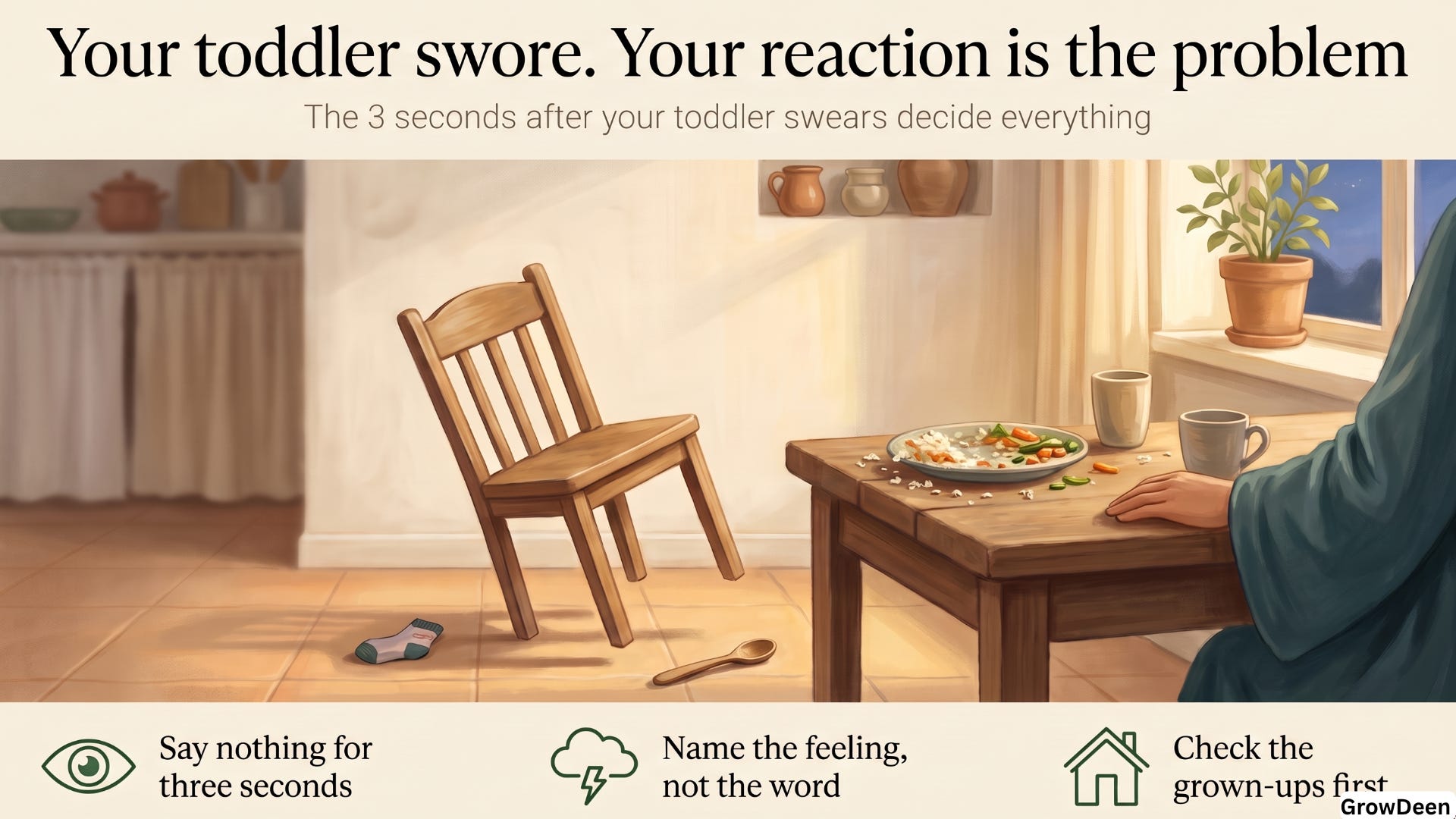
The word arrived at the checkout.
Your three-year-old said it clearly, over the beep of the scanner, while the woman behind you was loading her shopping onto the belt. You did what the parenting books say. You crouched to eye level, kept your voice soft, and explained that we don’t use that word. Your child looked straight at you, grinned, and said it again. Louder.
You are not doing this wrong. You are watching something work exactly as it was designed to, just not for you.
So here’s the question to carry through the rest of this article. Why does a word your child cannot define, cannot spell, and has never heard you say keep coming back for more? The answer isn’t in your child. It’s in the three seconds after the word lands.
Why This Guide Is Different
The research is named and dated. Every claim here traces to the CDC’s parenting guidance, the American Academy of Pediatrics, the NHS, or the psychologists who actually study children’s taboo vocabulary. [1,3,4]
The Islamic framing is verified, not decorative. Every verse and hadith here was checked against Tafsir Ibn Kathir on quran.com and the grading shown on sunnah.com before it went into this article.
You already have the free Rude Words Pack from the top of this page. Three printable pages for the moment itself, the week after it, and the words you want your child reaching for instead.
Why a word your child can’t define keeps coming back
Think about what actually happened at that checkout. The word landed, and the whole world responded. The woman behind you looked up. Your voice changed. Your face changed. For a three-year-old still working out which of their behaviours move the adults around them, that is an enormous result for very little effort.
This is what the CDC’s parenting guidance describes: any attention a child receives straight after a behaviour, whether that attention is praise or a scolding, makes the behaviour more likely to happen again. [3] Your calm, patient, crouching explanation was still attention. It was a reward with a soft voice on it.
Raising your voice doesn’t help either. In its 2018 policy statement on discipline, the American Academy of Pediatrics found that yelling at children and shaming them are minimally effective in the short term and not effective in the long term. [4] The same statement links yelling and shaming to raised stress hormones, and harsh verbal abuse to mental health problems in preteens and adolescents. [4] So the two instincts most parents reach for, the gentle lecture and the sharp reprimand, both feed the same machine.
The word feeds on your face.
That’s the whole mechanism. And it’s the reason the first three seconds matter more than everything you say afterwards.
The four engines behind a toddler’s rude word
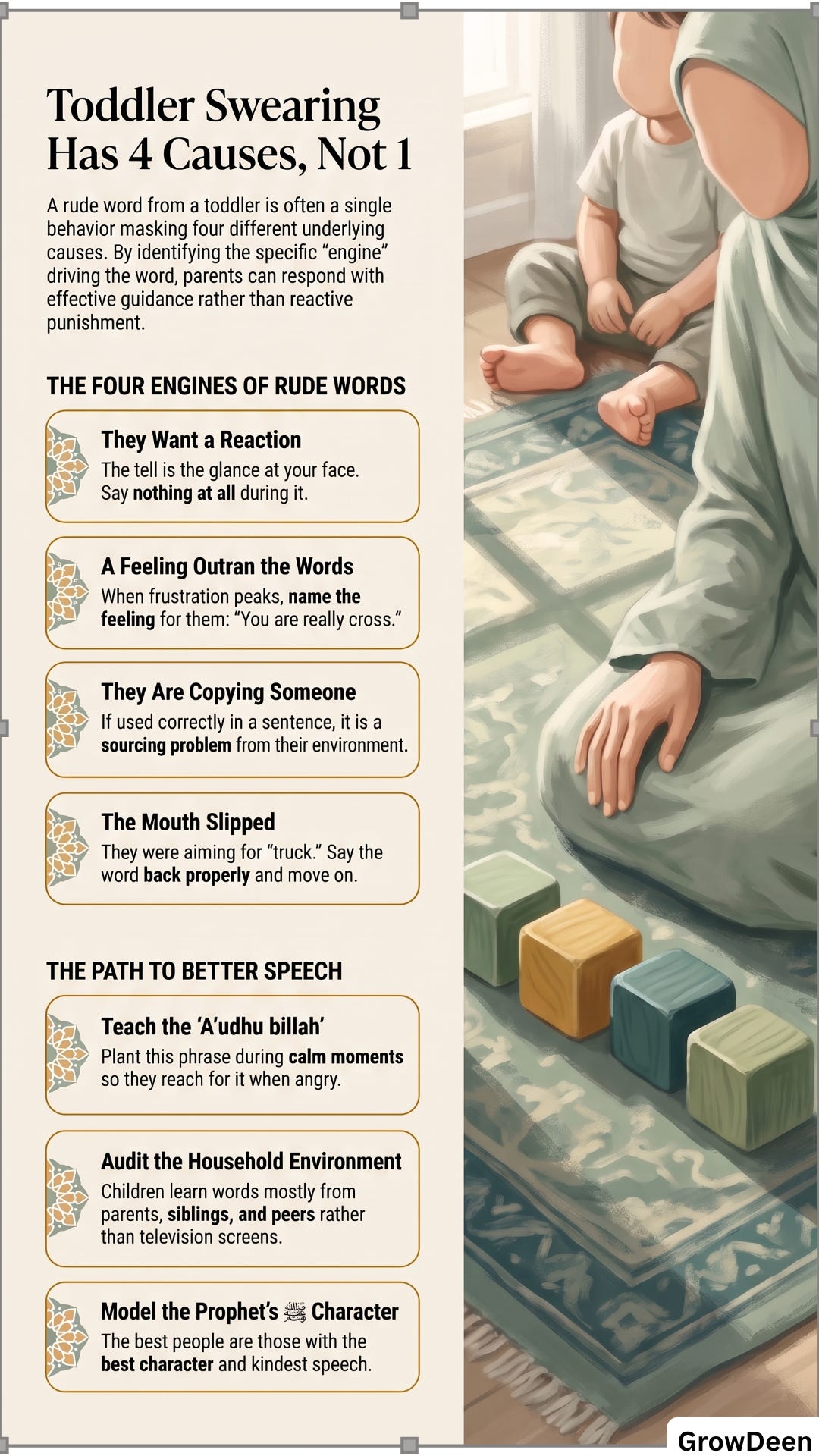
Not every rude word runs on the same fuel, and the right response depends entirely on which engine is firing. Here’s how to tell them apart.
It’s a bid for attention. The word arrives with a glance at you, or a grin, or a pause to see what happens. Take your attention away completely while it’s happening. The CDC advises avoiding eye contact and saying nothing during the behaviour, then giving warm attention the moment your child does something you’d like more of. [7] Be ready for it to get worse first. The CDC warns that behaviour often spikes when parents start ignoring it, and that giving in at that point teaches a child the behaviour has to escalate to work. [8] Ignoring is only for mild words. It is not for anything dangerous, anything that hurts another person, or a child in real distress. [7]
A feeling outran the words. The tower fell. The biscuit snapped. Your two-year-old has the emotion of a hurricane and the vocabulary of a toddler. The NHS advises naming the feeling for your child so they learn the words for it, and staying calm yourself while they settle. [9] “You’re really cross. You worked so hard on that tower.”
Someone is being copied. An older cousin, a neighbour’s child, a stranger in a queue, a programme playing in the next room. When researchers ask young adults where they first learned to swear, the answers point mostly to parents, peers and siblings rather than television. [1]
The mouth slipped. Children simplify tricky clusters of consonants while they learn to talk, which is how “truck” comes out sounding like something you’d rather it didn’t. Most children have mastered most speech sounds by about five, and this kind of simplifying usually fades between four and five. [5] Say the word back correctly in an ordinary voice and move on. “Yes, a big red truck.”
That’s four responses to hold in your head while you’re also unloading a trolley and answering a cashier. That’s why the free Rude Words Pack exists: one page sorts the four engines with the exact sentence for each, one page audits where the words are coming from, and one page holds the words to give your child instead. The download button is at the top of this page, and there’s a full description of what’s inside it below.
What the Qur’an says about the words we refuse to answer
Before any of this was research, it was guidance. Allah says: “And if an evil suggestion comes to you from Satan, then seek refuge in Allah. Indeed, He is Hearing and Knowing.” [10] Tafsir Ibn Kathir carries a striking explanation here, recorded from Ibn Jarir at-Tabari. If Satan stirs you to anger and pushes you away from forgiving toward punishing, then seek refuge with Allah, who hears everything that is said. [11]
Sit with that for a second. The verse doesn’t arrive when the other person is calm. It arrives at the exact moment you want to punish.
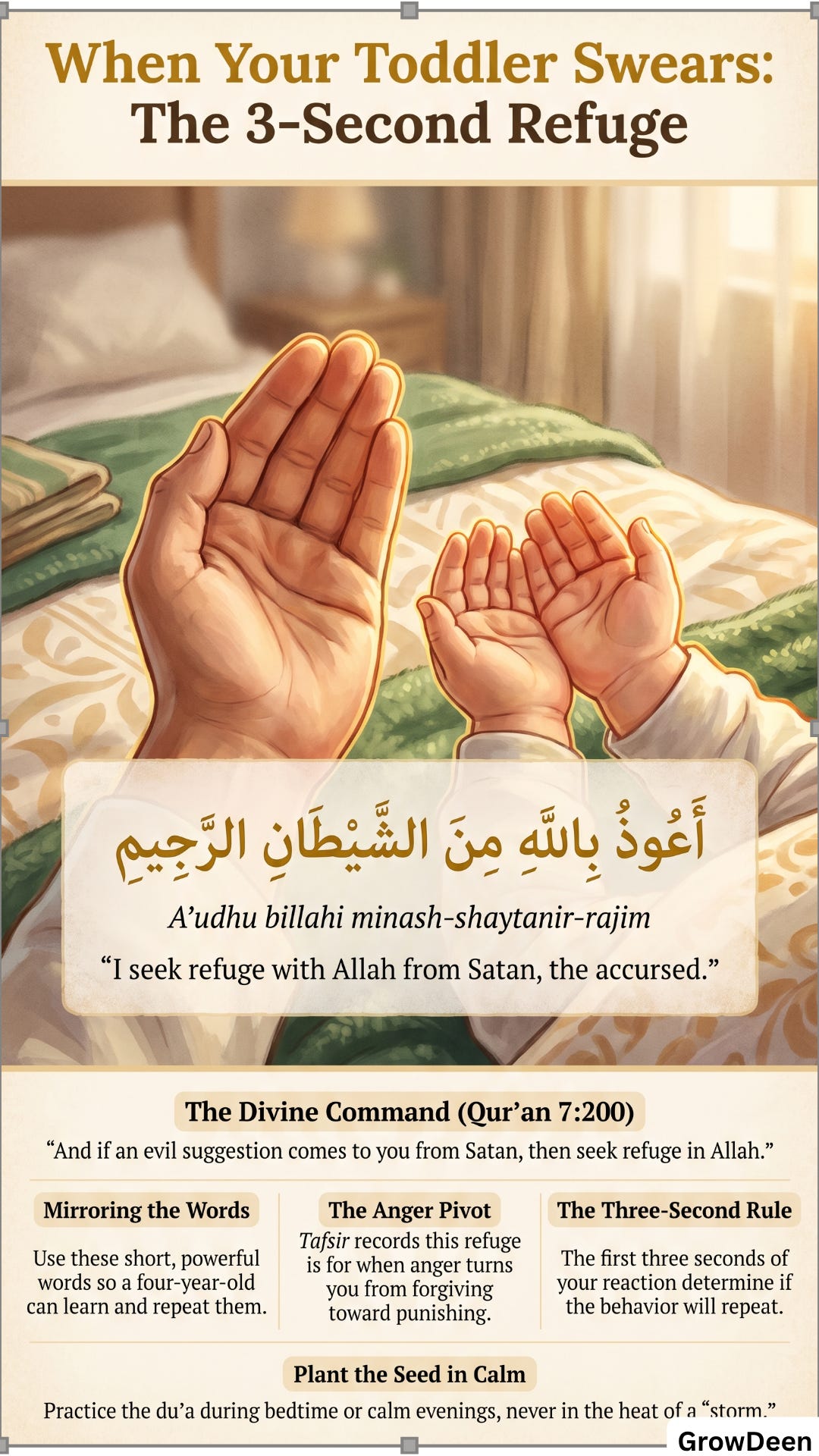
That’s the checkout. That’s the grin and the repeat. And the phrase Allah directs you to is short enough for a four-year-old to learn alongside you:
أَعُوذُ بِاللَّهِ مِنَ الشَّيْطَانِ الرَّجِيمِ
A’udhu billahi min ash-shaytan ir-rajim
“I seek refuge with Allah from Satan, the accursed.”
The Prophet ﷺ lived that instruction. He was never coarse or obscene in his speech, and he used to say that the best people are those with the best character. [6] He described a believer’s speech plainly: “The believer does not insult the honor of others, nor curse, nor commit fahishah, nor is he foul.” [12] Fahishah means obscenity. Your three-year-old is nowhere near that standard. Neither is any adult on a hard evening. It isn’t a test you pass. It’s a direction the whole house walks in.
What to say, and what to hand them instead
Under four, skip the explanation. They can’t follow why a word is wrong, and the attempt gives the word airtime. “We don’t say that word,” then change the subject.
At four and five, children start grasping that words can hurt people, even before they know what a particular word means. “That word makes people feel sad. In our family we choose words that make people feel good.” You can bring Allah into it lightly: “Allah loves it when we say kind things.”
Expect a toilet-word phase somewhere in here. Toilet words top the list of the earliest rude words children use [2], and a stretch of finding bottoms hilarious is ordinary. “That’s a bathroom word, not a dinner word,” then move on.
With an older preschooler who keeps asking why, ask first what they think the word means. Their answer tells you how much they actually understand, and it stops you teaching them something new by accident. Then keep it general: “It’s a rude word for the toilet, and it isn’t a kind way to talk.”
But taking a word away leaves a hole, and a frustrated child will fill it with whatever is nearest. Give them the replacements before the next tower falls:
A feeling word: “I’m so cross!” beats any substitute you invent for them.
A silly family word, the sillier the better, that can be shouted at full volume without offending anyone.
A’udhu billah for real anger. Practise it on calm days, in the car or at bedtime, so it’s already in their mouth when they need it.
Kindness toward objects and animals belongs in the same lesson. Toddlers shout at the shoe that won’t go on and the cat who knocked the cup over. The Prophet ﷺ told people not to curse the rooster, because it wakes people for prayer. [13] A noisy bird protected from harsh words is a story a four-year-old understands immediately.
Where the word came from, and what to do about it
Look close to home first. Since swear words are mostly picked up from people rather than screens [1], the honest audit is of your own house: what you say when the pan burns, what visiting relatives say, and what adults say over children’s heads assuming nobody is listening.
Screens still count. The American Academy of Pediatrics advises no more than about an hour a day of high-quality programming for children aged two to five, watched with a parent. Mealtimes stay screen-free. [14] Choose Islamically suitable, music-free, parent-approved content, and notice the background too, including the videos on your own phone while your child sits at your elbow.
Then there’s company. The Prophet ﷺ compared a good companion to someone carrying musk, who might give you some, sell you some, or at least leave you smelling pleasant. A bad companion he compared to someone blowing a blacksmith’s bellows, who might burn your clothes or leave you smelling of smoke. [15] For a preschooler, companions means the children they play with and the adults who look after them. You don’t need to cut anyone off. You need to know where the words are arriving from, and to ask the other adults in your child’s life, kindly, to hold the line you hold.
And hold it yourself. Children notice within a day when a rule runs in only one direction. When a word slips out of your own mouth, say so in front of them: “That wasn’t a kind word. Astaghfirullah. Let me try again.”
When to speak to your doctor
Swearing on its own is rarely a medical concern. Speak to your doctor or paediatrician if your child’s speech is still very hard to understand as school age approaches, or if sound errors continue past the ages you’d expect. Sound patterns that persist or look unusual are what lead to a diagnosis of a phonological disorder, and a speech-language therapist can assess it. [5]
Ask for advice too if the swearing comes with frequent hitting that isn’t easing with calm, consistent responses, or if your child’s anger is out of proportion and starting to affect sleep and eating. If the language is sexual and goes beyond ordinary curiosity about bodies and toilets, talk to your paediatrician promptly. The American Academy of Pediatrics explains that most body curiosity between ages two and six is a normal part of development, and helps parents tell that apart from behaviour that may signal a problem. [16]
This article doesn’t replace medical advice. Follow your doctor’s guidance for your own child.
Your Free Rude Words Pack
If you’ve read this far, you’re the kind of parent who wants to understand the behaviour rather than just stop it. That says something about you.
Inside the Rude Words Pack (one comprehensive PDF, 3 pages):
Page 1: The Four Engines Sorter — the four reasons a young child swears, each with the tell that identifies it and the exact words to use in reply, laid out so you can find your situation in under ten seconds. Designed as a fridge card for the moment it happens.
Page 2: The Household Word Audit — a one-sitting audit of where your child’s words are actually coming from, covering adults at home, visitors, playmates, screens and background listening, with a short agreement page for the grown-ups to fill in together.
Page 3: The Words We Reach For Instead — a child-height card with the replacement words, including a’udhu billah in Arabic with transliteration and meaning, plus the reminder from Qur’an 7:200 and the Prophet’s ﷺ description of a believer’s speech, written so a parent and child can read it together.
This isn’t a PDF to download and forget. It’s built to live on your fridge and at your child’s eye level, where the words actually get chosen.
This Rude Words Pack is what every subscriber receives with each article. We cover the full journey of raising Muslim children, from newborns to school age, all backed by scientific research and rooted in Islamic wisdom.
If you’re a Muslim parent who wants both evidence-based guidance and Islamic perspective, subscribe for free so future resources arrive in your inbox before you need them.
Subscribe free for parenting resources backed by both science and Sunnah, guidance so unique you literally can’t get it anywhere else. No spam, no clutter, just resources that matter.
One thing to do tonight
At bedtime, teach your child a’udhu billahi min ash-shaytan ir-rajim. Say it once, slowly, and let them repeat it. Don’t attach it to the word they said today. Just plant it, tonight, while everyone is calm.
May Allah place barakah in your patience, guard your child’s tongue, and make your home a place where good speech feels ordinary.
Share This With Someone Who Needs It
Think of one person right now: the sister whose four-year-old shouted something at the park last week, who laughed it off and then went quiet, or the friend who texted you about it and then wrote “never mind, he’s only three.”
This article could take the panic out of their week. Send it to them today, not as advice, but as company. Sometimes the kindest thing is telling someone the thing they’re worried about has a name and a mechanism.
Frequently Asked Questions
Q: Is it normal for a 3-year-old to swear? A: Yes, and it’s more common than most parents realise. Swearing tends to appear by about age two, and researchers who study children’s taboo vocabulary find most children start school knowing 30 to 40 offensive words. [1] At three, your child almost certainly has no idea what the word means.
Q: Should I punish my toddler for saying a bad word? A: Punishment misfires here, because a young child usually doesn’t understand what they said. For mild attention-seeking words, the CDC’s advice is to take your attention away while it’s happening and praise good words straight after. [3,7] For anything that hurts someone, that’s a separate conversation about the hurting, not the word.
Q: Where do young children learn swear words? A: Mostly from people rather than screens. When young adults are asked where they first learned to swear, the answers point to parents, peers and siblings ahead of television. [1] Start your search at home, then look at visitors, playmates and background listening. See “Where the word came from” above.
Q: What should I say when my child swears in public? A: Say as little as possible in the moment. A calm “We don’t say that word” and a change of subject costs the word its audience, and you can deal with it properly at home when nobody is watching. For what to say at each age, see “What to say, and what to hand them instead” above.
Q: Is there a du’a for anger I can teach my child? A: Yes, and it’s short enough for a four-year-old. Allah says that when an evil suggestion comes from Satan, seek refuge in Allah [10], and the words for it are a’udhu billahi min ash-shaytan ir-rajim, “I seek refuge with Allah from Satan, the accursed.” Teach it on a calm day, not mid-meltdown.
Q: When should I worry about my child’s swearing? A: Worry less about the word and more about what travels with it. Speak to your doctor if the swearing comes with frequent aggression that isn’t easing, if the anger is affecting sleep and eating, or if the language is sexual and goes beyond ordinary body curiosity. [16] Also ask if their speech is still hard to understand near school age. [5]
References
[1] Jay, T., & Janschewitz, K. (2012). The science of swearing. APS Observer, 25(5). Association for Psychological Science.
[2] Jay, K., & Jay, T. (2013). A child’s garden of curses: A gender, historical, and age-related evaluation of the taboo lexicon. The American Journal of Psychology, 126(4), 459-475.
[3] Centers for Disease Control and Prevention. Tips for using positive and negative attention. Essentials for Parenting Toddlers and Preschoolers.
[4] Sege, R. D., & Siegel, B. S. (2018). Effective discipline to raise healthy children. Pediatrics, 142(6), e20183112.
[5] American Speech-Language-Hearing Association. Selected phonological patterns. ASHA Practice Portal: Speech Sound Disorders.
[6] Sahih al-Bukhari 6035 — Graded: Sahih
[7] Centers for Disease Control and Prevention. Tips for redirecting your attention. Essentials for Parenting Toddlers and Preschoolers.
[8] Centers for Disease Control and Prevention. Steps for ignoring. Essentials for Parenting Toddlers and Preschoolers.
[9] NHS Best Start in Life. Help your toddler with their emotions.
[10] Quran, Surah Al-A’raf 7:200
[11] Ibn Kathir. Tafsir Ibn Kathir, Surah Al-A’raf 7:199-200 commentary, recording the explanation of Ibn Jarir at-Tabari
[12] Jami’ at-Tirmidhi 1977 — Graded: Hasan
[13] Sunan Abi Dawud 5101 — Graded: Sahih
[14] American Academy of Pediatrics, Council on Communications and Media. (2016). Media and young minds. Pediatrics, 138(5), e20162591.
[15] Sahih al-Bukhari 5534 — Graded: Sahih
[16] American Academy of Pediatrics. Sexual behaviors in young children: What’s normal, what’s not? HealthyChildren.org.