

About a quarter of parents’ praise is inflated. [1] In one study, that single extra word made children who doubted themselves choose easier tasks. [1]
Fridge-ready, for tonight’s loudest hour.
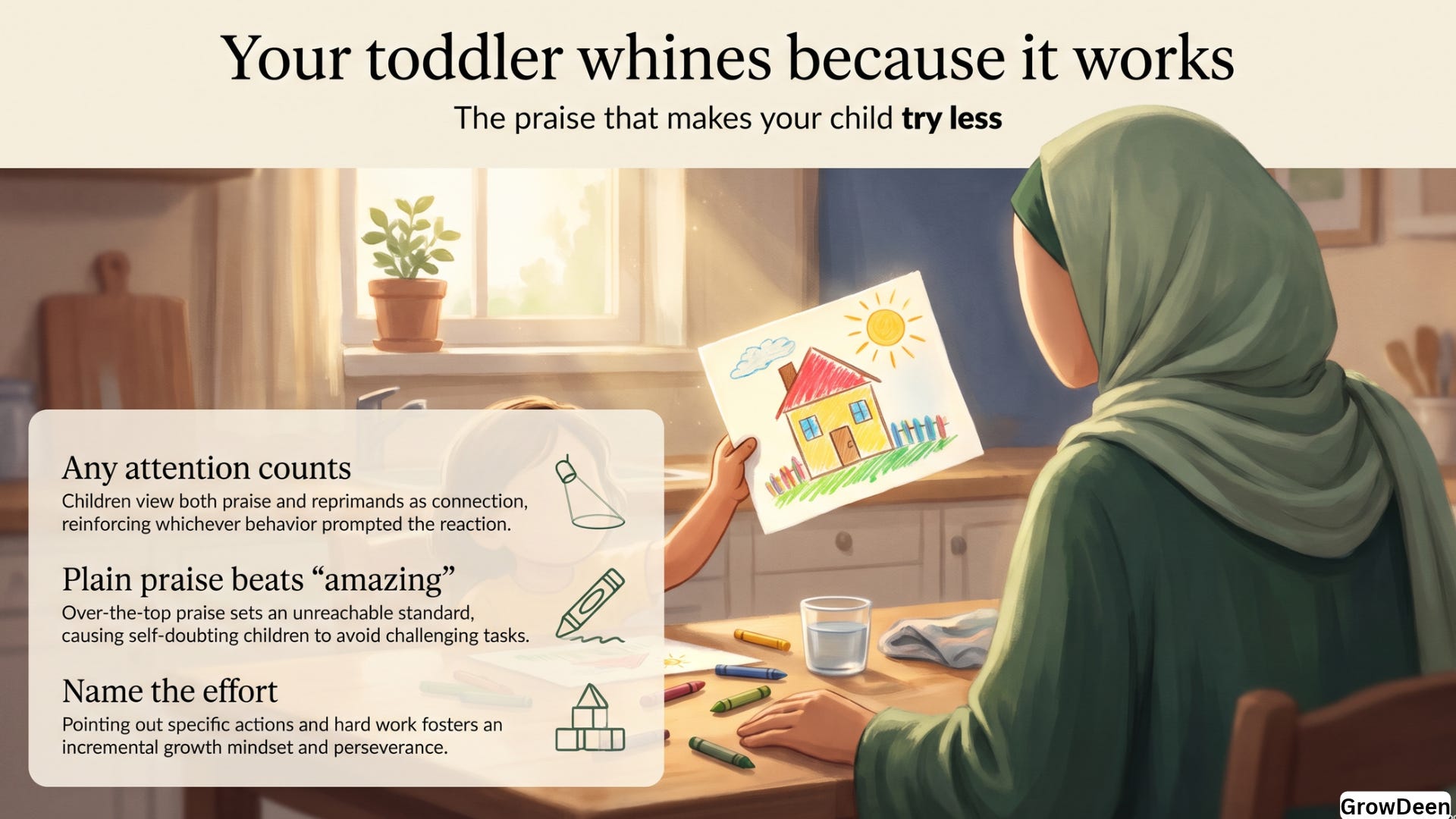
She held up her drawing at four o’clock.
You did exactly what every parenting post tells you to do. You stopped, you smiled, and you told her it was amazing and that she was the best artist in the whole world. The next morning she started a new picture, drew one line, decided it was wrong, and pushed the paper away.
So how can praise make a child try less? It sounds backwards, and it isn’t your imagination. The answer changes how you talk to your child for the rest of the day, and it starts with something most parents never think about: where their attention lands, and the exact words they use when it does.
If you’ve been trying hard and still feel like you’re getting it wrong, you’re in good company. Most loving parents are doing a version of this every day.
What Makes This Guide Different
Every recommendation here is backed by peer-reviewed research and guidance from the CDC and the American Academy of Pediatrics, including a pair of meta-analyses covering 154 randomised trials.
The Islamic layer comes from verified sources: a verse from Surah an-Najm, read through Tafsir Ibn Kathir, and two sahih narrations showing how the Prophet ﷺ noticed the people around him.
You already have the free Spotlight Pack from the top of this page, built for the moments this article is about.
Why Do Children Repeat The Behaviour You Most Want Them To Drop?
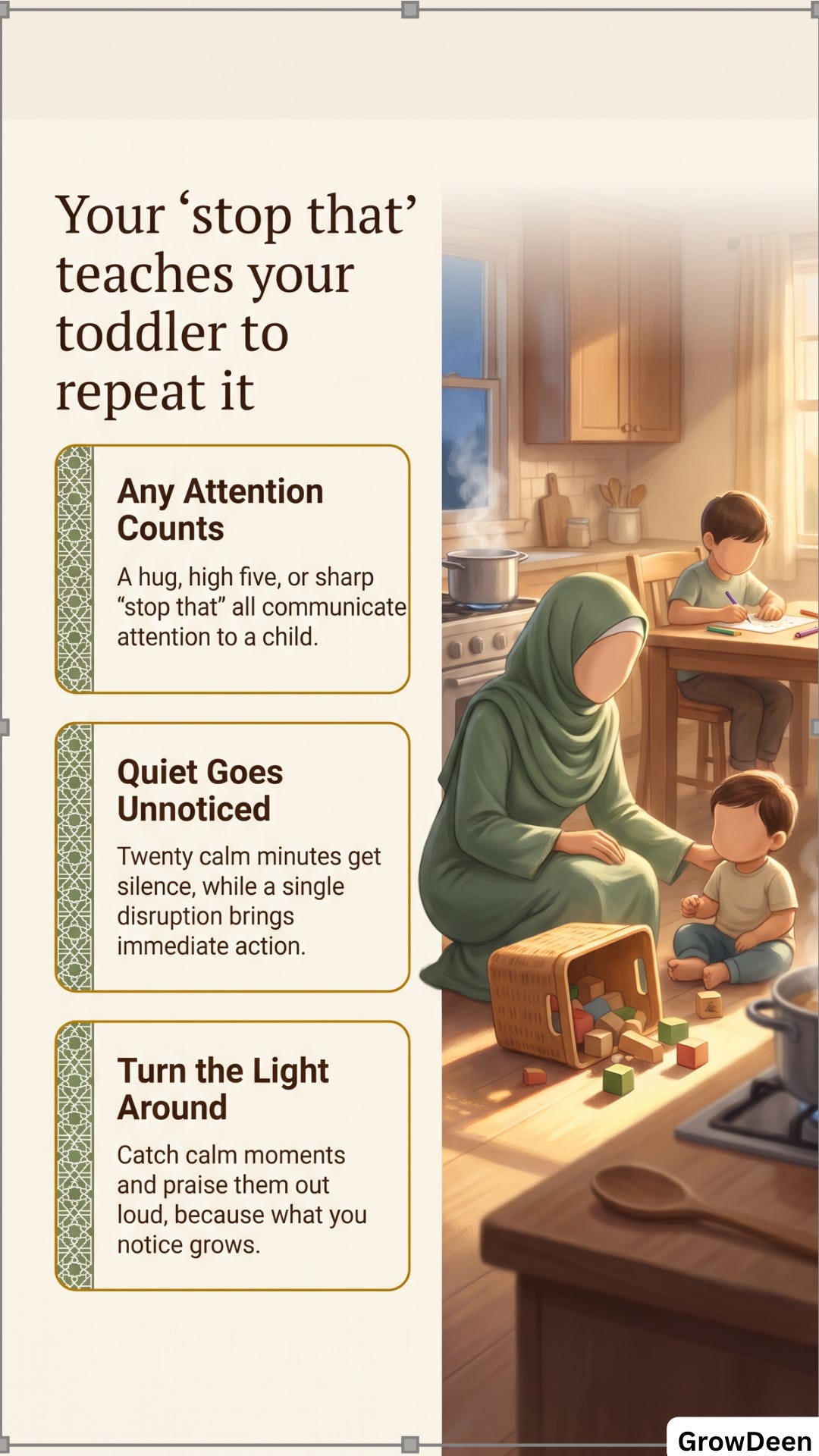
Think about the last hour before dinner. The children played quietly for twenty minutes and nobody said a word. Then someone grabbed a toy, someone screamed, and you were in the room in four seconds flat.
Children read that pattern perfectly.
Young children want a huge amount of attention from the adults around them, and they’re not fussy about what kind they get. [2] A hug counts. A high five counts. A sharp “Stop that” counts too, because it still says I see you. The CDC is blunt about it: attention, positive or negative, reinforces behaviour. [3]
The villain in most homes is the loud-moment reflex, the habit almost every parent falls into of looking up only when something goes wrong. A child who learns that grabbing brings a parent running and sharing brings silence is making a perfectly sensible choice.
There’s a quieter cost too, and it’s yours. By the evening you may have heard yourself say “no” and “stop” so many times that your own voice sounds unfamiliar. Plenty of parents go to bed wondering why every day seems to end in correction. Usually that feeling means the spotlight has been pointing in one direction for a while, and nothing worse.
The research on turning it around is unusually clear. Two meta-analyses pooled 154 randomised trials of parenting programmes and checked 26 separate techniques to see which ones went with bigger improvements in disruptive behaviour. Only three stood out, and positive reinforcement, praise in particular, was one of them, alongside natural or logical consequences. [4]
Before you can move the spotlight, though, it helps to know what a behaviour is trying to say.
Is It Misbehaviour Or A Message?
A three-year-old who suddenly clings to your leg at every drop-off, a week after the new baby came home, isn’t being difficult for the sake of it. Neither is the five-year-old who melts down at 5pm when lunch was hours ago.
The CDC describes behaviour as communication and a chance to connect. [3] Hunger, tiredness and big changes at home, like a move or a new sibling, all show up in how a child acts long before a child can explain them in words.
The child who keeps interrupting your phone call may simply be asking whether they still matter while your attention is somewhere else. Answer that question with a hand on the shoulder and a quick “I’ll be with you in two minutes,” and the interrupting often shrinks on its own.
What Does Helpful Praise Actually Sound Like?
Picture a Tuesday afternoon. Your son has just tidied the prayer mats after Asr without being asked, and folded one of them slightly wrong. What do you say?
“Good boy!” is warm. It just doesn’t tell him much. Praise that names exactly what happened tells a child which behaviour to repeat. [5] So something like: “You put the mats away by yourself. That was thoughtful.” Short, plain and true.
The Sunnah has a picture of exactly this kind of noticing. The Prophet ﷺ once asked the companion Ubayy ibn Ka’b which verse of Allah’s Book was the greatest. Ubayy first deferred to Allah and His Messenger. When the Prophet ﷺ asked again, Ubayy named Ayat al-Kursi. The Prophet ﷺ struck him on the chest and prayed that knowledge would be pleasant for him, calling him by his kunya, Abu’l-Mundhir. [6] A question, an answer, then a touch and a du’a, all landing on the exact thing Ubayy had got right.
At home, that can be as simple as a hand on your daughter’s head and “You said Bismillah before you started eating, all by yourself. May Allah bless you.”
Not all positive attention is spoken. A smile across the kitchen or a squeeze of the shoulder does the same job in a busy moment. [2] So does listening properly, with your phone face down and your body turned toward your child while they tell you a long story about an ant.
Which brings us back to the drawing at four o’clock.
How Can Praise Make A Child Try Less?
The kind of praise matters as much as the amount, and two studies show why.
The first followed families over years. Researchers filmed parents and toddlers at home at ages one, two and three. Children who heard a higher share of process praise, meaning praise for effort and strategy, later believed that ability could grow and wanted more challenge, and that belief predicted their maths and reading comprehension in fourth grade. [7] It was a small study of 53 families, so treat it as a strong hint rather than a final word.
The second explains the drawing. Eddie Brummelman and colleagues found that adults hand out more over-the-top praise to children with low self-esteem, the very children they most want to lift. In an experiment with 8- to 12-year-olds, inflated praise (”That’s incredibly beautiful”) made children with low self-esteem more likely to choose easier tasks afterwards, while plainer praise (”That’s beautiful”) did not. [1] One extra word seemed to set the bar so high that a doubting child stopped wanting to risk missing it.
That’s the answer to the puzzle. “The best artist in the whole world” is a standard nobody can meet twice. “You used three colours for the sky and kept going until the edges were filled” is something a child can do again tomorrow.
What you notice grows. The trick is noticing the right thing.
So when your six-year-old has been stuck on the same tricky word for a week, skip the fireworks. Try: “You worked out the first part by yourself this time. I heard you sounding it out.” Then help with the rest.
Keeping all of this in your head while dinner is burning is a lot to ask, and the Spotlight Pack exists for exactly that hour. Its decision chart helps you choose, in the moment, whether a behaviour needs your attention or your calm, and it pairs twelve common behaviours with the good opposite you should be watching for instead. The download button is at the top of this page, and there’s a full description of what’s inside it below.
Something sits underneath all of this that research can’t reach on its own.
The Sacred Trust Of Noticing Effort
Every time you name a child’s effort, you’re doing something Islam gives a deeper root. Allah says in Surah an-Najm, “And that there is not for man except that [good] for which he strives,” and “And that his effort is going to be seen.” [8] According to Tafsir Ibn Kathir, a soul benefits only from the good it earns for itself, and its deeds will be shown on the Day of Resurrection, a meaning he supports with Allah’s words in Surah at-Tawbah that Allah, His Messenger and the believers will see one’s deeds. [8] The verse speaks of the Hereafter. Still, a tired parent can hold on to it: no effort, even a child’s clumsy one, goes unseen by Allah.
The Prophet ﷺ modelled that kind of seeing in this world too. When Abu Hurairah asked who would be the most fortunate to receive his intercession, the Prophet ﷺ told him he had expected that question to come from him first, because of how eager he was to learn hadith, and only then gave the answer. [9] He named the eagerness before anything else.
When you tell your child, “I saw how hard you tried,” you’re walking close to that example. The research on process praise and the Sunnah arrive at the same place: effort deserves to be seen, and said out loud.
Support Muslim Parenting Lab ❤️
Would you rather give a small amount that never stops than a large one you keep postponing? Set a monthly amount you are comfortable with, in a few seconds, using the button below.
The Prophet ﷺ said the deed most beloved to Allah is the most constant, even if little. (Sahih al-Bukhari 6464)
What Should You Do About The Whining And Back-Chat?
So what does all this look like at six o’clock, when the whining starts and the rice is boiling over?
Small, attention-seeking behaviour, like silly noises or a low whine, often fades faster with a calm, brief response than with a long reaction, because a long reaction is still a spotlight. Then watch for the moment it stops and catch the good behaviour that replaces it.
When a real line has been crossed, a clear, mild and non-violent consequence, given calmly and without a lecture, is one of the techniques with the strongest research behind it. [4]
Harshness is where things go wrong. In its 2018 policy statement, the American Academy of Pediatrics described aversive strategies, including yelling at or shaming children, as minimally effective in the short term and not effective in the long term, and it advises adults to avoid both physical punishment and verbal abuse of children. [10] One of the statement’s authors put the alternative simply: start from the premise of rewarding positive behaviour, set expectations in advance, and follow through consistently. [11]
Where Does Warmth Fit Into Good Behaviour?
Think of the evenings when you finally sat on the floor with your child for ten unhurried minutes. Bedtime usually went better afterwards, didn’t it?
There’s a reason for that. The Center on the Developing Child at Harvard calls these back-and-forth exchanges serve and return: you notice what your child is focused on, support it, put a name to it, and then wait for them to take their turn. [12] With a baby, the serve might be a gurgle or a pointed finger. With a five-year-old, it might be a long and winding report on a beetle.
Let your child lead now and then. Give them the choice of book or game and follow along. Sit on the floor or crouch beside their chair so they can see your face relaxed and smiling, instead of watching from across the room.
The effects of this kind of closeness last. A meta-analysis of research on children up to age eight found that warm, responsive and sensitive parenting was consistently linked with stronger executive function, the mental skills children use to plan, focus and hold back an impulse. [13] An Australian study that followed families for several years found that warm, non-hostile parenting at ages two and three supported toddlers’ self-regulation, which in turn predicted kinder, more helpful behaviour at age six and seven, as rated by their teachers. [14]
What Does Positive Attention Look Like At Each Age?
Babies (0 to 12 months): smile back, copy their sounds, name what they’re looking at, and pause so they can “answer.” [12]
Toddlers (1 to 3 years): short, specific praise the moment it happens, with plenty of hugs and high fives. [2]
Preschoolers (3 to 5 years): praise effort and kindness, and give them small real jobs like carrying the dates to the table at iftar, with a thank-you every time.
Early school years (6 to 8 years): keep praise for reading and Qur’an memorisation plain and true, and offer some of it privately instead of in front of siblings. [1]
Five Habits That Quietly Undo Good Praise
Relying on vague labels like “good boy” when a specific comment would teach more. [5]
Praising the result and skipping the effort that produced it. [7]
Piling on superlatives for a child who already doubts themselves. [1]
Ending praise with a correction (”Well done for tidying, but you missed the corner”).
Yelling or shaming, especially in front of others. [10]
When Is It Time To Ask For Help?
Every child has rough weeks. If your child’s behaviour is frequent and intense, or doesn’t ease after several weeks of consistent warmth and positive attention, speak with your child’s doctor or a qualified child psychologist. Regular aggression toward other people is also worth raising with a professional. Structured parenting programmes are a recommended route for disruptive behaviour and can make a real difference. [4] This article offers general guidance and does not replace medical advice.
Go back to that drawing one last time. Your daughter didn’t need to hear she was the best artist in the world. She needed to hear what she’d actually done, in words she could live up to the next morning. The loud-moment reflex will still pull at you, especially at six o’clock. Now you know where to point the light instead. What you notice grows.
The Spotlight Pack: One PDF, Three Pages
If you’ve read this far, you’re a parent who wants the small daily moments to go right, and that already says something good about you.
Inside the Spotlight Pack (one comprehensive PDF, 3 pages):
Page 1: Where Does My Spotlight Go? A one-page decision chart that walks you through the four questions to ask the second a behaviour starts, so you know whether it needs your calm, your help, a mild consequence, or a warm word, designed as a fridge chart you can read in ten seconds with dinner on the stove.
Page 2: The Positive Opposite Finder. Twelve everyday behaviours, from grabbing and interrupting to whining and refusing, each paired with the good behaviour to watch for instead and a model sentence for naming it the moment it happens, so you can turn your next hard moment into something to notice within 15 minutes.
Page 3: Seen by Allah, Seen by You. A reflection card carrying Surah an-Najm 53:39-40 with a short explanation from Tafsir Ibn Kathir, the Prophet’s ﷺ words to Abu Hurairah about his eagerness, and his warm response to Ubayy ibn Ka’b, with three evening reflection prompts for you to sit with after the children are asleep.
This isn’t a PDF to download and forget. It’s built to stay on your fridge, where you’ll actually reach for it at the hour you need it most.
The Spotlight Pack is what every subscriber receives with each article. Muslim Parenting Lab covers raising Muslim children from the newborn weeks to the early school years, all backed by research and rooted in Qur’an and Sunnah.
Try This In The Next Five Minutes
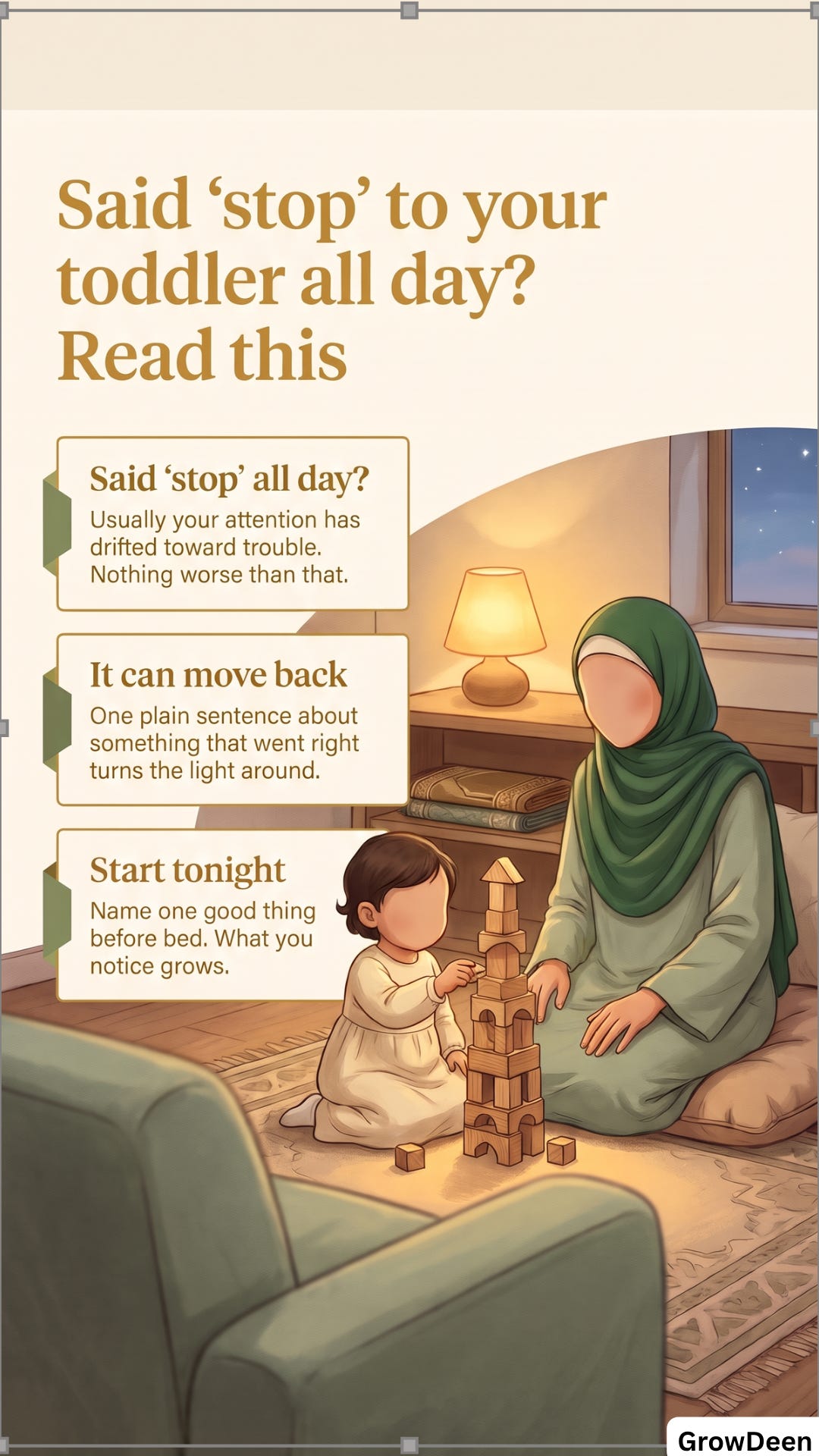
Find your child. Name one thing they did today that went right, in one plain sentence, with no superlatives. “You carried your plate to the sink after lunch.” Then walk away and let it land.
May Allah put barakah in your children and in your patience with them, and make you a parent who sees the effort first.
Share This With Someone Who Needs It
Think of one person right now: the sister who told you after Jumu’ah that she hears herself shouting all day, or the friend whose voice notes always end with “he only listens when I yell.”
This article could change how her evenings feel. Share it with her today, not as advice, but as company. Sometimes the kindest thing is to pass on what made the house quieter.
Frequently Asked Questions
Q: What is positive attention in parenting?
A: It’s any sign that you’ve noticed something good your child did: a smile, a hug, a specific word of praise, or simply listening properly. [2] It works because children repeat what earns their parents’ attention. For more detail, see “Why Do Children Repeat the Behaviour You Most Want Them to Drop?” above.
Q: Can you praise a child too much?
A: The amount matters less than the kind. Over-the-top praise can make children who doubt themselves avoid challenges, while plain, specific praise doesn’t carry that risk. [1] Aim for praise your child could earn again tomorrow.
Q: Should I ignore bad behaviour completely?
A: For small attention-seeking behaviour, a calm, brief response often works better than a big reaction. Behaviour that hurts someone or crosses a clear line still needs a mild, consistent consequence. [4]
Q: Is it better to praise effort or results?
A: Effort, more often than not. Toddlers who heard more praise for effort and strategy grew into children who believed ability could grow, and that belief predicted their later school results. [7]
Q: What does Islam say about praising children?
A: The Sunnah shows the Prophet ﷺ noticing and naming good qualities in the people around him, such as Abu Hurairah’s eagerness to learn. [9] Praise that is true and specific sits comfortably within that example. For more, see the section on the sacred trust of noticing effort above.
Q: When should I worry about my child’s behaviour?
A: If behaviour is frequent and intense, or doesn’t improve after several weeks of consistent warmth and positive attention, talk to your child’s doctor or a child psychologist, and raise regular aggression with them too. Structured parenting programmes can help. [4]
References
[1] Brummelman, E., Thomaes, S., Orobio de Castro, B., Overbeek, G., & Bushman, B.J. (2014). “That’s not just beautiful, that’s incredibly beautiful!”: The adverse impact of inflated praise on children with low self-esteem. Psychological Science, 25(3), 728-735.
[2] Centers for Disease Control and Prevention. Tips for Using Positive and Negative Attention. Essentials for Parenting Toddlers and Preschoolers.
[3] Centers for Disease Control and Prevention. Tips for Responding to Behavior. Essentials for Parenting Toddlers and Preschoolers.
[4] Leijten, P., Gardner, F., Melendez-Torres, G.J., Van Aar, J., Hutchings, J., Schulz, S., Knerr, W., & Overbeek, G. (2019). Meta-analyses: Key parenting program components for disruptive child behavior. Journal of the American Academy of Child & Adolescent Psychiatry, 58(2), 180-190.
[5] Centers for Disease Control and Prevention. Tips for Using Praise and Rewards. Essentials for Parenting Toddlers and Preschoolers.
[6] Sahih Muslim 810 (Book 6, Hadith 313), narrated by Ubayy ibn Ka’b. Chapter: the virtue of Surat al-Kahf and Ayat al-Kursi. Graded: Sahih.
[7] Gunderson, E.A., Sorhagen, N.S., Gripshover, S.J., Dweck, C.S., Goldin-Meadow, S., & Levine, S.C. (2018). Parent praise to toddlers predicts fourth grade academic achievement via children’s incremental mindsets. Developmental Psychology, 54(3), 397-409.
[8] Quran, Surah An-Najm 53:39-40 (Saheeh International) · Ibn Kathir. Tafsir Ibn Kathir, Surah An-Najm 53:39-41 commentary.
[9] Sahih al-Bukhari 99 (Book 3, Hadith 41), narrated by Abu Hurairah. Book of Knowledge, chapter: eagerness to learn the hadith. Graded: Sahih.
[10] Sege, R.D., Siegel, B.S., AAP Council on Child Abuse and Neglect, & AAP Committee on Psychosocial Aspects of Child and Family Health. (2018). Effective discipline to raise healthy children. Pediatrics, 142(6), e20183112.
[11] American Academy of Pediatrics, HealthyChildren.org. (2018). Mounting evidence shows that spanking is ineffective and harmful, and AAP calls for it to be banned.
[12] Center on the Developing Child at Harvard University. 5 Steps for Brain-Building Serve and Return.
[13] Valcan, D.S., Davis, H., & Pino-Pasternak, D. (2018). Parental behaviours predicting early childhood executive functions: A meta-analysis. Educational Psychology Review, 30, 607-649.
[14] Williams, K.E., & Berthelsen, D. (2017). The development of prosocial behaviour in early childhood: Contributions of early parenting and self-regulation. International Journal of Early Childhood, 49(1), 73-94.
We combine scientific research with Qur’an and authentic Sunnah, and we cite our sources. Even so, this is general guidance and no substitute for a doctor who can examine your child.
The inflated-praise detail is the part parents miss: one extra word, "incredibly" in front of "beautiful," and a child who already doubts herself picks the easier task next time. In the children's centers I ran for twenty years, the kids who pushed the paper away after one line were almost always the ones who had been told they were the best. What brought them back was smaller than praise: "You drew the roof first this time." One true thing, and the pencil stayed in her hand.