

Half of them had a second problem. In one clinic sample of 673 children referred for insomnia, 45% of preschoolers and 48% of school-age children also carried another sleep disorder. [2]
Print it tonight. Fourteen boxes, then the doctor.
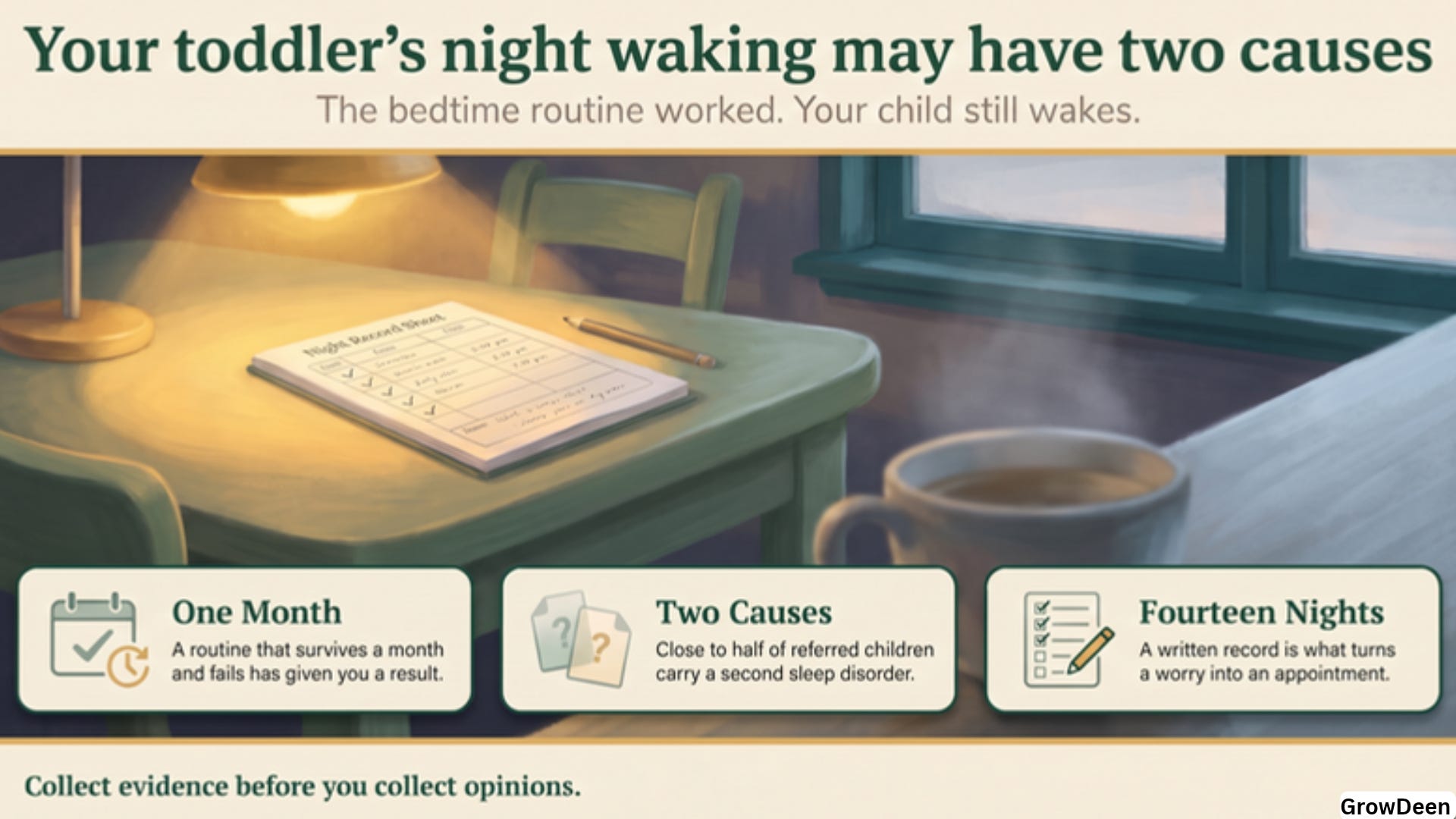
It is 1:40am again.
You know the shape of this landing in the dark. Third waking, and the clock says you have four hours before the school run. Downstairs, the chart you started on Monday is still on the table with Thursday blank, because by Thursday it felt like paperwork for a problem that is never going to end.
Here is what nobody says out loud to a parent in month three: you have probably done the routine correctly and it has probably not worked. That is not a report on your parenting. It may be the single most useful piece of information you have.
So why does a month of doing everything right change nothing? Hold that question. The answer sits in a clinic dataset, and it reframes the whole problem.
Why This Guide Is Different From A General List Of Sleep Tips
Every claim is carried by peer-reviewed sleep research and clinical guidance, including a 673-child clinic sample and the American Academy of Sleep Medicine’s own published positions.
The Islamic layer is not decoration added at the end. The Qur’an’s instruction on verifying a claim before acting on it is the organising principle of the whole piece.
You already have the free Night Evidence Pack from the button at the top of this page, which turns the next fourteen nights into something a doctor can actually read.
The Line That Changes What You Are Being Asked To Do
There is a point where a bad patch stops being a bad patch.
Short-term sleep trouble usually has a cause you can name. A house move, a new baby, a chest infection, a frightening story at a cousin’s house. The nights go sideways for a week or two, the routine holds, the child comes back. A persistent sleep problem is defined differently: it lasts beyond roughly a month, it survives the tidying up of bedtime habits, and it leaves a mark on the child’s daytime [1].
That last part is the clinical hinge. A child who sleeps oddly but functions well sits in a different category from a child whose days are being eaten by their nights.
And crossing the line changes the job. Below it, the work is habits. Above it, the work is evidence.
What The Clinic Actually Finds When A Child Like Yours Walks In
Here is the answer to the question planted at the top.
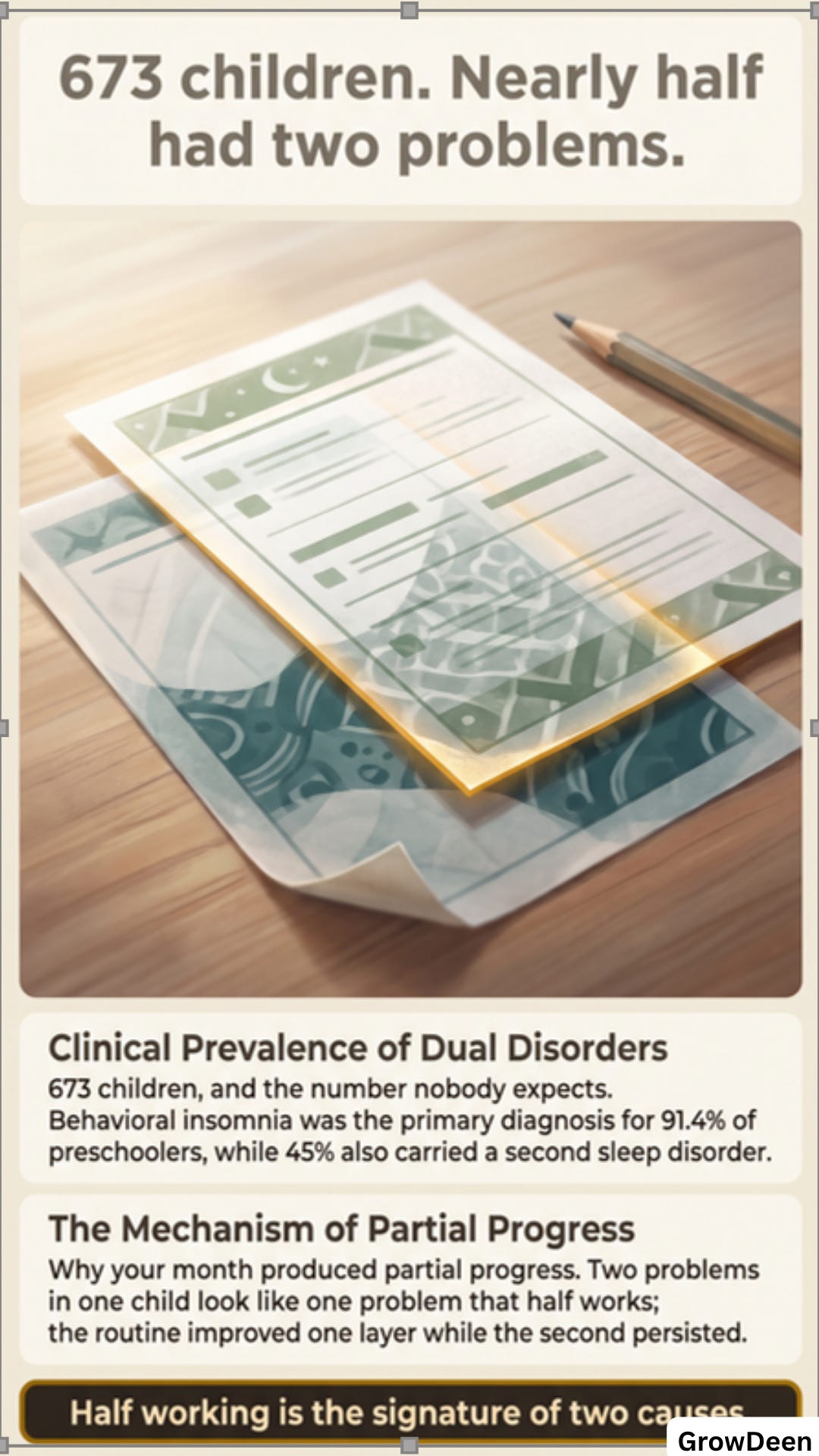
When children are referred to a paediatric sleep clinic for insomnia, the picture is almost never one problem. In a sample of 673 children, behavioural insomnia of childhood was the primary diagnosis in 91.4% of preschoolers and 72.3% of school-age children. Around 45% of the preschoolers and 48% of the school-age children also carried at least one additional sleep disorder, and sleep-related breathing disorders accounted for roughly a quarter of each group [2].
Read those numbers together and the month of effort makes sense. Most of these children do have a learned settling problem, which responds to patient change at home [3]. And close to half of them have something else running underneath it at the same time. A breathing disorder and a bedtime battle can live in the same child. Fix one, and the other carries on working in the dark.
So the routine was not wasted. It was a test, and it came back with a result.
Two Tracks, And Only One Of Them Answers To A Routine
The settling track covers how and where a child falls asleep, and what happens when they surface.
Everyone wakes in the night, adults included, several times, usually without ever reaching full awareness. A child who can only fall asleep under particular conditions, a parent lying beside them, a bottle in the bed, one specific hand to hold, reaches the end of a sleep cycle, finds those conditions gone, and has no route back without them. The waking is ordinary. The dependency is what turns it into a two-hour event. The same track holds trouble falling asleep at all, waking far too early, bedtime resistance in all its negotiating forms, genuine anxiety about going to bed, and a schedule that shifts by hours from one night to the next [1][4].
What works here is unglamorous. Consistent bedtime routines improve how quickly young children fall asleep and how often they wake, in a dose-dependent way: more nights of the routine, better outcomes [5]. Behavioural treatments for paediatric insomnia carry the strongest evidence base available and are the usual first line rather than medication [3]. Fix the morning before you fix the evening, because a waking time that holds within half an hour, weekends included, anchors the body clock more reliably than a bedtime does. Bedtime needs a child’s cooperation. Waking time does not.
The body track is a different animal, and no routine will touch it. Obstructive sleep apnoea, restless legs syndrome, narcolepsy and delayed sleep phase are recognised conditions with diagnostic criteria of their own [4].
The one most often missed is the breathing one, because its signs do not look like sleep problems. Snoring on most nights. A pause, then a gasp. Mouth breathing. A child who has had ten hours in bed and is wrecked by mid-morning. A child who is overactive and irritable rather than visibly sleepy, which is how tiredness usually presents before adolescence.
Delayed sleep phase belongs to the teenage years. The body clock really does drift later, then collides with a school start time set for someone else’s biology, and the research on school start times is one of the clearer bodies of evidence in adolescent health [6]. A teenager who cannot sleep before one and cannot rise at seven may be sleeping correctly on the wrong schedule.
Restless legs shows up as a child who has to move, who calls their legs itchy or fizzy, and who cannot stay still long enough to drop off.
The presentation shifts with age, because a four-year-old and a fourteen-year-old have different bodies, different fears and different evenings [7]. Under five it tends to look like fear of the dark, needing a particular person present, and bedtime resistance. From five to eight, fears attach to something specific the child has seen, and teeth grinding and device-in-the-bedroom habits arrive. From nine upwards, insomnia, anxiety about sleep itself and delayed sleep phase take over. Screening early is easier than waiting for a crisis, and it is worth doing from infancy rather than at breaking point [8].
Before The Islamic Part, One Practical Thing
Everything above is a lot to hold in your head at 1:40am, which is exactly when you need it.
That is why the Night Evidence Pack exists: a printable three-page set that turns scattered observations into one page a doctor can read in ninety seconds. The download button is at the top of this page, and there is a full description of what is inside it below.
What The Qur’an Settles About Acting On A Guess
By month three, a parent has collected a dozen explanations. She is doing it for attention. He is just spoiled. Cut the naps. Tire him out. Those ideas come from people who love the child. None came from an assessment.
Allah addresses acting on unverified claims directly. When a report arrives from an unreliable source, the believers are told to “investigate” [18]. The reason follows immediately: so that people are not harmed out of ignorance, leaving the one who acted in regret. According to Tafsir Ibn Kathir, Allah is ordering that news carried by the wicked be investigated to establish whether it is authentic, and he notes that the scholars of hadith refuse a narration when a narrator’s reliability is unknown [18]. The verse is speaking about reports and the people who carry them, not about children’s sleep, so the application here is yours rather than the commentary’s. The principle still lands: a confident claim is not a verified one, and acting on it can cost someone.
The Sunnah puts it in a sentence. A man with a wound was told confidently how to purify himself, followed the advice, and it cost him his life. The Prophet ﷺ held those who had advised without knowledge responsible, and asked: “Is not inquiry the cure of ignorance?” [19]. The narration is graded Hasan.
Collect evidence, not opinions. That is the whole instruction, and it arrives from both directions at once.
The Fourteen Nights Before The Appointment
Two weeks of a simple record beats an hour of recollection, and it is the single most useful thing you can do between now and a diagnosis.
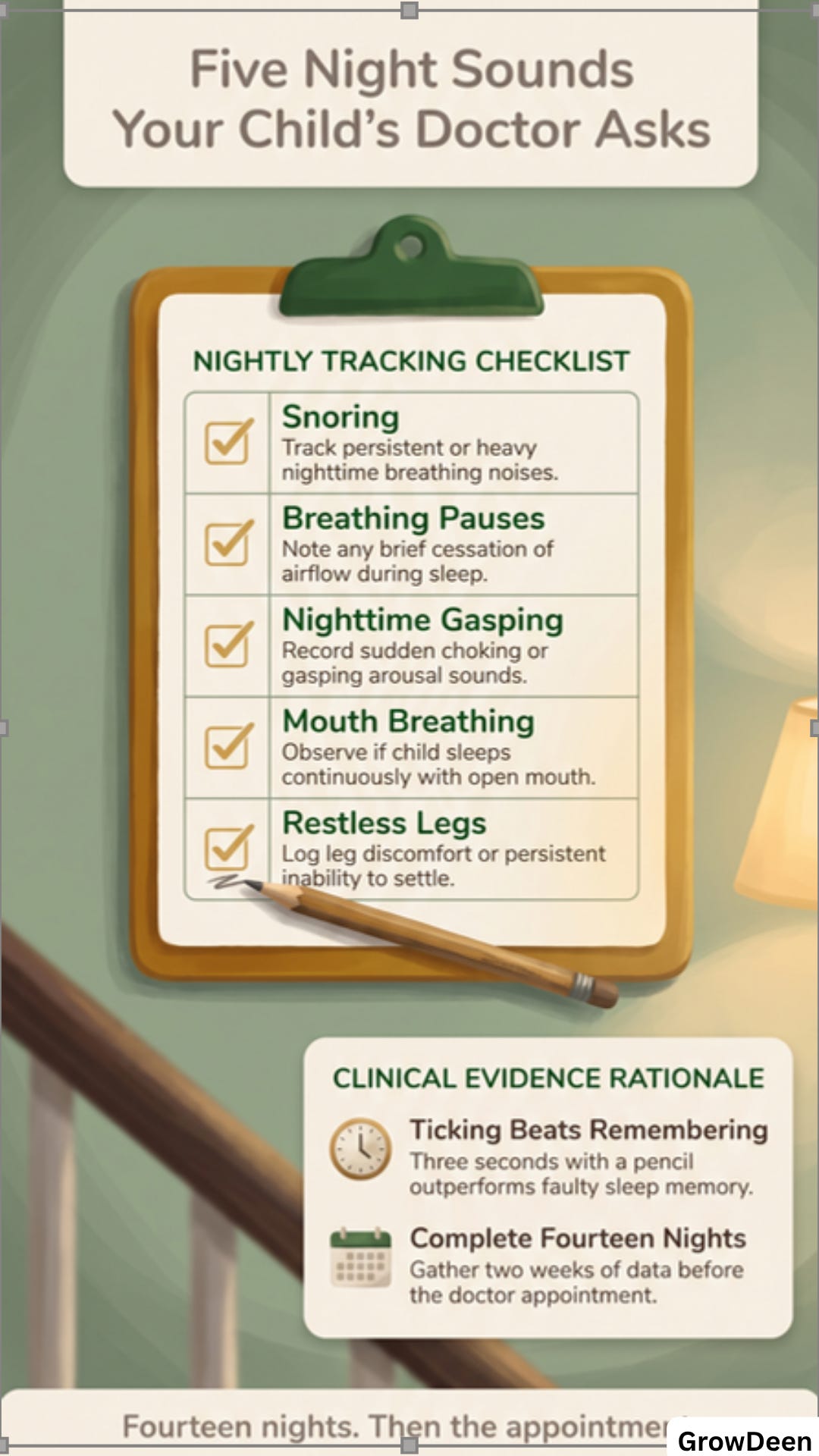
Write down four things each night: time into bed, roughly when sleep came, every waking and what settled it, and the final waking time. Add one line on how the following day went. Then listen, deliberately, and note what you hear: snoring, pauses, a gasp, mouth breathing, legs that will not stay still.
While you are recording, keep the ordinary layer running. Dark, cool, quiet. Bedtime and waking within the same half hour daily, weekends included. The evening meal early enough that nobody goes up full. Caffeine, including cola and chocolate, out of the afternoon. Devices out of the bedroom for every child in the house, so no one is singled out, because devices in the bedroom and screen use close to sleep are associated with later sleep onset and shorter sleep [23][24][25]. And check what the age actually needs, since parental estimates routinely sit below the published recommendations [26].
Muslim families already hold the rest of the material. Wudu before bed, performed as for prayer, is both an instruction of the Prophet ﷺ and a clean physical signal to a young body that the day has closed [20]. The three short suwar, recited into cupped hands and wiped over the head, face and body, hand a frightened child something to do with the fear rather than something to be told about it [21]. The du’a of protection the Prophet ﷺ said over Al-Hasan and Al-Husain, seeking Allah’s perfect words as a shelter from every devil, every poisonous creature and every harmful eye, costs nothing and settles a household [22]. Quiet Qur’an recitation, gentle adhkar, or a story told by a parent from the Qur’an or the seerah will slow a child down. A screen will not.
Some things are worth not doing while you wait. Do not start melatonin, a herbal preparation or any supplement without medical advice. The American Academy of Sleep Medicine issued a health advisory on exactly this in 2022, noting that melatonin is regulated in the United States as a dietary supplement rather than as a medicine, and that in one analysis product content ranged from under half to more than four times the labelled amount, with chewable tablets the most variable and the form children most often take [28]. The advisory is blunt about the order of operations: speak to a paediatric health professional first, and expect many sleep problems to answer better to changes in schedule and habit than to a supplement [28]. Do not use a screen as the wind-down, which pushes sleep later rather than earlier [24]. Do not let bedtime become a nightly negotiation, which teaches a child that the rules move if pushed. Do not wake a child fully out of a night terror. And do not use fear about what will happen if they do not sleep, since anxiety about sleep is itself one of the things keeping older children awake.
Body-rocking, head-rolling, head-banging on the pillow, nightmares and night terrors are common, and children grow out of them. Where they are not distressing the child and the household is coping, they do not generally need treatment [1]. A night terror is not a nightmare: the child sits up, may scream or sweat, looks awake and is not, and remembers nothing by morning, and most settle without being woken [1]. Keep them safe, keep the light low, stay close, say little the next day. Nightmares are the opposite, because the child wakes and remembers, and here the Prophet ﷺ gave a child-sized response. A good dream is from Allah, a bad one is from Shaytan, and the person who sees something they dislike should seek refuge with Allah and turn away from it, after which it will not harm them [27]. Teach it once, calmly, in daylight.
Support Muslim Parenting Lab ❤️
Would you rather give a small amount that never stops than a large one you keep postponing? Set a monthly amount you are comfortable with, in a few seconds, using the button below.
The Prophet صلى الله عليه وسلم said the deed most beloved to Allah is the most constant, even if little. (Sahih al-Bukhari 6464)
What The Appointment Is For, And What It Costs You To Delay It
Persistent sleep problems usually need professional help, and the first step is asking your doctor for an assessment of your child’s sleep [1]. Take the record with you.
Bring it forward sooner if your child snores most nights with pauses or gasping, is sleepy all day despite enough time in bed, falls asleep at school, has leg discomfort that drives movement at night, or has turned low, anxious or very irritable alongside the sleep problem [4][14].
Your doctor may refer on to a paediatrician, a sleep specialist, a psychologist or a respiratory physician. Obstructive sleep apnoea caused by enlarged adenoids and tonsils is sometimes treated surgically. For insomnia, behavioural treatment is the usual starting point [3]. Sleep medicine is prescribed only occasionally, and only where your child’s doctor has advised it and is supervising the treatment.
The cost of waiting is not neutral. Short sleep in childhood tracks with poorer attention, weaker memory and lower performance on thinking tasks across many studies rather than one [9][10], and lifestyle patterns that include poor sleep show up in academic performance too [11]. Sleep debt hits mood directly, with research on the sleep-deprived brain pointing to the amygdala and a lowered threshold for anger [12]. In early childhood, sleep and daytime behaviour feed each other in both directions [13]. Over the longer run, children whose sleep problems persist show higher rates of mental health difficulty in adolescence [14]. Children with ADHD carry extra weight here, with sleep disorders measurably worsening daytime functioning, and sleep hygiene has been studied specifically in that group [15][16]. There is also a known gap between what sleep research has established and what reaches families in practice, which is part of why households carry this alone for months before anyone says the word assessment [17].
Seeking help is not a lapse in tawakkul. Taking the means Allah has provided and leaving the outcome to Him is the whole of it, and the means here is a qualified opinion.
The Parent In The Next Room
Caring for a child who does not sleep will wear through you. Ask family to cover a night. Ask a friend to take the school run. A parenting helpline or a qualified counsellor is a reasonable thing to use rather than evidence that something has gone wrong with you.
Islam does not treat a parent’s body as an unlimited resource. Rest is owed, not earned, and a parent who refuses it in the name of getting through is borrowing from the same account their child needs.
The Night Evidence Pack
If you have read this far, you are the kind of parent who would rather find out than guess. That already tells me something about you.
Inside the Night Evidence Pack (one comprehensive PDF, 3 pages):
Page 1: The Night Listening Sheet. Fourteen numbered rows with tick columns for snoring, breathing pauses, gasping, mouth breathing and restless legs, plus a narrow column for the time of each waking. It is designed as a printable bedside sheet you keep on the landing or inside a cupboard door, so a tick takes three seconds at 2am and nothing has to be remembered in the morning.
Page 2: The Appointment Page. A one-page handover with four fill-in summary boxes (how long this has lasted, what you have already tried, what the days look like, what you have heard at night), the five questions worth asking your doctor, and a short note on what a referral usually leads to, so you can walk in with evidence rather than a story, in a consultation that may only run ten minutes.
Page 3: Ask, Do Not Guess. An Islamic reflection card built on the Qur’anic instruction to verify a report before acting on it, with Tafsir Ibn Kathir’s explanation and the Prophetic narration on inquiry being the cure of ignorance. English translation and source references only, designed to be read on the evening when you are tempted to take the loudest advice you have been given.
This is not a PDF to download and forget. It is built to sit where the problem happens, on the landing and in the doctor’s room.
The Night Evidence Pack is what every subscriber receives with each article. Muslim Parenting Lab covers the full span of raising Muslim children, all of it backed by scientific research and rooted in Islamic wisdom.
Before You Close This Tab
Do one thing tonight. Go and write today’s date at the top of a blank sheet of paper, and put it on the landing with a pencil. That is night one of fourteen, and it is the only step that has to happen before any of the rest can.
May Allah grant your household rest, and reward every night you have spent awake for the sake of someone small.
Share This With Someone Who Needs It
Think of one person right now: the sister at the masjid who said her four-year-old has been up since Ramadan and laughed it off, the cousin whose seven-year-old snores loudly enough to hear through a wall, the friend who has started apologising for being tired.
This article could get their child assessed months earlier than they would have managed alone. Send it to them today, not as advice, but because you know exactly how that corridor feels at 1:40am.
Frequently Asked Questions
Q: How long should a child’s sleep problem last before I worry?
A: Beyond about a month, especially if it has survived a proper bedtime routine and is showing up in your child’s daytime [1]. Short of that, improving habits usually does the work on its own.
Q: Why hasn’t a consistent bedtime routine fixed my child’s sleep?
A: Possibly because there are two problems and the routine only treats one. In one clinic sample, around half of the children referred for insomnia also had a second sleep disorder, often a breathing one [2]. The routine is still worth running, but it is not the whole answer.
Q: Is my child’s snoring something to worry about?
A: Snoring on most nights, especially with pauses, gasping or mouth breathing, is worth a doctor’s appointment rather than a stricter bedtime [4]. Obstructive sleep apnoea caused by enlarged adenoids and tonsils is sometimes treated surgically.
Q: Can I give my child melatonin to help them sleep?
A: Not without medical advice. The American Academy of Sleep Medicine advises speaking to a paediatric health professional first, and notes that melatonin content in one analysis ranged from under half to more than four times the labelled amount [28].
Q: Why can’t my teenager fall asleep before 1am?
A: The adolescent body clock does shift later, which is what delayed sleep phase describes, and it collides badly with early school start times [4][6]. It is a timing problem rather than a willingness problem, and it has treatments.
Q: What should I bring to the doctor’s appointment about my child’s sleep?
A: Two weeks of a simple night record: bed time, approximate sleep onset, every waking and what settled it, final waking time, and anything you heard at night. That is what Page 1 of the Night Evidence Pack is for.
References
[1] Blunden, S.L. (2012). Behavioural sleep disorders across the developmental age span: An overview of causes, consequences and treatment modalities. Psychology, 3(3), 249-256.
[2] Van Dyk, T.R., Becker, S.P., & Byars, K.C. (2018). Mental health diagnoses and symptoms in preschool and school age youth presenting to insomnia evaluation: Prevalence and associations with sleep disruption. Behavioral Sleep Medicine, 17(6), 790-803.
[3] Meltzer, L.J., Wainer, A., Engstrom, E., Pepa, L., & Mindell, J.A. (2021). Seeing the whole elephant: A scoping review of behavioral treatments for pediatric insomnia. Sleep Medicine Reviews, 56, Article 101410.
[4] Thorpy, M.J. (2017). International classification of sleep disorders. In S. Chokroverty (Ed.), Sleep disorders medicine: Basic science, technical considerations and clinical aspects (4th edn, pp. 475-484). Springer New York.
[5] Mindell, J.A., & Williamson, A.A. (2018). Benefits of a bedtime routine in young children: Sleep, development, and beyond. Sleep Medicine Reviews, 40, 93-108.
[6] Wahlstrom, K.L., & Owens, J.A. (2017). School start time effects on adolescent learning and academic performance, emotional health and behaviour. Current Opinion in Psychiatry, 30(6), 485-490.
[7] Corcoran, H., Cooke, F., & Griffiths, A.L. (2023). Sleep development in infancy and childhood. In K. Cohen Kadosh (Ed.), The Oxford handbook of developmental cognitive neuroscience (pp. 333-380). Oxford Academic.
[8] Honaker, S.M., McQuillan, M.E., Mindell, J.A., Downs, S.M., Slaven, J.E., & Schwichtenberg, A.J. (2021). Screening for problematic sleep in a diverse sample of infants. Journal of Pediatric Psychology, 46(7), 824-834.
[9] Short, M.A., Blunden, S., Rigney, G., Matricciani, L., Coussens, S., Reynolds, C.M., & Galland, B. (2018). Cognition and objectively measured sleep duration in children: A systematic review and meta-analysis. Sleep Health, 4(3), 292-300.
[10] Matricciani, L., Paquet, C., Galland, B., Short, M., & Olds, T. (2019). Children’s sleep and health: A meta-review. Sleep Medicine Reviews, 46, 136-150.
[11] Dumuid, D., Olds, T., Martin-Fernandez, J-A., Lewis, L.K., Cassidy, L., & Maher, C. (2017). Academic performance and lifestyle behaviors in Australian school children: A cluster analysis. Health Education & Behavior, 44(6), 918-927.
[12] Saghir, Z., Syeda, J.N., Muhammad, A.S., & Abdalla, T.H.B. (2018). The amygdala, sleep debt, sleep deprivation, and the emotion of anger: A possible connection? Cureus, 10(7), Article e2912.
[13] Cremone, A., de Jong, D.M., Kurdziel, L.B.F., Desrochers, P., Sayer, A., LeBourgeois, M.K., Spencer, R.M.C., & McDermott, J.M. (2018). Sleep tight, act right: Negative affect, sleep and behavior problems during early childhood. Child Development, 89(2), e42-e59.
[14] Shimizu, M., Zeringue, M.M., Erath, S.A., Hinnant, J.B., & El-Sheikh, M. (2021). Trajectories of sleep problems in childhood: Associations with mental health in adolescence. Sleep, 44(3), Article zsaa190.
[15] Craig, S.G., Weiss, M.D., Hudec, K.L., & Gibbins, C. (2020). The functional impact of sleep disorders in children with ADHD. Journal of Attention Disorders, 24(4), 499-508.
[16] Nikles, J., Mitchell, G.K., de Miranda Araujo, R., Harris, T., Heussler, H.S., Punja, S., Vohra, S., & Senior, H.E.J. (2020). A systematic review of the effectiveness of sleep hygiene in children with ADHD. Psychology, Health & Medicine, 25(4), 497-518.
[17] Parthasarathy, S., Carskadon, M.A., Jean-Louis, G., Owens, J., Bramoweth, A., Combs, D., Hale, L., Harrison, E., Hart, C.N., Hasler, B.P., Honaker, S.M., Hertenstein, E., Kuna, S., Kushida, C., Levenson, J.C., Murray, C., Pack, A.I., Pillai, V., Pruiksma, K., ... Buysse, D. (2016). Implementation of sleep and circadian science: Recommendations from the Sleep Research Society and National Institutes of Health workshop. Sleep, 39(12), 2061-2075.
[18] Qur’an, Surah Al-Hujurat 49:6, with Tafsir Ibn Kathir on 49:6. Translation quoted: Saheeh International.
[19] Sunan Abi Dawud 337. Narrated by Abdullah ibn Abbas. Graded: Hasan (Al-Albani).
[20] Sahih al-Bukhari 247. Narrated by Al-Bara’ ibn ‘Azib. Graded: Sahih.
[21] Sahih al-Bukhari 5017. Narrated by Aisha. Graded: Sahih.
[22] Sahih al-Bukhari 3371. Narrated by Ibn Abbas. Graded: Sahih.
[23] Hale, L., Kirschen, G.W., LeBourgeois, M.K., Gradisar, M., Garrison, M.M., Montgomery-Downs, H., Kirschen, H., McHale, S.M., Chang, A-M., & Buxton, O.M. (2018). Youth screen media habits and sleep: Sleep-friendly screen behavior recommendations for clinicians, educators, and parents. Child and Adolescent Psychiatric Clinics of North America, 27(2), 229-245.
[24] Staples, A.D., Hoyniak, C., McQuillan, M.E., Molfese, V., & Bates, J.E. (2021). Screen use before bedtime: Consequences for nighttime sleep in young children. Infant Behavior and Development, 62, Article 101522.
[25] Gu, C., Jackson, R.F., Meredith-Jones, K.A., Wickham, S-R., Brosnan, B., Haszard, J.J., Galland, B.C., & Taylor, R.W. (2025). Prebed screen use, activity, and food in relation to sleep in youth: A repeated measures study. Pediatrics Open Science, 1(3), 1-10.
[26] Paruthi, S., Brooks, L.J., D’Ambrosio, C., Hall, W.A., Kotagal, S., Lloyd, R.M., Malow, B.A., Maski, K., Nichols, C., Quan, S.F., Rosen, C.L., Troester, M.M., & Wise, M.S. (2016). Consensus statement of the American Academy of Sleep Medicine on the recommended amount of sleep for healthy children: Methodology and discussion. Journal of Clinical Sleep Medicine, 12, 1549-1561.
[27] Sahih al-Bukhari 6986. Narrated by Abu Qatada. Graded: Sahih.
[28] American Academy of Sleep Medicine. (2022). Health advisory: Melatonin use in children and adolescents. Adopted by the AASM Board of Directors, 9 September 2022.
We combine scientific research with Qur’an and authentic Sunnah, and we cite our sources. Even so, this is general guidance and no substitute for a doctor who can examine your child.