

A 2009 Science study filmed 50 toddlers at 14 months. The range of meanings they conveyed by gesture predicted their vocabulary size at 54 months. Here is how to use that between 12 and 24 months.
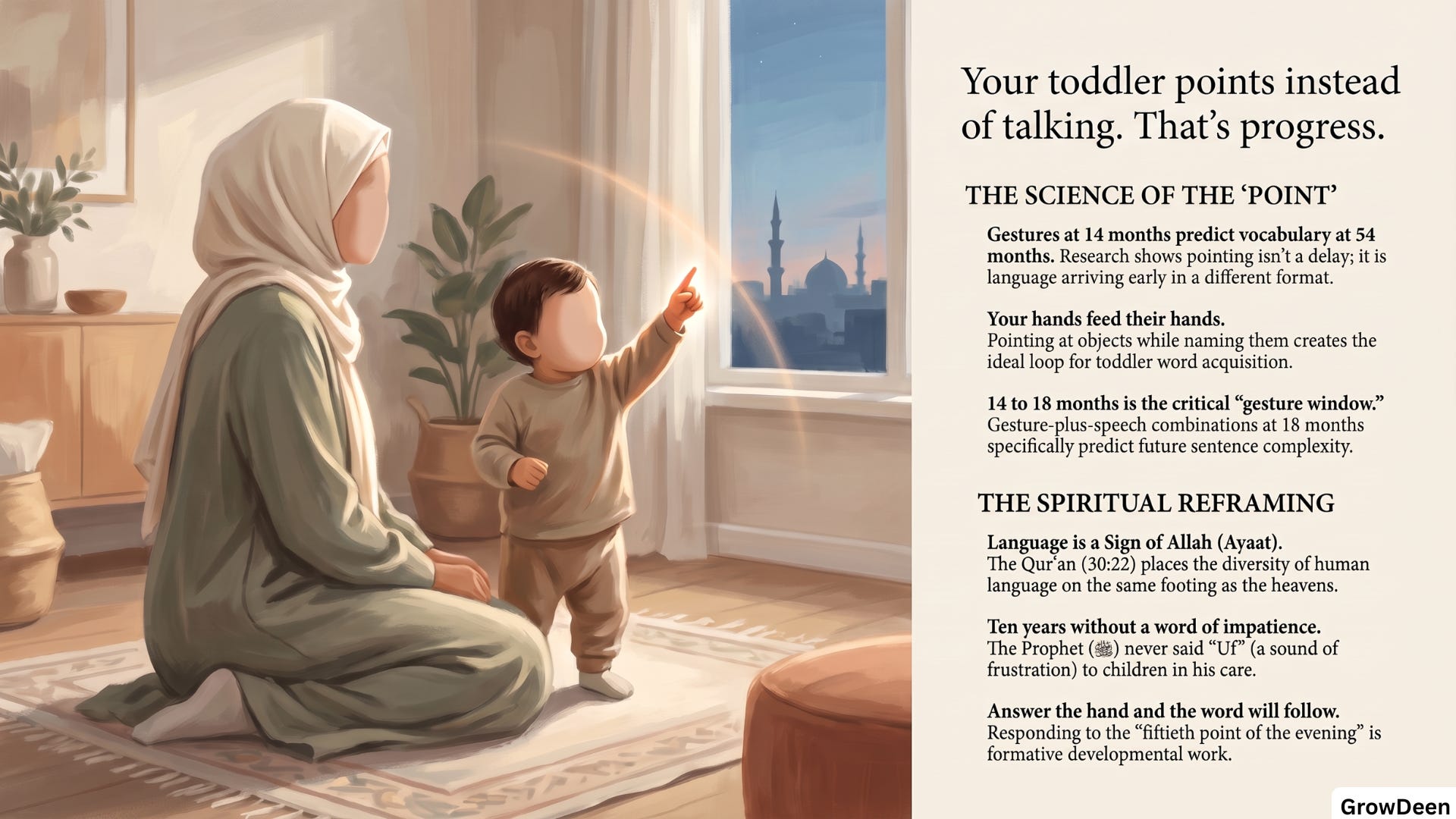
It’s 8:40pm and your toddler is pointing again.
At the light. Then the cup. Then something on the shelf you cannot identify. Each point comes with a sound that is almost a word, and each one waits for you to supply the answer. You have named that light four times tonight.
And underneath the tiredness there is a quieter worry, the one you have not said out loud to anyone: shouldn’t they be talking more by now?
Here is the part that surprised me when I finally read the research properly. Two researchers at the University of Chicago filmed 50 children with their caregivers at home at 14 months, doing nothing special, just ordinary things. Then they came back when those children were 54 months old and measured their vocabulary. The number of different meanings a child had conveyed by gesture at 14 months predicted how many words they had nearly three and a half years later. [1]
Not their words. Their hands.
So that finger you have been answering all evening is not a delay in the talking. It is the talking, arriving early, in a different format.
Why This Guide Is Different
It is built on one specific finding, not general advice. Everything here comes from peer-reviewed work published between 2009 and 2023, including Science, Child Development, and current NICE and ASHA clinical guidance.
It treats the Islamic layer as load-bearing. The Qur’an names the diversity of human languages as a sign of Allah, and Ibn Kathir treats that literally. That reframes what your toddler is doing all day, and this guide uses it that way rather than as decoration.
You get the free Toddler Signal Decoder Pack. A printable three-page PDF that translates what your toddler’s hands and half-words actually mean, so you stop guessing.
Why Does The Quieter Toddler Sometimes End Up With The Bigger Vocabulary?
Hold that question. It has a real answer, and it is not the one most parents expect.
First, what the year actually looks like from the inside.
Between 12 and 24 months, words arrive in an order that holds steady across children and across languages. [4] Nouns come first, because nouns can be pointed at. Cup. Dog. Shoe. Verbs come next and they are much harder, because nobody can point at eat the way they point at bread. Adjectives are last of the three.
By 18 months, most toddlers know and use somewhere between 20 and 100 meaningful words, with new ones appearing almost daily. [3] Around the same time your child starts referring to themselves by name, in the third person, like they are narrating someone else.
And then somewhere near 24 months, two things happen at once. Words start combining. Mummy car. Me do it. Dog eat. And your child stops saying their own name and starts saying I.
That switch is bigger than it looks. It is the moment a child works out that they are a separate person with thoughts that belong to them.
But here’s the thing. All of that is the visible layer. Underneath it, something else has been running the whole time.
What Your Toddler Is Actually Doing When They Point
Your toddler understands far more than they can say. All year. Familiar phrases land. It’s time to eat. Simple instructions land. Stop that. Even short explanations get through. The sun is out, so we need our hats. [3][4]
So a quiet toddler is not an uncomprehending one. The receptive side is ahead, and it stays ahead.
Which is where the gesture research becomes useful rather than just interesting. A follow-up study found the link is specific rather than vague: the number of different meanings a child gestured at 18 months predicted their vocabulary at 42 months, while gesture-plus-speech combinations at 18 months predicted their sentence complexity at 42 months. [2] Two different kinds of hand movement, forecasting two different language skills, two years out.
And the same researchers traced children’s gesture back to their parents’ gesture. [1]
Read that again, because it is the actionable part. Your hands feed their hands. Their hands feed their words.
So when your toddler points at the kettle and looks at you, that point is doing developmental work. And when you point while you talk, so is yours.
I know what you might be thinking: one more thing to be conscious of. I understand. But this one costs nothing and adds no time to your day, and I will show you exactly what it looks like at 8pm on a Tuesday.
The Reply That Does Most Of The Work
Every parent has been told to talk to their toddler. Almost nobody is told what kind of talking counts.
Here is what the research narrows it to: the quantity of speech a child hears matters, but the character of it matters more. Specific qualities of caregiver speech, rather than sheer volume, predict later vocabulary. [5] And the relationship runs in both directions. The home language environment shapes the child’s language, and the child’s emerging language in turn shapes how the adults around them speak. [6] It is a loop, not a delivery service.
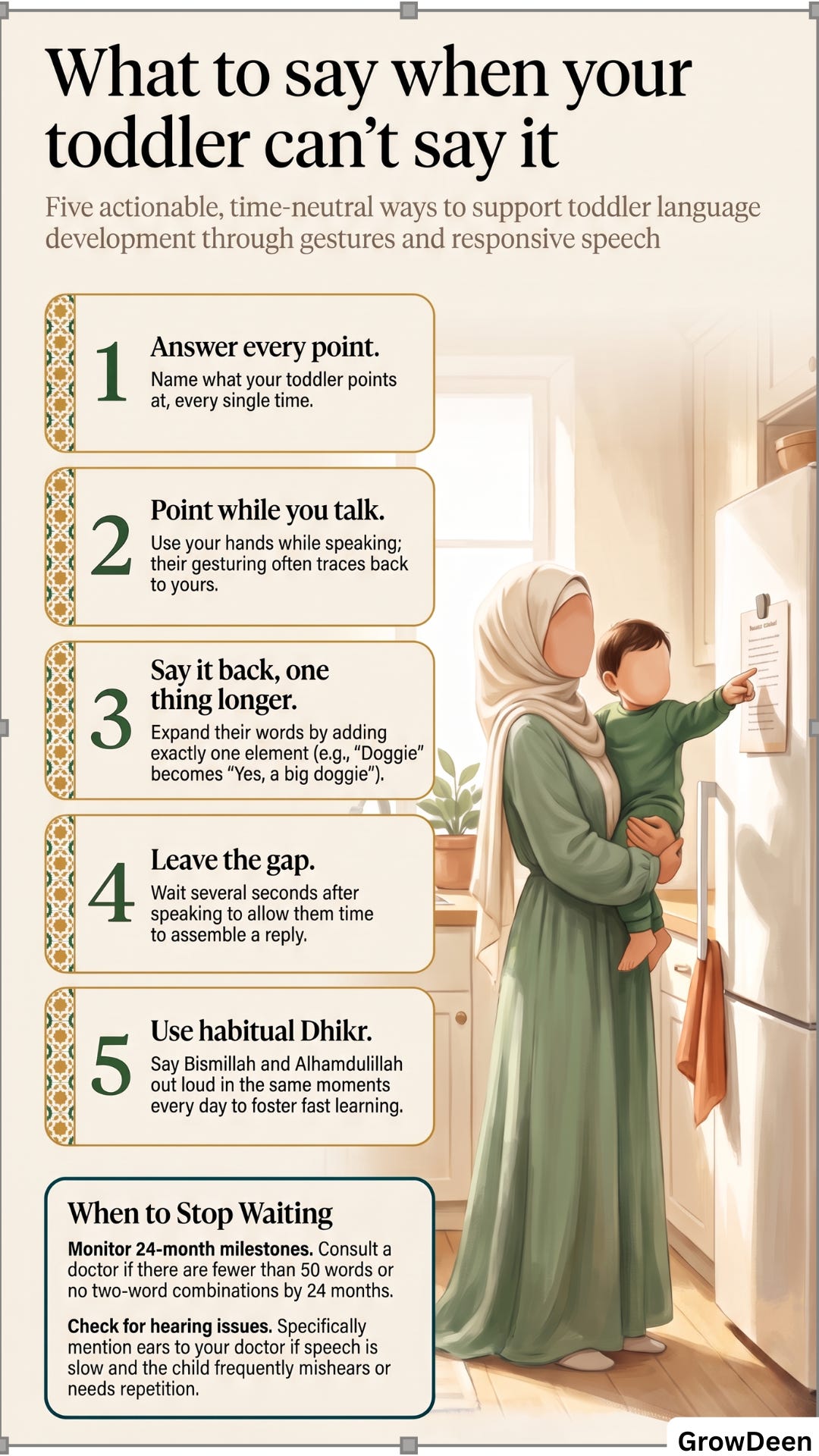
The technique that carries the most weight fits on a fridge magnet.
Say it back, one step longer.
Your toddler says doggie. You say, “Yes, a big doggie.” They say more. You say, “More water? Here is more water.” They say ball go. You say, “The ball went under the chair.”
One element added. Not five. No request to repeat. No test.
And in a Muslim home, some of the most repeatable phrases of the entire day are already sitting there, unused as language tools. Bismillah before the cup. Alhamdulillah after it. Assalamu alaykum when someone comes through the door. Short. Said dozens of times a week. Always in exactly the same context.
Fixed context plus high repetition is close to ideal conditions for a toddler acquiring words. Nobody needs to sit an 18 month old down and teach these. They need to hear them out loud, at the moment they apply, from the adults around them.
There’s one more thing I want to give you before we go further.
Something To Print Before You Forget All Of This
I know this is a lot to hold in your head, especially at the end of a day when you have already answered the same point forty times. That is why I made a free Toddler Signal Decoder Pack, a printable guide that translates your toddler’s gestures and half-words into what they actually mean, and tells you what to say back. Keep reading and you can download it at the end. It is designed to live on your fridge, where the pointing actually happens.
But here’s what most parents don’t realise about all this.
What The Qur’an Says About The Half-Words Coming Out Of Your Toddler’s Mouth
By the fiftieth wassat of a Tuesday afternoon, “sign of Allah” is not the phrase in your head. I know. Mine neither.
But when I sit with the verse where
Allah says, “And of His signs is the creation of the heavens and the earth and the diversity of your languages and your colours. Indeed in that are signs for those of knowledge” [Qur’an 30:22] [12],
what strikes me is how concrete Ibn Kathir gets with it. According to Tafsir Ibn Kathir, commenting on the difference of tongues, he does not stay abstract at all. He lists them out: Arabic, and the languages of the Persians, the Ethiopians, the Berbers, the Indians, the Armenians, the Kurds and others, and concludes that only Allah knows the full range of tongues spoken among the children of Adam. [13]
Human language, placed on the same footing as the heavens and the earth.
Which recasts the pointing entirely. Your toddler is not being tiresome. They are stepping into something Allah singled out by name.
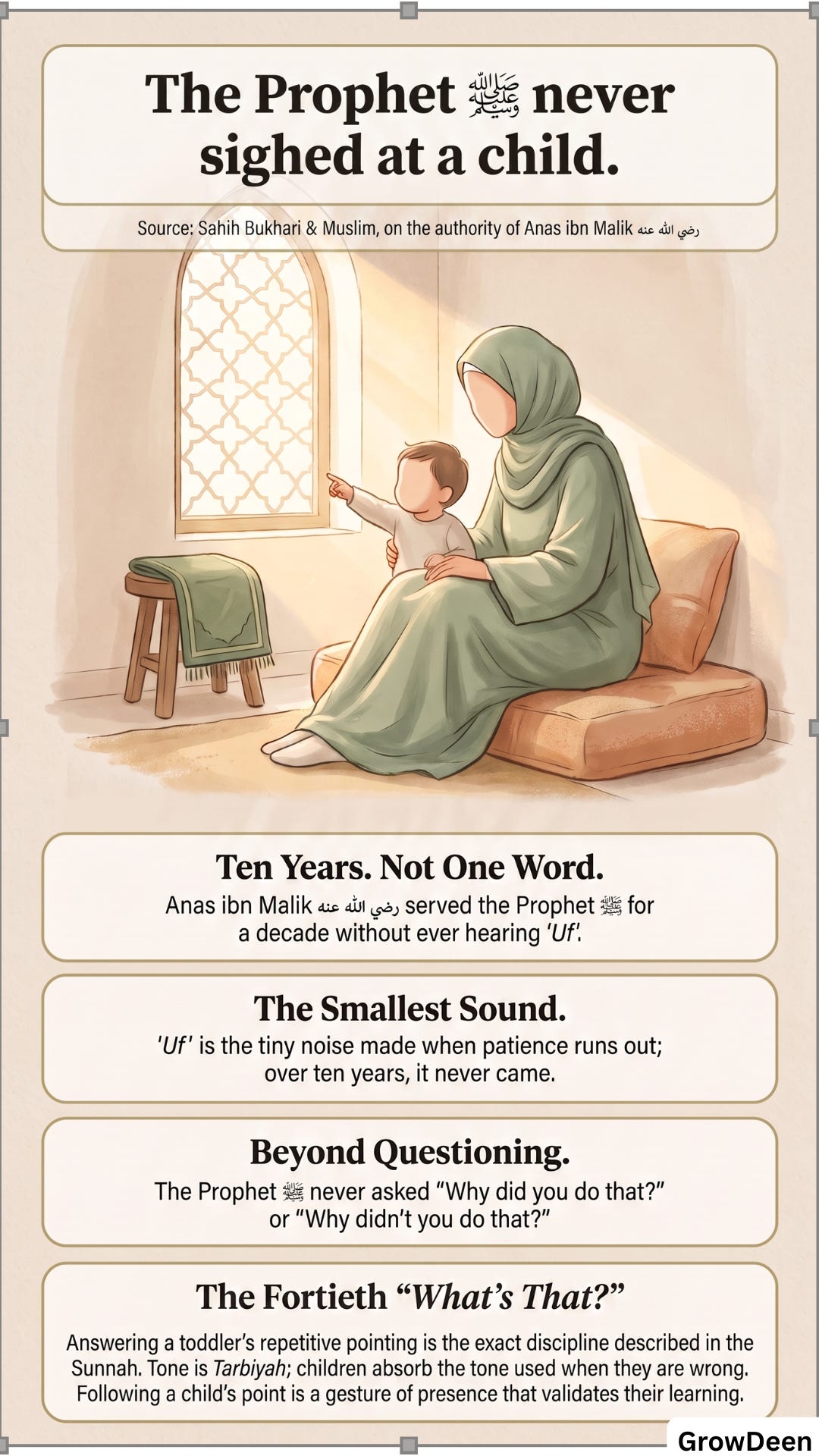
And the Sunnah sets the standard for how you meet them there. Anas ibn Malik رضي الله عنه, who came into the Prophet’s ﷺ household as a boy, said: “I served the Prophet ﷺ for ten years, and he never said to me ‘Uf’, and he never blamed me by saying, ‘Why did you do so or why didn’t you do so?’” [Sahih al-Bukhari 6038, Graded: Sahih] [14]
Ten years. A child in his care, making ordinary childhood mistakes, and not one recorded syllable of impatience. Not a raised voice. Uf, the smallest possible sound of being fed up, and it never came.
That is this year, described exactly.
Answer the hand and the word will follow.
Support Muslim Parenting Lab ❤️
Would you like one parent, somewhere, to be guided because of you? Fund the articles that reach them, with the button below.
The Prophet ﷺ said one person guided through you is better for you than red camels, the greatest wealth of that time. (Sahih al-Bukhari 3701)
Why “Tar” Instead Of “Car” Is Not A Problem To Fix
Toddler pronunciation is wrong in patterned ways, not random ones.
Sounds made at the back of the mouth get pulled forward, so car becomes tar. Final consonants drop off, so cat becomes ca. Two-consonant beginnings collapse to one, so plane becomes pane and snake becomes nake. Harder sounds get swapped for easier ones, giving dat for that and wed for red. Whole first syllables vanish, turning banana into nana.
The benchmark worth remembering: at 24 months, someone outside your family should follow roughly half of what your child says. Inside the house it will be far higher, because you have context a stranger does not.
Now, how you respond matters more than most parents expect. Say the word back correctly inside a short, ordinary sentence, then carry on. Do not ask for a repetition. Do not drill the sound. And do not echo the mistake back, however sweet it sounds, because the correct version is the exact thing they are listening for, and they will not get it from you if you copy them.
Two Languages At Home? Here Is What The Research Actually Says
Plenty of Muslim families are running two or three languages, and the worry is common enough to meet head on.
A multilingual toddler’s vocabulary within any single language may look smaller than a monolingual peer’s. Their combined vocabulary across languages is comparable. [7] There is often a stretch where a child mixes languages inside one sentence. That stops as each system matures. It is not confusion and it is not delay.
One caveat worth knowing, because it prevents both panic and complacency. A genuine language difficulty shows up in both languages, not just one. Weakness confined to a single language is usually a question of exposure rather than ability. [7] Cutting a child’s languages down to one is not the recommended answer.
When Waiting Stops Being The Right Call
Most differences in timing turn out to be nothing. But early help works better than late help, so a check is never wasted.
Speak to your doctor or paediatrician if, by 12 months, your toddler shows no interest in sounds, does not respond to their name, or is not trying to communicate through babbling, words or gestures. By 18 months, if they say no single words, do not point, wave or use other gestures, or cannot follow a simple instruction like “Give me the ball.” By 24 months, if they are not combining two or more words, cannot follow “Get your jacket,” or do not copy your actions and words during simple action rhymes and spoken games. [3]
At any age, if your child loses a language skill they previously had, treat it as urgent.
Two things here that parents are rarely told.
The pattern above has a clinical name. A toddler producing fewer than 50 words, or not combining words, at 24 months meets the commonly used criteria for late language emergence. That describes an estimated 10% to 20% of two year olds. Many catch up. A meaningful number do not without support, and there is no reliable way to know in advance which group a particular child is in. [8]
And one of the most common contributors to slow language at this age is also one of the most treatable, and it is easy to miss entirely. Glue ear, or otitis media with effusion, is fluid building up in the middle ear without any sign of infection. Up to 80% of children under four are affected at some point. It often produces no obvious illness at all, but it can cause fluctuating or persistent hearing loss, and that hearing loss affects listening, language development and behaviour. [9] If your toddler’s speech is slow and they seem to mishear, need things repeated, or struggle to follow you in a noisy room, mention the ears specifically when you see the doctor.
Nothing about booking that appointment sits awkwardly with tawakkul. Hearing and speech are an amanah placed in your child. Taking the practical means to protect a trust is part of honouring it, not an alternative to relying on Allah.
Two more things worth knowing while you decide whether to wait. Screens cannot do this job: language is built through responsive exchange with a person, and passive input displaces the face-to-face time that actually does the building. [10] And the words your toddler is assembling right now are not just this year’s business. Oral language in early childhood is the foundation later reading gets built on, and weaknesses in it are strongly implicated in reading difficulties that only surface years afterwards. [11]
So, The Quieter Toddler
Back to the question from the opening.
The child with fewer spoken words at 18 months who ends up with the larger vocabulary at four is usually not a mystery and not a miracle. They were communicating the whole time. Their hands were busy, their meanings were varied, and somebody in the house was answering. [1][2]
That is the whole finding, and it is oddly comforting. Because the thing that predicts your child’s vocabulary is not a program you have not bought or a milestone you have not hit.
It is the fiftieth point of the evening, and whether anyone answers it.
Your Free Toddler Signal Decoder Pack
If you have read this far, you are the kind of parent who wants to understand your child rather than just measure them against a chart. That tells me something good about you.
Inside the Toddler Signal Decoder Pack (one comprehensive PDF, 3 pages):
Page 1: The Gesture Inventory — Sixteen different meanings toddlers commonly convey with their hands and body before they can say them, each with a tick box and the exact sentence to say back when you see it. Designed as a fridge card you can work through slowly over weeks, so you can see the range your child already has rather than guessing at it.
Page 2: The Toddler Sound Decoder — A three-column translation table for the pronunciation swaps toddlers actually make (tar for car, nake for snake, nana for banana), plus the four response rules that stop you accidentally reinforcing the error. So you can decode your child in under a minute instead of asking them to repeat themselves.
Page 3: Two Reflections For The Talking Year — Two authenticated Islamic reflections in full: Qur’an 30:22 on the diversity of human tongues with Ibn Kathir’s commentary, and the narration of Anas ibn Malik رضي الله عنه on ten years without a word of impatience from the Prophet ﷺ. One for what your child is becoming, one for how you speak to them while they get there.
This isn’t just a PDF to download and forget. It’s a tool designed to stay on your fridge, where the pointing actually happens.
This Toddler Signal Decoder Pack is what every subscriber receives with each article. We cover the full journey of raising Muslim children, from newborns to school age, all backed by scientific research and rooted in Islamic wisdom.
Before you do anything else today, try this once: the next time your toddler points at something, don’t just name it. Point at it yourself while you say the word. Your hands feed their hands. That’s the whole practice, in five seconds.
May Allah place barakah in your effort, accept your intention, and make every ordinary word you answer more formative than it feels in the moment.
Think of one person right now: the sister who mentioned at the masjid that her 20 month old “still isn’t really talking” and laughed it off in a way that didn’t sound like laughing, or the cousin quietly comparing her toddler to her friend’s chatty one, or the new mother who has no idea that pointing counts as progress.
This article could take a weight off them tonight. Share it with them, not as advice-giving, but as care. Sometimes the kindest thing we can do is tell someone their child is already doing the thing.
Frequently Asked Questions
Q: My toddler is 18 months and only says a few words. Should I be worried?
A: Not automatically. Most toddlers know and use between 20 and 100 words by 18 months, but the normal range is genuinely wide. [3] What matters more at this stage is whether they point, wave, gesture and follow simple instructions. If they do none of those by 18 months, that’s worth raising with your doctor. See “When Waiting Stops Being The Right Call” above.
Q: How many words should a 2 year old say?
A: Around 24 months, most toddlers are combining two or three words, like “Mummy car” or “me do it.” [3] Fewer than 50 words, or no word combinations at all at 24 months, meets the commonly used definition of a late talker, which describes 10% to 20% of two year olds. [8] That doesn’t mean something is wrong, but it does mean it’s worth an assessment rather than waiting.
Q: Why does my toddler point instead of talking?
A: Because pointing works, and because their hands develop the ability to signal meaning before their mouth does. This isn’t avoidance. The range of meanings a child conveys by gesture at 14 to 18 months predicts their vocabulary years later. [1][2] Answer the point every time.
Q: Should I correct my toddler’s pronunciation?
A: No. Say the word back correctly inside a short sentence, then move on. Don’t ask them to repeat it, and don’t echo the mistake back even affectionately. At 24 months, someone outside the family understanding about half of what your child says is normal.
Q: Does raising a child bilingual delay their speech?
A: No. A multilingual toddler’s vocabulary in each individual language may look smaller, but their combined vocabulary across languages is comparable to a monolingual child’s. [7] A real language difficulty would show up in both languages, not one.
Q: Can ear infections cause speech delay in toddlers?
A: Yes, and it’s easy to miss. Glue ear affects up to 80% of children under four, often with no obvious illness, and the fluctuating hearing loss it causes can affect language development. [9] If your toddler’s speech is slow and they also mishear or need things repeated, mention the ears specifically to your doctor.
References
[1] Rowe, M.L., & Goldin-Meadow, S. (2009). Differences in early gesture explain SES disparities in child vocabulary size at school entry. Science, 323(5916), 951–953. https://doi.org/10.1126/science.1167025
[2] Rowe, M.L., & Goldin-Meadow, S. (2009). Early gesture selectively predicts later language learning. Developmental Science, 12(1), 182–187. https://doi.org/10.1111/j.1467-7687.2008.00764.x
[3] Zubler, J.M., Wiggins, L.D., Macias, M.M., Whitaker, T.M., Shaw, J.S., Squires, J.K., et al. (2022). Evidence-informed milestones for developmental surveillance tools. Pediatrics, 149(3), e2021052138. https://doi.org/10.1542/peds.2021-052138
[4] Owens, R.E. (2019). Language development: An introduction (10th edn). Pearson.
[5] Rowe, M.L. (2012). A longitudinal investigation of the role of quantity and quality of child-directed speech in vocabulary development. Child Development, 83(5), 1762–1774. https://doi.org/10.1111/j.1467-8624.2012.01805.x
[6] Bornstein, M.H., Putnick, D.L., & Esposito, G. (2020). Skill-experience transactions across development: Bidirectional relations between child core language and the child’s home learning environment. Developmental Psychology, 56(10), 1842–1854. https://doi.org/10.1037/dev0001092
[7] Hoff, E., Core, C., Place, S., Rumiche, R., Señor, M., & Parra, M. (2012). Dual language exposure and early bilingual development. Journal of Child Language, 39(1), 1–27. https://doi.org/10.1017/S0305000910000759
[8] American Speech-Language-Hearing Association. Late language emergence. ASHA Practice Portal. https://www.asha.org/practice-portal/clinical-topics/late-language-emergence/
[9] National Institute for Health and Care Excellence. (2023). Otitis media with effusion in under 12s. NICE guideline NG233. https://www.nice.org.uk/guidance/ng233
[10] American Academy of Pediatrics, Council on Communications and Media. (2016). Media and young minds. Pediatrics, 138(5), e20162591. https://doi.org/10.1542/peds.2016-2591
[11] Snowling, M.J., & Hulme, C. (2020). Annual research review: Reading disorders revisited, the critical importance of oral language. Journal of Child Psychology and Psychiatry. https://doi.org/10.1111/jcpp.13324
[12] Qur’an, Surah Ar-Rum 30:22 — https://quran.com/30/22
[13] Ibn Kathir. Tafsir Ibn Kathir, Surah Ar-Rum 30:22 commentary — https://quran.com/en/30:22/tafsirs/en-tafisr-ibn-kathir
[14] Sahih al-Bukhari 6038, narrated by Anas ibn Malik رضي الله عنه; also Sahih Muslim 2309 — Graded: Sahih (Muttafaqun Alayhi) — https://sunnah.com/bukhari:6038
We combine scientific research with Qur’an and authentic Sunnah, and we cite our sources. Even so, this is general guidance and no substitute for a doctor who can examine your child.