

86% of adolescents miss the WHO’s activity targets. [1] Between ages 10 and 13, active play falls by about 20 minutes a day. [2]
Print it before this Saturday’s walk.
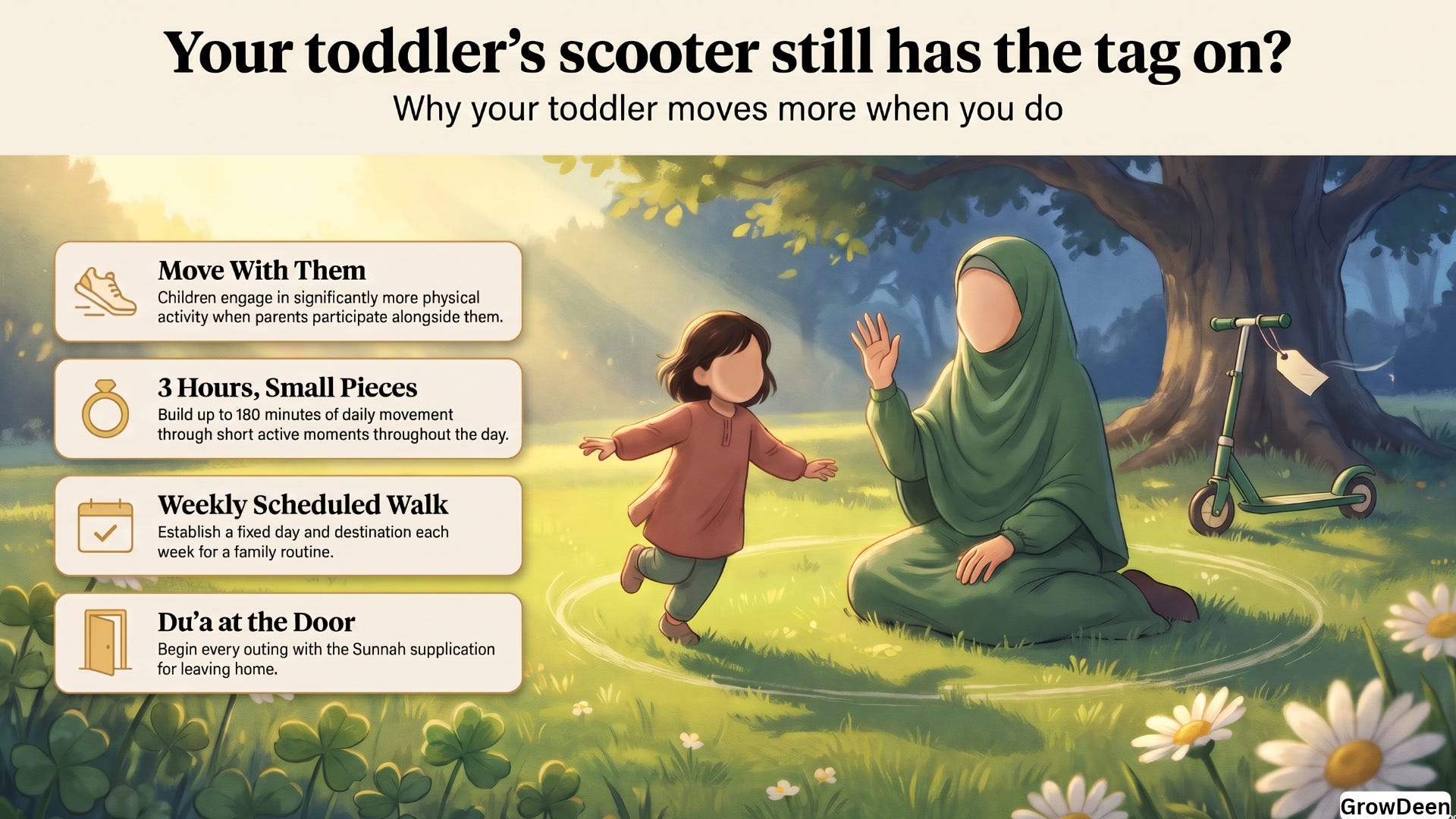
The scooter still has the tag on it.
It has leaned against the hallway wall since Eid, next to a football that has never been kicked. Your five-year-old walks past both of them to the sofa every afternoon. You have said “go and play outside” so many times that the words have stopped meaning anything in your house.
Then one Saturday you sit on the grass at the park instead of the bench, because your back hurts and the bench is wet. Within two minutes your child is circling you. Within ten, the two of you are racing to the bin and back, and she runs for forty minutes without being asked once.
So why does a child who ignores “go and play” every weekday run until she is pink in the face the moment you are out there with her? The answer explains almost everything about raising an active child, and it costs nothing.
You are doing more than you think. Most parents who worry about this are tired and half-convinced that they’ve already got it wrong. They haven’t.
What Makes This Approach Different
Every figure here comes from the WHO’s 2019 and 2020 guidelines and from peer-reviewed reviews published between 2015 and 2025.
A child’s body is treated as an amanah from Allah, and the Sunnah of a regular walk sits at the centre of the plan.
You already have the free Walk With Me Pack from the top of this page: a join-in ladder, a Saturday walk planner and a door du’a card.
Why Does My Child Only Move When I Do?
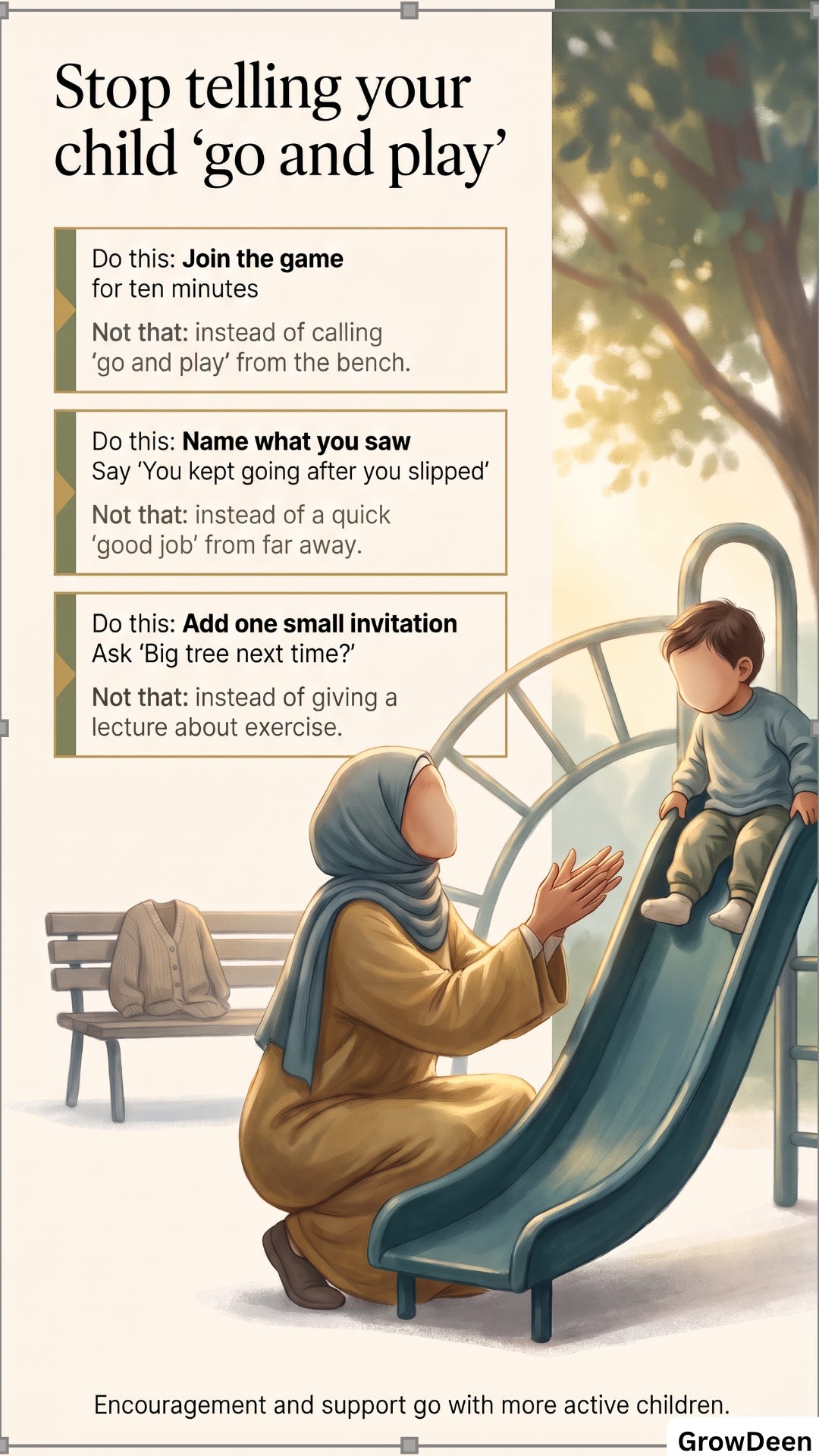
Picture a Sunday at the park. On the bench, a father scrolls his phone while his son pushes a toy truck in the sand. Ten metres away, another father is crouched at the bottom of the slide, calling out a count before each go, and his daughter has climbed the ladder fourteen times.
The equipment is identical. The parent isn’t.
The research behind that scene is surprisingly consistent. A systematic review of 39 studies found a positive link between how active parents are and how active their children are in 35 of 41 analyses. The link was modest, but it showed up across ages and in every combination of mother, father, son and daughter, and it was strongest in studies that tracked parents’ movement with a device rather than a questionnaire. [3] A separate meta-analysis found that encouragement and support from parents went with more activity in children and teenagers. Whether punishment or discouragement made any difference couldn’t be judged, because too few studies had looked. [4]
The newest piece is the most useful one. A 2025 review of 15 studies found that parents taking part alongside their children was linked with children’s activity in most of the studies that examined it. [5] Watching from the bench is good. Joining in is better.
Which brings the problem into view. Somewhere along the way, many families absorbed the idea that a child’s activity is something parents arrange: a class, a club, a bigger garden, a better scooter. All of those have their place. None of them replaces an adult who moves where the child can see.
Children follow feet, not instructions.
The Sunnah has an example of how encouragement lands. When a dream seen by the young Abdullah ibn Umar was passed on to the Prophet ﷺ, he said, “Abdullah is a good man. I wish he prayed Tahajjud.” After that, Abdullah slept only a little at night. [6] The praise came first and it was sincere. The nudge was gentle and specific.
That pattern transfers neatly to a playground. Name exactly what you saw (”You kept going on the monkey bars after you slipped”), then add one small invitation: “Shall we try for the big tree next time?” A vague “good job” from the bench does far less.
Tonight, before anything else, pick one activity that you can both enjoy. Kicking a ball against a wall counts. So does a race to the lamppost or ten minutes with a kite. Then do it where your child can see you, and let them catch you breathing hard.
We Don’t Have A Garden. Does That Matter?
A flat with a narrow hallway is enough. Line the hallway with cushions and it becomes a river that has to be crossed on stepping stones. Bear crawl down it one way and frog jump back, then try crab walks and kangaroo hops. Play freeze, where everyone moves until someone calls “stop” and has to hold their pose, and a whole wet afternoon goes by without a screen.
Outdoors still matters, though, and the reason is worth knowing. A systematic review of 28 studies found that children who spend more time outside tend to be more active and less sedentary. [7] Almost all of those studies looked at children at one point in time, so they can’t prove that being outside causes the extra movement, and the authors said so plainly. The direction of the evidence was consistent all the same.
If there’s no garden, borrow space. Parks and playgrounds come first, then sports fields, beaches, a relative’s back garden, school grounds out of hours, community and indoor sports centres, and the open area around a masjid where children are welcome.
There’s also a resource most families overlook: the neighbours. Two or three households with young children can take turns watching them at the local park, which hands each parent a free afternoon and each child someone to run with. The Prophet ﷺ said that Jibril kept urging him to treat neighbours well, so often that he thought the neighbour would be given a share of inheritance. [8] A rota of parents taking turns at the swings is a very ordinary way of honouring that.
Which leaves the hardest question for most families. Not where, but when.
Where Does The Time Come From?
The week is already full. School runs, Qur’an class, homework, dinner, Isha, bath, bed. Adding “an hour of activity” to that list feels like being handed a second job.
One reframe helps. Children who get long, unhurried stretches of play use space in their own way, and give a child an afternoon and a patch of grass and within twenty minutes there will be a game with rules nobody taught them. That kind of time rarely appears on its own, so it has to be protected on purpose: a kickabout on Sunday morning, forty minutes at the park after Asr, written into the week the same way a doctor’s appointment is.
Movement also hides inside jobs you already do. Set a timer while the toys go back into the basket and see whether tomorrow’s tidy can beat today’s. A toddler can carry the bread from the car, and a five-year-old can sweep the path or water the garden beside you. A child who helps their parents is practising adab while using their legs, and many children like being useful far more than adults expect.
The urgency is real, because this window does not stay open. The WHO notes that habits formed early in life help shape habits through childhood and adolescence and into adult life. [9] Worldwide, 86% of adolescents don’t reach recommended activity levels. [1] In a study that followed more than 3,600 Australian children from ages 10 to 11 into ages 12 to 13, time spent in active play fell by roughly 20 minutes a day, with a steeper drop for girls. [2]
A child who still wants to run for the sake of running is a child whose habits are still being set.
Remembering all of this on an ordinary Tuesday is a lot to ask of a tired parent. The Walk With Me Pack exists so that you don’t have to: a ladder for joining in that fits on the fridge, a planner for a fixed weekly walk, and a door card with the du’a for leaving home. The download button is at the top of this page, and there’s a full description of what’s inside it below.
There’s one more thing worth knowing before the practical part, because it changes what a walk with a child is.
The Sacred Trust Of A Weekly Walk: What The Prophet ﷺ Kept Every Saturday
Caring for your child’s body is part of the amanah of raising them, and the Sunnah shows movement being lived rather than lectured about. Ibn Umar reported that the Prophet ﷺ went to the Mosque of Quba every Saturday, sometimes walking and sometimes riding, and that Ibn Umar kept up the same practice. [10] The explanation on HadeethEnc notes that naming Saturday meant he set particular days aside for the visit. [11] It had a fixed day and a destination, and the younger man who watched it carried the habit on.
That is exactly the walk worth building with a child.
The outdoors adds a second layer, and it speaks to the parent standing at the park gate wondering whether any of this is worship. Allah says: “And the earth - We spread it out and cast therein firmly set mountains and made grow therein [something] of every beautiful kind,” “Giving insight and a reminder for every servant who turns [to Allāh].” [12] According to Tafsir Ibn Kathir, Allah made the earth spacious and spread it out, set the mountains firm so it would not shake with its people, and brought out every beautiful kind of plant and fruit. Looking at all of this, he explains, gives insight and a reminder to every servant who turns to Allah humbly and with awe. [12]
So when your four-year-old crouches on the path over a beetle, or asks who made the hill she just ran up, she is doing a small version of that looking. The walk gives her legs work, and it gives her eyes something to reflect on.
How Much Movement Is Enough At Each Age?
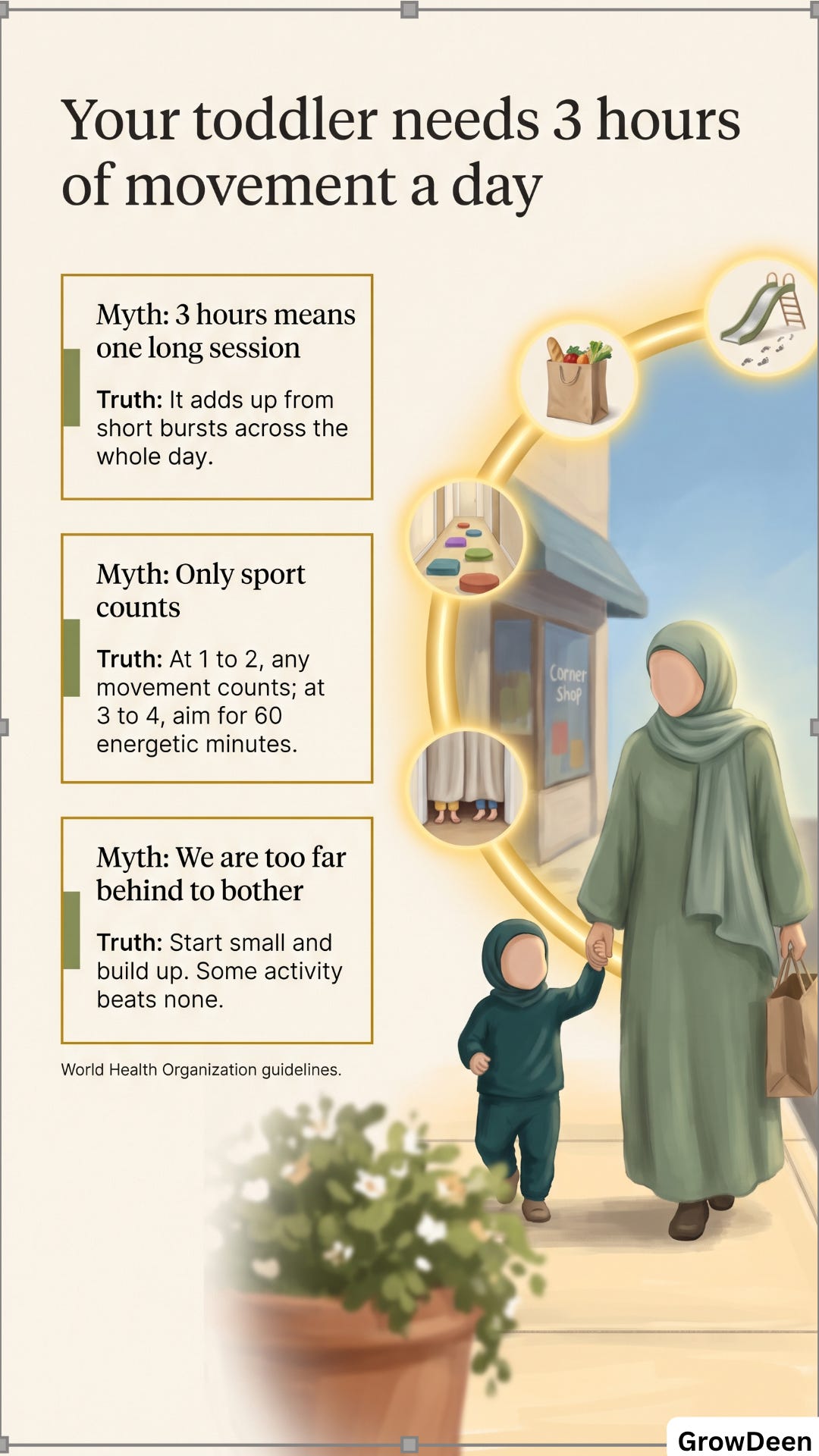
Most parents are surprised by how generous the numbers are. The WHO counts movement for under-fives in hours across a whole day, and it places activity, sitting and sleep side by side. [9]
Babies under one: active several times a day, mostly through floor play with you, with at least 30 minutes of tummy time spread through the waking hours for babies who aren’t yet crawling. No more than an hour at a stretch in a pram, high chair or carrier, no screens, and 14 to 17 hours of sleep in the first three months, 12 to 16 hours from four to eleven months. [9]
Ages one to two: at least 180 minutes of activity a day at any intensity, the same one-hour restraint limit, no screens at one and no more than an hour at two, and 11 to 14 hours of sleep. [9]
Ages three to four: at least 180 minutes, with at least 60 of them moderate to vigorous, the breathing-hard kind of play. Screens under an hour, and 10 to 13 hours of sleep, which may include a nap. [9]
Ages five and over: an average of at least 60 minutes a day of moderate to vigorous activity across the week, mostly aerobic, with vigorous play and muscle and bone strengthening on at least three days a week. [13]
Look at that 180 minutes again before it starts to feel impossible. Twenty minutes at the playground, the walk to the shops, a game of chase in the hallway before Dhuhr and hide and seek after dinner come to a surprising total. For a child who is nowhere near it yet, the WHO’s advice is to start small and build up, since some activity is better than none. [13]
The payoff is broad. Reviewing the evidence for its 2020 guidelines, the WHO linked activity in children and adolescents with fitter hearts and muscles, healthier blood pressure, blood fats and blood sugar, stronger bones, better academic performance and executive function, fewer symptoms of depression, and less body fat. [13] For under-fives, it ties more activity, less sitting and good sleep to physical and mental health, to preventing childhood obesity, and to motor and cognitive development. [9]
One detail is easy to miss. When a baby or toddler is sitting still, the WHO encourages reading and storytelling with a caregiver. [9] For a Muslim home, that is an open door to Islamic picture books and the stories of the Prophets, told slowly on the sofa after a busy morning outside.
Support Muslim Parenting Lab ❤️
Is there someone you have lost who you would still like to send a reward to? Give in their name with the button below.
Asked whether he could give charity for his late mother, the Prophet ﷺ said: yes, give on her behalf. (Sahih al-Bukhari 2760)
My Child Hates Sport. What Now?
Some children dread the football club or cry at the swimming pool. A few announce at four that they are “not a running person.”
None of that rules them out. Different activities build different skills and keep a child challenged, and the more a child tries, the better the chance of finding the one they love. The WHO’s guidance explicitly calls for activities that children enjoy, that offer variety, and that suit their age and ability. [13] Enjoyment is not a bonus here. The 2025 review found a child’s confidence in their own ability and their enjoyment of activity among the factors most consistently linked with being active. [5]
So stop recruiting and start watching what your child already does:
Balancing on kerbs and low walls points toward climbing frames, cycling or gymnastics.
Throwing everything in sight points toward ball games in the park, ten-pin bowling, frisbee, cricket or tennis.
A child who heads straight for every puddle may be ready for swimming lessons.
A child who races everywhere may love running races, scooters, tag and relay games.
Children with disability can join a great many activities and sports, and many sports can be adapted so that every child takes part fully. The WHO’s 2020 guidelines include children and adolescents living with disability. [14] Ask your child’s doctor or therapist what suits their body, then look for inclusive programs near you. Every child is an amanah, and every child deserves the joy of moving in the ways their body allows.
How Do I Make A Daily Walk Stick?
If only one habit survives a busy month, make it the walk. Babies ride in a carrier or pram and toddlers walk part of the way. Before long an older child will insist on choosing the route.
Australian research across 25 primary schools found that the route matters more than willpower. Boys were far less likely to walk to school when the way meant crossing a busy road. Tight family schedules and parents finding driving more convenient both pushed children into cars, while children who said they preferred walking were much more likely to walk. [15]
That points to three small changes: leave five minutes earlier, take the quieter street even when it’s longer, and ask your child what they like about the walk. Then give one walk a week a fixed day and a destination, the way the Prophet ﷺ kept Saturdays for Quba. The park every Saturday works. So does the grandparents’ house after Jumu’ah, or a longer trip at the weekend to botanical gardens, bushland, a lake or a marked nature trail.
The walk is also where manners get taught without a lecture. The Prophet ﷺ warned people against sitting in the roads. When they said they had nowhere else to gather, he told them to give the road its rights: lowering the gaze, not harming people, returning greetings, and enjoining good and forbidding wrong. [16]
For a small child, that becomes very concrete. Hold hands at the kerb and stop, look and listen before crossing. Keep to one side of the footpath so a pram or a wheelchair can get by. Say salaam to the neighbour at her gate, and answer when someone greets you first. Pick up the crisp packet on the path and carry it to the next bin.
And start at the door. Umm Salamah reported that whenever the Prophet ﷺ left the house, he would raise his eyes to the sky and seek Allah’s protection from going astray or leading others astray, from slipping or making others slip, from wronging or being wronged, and from acting ignorantly or being treated ignorantly. [17]
اللَّهُمَّ إِنِّي أَعُوذُ بِكَ أَنْ أَضِلَّ أَوْ أُضَلَّ أَوْ أَزِلَّ أَوْ أُزَلَّ أَوْ أَظْلِمَ أَوْ أُظْلَمَ أَوْ أَجْهَلَ أَوْ يُجْهَلَ عَلَىَّ
Allahumma inni a’udhu bika an adilla aw udalla, aw azilla aw uzalla, aw azlima aw uzlama, aw ajhala aw yujhala ‘alayya.
Say it at the door each morning and let a little one echo the first few words. Children who hear it daily often start it before their shoes are on.
Do Screens, Gadgets Or Classes Help?
They can, as long as they end with your child moving.
Arrange active playdates. Meeting a friend at the park is enough.
Camp, or take a nature walk as a family.
Chalk a racetrack onto the playground tarmac, or lay out an obstacle course from whatever is lying around.
Keep a box of outdoor kit at home and another in the car, with a ball, a bat, a kite, and a bucket and spade.
Give gifts that get children moving. A ball, a skipping rope, a scooter or a first bike makes a lovely Eid present, as long as somebody takes the tag off and goes outside with it.
Screens can help when they stay inside the limits above. Choose music-free, parent-approved games that get children up off the sofa, such as movement or sports games. Plan a walk to the shops or a woodland trail together on a phone map. Film your child mastering a new skill and watch it back together to see how far they’ve come.
When Should I Check With A Doctor?
Most children simply need more chances to move. A few need a closer look.
Supervise closely near roads, driveways, water and heights, and keep toddlers within arm’s reach near any water.
Check that playground surfaces are soft and that equipment suits your child’s size.
Use a helmet for every bike and scooter ride.
Bring water and sun protection on hot days, and warm layers on cold ones.
Stop when your child is worn out. Pushing a tired, unwilling child rarely builds a love of moving.
See your child’s doctor if your child gets tired much faster than other children their age, becomes unusually breathless, complains of pain during or after activity, struggles with movements their friends manage easily, or loses a physical skill they used to have. If your child has a heart, lung or other medical condition, check with the doctor before they start a new sport. Get urgent medical care for chest pain, fainting during activity or difficulty breathing. Taking these steps is part of the means Islam asks parents to take alongside trust in Allah, and none of this replaces advice from your own doctor.
So Why Did She Run For Forty Minutes?
Go back to that wet Saturday and the parent on the grass. Nothing about the park changed. The scooter was still at home with its tag on. What changed was that an adult she loved was down at her level and close enough to race.
That is what the research keeps finding, from the 35 analyses linking active parents with active children to the reviews that single out parents who join in. [3,5] And it is what Ibn Umar did with a Saturday walk he had watched the Prophet ﷺ keep: he kept it too. [10]
Children follow feet, not instructions. Yours are the ones they are watching.
Your Walk With Me Pack, Explained
Reading this far means you take your child’s body seriously, as an amanah from Allah. That says something good about the parent you already are.
Inside the Walk With Me Pack (one comprehensive PDF, 3 pages):
Page 1: The Join-In Ladder — four ways to move with your child, from naming what you saw to letting them lead the game, with the exact words to use at each rung, a seven-day tick strip and the WHO daily targets by age — designed as a fridge card you can glance at before you head out.
Page 2: The Saturday Walk Planner — a fixed day and destination at the top, a five-point route check built on what makes children walk more, and a four-week log with a column for one thing Allah made that you noticed together — so you can plan the week’s walk in under ten minutes on a Friday night.
Page 3: Out the Door with Bismillah — the du’a the Prophet ﷺ made when leaving the house, in Arabic with transliteration and meaning, plus the rights of the road from the Sunnah turned into four child-sized habits — something to say at the door every morning and practise on every walk.
This isn’t just a PDF to download and forget. It’s built to live on your fridge and by your front door, where you’ll actually use it when you need it most.
The Walk With Me Pack is what every subscriber receives with each article. Muslim Parenting Lab covers raising Muslim children from the newborn weeks through the school years, always backed by research and rooted in the Qur’an and Sunnah.
Try This In The Next Five Minutes
Stand at your front door with your child. Say Bismillah together and read the first line of the du’a above. Then walk to the end of the street and back. That’s the whole thing. Tomorrow, go one house further.
May Allah put barakah in every step your family takes together, and make your child’s strength a means of serving Him for a lifetime.
Share This With Someone Who Needs It
Think of one person right now: the mother at the masjid who told you last week that her son won’t put his tablet down, or your sister with a scooter still boxed up in her hallway since Eid.
This could lift a weight off her. Send it today, simply as support. Sometimes the kindest thing is to pass on what made the walk easier for you.
Frequently Asked Questions
Q: How much physical activity does a toddler need each day?
A: Toddlers aged one to two need at least 180 minutes of activity a day at any intensity, and three- and four-year-olds need the same 180 minutes with at least 60 of them energetic. [9] It adds up from short bursts, so a playground visit and a walk to the shops already go a long way. For every age band, see “How much movement is enough at each age?” above.
Q: How do I get my child to play outside when they refuse?
A: Go out with them and join in. A 2025 review found parents taking part was linked with children’s activity in most of the studies that looked at it, and a review of 39 studies linked active parents with active children. [5,3] Start with ten minutes of something you both enjoy, and see “Why does my child only move when I do?” above.
Q: Do active video games count as exercise for kids?
A: They can count toward movement if they really get your child up and moving, but they still sit inside the WHO screen limits: none under two and no more than an hour a day for two- to four-year-olds. [9] Choose music-free, parent-approved games and treat them as an extra rather than the main source of activity.
Q: How much sleep does a preschooler need?
A: The WHO recommends 10 to 13 hours for three- and four-year-olds, which can include a nap, with regular times for bed and getting up. [9] Active days and good sleep work together, which is why the guidelines treat them as one package.
Q: Can children with disabilities follow the same activity guidelines?
A: The WHO’s 2020 guidelines include children and adolescents living with disability. [14] Many sports can be adapted, so ask your child’s doctor or therapist what suits your child’s body and look for inclusive programs nearby.
Q: What does Islam say about physical activity for children?
A: A child’s body is an amanah, and the Sunnah shows movement built into ordinary life: the Prophet ﷺ went to the Mosque of Quba every Saturday, walking or riding, and Ibn Umar kept the same habit. [10] Time outdoors also opens the door to reflecting on creation, which Ibn Kathir describes as insight and a reminder for the servant who turns to Allah. [12] See “The Sacred Trust of a Weekly Walk” above.
References
[1] World Health Organization. Physical activity [Fact sheet].
[2] Kemp, B.J., Parrish, A-M., Batterham, M., & Cliff, D.P. (2022). Changes in subdomains of non-organized physical activity between childhood and adolescence in Australia: A longitudinal study. International Journal of Behavioral Nutrition and Physical Activity, 19, Article 73.
[3] Petersen, T.L., Møller, L.B., Brønd, J.C., Jepsen, R., & Grøntved, A. (2020). Association between parent and child physical activity: A systematic review. International Journal of Behavioral Nutrition and Physical Activity, 17, Article 67.
[4] Su, D.L.Y., Tang, T.C.W., Chung, J.S.K., Lee, A.S.Y., Capio, C.M., & Chan, D.K.C. (2022). Parental influence on child and adolescent physical activity level: A meta-analysis. International Journal of Environmental Research and Public Health, 19(24), Article 16861.
[5] Zhao, C., Yuan, J., & Huang, W.W. (2025). Multilevel determinants of physical activity in children and adolescents: A meta-analysis guided by social ecological model. BMC Sports Science, Medicine and Rehabilitation, 17, Article 202.
[7] Gray, C., Gibbons, R., Larouche, R., Beate Hansen Sandseter, E., Bienenstock, A., Brussoni, M., Chabot, G., Herrington, S., Janssen, I., Pickett, W., Power, M., Stanger, N., Sampson, M., & Tremblay, M.S. (2015). What is the relationship between outdoor time and physical activity, sedentary behaviour, and physical fitness in children? A systematic review. International Journal of Environmental Research and Public Health, 12(6), 6455-6474.
[12] Quran, Surah Qaf 50:7-8 (Saheeh International). · Ibn Kathir. Tafsir Ibn Kathir, Surah Qaf 50:6-11 commentary.
[13] Chaput, J.P., Willumsen, J., Bull, F., et al. (2020). 2020 WHO guidelines on physical activity and sedentary behaviour for children and adolescents aged 5-17 years: Summary of the evidence. International Journal of Behavioral Nutrition and Physical Activity, 17, Article 141.
[14] Bull, F.C., Al-Ansari, S.S., Biddle, S., et al. (2020). World Health Organization 2020 guidelines on physical activity and sedentary behaviour. British Journal of Sports Medicine, 54(24), 1451-1462.
[15] Trapp, G.S.A., Giles-Corti, B., Christian, H.E., Bulsara, M., Timperio, A.F., McCormack, G.R., & Villaneuva, K.P. (2011). Increasing children’s physical activity: Individual, social, and environmental factors associated with walking to and from school. Health Education & Behavior, 39(2), 172-182.
We combine scientific research with Qur’an and authentic Sunnah, and we cite our sources. Even so, this is general guidance and no substitute for a doctor who can examine your child.