

A University of California study tracked 44 children every two weeks from 10 to 13.5 months and found that vocabulary jumped once walking began, independent of how old the child was. [1] Here is what that means for your toddler this week.
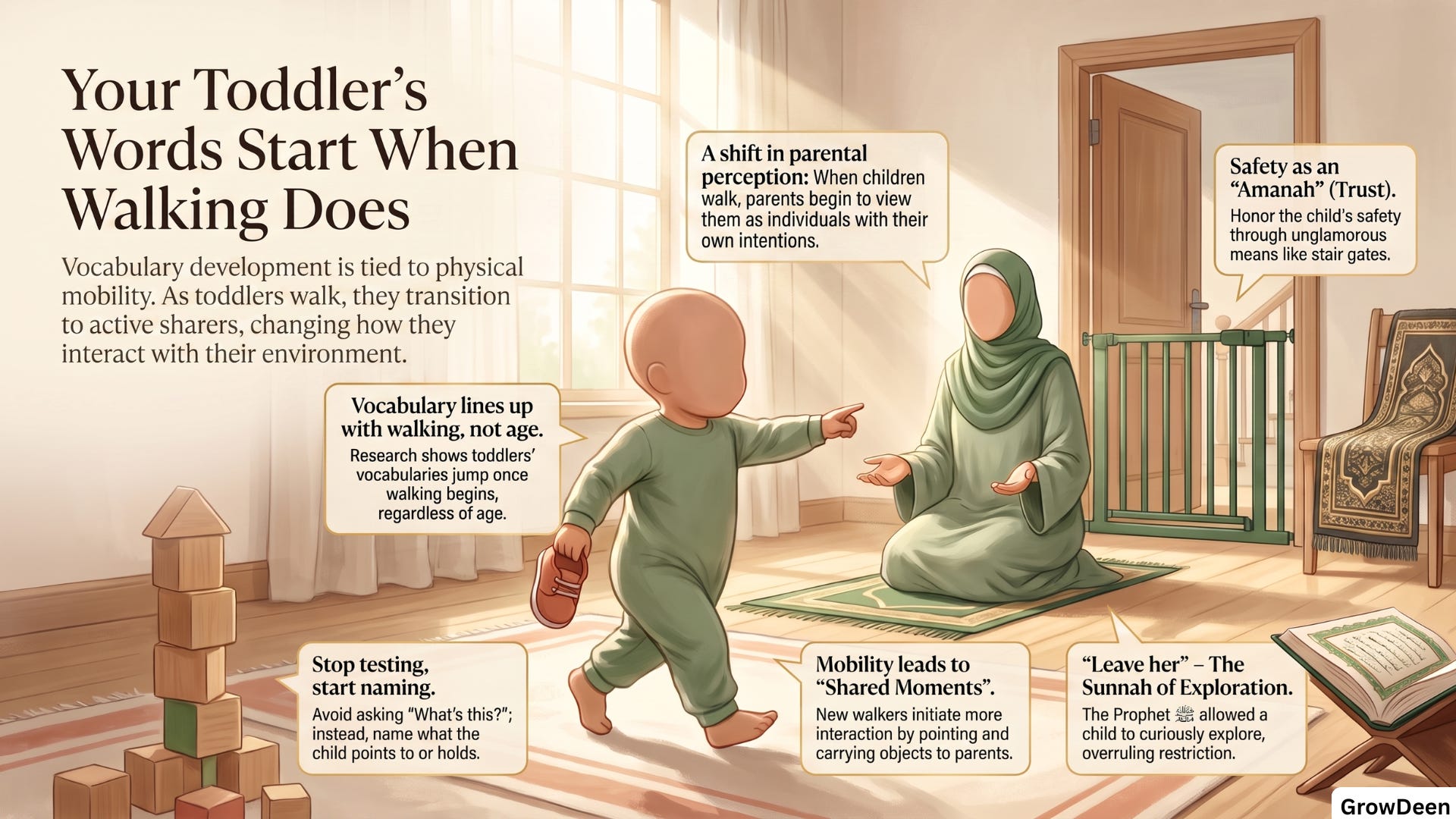
She brought me a shoe.
Not to put on. Just to hand over, then take back, then hand over again. Fourteen months old, maybe eight words to her name, and her mother had spent three months doing everything the leaflets said. Naming objects. Reading at bedtime. Pointing at the ball and waiting.
Nothing. Then one fortnight, the words started arriving in twos and threes, and nobody could work out what had changed.
I know that feeling of doing everything right and getting silence back. You are not imagining the effort, and you are not doing it wrong.
But here is what surprised me when I went looking. When researchers at the University of California tracked 44 children every two weeks from 10 to 13.5 months, the jump in language did not line up with age. It lined up with walking. [1] They ran it again with 38 crawling children and 37 walking children who were all exactly 12.5 months old, and the walkers still had bigger vocabularies. [1]
So why do the words arrive the same fortnight the walking does?
Hold that question. It changes what you do tonight.
What Makes This Guide Different
Peer-reviewed, and recent. Every claim here traces to a named source, from Developmental Psychology and Science to CDC and WHO guidance, not to parenting folklore. [1][7][8]
Islamically grounded, not Islamically decorated. The Sunnah material here is a narration most parents have never read, and it directly contradicts what your instinct tells you to do when your toddler reaches for something. [14]
You leave with a tool, not a to-do list. The free Newly Walking Toddler Pack is three printable pages you will actually stick on a cupboard door.
What Researchers Found When They Watched Toddlers Learn to Walk
Walking looks like a leg story. It is not.
Follow-up work traced what actually shifts. Within two to four weeks of a child’s first independent steps, they start initiating shared moments far more often. Pointing at things. Carrying objects across the room and putting them in a parent’s lap. And they get better at following where a parent is already pointing or looking. [2]
Something else moved too, and this one is quietly startling. Parents in that study began describing their newly walking child as more of a person, an individual with their own intentions. [2] The child changed. Then the parent changed. Then the language grew.
That shoe was not a random object. It was an invitation.
Even before walking, twelve-month-olds will point at something purely to tell an adult where it is, with nothing in it for themselves. [3] They are not asking. They are sharing.
Which brings me to the thing most of us get backwards.
The Habit That Quietly Shuts Toddlers Down
You know the exercise. You hold up the ball. “What’s this? Say ball. Ball. Say ball.”
Let’s be honest about what is underneath that. It is not really a teaching moment. It is a checking moment, because somewhere at the last family gathering, a cousin’s child the same age said four words in a row and something in your stomach dropped.
I understand that feeling completely. It is also the thing making this harder.
Here is the difference. When you test a toddler, you are the examiner and they are the subject. When you answer a toddler, you are two people looking at the same thing. Only one of those builds language, and the research keeps pointing at the second one. The back and forth of a child’s signal and an adult’s reply is what builds the architecture underneath early speech. [11]
So the practical version is almost too simple: stop asking, start naming.
When they point, look where they are pointing and say what it is. “A bird. A little brown bird.” When they hand you the shoe, take it and say “Shoe. That’s your shoe.” When they say “mama,” answer it like speech, not noise: “Yes. I’m your mama.”
Then extend it slightly. “Chair” becomes “big chair,” and a week later, “big red chair.” [12]
Reading does the same work in concentrated form. Islamic picture books, stories of the Prophets, gentle Qur’an recitation in the background of an ordinary afternoon. All of it gives a Muslim toddler language and meaning in the same breath. [10][12]
There is one more thing I want to hand you before we go further.
A Small Thing to Keep
I know this is a lot to hold in your head at 7pm with a toddler on your hip and dinner half made. That is exactly why I put together a free Newly Walking Toddler Pack, three printable pages covering the home sweep this stage demands, a clear card for telling normal variation apart from the signs worth raising with a doctor, and a short Islamic reflection. It is at the end of this article. It is meant to live on a cupboard door, not in a downloads folder.
Why a Newly Walking Toddler Makes Your Home a Different House
Nobody warns you how fast climbing follows walking.
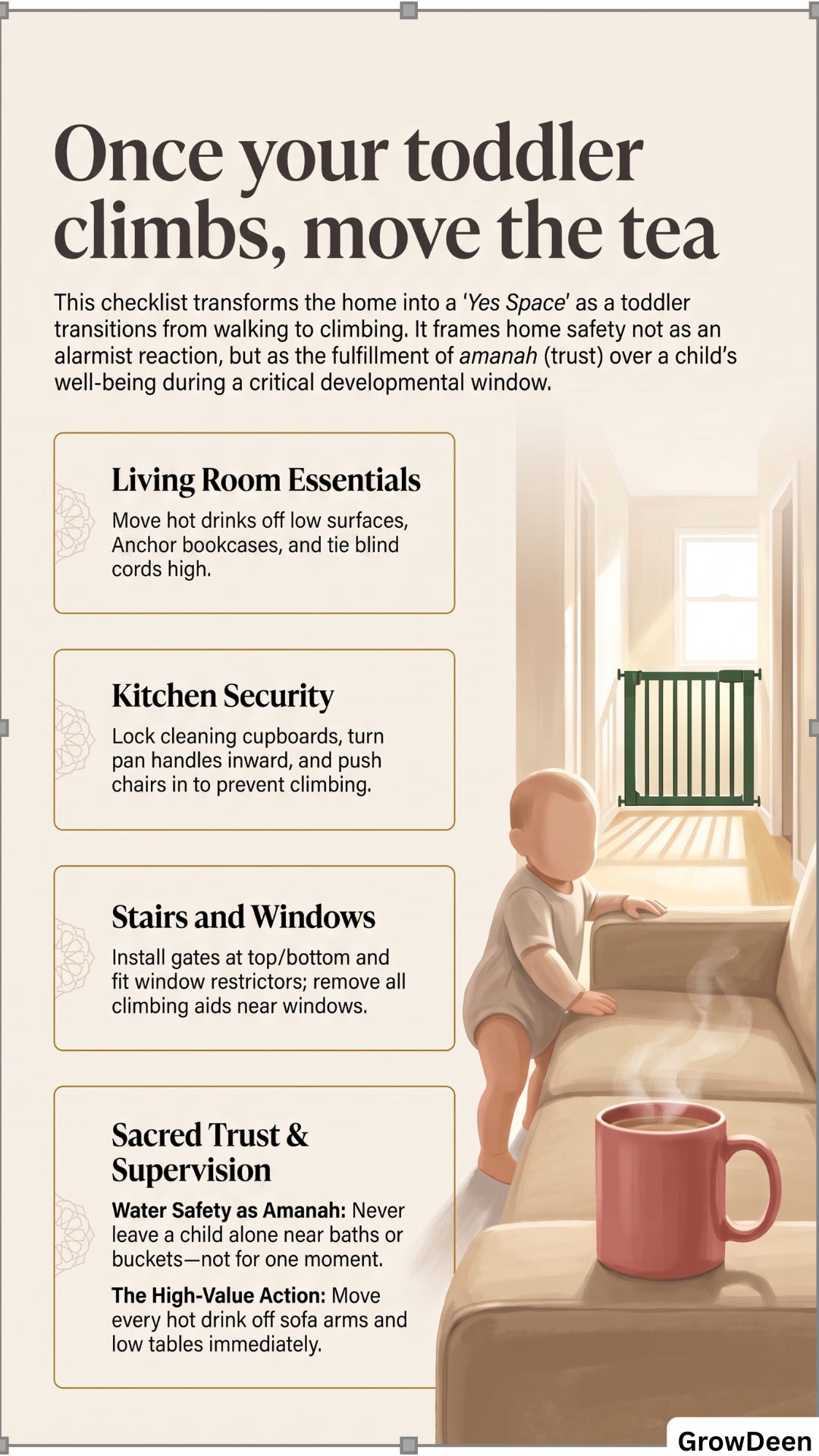
One week they are cruising the sofa. The next, they are standing on the sofa arm, and the fear you feel is not overreaction. Climbing arrives fully formed and completely ahead of any sense of danger.
This is the point where home safety stops being sensible practice and becomes something heavier. Your child is an amanah, a trust placed in your hands, and this year that trust gets honoured in unglamorous ways. A stair gate. A locked cupboard. A window restrictor. The mug of tea moved off the arm of the sofa where you have put it every evening for two years.
Movement itself is not the enemy. The WHO suggests children aged one to two spend at least 180 minutes a day in varied physical activity, spread across the day, at any intensity. [7] That is not a programme to run. That is floor time and garden time and not sitting strapped in for long stretches. The same guidance says screen time is not recommended for one-year-olds at all. [7]
And some wobbling is the point. A child who is never allowed to lose balance never learns balance. The skill is putting the line at real danger rather than at mess.
Which is where a narration I only recently read properly comes in, because it says the same thing far better than I can.
Support Muslim Parenting Lab ❤️
Would you like a deed that keeps earning for you after you die? Start one in a few seconds with the button below.
The Prophet ﷺ named ongoing charity and beneficial knowledge among the three things that keep counting after death. (Sahih Muslim 1631)
What the Prophet ﷺ Did When an Adult Tried to Stop a Small Child
When your toddler reaches for something they should not have, your instinct is to say no. Mine too. So this narration stopped me.
A small girl, Umm Khalid, came to the Prophet ﷺ with her father, wearing a yellow shirt. He greeted her with a word from the Abyssinian tongue she had grown up hearing, so that she would actually understand him. She then reached out and started playing with the seal of prophethood on his back. Her father told her off. The Prophet ﷺ said, “Leave her,” and made du’a that she would live a long life. [14]
Read it again and count what he did. He met her in the words she already had. He let her touch. And when the adult moved to stop the child exploring, he overruled the adult, not the child.
When I sit with that alongside the research, I stop feeling like I am choosing between the two. Both are saying that a small child moves forward when they are answered and allowed, not corrected and quizzed.
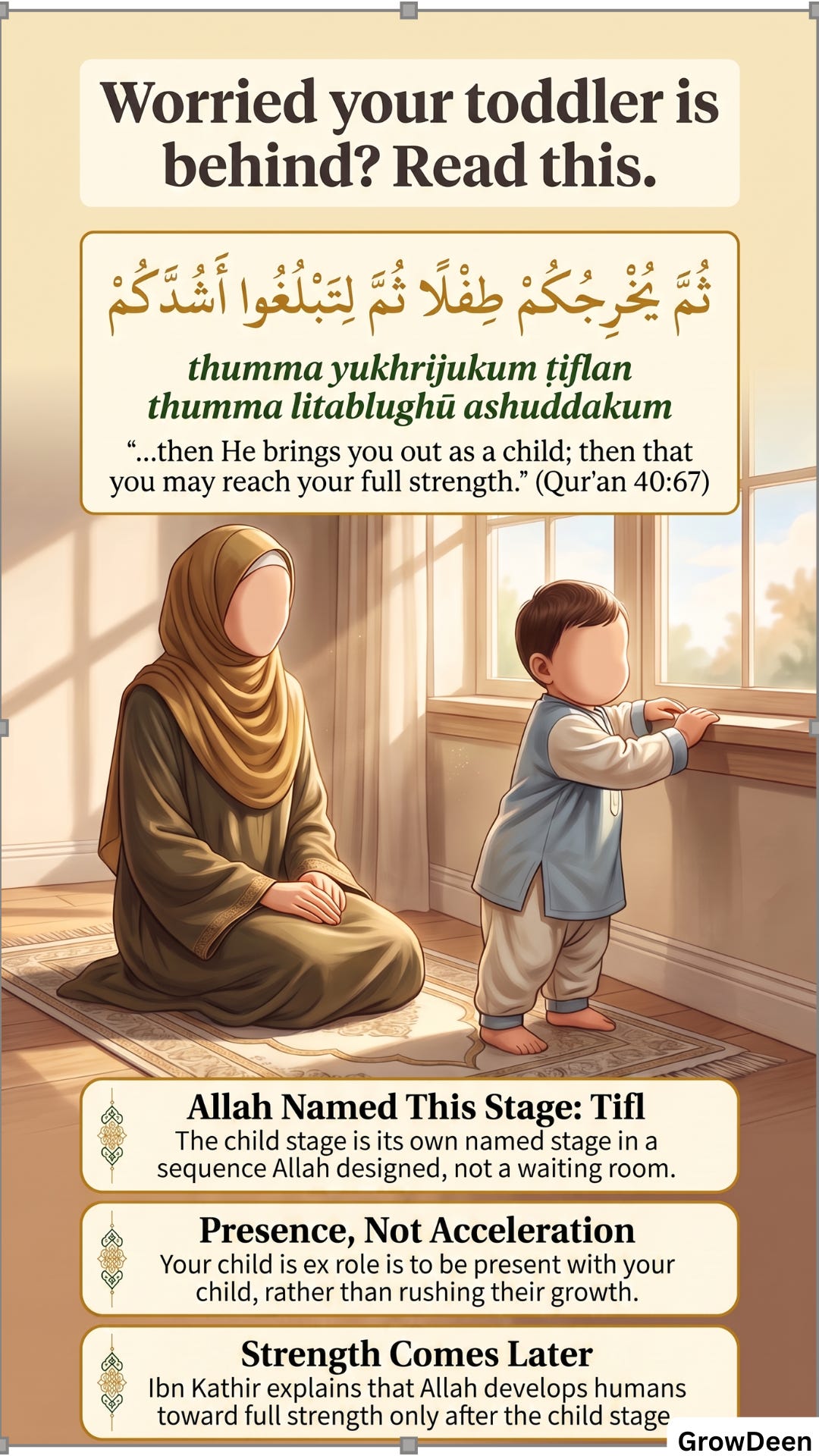
There is a verse that sits underneath all of this for me. Allah says that He brings you out as a child, then develops you until you reach your full strength. [13] According to Tafsir Ibn Kathir, this describes the stages one by one: Allah brings the human out of the mother’s womb as a young child, and only afterwards develops that child toward full strength, which he places at around eighteen to thirty years. [13]
The strength comes later. That is the design, not a delay in it.
The Other Thing That Starts This Month
Empathy arrives now, and it arrives unannounced.
Your toddler sees another child cry and goes still, or looks stricken, or cries too. That is not a reaction to noise. Something has landed.
And it goes further than most parents realise. Children of fourteen to eighteen months will spontaneously help an adult who is visibly struggling, fetching a dropped peg or opening a cabinet, with nobody asking and nothing offered in return. [8][9] They help when the adult is straining for the object, and not when the adult threw it away on purpose, which means they are reading intention rather than movement. [8]
When researchers later added a reward for helping, the helping went down. [9]
Sit with that as a Muslim parent for a second. Mercy toward others sits near the centre of what Islam asks of a person, and here it is, unprompted, in a child still in nappies who cannot say a sentence.
What you do with it matters. Name the feelings out loud, yours and theirs. “You’re upset. That was frightening. I’m here.” That gives the instinct somewhere to attach.
When Waiting Is Fine, and When to Ask
Not walking alone at fifteen months is not, by itself, a problem. A good number of children walk unaided only between fifteen and eighteen months. [5][15] What matters more is whether they pull to stand, cruise along furniture, and take weight evenly through both legs.
But some things are worth raising rather than waiting on. Speak to a doctor, paediatrician, or child health nurse if your toddler is not making eye contact, is not following moving objects with their eyes, has an eye that turns in or out most of the time, shows no interest in sounds, does not respond to their name, is not babbling or using any single words, is not trying to let you know what they want, or is not waving or pointing. [4][6]
Also raise it if they do not seem to understand simple words or instructions, are not showing emotions, cannot hold a spoon or block, cannot stand even while holding on, or use one hand noticeably more than the other. [4][6]
And in every case: if your child has lost a skill they used to have, whether a word, a gesture, or a movement, get it looked at promptly rather than waiting to see.
Early support changes outcomes. [6] Asking is not a failure of tawakkul. Using the means Allah provided has always sat inside reliance on Him, never against it. You take the appointment, and you make the du’a.
Your Free Newly Walking Toddler Pack
If you have read this far, you are the kind of parent who wants to understand this stage rather than just survive it. That already tells me something about the home your child is growing up in.
Inside the Newly Walking Toddler Pack (one comprehensive PDF, 3 pages):
Page 1: The Yes Space Safety Sweep — a room-by-room tick list covering the living room, kitchen, stairs, windows, and bathroom, sized for one ten-minute pass through the house, designed as a print-and-tick card you can keep inside a kitchen cupboard door.
Page 2: Wait or Ask? The 12–15 Month Decision Card — a two-column card separating normal variation from the specific signs worth raising, plus three sentences to say at the appointment and a space to note the date, so you can walk into a check-up in under fifteen minutes of preparation without second-guessing yourself.
Page 3: Leave Her — a short Islamic reflection card built on the narration of Umm Khalid and the verse from Surah Ghafir, for the moment when your instinct says stop and you are trying to decide whether it is danger or just curiosity.
This isn’t just a PDF to download and forget. It’s a tool designed to stay on your kitchen cupboard door, where you’ll actually use it when you need it most.
This pack is what every subscriber receives with each article. Muslim Parenting Lab covers the whole journey of raising Muslim children, from newborn sleep through toddler behaviour to school-age friendships, all backed by peer-reviewed research and rooted in the Qur’an and Sunnah.
One Thing to Do in the Next Five Minutes
Go and move the hot drinks. Every mug, every glass, off every low table and sofa arm in your house. Right now, before you forget. It takes two minutes and it is the single highest-value thing on the whole safety list for a child who has just learned to climb.
May Allah place barakah in your effort, protect the small hands reaching into everything, and make these exhausting months lighter than they feel.
Share This With Someone Who Needs It
Think of one person right now: the sister at the masjid whose fourteen-month-old is not talking yet and who keeps making a joke of it, the cousin whose toddler just started walking and whose kettle still sits at the edge of the counter, the friend who went quiet after the last family gathering because someone compared their child to another.
This could take a weight off them. Send it today, not as advice, but as the thing you wished someone had sent you.
Frequently Asked Questions
Q: My toddler is 15 months and still not walking. Should I worry?
A: Usually not. A good number of children walk unaided only between fifteen and eighteen months. [5][15] What I would watch for instead is whether they pull to stand, cruise along the furniture, and take weight through both legs. If they cannot stand even while holding on to you, that one is worth a call to your doctor. [4]
Q: How many words should a 12 to 15 month old say?
A: Fewer than you think, and the range is wide. What matters more at this age is whether they respond to their name, follow a simple instruction like “give me the block,” and use gestures such as pointing and waving. [4][12] Missing gestures worries me more than a small vocabulary.
Q: Does walking really affect my toddler’s talking?
A: Yes, and the evidence is stronger than most parents realise. Walking children had bigger vocabularies than crawling children of the exact same age, and joint attention rose within two to four weeks of walking onset. [1][2] See “What Researchers Found When They Watched Toddlers Learn to Walk” above.
Q: Should my 1-year-old have any screen time?
A: The WHO’s guidance is no screen time at all for one-year-olds. [7] The harder version of that question is usually background media, and I would treat that the same way: at this age they absorb sound without any filter, so Qur’an recitation or simple quiet does more for them than anything with music in it.
Q: How do I get my toddler to talk more?
A: Stop asking them to. Answer them instead. When they point, name what they are pointing at; when they babble, reply as though it were speech; when they hand you something, take it and name it. [3][11] Drilling “say ball” reliably makes toddlers go quiet.
Q: How much physical activity does a toddler this age need?
A: The WHO suggests at least 180 minutes a day of varied activity for children aged one to two, spread across the day at any intensity. [7] In practice that means floor time, garden time, and not long stretches in a pram or high chair. It is far less structured than it sounds.
References
[1] Walle, E.A., & Campos, J.J. (2014). Infant language development is related to the acquisition of walking. Developmental Psychology, 50(2), 336–348. https://doi.org/10.1037/a0033238
[2] Walle, E.A. (2016). Infant social development across the transition from crawling to walking. Frontiers in Psychology, 7, 960. https://doi.org/10.3389/fpsyg.2016.00960
[3] Liszkowski, U., Carpenter, M., Striano, T., & Tomasello, M. (2006). Twelve- and 18-month-olds point to provide information for others. Journal of Cognition and Development, 7(2), 173–187.
[4] Centers for Disease Control and Prevention. (2022). Important milestones: your child by fifteen months. https://www.cdc.gov/ncbddd/actearly/milestones/milestones-15mo.html
[5] Sharma, A., Cockerill, H., & Sanctuary, L. (2022). Mary Sheridan’s from birth to five years: children’s developmental progress (5th edn). Routledge.
[6] Zubler, J.M., Wiggins, L.D., Macias, M.M., Whitaker, T.M., Shaw, J.S., et al. (2022). Evidence-informed milestones for developmental surveillance tools. Pediatrics, 149(3). https://doi.org/10.1542/peds.2021-052138
[7] World Health Organization. (2019). Guidelines on physical activity, sedentary behaviour and sleep for children under 5 years of age. https://www.who.int/publications/i/item/9789241550536
[8] Warneken, F., & Tomasello, M. (2006). Altruistic helping in human infants and young chimpanzees. Science, 311(5765), 1301–1303. https://doi.org/10.1126/science.1121448
[9] Warneken, F., & Tomasello, M. (2007). Helping and cooperation at 14 months of age. Infancy, 11(3), 271–294.
[10] Yogman, M., Garner, A., Hutchinson, J., Hirsh-Pasek, K., Michnick Golinkoff, R., et al. (2018). The power of play: a pediatric role in enhancing development in young children. Pediatrics, 142(3). https://doi.org/10.1542/peds.2018-2058
[11] National Scientific Council on the Developing Child. (2004). Young children develop in an environment of relationships: working paper no. 1. Center on the Developing Child at Harvard University. https://developingchild.harvard.edu/resources/working-paper/wp1/
[12] Zero to Three. (2022). Supporting language and literacy skills from 12 to 24 months. https://www.zerotothree.org/resource/supporting-language-and-literacy-skills-from-12-24-months/
[13] Qur’an, Surah Ghafir 40:67. https://quran.com/40/67 — Tafsir Ibn Kathir on this verse explains the stages in sequence, including Allah bringing the human forth from the mother’s womb as a young child and then ordaining that they attain full strength, which he places at approximately eighteen to thirty years.
[14] Sahih al-Bukhari 5993, Book 78 (Good Manners and Form), Hadith 24, chapter: “Whoever allowed a small girl to play with him.” Graded: Sahih. https://sunnah.com/bukhari:5993
[15] Carter, R.G., & Feigelman, S. (2020). The second year. In R. Kliegman & J.W. St Geme III (Eds), Nelson textbook of pediatrics (22nd edn). Elsevier.