

About 90% of child sexual abuse is committed by someone the child and family already know and trust [6]. That single number should change how every parent of a young child thinks about protection.
Forget the stranger in the van. Forget the shadowy figure at the park.
You were probably raised on that image, and it’s almost entirely wrong. Most parents of babies, toddlers, and preschoolers spend their protective energy watching for a threat that barely exists, while the real one usually looks like someone you already let in.
I know that’s uncomfortable to sit with. It was uncomfortable for me too, the first time I read the CDC’s numbers in full [6]. But here’s the thing: once you understand who actually poses the risk, protecting your child stops feeling impossible and starts feeling specific. You’re not guarding against everyone. You’re learning to read a much smaller, much more knowable group of behaviors.
Why This Guide Is Different
Research-backed, not fear-based. Every pattern described here comes from peer-reviewed studies on grooming behavior, including interviews with convicted offenders about their own process [1][7][8].
Islamically grounded, not bolted on. This isn’t safety advice with a verse pasted at the end — the Islamic principle of khulwa (unsupervised privacy) is the same structural logic modern prevention research arrived at independently, fourteen centuries later.
You’ll get The Family Gatekeeper Guide — a free printable to keep where it’s actually useful, not just information you’ll forget by next week.
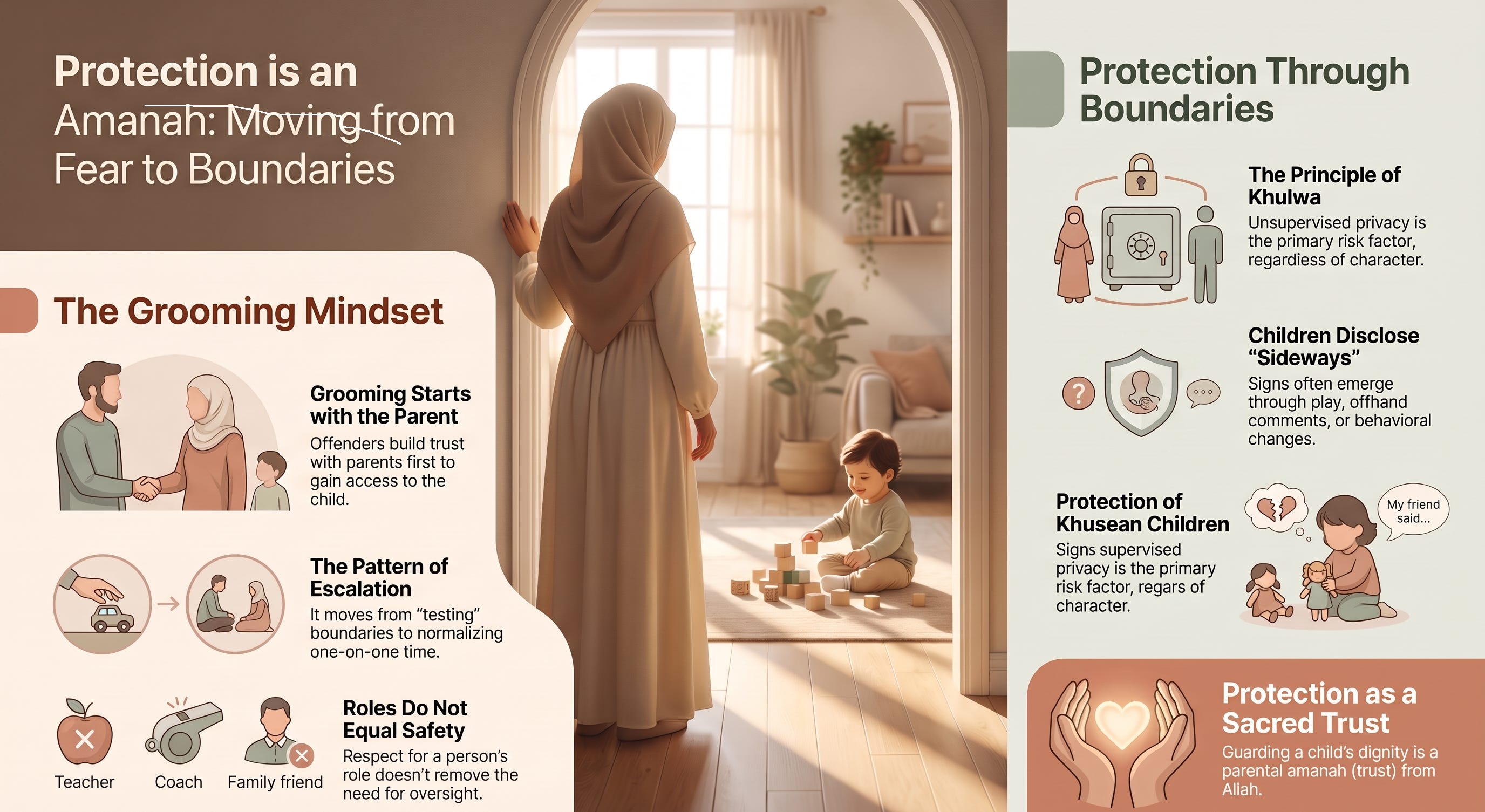
Grooming a Young Child Happens Through You, Not to Them
A baby can’t be groomed the way a teenager can. There’s no phone to monitor, no friend group to worry about. A child under five has almost no world outside the home. So when someone sets out to gain access to a young child, they don’t build a relationship with the child first.
They build one with you.
Researchers who’ve interviewed convicted offenders describe something closer to a slow campaign than a single decision [7][8]. It starts with picking a family that feels reachable, one under some strain, or simply warm and unguarded. Then comes the hardest part to catch in real time: becoming so reliably present that nobody thinks to question it anymore.
Small tests creep in next. A bit more physical affection than usual. A push for a little private time. Nothing dramatic on its own. Each one calibrated to see what the family notices, and what it lets slide.
Here’s what surprised me most in the research: if nothing gets challenged, the same warm, helpful behavior usually continues even after a line gets crossed. Not because the person feels safe. Because they need you to keep trusting them [7].
A few patterns are worth watching, especially together, and especially when they escalate [4][5]:
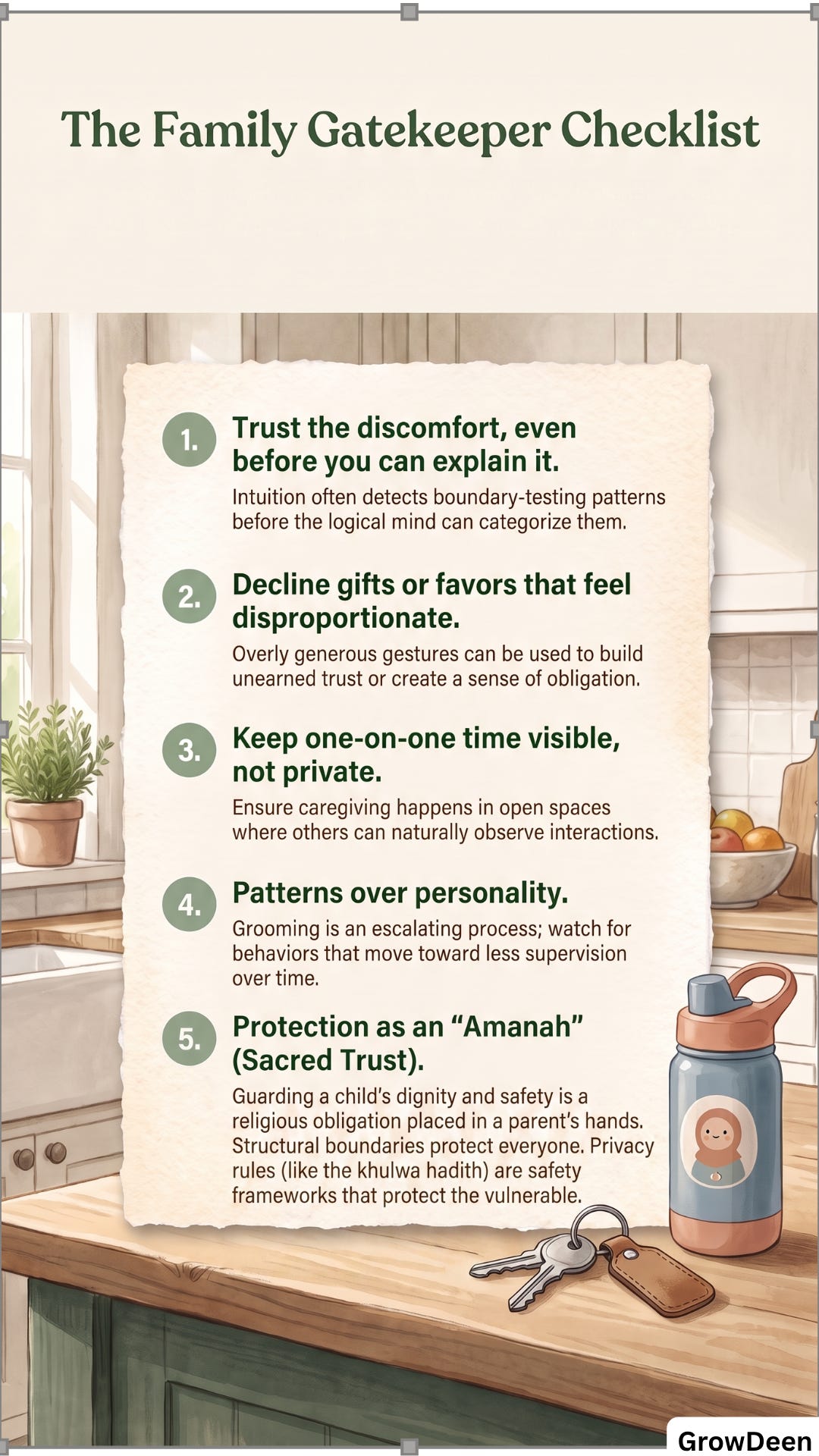
Someone who moves toward closeness faster than the relationship should reasonably allow. Someone who keeps angling for time alone with your child. Gifts and favors a little too generous for what the relationship actually is. Praise about your parenting that’s heavier and more frequent than it needs to be, flattery works on parents more than most of us want to admit. Physical affection that keeps nudging past comfortable, followed by a close read of how you react. And a slow normalization of one-on-one time, until it stops registering as unusual at all.
None of these signs alone means anything sinister. Most people who do kind things for a family are exactly what they seem.
What separates grooming from ordinary generosity is the shape of it over time. It persists. It escalates. It keeps angling toward less supervision [4][5]. And it isn’t limited to any one kind of person, relatives, family friends, respected community figures, coaches, caregivers, any gender, any age [1][6].
One more thing needs saying plainly, especially for close-knit religious communities. Research on institutional grooming, including within faith settings, has found these tactics tend to work better in environments built on trust and deference to respected figures. Not worse [4][5]. A Qur’an teacher. A youth group leader. Someone well-regarded at the masjid. None of that removes the possibility of misuse. If anything, it becomes cover, both for gaining private access and for making a family hesitate before asking hard questions.
Respect for someone’s role is not the same thing as certainty about who they are.
What Islam Already Told Us About This
Here’s what changed my perspective completely: Islam didn’t wait for prevention science to catch up.
The Prophet ﷺ said, “A man is not alone with a woman but the third of them is Shaytan” [10]. That’s not an accusation against any particular person. It’s a recognition that private, unsupervised space between two non-mahram people is itself the risk, whatever anyone’s character happens to be.
Allah extends the same logic somewhere even more ordinary: walking into another person’s home. “O you who have believed, do not enter houses other than your own houses until you ascertain welcome and greet their inhabitants” [11]. What struck me reading the tafsir is this: the requirement to ask permission applies even to a person’s own mother or sister, because privacy is a right owed to everyone, not a courtesy for strangers [11].
If that standard holds for a grown man visiting his own mother, it holds without question for any adult seeking private time with someone else’s child. Keeping caregiving visible instead of private isn’t suspicion dressed up as caution. It’s simply what these two references have been asking of believers all along.
I Know This Is a Lot to Hold Onto
You’re already tracking naps, meals, milestones, and a hundred other things. Remembering a full list of grooming red flags on top of that feels like one more mental load you didn’t ask for.
That’s exactly why I put together The Family Gatekeeper Guide — a printable you can keep in a drawer, not in your head. Keep reading to download it at the end of this article. It’s designed to stay in the spaces where these decisions actually get made, not buried in an inbox.
Support Muslim Parenting Lab ❤️
Would you like a small amount of yours grown into something enormous? Give what you can spare with the button below.
The Prophet ﷺ said Allah grows a charity the size of a date until it is like a mountain. (Sahih al-Bukhari 1410)
Signs in a Very Young Child
A child under five doesn’t have the words to tell you something happened. What surfaces instead is the body, and the behavior [2][6].
None of what follows proves anything by itself. Young children’s behavior shifts for a hundred ordinary reasons. But a cluster of new, unexplained changes deserves real attention, particularly after a stretch of increased contact with someone new.
Watch for sudden fear or clinginess around a specific person or place, with no clear cause. Regression, a return to thumb-sucking, bedwetting, baby talk, after your child had genuinely moved past it. New nightmares. Pulling back from activities they used to love. Sexual knowledge, language, or play well beyond their age [2][6]. A sudden shift toward being either unusually eager to please or unusually aggressive.
Physically: pain, redness, or irritation around the genital area; pain or difficulty toileting, walking, or sitting; unexplained bruising on soft parts of the body; repeated urinary tract infections with no other explanation [2].
One clarification matters here. Ordinary curiosity about bodies is developmentally normal [2]. The distinction is knowledge or behavior out of step with a child’s age and stage, especially bundled with visible distress.
When was the last time you thought about how your own child would actually tell you something was wrong?
Disclosure research is consistent on a point that surprises most parents: children rarely say it once, clearly, and move on. It comes out sideways, through play, through an offhand comment, spread across several conversations rather than one [9]. A child might mention something odd a single time and never bring it up again unless someone asks, gently, later. Silence afterward isn’t evidence that nothing happened [9].
Three assumptions quietly leave parents of under-fives less protected than they think. “I’d obviously know if something was wrong” doesn’t hold up against the research, most parents, looking back, describe missing signs not from carelessness, but because those signs looked exactly like ordinary childhood behavior in isolation [6][9]. “Abuse is committed by strangers” isn’t borne out either. And “my child would just tell me” underestimates how limited a young child’s vocabulary is, and how often children are told, sometimes outright, sometimes through fear, to keep quiet [1][9].
If you notice these signs, stay calm and matter-of-fact. Ask open, simple questions. “Is anything worrying you?” works better than anything that hints at an answer. Don’t talk yourself out of a concern because it seems unlikely. An early conversation costs almost nothing. Waiting can cost everything.
What the Qur’an and Sunnah Ask of a Parent Here
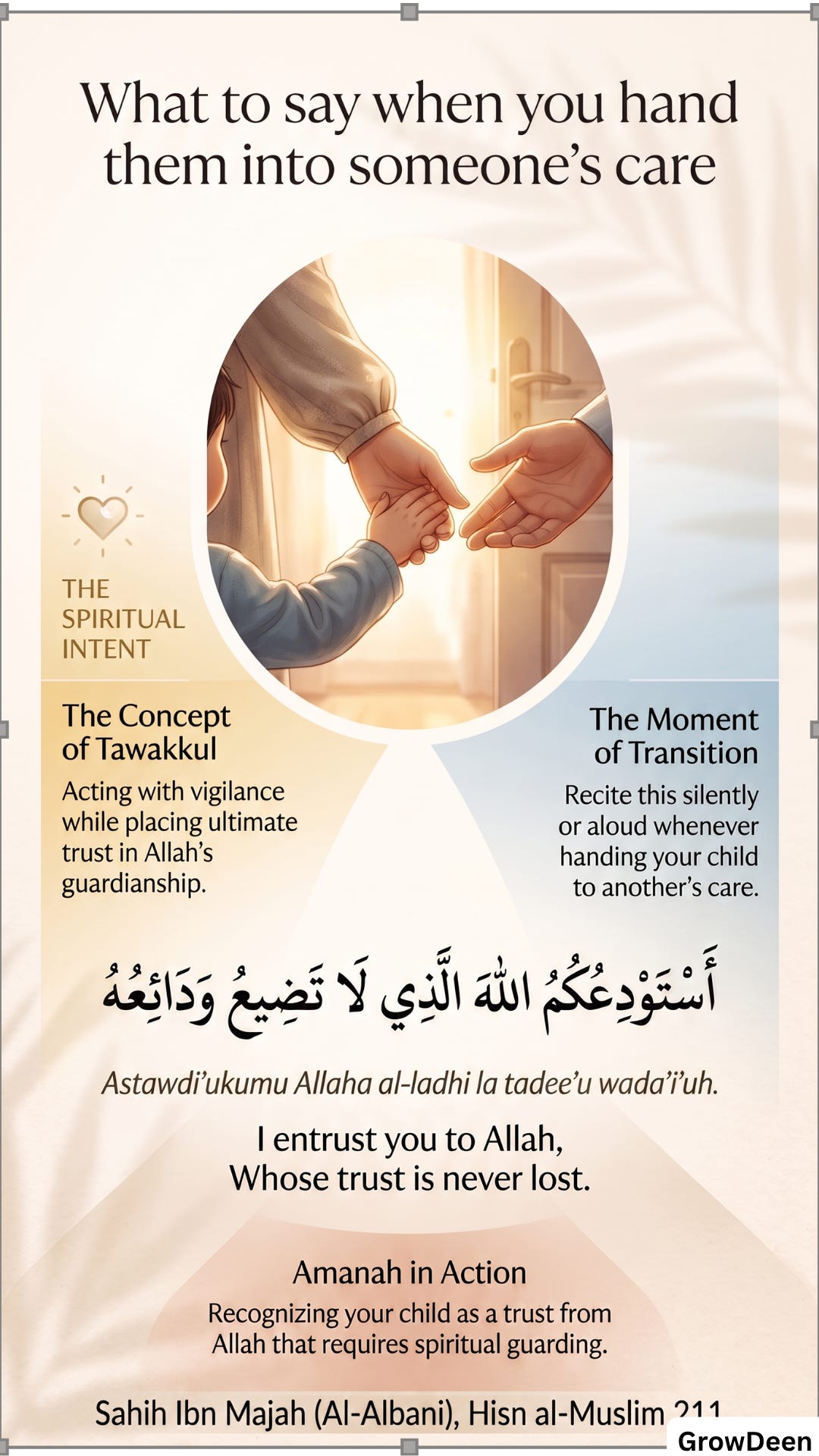
A child, in Islam, is an amanah, a trust placed in a parent’s hands by Allah. Raising a child well is only half of what that trust requires. Guarding them is the other half, and I don’t think we talk about that second half nearly enough.
When I sit with the khulwa hadith [10] and the permission-to-enter verse [11] together, I don’t read them as rules about adult manners anymore. I read them as one consistent worldview: structural boundaries protect people better than character judgments do. That’s the same principle that shows up in every “keep caregiving visible” recommendation in this article, just applied fourteen centuries earlier.
Concepts like haya’ and hifz al-’ird round this out further. A child’s comfort and dignity are never something any adult, however trusted, gets to casually override. Asking a second question about who’s spending time with your child isn’t disrespect. It’s amanah, in action.
Your Family Gatekeeper Guide
If you’ve read this far, you’re the kind of parent who takes this seriously, not as paranoia, but as protective love. That tells me something beautiful about you.
Inside The Family Gatekeeper Guide (one comprehensive PDF, 3 pages):
Page 1: The Grooming Pattern Checklist — A clear visual walking through the five-stage grooming sequence with the specific behaviors to watch for at each stage, designed as a card you can keep in your phone or wallet for a quick mental check whenever someone new becomes a regular presence around your child.
Page 2: The “Is This Normal?” Quick Reference — A side-by-side comparison of developmentally normal behavior versus signs that warrant a closer look, covering both the emotional/behavioral and physical categories, so you can move from worry to clarity in under 5 minutes.
Page 3: The Amanah Reflection Card — The khulwa hadith and Qur’an 24:27 with transliteration and translation, alongside a short reflection on privacy as protection rather than suspicion, something you can return to whenever you need to remember why boundaries are love, not distrust.
This isn’t just a PDF to download and forget. It’s a tool designed to stay in your phone or on your fridge, where you’ll actually use it when you need it most.
This Family Gatekeeper Guide is what every subscriber receives with each article. Muslim Parenting Lab covers the full journey of raising Muslim children, from newborn through the school years, all backed by research and rooted in Islamic wisdom.
One Thing You Can Do in the Next 5 Minutes
Think of the one adult who currently has the most unsupervised, one-on-one access to your child, a babysitter, a relative, a teacher. Ask yourself honestly: is that arrangement visible, or is it private? If it’s private, make one small change this week to bring it into view. That’s it. That’s the practice.
Share This With Someone Specific
Think of one person right now: a new mother in your family who’s just started trusting relatives with childcare, a sister whose warmth makes her an easy target for exactly the kind of person this article describes, a friend at the masjid raising a toddler alone.
This article could protect their child. Share it with them today, not because you’re being preachy, but because you care. Sometimes the most loving thing we can do is pass along knowledge that prevents tragedy.
Frequently Asked Questions
Q: What’s the difference between normal affection and grooming behavior?
A: Normal affection doesn’t escalate, doesn’t push for privacy, and doesn’t test your boundaries repeatedly. Grooming behavior does all three, and it persists even after you’ve shown discomfort [4][5]. See “Grooming a Young Child Happens Through You” above for the full pattern.
Q: Can grooming happen at the masjid or in religious settings?
A: Yes. Research on institutional grooming shows these tactics often work better in environments built on trust and deference, not worse [4][5]. Respecting someone’s role isn’t the same as certainty about who they are.
Q: My toddler touches themselves sometimes. Is that a warning sign?
A: No, on its own it isn’t. Ordinary curiosity about one’s own body is developmentally normal at this age [2]. The concern is knowledge or behavior well beyond a child’s developmental stage, especially paired with visible distress.
Q: What if my child mentions something once and never brings it up again?
A: That’s actually consistent with how young children disclose. Research shows disclosure is often partial and spread across multiple conversations rather than one clear statement, and silence afterward doesn’t mean nothing happened [9].
Q: Is it disrespectful to ask a trusted family member or Qur’an teacher about their access to my child?
A: No. Islam’s own guidance on privacy, including the requirement to seek permission even to enter a mother’s or sister’s space [11], establishes that structural boundaries are a right, not an insult. Asking is fulfilling an amanah, not committing suspicion.
Q: When should I contact a professional?
A: If you notice a cluster of the signs described above, especially following increased contact with someone new, speak with your child’s doctor or a qualified child-development professional. If you believe abuse has occurred, contact your local child protection authority or emergency services.
References
[1] Jeglic, E.L., Winters, G.M., & Johnson, B.N. (2023). Identification of red flag child sexual grooming behaviors. Child Abuse & Neglect, 136, Article 105998.
[2] American Academy of Pediatrics. (2023). 10 tips for parents to teach children about body safety and boundaries. AAP.
[3] National Office for Child Safety (NCOS). (2021). National strategy to prevent and respond to child sexual abuse 2021–2030. NCOS.
[4] O’Leary, P., Koh, E., & Dare, A. (2017). Grooming and child sexual abuse in institutional contexts. Commonwealth Royal Commission into Institutional Responses to Child Sexual Abuse.
[5] Craven, S., Brown, S., & Gilchrist, E. (2007). Current responses to grooming: Implications for prevention. The Howard Journal of Crime and Justice, 46(1), 60–71.
[6] Centers for Disease Control and Prevention. (2025). About Child Sexual Abuse. CDC, Child Abuse and Neglect Prevention. “About 90% of child sexual abuse is perpetrated by someone known and trusted by the child or child’s family members.”
[7] Cook, A., Reynald, D.M., Leclerc, B., & Wortley, R. (2019). Learning about situational crime prevention from offenders. Criminal Justice Review, 44(4), 431–451.
[8] Craven, S., Brown, S., & Gilchrist, E. (2006). Sexual grooming of children: Review of literature and theoretical considerations. Journal of Sexual Aggression, 12(3), 287–299.
[9] Brennan, E., & McElvaney, R. (2020). What helps children tell? A qualitative meta-analysis of child sexual abuse disclosure. Child Abuse Review, 29(2), 97–113.
[10] Jami’ at-Tirmidhi 2165 — graded Sahih (Darussalam), verified on sunnah.com.
[11] Qur’an 24:27 — verified via Tafsir Ibn Kathir (alim.org).
We combine scientific research with Qur’an and authentic Sunnah, and we cite our sources. Even so, this is general guidance and no substitute for a doctor who can examine your child.