

Your 8-month-old cries the moment you leave the room? The free 8–9 Month Development Pack gives you a milestone tracker, a 7-day Qur’an plan and an intentions card.
AGES 3–12 MONTHS · 19 MIN READ
You are home from work and on dinner duty. Your baby sits on the rug, banging two blocks together.
You get up to stir the pot. You reach the kitchen doorway. Before you take two steps, the crying starts.
Last month he played happily while I cooked. Now I can’t even leave the room. What changed?
You have not done anything wrong. Your baby may be noticing something new. You still exist, even when he can’t see you.
The first question is not “How do I stop this?” It is “What is my baby beginning to understand?”
This guide brings together scientific research and the Qur’an and authentic Sunnah. You’ll see what your baby is starting to understand, and what to try tonight.
The Short Answer
Right for your child? Babies around 8 to 9 months who suddenly cry when you leave the room. Born early? Use your baby’s corrected age.
What’s probably happening: your baby now knows you still exist out of sight. They can’t yet know when you’ll come back.
Keep safe: stay with your baby at every meal, and give no honey before 12 months.
Try tonight (1 minute): before you leave the room, say calmly where you are going. When you come back, greet your baby warmly.
You’ll know it’s working when: your baby may settle a little sooner after you return. Some crying at goodbyes is common at this age, so it does not mean failure.
Get help if: your baby loses a skill, or isn’t doing one or more 9-month milestones. Talk with your child’s doctor or pediatrician.
The rest of this guide explains why, and what to do if it does not work.
How to Read This Guide
3 minutes: The Short Answer above is enough for tonight.
7 minutes: The Short Answer, then Knowledge in Practice and If Things Don’t Go to Plan.
The whole guide: read on for the scientific research, the Qur’an and Sunnah, and the References.
To share: the bold lines and the pull quotes are made to be shared.
To listen: open this guide in the free Substack app and tap Listen.
Inside This Guide
Myth Check: “My Baby Was Fine Last Month, So I Did Something Wrong”
Knowledge in Practice: Goodbyes, Games and Little Conversations
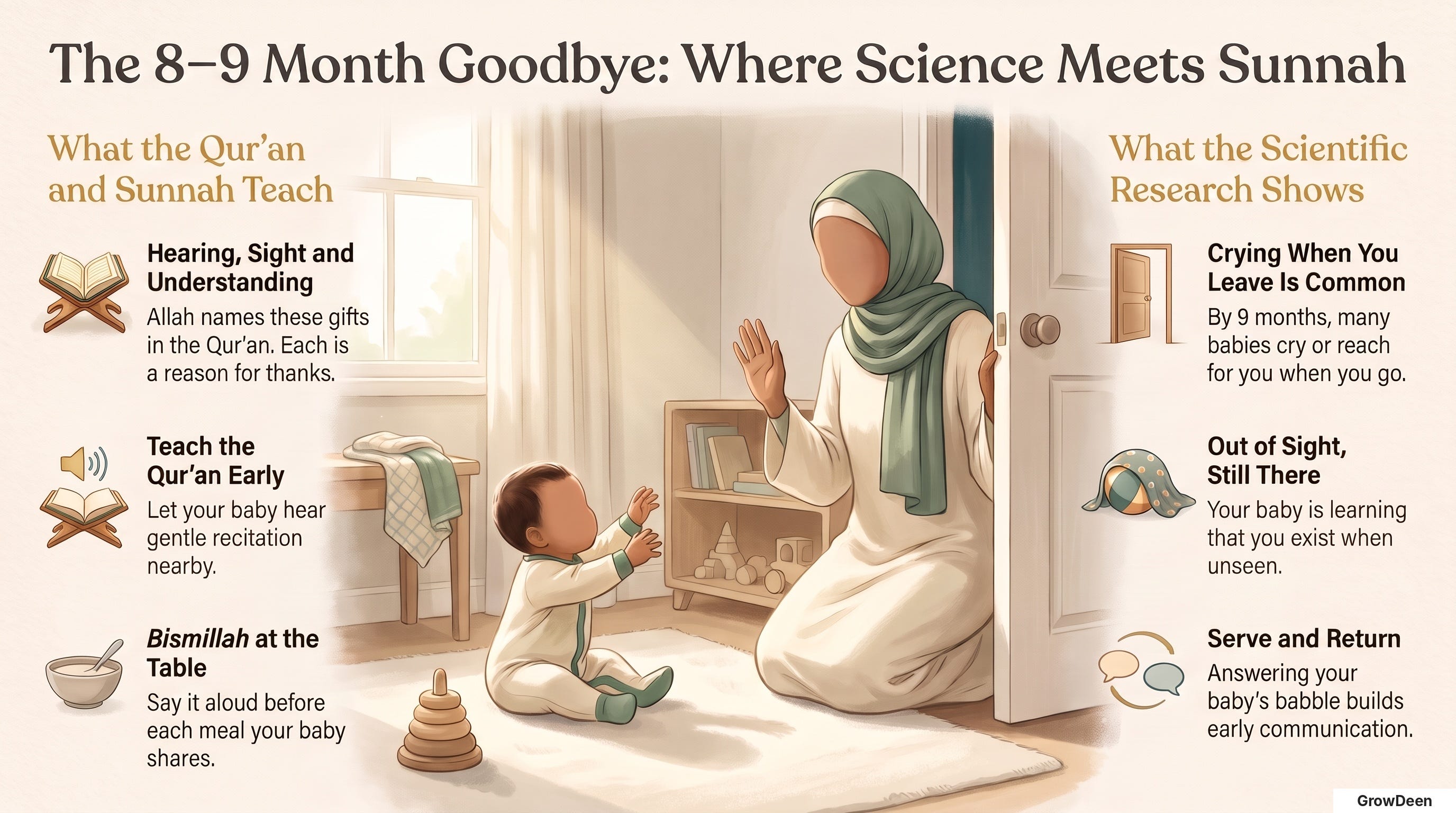
Crying at the doorway is common at 8 months. It often means your baby has noticed you are gone.
Myth Check: “My Baby Was Fine Last Month, So I Did Something Wrong”
What this belief gets right. The change is real. Last month your baby played while you cooked. Now every trip to the kitchen brings tears, and you are right to notice.
What the evidence says. The CDC lists being “shy, clingy, or fearful around strangers” among the things most babies do by 9 months. It also lists reacting when you leave: looking, reaching for you or crying. [1] The American Academy of Pediatrics (AAP) notes that most babies show stronger separation anxiety at around 9 months. [2]
So: the change usually comes from your baby’s growing understanding, not from something you did. What helps is a calm goodbye and a warm return, and step 1 below walks you through it.
Why This Happens
Why does my baby cry the second I leave?
A toy slips under a cloth, and your baby leans forward to search. A parent walks out of view, and your baby looks toward the doorway.
These moments are clues to a new understanding: people and objects keep existing when they can’t be seen. Scientists call this object permanence. [3]
It develops gradually, with no single day when it switches on. At around eight months, many babies will lift a cloth to find a hidden toy. A couple of months later, they are surer it is still there, and they keep looking for it. [3]
The tears come from a gap. Knowing you still exist does not mean knowing when you will come back.
Young babies don’t yet understand time. [4] That gap can make a short trip to the kitchen feel enormous to someone with so little experience of waiting. It can feel demanding for you too, when every small task needs another goodbye.
The fear can be stronger when a stranger is nearby. [4] Goodbyes can also be harder when your baby is hungry, tired or unwell. [2]
You may notice your baby glance at your face in a new moment, as if checking in with you. Your calm response can make this new discovery feel safer.
Is my baby trying to talk to me?
“Mamama.” A pause. You answer.
Another sound follows. That is already an exchange, long before your baby can tell a story.
By around nine months, many babies make lots of different repeated sounds, like “mamamama” and “bababababa”. They look when you call their name, and they lift their arms to be picked up. [1] They also learn from the words, expressions and rhythms of the people around them.
Scientists at Harvard’s Center on the Developing Child call this back-and-forth “serve and return”. When a baby babbles, gestures or cries, an adult may respond with eye contact, words or a hug. That exchange helps build the brain connections behind communication and social skills. [5]
This is also why a book belongs in your baby’s day before your baby can speak. Shared reading is serve and return with pictures. You point and name. Your baby looks or reaches, and you answer.
The CDC’s tips for 9-month-olds say reading can be talking about the pictures. [1] The AAP encourages parents to read aloud with babies from birth, for closeness as well as language. [6]
Why won’t my baby stay where I put them?
One baby rolls toward a cloth book. Another pivots across the rug. Another rocks on hands and knees, then sits to look at a toy.
Babies explore their surroundings in different ways. At this age, many are getting steadier at sitting, reaching and moving things from one hand to the other. [1]
Some crawl on hands and knees. Others shuffle on their bottom, roll or belly-crawl. These differences are not a competition.
Why is my baby pulling up on everything?
A baby grips the sofa, rises, wobbles and looks delighted. Some then get stuck at the top and cry, because lowering themselves is a new skill. Furniture within reach becomes something to pull on, so step 5 covers making it safe.
Food is changing too. From about 6 months, babies start foods other than breast milk and infant formula, and they slowly get used to new textures. [7]
Breast milk or infant formula stays important through the first year. [8,9] Drinking cow’s milk is not recommended until after 12 months. [7]
This is a step forward. Your baby has learned you still exist, but not yet when you'll return.
What the Scientific Research Shows
The strongest guide for this age is the CDC’s milestone checklist, revised in 2022 with the AAP. An expert group chose milestones that at least 75% of children would be expected to reach by each check-up age. One aim was to discourage “wait and see”. [10]
Who it covers: a guideline, not a single study. Body: the CDC, with the AAP · Country: US · Revised: 2022 · Page reviewed: May 2026. [1]
How strong this is: Strong for what most babies do, because it is an official guideline. The study’s authors note that social-emotional and cognitive milestones had the least normative data behind them. [10]
Serve and return. Harvard’s Center on the Developing Child is a US center that summarizes child development science. It describes responsive back-and-forth as a builder of early communication and social skills. [5]
How strong: Suggestive (an expert summary). Who was studied: the summary does not name one group, and no study has yet tested this with Muslim families.
When separation anxiety peaks. Sources agree it is common and usually ends by about age 3, but they differ on the peak. Children’s Hospital of Philadelphia puts it between 10 and 18 months. [4] Australia’s Raising Children Network says 14 to 18 months. [11]
How strong: Suggestive (clinical guidance from expert bodies).
Shared reading. In 2024, the AAP updated its policy statement on literacy promotion. It encourages shared reading from birth, to build close relationships and support language and brain development. [6] How strong: Strong (official guidance from a professional body, with a technical report reviewing the evidence).
What we don’t know yet: exactly when your baby will reach each step. Timing varies, and a checklist is not a screening tool that can diagnose a child. [1]
None of the sources here tests Qur’an recitation and baby development. In this guide, recitation is Islamic practice, with no brain claim attached.
What this means for you: most of what helps is ordinary: a calm goodbye, an answered babble, a shared book and a watched meal.
What the Qur’an and Sunnah Teach
قُلۡ هُوَ ٱلَّذِيٓ أَنشَأَكُمۡ وَجَعَلَ لَكُمُ ٱلسَّمۡعَ وَٱلۡأَبۡصَٰرَ وَٱلۡأَفۡـِٔدَةَۚ قَلِيلٗا مَّا تَشۡكُرُونَ
Say, ˹O Prophet,˺ “He is the One Who brought you into being and gave you hearing, sight, and intellect. ˹Yet˺ you hardly give any thanks.”
Al-Mulk 67:23 · The Clear Quran [12]
Text. Allah names three gifts: hearing (sam’), sight (basar) and the heart’s understanding (fu’ad). Ibn Kathir explains the third as “intellects and powers of reasoning”. He explains the little thanks as how little people use these blessings to obey Allah. [13]
Our reflection. This verse invites gratitude for gifts Allah has given every person. It is not a scientific timetable for when a baby’s hearing, sight or understanding should reach a milestone.
Your baby may turn toward a familiar voice, follow you across the room, or answer a repeated gesture. These are observable parts of development. They do not prove a particular spiritual state. Gratitude gives the moment meaning. Careful observation helps you respond to the child in front of you.
The Prophet ﷺ said, “The best among you (Muslims) are those who learn the Qur’an and teach it.”
Sahih al-Bukhari 5027 · sunnah.com [14]
Our reflection. Teaching the Qur’an can start long before a child holds a pen. Speak kindly, let your baby hear you recite as part of family life, and notice what draws their attention. You can build a home of remembrance without expecting a baby to understand the words as an older child would.
Text. The Sunnah also shows teaching at the table. When a boy in his care let his hand wander around the dish, the Prophet ﷺ told him, “O boy! Mention the Name of Allah and eat with your right hand…” [15] Saying Bismillah aloud before your baby’s meal is a small way to begin that practice together.
Our reflection. Some parents turn 67:23 into three small intentions for the month.
What will my baby hear? What will I show them as a sign of Allah’s creation? What will I begin as our Qur’an habit?
The third page of the Companion Pack gives you space to write them.
Hearing and sight are gifts to thank Allah for. Your gentle recitation nearby is one way to do it.
The Lab Verdict
The science: by 9 months, crying when you leave and wariness of strangers are common, and answering a baby’s sounds supports early communication. (Strong for the milestones; Suggestive for serve and return)
The Qur’an and authentic Sunnah: hearing, sight and understanding are gifts to thank Allah for, and the Prophet ﷺ taught a child gently at the table.
Where they meet: the science explains what your baby is learning, and the Qur’an gives the moment its meaning. Neither proves the other.
So at home: say where you’re going, come back warmly, answer the babble, and let your baby hear Bismillah and the Qur’an.
Knowledge in Practice: Goodbyes, Games and Little Conversations
Knowing why your baby clings is half the work. Knowledge bears fruit only when it reaches the kitchen doorway.
If you can only do one thing, do step 1. It is enough.
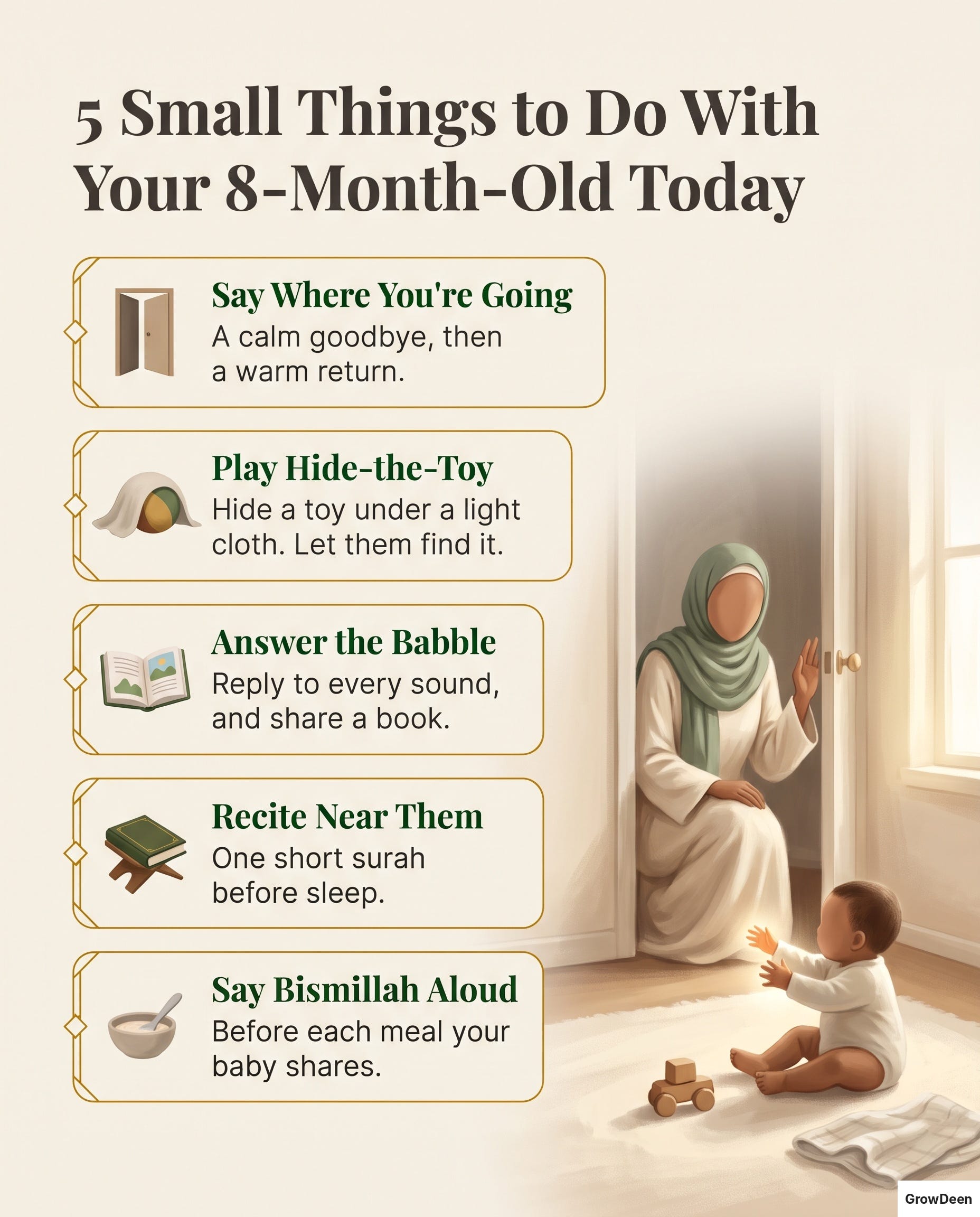
1. Say where you are going, then come back warmly (1 minute). Slipping away may seem kinder, but it can leave your baby more upset and harder to settle next time. [11] The CDC suggests a quick, cheerful goodbye instead of sneaking away, then letting your baby know you’re back. [1]
Say this: “I’m going to the kitchen. I’ll be right back.” (Say it in the language your child knows best.)
More lines to borrow:
“Mama’s going to pray. I’ll be back soon.”
“I’m getting the laundry. You’ll hear me.”
“I’m back. There you are.”
“Baba’s here. I came back.”
Instead of: “Shh, don’t cry, it’s nothing.” Try: “You noticed I left. I’m back now.”
Keep separations brief when you can, and reconnect warmly when you return. If another trusted adult will care for your baby, give them time to settle together before you leave. [11]
2. Play hide-the-toy (2 minutes). Hide a familiar toy partly beneath a light cloth while your baby watches. Pause. Let them look or reach.
Keep it playful, with nothing to pass. [3,1]
Say this: “Where did the ball go? There it is.”
Peekaboo works the same way. You can cover your own head with a cloth and see if your baby pulls it off. [1]
3. Answer the babble, and share a book (any moment; 5 minutes for a book). Three small ways to begin:
Say your baby’s name, then wait for a look or a movement.
Follow their attention. Name the cup, the book or the light they notice.
Answer a babble, then pause. Give them space for another turn.
Say this: “Ba-ba-ba? Ball. You see the ball.” The CDC suggests this move: repeat your baby’s sounds, then say a simple word that uses them. [1]
With a book, point and name: “A cat. A soft, gray cat.” You don’t need to read every word, and you don’t need a lesson plan. The ordinary language of your home already offers chances to connect.
If your baby babbles only a little so far: copy any sound they make, and count a look or a kick as their turn.
4. Let your baby hear the Qur’an in your day (1 to 10 minutes). Tonight, before your baby sleeps, recite one short surah near them, such as Surah Al-Ikhlas, three times. It takes less than a minute.
Then tie a short recitation to moments you already have. Try a morning feed, floor play, settling for a nap, bath time or family dhikr (remembrance of Allah). The Companion Pack’s 7-day plan pairs each day with one of these moments.
Your baby does not need to understand the words. They are hearing what your home sounds like.
Say this: “Bismillah. Let’s listen together.”
5. Make room to move and to taste, safely (as you go). Offer supervised floor play on a safe, uncluttered surface. Put a familiar, age-appropriate toy a little out of reach, and follow your baby’s response. [1] Move it closer if they become frustrated, and give them time to look, stretch, turn or change their plan.
Sometimes discovery is picking up the same object again, feeling its texture, and looking at it from another angle. Your job is to make room for curiosity, without hurrying the next movement.
If your baby is starting to pull up, anchor furniture to the wall and move hazards out of reach. [16,1] Stay close as they practice lowering themselves. There is no need to force standing before they are ready.
At meals, your baby sits upright in a high chair, and you watch the whole time. [17] Prepare food to a texture, shape and size that suits your baby’s stage. Avoid small, hard, round or sticky foods and other high-risk choking foods, like whole grapes or nuts. [17] Prepare foods safely: “small” does not always mean safe.
No honey before 12 months. [18] Say Bismillah aloud before each meal.
Say this: “Bismillah. Here’s your spoon.”
Small home or tight budget? A clean blanket on the floor and a few safe household things, like a wooden spoon and a cloth, are enough.
Born early? Use your baby’s corrected age when you think about which of these they are ready for. [19]
Make It Work in Your Home
On your own with your baby? Narrate your trips out loud, even to the bathroom: “I’m going to wash my hands. I’ll be right back.” Keep a few safe toys where you can see your baby from the kitchen.
Several children? Older siblings can play hide-the-toy and peekaboo. [1] Give them the job of saying, “Mama’s coming back.”
A grandparent or babysitter caring for your baby? Arrive a few minutes early so your baby can settle with them while you are still there. [11]
Say this to Grandma (or the babysitter): “Mama, she loves being with you. Can we sit with her together for a few minutes? Then I’ll say goodbye and go.”
Say this to your spouse: “Can we both say where we’re going, instead of slipping out? It might help him trust our goodbyes.”
The family question: ask an elder, “What did you say to us when you had to leave the room?”
Try It Seven Times
Any seven goodbyes in the next week or two. Seven is only a starting goal.
After each one, note one word for how your baby reacted when you came back. Tell us in the comments what your baby did.
Tell them, step out briefly, come back warmly, and answer every little sound you can.
If Things Don’t Go to Plan
If your baby still cries at every goodbye: that is common. Separation anxiety often grows for months before it eases. [4] Keep goodbyes short, and don’t drag them out. [11]
If it gets stronger after a calmer patch: this can happen. Goodbyes are often harder when your baby is hungry, tired or unwell, or when a stranger is near. [2,4] On tough days, keep transitions short and routine. [2]
If you start doubting yourself: Am I making him clingy by always coming back? No. Coming back when you said you would is how trust in your goodbyes grows. [2]
If you lose your patience: many parents know this moment. Pick your baby up and say, “I’m sorry I was sharp. I’m here.” Coming back to each other is part of the lesson too.
When to ask your baby’s doctor: babies develop at different rates. Milestones describe skills most babies show by a certain age. They are not a pass-or-fail exam, and a checklist cannot diagnose a child. [1]
Around nine months, your child’s doctor or pediatrician may ask about a few things. Does your baby look when you call their name, and make varied repeated sounds? Do they sit without support, look for a dropped object, and react when you leave? [1]
Tell them what your baby does comfortably, what seems hard, and any questions about hearing, vision, movement, feeding or communication. Ask about developmental screening and follow-up, rather than waiting for a checklist to answer every question. [1]
If your baby loses a skill they once used, contact their doctor promptly. [1] For a baby born early, ask about corrected age. [19] For questions about food readiness, allergies, swallowing or preparation, ask your baby’s doctor too. [7]
A calm question is a form of care. You know your baby in the everyday moments, and a doctor can help you make sense of what you see.
Signs are clearer looking back. Seeing them late is not neglect.
Who to turn to: your child’s doctor or pediatrician. For questions of deen, ask your local imam or a local scholar, and share the details with him. In an emergency, such as choking, call your local emergency number.
Support Muslim Parenting Lab ❤️
Would you like the most rewarded kind of charity there is? Use the button below now, while you are well, rather than later.
Asked which charity is best, the Prophet ﷺ said the one given while you are healthy, not deferred until death is near. (Sahih al-Bukhari 1419)
Your Companion Pack: Your Baby’s 8–9 Month Development Pack
Small observations and repeated routines are easier to remember when they are visible. Three free printable pages to keep where you will see them:
Milestone Tracker: twenty observations across movement, communication, thinking and learning, and social and emotional development, with boxes to tick. Notice progress, and bring any concerns to your baby’s doctor.
7-Day Qur’an Immersion Starter: a Monday-to-Sunday plan. It pairs an everyday moment (a feed, floor play, a nap, after Asr, bath or bedtime, family dhikr) with a suggested surah.
Tarbiyah Intentions, Month 8–9: a Qur’an 67:23 reflection card. It has spaces for what your baby will hear, what you will show them, and what you will plant in their heart: the Qur’an habit they may begin learning through your example.
Parents Also Ask
Is it normal for my 8-month-old to cry every time I leave the room?
Yes, it is common. By 9 months, the CDC lists being shy, clingy or fearful around strangers among the things most babies do, along with reacting when you leave: looking, reaching for you or crying. [1] It often reflects a new understanding that you still exist when out of sight. [3]
Should I sneak out so my baby doesn’t see me leave?
Slipping away may seem kinder, but it can leave your baby more upset and harder to settle next time. [11] A short, calm goodbye usually works better: say where you are going, go, and come back warmly. Step 1 in Knowledge in Practice shows how.
When does separation anxiety peak, and when does it end?
Often in the months after it starts. Many babies show stronger separation anxiety around 9 months, and it usually peaks somewhere between 10 and 18 months. [2,4,11] It can also flare when your baby is hungry, tired or unwell, or when a stranger is near. [2,4]
As toddlers grow more independent, they may become even more aware of separations. [2] It usually ends by about age 3. [4]
Why read to a baby who can’t talk yet?
Because reading together is a conversation before words. You point and name. Your baby looks or reaches, and you reply.
That is serve and return, which helps build communication and social skills. [5] The AAP encourages shared reading from birth, for closeness as well as language. [6] At 8 to 9 months, “reading” can mean talking about the pictures. [1]
What foods can I give my 8-month-old?
Foods that are smooth, mashed or finely chopped, moving to thicker, lumpier textures as your baby’s eating develops. [1,7] Potentially allergenic foods, such as eggs, can be introduced along with other foods.
If your baby has severe eczema or an egg allergy, ask your baby’s doctor first about foods with peanuts. [7] Breast milk or infant formula stays important through the first year, and there is no honey before 12 months. [8,18]
What are the main milestones around 9 months?
The CDC groups them into four areas. Social and emotional: clingy or wary with strangers, reacting when you leave, looking when called. Language: many repeated sounds, and lifting arms to be picked up.
Thinking: looking for dropped objects and banging two things together. Movement: sitting without support and moving things from hand to hand. [1]
Final Reflection
Dear parent,
You stopped to understand your baby’s tears instead of brushing them aside. That care is where every good goodbye begins.
Maybe you felt a flash of frustration at the doorway tonight. That is human. You were tired, and dinner was on the stove.
That cry often means your baby noticed you were gone.
You are not behind if your baby crawls differently. You are not failing when they cry at the door.
You don’t need to change every goodbye this week. Start with one calm sentence at the door. Allah sees the intention behind each Bismillah you say over a messy meal.
Often, your 8-month-old cries when you leave because they now know you are somewhere. Tell them, and come back.
A Du’a for This
For you:
رَبِّ أَوۡزِعۡنِيٓ أَنۡ أَشۡكُرَ نِعۡمَتَكَ ٱلَّتِيٓ أَنۡعَمۡتَ عَلَيَّ وَعَلَىٰ وَٰلِدَيَّ وَأَنۡ أَعۡمَلَ صَٰلِحٗا تَرۡضَىٰهُ وَأَصۡلِحۡ لِي فِي ذُرِّيَّتِيٓۖ
Rabbi awzi’nī an ashkura ni’matakal-latī an’amta ‘alayya wa ‘alā wālidayya wa an a’mala ṣāliḥan tarḍāhu wa aṣliḥ lī fī dhurriyyatī.
“My Lord, enable me to be grateful for Your favor which You have bestowed upon me and upon my parents and to work righteousness of which You will approve and make righteous for me my offspring.”
Al-Ahqaf 46:15 · Sahih International [20]
With your child: Bismillāh, “In the name of Allah.” Say it aloud before each meal, even over a baby who can’t speak yet. The Prophet ﷺ taught a boy in his care to mention Allah’s name before eating (Sahih al-Bukhari 5376).
Share the Khayr
If you know a parent whose baby suddenly cries at every goodbye, send this to them. It may help them feel less alone tonight. The Prophet ﷺ said that one who guides to something good has a reward like the one who does it. [21]
Tell us in the comments: what does your baby do when you walk back into the room? We’d love to know.
Parents Also Read
Parents who read this guide also found these helpful.


References
[1] Centers for Disease Control and Prevention. (2025, updated and reviewed May 2026). Milestones by 9 Months. Learn the Signs. Act Early. (US · Strong)
[2] American Academy of Pediatrics. (2026). How to Ease Your Child’s Separation Anxiety. HealthyChildren.org. (US · Suggestive)
[3] American Academy of Pediatrics. (2023). Cognitive Development in Infants: 8 to 12 Months. HealthyChildren.org. (US · Suggestive)
[4] Children’s Hospital of Philadelphia. (n.d.). Separation Anxiety. (US · Suggestive)
[5] Center on the Developing Child at Harvard University. (n.d., page updated 2026). Serve and Return: Back-and-forth exchanges. (US · Suggestive)
[6] American Academy of Pediatrics. (2024, September 29). American Academy of Pediatrics promotes shared reading starting in infancy as a positive parenting practice with lifelong benefits. News release on the policy statement “Literacy Promotion: An Essential Component of Primary Care Pediatric Practice”, Pediatrics. (US · Strong)
[7] Centers for Disease Control and Prevention. (2024, reviewed April 2026). When, What, and How to Introduce Solid Foods. Infant and Toddler Nutrition. (US · Strong)
[8] Centers for Disease Control and Prevention. (reviewed April 2026). Frequently Asked Questions (FAQs). Infant and Toddler Nutrition. (US · Strong)
[9] Centers for Disease Control and Prevention. (reviewed April 2026). Choosing an Infant Formula. Infant and Toddler Nutrition. (US · Strong)
[10] Zubler, J.M., Wiggins, L.D., Macias, M.M., et al. (2022). Evidence-Informed Milestones for Developmental Surveillance Tools. Pediatrics, 149(3), e2021052138. (US · Strong)
[11] Raising Children Network. (n.d.). What is separation anxiety in babies & children? (Australia · Suggestive)
[12] Qur’an, Al-Mulk 67:23. Translation: The Clear Quran (Dr. Mustafa Khattab).
[13] Tafsir Ibn Kathir (Abridged) on Al-Mulk 67:23. Quran.com.
[14] Sahih al-Bukhari 5027.
[15] Sahih al-Bukhari 5376.
[16] American Academy of Pediatrics. (2021). Preventing Furniture and TV Tip-Overs. HealthyChildren.org. (US · Strong)
[17] Centers for Disease Control and Prevention. (2024, reviewed March 2026). Choking Hazards. Infant and Toddler Nutrition. (US · Strong)
[18] Centers for Disease Control and Prevention. (reviewed April 2026). Foods and Drinks to Avoid or Limit. Infant and Toddler Nutrition. (US · Strong)
[19] American Academy of Pediatrics. (2018). Corrected Age For Preemies. HealthyChildren.org. (US · Strong)
[20] Qur’an, Al-Ahqaf 46:15. Translation: Sahih International.
[21] Sahih Muslim 1893a.
We combine scientific research with Qur’an and authentic Sunnah, and we cite our sources. Even so, this is general guidance and no substitute for a doctor who can examine your child.
Sources & confidence
The hadith in this guide are from Sahih al-Bukhari and Sahih Muslim. Qur’an 67:23 is quoted in The Clear Quran, to match MPL’s printed magazine; Qur’an 46:15 in Sahih International. Health guidance follows the CDC and the AAP. Checked October 2026. Found a source that looks wrong? Email us at info@growdeen.com.
Words in this guide
du’a (doa): supplication.
Bismillah: “In the name of Allah.”
sam’: hearing.
basar: sight.
fu’ad: the heart, understanding.
dhikr (zikr): remembrance of Allah.
surah: a chapter of the Qur’an.
Asr: the afternoon prayer.
tarbiyah: raising a child toward good.
deen: Islam as a way of life.
khayr: good.
ﷺ: “peace and blessings be upon him.”
imam: a leader of prayer and teacher at a masjid.
pediatrician (paediatrician): a children’s doctor.
object permanence: knowing that people and things still exist when out of sight.
corrected age: a baby’s age counted from the due date.
separation anxiety: upset when a parent leaves, common from around 8 to 9 months.
stranger anxiety: wariness of unfamiliar people.
serve and return: the back-and-forth of your baby’s sounds and your replies.
milestones: skills most children show by a certain age.
Thanks for like
Great