

Up at 3am, not sure if your baby is even awake? The free Night Shift Pack helps you decide in the dark, and share the nights.
AGES 0–12 MONTHS · 18 MIN READ
It is 3:14am and you are already standing up.
The sound from the crib (cot) is small. A grunt, a shuffle, a cry that stops and starts. You lift her. Her body is heavy and loose. Her eyes stay shut.
Somewhere between the crib and your shoulder, you wonder.
Was she even awake when I picked her up? That's the third time tonight.
You are doing what loving parents do. Nobody told you what the end of a sleep cycle sounds like.
This guide brings together scientific research and the Qur'an and authentic Sunnah. You'll see why babies wake at night, and when to wait before you lift.
The Short Answer
Right for your child? Babies from about 2 months to 1 year who stir, grunt or cry out at night, and are otherwise well. [1]
What's probably happening: babies surface briefly between sleep cycles, and the noise at the end of a cycle can sound like waking. [2]
Keep safe: on her back for every sleep, in her own crib, with a fitted sheet and nothing else. [3]
Try tonight (90 seconds): when the noise starts, stay still and count to 90 before you lift. If the cry keeps rising, go in. [2]
You'll know it's working when: some wake-ups settle on their own while you count. A cry that keeps going is not failure. It means she needs you.
Get help if: she seems unwell, feeds poorly, or cries as if in pain. Start with your child's doctor or pediatrician.
The rest of this guide explains why, and what to do if it does not work.
How to Read This Guide
3 minutes: The Short Answer above is enough for tonight.
7 minutes: The Short Answer, then Knowledge in Practice and If Things Don't Go to Plan.
The whole guide: read on for the scientific research, the Qur'an and Sunnah, and the References.
To share: the bold lines and the pull quotes are made to be shared.
To listen: open this guide in the free Substack app and tap Listen.
Inside This Guide
Night waking is part of how babies sleep. It is not a mark against you.
Myth Check: "A Good Baby Sleeps Through the Night by 6 Months"
You hear it everywhere, often from someone who loves you: by six months, a baby should sleep through.
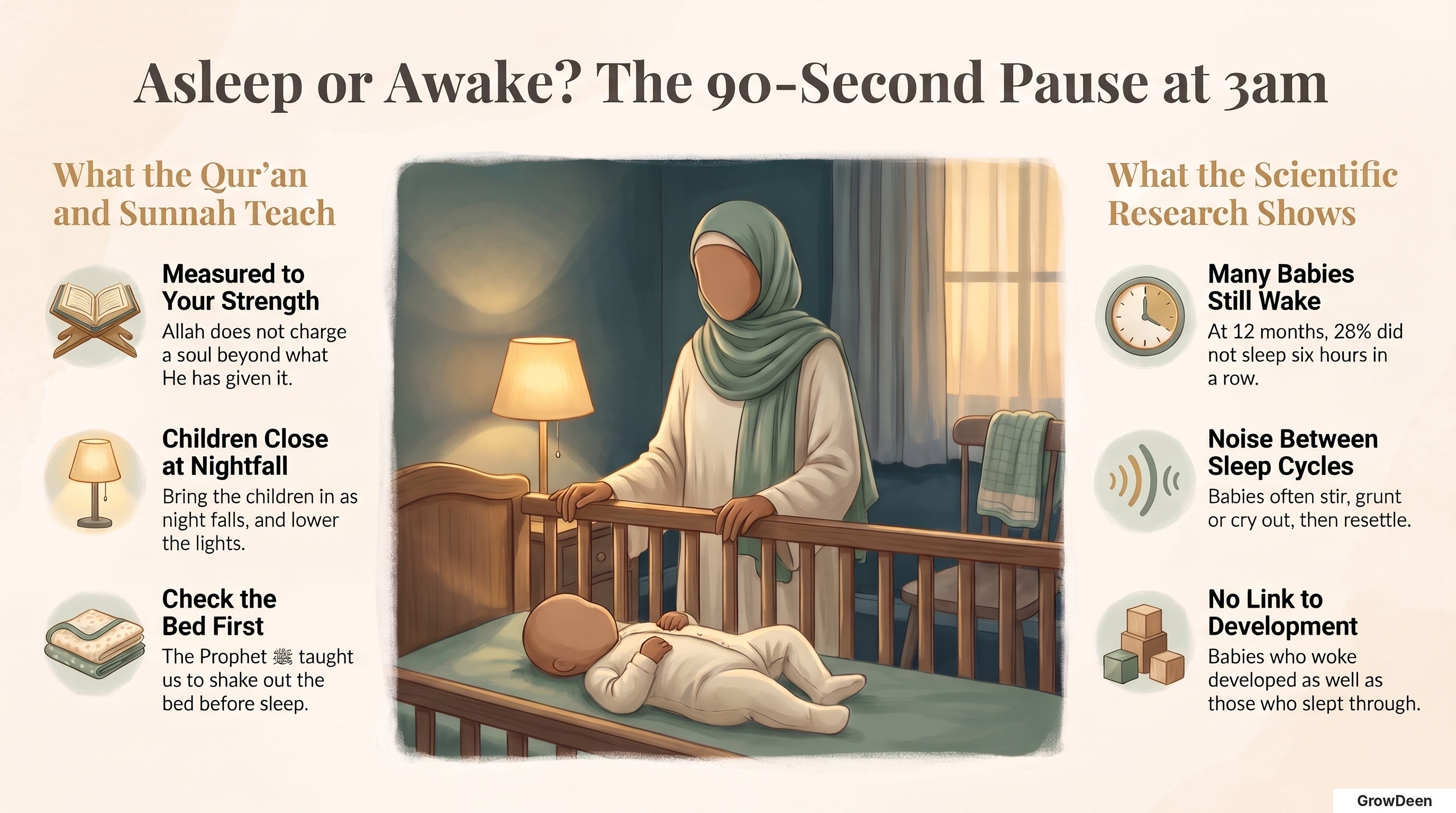
What this belief gets right. Sleep does change across the first year. By 6 months, some babies sleep a block of about six hours at night. [4]
What the evidence says. Many do not, and they are healthy. In a Canadian study of close to 400 babies, more than a third of 6-month-olds did not sleep six hours in a row. [4] In a survey of 715 babies aged 6 to 12 months, about 8 in 10 still woke at least once a night. [5]
So "sleeping through" is a common hope, not a health test. The baby who wakes is not behind, and the parent who goes to her is not failing.
Why This Happens
Why does she sound awake when she isn't?
In the early months, a baby's sleep cycle lasts roughly 50 to 60 minutes. Each one moves between active sleep and quiet sleep. [6]
In active sleep, babies move their arms and legs, suck, and may twitch or grunt. [2,7] At the end of a cycle, many pass through a light, in-between state. They stir, may seem awake, and may cry or call out. Sometimes they go back to sleep on their own, and sometimes they need your help. [2]
The grunt, the shuffle, the cry that stops and starts: that is often this in-between state. Lifting a baby in it can wake her fully. An Australian parenting service advises waiting a moment longer before you resettle, because responding too early can interrupt sleep. [2]
That is the 3am mistake: lifting at the first sound, before you know she is awake.
Often, the noise at 3am is the end of a sleep cycle, not a call for help.
Why does it get harder at 6 months, not easier?
Her sleep was settling, and now she wakes more. Between 6 and 12 months, babies gain new skills, and some of them cost sleep.
In a study of 107 babies aged 5 to 8 months, those already crawling woke more at night. They also had more trouble settling at bedtime. [8]
In two large Finnish groups of babies, night sleep only began to settle in the second year. [9]
Nothing went backwards. Something was gained, and the gain is loud. People call it a "sleep regression", but the word misleads.
So here is the line for the fourth wake-up: waking is the design, not the fault.
How much sleep does a baby need?
Ranges describe most babies, not yours exactly. A healthy baby can sleep a little more or less than the range. [10]
2 to 3 months: the recommended range up to 3 months is 14 to 17 hours in every 24, across day and night. [10] In a New Zealand study of 75 babies, half were sleeping from midnight to 5am without calling for a parent by about 3 months. [11]
3 to 6 months: from 4 months, the recommended range is 12 to 15 hours. [10] The World Health Organization gives 12 to 16 hours for ages 4 to 11 months, naps included. [12] At 6 months, more than half of the babies in a Canadian study did not yet sleep eight hours in a row. [4]
6 to 12 months: the range stays 12 to 15 hours until the first birthday, then 11 to 14 hours from one year. [10] About 8 in 10 babies this age still wake at least once a night. [5]
What the Scientific Research Shows
The clearest finding comes from Canada. Mothers of close to 400 babies reported their babies' longest stretch of sleep at 6 and 12 months. [4]
At 6 months, 38% of babies did not sleep six hours in a row, and 57% did not sleep eight. At 12 months, 28% did not sleep six hours, and 43% did not sleep eight. [4]
Who was studied: typically developing babies in Montreal and Hamilton, Canada. Ethnicity, culture and family income are not given in the study summary. Babies with additional needs were not the focus.
What was measured: the longest stretch of unbroken sleep, the babies' mental and movement development, and mothers' mood.
What changed: sleeping through was not linked with development, then or later, or with mothers' mood. Babies who woke were more often breastfed. [4]
How strong this is: Suggestive. One well-run study, based on mothers' reports.
Larger pictures agree. In two Finnish birth cohorts of more than 1,000 healthy babies each, sleep varied widely in the first two years. Night sleep began to settle in the second year. [9] A review of 74 studies found that night wakings fell mostly in the first six months, though studies disagreed on exact numbers. [1] How strong this is: Suggestive. Large studies, with numbers that vary.
The body clock grows too. In a small English study of 35 babies, a day and night hormone rhythm appeared at about 8 weeks. Night sleep began to form at the same time. [13] How strong this is: Early.
Settling methods worry many parents. In an Australian trial, 43 babies aged 6 to 16 months had one of two settling methods or sleep advice only. Both methods helped babies fall asleep faster, with no signs of extra stress. A year later, attachment, emotions and behavior showed no harm. [14] How strong this is: Suggestive. One small trial.
Support for parents matters too. In a Melbourne trial of 781 babies, parents got simple information on normal infant sleep, crying, settling and self-care. At 6 months, fewer had signs of postnatal depression, though babies' sleep was similar. [15] How strong this is: Suggestive. One large trial.
What we do not know yet: no study has tested a 90-second pause. The number is our practical choice, not a finding. No study has yet tested this with Muslim families.
What this means for you: a baby who still wakes at night is common and healthy. Your job is to respond well, and the waking itself is normal.
What the Qur'an and Sunnah Teach
For a parent counting wake-ups at 4am, one verse speaks to the exact shape of the problem. It sits inside a passage about a nursing baby.
لَا يُكَلِّفُ ٱللَّهُ نَفْسًا إِلَّا مَآ ءَاتَىٰهَا ۚ سَيَجْعَلُ ٱللَّهُ بَعْدَ عُسْرٍ يُسْرًا
Allāh does not charge a soul except [according to] what He has given it. Allāh will bring about, after hardship, ease [i.e., relief].
At-Talaq 65:7 · Sahih International [16]
Text. The verse comes in a passage on caring for a divorced mother and the nursing of her child. In his tafsir (explanation of the Qur'an), Ibn Kathir explains that a father of means spends on the child according to his means. One with little spends from what Allah has given him, for Allah puts no burden on anyone beyond what He has given. He calls the promise of ease a sure promise, and says Allah never breaks His promises. [17]
Our reflection. In its own setting, the verse is about the care of a baby and the capacity of the adults around that baby. A mother or father at 4am is not falling short of a standard. You are spending what you were given. And the ease was promised to come after the hardship, not instead of it.
Your nights were measured to what you were given. The ease was promised after them.
The evening itself has a Sunnah shape.
The Prophet ﷺ said, "When night falls (or it is evening), keep your children close to you for the devils spread out at that time."
Sahih al-Bukhari 3304 · sunnah.com [18]
Our reflection. In many Muslim homes, the wind-down starts at maghrib (the sunset prayer). Bring the children in, pray, lower the lights, and let the house grow quiet.
Then there is the bed.
The Prophet ﷺ said, "When anyone of you go to bed, he should shake out his bed with the inside of his waist sheet, for he does not know what has come on to it after him."
Sahih al-Bukhari 6320 · sunnah.com [19]
Text. In the same hadith, he taught the words to say next, which begin Bismika Rabbi wada'tu janbi. [19] He sought protection for his grandsons, Al-Hasan and Al-Husain, with words from every devil, poisonous pest and envious eye. [20] And in a long narration, he confirmed that reciting Ayat al-Kursi at bedtime brings a guard from Allah until morning. [21]
Our reflection. Said quietly over a crib, these words are tarbiyah (raising a child toward good) that begins long before she understands them.
Where Sunnah Meets Safety: Checking the Bed
The practice: the Prophet ﷺ taught us to shake out the bed before lying down. Sunnah (Sahih al-Bukhari 6320). [19]
What it covers: the hadith speaks of an adult's own bed. Applying it to a baby's crib is our reflection, not a ruling.
What health bodies say: back to sleep for every sleep until 1 year. A firm, flat surface with only a fitted sheet. No pillows, quilts, bumpers, blankets or toys. Share a room, not a bed, for at least 6 months. A smoke-free space. (American Academy of Pediatrics; checked Oct 2026) [3]
Keep · Swap · Skip: keep checking the bed and saying the words. Swap shaking a blanket for clearing the crib with your hand. Skip pillows, bumpers, toys and loose bedding.
Say it to the family: "Before every sleep we clear her crib. It's the Sunnah of checking the bed, and it keeps her safe."
The Lab Verdict
The science: many healthy babies still wake at night through the first year, with no link to their development. Babies often stir between sleep cycles and sometimes resettle alone. (Suggestive)
The Qur'an and authentic Sunnah: Allah charges no soul beyond what He has given it, and promises ease after hardship. The Prophet ﷺ taught us to bring children close at nightfall and to check the bed.
Where they meet: the science shows why the nights are hard; the Sunnah shows how to carry them with calm. Neither proves the other.
So at home: pause before you lift, clear the crib, and share the nights.
Knowledge in Practice: The Ninety-Second Pause
Knowing why she wakes is half the work. The rest happens in a dark room, one wake-up at a time.
If you can only do one thing, do step 1. It is enough.
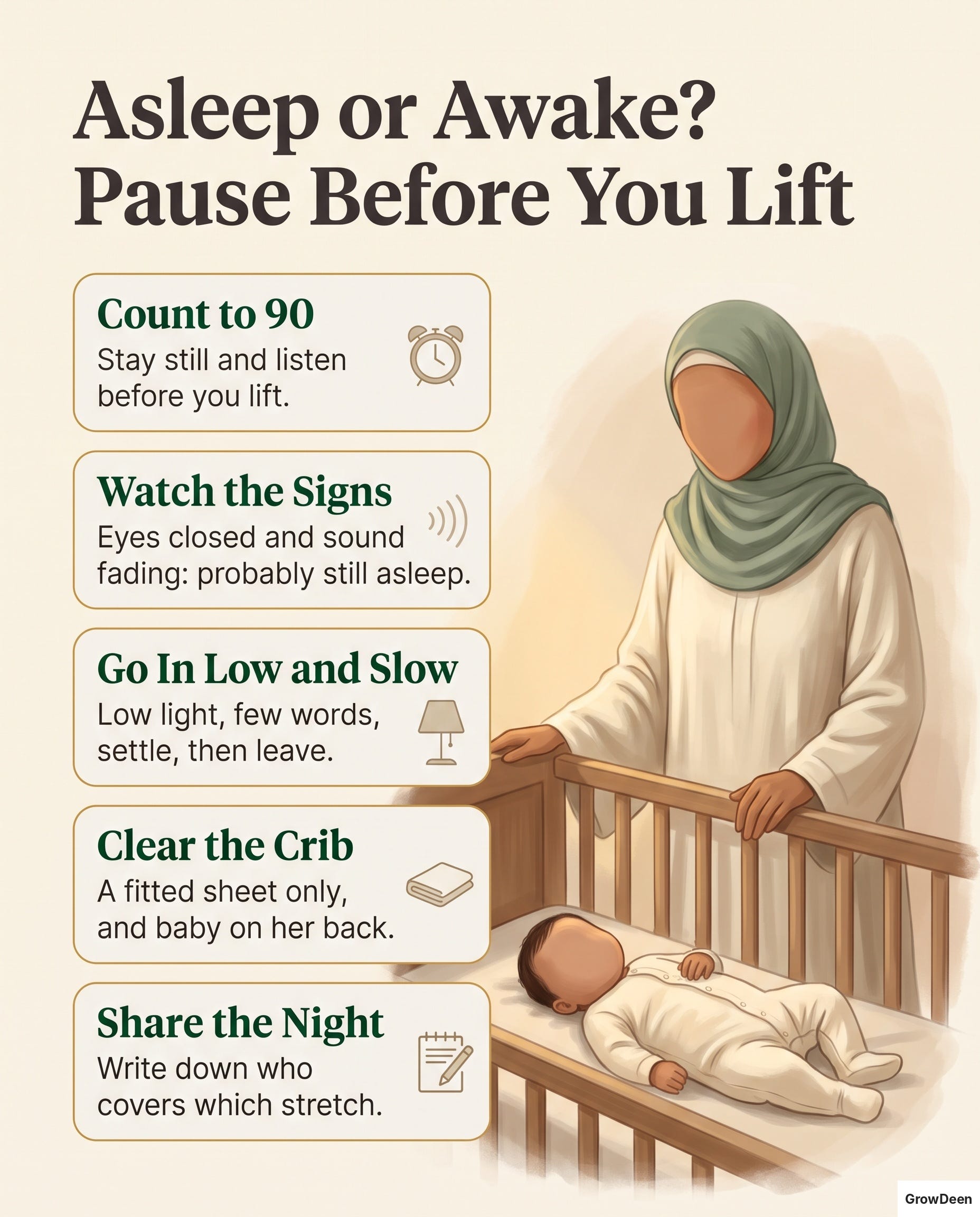
1. Pause and count before you lift (90 seconds, at each wake-up). Sounds at the end of a sleep cycle may fade on their own, and lifting too soon can wake her fully. [2] Set a phone timer named "wait", and start it before you stand up. A real waking will still be there in 90 seconds.
While you count, watch for the signs.
Probably still asleep: eyes closed; grunts, squeaks or short cries that stop and start; arms and legs moving, body loose and heavy; the sound fades while you stay still. [2,7]
Probably truly awake: eyes open and staying open; a cry that rises and keeps rising; rolling, sitting up, or stuck against the crib side; the sound still going after 90 seconds.
Under 3 months: pause only briefly, and feed her if she is hungry. 6–12 months: new skills such as crawling can bring more waking. [8] Pause first, then go if the cry builds.
2. If she is awake, go in low and slow (a few minutes). Keep the light low, use few words, settle her, and leave again.
Say this: "Shh, it's still night. I'm here. Sleep time." (Say it in the language your child knows best.)
Instead of: switching on the big light and chatting. Try: "Shh, it's still night. Sleep time."
3. Clear the crib before every sleep (30 seconds). Run your hand across the whole mattress, as the Sunnah of checking the bed. Take out anything that does not belong: a muslin, a toy, a loose sheet. Then lay her on her back. [3,19]
4. Decide about night feeds, without hurry (once, at a calm time). Night feeds are still common after 6 months. In one survey of 715 babies aged 6 to 12 months, about 6 in 10 still had a milk feed at night. Night feeds fell with age. [5] There is no need to hurry if they suit you. If you want to phase them out, check first with your child's doctor that she is growing well. Some parents give a late "dream" feed between 10pm and midnight. In a small American trial with breastfed newborns, parents who did this, along with other night-time steps, saw longer night sleep within 3 weeks. [22] Try it for a week and judge by your own house.
Cutting night feeds is not a decision to stop breastfeeding. The Qur'an speaks of nursing for "two complete years for whoever wishes to complete the nursing". [23] For weaning questions, talk to your doctor or a lactation consultant. For questions of deen, ask your local imam or a local scholar, and share the details with him.
5. Split the night between the adults (10 minutes, once a week). Sit at the kitchen table, not at 2am. Write down who covers bedtime to about 1am, and who covers 1am to 5am. Add a protected nap for whoever needs it. The off-duty adult does not get up: that is the whole point of writing it down.
A plan in your head is not a plan anyone else can follow.
Make It Work in Your Home
You and your spouse share the nights? Take a stretch each. The other one counts the 90 seconds.
One parent works nights, travels, or is on their own? Ask for one afternoon of cover from outside the house each week, from a relative or a friend. One protected nap can change how the week feels.
Several children? Give the first stretch to whoever does bedtime for the older ones, so nobody does both.
Say this to your spouse: "You're so good with her at night. Can we take a stretch each this week? I'll do bedtime to 1am, and you take 1am to 5am."
Say this to a grandparent: "Mama, she settles so well with you. Could you take her on Saturday afternoon so I can sleep for two hours?"
The family question: at breakfast, ask, "Who looked after the nights when you were a baby?" The answer often explains why asking for help feels hard.
Try It Seven Times
Any seven nights in the next week or two. Seven is a starting goal, not a magic number. Each morning, tick every wake-up that settled while you counted. Tell us in the comments how many settled on their own. We'd love to know.
Pause before you lift: ninety seconds of listening is the whole practice.
If Things Don't Go to Plan
If the cry builds before 90 seconds: go in. The pause is a listening tool, not a test.
If nothing settles on its own: that is fine. Some babies need more help at certain ages. Look at the week, not the night. Teething or illness can set sleep back for a while.
If you start doubting yourself: Am I neglecting her by not going straight in? No. Ninety seconds of listening is care. You are right there, deciding with your eyes open.
If you lose your patience: it happens to every parent. Breathe, pick her up gently, and say, "I'm sorry, my love. I'm tired. I'm here." Repair is part of the lesson.
If you keep nodding off during night feeds: that is a sign you need more sleep. Never sleep with your baby on a sofa or armchair. [3] Use the planner in step 5 to protect one stretch for you.
Speak to someone if:
she seems unwell, feeds poorly, or cries as if in pain;
her waking changes suddenly and you are worried;
your own low mood or anxiety settles in and stays.
Signs are clearer looking back. Seeing them late is not neglect.
And you? Broken nights can wear down your health and your patience. In a Canadian study of 505 new mothers, those who developed signs of postnatal depression were more often woken three or more times a night. They were also more likely to get under six hours of sleep a day. [24] Low mood that stays is a medical matter: tell your own doctor or midwife.
Who to turn to: your child's doctor or pediatrician. For yourself, your own doctor or midwife. For questions of deen, ask your local imam or a local scholar, and share the details with him. In an emergency, call your local emergency number.
Support Muslim Parenting Lab ❤️
Would you rather give a small amount that never stops than a large one you keep postponing? Set a monthly amount you are comfortable with, in a few seconds, using the button below.
The Prophet ﷺ said the deed most beloved to Allah is the most constant, even if little. (Sahih al-Bukhari 6464)
Your Companion Pack: The Night Shift Pack
Nobody remembers a guide in the dark with a crying baby. The free Night Shift Pack puts the two night decisions on paper. It is one PDF of 3 pages:
The 3am Decision Card: the 90-second rule, the signs of "probably still asleep" and "probably truly awake", and what to do next. Keep it by the crib.
The Night Shift Planner: a fill-in week for dividing the night, with a protected nap and a line for how each day went.
The Measured Burden Card: At-Talaq 65:7, where it sits, and Ibn Kathir's explanation, to read standing up at 4am.
Parents Also Ask
When do babies sleep through the night?
There is no set age. In a Canadian study of close to 400 babies, more than a third of 6-month-olds did not sleep six hours in a row. At 1 year, 28% still did not. [4]
Is it normal for a 9-month-old to wake three times a night?
It can be. In one survey of 715 babies aged 6 to 12 months, about 8 in 10 still woke at least once a night. [5] Waking on its own is not a sign that something is wrong.
Should I pick up my baby every time she cries at night?
Go to her when she needs you. A short pause first helps you tell a true waking from stirring between sleep cycles. [2]
Why does my baby grunt and cry in her sleep?
In active sleep, babies move, suck, and may grunt or twitch. [2,7] At the end of a cycle they may cry out briefly and then resettle. Why This Happens explains more.
Is the 6-month sleep regression real?
Many parents notice more waking in the second half of the first year. In one study, babies who had started crawling woke more at night than those who had not. [8] Nothing has gone backwards; in large Finnish studies, night sleep began to settle in the second year. [9]
Is sleep training harmful to my baby?
In an Australian trial of babies aged 6 to 16 months, two settling methods showed no extra stress. A year later, attachment showed no harm. [14] It was a small study. Whether a method suits your family is your decision.
What du'a can I say over my baby at bedtime?
The Prophet ﷺ sought protection for his grandsons with "I seek Refuge with Your Perfect Words from every devil and from poisonous pests and from every evil, harmful, envious eye." [20] At lights out, he said Bismika Allāhumma amūtu wa aḥyā. [25]
Final Reflection
Dear parent,
You read a whole guide about the nights, probably on little sleep. That care is already in every wake-up you have answered.
You have not been doing it wrong. You were answering a sound nobody had explained to you. Night waking in the first year is common. It is not a verdict on you.
You do not need a new routine tonight. Start with step 1: set the timer, name it "wait", and count before you lift. Make your niyyah (intention) her rest and yours, and the counting becomes care.
Often, the baby you lift at 3am was still asleep. A short pause lets her tell you.
A Du'a for This
For you:
رَبَّنَا وَلَا تُحَمِّلْنَا مَا لَا طَاقَةَ لَنَا بِهِۦ ۖ وَٱعْفُ عَنَّا وَٱغْفِرْ لَنَا وَٱرْحَمْنَآ
Rabbanā wa lā tuḥammilnā mā lā ṭāqata lanā bih, wa'fu 'annā, waghfir lanā, warḥamnā
"Our Lord, and burden us not with that which we have no ability to bear. And pardon us; and forgive us; and have mercy upon us."
Al-Baqarah 2:286 · Sahih International [26]
With your child: Bismika Allāhumma amūtu wa aḥyā, "With Your name, O Allah, I die and I live." The Prophet ﷺ said it at bedtime. [25] Say it softly over your baby at lights out. In the morning, Alhamdulillah is a good first word for her to hear.
Share the Khayr
Think of one parent right now. Maybe the friend who texted at midnight asking if it is normal that her baby "was sleeping so well and now isn't". Maybe your sister, who keeps saying sorry for sounding tired. Send this to her today. The Prophet ﷺ said that whoever guides someone to good has a reward like the one who does it. [27]
Tell us in the comments: how many wake-ups settled while you counted? We'd love to know.
Parents Also Read
Parents who read this guide also found these helpful.


References
[1] Dias, C.C., Figueiredo, B., Rocha, M., & Field, T. (2018). Reference values and changes in infant sleep-wake behaviour during the first 12 months of life: a systematic review. Journal of Sleep Research, 27(5), e12654.
[2] Tresillian. (2026). Baby sleep cycles.
[3] Moon, R.Y., Carlin, R.F., Hand, I., & Task Force on Sudden Infant Death Syndrome and the Committee on Fetus and Newborn. (2022). Sleep-Related Infant Deaths: Updated 2022 Recommendations for Reducing Infant Deaths in the Sleep Environment. Pediatrics, 150(1), e2022057990. American Academy of Pediatrics.
[4] Pennestri, M.H., Laganière, C., Bouvette-Turcot, A.A., Pokhvisneva, I., Steiner, M., Meaney, M.J., Gaudreau, H., & Mavan Research Team. (2018). Uninterrupted infant sleep, development, and maternal mood. Pediatrics, 142(6), e20174330.
[5] Brown, A., & Harries, V. (2015). Infant sleep and night feeding patterns during later infancy: association with breastfeeding frequency, daytime complementary food intake, and infant weight. Breastfeeding Medicine, 10(5), 246–252.
[6] El Shakankiry, H.M. (2011). Sleep physiology and sleep disorders in childhood. Nature and Science of Sleep, 3, 101–114.
[7] Davis, K.F., Parker, K.P., & Montgomery, G.L. (2004). Sleep in infants and young children: Part one: normal sleep00149-4). Journal of Pediatric Health Care, 18(2), 65–71.
[8] Scher, A., & Cohen, D. (2005). Locomotion and nightwaking. Child: Care, Health and Development, 31(6), 685–691.
[9] Paavonen, E.J., Saarenpää-Heikkilä, O., Morales-Munoz, I., Virta, M., Häkälä, N., Pölkki, P., Kylliäinen, A., Karlsson, H., Paunio, T., & Karlsson, L. (2020). Normal sleep development in infants: findings from two large birth cohorts. Sleep Medicine, 69, 145–154.
[10] Hirshkowitz, M., Whiton, K., Albert, S.M., Alessi, C., Bruni, O., DonCarlos, L., Hazen, N., Herman, J., Katz, E.S., Kheirandish-Gozal, L., Neubauer, D.N., O'Donnell, A.E., Ohayon, M., Peever, J., Rawding, R., Sachdeva, R.C., Setters, B., Vitiello, M.V., Ware, J.C., & Adams Hillard, P.J. (2015). National Sleep Foundation's sleep time duration recommendations: methodology and results summary. Sleep Health, 1(1), 40–43.
[11] Henderson, J.M., France, K.G., Owens, J.L., & Blampied, N.M. (2010). Sleeping through the night: the consolidation of self-regulated sleep across the first year of life. Pediatrics, 126(5), e1081–e1087.
[12] World Health Organization. (2019). Guidelines on physical activity, sedentary behaviour and sleep for children under 5 years of age. Geneva: WHO.
[13] Joseph, D., Chong, N.W., Shanks, M.E., Rosato, E., Taub, N.A., Petersen, S.A., Symonds, M.E., Whitehouse, W.P., & Wailoo, M. (2015). Getting rhythm: how do babies do it? Archives of Disease in Childhood. Fetal and Neonatal Edition, 100(1), F50–F54.
[14] Gradisar, M., Jackson, K., Spurrier, N.J., Gibson, J., Whitham, J., Williams, A.S., Dolby, R., & Kennaway, D.J. (2016). Behavioral Interventions for Infant Sleep Problems: A Randomized Controlled Trial. Pediatrics, 137(6), e20151486.
[15] Hiscock, H., Cook, F., Bayer, J., Le, H.N., Mensah, F., Cann, W., Symon, B., & St James-Roberts, I. (2014). Preventing early infant sleep and crying problems and postnatal depression: a randomized trial. Pediatrics, 133(2), e346–e354. (Australia · Suggestive)
[16] Qur'an, At-Talaq 65:7. Translation: Sahih International.
[17] Tafsir Ibn Kathir on At-Talaq 65:7.
[18] Sahih al-Bukhari 3304.
[19] Sahih al-Bukhari 6320.
[20] Sahih al-Bukhari 3371.
[21] Sahih al-Bukhari 2311.
[22] Pinilla, T., & Birch, L.L. (1993). Help me make it through the night: behavioral entrainment of breast-fed infants' sleep patterns. Pediatrics, 91(2), 436–444.
[23] Qur'an, Al-Baqarah 2:233. Translation: Sahih International.
[24] Dennis, C.L., & Ross, L. (2005). Relationships among infant sleep patterns, maternal fatigue, and development of depressive symptomatology. Birth, 32(3), 187–193.
[25] Sahih al-Bukhari 6324.
[26] Qur'an, Al-Baqarah 2:286. Translation: Sahih International.
[27] Sahih Muslim 1893a.
We combine scientific research with Qur’an and authentic Sunnah, and we cite our sources. Even so, this is general guidance and no substitute for a doctor who can examine your child.
Sources & confidence
The hadith in this guide are from Sahih al-Bukhari and Sahih Muslim. Qur'an translations are Sahih International. Checked October 2026. Found a source that looks wrong? Email us at info@growdeen.com.
Words in this guide
sleep cycle: one round of active and quiet sleep, about 50 to 60 minutes in young babies · active sleep: lighter sleep when babies move, suck, grunt or twitch · quiet sleep: deeper, stiller sleep · sleeping through the night: sleeping a long stretch, often counted as six or eight hours · sleep regression: a popular name for a spell of more night waking, often around new skills · dream feed (rollover feed): a late feed given between 10pm and midnight while the baby is drowsy · night weaning: slowly phasing out night feeds · crib (cot): a baby's bed with high sides · du'a (doa): supplication · maghrib: the sunset prayer · tafsir: explanation of the Qur'an · tarbiyah: raising a child toward good · Ayat al-Kursi: the Verse of the Throne, Al-Baqarah 2:255 · niyyah: intention · deen: the way of life Allah has given · khayr: good.