

Saying "fine" when you are not?
The free Beyond Fine Pack puts the real answer on paper for your doctor and family.
PREGNANCY & POSTPARTUM · 19 MIN READ
Content note: this guide names thoughts of suicide and of harming a baby, most fully in If Things Don't Go to Plan. To skip that section, go to Your Companion Pack: Beyond Fine Pack.
She says she is fine, and everyone believes her.
Visitors bring dates and a pot of soup. She smiles for the baby photo. Asked about his sleep, she says, "Alhamdulillah."
At two in the afternoon, she lies down beside the crib (cot). Her heart races the whole hour.
I have a healthy baby and a full house. So why do I feel so empty inside?
You are not ungrateful, and you are not failing. If that is you, or someone you love, this guide is for that hour. What you feel has a name, and it can be treated.
This guide brings together scientific research and the Qur'an and authentic Sunnah. You'll see why depression hides at home, what Islam says about a heavy heart, and what to say first.
The Short Answer
Right for you? You are pregnant or had a baby this year. Low mood, worry or numbness has lasted over two weeks. Husbands, read on too.
What's probably happening: this may be perinatal depression, a common illness that can be treated. It often hides behind "tired", "grateful" and "coping".
Try tonight (2 minutes): text one person you trust: "I haven't felt like myself lately. Can we talk tonight?"
You'll know it's working when: someone knows the real answer, and an appointment is booked. Feeling no lighter yet is not failure.
Get help if: low mood lasts past two weeks: see your doctor or midwife. Thoughts of suicide or of harming your baby, or confusion: call your local emergency number.
The rest of this guide explains why, and what to do if it does not work.
How to Read This Guide
3 minutes: The Short Answer above is enough for tonight.
7 minutes: The Short Answer, then Knowledge in Practice and If Things Don't Go to Plan.
The whole guide: read on for the scientific research, the Qur'an and Sunnah, and the References.
To share: the bold lines and the pull quotes are made to be shared.
To listen: open this guide in the free Substack app and tap Listen.
Inside This Guide
Myth Check: "It's Only the Baby Blues"
The milk comes in, and so do the tears. A dropped spoon sets them off, or a kind text from an aunt.
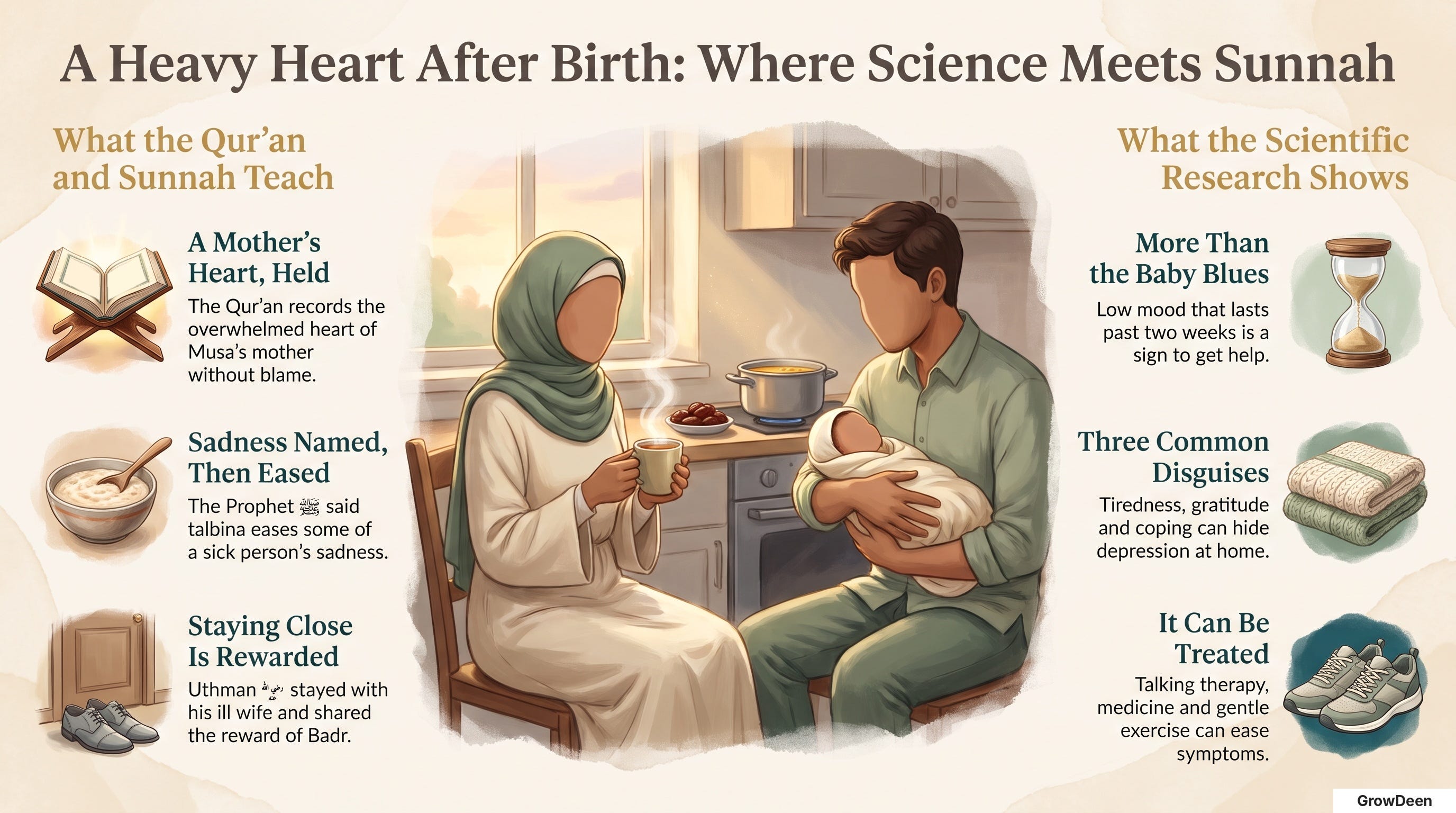
What the belief gets right. The baby blues are real and common. These mild mood changes come in the first two weeks after birth [2], and they usually last only a few days. [1]
What the evidence says. Depression behaves differently. It is a sad, anxious or "empty" mood most of the day, nearly every day, for at least two weeks. It often brings a loss of interest in things that used to matter. [2] At that point, the next step is a talk with your doctor or midwife.
It can begin in pregnancy, too. Doctors call it prenatal (antenatal) depression in pregnancy and postpartum (postnatal) depression after birth. They group both under one name: perinatal depression. [2]
So "wait and see" makes sense for a few days. Past two weeks, it is time to tell someone.
Why This Happens
Why does something so common stay hidden in a house full of people who love her? Often, the illness wears three disguises, and each one sounds reasonable.
"I'm Tired, That's All"
He asks how she is. She says tired, and he nods. Of course she is tired; there is a newborn in the house.
Tiredness is the most convincing disguise. A review of 35 studies found a strong link between tiredness and depressive symptoms in the first two years after birth. [3] That overlap is why "tired" covers a low mood so well.
The clue is what rest does. Depression can bring tiredness that does not lift, and trouble sleeping even when the baby is asleep. [2] If a long nap leaves her as heavy as before, tiredness may not be the whole story.
"I Should Be Grateful"
This is the disguise many Muslim mothers know best. She has a healthy baby, a blessing other women pray years for. So the private verdict comes fast: what kind of mother feels this empty holding a gift like this?
Gratitude and sadness can sit in the same heart. Saying Alhamdulillah is right, but it does not treat an illness. What the Qur'an and Sunnah Teach, below, shows how Islam meets a heavy heart: with mercy and practical care, never with blame.
"She's Still Coping"
The washing gets done. The baby is fed and changed. From the outside, everything works, so nobody asks.
Depression often looks like a mother running on autopilot. One way to sort the signs is into four areas: what she feels, what she thinks, what she does and what her body does. Listen for sentences like these:
"I can't cope," or a running sense that everything going wrong is her fault. [2]
"The baby would be better off with someone else," or "I don't think he even likes me." [2]
"I don't enjoy anything anymore," even things she once loved. [2]
"I'm scared to be on my own with him."
"I can't sleep even when he does," or sleeping far more than usual, with appetite gone or swinging the other way. [2]
Anxiety travels with perinatal depression so often that doctors expect the two together. [4] Watch for constant worry and restlessness [2], and for a pounding or racing heart. [5]
The disguises only work while nobody says the real sentence aloud.
Often, depression doesn't look like falling apart. It looks like "fine." A heavy heart is meant to be shared.
What the Scientific Research Shows
About 1 in 10 pregnant women, and about 13 in every 100 women who have recently given birth, have a mental health condition, mostly depression. That is the World Health Organization's estimate. [6] In lower-income countries, WHO gives 15.6% during pregnancy and 19.8% after birth. [6]
The American College of Obstetricians and Gynecologists (ACOG) puts all perinatal mental health conditions together at more than one in five people. [7] Early identification and treatment have been linked with better outcomes. [7]
Who wrote this: WHO (international; its page carries no review date) and ACOG, Clinical Practice Guideline No. 4 (US, June 2023).
How strong this is: Strong. Official estimates and a national clinical guideline.
Almost any mother can be affected. [6] Poverty, migration, extreme stress, exposure to violence and low support all raise the risk. [6] A past history of mental illness is the biggest risk factor of all, so it is worth telling your care team about. [4]
What about Islam itself? A 2026 study looked at 350 Pakistani women going through postpartum depression.
Leaning on tawakkul (trusting Allah) and sabr (patient perseverance) was linked with milder symptoms. [8] Negative religious coping was linked with more severe symptoms, carried through internalized stigma, which is shame turned inward. [8]
Who was studied: Pakistan · Pakistani Muslim women · income not given in the study summary · additional needs not given in the study summary.
How strong this is: Suggestive. One study, which shows a link, not a cause.
What we do not know yet: the WHO and ACOG figures do not report religion. They cannot show how common this is among Muslim mothers in the West.
What this means for you: you are far from alone, and speaking up early is linked with better outcomes.
What the Qur'an and Sunnah Teach
When your own heart feels emptied out, sit for a moment with the mother of Musa.
وَأَصْبَحَ فُؤَادُ أُمِّ مُوسَىٰ فَـٰرِغًا ۖ إِن كَادَتْ لَتُبْدِى بِهِۦ لَوْلَآ أَن رَّبَطْنَا عَلَىٰ قَلْبِهَا لِتَكُونَ مِنَ ٱلْمُؤْمِنِينَ
And the heart of Moses' mother became empty [of all else]. She was about to disclose [the matter concerning] him had We not bound fast her heart that she would be of the believers.
Al-Qasas 28:10 · Sahih International [9]
Text. Ibn Kathir, reporting Ibn 'Abbas and other early scholars, explains that she could think of nothing in this world except her son. Her grief was so intense that she almost told people she had lost a son.
Allah binding her heart means He gave her strength and patience. [10] A few verses later, Allah returned Musa to her "that she might be content and not grieve." [11]
Our reflection. The Qur'an records a mother's overwhelming emotion without a word of blame, and it credits her steadiness to Allah. For a mother today, that strength may reach her through the people and the care Allah places in her path.
"Eat of it, for I heard Allah's Messenger (ﷺ) saying, 'The Talbina soothes the heart of the patient and relieves him from some of his sadness.'"
'Aisha (may Allah be pleased with her), to the women gathered after a death in her family · Sahih al-Bukhari 5417 · sunnah.com [12]
Text. Whenever women gathered after a death in her family, 'Aisha had a pot of talbina cooked and told them to eat it. Talbina is a soft dish made from flour or bran. She had heard the Prophet ﷺ say that talbina soothes the heart of a sick person and eases some of their sadness. [12]
Our reflection. This narration speaks of sadness plainly and answers it with something you can eat. Seeking help, then leaving the outcome with Allah, is part of trusting Him. In our time, help also comes through a doctor, a midwife and a counselor.
The Qur'an records an overwhelmed mother's heart without blame. Allah sees yours too.
The Lab Verdict
The science: perinatal depression is common and treatable. Talking therapy, medicine when needed, and exercise reduce symptoms for many mothers, and support groups may help too. (Strong)
The Qur'an and authentic Sunnah: the Qur'an records a mother's overwhelmed heart without blame, and the Prophet ﷺ named sadness and pointed to a practical comfort for it.
Where they meet: the science shows what helps a heavy mood lift; the Sunnah gives the mercy to ask for that help without shame. Both point us to the same step: saying it aloud.
So at home: say the real sentence to one person this week, and let your doctor or midwife help carry the rest.
Knowledge in Practice: Saying the Real Sentence
Knowing why depression hides is half the work. Knowledge bears fruit only when it reaches your home.
If you can only do one thing, do step 1. It is enough. Step 1 takes two minutes.
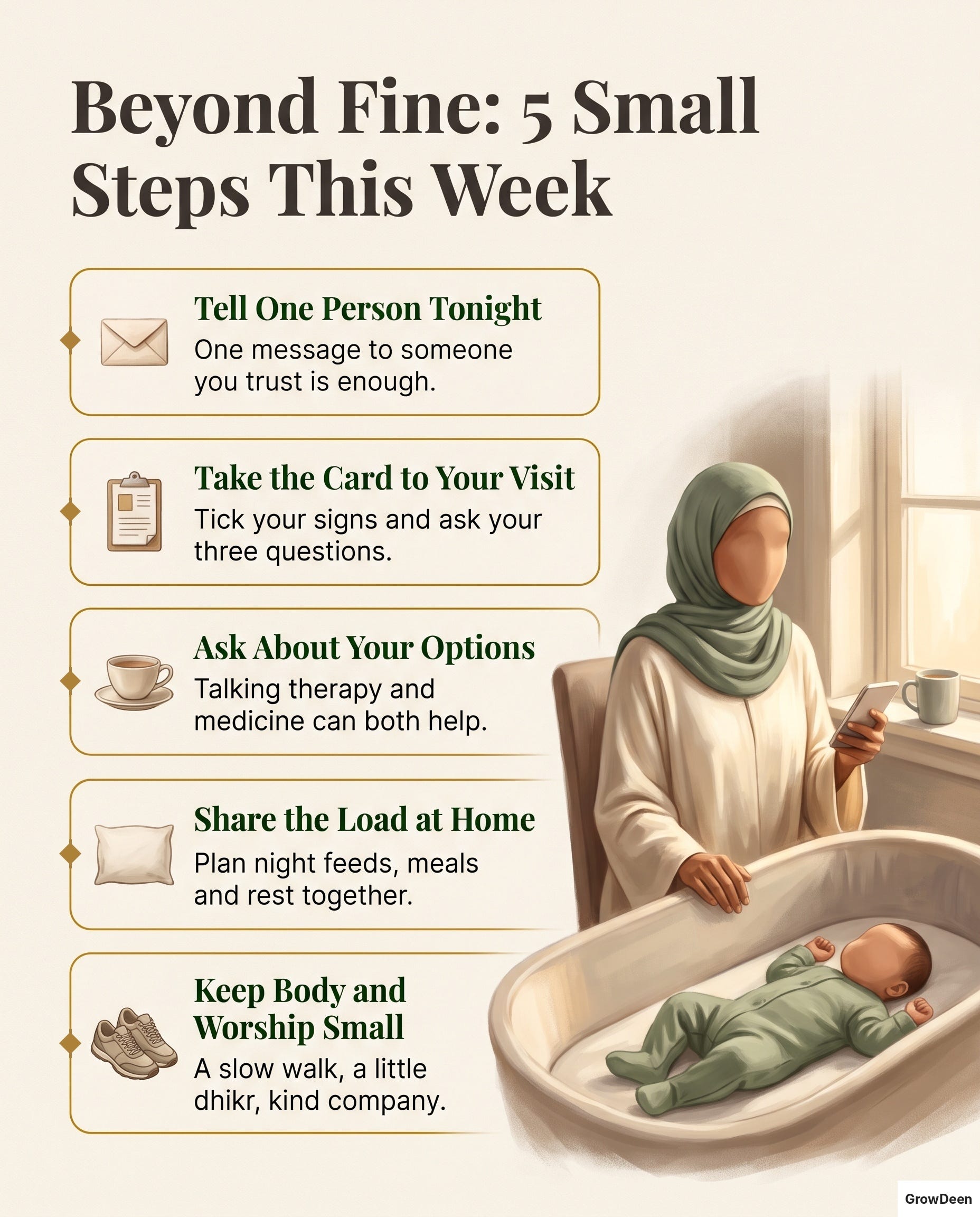
1. Tell one person tonight (2 minutes). The disguises lose their hold once one person knows. Choose someone safe: your husband, your mother, a sister or a friend.
Say this: "I haven't felt like myself lately. Can we talk tonight?" (Say it in whichever language comes most easily.)
If those words don't fit, try one of these:
"I'm not okay, and I don't want to pretend anymore."
"Can you sit with me after the baby goes down? I need to tell you something."
"I've been saying I'm fine. It isn't true."
Instead of: "I'm fine, Alhamdulillah, only tired." Try: "Alhamdulillah for the baby. But I'm not okay, and I need help."
2. Fill in the appointment card and book a visit (10 minutes). Page 1 of the Beyond Fine Pack sorts the signs into the same four areas. Tick what fits, note how long it has lasted, and take it with you.
No printer? Write the four headings on paper or in your phone.
Many clinics screen pregnant and new mothers with a short questionnaire, such as the Edinburgh Postnatal Depression Scale (EPDS), at more than one visit. [7] Answer it the way things are. If nobody asks, start the conversation yourself.
Say this to your doctor or midwife: "I have felt low most days for about three weeks, and I am not enjoying anything."
Mention any past depression or anxiety: it is the biggest risk factor, and your care team can plan around it. [4] Say if you are breastfeeding or pregnant. Then ask three questions:
"What do you think is going on, and what are my options?"
"Can this treatment be used while I'm breastfeeding?"
"Who do I contact if I feel worse before my next appointment?"
Many mothers assume getting help means weaning. In many cases it does not: with SSRIs and SNRIs, two groups of antidepressants, breastfeeding can continue. [13]
3. Ask what treatment involves (at the appointment). Your doctor will suggest a plan that fits you and how severe the depression is. [13]
Talking therapy. Cognitive behavioral therapy (CBT) and interpersonal therapy (IPT) both help with perinatal depression, usually one to one. [2,4] CBT tests harsh thoughts, such as "I'm a terrible mother," against what is happening; IPT works on the role changes a baby brings. You may ask for a counselor who understands your values.
Medicine. A doctor may suggest an antidepressant, weighing its risks against the risks of untreated depression. [13] Used together, therapy and medicine can work better than either alone. [13]
Hospital care. Occasionally, when symptoms are severe, a mother needs care in hospital. [4] Some hospitals have specialist mother and baby units, so the two can stay together. [1]
If you already take a prescribed medicine: do not stop it suddenly on your own. Talk to your doctor first. [13]
Say this: "Which of these would you suggest for me, and why?"
4. Share the load at home (15 minutes, once this week). Sit down with your husband, or whoever lives with you, and fill in the Home Support Plan. Use page 2 of the pack, or a sheet of paper. Decide who covers night feeds, who brings a hot meal, who keeps you company, how long visitors stay, and when you rest.
Rest whenever someone else can hold the baby, and accept the help without guilt. Eat regular meals, even simple ones: dates, fruit, yogurt, a flask of soup someone else made.
Say this: "Can we sit down for fifteen minutes and plan this week together? I need more rest than I'm getting."
5. Keep your body and your worship small (a few minutes a day). Move a little each day when your body allows. A 2025 review of trials found that exercise after birth, such as brisk walking or stationary cycling, reduced depressive and anxiety symptoms. [14]
Ask your doctor or midwife what is safe for your stage of recovery. A slow walk counts.
Keep worship small and possible. The Prophet ﷺ said Allah has remitted fasting for the traveler, the nursing woman and the pregnant woman. The narrator was unsure whether both women were named (Sunan Abi Dawud 2408, Hasan Sahih). [15]
Our reflection: if the law Allah revealed makes room for a mother's body, she can make room for herself. For how any concession applies to you, ask your local imam or a local scholar, and share the details with him.
On the heaviest days, a few minutes of dhikr (remembering Allah) may be all you can manage. The Prophet ﷺ taught Asma bint Umays words to say in distress; they are in A Du'a for This, below. [16]
Find other mothers, too. A support group, such as a mothers' circle at the masjid, may help ease depression symptoms after birth. [4]
Say this to a friend at the masjid: "Is there a mothers' circle here? I'd like to come."
Make It Work in Your Home
Your husband works nights or travels? Ask one other adult for one fixed evening a week, and write their name on the plan.
On your own with the baby? Ask your doctor or midwife what support exists near you, and say yes to one offer this week.
A house full of visitors? Visitors can be kind and still be too much. Keep visits short, and let one person say no for you.
Say this to your mother or mother-in-law: "Mama, you raised us, and you know how hard these weeks are. Will you take the baby for an hour each afternoon so I can sleep?"
The family question: ask your husband, or whoever is closest, "Who can give me two hours of company this week?"
If You Are the Husband Reading This
You find her crying at the sink and say the kind thing you know: "You'll be fine, it's only hormones." She stops talking about it. That silence is the one to worry about.
When the Muslims marched out to Badr, Uthman ibn Affan (may Allah be pleased with him) stayed behind. His wife, a daughter of the Prophet ﷺ, was ill. The Prophet ﷺ told him he would have a reward and a share like one who fought at Badr. [17]
Practical ways to stand beside her:
A vague offer leaves her to do the work of asking. Offer something specific: "I'll take the baby from six until nine so you can sleep."
Arrange regular company if she spends long stretches alone with the baby.
Go with her to appointments if she would like you there.
Keep visitors, and unrequested advice, to a minimum.
Learn the emergency signs in If Things Don't Go to Plan, and act at once if you see them.
Words matter too. In studies where mothers described perinatal depression, some were told, in effect, to snap out of it. Stigma like that left them lonelier. [18]
Instead of: "You'll be fine, it's only hormones." Try: "You don't have to explain. I'm here."
Say this to her: "Shall I come with you to the appointment?" Or: "What would make today one notch easier?"
And you? Check in on yourself as well.
A meta-analysis estimated that about 1 in 10 fathers have depression from early pregnancy to the end of the first year. Rates were highest at three to six months after birth. It was moderately linked with depression in the mother. [19]
If that sounds like you, tell your own doctor.
One true sentence, one appointment, one shared week: that is the whole practice.
If Things Don't Go to Plan
Get help today if any of these are true:
You have thoughts of ending your life, or of hurting yourself.
You have thoughts of harming your baby that feel like intentions or plans, not unwanted flashes.
You can no longer care for yourself or your baby.
You, or your family, notice sudden confusion, hearing or seeing things others do not, racing thoughts, or behavior that is not like you at all.
Call your local emergency number, go to the nearest hospital emergency department (ER), or contact a crisis line in your country. [1,2] A frightening thought is different from an intention, and the part below explains why.
If the first person you tell doesn't understand: tell someone else, or go straight to your doctor or midwife.
If treatment feels slow: recovery can come in small steps, with good days and slow days. Keep the plan and the appointments, and tell your doctor if you are not improving.
If you start doubting yourself: Am I a weak Muslim for feeling this? No. An illness is not a verdict on your iman. The Prophet ﷺ spoke about sadness and offered a comfort for it. [12]
What happens if I tell? Telling your doctor or midwife how you feel is how help starts.
Signs are clearer looking back. Seeing them late is not neglect.
The Thoughts Mothers Are Most Afraid to Say Out Loud
It arrives without warning at bath time: a sudden picture of the baby slipping under the water. She is horrified, and she tells no one.
Unwanted thoughts like these are common, and they often fade by themselves. [20] In a Canadian study of 388 new mothers, those who had them were not more likely to report aggression toward their baby. [21] That finding is reassuring, and it is also a reason to speak up.
Thoughts that keep coming and cause distress are most often linked with obsessive-compulsive disorder (OCD), and they may need treatment. [20] Tell your doctor or midwife.
A different and much rarer illness sits at the other end. Postpartum psychosis affects around 1 in 1,000 mothers after birth. It usually starts within the first two weeks, often within hours or days. [1]
It can bring confusion, false beliefs, seeing or hearing things, and fast mood changes. She may not realize she is ill, so her husband, mother or sister may need to act. [1]
It is a medical emergency: call your local emergency number. With the right treatment, most mothers make a full recovery. [1]
Who to turn to: your doctor or midwife for you, and your baby's doctor or pediatrician for your baby. A counselor can offer talking therapy. In an emergency, call your local emergency number. For questions of deen, ask your local imam or a local scholar, and share the details with him.
Support Muslim Parenting Lab ❤️
Would you like a share in every good thing that comes from what you fund? Support it with the button below, at any level you choose.
The Prophet ﷺ said whoever sets a good precedent earns its reward and the reward of everyone who follows it. (Sahih Muslim 1017a)
Your Companion Pack: Beyond Fine Pack
Free to download: three pages, made to go from the fridge door to the doctor's desk.
Page 1: The Appointment Card. Tick boxes for the signs in all four areas, how long it has lasted, the three questions to ask, and space for notes. Hand it over when the words won't come.
Page 2: The Home Support Plan. A weekly grid for night feeds, hot meals, company, visitors and her rest window, with the emergency signs at the top and words that help.
Page 3: For the Heart That Feels Empty. The du'a for distress the Prophet ﷺ taught Asma bint Umays, in Arabic with transliteration and meaning. With it: the mother of Musa and the heart Allah bound, and Uthman at Badr, for the one standing beside her.
Parents Also Ask
How do I know if it's the baby blues or postpartum depression?
The baby blues are mild mood changes in the first two weeks after birth that usually pass within days. [1,2] A sad, anxious or empty mood most of the day for at least two weeks points toward depression. [2]
Raise it with your doctor or midwife. The Myth Check above explains more.
Is postpartum depression a sign of weak iman?
Our reflection: no. The Prophet ﷺ said talbina eases some of a sick person's sadness. [12] In one study of Pakistani mothers, leaning on tawakkul and sabr was linked with milder symptoms, and negative religious coping with more severe ones. [8] For your own situation, ask your local imam or a local scholar, and share the details with him.
How can I help my wife with postpartum depression?
Offer specific help, such as taking the baby for set hours so she can sleep. Keep her company, go to appointments with her, and keep visitors short. If You Are the Husband Reading This has more.
Can I take antidepressants while breastfeeding?
Often, yes. With SSRIs and SNRIs, ACOG's guideline says breastfeeding can continue. [13] Ask your doctor before you decide anything about weaning, and never stop a prescribed medicine suddenly.
Are scary intrusive thoughts after having a baby normal?
Unwanted, frightening thoughts are common in new mothers, and they often fade. [20] They were not linked with aggression toward the baby in a Canadian study. [21]
Still, tell your doctor or midwife. If they feel like plans, or come with confusion, call your local emergency number. [1]
Can dads get postpartum depression?
Yes. About 1 in 10 fathers have depression from early pregnancy to the end of the first year. Rates are highest three to six months after birth. [19] Depression in one parent is linked with depression in the other, so check on both.
Final Reflection
Dear parent,
You read this far, for yourself or for someone you love. That care matters.
If you have been saying "fine," you were likely protecting the people around you. Many mothers do the same. Feeling this way is not a failure of gratitude or of iman.
You are not ungrateful. You are not weak. You are carrying something heavy.
You don't need to fix everything this week. Start with step 1: one message to one person you trust. Make the intention to take the means, and leave the rest with Allah.
You can say Alhamdulillah and still need help. Often, the way out begins with one true sentence.
A Du'a for This
For you:
اللَّهُ اللَّهُ رَبِّي لاَ أُشْرِكُ بِهِ شَيْئًا
Allahu Allahu Rabbi, la ushriku bihi shay'a
"Allah, Allah is my Lord, I do not associate anything as partner with Him."
Sunan Abi Dawud 1525 · Sahih (Al-Albani) · sunnah.com [16]
The Prophet ﷺ taught these words to Asma bint Umays for times of distress. Say them on the hard nights, while rocking the baby, or whenever the heaviness rises.
In your own words: May Allah bind your heart, lift what weighs on it, and return you to contentment.
With your child: Alhamdu lillahi Rabbil 'alamin, "[All] praise is [due] to Allāh, Lord of the worlds." (Al-Fatihah 1:2) [22]
Whisper it over your baby during a feed, from the newborn days onward.
Share the Khayr
Think of one person. Maybe it is the sister who had a baby in the spring and went quiet in the family group. Or the friend at the masjid who says "Alhamdulillah, fine" a little too quickly. Send this to her today, as an act of care.
The Prophet ﷺ said that whoever guides someone to good has a reward like the one who does it. [23]
If you are her sister, husband or friend, this is for you too. A line you can send with it: "I thought of you when I read this. No need to reply. I'm here."
Parents Also Read
Parents who read this guide also found these helpful.


References
[1] NHS. (2023). Postpartum psychosis. NHS website.
[2] National Institute of Mental Health. (2023). Perinatal Depression. NIH Publication No. 23-MH-8116.
[3] Wilson, N., Lee, J.J., & Bei, B. (2019). Postpartum fatigue and depression: A systematic review and meta-analysis. Journal of Affective Disorders, 246, 224–233.
[4] Highet, N.J., & the Expert Working Group and Expert Subcommittees. (2023). Mental Health Care in the Perinatal Period: Australian Clinical Practice Guideline. Centre of Perinatal Excellence.
[5] Washington State Health Care Authority. (2025). Perinatal anxiety toolkit. HCA 82-0660.
[6] World Health Organization. Perinatal mental health.
[7] American College of Obstetricians and Gynecologists. (2023). Screening and diagnosis of mental health conditions during pregnancy and postpartum: ACOG Clinical Practice Guideline No. 4. Obstetrics & Gynecology, 141(6), 1232–1261.
[8] Amin, Z. (2026). The sacred strain: Religion as both resource and burden in the psychological well-being of Pakistani women navigating postpartum depression. Journal of Health Psychology.
[9] Qur'an, Al-Qasas 28:10. Translation: Sahih International.
[10] Tafsir Ibn Kathir on Al-Qasas 28:10–13.
[11] Qur'an, Al-Qasas 28:13. Translation: Sahih International.
[12] Sahih al-Bukhari 5417.
[13] American College of Obstetricians and Gynecologists. (2023). Treatment and management of mental health conditions during pregnancy and postpartum: ACOG Clinical Practice Guideline No. 5. Obstetrics & Gynecology, 141(6), 1262–1288.
[14] Deprato, A., Ruchat, S.M., Ali, M.U., et al. (2025). Impact of postpartum physical activity on maternal depression and anxiety: A systematic review and meta-analysis. British Journal of Sports Medicine, 59(8), 550–561.
[15] Sunan Abi Dawud 2408. Graded: Hasan Sahih, by Al-Albani.
[16] Sunan Abi Dawud 1525. Graded: Sahih, by Al-Albani.
[17] Sahih al-Bukhari 3130.
[18] Adlington, K., Vasquez, C., Pearce, E., Wilson, C.A., Nowland, R., Taylor, B.L., Spring, S., & Johnson, S. (2023). 'Just snap out of it' – the experience of loneliness in women with perinatal depression: a meta-synthesis of qualitative studies. BMC Psychiatry, 23, 110.
[19] Paulson, J.F., & Bazemore, S.D. (2010). Prenatal and postpartum depression in fathers and its association with maternal depression: A meta-analysis. JAMA, 303(19), 1961–1969.
[20] Collardeau, F., Anglin, O.L.U., Albert, A., Mayhue, J.G., & Fairbrother, N. (2024). Prevalence and course of unwanted, intrusive thoughts of infant-related harm. The Journal of Clinical Psychiatry, 85(3), 23m15145.
[21] Fairbrother, N., Collardeau, F., Woody, S.R., Wolfe, D.A., & Fawcett, J.M. (2022). Postpartum thoughts of infant-related harm and obsessive-compulsive disorder: Relation to maternal physical aggression toward the infant. The Journal of Clinical Psychiatry, 83(2), 21m14006.
[22] Qur'an, Al-Fatihah 1:2. Translation: Sahih International.
[23] Sahih Muslim 1893a.
We combine scientific research with Qur’an and authentic Sunnah, and we cite our sources. Even so, this is general guidance and no substitute for a doctor who can examine your child.
Sources & confidence
The hadith in this guide are from Sahih al-Bukhari, Sahih Muslim and Sunan Abi Dawud. The Sunan Abi Dawud grades are Al-Albani's, as sunnah.com shows them. The health guidance follows NIMH (US, 2023), ACOG (US, 2023), the NHS (UK), the World Health Organization and COPE (Australia, 2023). Checked November 2026. Found a source that looks wrong? Email us at info@growdeen.com.
Words in this guide
perinatal depression · scientific term: depression during pregnancy or in the first year after birth.
prenatal depression (antenatal depression) · scientific term: depression that begins during pregnancy.
postpartum depression (postnatal depression, PPD) · scientific term: depression in the weeks and months after birth.
Edinburgh Postnatal Depression Scale (EPDS) · scientific term: a short questionnaire many clinics use to check for depression in pregnancy and after birth.
cognitive behavioral therapy (CBT) · scientific term: a talking therapy that helps you notice harsh thoughts and test them against what is happening.
interpersonal therapy (IPT) · scientific term: a talking therapy that works on relationships and the role changes a baby brings.
SSRIs and SNRIs · scientific term: two groups of antidepressant medicines.
intrusive thoughts · scientific term: sudden, unwanted thoughts or pictures, here of harm coming to the baby.
obsessive-compulsive disorder (OCD) · scientific term: a treatable condition in which distressing thoughts keep returning.
postpartum psychosis · scientific term: a rare, serious illness after birth with confusion, false beliefs, or seeing and hearing things; a medical emergency.
internalized stigma · scientific term: shame about an illness that a person turns on herself.
meta-analysis · scientific term: a study that combines the results of many studies.
baby blues · everyday term: mild, short-lasting mood changes in the first two weeks after birth.
Alhamdulillah · Islamic term: all praise is for Allah.
du'a (doa, dua) · Islamic term: supplication, asking Allah.
dhikr · Islamic term: remembering Allah with short phrases.
iman · Islamic term: belief in Allah.
sabr · Islamic term: patient perseverance.
tawakkul · Islamic term: trusting Allah while taking the means.
talbina · Islamic term: a soft dish prepared from flour or bran, which the Sunnah says eases some of a sick person's sadness.
deen · Islamic term: the way of life of Islam.
khayr · Islamic term: good.
masjid · Islamic term: mosque.
crib (cot) · country word: a baby's bed with high sides.
ER (emergency department) · country word: the hospital department for emergencies.
counselor (counsellor) · country word: a trained person who offers talking therapy.
yogurt (yoghurt) · country word: US spelling.