

Your child chats all evening, then freezes at preschool or the masjid? The free Quiet Voice Pack gives you cards for teachers and family, and a plan for Eid visits.
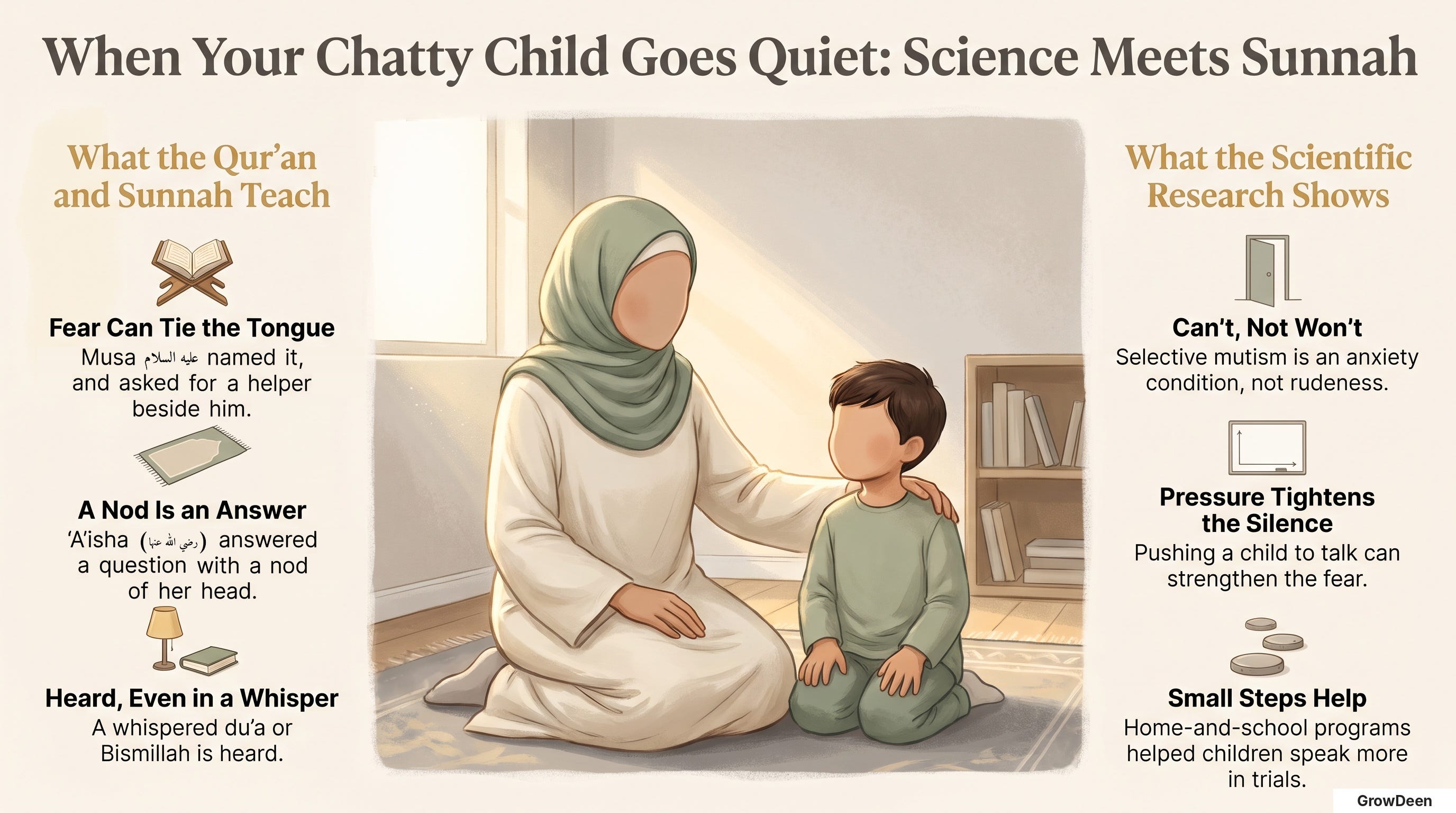
AGES 3–8 YEARS · 23 MIN READ
The sticker chart was your idea. One gold star for every word he said at preschool.
By Thursday the chart was still empty. He cried in the car outside the gate.
That evening, on the drive home, he retold the elephant army from Surah al-Fil. Full volume. Sound effects included.
He talks all the way home. So why can't he say one word to his teacher?
You are not the only parent asking that in a parked car. And there is a real reason a chatty child can't even ask for the toilet.
This guide brings together scientific research and the Qur'an and authentic Sunnah. You'll see why the words get stuck, what the Prophet ﷺ accepted as an answer, and what to try tonight.
The Short Answer
Right for your child? Ages 3–8 who chat at home but freeze at preschool, school or the masjid. Autistic or speech-delayed? Look for "Show this".
What's probably happening: if it has lasted over a month, it may be selective mutism, an anxiety condition. Pressure to talk sets off a freeze.
Try tonight (1 minute): at bedtime, say, "You don't have to talk at preschool until you're ready. A nod counts." Then drop the subject.
You'll know it's working when: drop-offs feel calmer, and he nods, points or whispers more. More gestures count as progress. Speaking often grows from them.
Get help if: silence outside home lasts over a month, or he can't ask for the toilet. Start with your child's doctor or pediatrician.
The rest of this guide explains why, and what to do if it does not work.
How to Read This Guide
3 minutes: The Short Answer above is enough for tonight.
7 minutes: The Short Answer, then Knowledge in Practice and If Things Don't Go to Plan.
The whole guide: read on for the scientific research, the Qur'an and Sunnah, and the References.
To share: the bold lines and the pull quotes are made to be shared.
To listen: open this guide in the free Substack app and tap Listen.
Inside This Guide
A child with selective mutism isn't choosing silence. Your patience is part of the help.
Myth Check: "He's Only Shy. He'll Grow Out of It."
What it gets right. Some children take a long time to warm up, and patience is a real kindness. Waiting also avoids a scene in front of the family.
What the evidence says. The NHS advises parents not to accept the view that a child will grow out of it, or is only shy. [1] A child can often overcome selective mutism when it is recognized early and managed well. The older a child is at diagnosis, the longer treatment tends to take. [1]
What to do instead. Keep the patience, and add a plan. If the pattern has lasted more than a month, speak with your child's doctor, and start the steps in this guide tonight. Try not to settle for advice to wait and see. [1]
Why This Happens
What happens in the seconds after someone asks him a question?
Watch the next time it happens. An aunty asks something simple. His shoulders rise, and his eyes drop to the floor.
From the outside, it can look like defiance, or like he didn't hear. Selective mutism is an anxiety disorder. A child speaks freely in some places, usually at home with close family. In others, such as preschool, the masjid or a cousin's house, he consistently cannot speak. [1,3]
The word that matters is cannot. Your child is not choosing silence: the expectation to talk triggers a freeze response, and talking feels impossible in that moment. [1]
That fear has a shape you can see. Some children go suddenly still, with a frozen face. Others look nervous and uneasy, or avoid eye contact. Some nod, point, whisper or use an altered voice in place of normal speech. [1,2]
Anxiety can also make it harder to process language in that moment, so he may seem not to understand a simple question. [2] Often, he heard every word.
Is it shyness, a new language, or selective mutism?
Shyness and selective mutism can look alike in a busy room. Three questions help tell them apart.
Does the silence follow the place rather than the person? A shy child may be quiet with new people everywhere. A child with selective mutism may talk with someone in one setting and not at all in another, even with the same familiar person. [2]
Has it lasted more than a month, and is it getting in his way? Doctors look for at least a month, not counting the first month at a new school, when many children are quiet while they settle. It must also get in the way of learning or friendships. [3]
Does it hold in every language your child knows? Many children go through a brief quiet stretch while learning a new language, and that alone is something else. [2] Selective mutism is diagnosed only when the silence can't be explained by the language being spoken, and it shows in every language the child uses. [2,3]
This matters for many Muslim families. The NHS notes that selective mutism is more common in girls and in children who have recently migrated, though studies disagree about girls and boys. [1,2] It most often starts between about ages 2 and 4, and it is often first noticed when a child starts preschool or school. [1,2]
Why can't he even ask for the toilet?
Back to the puzzle from the start. A child with selective mutism may struggle to ask for help, even to ask for the toilet. [1,2] Some hold on for hours, and accidents can happen at preschool or school. [1,2]
He may seem withdrawn around other children, and shrink from anything that draws attention, like standing up to recite. [1,2]
For that child, being heard in that room feels more dangerous than being uncomfortable. At home, his voice has years of safety behind it. At preschool it has almost none yet, and the fear can outweigh even a full bladder.
There is rarely one single cause. [2] Most children with selective mutism also have another anxiety disorder, most often social anxiety. [4] Anxiety often runs in families, and a temperament that is naturally wary of new people has been linked with it. [2,5] Some children also have a speech, language or hearing difficulty, so a hearing and speech check is part of an assessment. [1,2]
What makes the silence tighter?
These habits come from love, and they tend to backfire. When a child is pushed to talk, his relief when the moment passes can strengthen his belief that talking is a bad experience. [1]
Pressuring or bribing your child to speak. [1]
Praising his speech in front of others, or showing surprise and making a fuss when words come. [1]
Punishing the silence, or calling it rude or bad adab (good manners).
Agreeing that he's only shy, or that he'll grow out of it without help. [1]
Asking him to speak in front of a class or group, or discussing his silence with adults while he stands there.
A sticker chart for words he cannot yet say is one more push. Therapists do reward small, reachable steps, inside a plan the team builds together. [2]
For a child with selective mutism, silence often means can't, not won't. The voice comes out where it feels safe.
What the Scientific Research Shows
The strongest finding is a hopeful one. A 2021 meta-analysis of five randomized trials, with 233 children in all, found psychological treatment more effective than no treatment. [6]
Who was studied: country, ethnicity, family income and additional needs are not given in the study summary. How strong this is: Strong. A meta-analysis of randomized trials, though the trials were few.
A 2023 systematic review found that combined home-and-school behavioral programs improved children's speaking compared with waiting lists, in three trials. The authors called these programs promising and asked for more studies. [7] Who was studied: not given in the study summary. How strong this is: Suggestive. A careful review, built on few small trials.
A small randomized pilot trial in the US tested a 24-week behavioral program with 21 children aged 4 to 8. Their speaking increased, as rated by parents and teachers. [8] Who was studied: US children; ethnicity, family income and additional needs are not given in the study summary. How strong this is: Early. One small pilot trial.
What happens over the years? A 2023 systematic review of 11 follow-up studies looked at recovery. By the end, 190 of 243 children (78%) had moderate or full improvement in their symptoms. Anxiety problems were still common later in life, and the authors called for early detection and treatment. [9] Who was studied: children in the UK, Norway, the US, Turkey, Finland, Germany, Switzerland, Israel, Italy and Canada. Ethnicity, family income and additional needs were not reported. How strong this is: Strong. A systematic review, of studies of moderate quality.
Why anxiety sits at the center: a 2020 meta-analysis pooled 22 studies, with 837 children. In them, 80% of children with selective mutism had another anxiety disorder, most often social anxiety (69%). [4] Who was studied: not given in the study summary. How strong this is: Strong for the link, which shows an association, not a cause. A 2024 study of 169 Dutch children aged 6 to 12 linked selective mutism symptoms with social anxiety and an anxiety-prone temperament. [5] How strong this is: Suggestive. One study, using parent questionnaires.
How common is it? About 1 in 140 young children have selective mutism. [1] Across studies, estimates range from 0.2% to 1.6% of children. [2] Medicine has limited evidence, from small studies with few comparisons, and is used mainly when progress with therapy is limited or slow. [10] How strong this is: Early.
Guidance used: the NHS (UK; last reviewed 2023, review now overdue), the ASHA Practice Portal (US; undated) and the DSM-5-TR criteria (US, 2022).
What we do not know yet: no study has yet tested these programs with Muslim families. None has looked at reciting at a madrasa or masjid.
What this means for you: small, steady steps, carried out at home and at school together, often help children find their voice.
What the Qur'an and Sunnah Teach
When Allah sent Musa عليه السلام to Pharaoh, he told his Lord that he feared they would deny him. Then he named what that fear does to the body. [11]
وَيَضِيقُ صَدْرِى وَلَا يَنطَلِقُ لِسَانِى فَأَرْسِلْ إِلَىٰ هَـٰرُونَ
And that my breast will tighten and my tongue will not be fluent, so send for Aaron.
Ash-Shu'ara 26:13 · Sahih International
Text. Ibn Kathir reads this alongside the request of Musa عليه السلام in Surah Ta-Ha, and notes that Allah granted what he asked. [12] In Surah Al-Qasas, Musa عليه السلام calls Harun عليه السلام "more fluent than me in tongue" and asks for him "as support". Allah answers, "We will strengthen your arm through your brother." [13]
Why did Musa عليه السلام want Harun عليه السلام beside him? Ibn Kathir records Muhammad ibn Ishaq's answer: "to explain to them what I say, for he can understand me where they may not." [14]
Our reflection. A prophet of Allah felt his chest tighten and his tongue hold back, and he asked for help. Fear like that is not a sign of weak iman (belief). The help Allah gave him was a person beside him. That is close to your role: the one who understands your child where others can't, until his own voice is strong enough. Call it the role of Harun عليه السلام.
The Qur'an also shows that someone who cannot speak in a moment can still communicate. When Zakariyya عليه السلام asked his Lord for a sign, he was told: [15]
قَالَ ءَايَتُكَ أَلَّا تُكَلِّمَ ٱلنَّاسَ ثَلَـٰثَةَ أَيَّامٍ إِلَّا رَمْزًا
He said, "Your sign is that you will not [be able to] speak to the people for three days except by gesture."
Al 'Imran 3:41 · Sahih International
Text. Ibn Kathir explains that Zakariyya عليه السلام could speak only with signals, "although you are not mute". [16] His silence was a sign from Allah, which is a different matter from a child's anxiety. Still, it shows that a gesture can carry real meaning.
Imam al-Bukhari placed narrations in his Sahih (his collection of authentic hadith) under a chapter about giving a religious verdict "by beckoning or by nodding". [17] In one, the Prophet ﷺ was asked a question during his final Hajj (pilgrimage):
The Prophet (ﷺ) beckoned with his hand and said, "There is no harm in that."
Sahih al-Bukhari 84 · sunnah.com
In another, 'A'isha (رضي الله عنها) was in the middle of prayer when her sister Asma' (رضي الله عنها) asked her a question: [18]
She nodded with her head meaning, "Yes."
Sahih al-Bukhari 86 · sunnah.com
Our reflection. A nod was enough of an answer among the Companions رضي الله عنهم. It can be enough for your child, for now.
Quiet worship has its own honor, too. Zakariyya عليه السلام called on his Lord privately: [19]
إِذْ نَادَىٰ رَبَّهُۥ نِدَآءً خَفِيًّا
When he called to his Lord a private call [i.e., supplication].
Maryam 19:3 · Sahih International
Text. Ibn Kathir explains that he made his supplication secretly because that is more beloved to Allah. He records Qatadah saying, "Verily, Allah knows the pious heart and he hears the hidden voice." [20]
Our reflection. So a whispered Bismillah ("In the name of Allah") is a Bismillah. A du'a (supplication) said silently in the heart is heard. Let his whispers count at home, and at bedtime try making du'a softly over him while he listens.
Fear that ties the tongue is not weak iman. A prophet of Allah felt it and asked for help.
The Lab Verdict
The science: small-step behavioral treatment helped children speak more in trials (Strong for psychological treatment overall; Suggestive for home-and-school programs). Pressure to talk tends to feed the fear.
The Qur'an and authentic Sunnah: a prophet named the fear that tied his tongue and asked for a helper. A nod and a hand gesture were accepted as answers.
Where they meet: the science shows how speaking grows, step by small step; the Sunnah gives the mercy to accept every way a child communicates. They meet in patience.
So at home: take the pressure off, accept the nod, and stay beside him while his voice catches up.
Knowledge in Practice: Make Speaking Feel Safe Again
Knowing why the words get stuck is half the work. The other half happens at the preschool gate and the masjid door.
If you can only do one thing, do step 1. It is enough.
1. Take the pressure off, out loud (1 minute, tonight). Treatment starts by removing the pressure to speak, because pressure feeds the anxiety that holds the words back. [1]
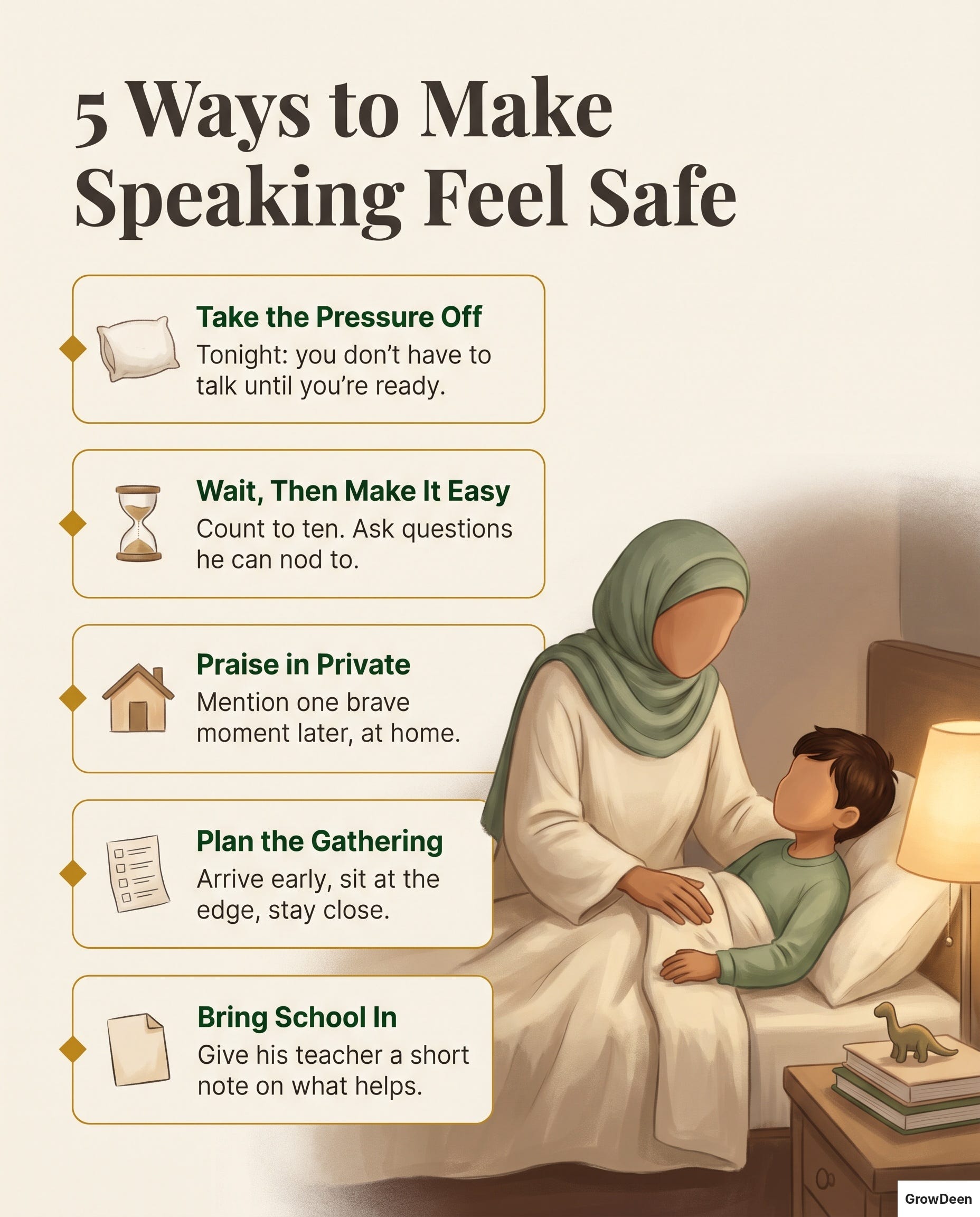
Say this: "I know talking is hard in some places. You're not in trouble. You can take small steps when you're ready, and talking will get easier." (Say it in the language your child knows best.)
At bedtime, add the sentence from The Short Answer: "You don't have to talk at preschool until you're ready. A nod counts." Then say nothing more about it.
Instead of: "Go on, say salaam to Aunty." Try: "You can smile at Aunty. I'll say salaam for both of us."
The Prophet ﷺ said, "Your smiling in the face of your brother is charity." [24] His smile is already a good deed. The spoken salaam will come in time.
Now and then, tell him about a time you felt nervous, and what you did: a few slow breaths, or a du'a under your breath. That way he hears that grown-ups feel it too.
2. Wait, then make answering easy (10 seconds, every time someone asks). A child needs time to process and respond, so try not to answer for him straight away. [2] Count to five, or even ten, silently before you step in.
Ask questions that need one word, a nod or a point. "Is it the green cup?" is far easier than "What would you like?" At a gathering, try "Juice or water?"
Accept gestures as full answers. [1] If someone asks your son how old he is, you might say, "Ibrahim, you're five, aren't you?" while holding up five fingers. He nods, and he is part of the conversation. If he does speak, carry on calmly, as you would with any child. [1]
When someone asks why he doesn't talk, answer briefly and kindly. Say it where he can hear without being put on the spot: "Ibrahim talks all day at home. He's getting comfortable talking in new places."
3–5: offer two choices he can point to. Chat side by side about something he loves, like the cat next door, with no question he must answer. 6–8: he may prefer to draw or write an answer, or whisper it to a trusted friend.
Show this: a nod or a head shake, a point, a thumbs up or down, a drawing, or a whisper to you. Decide together which ones count, and tell his teacher.
3. Praise in private, and keep it light (1 minute, at home). Praising his speech in front of others can embarrass him and make the next try harder. Wait until you're alone. [1]
Instead of: "Did you hear that? He talked." (in front of the relatives) Try: "You waved to Aunty Safiya today. I noticed." (later, at home)
Say nothing about what didn't happen. One brave moment is enough to mention.
4. Plan the gathering: before, during and after (10 minutes, the morning of). Keep going to Eid lunches and family visits, and shape them so he feels more at ease. [1]
Before: tell him who will be there and what will happen. Agree on a private signal for "I need a break," like two squeezes of your hand. Message one or two relatives: "Please let him warm up. A smile is enough for now." Plan to arrive early, while the room is still quiet, and pack one familiar toy or book.
During: sit together at the edge of the room at first, then move closer to the other children bit by bit. Stay close when a new adult comes over. In treatment, the trusted parent often stays beside the child while a new person is slowly brought into the talking, then quietly steps back. [1] That is the role of Harun عليه السلام, on a living room carpet.
After: in the car, mention one brave moment, privately and lightly. Then write down what helped, for next time.
Say this to a relative who leans in: "A smile is a lovely start. Thank you for waiting."
5. Grow the voice at home, and bring school and madrasa in (this week). The voice grows where it already feels safe, then spreads outward.
At home and out, let him watch you do ordinary social things without fuss. Say salaam to the woman at the next table, or ask the shopkeeper how his family is. Read picture books together about nervous or shy feelings, and the stories of the Prophets عليهم السلام. Invite one or two friends to play at home for a long, relaxed afternoon, with active, silly games like bubbles or a ball game.
Then tell the adults who need to know: his teacher, his Qur'an teacher, grandparents and close family friends. Explain that he has selective mutism, that his silence is not rudeness, and what helps. The pass-along cards in the Quiet Voice Pack say it for you.
At madrasa (Qur'an class), reciting aloud in front of a group is one of the hardest things to ask of him. Ask whether he could recite to you at home and send an audio recording, or follow the lines with his finger while the teacher reads. Hearing his own recorded voice is one of the methods therapists use to help a child get used to being heard. [1]
A child who comes to dread Qur'an class is being pushed away from the thing you most want him to love. Protect that love while his voice catches up.
Before a new school year, ask whether he can be placed with a familiar classmate. Visit the new classroom early, meet the teacher, and play a game together that needs no talking. Teachers can praise every attempt to join in, like passing a crayon or nodding, and respond warmly when he speaks. [1] Johnson and Wintgens' practical manual for selective mutism gives ideas for managing it at home, at school and in the community. [21]
Make It Work in Your Home
On your own, or a spouse on night shifts? Steps 1 to 3 cost nothing and fit into bedtime and drop-off. Give the school card to whoever does drop-off.
Several children? Brothers and sisters often answer for a quiet sibling. Ask them kindly to wait too, and thank them in private when they do.
Grandparents who aren't Muslim? The same rule works for "say hello" or "say thank you": a wave counts for now.
You and your spouse see it differently? Read The Short Answer together, and agree on one plan.
Say this to the teacher: "Thank you for caring about him. He has selective mutism, an anxiety condition, and it isn't rudeness. He wants to talk, and he can't yet. Could you ask questions he can nod or point to, and praise any way he joins in?"
Say this to the madrasa teacher: "Thank you for teaching him the Qur'an. Reciting in front of the group is the hardest thing for him right now. Could he send a recording from home, or follow the lines with his finger for now?"
Say this to Grandma: "Ammi, he loves you, and he talks about you all the way home. Talking here feels hard for him right now. Could you let him warm up, and smile at a wave?"
The family question: ask an elder, or your spouse, "Was there a place where you went quiet as a child? What helped you?"
Try It Seven Times
Any seven times in the next week or two, count to ten silently before anyone answers for him, and accept the nod. Seven is a starting goal, not a magic number. One tick, and one word for what he did instead of speaking. Tell us in the comments what changed. We'd love to know.
Take the pressure off and stay close by. That is the whole practice.
If Things Don't Go to Plan
If he still freezes after weeks of trying: small changes are the real progress. A wave this month, a whisper to a cousin next month. Progress can take a long time, and the older a child is at diagnosis, the longer it tends to take. [1]
If you start doubting yourself: Did I cause this? No single cause has been found. Selective mutism is linked with anxiety and often runs in families, and it is not a sign that you failed. [1,2] What you do from here can help.
If you lose your patience: on the day you explain for the fifth time why he won't say hello, your face may go hot. That frustration is allowed. Take it to Allah on your prayer mat, then repair with your child: "I'm sorry I pushed. You don't have to talk until you're ready."
If you're already working with a specialist: treatment works on the anxiety underneath the silence, not on the speaking itself. [1] It often involves a team: a psychologist or other mental health professional and a speech therapist (speech-language pathologist), working closely with the school. [2] Most approaches move in small steps. [1]
Graded exposure: the least frightening situations first, repeated until easy, then one step up.
Stimulus fading: a new person is slowly brought into his talk with you, until you can step away.
Shaping: from gestures to eye contact, single words, short sentences and, finally, conversation.
Desensitization: voice or video recordings, so he gets used to others hearing his voice.
Cognitive behavioral therapy: more often for older children; it looks at how he thinks about himself and others, and uses graded exposure.
Medicine is considered only for some older children and teens, for example when anxiety has led to depression or other help has not worked. It is used alongside behavioral work, never instead of it. [1,10] If a speech or language delay is part of the picture, ask the team whether speech therapy should be added, and when.
Speak to someone if:
he hasn't been able to speak outside home for more than a month, beyond the settling-in time at a new preschool or school [3]
the silence is affecting learning, friendships or his ability to ask for help, including the toilet [1,3]
you have concerns about his hearing, his understanding of instructions or his language development [1]
Signs are clearer looking back. Seeing them late is not neglect. Booking an assessment and making du'a for your child belong together, so do both. For questions of deen, ask your local imam or a local scholar, and share the details with him.
Who to turn to: your child's doctor or pediatrician, who can refer you on. A child psychologist or a speech therapist can also help, and in some places you can contact a speech therapist directly. [1,2]
Support Muslim Parenting Lab ❤️
Would you like a small amount of yours grown into something enormous? Give what you can spare with the button below.
The Prophet ﷺ said Allah grows a charity the size of a date until it is like a mountain. (Sahih al-Bukhari 1410)
Your Companion Pack: The Quiet Voice Pack
Free to download: one PDF of three pages, to print or to show from your phone.
Page 1, Pass-Along Cards for Teachers and Family. Two cut-out cards, one for school or preschool and one for the madrasa and relatives. Each says what your child can do now and how adults can help.
Page 2, The Eid and Gathering Game Plan. Before, during and after, with the words to use when someone asks your child a question.
Page 3, A Nod Is an Answer. The four moments from the Qur'an and Sunnah in this guide, each with a short note. They are the gesture of Zakariyya عليه السلام, the Prophet's ﷺ answer with his hand, the nod of 'A'isha (رضي الله عنها) and the private call.
Parents Also Ask
Why does my child talk at home but not at school?
Often the reason is anxiety, even when it looks like stubbornness. In selective mutism, the expectation to talk in certain places triggers a freeze, so speaking feels impossible there. [1] Why This Happens explains more.
Is it shyness or selective mutism?
A shy child may be quiet with new people everywhere. A child with selective mutism talks freely in some places and consistently can't in others. It lasts more than a month and gets in the way of learning or friendships. [2,3] The three questions in Why This Happens help tell them apart.
Is selective mutism a sign of autism?
Not by itself. Selective mutism is an anxiety disorder. It isn't diagnosed when the silence is better explained by a communication disorder, or happens only because of autism. [2] A child can be autistic and also have selective mutism, which is why a full assessment helps. [1,2]
Will my child grow out of selective mutism?
Many children improve, especially with help: in a 2023 review, 190 of 243 children (78%) improved moderately or fully over time. [9] Anxiety problems were still common later, and the NHS advises parents not to wait for it to pass on its own. [1]
Can speaking two languages cause selective mutism?
A brief quiet stretch while learning a new language is common, and it isn't selective mutism. [2] The diagnosis applies only when the silence can't be explained by the language and shows in every language the child speaks. [2,3]
Should I make my child say salaam or recite at the masjid?
Pressure to speak tends to make the silence worse, so accept a smile, a nod or a whispered greeting for now. [1] You can say the salaam aloud for both of you. Text: the Qur'an honors the private call of Zakariyya عليه السلام to his Lord. [19,20] Our reflection: a whispered Bismillah still counts, so protect his love of the Qur'an while his voice catches up. For a ruling on your own situation, ask your local imam or a local scholar, and share the details with him.
What is the most effective treatment for selective mutism?
Psychological treatments, mainly behavioral programs that build speaking up in small steps, have the most evidence, though the trials are few and small. [6,7] Home and school work on the same plan, often with a psychologist and a speech therapist. [1,2]
Final Reflection
Dear parent,
You read a long guide to understand one quiet child. That care is already part of his help.
A sticker chart or a gentle push is what loving parents often try first. You were doing your best with what you knew. Allah sees every evening you spent wondering what to do.
You are not raising a rude child. You are learning his other ways of speaking.
Start small. Tonight, say the one sentence from step 1, then let it rest. Make your intention for Allah, and ask Him to accept every patient wait.
Often, a child who can't ask for the toilet isn't refusing. The room doesn't feel safe enough yet.
A Du'a for This
For you:
رَبِّ ٱشْرَحْ لِى صَدْرِى وَيَسِّرْ لِىٓ أَمْرِى وَٱحْلُلْ عُقْدَةً مِّن لِّسَانِى يَفْقَهُوا۟ قَوْلِى
Rabbish-raḥ lī ṣadrī, wa yassir lī amrī, waḥlul ʿuqdatan min lisānī, yafqahū qawlī.
"My Lord, expand [i.e., relax] for me my breast [with assurance] / And ease for me my task / And untie the knot from my tongue / That they may understand my speech."
Ta-Ha 20:25–28 · Sahih International
Musa عليه السلام made this du'a when he was sent to Pharaoh. [22] Make it for yourself before a hard gathering or a school meeting.
With your child: Wa yassir lī amrī, "And ease for me my task." (Ta-Ha 20:26) [22]
For ages 3–8: say it together at bedtime, or whisper it over him while he listens. A whisper counts.
In your own words, you might add: "Ya Allah, give my child ease in every room he walks into."
Share the Khayr
If you know a parent whose child chats at home and freezes at preschool or the masjid, send this to them. The Prophet ﷺ said, "One who guides to something good has a reward similar to that of its doer." [23]
Tell us in the comments: what was the first small sign of your child's voice, like a nod or a whisper? We'd love to know.
Parents Also Read
Parents who read this guide also found these helpful.


References
[1] NHS. (2023). Selective mutism. National Health Service.
[2] American Speech-Language-Hearing Association. (n.d.). Selective Mutism (Practice Portal). American Speech-Language-Hearing Association.
[3] American Psychiatric Association. (2022). Diagnostic and Statistical Manual of Mental Disorders (5th ed., text rev.; DSM-5-TR). American Psychiatric Association Publishing.
[4] Driessen, J., Blom, J.D., Muris, P., Blashfield, R.K., & Molendijk, M.L. (2020). Anxiety in children with selective mutism: A meta-analysis. Child Psychiatry & Human Development, 51(2), 330–341.
[5] Muris, P., Büttgens, L., Koolen, M., Manniën, C., Scholtes, N., & van Dooren-Theunissen, W. (2024). Symptoms of Selective Mutism in Middle Childhood: Psychopathological and Temperament Correlates in Non-clinical and Clinically Referred 6- to 12-year-old Children. Child Psychiatry & Human Development, 55(6), 1514–1525.
[6] Steains, S.Y., Malouff, J.M., & Schutte, N.S. (2021). Efficacy of psychological interventions for selective mutism in children: A meta-analysis of randomized controlled trials. Child: Care, Health and Development, 47(6), 771–781.
[7] Hipolito, G., Pagnamenta, E., Stacey, H., Wright, E., Joffe, V., Murayama, K., & Creswell, C. (2023). A systematic review and meta-analysis of nonpharmacological interventions for children and adolescents with selective mutism. JCPP Advances, 3(3), e12166.
[8] Bergman, R.L., Gonzalez, A., Piacentini, J., & Keller, M.L. (2013). Integrated behavior therapy for selective mutism: A randomized controlled pilot study. Behaviour Research and Therapy, 51(10), 680–689.
[9] Koskela, M., Ståhlberg, T., Yunus, W.M.A.W.M., & Sourander, A. (2023). Long-term outcomes of selective mutism: A systematic literature review. BMC Psychiatry, 23, 779.
[10] Manassis, K., Oerbeck, B., & Overgaard, K.R. (2016). The use of medication in selective mutism: A systematic review. European Child & Adolescent Psychiatry, 25(6), 571–578.
[11] Qur'an, Ash-Shu'ara 26:12–13. Translation: Sahih International.
[12] Tafsir Ibn Kathir (Abridged) on Ash-Shu'ara 26:13.
[13] Qur'an, Al-Qasas 28:34–35. Translation: Sahih International.
[14] Tafsir Ibn Kathir (Abridged) on Al-Qasas 28:34.
[15] Qur'an, Al 'Imran 3:41. Translation: Sahih International.
[16] Tafsir Ibn Kathir (Abridged) on Al 'Imran 3:41.
[17] Sahih al-Bukhari 84.
[18] Sahih al-Bukhari 86.
[19] Qur'an, Maryam 19:3. Translation: Sahih International.
[20] Tafsir Ibn Kathir (Abridged) on Maryam 19:3.
[21] Johnson, M., & Wintgens, A. (2016). The Selective Mutism Resource Manual (2nd ed.). Routledge.
[22] Qur'an, Ta-Ha 20:25–28. Translation: Sahih International.
[23] Sahih Muslim 1893a.
[24] Jami` at-Tirmidhi 1956. Graded: Hasan, by Darussalam.
We combine scientific research with Qur’an and authentic Sunnah, and we cite our sources. Even so, this is general guidance and no substitute for a doctor who can examine your child.
Sources & confidence
The hadith in this guide are from Sahih al-Bukhari, Sahih Muslim and Jami` at-Tirmidhi (graded Hasan by Darussalam). The Qur'an translation is Sahih International, and the tafsir quotations are from Tafsir Ibn Kathir (Abridged) on quran.com. Checked November 2026. Found a source that looks wrong? Email us at info@growdeen.com.
Words in this guide
selective mutism · scientific term: an anxiety disorder in which a child speaks freely in some places and consistently cannot speak in others.
freeze response · scientific term: the sudden stillness anxiety can cause when a child is expected to talk.
social anxiety (social phobia) · scientific term: a strong fear of being watched or judged by other people.
behavioral inhibition (wary temperament) · scientific term: a temperament that is naturally cautious with new people and places.
silent period (quiet stretch) · scientific term: a short time of little talking while a child learns a new language.
graded exposure (fear ladder) · scientific term: facing a feared situation in small, planned steps, starting with the easiest.
stimulus fading · scientific term: bringing a new person slowly into a conversation the child is already having with a trusted adult.
shaping · scientific term: building from gestures to words, then to sentences, one small step at a time.
desensitization (desensitisation) · scientific term: getting used to other people hearing your voice, often through recordings.
cognitive behavioral therapy (CBT) · scientific term: a talking therapy that looks at thoughts and works through fears step by step.
meta-analysis · scientific term: a study that combines the results of several earlier studies.
slow to warm up · everyday term: a child who takes time to feel at ease with new people and places.
pass-along card · everyday term: a short note you hand to a teacher or relative that explains what helps your child.
Ammi · everyday term: a word for mother used in many Muslim families.
adab · Islamic term: good manners and respectful conduct.
iman · Islamic term: belief in Allah.
du'a (doa) · Islamic term: supplication, asking Allah.
Bismillah · Islamic term: "In the name of Allah", said before eating and other actions.
salaam · Islamic term: the Islamic greeting of peace.
madrasa (Qur'an class, maktab) · Islamic term: a class where children learn to read and recite the Qur'an.
tafsir · Islamic term: explanation of the meaning of the Qur'an.
Sahih · Islamic term: authentic; Sahih al-Bukhari and Sahih Muslim are the two most trusted hadith collections.
Hajj · Islamic term: the pilgrimage to Makkah.
khayr · Islamic term: good.
sadaqah jariyah · Islamic term: charity whose reward continues after it is given.
preschool (nursery, daycare) · country word: care and early learning for children before school starts.
pediatrician (paediatrician) · country word: a doctor who specializes in children.
speech therapist (speech-language pathologist, speech and language therapist) · country word: a specialist in speech, language and communication.
behavior (behaviour) · country word: US spelling of the way a person acts.