

Touring schools for your child's first year? The free School Tour Pack helps you see each school clearly, then compare them side by side.
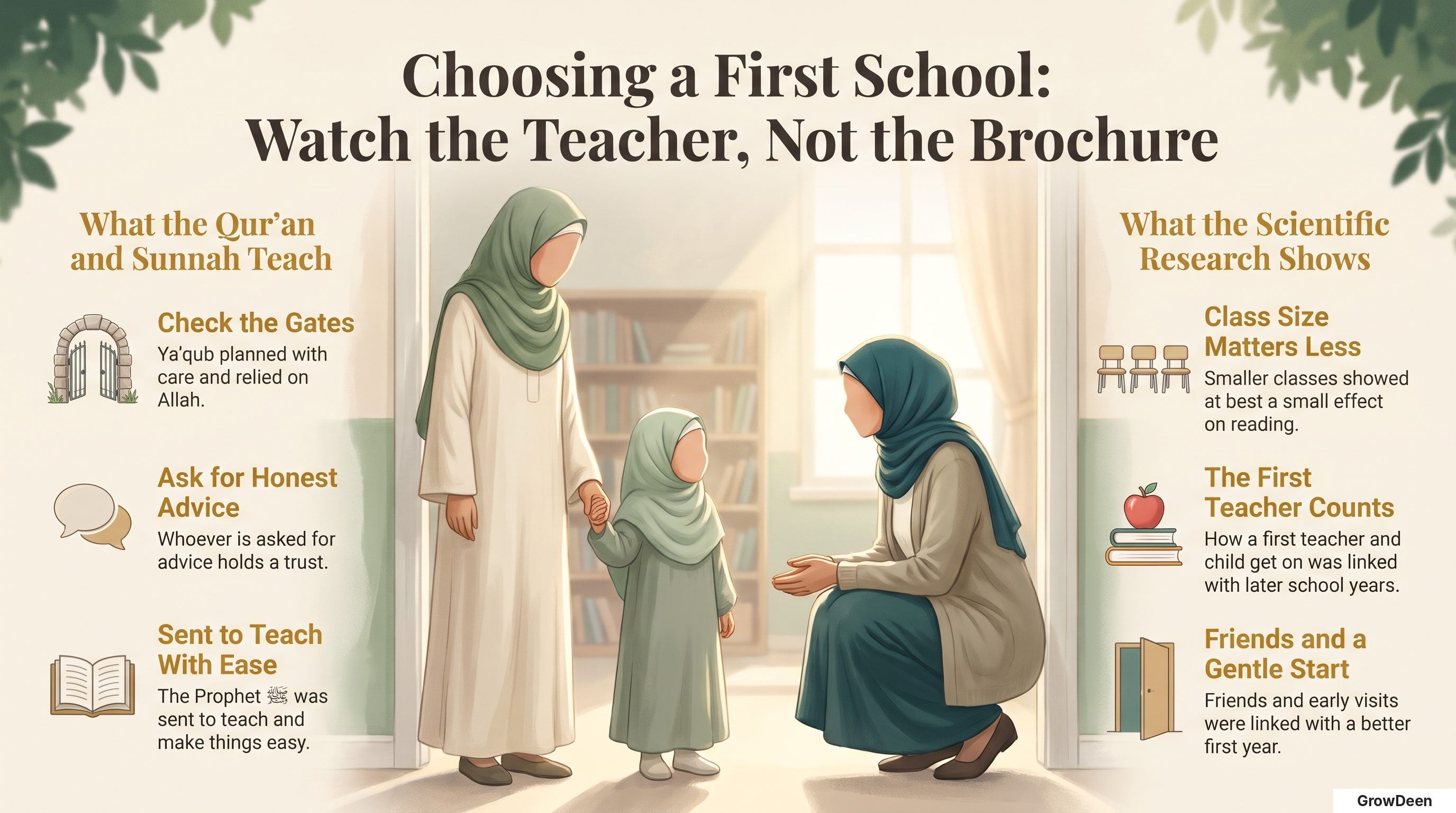
This guide's science-and-Sunnah view of choosing a school can help Muslim parents everywhere, but it is written mainly for parents in the West and in Muslim-minority countries, for whom an Islamic school is not easily accessible. That is why the checklist asks about a place to pray and make wudu, halal food and a modest uniform.
AGES 3–5 YEARS · 16 MIN READ
Two schools sit on the same street. One has small classes, a new library and results near the top. The other has bigger classes and a playground that needs work.
On paper, there is no contest. Yet the plainer school could be the better start.
The enrollment deadline is close. You have read every review twice.
Everyone says go for the small classes. What if I choose wrong, and she struggles for years?
This worry makes sense, and you are not the only parent carrying it. A first school is a big choice. You can make it with a clear head.
This guide brings together scientific research and the Qur'an and authentic Sunnah. You'll see what matters most on a school tour, and how to decide in peace.
The Short Answer
Right for your child? Ages 3–5, when you are choosing a first school (kindergarten or Reception). A disability, a delay or an assessment on the way? See "If Things Don't Go to Plan" for extra steps.
What matters most: a warm teacher, a gentle start and friends nearby. Class size often makes only a small difference.
Try tonight (5 minutes): message your child's preschool teacher: "Which kind of school do you picture my child in, and why?"
You'll know it's working when: you leave each tour knowing how the teachers treat children. Still feeling torn is not failure. This is a big choice.
Get help if: your child has a disability or a delay, or is waiting for an assessment. Talk to your child's doctor or pediatrician and their preschool teacher before you choose.
The rest of this guide explains why, and what to do if it does not work.
How to Read This Guide
3 minutes: The Short Answer above is enough for tonight.
7 minutes: The Short Answer, then Knowledge in Practice and If Things Don't Go to Plan.
The whole guide: read on for the scientific research, the Qur'an and Sunnah, and the References.
To share: the bold lines and the pull quotes are made to be shared.
To listen: open this guide in the free Substack app and tap Listen.
Inside This Guide
You cannot see every year ahead. You can choose a warm teacher and a gentle start.
Myth Check: "Smaller Classes Mean a Better School"
At every open day, someone asks about class size, and the number gets written down like a score.
What the belief gets right. Fewer children can mean more of the teacher's time. A review of 112 papers found that smaller classes in the first four years of school can have an important and lasting impact. [1]
This was especially so for children from culturally, linguistically and economically disadvantaged communities. [1] The review found it is most true when teachers change how they teach to suit the smaller group. [1]
What the wider evidence says. A Campbell systematic review gathered 148 reports from 41 countries. It found, at best, a small effect of smaller classes on reading, and a negative but not statistically significant effect on math. [2] An Australian study of Grade 3 and Grade 5 national test results found effect sizes for class size close to zero. [3]
So on the tour: don't stop at the number. Ask what the teachers do differently when a class is small.
Why This Happens
Why does the first teacher matter so much?
A four-year-old spends most of each school day with one or two adults. Those adults decide whether a hard morning ends in shame or in help.
They also decide whether a quiet child is drawn in or left at the edge. A big library cannot do that, but a warm teacher can.
For a young child, a school is not its brochure. It is the adult who greets them each morning.
Why do friends and a gentle start help?
On the first day of school, almost everything around a child is new. A familiar face and a few early visits make that change smaller.
Children differ here. A cautious child may want time at the edge of a room before joining in.
A child who needs to move may enjoy more space, and one still learning English may lean on one friend. Each of these is something you can plan for.
A school is a teacher, a start and a circle of friends before it is a building.
What the Scientific Research Shows
The strongest evidence is about class size, and it is modest: in the Campbell review, smaller classes had at best a small effect on reading. [2] Strong (a systematic review of primary and secondary pupils in 41 countries).
The first teacher shows up more clearly. A study followed 179 children from kindergarten through eighth grade. [4] Kindergarten teachers rated how much conflict and dependency they felt with each child.
More of this negativity was linked with poorer academic and behavioral outcomes through eighth grade, especially for boys and for children with early behavior problems. [4] The link held after accounting for gender, ethnicity, cognitive ability and behavior. [4] It shows a link and cannot prove cause. Suggestive (one long-term US study).
The start of the year matters as well. A study followed 17,212 children in 992 US schools. [5] The more transition practices a school used at the start of kindergarten, the higher children's achievement was at the end of it. [5]
The effect was stronger for children from low- and middle-income families, and worked partly through parents becoming more involved in school. [5] Suggestive (one large observational study).
Friends matter in that first year. In a study of 125 children starting school, those with more classroom friends at the start felt more positive about school by the second month. [6] Those who kept these friends liked school more as the year went on. [6]
Early rejection by classmates was linked with liking school less and avoiding it more. [6] Suggestive (one study).
Readiness is broader than letters and numbers. The American Academy of Pediatrics (AAP, US, 2019) describes five parts of readiness in the child. [7] They are physical well-being, social and emotional development including self-regulation, approaches to learning, language, and general knowledge and thinking. [7]
It adds that schools must be ready for children too, with a smooth move from home to school. [7] Strong (an official report).
What we do not know yet: no study here was done with Muslim families. None asked how a school's welcome of Islamic practice shapes a child's first year.
What this means for you: look past the class size figure. Watch the teacher, ask about the start, and find out where your child's friends are going.
What the Qur'an and Sunnah Teach
Text. When 'A'isha asked the Prophet ﷺ not to share her answer with his other wives, he said:
"God did not send me to be harsh, or cause harm, but He has sent me to teach and make things easy."
Sahih Muslim 1478 · sunnah.com [8]
Our reflection. The measure in that sentence is the teacher's manner. Look for the same in a first school.
Text. When Ya'qub, peace be upon him, sent his sons into Egypt, he gave them a practical instruction:
يَـٰبَنِىَّ لَا تَدْخُلُوا۟ مِنۢ بَابٍ وَٰحِدٍ وَٱدْخُلُوا۟ مِنْ أَبْوَٰبٍ مُّتَفَرِّقَةٍ ۖ
"O my sons, do not enter from one gate but enter from different gates."
Yusuf 12:67 · Sahih International [9]
In the same verse he says his precaution cannot avail them against Allah at all, and that upon Allah he has relied. [9] The next verse says he was a possessor of knowledge because of what Allah had taught him. [10]
Our reflection. Ya'qub planned with care and placed his reliance on Allah in the same breath. For a parent, careful checks on a school can sit beside tawakkul (trusting Allah).
Text. Asking for advice is part of the Sunnah, and the person asked carries a duty:
The Prophet ﷺ said: He who is consulted is trustworthy.
Sunan Abi Dawud 5128 · Sahih (Al-Albani) · sunnah.com [11]
Our reflection. When you ask a preschool teacher or another parent about a school, they hold your question as a trust. When a parent from the year below asks you, you owe them the same.
Text. Allah told the Prophet ﷺ not to let his eyes pass beyond those who call upon their Lord, "desiring adornments of the worldly life." [12]
Our reflection. In a polished foyer, ask what kind of company your child will keep there.
Text. The Prophet ﷺ used to teach his Companions istikhara (asking Allah to guide a choice) for every matter. [13] He taught it as he taught them surahs of the Qur'an. [13]
Families choose differently. Some choose a full-time Islamic school. Others choose a public or local school and build Islamic learning around it, through weekend classes, the masjid or lessons at home. For a question of ruling about your own family, ask your local imam or a local scholar, and share the details with him.
Ya'qub checked the gates and trusted Allah in the same breath. We can do both too.
The Lab Verdict
The science: class size alone often makes only a small difference (Strong). A warm first teacher, a gentle start and friends are linked with a better first year (Suggestive). The evidence cannot choose your school, but it can tell you what to watch.
The Qur'an and authentic Sunnah: plan with care, ask people who will be honest with you, then rely on Allah.
Where they meet: the science shows what to check on a tour, and the Sunnah shows how to choose. Scientific research gives the steps; the Sunnah gives them peace.
So at home: watch the teacher, check the gates you can, ask for honest advice, then decide and leave the outcome with Allah.
Knowledge in Practice: How to Decide in Five Steps
Knowing what matters is half the work. The other half is doing it, one step at a time.
If you can only do one thing, do step 1. It is enough.
1. Write down who your child is, then ask their preschool teacher (20 minutes, once). Every school then gets measured against the same child.
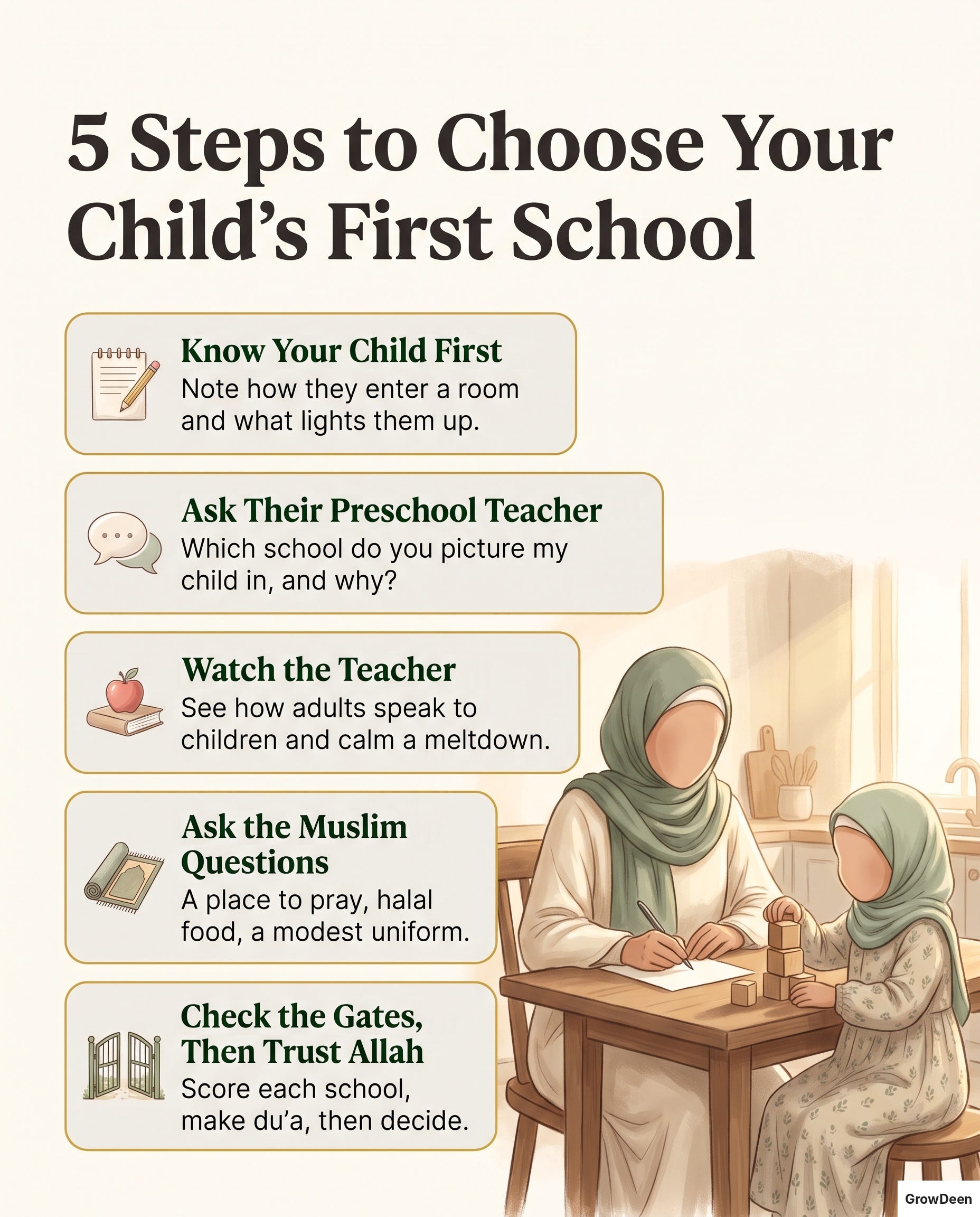
Note how your child walks into a new room. Do they head for the busiest corner, watch first and join later, or hold your hand for a while? If your child is cautious, notice how calm each setting feels on the tour.
Write three things your child could do all afternoon. Note any support they may need: speech or language, attention and focus, or noise, light or crowds. Add a disability or medical condition, or a home language different from the school's.
Then think about readiness in five areas, based on the AAP's description. [7] They are the body (moving, eating, toileting, staying well), feelings and friendships, calming down after upset, talking and listening, and thinking and solving problems. A child who can count to fifty but falls apart when a toy is taken may need more help with calming down than with counting.
Your child's early childhood teacher has seen something you rarely get to see: your child in a group on an ordinary day.
Say this to the teacher: "You know her in a group. What kind of school do you picture her in, and why? What support might she need there? And where are most of her friends going?"
Say this to your child: "Tomorrow we're going to look at a school. You can hold my hand the whole time." (Say it in the language your child knows best.)
2. On each tour, watch the teacher, not the brochure (about an hour per school). Look for these four things in a classroom:
Teachers crouch down, speak to children at their level and use their names.
Children go to adults easily, without hesitating.
A child's meltdown is met with calm help, and the child is brought back in.
Teaching changes when a class is small.
Say this to a teacher: "Could you walk me through what happens when a five-year-old melts down in the middle of a lesson?"
Instead of: "How many children are in each class?" Try: "What do your teachers do differently when a class is small?"
Then ask about a gentle start: visits before the school year, a chance to meet the teacher, and staggered or gentle first days. Ask whether children from your child's preschool are going there.
For learning, ask for results across several years rather than one, and look at the library, outdoor space, clubs and sport. Ask how the school supports children with additional needs, and who coordinates that support.
3. Ask the Muslim questions on the first visit (10 minutes). Ask them before you enroll:
Is there a clean place to pray and make wudu (the washing before prayer)?
How do you handle halal food at lunch, class parties and field trips?
Are there modest uniform options, including for sport and swimming?
How are Eid absences recorded, and how is Ramadan handled for older children who fast?
What happens when a family asks for their child to sit out an activity?
Listen to how the answers arrive. A relaxed "we already do that for several families" tells you something different from a long pause.
Say this to the school: "In our family, we pray and we eat halal. How have you made room for families like ours?"
If you are touring an Islamic school, ask the questions in step 2 with the same care. A Muslim school still needs a warm teacher and a gentle start.
4. Check the gates, then score each school (10 minutes after each visit). Before you leave the parking lot (car park), note the daily-life answers:
Is your home inside the school's zone or catchment area, or does it accept children from outside it?
How long is the trip each way?
Do before-school, after-school and holiday care fit your working hours?
Can your other children attend too?
Say this to the school: "Do you expect to take children from outside your area in the year my child starts?"
Then score each line 1, 2 or 3 while the details are fresh, and write one line on what your gut says.
5. Make du'a, decide, and leave the outcome with Allah (one evening). Lay the scores side by side. Make du'a in your own words, and pray istikhara if you wish. [13] Then choose, and let the choice rest.
Say this to your child: "We found your school. We asked Allah to make it good for you."
Make It Work in Your Home
On your own? Bring the scorecard on every tour, or ask a friend to come and watch the teachers with you. Two sets of eyes notice more.
Several children? Ask early whether siblings can attend together. No car? Ask how families reach the school by bus or on foot.
Spouses who see this differently? Score the schools separately, then compare. The lines where you agree are often the answer.
Say this to your spouse or the other parent: "Can we each score the schools on our own tonight? Then let's see where we agree."
Say this to a grandparent who sends league tables: "Mama, thank you for looking out for her. The results matter. Her first teacher matters more. Will you come on a tour with me and watch the teachers?"
The family question: ask a grandparent, "What do you remember about your first teacher?"
Know your child, watch the teacher, ask the Muslim questions, check the gates, then decide with du'a.
If Things Don't Go to Plan
If no school ticks every box: none will. Put the teacher and the start first, then the gates.
If the school you want is outside your area: ask the school or your local education authority. Does it expect to take children from outside its zone or catchment in your child's starting year?
If your child has a disability and a special school is an option: most parents in Australian focus groups felt their choice of school was limited. [14] They still wanted to make the decision themselves. [14]
Take your time, visit both kinds of school where you can, and ask for important information in writing. A school that seems reluctant to talk about support has already told you something.
If you start doubting yourself: What if I choose wrong? You are choosing with care and the best you can know. If a school does not fit, you can talk with the teacher, ask for support and, in time, choose again.
Speak to someone if: you are unsure your child is ready to start, or you notice a delay. Your child's doctor or pediatrician and their preschool teacher can help. For questions of deen, ask your local imam or a local scholar, and share the details with him.
Who to turn to: your child's doctor or pediatrician, and your child's preschool or early childhood teacher. For questions about enrollment, the school or your local education authority.
Support Muslim Parenting Lab ❤️
Think your amount is too small to matter? Give whatever you have with the button below.
The Prophet ﷺ said to shield yourself from the Fire even with half a date. (Sahih al-Bukhari 1417)
Your Companion Pack: The School Tour Pack
Three tours in one week blur together by Friday. This free pack keeps them apart. Inside, three printable pages:
Page 1: Know Your Child Before You Tour. Fill it in once, at home. It covers how your child walks into a new room, what lights them up and where they may need support. It adds a five-area readiness check and three questions for their early childhood teacher.
Page 2: The School Tour Scorecard. Score up to three schools on the teacher's manner, a gentle start, room to be Muslim, daily life and learning. A last line holds what your gut says.
Page 3: Check the Gates, Then Trust Allah. Ya'qub's instruction to his sons, the hadith on honest advice, and three steps for the night before you decide.
Parents Also Ask
What should I look for when choosing a primary school?
Look hardest at the teachers and how they treat children. In one long-term study, more conflict in a child's relationship with their kindergarten teacher was linked with poorer outcomes years later. [4] Knowledge in Practice lists what to watch.
Does class size matter in kindergarten?
Less than most parents expect. A large systematic review found at best a small effect on reading. [2] Smaller early classes may help children from disadvantaged communities most, when teachers adapt how they teach. [1]
Should I choose an Islamic school or a public school?
There is no single right answer. Families choose differently: some choose a full-time Islamic school, and others build Islamic learning around a public or local school. Ask every school about prayer, halal food, modest uniforms, Eid and Ramadan. For a question of ruling, ask your local imam or a local scholar, and share the details with him.
How do I know if my child is ready for school?
Readiness is broader than letters and numbers. The AAP describes it as physical well-being, social and emotional development including self-regulation, approaches to learning, language, and thinking skills. [7] If you have doubts, ask your child's preschool teacher and their doctor or pediatrician.
Does it help if my child starts school with friends?
It can. In one study, children with more classroom friends at the start felt more positive about school within two months. [6] Ask the preschool teacher where your child's group is heading.
Should I pray istikhara about choosing a school?
Text: the Prophet ﷺ taught his Companions istikhara for every matter. [13] It sits alongside the practical checks. For how to pray it, ask your local imam or a local scholar, and share the details with him.
Final Reflection
Dear parent,
You are reading every review and asking hard questions on each tour. That care is already a gift to your child.
Until now, you may have weighed class sizes first. You were doing what you were told.
Nothing is lost. You can still watch the teachers on your next tour.
You do not need the perfect school. Send one message to the preschool teacher tonight.
Make your intention to choose well for Allah's sake. Let that be enough for today.
Your child doesn't have to represent anyone. They can be ordinary.
Often, what your child needs most from a first school is a warm teacher. No brochure can show you that.
A Du'a for This
For you:
رَبِّ ٱشْرَحْ لِى صَدْرِى وَيَسِّرْ لِىٓ أَمْرِى
Rabbi-shraḥ lī ṣadrī, wa yassir lī amrī
"My Lord, expand for me my breast [with assurance] and ease for me my task."
Ta-Ha 20:25–26 · Sahih International [15]
With your child: Rabbi zidnī 'ilmā, "My Lord, increase me in knowledge." (Ta-Ha 20:114) [16] Say it together at the school gate each morning, from age 3. A younger child can listen while you say it.
Share the Khayr
If you know a parent at pick-up with three school tours booked and no idea what to ask, send this to them. The Prophet ﷺ said that one who guides to something good has a reward like the one who does it. [17]
Tell us in the comments: what is the one question you'll ask on your next school tour?
Parents Also Read
Parents who read this guide also found these helpful.


References
[1] Zyngier, D. (2014). Class size and academic results, with a focus on children from culturally, linguistically and economically disenfranchised communities. Evidence Base, 2014(1), 1–24.
[2] Filges, T., Sonne-Schmidt, C.S., and Nielsen, B.C.V. (2018). Small class sizes for improving student achievement in primary and secondary schools: A systematic review. Campbell Systematic Reviews, 14(1), 1–107.
[3] Watson, K., Handal, B., and Maher, M. (2016). The influence of class size upon numeracy and literacy performance. Quality Assurance in Education, 24(4), 507–527.
[4] Hamre, B.K., and Pianta, R.C. (2001). Early teacher-child relationships and the trajectory of children's school outcomes through eighth grade. Child Development, 72(2), 625–638.
[5] Schulting, A.B., Malone, P.S., and Dodge, K.A. (2005). The effect of school-based kindergarten transition policies and practices on child academic outcomes. Developmental Psychology, 41(6), 860–871.
[6] Ladd, G.W. (1990). Having friends, keeping friends, making friends, and being liked by peers in the classroom: Predictors of children's early school adjustment? Child Development, 61(4), 1081–1100.
[7] Williams, P.G., Lerner, M.A., Council on Early Childhood, and Council on School Health. (2019). School readiness. Pediatrics, 144(2), e20191766.
[8] Sahih Muslim 1478.
[9] Qur'an, Yusuf 12:67. Translation: Sahih International.
[10] Qur'an, Yusuf 12:68. Translation: Sahih International.
[11] Sunan Abi Dawud 5128. Graded: Sahih, by Al-Albani.
[12] Qur'an, Al-Kahf 18:28. Translation: Sahih International.
[13] Sahih al-Bukhari 6382.
[14] Mann, G., Cuskelly, M., and Moni, K. (2015). Choosing a school: Parental decision-making when special schools are an option. Disability and Society, 30(9), 1413–1427.
[15] Qur'an, Ta-Ha 20:25–26. Translation: Sahih International.
[16] Qur'an, Ta-Ha 20:114. Translation: Sahih International.
[17] Sahih Muslim 1893a.
We combine scientific research with Qur’an and authentic Sunnah, and we cite our sources. Even so, this is general guidance and no substitute for a doctor who can examine your child.
Sources & confidence
The hadith in this guide are from Sahih al-Bukhari, Sahih Muslim and Sunan Abi Dawud (graded Sahih by Al-Albani). Where we could read only a study's summary, we say no more than that summary states. Checked November 2026. Found a source that looks wrong? Email us at info@growdeen.com.
Words in this guide
school readiness · scientific term: the health, skills and support that help a child start school well, and a school ready to receive them.
transition practices (transition program) · scientific term: steps a school takes to ease new children in, such as visits before term and staggered first days.
teacher-child relationship · scientific term: how warm or how tense the bond is between a teacher and one child.
systematic review · scientific term: a study that gathers and weighs all the good studies on one question.
self-regulation (calming down) · scientific term: a child's growing ability to manage feelings and actions, such as settling after upset.
school tour (open day, open house) · everyday term: a visit to a school before you apply, to see classrooms and meet staff.
class size · everyday term: how many children share one class.
tawakkul · Islamic term: trusting Allah and relying on Him after doing your part.
istikhara · Islamic term: a prayer and du'a asking Allah to guide a choice.
du'a (doa) · Islamic term: supplication, asking Allah.
wudu · Islamic term: the washing before prayer.
khayr · Islamic term: good.
kindergarten (Reception, Prep) · country word: the first year of full-time school.
preschool (nursery, pre-K) · country word: early learning before school starts.
school zone (catchment area) · country word: the area a public school mainly takes children from.
pediatrician (paediatrician) · country word: a doctor for children.
enrollment (enrolment) · country word: signing your child up for a school place.
parking lot (car park) · country word: the place where cars are left during a visit.