

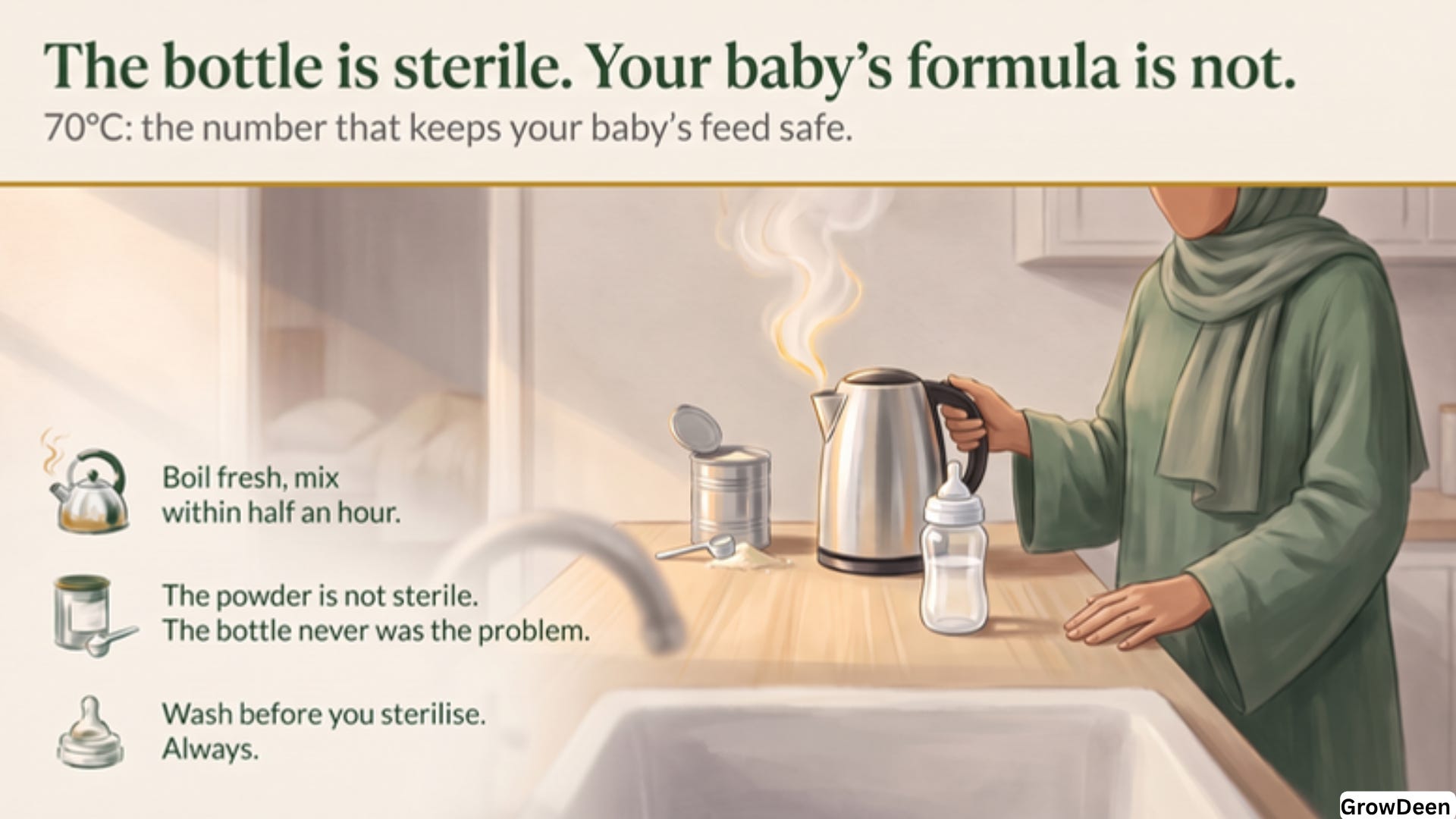
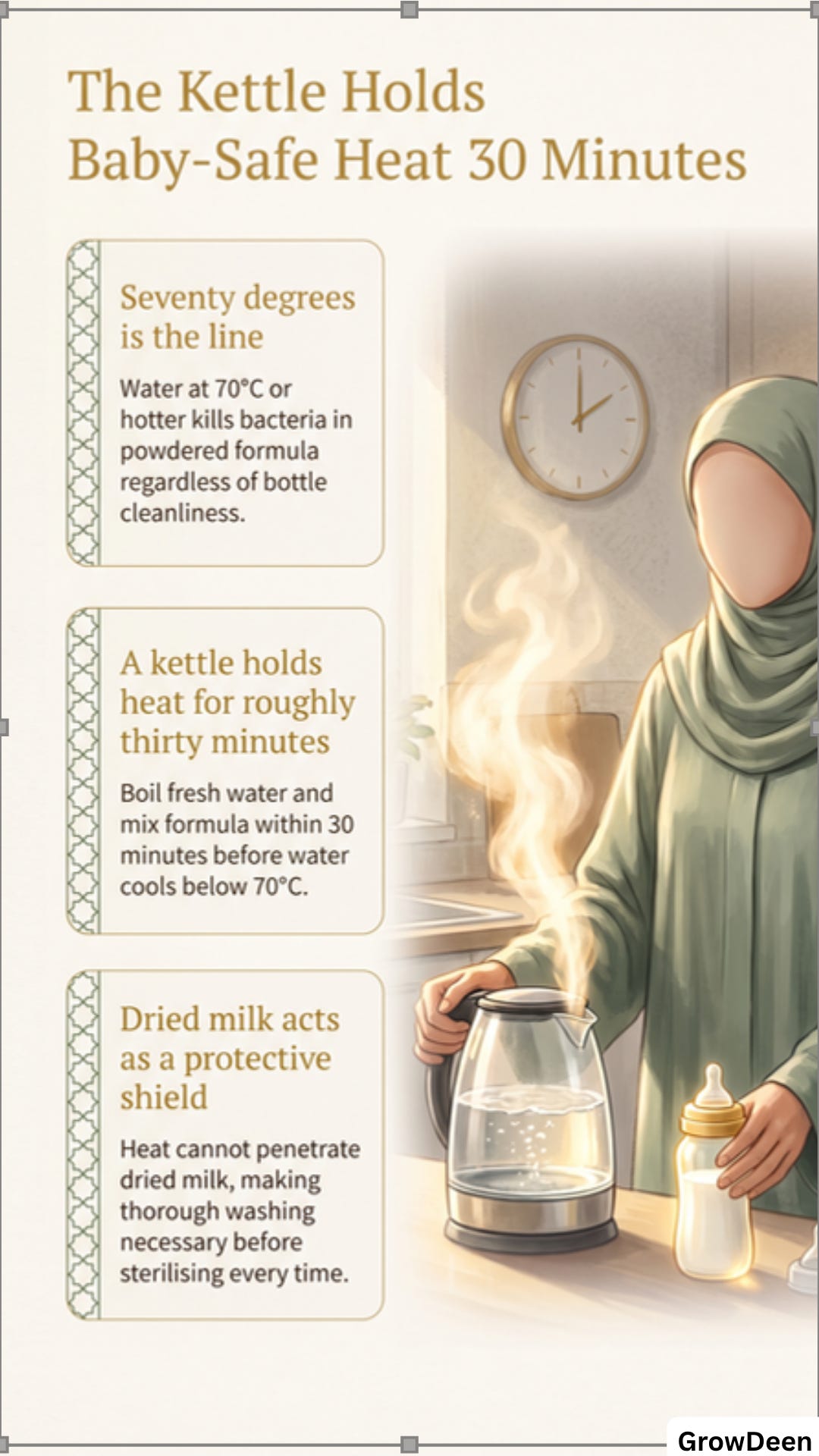
Powdered baby formula is not sterile. Water at 70°C or hotter kills what lives in the tin, and a boiled kettle holds that heat for roughly thirty minutes. [1]
Three pages. Fridge-ready. Print it tonight.
You did everything right.
The bottle went into the pan. It boiled, it cooled, you lifted the pieces out with clean tongs and put them together with freshly washed hands. Then you tipped in the powder, added water from the kettle you had boiled an hour ago and left to cool because you did not want to scald anyone, shook it, and gave it to your baby.
That last step undid the first four.
Nobody told you, and that is the part worth sitting with. You were not careless. You were following the half of the instructions that gets printed on the box, and the other half lives in a World Health Organization guidance document that no steriliser manufacturer has any reason to quote at you.
Bacteria get to a baby's milk through three doorways. You already guard one of them well. One of the three is not a cleaning problem at all, and no steriliser on the market touches it.
Why This Guide Is Different From Generic Bottle-Cleaning Lists
It reconciles the guidance instead of picking one. The CDC says boil for five minutes and the NHS says at least ten [2][3]. Most articles quote whichever they found first. This one tells you both and tells you which to follow.
It treats hygiene as amanah, not housework. Guarding what goes into your child is a trust you were given, and the Qur'an and Sunnah speak directly to water, to vessels, and to what gets left behind in them.
It closes the gap the steriliser leaves. You already have the free Bottle Hygiene Kit from the top of this page, built around the one step most bottle guides skip entirely.
The Three Doorways
Think of contamination as a route rather than an event. Something has to get in, and there are only three ways it does: residue left behind from the last feed, air and surfaces after sterilising, and the powder itself.
They fail in that order, and they fail for different reasons, which is why one piece of equipment cannot cover all three.
Doorway One: The Film You Cannot See
Picture the bottle you rinsed at midnight and meant to come back to. By morning there is a dull ring inside the neck and a tacky patch in the teat.
That ring is where this starts. Milk residue is food, and bacteria sit underneath it rather than on top of it, which is exactly why sterilising a dirty bottle accomplishes close to nothing. Heat and chemical solution reach surfaces. They do not reach through a layer of dried milk to the surface below it. Clean first, every single time, and sterilising then has bare plastic to work on.
Washing properly is less about effort and more about where you put it:
Wash your hands first, twenty seconds, dried on a clean cloth or paper towel.
Take every part off. Bottle, teat, ring, cap, disc. Anything left assembled is somewhere a brush cannot reach.
Use a basin kept only for the baby's feeding equipment rather than the kitchen sink itself, because drains and plugholes carry their own bacteria [2].
Use a bottle brush reserved for this job, plus a small teat brush for the inside of teats [2][3].
Work the screw threads and the underside of the ring rim. That is where milk collects and where nobody looks.
Push water through the teat hole until it runs clear, and turn teats inside out.
Rinse under clean running water, then stand everything on a clean paper towel to air dry [2]. A tea towel puts back what you just removed.
A dishwasher does all of that well if the parts are dishwasher safe, and if your machine has a heated drying or sanitising cycle, that cycle covers the sterilising step too [2].
Two habits worth breaking while you are here. Do not wash feeding equipment near where you change nappies, and do not clean the inside of the formula tin [2].
Here is where the saying starts to earn itself: a clean bottle cannot clean the powder. Hold that. It comes back.
Doorway Two: The Minute After The Lid Comes Off
Sterile is a state, not a property. It lasts exactly as long as the equipment stays protected.
The moment the lid lifts, the kitchen gets a vote. Steam, hands, the edge of the counter, the cloth hanging off the oven door. This is the doorway parents lose without noticing, because the work feels finished when the machine beeps.
Four ways to sterilise, and none is better than the others in any way that will matter to your baby. The best one is the one you will still be doing at week nine, half asleep.
Boiling. Nothing to buy. Submerge the washed pieces in a large pan, press out trapped air so water touches every surface, and bring it to a rolling boil. The CDC gives five minutes [2]. The NHS and several UK trusts give at least ten [3]. Follow the service that governs your own care, and if you have no reason to prefer one, the longer time costs nothing but faster teat wear. Leave everything in the covered pan to cool, then lift it out with clean tongs. If older children are around, boil while they are asleep or out.
Cold water sterilising solution. Tablets or liquid diluted in cold water. Mix to the exact strength stated, because a weak solution does nothing at all. Submerge everything with no air trapped inside and leave it at least thirty minutes [3]. A late bottle added to the tub restarts the clock for everything in it. Change the solution every twenty four hours and scrub the tub before refilling [3]. Plastic or glass containers only, since the solution corrodes metal. Shake off the excess, or rinse with cooled boiled water from the kettle rather than the tap. Keep the concentrate out of reach.
Electric steam steriliser. Load with the openings facing down, fill to the line, switch on, and it shuts itself off. Check the manual for how long the contents stay sterile once the lid has been lifted, because models differ.
Microwave steam steriliser. Same idea in a microwave unit. Follow the instructions exactly, check the wattage the unit needs, and never put metal inside. Loose bottles and teats put straight into a microwave do not get sterilised. They warp.
Ultraviolet units are widely sold now. Australian national guidance notes there are no current national or international standards for their use on infant feeding equipment, which makes a UV unit a reasonable addition rather than a replacement for a method with established backing [4].
Then the part that protects all of it. Shake off the water, reassemble with clean hands, or simply leave everything inside the steriliser or the covered pan until the next feed, which is what most manufacturers prefer [3]. Store assembled bottles in a clean covered container in the fridge, or in a closed cupboard used only for clean items, with the basin and the dry brush kept alongside rather than left by the sink [2].
Two containers in rotation makes this effortless. One in use, one being washed.
And when the lid goes on, say Bismillah. It costs a second and it turns the last step of a chore into something recorded for you.
So far, so manageable. The third doorway is the one that catches careful parents.
Doorway Three: The One The Steriliser Cannot Reach
Powdered infant formula is not a sterile product, and no manufacturing process currently makes it so.
Cronobacter sakazakii and Salmonella have both been recovered from sealed tins, and in a newborn a Cronobacter infection can cause sepsis or meningitis [1][5]. The condition is rare. It is also, in large part, preventable, and the thing that prevents it is not in your steriliser cupboard.
It is your kettle.
The WHO and FAO advise making powdered feeds with water at no less than 70°C, which in a real kitchen means boiling fresh water and mixing within about thirty minutes, before the kettle drops below that line [1][6]. Water at that temperature kills the bacteria sitting in the powder. Cool water does not. A spotless bottle filled with cool water and contaminated powder is still a contaminated feed, which is the whole of the point and the reason the phrase earns repeating: a clean bottle cannot clean the powder.
Later laboratory work found the finished feed can settle cooler than the water it started with, which is one more argument against letting the kettle stand [7].
The rest of the sequence matters almost as much:
Use freshly boiled drinking water from the cold tap [6].
Avoid artificially softened water, which carries added sodium, and avoid reboiling water that has already been boiled once [6].
Bottled water is generally not recommended, because it is not sterile and may carry more sodium or sulphate than suits an infant. Where tap water is unsafe, bottled water may be the only option, and the boiling and 70°C rule still applies [6].
Cool the sealed bottle under a running cold tap with the water off the lid, then test on the inside of your wrist until it feels warm or cool, never hot [6].
Never warm a feed in the microwave. It heats unevenly and leaves scalding pockets inside milk that feels fine on the outside [6].
Throw away any made feed left at room temperature beyond two hours [1], and pour away whatever is left in the bottle at the end of a feed, because saliva has entered it and warm milk is an ideal place for bacteria to grow [6].
If your baby is newborn, premature, or immune-compromised, ready to feed liquid formula is sterile inside the container and is the safer choice wherever cost and supply allow [1].
Which leaves the question most parents ask next, and it has a cleaner answer than you might expect.
When Your Baby Is In The Stricter Group
Not every baby needs the same level of caution, and knowing which group yours is in saves you a great deal of second-guessing.
The UK position is to sterilise every piece of feeding equipment, every feed, until your baby is at least twelve months old [3]. The CDC frames it as sanitising at least once a day, and then tightens that for babies under three months, babies born prematurely, and babies with a weakened immune system, who benefit from sanitising after every use [2].
If your baby is in any of those groups, take the stricter reading and stop weighing it up.
After the first birthday, the advice relaxes for everyone. Thorough washing in hot soapy water, or a hot dishwasher cycle, takes over from sterilising [3]. It is also a sensible moment to begin moving your child off bottles, since extended bottle use affects teeth and appetite.
Seeking the means and then trusting Allah with the outcome is the Islamic posture here, and it cuts both ways. It rules out carelessness, and it also rules out boiling the same teat twice because you cannot settle.
The Equipment Itself Has A Lifespan
Every wash is also an inspection, and this is the part of the routine that silently stops working.
Hold each teat to the light. Bin any that is cracked, torn, cloudy, sticky, swollen, or tacky to the touch, because bacteria lodge in damaged silicone and rubber where no brush reaches [3]. Teats wear faster than parents expect, faster still if you sterilise by boiling, and faster again as your baby's suck strengthens over the first year. The same applies to bottles that have gone chalky or scratched inside.
If you express, the pump needs the same eye. Mould inside pump tubing cannot be washed out. Mouldy tubing is thrown away, not scrubbed [2].
And if the bottle carries expressed milk rather than formula, the clock runs differently. The CDC gives freshly expressed milk up to four hours at room temperature, up to four days in the fridge, and best use within six months of freezing, with twelve months acceptable [8]. Thawed milk keeps a day in the fridge and one to two hours at room temperature, and is never refrozen [8]. Leftovers after a feed get two hours, then go [8]. Write the date on every container before it goes in the fridge, because at four in the morning nobody remembers which bottle came from Tuesday.
That is a lot to hold in your head, especially during the stretch of weeks when six or seven feeds a day are being prepared on ninety minutes of sleep at a time. The free Bottle Hygiene Kit exists for exactly that: three printable pages covering which steriliser to use and for how long, when to bin a teat before it becomes a problem, and an Islamic reflection card on water and on what gets left behind in a vessel. The download button is at the top of this page, and there is a full description of what is inside it below.
Support Muslim Parenting Lab ❤️
Would you like one parent, somewhere, to be guided because of you? Fund the articles that reach them, with the button below.
The Prophet ﷺ said one person guided through you is better for you than red camels, the greatest wealth of that time. (Sahih al-Bukhari 3701)
What The Qur'an Teaches About The Water You Wash With
You spend more time at that sink than anywhere else in the house right now, and Islam has a great deal to say about the substance you are standing in front of.
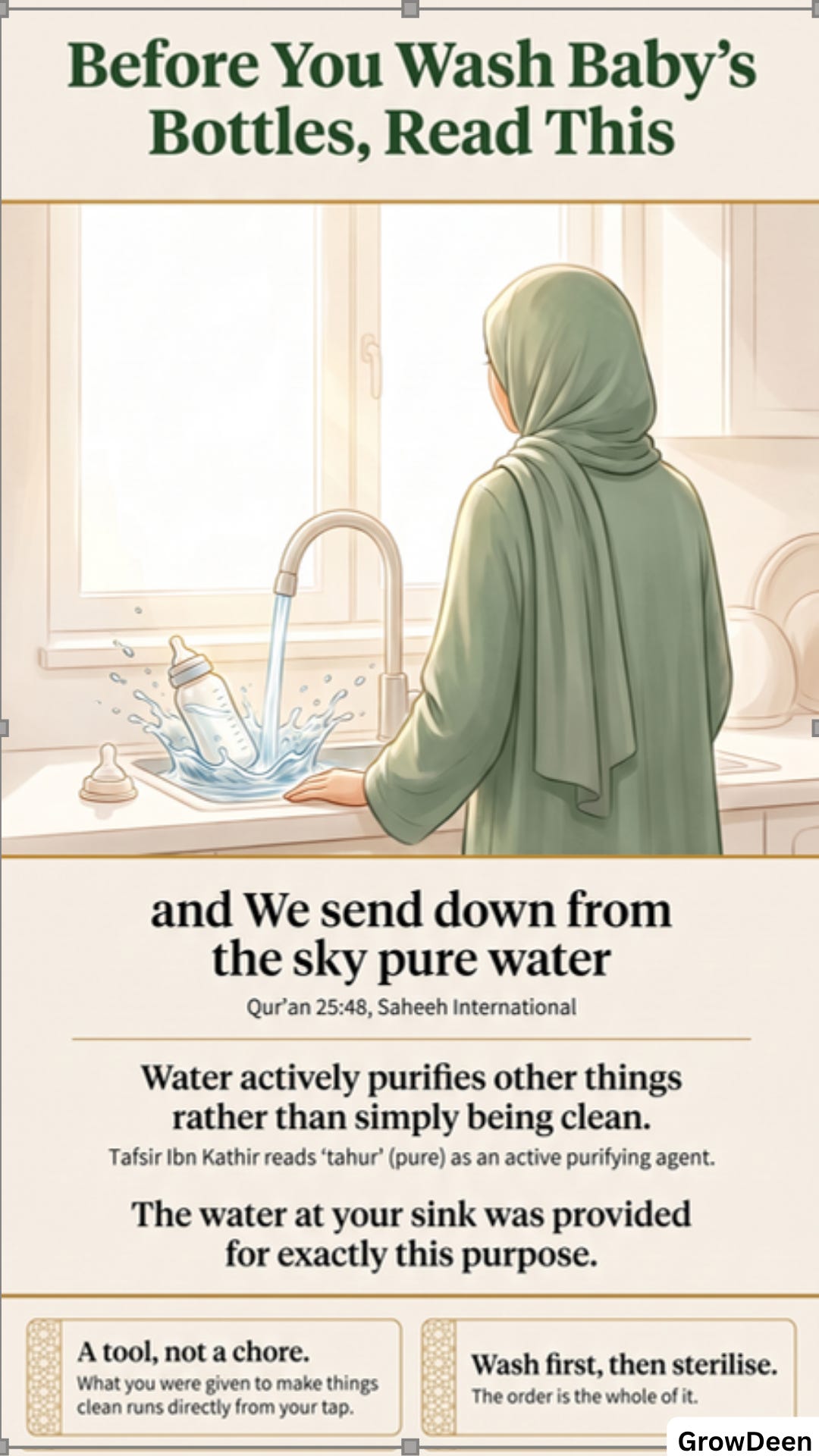
Allah says: "and We send down from the sky pure water" [Qur'an 25:48] [9]. The word rendered as pure is tahur, and according to Tafsir Ibn Kathir it carries an active sense, meaning water that purifies other things. Ibn Kathir supports that reading with the narration of the well of Buda'ah, where the Prophet ﷺ was asked whether its water could still be used despite the refuse thrown into it, and answered that water is pure and nothing renders it impure [9]. Water is a blessing to receive and also the instrument Allah gave for making things clean.
The Prophet ﷺ also spoke directly about drinking vessels. Abu Sa'id al-Khudri narrated that he forbade bending the mouths of waterskins in order to drink straight from them [Sahih al-Bukhari 5625] [10]. The chapter heading under which Imam al-Bukhari placed that narration names the practice exactly. Scholars note the plain consequence: whatever is in one mouth stays in the vessel for whoever comes next.
Fourteen centuries later, that is the entire logic of a sterilised bottle and of pouring away what your baby did not finish.
When To Speak To A Doctor
Seeking treatment is part of this, not a failure of trust.
Contact your doctor if your baby has repeated vomiting, diarrhoea, blood in the stool, a fever in a baby under three months, unusual drowsiness, poor feeding, far fewer wet nappies than normal, or a sunken soft spot. Dehydration moves quickly at this age. Act on what you can see rather than waiting to be certain.
Seek urgent care if your baby becomes floppy, hard to rouse, or refuses to feed at all. Nothing written here replaces medical advice, and your doctor's instruction outranks anything you read.
Your Free Bottle Hygiene Kit
If you have read this far, you are the kind of parent who takes the invisible part of feeding seriously, and who would rather find out now than after a bad week. That says something worth saying out loud.
Inside the Bottle Hygiene Kit (one comprehensive PDF, 3 pages):
Page 1: Which Steriliser, and For How Long. All four methods side by side on one sheet, with the exact timing for each, what each one costs you in teat wear, the CDC and NHS boiling times set out together so you are not guessing which article was right, and the storage rule that protects the work afterwards. Designed as a wipe-clean card for the inside of your kitchen cupboard door.
Page 2: When To Bin It. A replacement guide for every piece of equipment you own, with the damage signs to look for on teats, bottles, brushes and pump tubing, and the point at which each one stops being safe to clean. So you can check your whole set in under five minutes and know exactly what to reorder.
Page 3: Water That Purifies. An Islamic reflection card built on Qur'an 25:48 and the narration of the Prophet ﷺ about drinking vessels, in English with full source references, framing the sink as a place of amanah rather than a chore. Something to keep where you can see it on the nights the routine feels like nothing.
This is not a PDF to download and forget. It is built to live on a cupboard door, where you will actually look at it at the moment you need it.
This Bottle Hygiene Kit is what every subscriber receives with each article. Muslim Parenting Lab covers the whole arc of raising young Muslim children, from newborn care and feeding through sleep, behaviour and early tarbiyah, with every recommendation grounded in current research and rooted in Qur'an and Sunnah.
If you want both evidence-based guidance and the Islamic perspective in the same place, subscribe free so these resources reach you before you need them.
Subscribe free for parenting resources backed by both science and Sunnah, guidance you will not find assembled anywhere else. No spam, no clutter, just resources that matter.
Do This One Thing Before You Forget
Go and look at your kettle right now.
If there is water sitting in it from earlier today, tip it out. The next feed starts with a fresh boil and a thirty minute window, and the easiest way to make that automatic is to never let old water sit in the kettle in the first place. That is it. That is the whole action, and it takes fifteen seconds.
May Allah place barakah in the care you give, accept the hours nobody sees, and keep your child protected in the ways you cannot arrange yourself.
Share This With Someone Who Needs It
Think of one person right now: the friend who had her baby six weeks ago and keeps apologising for the state of her kitchen, the sister-in-law who just went back to work and is expressing in a staff toilet, the new mother at the masjid who asked you last week which steriliser she should buy.
She has the steriliser question covered. It is the kettle she has not been told about. Send her this today, not as correction, but because you would want someone to send it to you.
Frequently Asked Questions
Q: Do I really need to sterilise baby bottles, or is washing enough?
A: Washing alone is not enough in the first year. Sterilise all feeding equipment until your baby is at least twelve months old, because their immune system has not yet met the bacteria an adult handles without noticing [3]. After twelve months, thorough washing in hot soapy water or a hot dishwasher cycle takes over.
Q: How long do you boil baby bottles to sterilise them?
A: The CDC gives five minutes [2] and the NHS gives at least ten [3]. Follow whichever health service governs your own care. If you have no particular reason to choose, take the longer time, since the only cost is that teats wear out sooner. There is more on all four methods in "Doorway two" above.
Q: Can you put baby bottles in the dishwasher?
A: Yes, if the parts are dishwasher safe. Take everything apart and run a hot cycle, and if your machine has a heated drying or sanitising setting, that cycle handles the sterilising step as well, so nothing further is needed [2].
Q: Does sterilising the bottle make the formula safe?
A: No, and this is the step most parents are never told about. Powdered formula is not a sterile product, and only water at 70°C or hotter kills the bacteria inside the powder itself [1]. Boil fresh water, mix within about thirty minutes, then cool the bottle under a cold tap.
Q: How long can a made-up bottle of formula sit out?
A: Two hours at room temperature, then throw it away [1]. Milk left in the bottle after your baby has finished is done at that point regardless of the clock, because saliva has entered it [6]. Make feeds one at a time where you can.
Q: When should I throw away a baby bottle teat?
A: As soon as it is cracked, torn, cloudy, sticky, swollen, or tacky to the touch [3]. Bacteria settle into damaged silicone and rubber where no brush reaches. Teats wear faster if you sterilise by boiling and faster again as your baby's suck gets stronger, so check them at every wash rather than on a schedule.
References
[1] World Health Organization and Food and Agriculture Organization of the United Nations. (2007). Safe preparation, storage and handling of powdered infant formula: guidelines. WHO.
[2] Centers for Disease Control and Prevention. How to Clean, Sanitize, and Store Infant Feeding Items. CDC.
[3] National Health Service. Sterilising baby bottles. NHS UK.
[4] National Health and Medical Research Council. (2012). Infant feeding guidelines: information for health workers. NHMRC.
[5] Baldassarre, M.E., et al. (2016). Time for the 70 °C water precautionary option in the home dilution of powdered infant formula. Italian Journal of Pediatrics, 42, 15.
[6] National Health Service. How to make up baby formula. NHS UK.
[7] Losio, M.N., et al. (2018). Preparation of Powdered Infant Formula: Could Product's Safety Be Improved? Journal of Pediatric Gastroenterology and Nutrition, 67(4), 543-546.
[8] Centers for Disease Control and Prevention. Proper Storage and Preparation of Breast Milk. CDC.
[9] Qur'an, Surah Al-Furqan 25:48 (Saheeh International). Tafsir Ibn Kathir.
[10] Sahih al-Bukhari 5625. Narrated by Abu Sa'id al-Khudri. Graded: Sahih.
We combine scientific research with Qur’an and authentic Sunnah, and we cite our sources. Even so, this is general guidance and no substitute for a doctor who can examine your child.