

Your children fight over the same toys every afternoon?
The free Sibling Peace Plan gives you family rules and coaching words. It also reminds you why this work matters.
AGES 1–8 YEARS · 20 MIN READ
Your 4-year-old has spent twenty minutes on the rug. The blocks are sorted by color. Towers stand on one side, a road on the other.
You are thinking about dinner.
Then the younger one reaches for the red block at the top. The tower falls. Someone screams.
One child pushes, and the other cries. You step between them to keep both safe.
You have tried getting down to their level. You have reminded them to use words. Yet here you are again, in another argument over the same toys.
He shares at preschool all day. So why does he fight over every block the minute he’s home?
You are not the only parent asking this. Fights between young siblings are common.
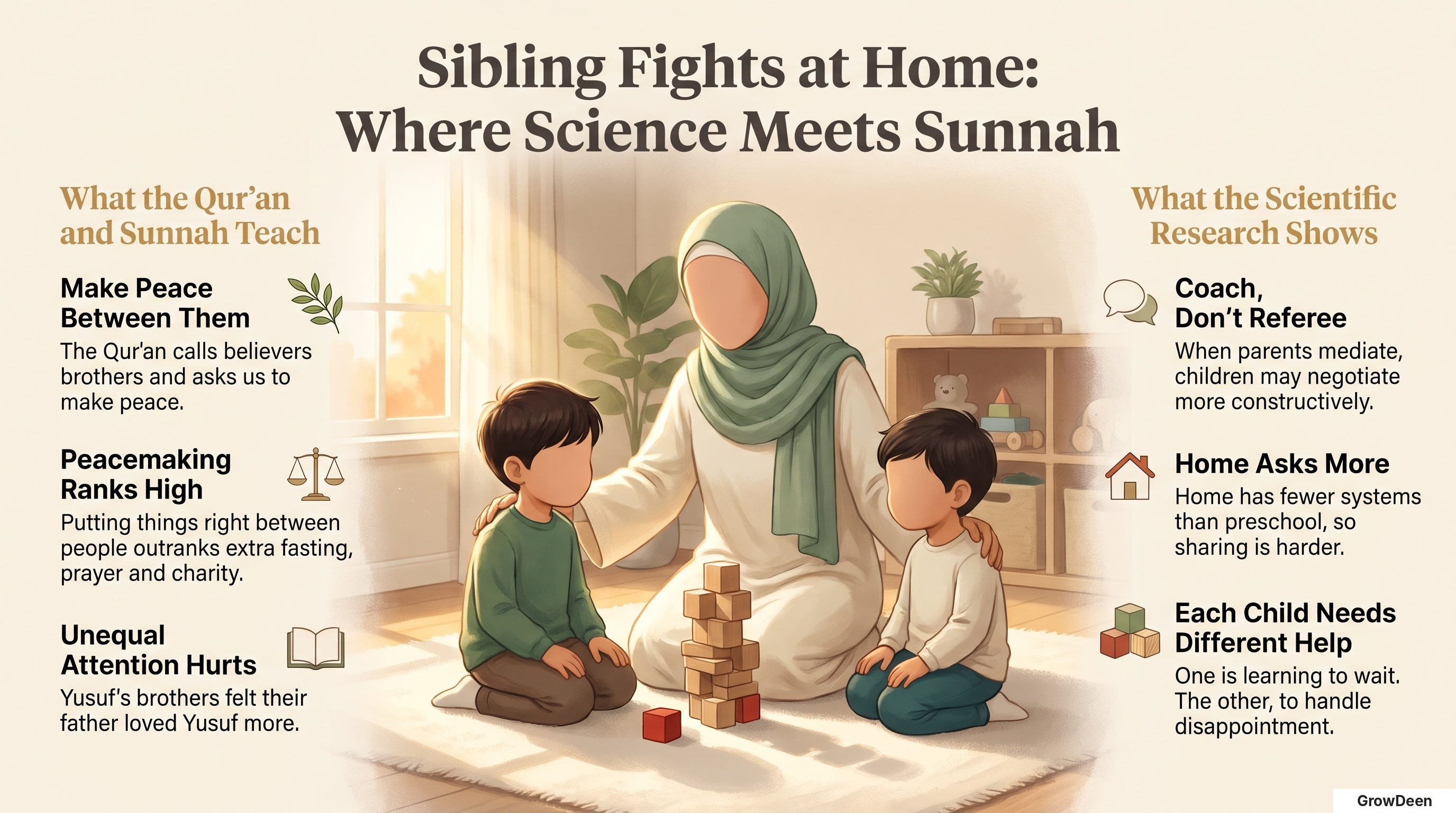
This guide brings together scientific research and the Qur’an and authentic Sunnah. You’ll see why home is harder, what the Prophet ﷺ taught about making peace, and the words to use tonight.
The Short Answer
Right for your child? Siblings around ages 2 to 8 who fight over toys, turns and space at home.
What’s probably happening: home has fewer systems than preschool, and each child is learning a different skill.
Try tonight (10 minutes): after dinner, ask, “How do we want to treat each other when we disagree?” Then write one rule together.
You’ll know it’s working when: a child mentions the rule, or asks before grabbing. A fight tomorrow is not failure, because skills take practice.
Get help if: one child is often frightened or hurt, or fighting disrupts sleep, mood or daily life. Start with your child’s doctor or pediatrician.
The rest of this guide explains why, and what to do if it does not work.
How to Read This Guide
3 minutes: The Short Answer above is enough for tonight.
7 minutes: The Short Answer, then Knowledge in Practice and If Things Don’t Go to Plan.
The whole guide: read on for the scientific research, the Qur’an and Sunnah, and the References.
To share: the bold lines and the pull quotes are made to be shared.
To listen: open this guide in the free Substack app and tap Listen.
Inside This Guide
A grabbed block is a chance to teach another way to ask.
Myth Check: “Find Out Who Started It”
When the shouting starts, an old instinct kicks in: find the guilty child and deliver a verdict.
What our parents got right. They wanted fairness, and they stepped in fast when someone was hurt. Both instincts are worth keeping.
Keep: stepping in at once when anyone is hurt or unsafe, and expecting kindness from every child. (custom)
Swap: “Who started it?” for “You both want the same block. I am going to hear each of you.” In one trial, children whose parents learned to mediate accused each other less in their own disputes. [1,2] (scientific research)
Skip: a verdict before each child is heard, and a rushed apology said only to end the scene. (our reflection)
“Who started it?” often has two honest answers. Neither one teaches the next step.
Why This Happens
Why do they share at preschool but fight at home?
At preschool (nursery), there may be labeled shelves, turns built into activities, familiar routines and an adult guiding disagreements. At home, children may share treasured belongings after a tiring day, while you cook or care for someone else.
The same child can behave differently in those two places. Structure is one possible reason among several. Fatigue, temperament, relationships and the meaning attached to a favorite toy also matter.
It is easy to read a fight as a verdict on your child’s character. In an Australian survey of 409 parents, most put sibling conflict down to their child’s own traits. [3] The setting around the children deserves a look too.
Why does each child react so differently?
One wants the block. The other wants things to be fair.
The younger child sees a bright red block and reaches. Stopping that impulse and asking first are skills still being learned.
Self-control is one of a set of skills that begin to grow soon after birth. Ages 3 to 5 are a window for dramatic growth, and development continues into early adulthood. [4]
The older child remembers building the tower, and may feel deeply wronged when it is touched.
Neither response tells you everything about either child’s character. Development varies. Tiredness, language, sensory needs and family history change what a child can manage in a given moment.
So fairness need not mean identical treatment. Both children need protection and respect. They may need different amounts of help to take turns, explain feelings or repair the damage.
Why does my own reaction matter so much?
When frustration rises, your children hear how you speak and what you do next. They also see whether you make amends. They do not need to see perfect patience to learn something valuable.
Often, your child isn't worse at home. Home asks more of them.
What the Scientific Research Shows
The strongest evidence on what parents can do comes from a trial of parent mediation. In Canada, 48 families with children aged 5 to 10 were randomly split into two groups. [1]
Half the parents were trained to mediate: to stay neutral and help both children reach a solution they could each accept. The other half stepped in as they normally would. [2]
After about two months, parents who mediated reported that their children used more constructive strategies and compromised more often. [1] When the children were observed negotiating on their own, those in mediation families showed less negativity.
They also understood their sibling’s view better, and grasped that people judge blame from their own side. [1] They even used mediation steps, such as setting ground rules, in their own talks. [2]
Who was studied: Canada · ethnicity, family income and additional needs: not given in the study summary.
How strong this is: Suggestive. One well-designed randomized trial with a small sample, not yet repeated in other countries.
A second trial adds a useful reality check. In Australia, 74 parents worried about sibling conflict were randomly assigned to one 2-hour parenting group or to a waitlist. [5]
Parents in the group reported more warmth between their children, but conflict did not fall more than in the waitlist group. The study’s authors describe the effect as small. They also note that more warmth does not automatically mean less conflict, so each needs its own attention. [5]
Who was studied: Australia · mostly Caucasian, middle-income mothers · children aged 3 to 10 · additional needs: not given in the study summary. How strong this is: Early. One small trial, based on parents’ reports.
Siblings also shape each other in the moment. A Canadian study filmed 205 sibling pairs, aged 5 to 13, talking through a recent conflict. [6]
Each child’s behavior shifted in response to the other’s, moment to moment. The study’s authors describe sibling conflicts as frequent, with a quick slide toward the positive or the negative as each child matches the other. [6]
Who was studied: Canada · 63.8% White, 15.1% South Asian, 15.1% East Asian, 5.9% Black · income, additional needs: not given. How strong this is: Suggestive. One careful observational study.
What we do not know yet: no study has yet tested these approaches with Muslim families. Most of the children studied were 5 or older, so less is known about 2- and 3-year-olds.
What this means for you: coaching your children through a fight is worth practicing. It builds skills more than it stops every fight, and warmth needs its own care.
What the Qur’an and Sunnah Teach
Breaking up the same fight three times in one afternoon can feel like refereeing. It can feel thankless. The Qur’an and Sunnah give this work a different weight.
إِنَّمَا ٱلْمُؤْمِنُونَ إِخْوَةٌۭ فَأَصْلِحُوا۟ بَيْنَ أَخَوَيْكُمْ ۚ وَٱتَّقُوا۟ ٱللَّهَ لَعَلَّكُمْ تُرْحَمُونَ
The believers are but one brotherhood, so make peace between your brothers. And be mindful of Allah so you may be shown mercy.
Al-Hujurat 49:10 · The Clear Quran [7]
Text. Ibn Kathir explains that this verse speaks of believers who fall out and fight, and that all believers are brothers in Islam. [8] The verse addresses reconciliation among believers. It sets the moral importance of restoring relationships; it is not an experiment about sibling development.
The Prophet ﷺ said: Shall I not inform you of something more excellent in degree than fasting, prayer and almsgiving (sadaqah)? The people replied: Yes, Prophet of Allah! He said: It is putting things right between people, spoiling them is the shaver (destructive).
Sunan Abi Dawud 4919 · Sahih (Al-Albani) · sunnah.com [9]
Text. The Prophet ﷺ taught that putting things right between people holds exceptional merit, and he warned against damaging relationships.
Our reflection. Peace between siblings is worship. Each time you kneel between two upset children and help them back to each other, you are practicing what this hadith praises. Allah sees every effort.
How does the story of Yusuf show the pain of unequal attention?
إِذْ قَالُوا۟ لَيُوسُفُ وَأَخُوهُ أَحَبُّ إِلَىٰٓ أَبِينَا مِنَّا وَنَحْنُ عُصْبَةٌ إِنَّ أَبَانَا لَفِى ضَلَـٰلٍۢ مُّبِينٍ
When they said, “Joseph and his brother are more beloved to our father than we, while we are a clan. Indeed, our father is in clear error.
Yusuf 12:8 · Sahih International [10]
Text. Prophet Yusuf’s older brothers believed their father loved Yusuf and his brother more than them. Next, they plot so that “the countenance of your father will [then] be only for you” (Yusuf 12:9). [10]
After a long separation, they admit their wrong (Yusuf 12:91). Yusuf answers, “No blame will there be upon you today. Allah will forgive you; and He is the most merciful of the merciful” (Yusuf 12:92). [11,12]
Our reflection. The story shows how a feeling of unequal attention, kept hidden, can grow into real harm. It also shows that forgiveness can still mend a family.
At home, a child may feel this pain even when our love is fair. So we take it seriously, without panic.
What does the Prophet’s ﷺ warning about jealousy and turning away teach?
Allah’s Messenger (ﷺ) said, “Do not hate one another, nor be jealous of one another; and do not desert one another, but O Allah’s worshipers! Be Brothers! And it is unlawful for a Muslim to desert his brother Muslim (and not to talk to him) for more than three nights.”
Sahih al-Bukhari 6076 · sunnah.com [13]
Text. The Prophet ﷺ named the feelings and habits that wear a bond down: hatred, jealousy and turning away from each other. He also set a limit on cutting off a brother: no more than three nights.
Our reflection. A relationship is worth protecting before it breaks. At home, that can mean noticing jealousy early, and helping children make up the same day instead of letting a quarrel harden into silence. Children also learn from watching how the adults around them make up.
What parenting practice adds. Young children benefit from help naming what happened, hearing one another and finding a workable next step. Older children can often settle small disagreements with less adult direction.
Our application. Protect first. Then help children practice reconciliation, without forcing a rushed apology or overlooking harm. We can treat peacemaking as meaningful service, while remembering that safety, fairness and real repair matter.
Every time you help two children make up, you are doing work the Prophet ﷺ praised.
The Lab Verdict
The science: when parents mediate, children may negotiate more constructively and understand each other better. (Suggestive) A short parenting class alone may not reduce conflict. (Early)
The Qur’an and authentic Sunnah: putting things right between people outranks fasting, prayer and charity in degree; jealousy and turning away are warned against.
Where they meet: the science shows that coaching can help children settle conflicts, and the Sunnah gives that coaching its weight as peacemaking. Neither proves the other.
So at home: protect first and coach each child toward a fair next step. Then notice the moments they get it right.
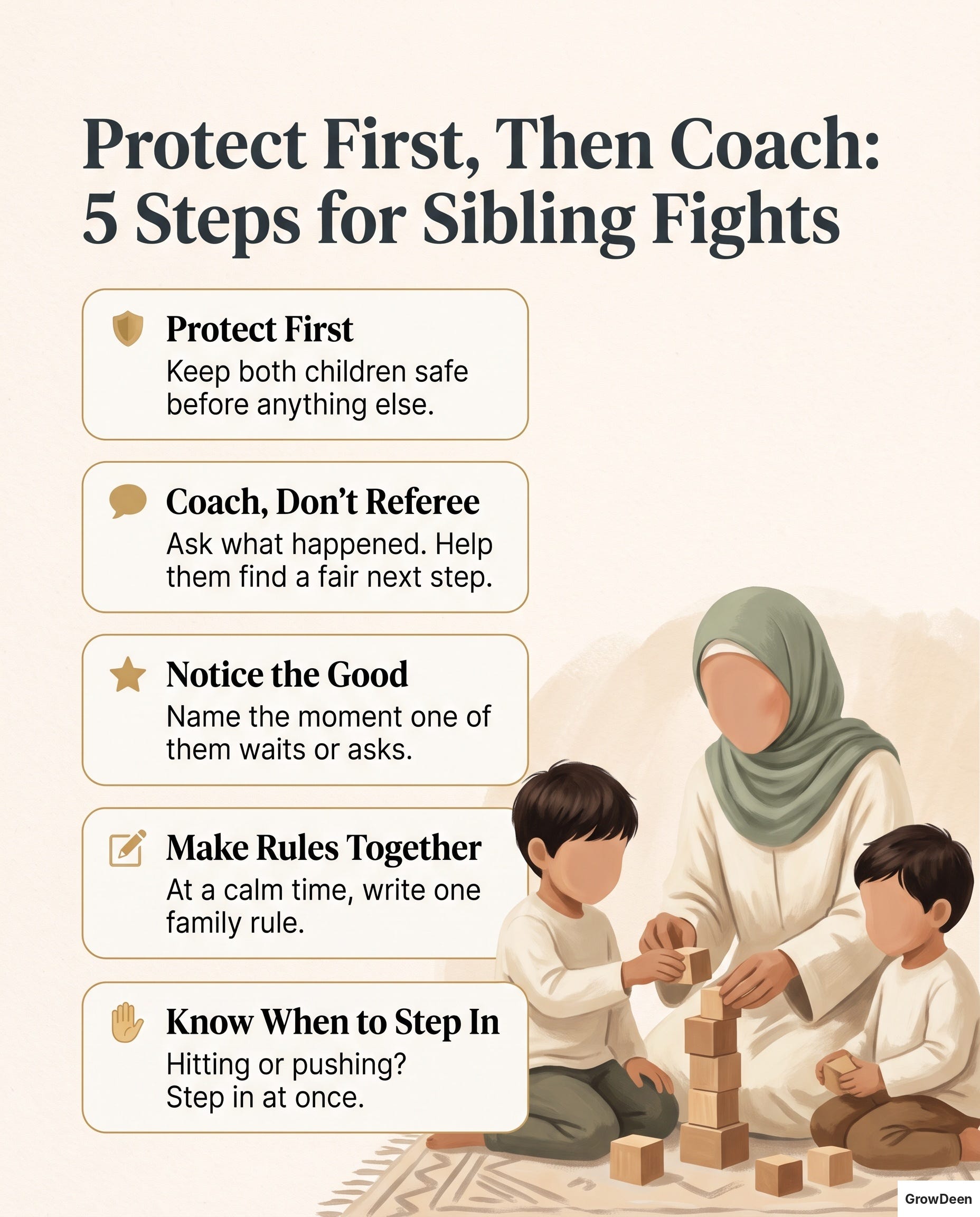
Knowledge in Practice: Protect First, Then Coach
Knowing why your children fight is half the work. Knowledge bears fruit only when it reaches the rug.
If you can only do one thing, do step 1. It is enough.
1. Protect first, then start with what happened (1 minute). Safety comes before any coaching. If anyone is hitting, throwing dangerous objects, frightened or unable to stop, separate them and protect them.
First attend to anyone who is hurt. Then, when everyone can listen, begin with what happened rather than who is bad.
Say this: “I am going to keep you both safe. Then I want to hear what happened.” (Say it in the language your child knows best.)
Under 3: use fewer words. Hold the younger child close and say, “Gentle hands. I’m here.”
6–8: “Take a breath. When you’re ready, you will each get a turn to tell me.”
A fallen tower is a real disappointment. A grabbed block is a chance to teach another way to ask.
2. Coach, don’t referee (3 to 5 minutes). Coaching means you stay with young children, who cannot yet solve the problem alone. You keep things safe while they practice one small skill.
Use these moves in order, once a disagreement is safe enough to discuss:
Check safety first. If anyone is hitting, throwing dangerous objects, frightened or unable to stop, separate and protect them before you coach.
Describe, don’t accuse. Instead of: “Who started it?” Try: “You both want the same block. I am going to hear each of you.”
Let each child speak. “One at a time. What happened?” Help a younger child with simple words: “You wanted a turn.”
Name both needs. “You want your tower left standing. You want something to build with.” Neither child has to agree right away.
Ask for a workable next step. “What would be fair?” If that is too hard: “Would you like to wait for this block, or choose a different one?”
Follow through. “I will stay nearby while you try.” Then praise a specific attempt to listen or negotiate, even if they still need help.
Each child needs a different kind of help. Start with the skill each child can practice next.
Say this to the younger child: “You want that block. It is being used. Let’s find one you can hold while we wait.”
Say this to the older child: “You worked hard on your tower. I will help keep it safe. What could your sibling build beside you?”
The five swaps on your Coaching Cheat Sheet:
Instead of: “Stop fighting.” Try: “I can see you both want it. What would be fair?”
Instead of: “Who started it?” Try: “What happened? Tell me one at a time.”
Instead of: “Give it back right now.” Try: “Can you ask how your sister is feeling about that?”
Instead of: “If you can’t share, nobody gets it.” Try: “What is one way you could both get a turn?”
Instead of: “I don’t want to hear it.” Try: “I know this is hard. Let’s figure it out together.”
Under 3: narrate for them: “You wanted the car. Zayd has it. That is frustrating. Let’s ask when he will be done.”
6–8: ask, “What do you think would be fair here?” At first, being asked matters more than a perfect answer.
3. Notice the good, and show repair (a few seconds, several times a day). Children notice how disagreement sounds at home. Specific, sincere attention makes cooperation visible, so fighting is not the only time siblings get your full attention.
Instead of: “Good job.” Try: “You waited while your sister finished with the blue block.” Or: “You asked before taking it. That helped.”
If you raise your voice, say this: “I shouted. That was not how I wanted to speak. I am sorry. We still need to keep each other safe.”
When you disagree with another adult: let children sometimes hear a respectful difference of opinion and see it resolved. Do not make them responsible for adult arguments.
Choose one effort worth noticing today, even if the rest of the afternoon felt hard.
4. Make peace easier before conflict starts (10 minutes, once this week). A family system is easier to follow than a rule invented mid-fight.
Build your rules together. Choose a calm time, perhaps after Maghrib (the sunset prayer). Ask your children, “How do we want to treat each other when we disagree?” Then write a few short, positive rules together. Two examples are “We ask before borrowing” and “We use gentle hands.” Others could be “We tell an adult when someone is unsafe,” “We speak kindly” and “We forgive quickly.” Invite your children to help choose the words.
Use them. Write rules that say what to do, as well as what to stop. Put the rules on the fridge. In the next conflict, point to them calmly: “Remember, we agreed: we ask first.”
Borrow one idea from the classroom: make the next step predictable. The next two points show how.
Before play: decide which toys belong to one child and which are shared. Set out enough materials for side-by-side play when you can.
When turns matter: say how turns will work before a dispute begins. Use a simple cue, like counting to 20 together, rather than expecting children to negotiate every detail alone.
Notice the repeats. Does trouble arrive when everyone is hungry, on an unstructured afternoon, or when one special toy appears? Change the setting: separate cherished belongings or offer enough materials for parallel play. Prepare ahead for a transition. When tension builds, move to another room, put on a short Qur’an recitation, or go outside.
In the car: seat children apart where you can, and keep books or audio stories ready. If a fight breaks out while you drive, stop somewhere safe before you deal with it.
You cannot turn your home into a preschool, nor should you need to. A little structure can leave more room for play.
Say this: “Tonight, let’s write one rule together.” Try the rule at a calm moment, before the next argument.
5. Know when to step back, and when to step in (a few seconds each time). Give children room to solve a minor, safe disagreement when they are managing it. If they are talking or even arguing loudly, without hitting or hurtful words, encourage them from a distance.
Say this: “I can hear you trying to work this out. Keep going.”
Step in at once for hitting, pushing or throwing, intimidation or deliberate targeting. Step in, too, if one child seems frightened of the other, if words turn deliberately hurtful, or if a child is in serious distress. Keep children safe rather than expecting them to work out harm alone.
Make It Work in Your Home
On your own, or your spouse works late? Pick one rule and one script for the week. Keep the rule-writing to five minutes at dinner.
Three or more children? Let the oldest help write the rules. Give each child one or two things that are theirs alone.
A small home or no spare money? Side-by-side play needs no new toys. Split the blocks into two piles, or hand out cups, pots and spoons.
A grandparent or caregiver helps with the children? Share the family rules and one script, so everyone uses the same words.
Say this to your spouse: “Can we both try the same words this week? When they fight, let’s say, ‘You both want the same block. I am going to hear each of you.’”
Say this to Grandma: “Mama, you raised us, and the children listen to you. When they argue, would you help them take turns with us, instead of looking for who started it?”
The family question: ask an elder, “When you were small and fought with your brothers or sisters, what helped you make up?”
Try It Seven Times
Any seven times in the next week or two, notice one moment of cooperation and describe it out loud. Seven is a starting goal, not a magic number.
Keep one tick and one word on the fridge for each time.
Tell us in the comments which effort you noticed first. We’d love to know.
Protect first, then coach: one fair next step at a time is the whole practice.
If Things Don’t Go to Plan
If they refuse to talk: keep both safe and pause. Say, “We can try again when you’re calm,” and come back later.
If it only improves a little: one child asking before grabbing, even once, is progress. Keep one rule and one script going.
If you start doubting yourself: Why do my children fight so much more than everyone else’s? Often they don’t.
You see your own afternoons and rarely anyone else’s. Fights between young siblings are common.
If you lose your patience: it happens to most parents. Use the repair line: “I shouted. That was not how I wanted to speak. I am sorry. We still need to keep each other safe.” Repair is part of the lesson.
If one child is always the target: step in every time, and protect the child being targeted. Give each child some calm one-to-one time, so neither has to fight for your attention.
Speak to someone if: one child is often frightened or hurt, or there is regular physical aggression. Speak up, too, if one child keeps targeting another, or the conflict keeps escalating or affects sleep, mood or daily life.
Signs are clearer looking back. Seeing them late is not neglect.
Asking for support is part of caring for the amanah (trust) of your children. For questions of deen (the way of life of Islam), ask your local imam or a local scholar, and share the details with him.
And you? Breaking up fights all afternoon is tiring. If you feel low or on edge most days, tell your own doctor.
Who to turn to: your child’s doctor or pediatrician, or a family therapist or counselor. In an emergency, call your local emergency number.
Support Muslim Parenting Lab ❤️
Would you like a small amount of yours grown into something enormous? Give what you can spare with the button below.
The Prophet ﷺ said Allah grows a charity the size of a date until it is like a mountain. (Sahih al-Bukhari 1410)
Your Companion Pack: The Sibling Peace Plan
Free to download. One PDF, three printable pages, made for the fridge door and the moments when you have no time to search:
Our Family Peace Rules: five numbered spaces with checkboxes and a date line, for rules your children help write. A tip reminds you to write what to do, as well as what to stop.
The Mid-Fight Coaching Cheat Sheet: five “Instead of refereeing / Try coaching” swaps, plus when an adult needs to step in.
A Reminder for the Peacemaker: a reflection card built around Sunan Abi Dawud 4919, on putting things right between people.
Parents Also Ask
How do I stop my children fighting over the same toys?
You may not stop every fight, and you don’t need to. Protect first, then coach: name what each child wants and help them find a fair next step. Agree a few family rules together at a calm time. When parents mediate this way, children may negotiate more constructively. [1]
Is it normal for siblings to fight every day?
It is common. Young children are still learning social skills and self-control while sharing space and belongings, so conflict comes up often. [5]
What matters most is how you respond, and whether their skills grow over time. If one child is often frightened or hurt, speak to your child’s doctor or pediatrician.
Should I always step in when my children fight?
Not always. If they are talking or arguing without hitting or hurtful words, they may be practicing a skill.
Step in at once for hitting, pushing, throwing, targeting, or a child who seems frightened. In one trial, children whose parents mediated later used mediation steps in their own talks. [2]
My older child always blames the younger one. How do I handle it fairly?
Skip “Who started it?” because it points children toward blame rather than solutions. Describe what you see instead: “You both want the same block. I am going to hear each of you.” Then: “What happened? Tell me one at a time.”
Coach both children through it. Fair help may not be identical help.
How does the story of Yusuf and his brothers explore the pain of perceived unequal attention?
Text and our reflection. The brothers believed their father loved Yusuf and his brother more (Yusuf 12:8). They wanted their father’s attention to be “only for you” (Yusuf 12:9), and that hidden feeling grew into a plan to harm. [10] Much later, they admitted their wrong and Yusuf forgave them (Yusuf 12:91–92). [11]
At home, take a child’s sense of unequal attention seriously, even when your love is fair. For questions about your own family, ask your local imam or a local scholar, and share the details with him.
What does a Prophetic warning about jealousy and turning away teach about protecting relationships?
Text and our reflection. The Prophet ﷺ said, “Do not hate one another, nor be jealous of one another; and do not desert one another” (Sahih al-Bukhari 6076). [13] He also set a limit of three nights on cutting off a brother.
It teaches that a bond is worth guarding before it breaks. At home, that can mean noticing jealousy early and helping children make up the same day. For your own family’s questions, ask your local imam or a local scholar, and share the details with him.
Final Reflection
Dear parent,
You want your children to grow up loving each other, and you are willing to learn how to help. That is no small thing.
If you have asked “Who started it?”, you did what most of us learned. You wanted fairness. That intention was never wasted.
You are not failing when they fight. You are not only a referee. You are the one teaching peace.
You do not need to change every afternoon this week. Write one rule. Try one script.
Let that be enough. Allah sees every effort.
Often, school has someone guiding the turns. At home, that someone can be you.
A Du’a for This
For you:
رَبَّنَا هَبۡ لَنَا مِنۡ أَزۡوَٰجِنَا وَذُرِّيَّٰتِنَا قُرَّةَ أَعۡيُنٖ وَٱجۡعَلۡنَا لِلۡمُتَّقِينَ إِمَامًا
Rabbanā hab lanā min azwājinā wa dhurriyyātinā qurrata a’yunin waj’alnā lil-muttaqīna imāmā
“Our Lord, grant us from among our wives and offspring comfort to our eyes and make us an example for the righteous.”
Al-Furqan 25:74 · Sahih International [14]
With your child: Rabbi-ghfir lī wa li-akhī, “My Lord, forgive me and my brother” (Al-A’raf 7:151). [15] Prophet Musa said this for himself and his brother Harun.
Say it together after making up, from about age 3, or say it over a younger child. A child with a sister can add a du’a for her in their own words.
Share the Khayr
If you know a parent whose children fought through a whole Eid visit, send this to them. It is also for the friend who whispered at pickup that they feel they are failing. The Prophet ﷺ said that one who guides to something good has a reward similar to that of its doer (Sahih Muslim 1893a). [16]
Tell us in the comments: what rule did your children choose first? We’d love to know.
Parents Also Read
Parents who read this guide also found these helpful.


References
[1] Smith, J., & Ross, H. (2007). Training Parents to Mediate Sibling Disputes Affects Children’s Negotiation and Conflict Understanding. Child Development, 78(3), 790–805. (Canada · Suggestive)
[2] Society for Research in Child Development (2007). Teaching Mediation Skills to Parents Helps Siblings Resolve Conflicts. ScienceDaily, summary of reference [1]. (Canada · Suggestive)
[3] Pickering, J. A., & Sanders, M. R. (2017). Integrating Parents’ Views on Sibling Relationships to Tailor an Evidence-based Parenting Intervention for Sibling Conflict. Family Process, 56(1), 105–125. (Australia · Suggestive)
[4] Center on the Developing Child at Harvard University (n.d.). InBrief: Executive Function: Skills for Life and Learning. (US · Suggestive)
[5] Pickering, J. A., Crane, M. E., Hong, J., Nickel, A.-K., Chainey, C., & Sanders, M. R. (2023). A Randomized Controlled Trial of a Parenting Program to Improve Sibling Relationships. Journal of Child and Family Studies, 32(5), 1438–1451. (Australia · Early)
[6] Borairi, S., Plamondon, A., Rodrigues, M., Sokolovic, N., Perlman, M., & Jenkins, J. (2023). Do Siblings Influence One Another? Unpacking Processes That Occur During Sibling Conflict. Child Development, 94(1), 110–125. (Canada · Suggestive)
[7] Qur’an, Al-Hujurat 49:10. Translation: The Clear Quran (Dr Mustafa Khattab).
[8] Tafsir Ibn Kathir on Al-Hujurat 49:10.
[9] Sunan Abi Dawud 4919. Graded: Sahih (Al-Albani).
[10] Qur’an, Yusuf 12:8–9. Translation: Sahih International.
[11] Qur’an, Yusuf 12:91–92. Translation: Sahih International.
[12] Tafsir Ibn Kathir on Yusuf 12:92.
[13] Sahih al-Bukhari 6076.
[14] Qur’an, Al-Furqan 25:74. Translation: Sahih International.
[15] Qur’an, Al-A’raf 7:151. Translation: Sahih International.
[16] Sahih Muslim 1893a.
We combine scientific research with Qur’an and authentic Sunnah, and we cite our sources. Even so, this is general guidance and no substitute for a doctor who can examine your child.
Sources & confidence
The hadith in this guide are from Sahih al-Bukhari, Sahih Muslim and Sunan Abi Dawud (graded Sahih by Al-Albani). Qur’an 49:10 is quoted from The Clear Quran; the other verses from Sahih International. Checked October 2026. Found a source that looks wrong? Email us at info@growdeen.com.
Words in this guide
amanah: a trust
deen: the way of life of Islam
du’a (doa): supplication
khayr: good
Maghrib: the sunset prayer
sadaqah: charity
Sadaqah Jariyah: ongoing charity whose reward continues
Sunnah: the teachings and practice of the Prophet ﷺ
preschool (nursery)
pediatrician (paediatrician)
counselor (counsellor)
color (colour)
sibling rivalry: competition and conflict between brothers and sisters.
mediation: a parent helping children talk through a conflict and find a fair solution together.