


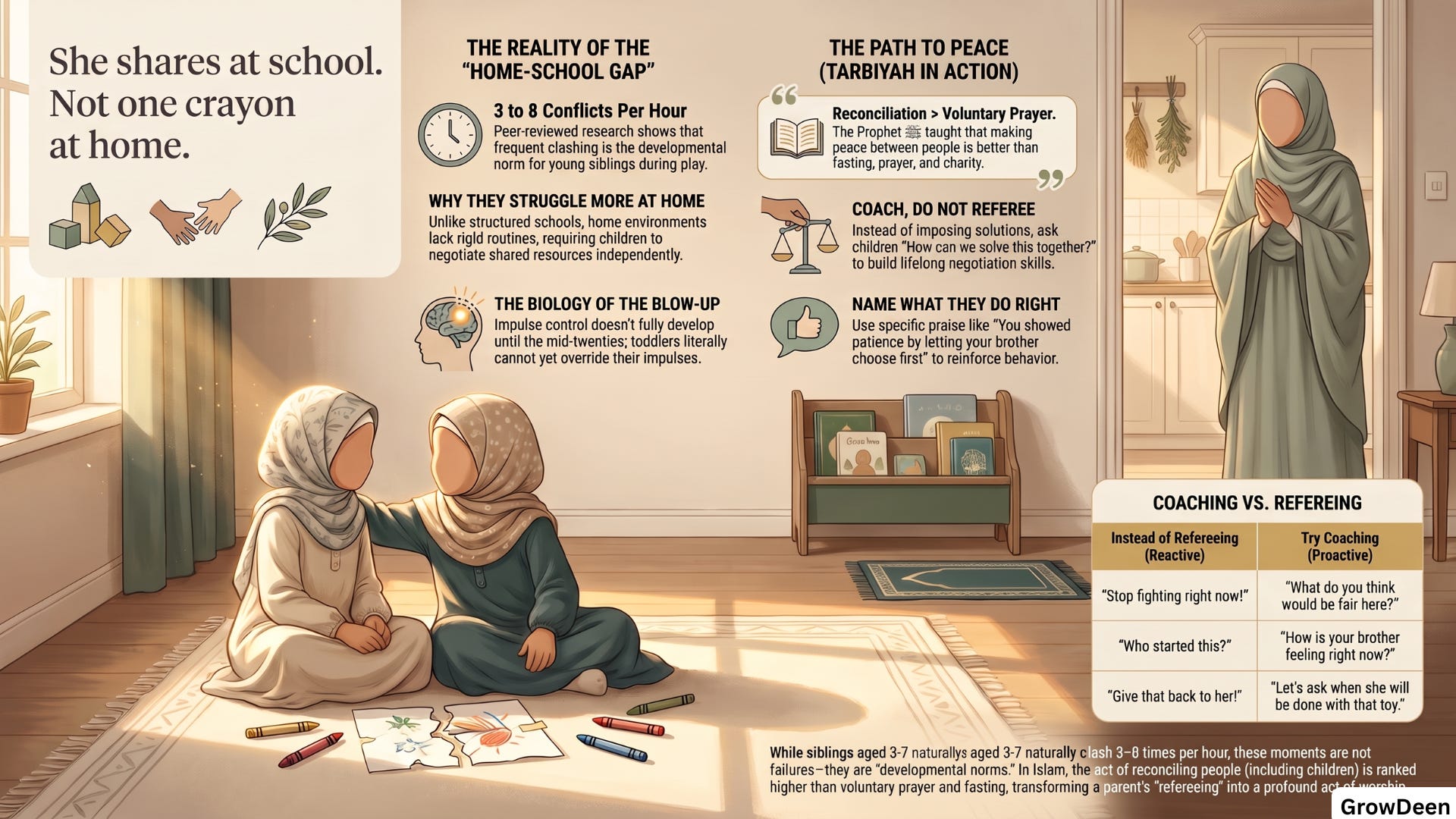
A 2023 study in Child Development found that siblings aged 3-7 can have between 3 and 8 conflicts per hour during unstructured play. [1] This guide shows you how the research and the Prophetic model work together to turn those fights into the most valuable parenting moments of your day!
The blocks were everywhere.
Your four-year-old had sorted them by colour. Towers on one side, a road on the other. Twenty minutes of quiet. You were about to start dinner. Then your two-year-old crawled over and grabbed the red one from the top of the tallest tower, and within three seconds there was screaming, a shove, and someone’s head hitting the edge of the coffee table.
You did everything the parenting books say. You stayed calm. You got down to their level. You used the words. And your four-year-old looked you in the eye and hit her sister again.
Here is what nobody warned you about: the strategies work, but not the first time. Not the fifth time either. And somewhere between the tenth broken tower and the twentieth “use your words,” a question starts forming that you do not say out loud: Is something wrong with my children? Or is something wrong with me?
Neither. A 2023 study published in Child Development found that young siblings can clash between 3 and 8 times in a single hour of play. [1] That is not a sign of failure. It is the developmental norm. But here is the part that changes everything, and the reason this article exists: what you do in those small, exhausting moments has a weight in Islam that most parents never realise.
The Prophet ﷺ told his companions that reconciliation between people ranks above voluntary fasting, prayer, and charity. [7] Every time you kneel between two crying children and help them find their way back to each other, you are practising that.
But why does a child who shares beautifully at school come home and refuse to let their sibling touch a single crayon? And what does that tell us about what actually prevents fights?
Keep reading. The answer surprised me.
What Makes This Guide Different From Generic Parenting Advice
Research you can trust. Every strategy is drawn from peer-reviewed studies on sibling conflict, including a 2023 randomised controlled trial that measured real changes in how siblings treated each other. [2]
An Islamic framework that reframes your effort. This is not tips with a hadith at the end. The Qur’an and Sunnah reshape how you see the entire role of peacemaking in your home, and why it matters more than you think. [7,8]
A free printable companion pack. The Sibling Peace Plan is a 3-page PDF you can use tonight: a family rules builder, a coaching cheat sheet for mid-fight moments, and an Islamic reflection card. Not just information. Tools.
The Real Reason They Fight Worse at Home
That question I planted earlier? Here is the answer, and it is not what most parents expect.
Your child behaves at school because the environment is structured. There are routines, clear expectations, and a teacher nearby. They do not need to negotiate for resources because the classroom already has systems in place. [3]
At home, all of that disappears. Unstructured time. Shared toys with no rotation system. A parent who is cooking dinner, not supervising play. The child is not worse at home. The environment is harder at home. [1,3]
Developmental science explains the rest. A toddler who grabs a toy is not being deliberately unkind. Their brain literally cannot override the impulse yet. The prefrontal cortex, the part responsible for impulse control and perspective-taking, will not finish developing until their mid-twenties. [4] You are asking a two-year-old to do something their brain is not wired to do.
By school age, a different problem appears. Your six-year-old has developed a strong sense of fairness, and she applies it with a rigidity that can feel maddening. “He got three grapes more than me” is not pettiness. It is a developmental milestone. She can now detect inequality, and she is protesting it with every tool she has. [1,5]
The Qur’an understood sibling jealousy long before developmental psychology named it. The entire story of Yusuf and his brothers (Qur’an 12) is built on what happens when children feel their parent’s attention is unequal and no one addresses it. [8] The brothers were not evil. They were hurting. And their hurt, left unmanaged, became destructive.
The lesson is not to panic. The lesson is to take it seriously.
I know this is a lot to hold in your head, especially when you are standing between two screaming children at 6pm with dinner burning on the stove. That is why I have created the Sibling Peace Plan, a free 3-page printable companion pack with a family rules builder, a coaching cheat sheet, and an Islamic reflection card. Keep reading to download it at the end of this article. It is designed for the moments when you need it most, not for the moments when you have time to think.
What the Qur’an and the Prophet ﷺ Teach About Peacemaking Between Children
When I think about the sheer exhaustion of breaking up the same fight three times in one afternoon, I sometimes forget what this work actually is. It feels like refereeing. It feels thankless.
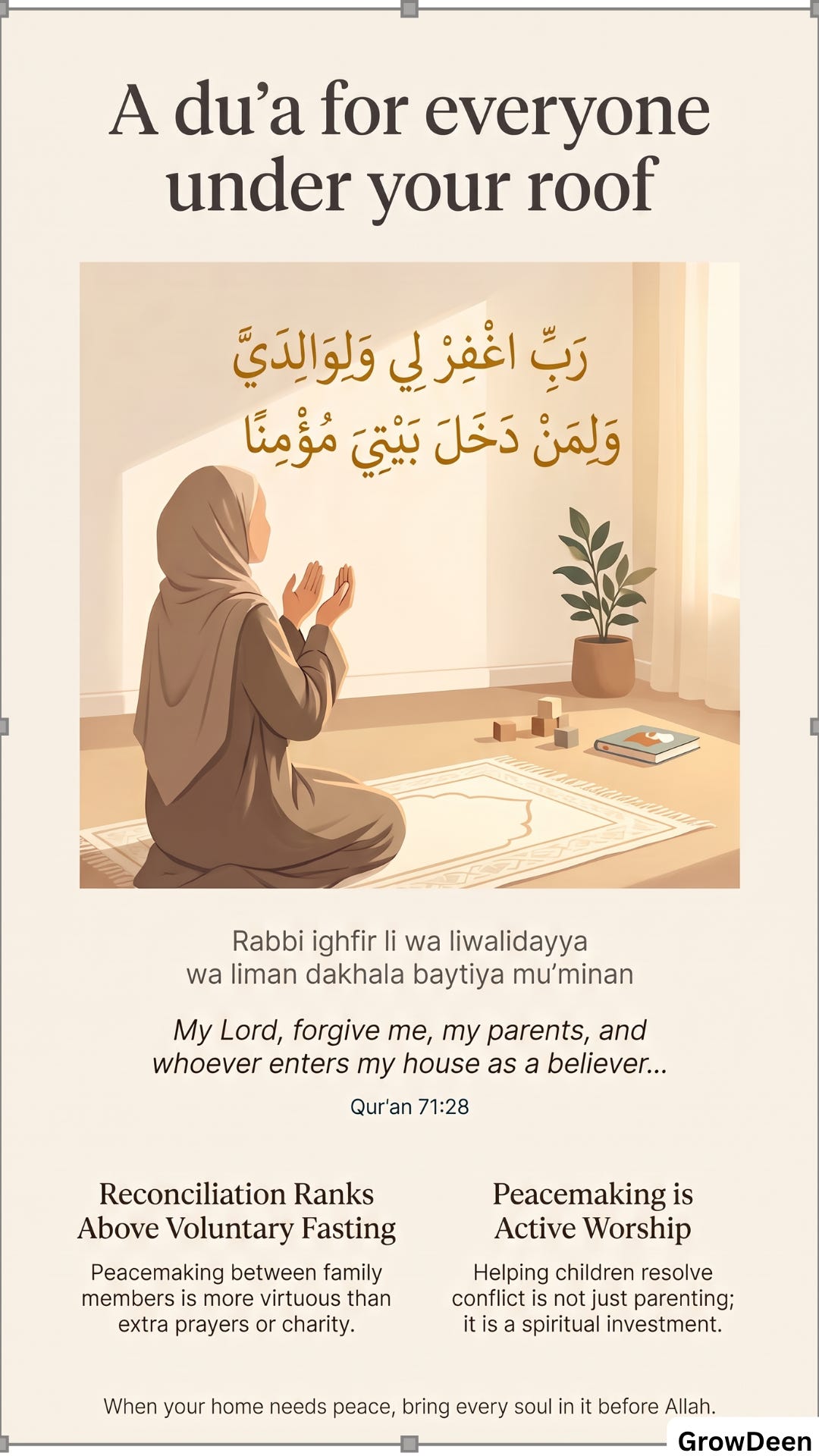
But the Prophet ﷺ reframed it. He asked his companions: “Shall I not tell you of something that is better in degree than fasting, prayer, and charity?” They said yes. He said: “Reconciliation between people. For indeed, spoiling relationships is the shaver” (Abu Dawud 4919). [7] According to scholars, “the shaver” means something that shaves away good deeds, or in some readings, shaves away the religion itself.
Peace between siblings is worship.
That is the weight of what you carry. And the Qur’an makes it explicit: “The believers are but brothers, so make settlement between your brothers. And fear Allah that you may receive mercy” (Qur’an 49:10). [8] According to Tafsir Ibn Kathir, this verse commands active intervention when conflict arises between believers, not passive hope that it will resolve itself. For parents, this is your job description.
The Islamic emphasis on reconciliation and the developmental research on coached conflict resolution point in the same direction: do not leave fights to chance. Step in with patience, guide with wisdom, and trust that the skills you build in your children today will shape who they become for life.
The Five Strategies That Actually Reduce Fights (Research-Tested)
You go first.
Your children watch how you handle frustration more closely than you think. A 2013 study found that parental modelling of constructive conflict resolution was one of the strongest predictors of prosocial behaviour between siblings. [6] If you shout when you disagree with your spouse, your children file that away. If you apologise after losing your temper, they file that away too.
The Prophet ﷺ named the exact emotional patterns that corrode the bond between siblings. He said: “Do not hate one another, nor be jealous of one another; and do not desert one another, but O Allah’s worshipers! Be brothers! And it is unlawful for a Muslim to desert his brother Muslim (and not to talk to him) for more than three nights” (Sahih al-Bukhari 6076). [9]
Think about that final part: not speaking to your brother for more than three nights is unlawful. That is how seriously Islam treats the silent treatment, the cold shoulder, the turning away. And children learn all of these from watching their parents. When was the last time your children saw you apologise?
Name what they are doing right.
A 2023 randomised controlled trial found that parents who received structured coaching on positive attention saw measurable improvements in sibling relationship quality. [2] The key was specificity. Not “good job” but “You let your brother choose first without being asked. That took real patience.”
Children repeat behaviours that earn positive attention. If the only time you pay close attention to their sibling interactions is during conflict, you are accidentally training them that fighting is the fastest route to being noticed.
Build the rules together.
Children follow rules they helped create. [3] Sit down after dinner one evening. Ask them: what kind of family do we want to be? Write three or four rules in positive language. “We speak kindly.” “We ask before borrowing.” “We forgive quickly because Allah loves those who forgive.”
Put them on the fridge. Refer to them calmly during the next conflict. “Remember, we agreed: we ask first.”
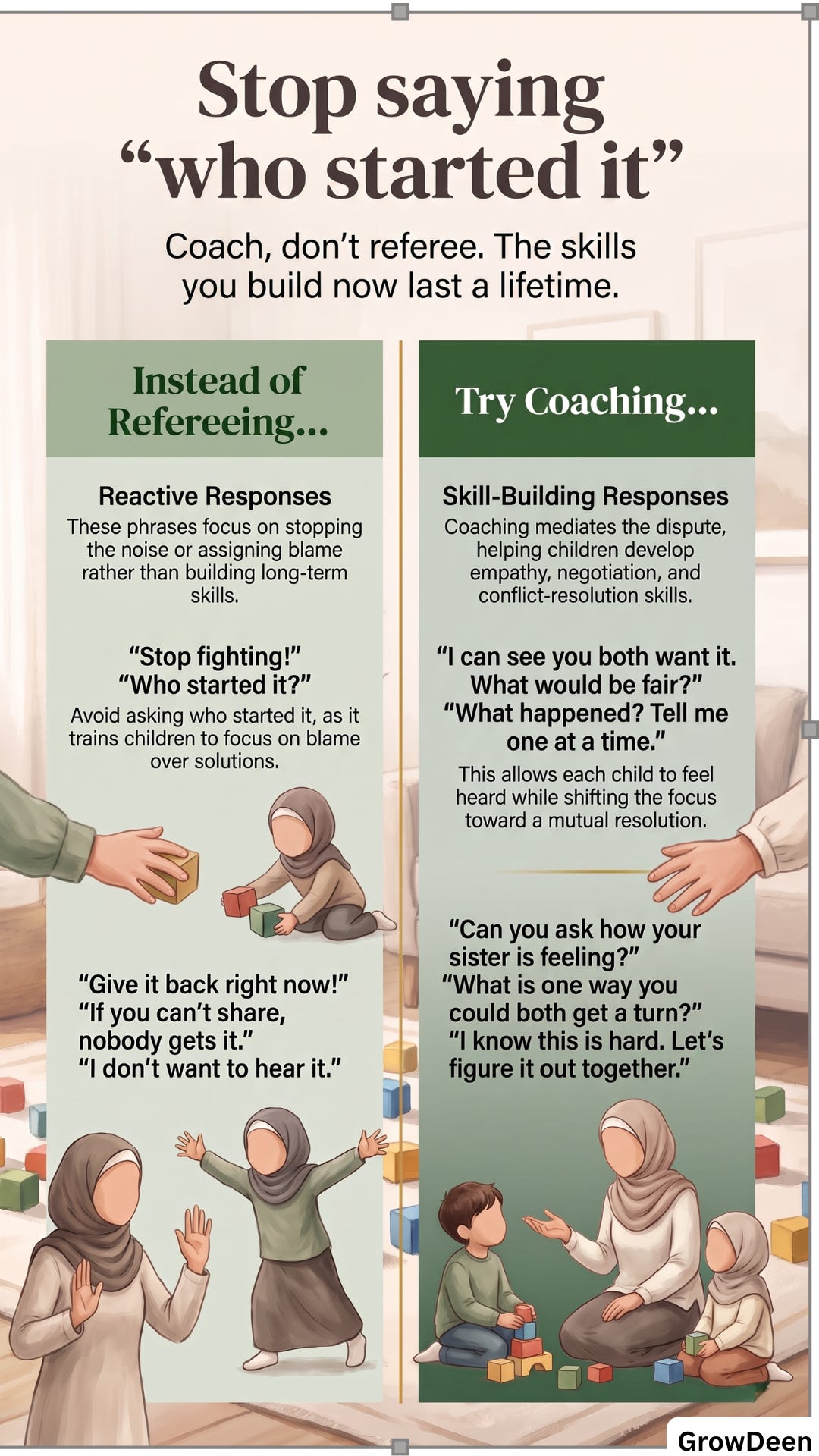
Coach, do not referee.
This is the strategy with the strongest evidence behind it. Smith and Ross (2007) found that parents trained to mediate sibling disputes (rather than impose solutions) produced children with significantly stronger negotiation skills, greater empathy, and deeper conflict understanding. [5]
With a toddler, this means narrating: “You wanted the car. Zayd has it. That is frustrating. Let us ask when he will be done.”
With a school-age child, it means asking: “What do you think would be fair here?” The quality of their answer does not matter yet. The process of being asked does.
Remember the mystery question? Your child shares at school because a teacher coaches them through disputes in real time. At home, you are that teacher. When you coach instead of referee, you close the gap.
Peace between siblings is worship. Every coached conversation counts.
Remove the triggers before they fire.
Most fights erupt in the same situations: unstructured afternoons, car trips, the moment a shared device appears. Plan ahead. [2]
At home, keep enough materials for parallel play. Allow each child to have some things that are only theirs. When tension is building, redirect before it breaks. Move to a different room. Put on a short Qur’an audio clip. Go outside.
In the car, separate children physically where you can. Keep a bag of colouring books and audio stories ready. If a fight erupts while you are driving, pull over. Always.
When to Let Them Work It Out
Not every disagreement needs you. Children who practise resolving conflicts on their own develop social skills that parental mediation cannot replace. [1,5]
If they are talking, debating, even arguing loudly but without hitting or genuinely hurtful words, they are learning. Encourage from a distance: “I can hear you trying to work this out. Keep going.”
Surah Yusuf reminds us that reconciliation is a process. It took Yusuf’s brothers years to arrive at repentance (Qur’an 12:91). His forgiveness, “No blame will there be upon you today” (12:92), remains one of the most powerful acts of mercy in the Qur’an. [8] Give your children the space to struggle, within safe boundaries. That is tarbiyah at its most effective.
When to Ask for Help
If fighting is constant, escalating, or causing visible emotional harm, speak with a paediatrician or qualified family counsellor. [2] Signs include one child consistently targeting another, regular physical aggression, a child who seems genuinely frightened of a sibling, or conflict affecting sleep and mood. Asking for support is not failure. It is the amanah of parenthood fulfilled with every resource available.
Your Free Sibling Peace Plan (3-Page Companion Pack)
If you have read this far, you are the kind of parent who takes sibling relationships seriously, not as a management problem but as a spiritual investment. That tells me something about you.
Inside the Sibling Peace Plan (one PDF, 3 pages):
Page 1: Our Family Peace Rules Builder — A ready-to-use worksheet where you and your children write your own household peace rules together. Five numbered lines with checkboxes, a date field, and a tip box reminding you to phrase rules positively. Designed to go straight on the fridge tonight.
Page 2: The Mid-Fight Coaching Cheat Sheet — A two-column quick reference: “Instead of Refereeing” (reactive phrases like “Stop fighting!” and “Who started it?”) alongside “Try Coaching” (replacement phrases like “What do you think would be fair?” and “How is your brother feeling right now?”). Plus a short “When to Step In” section covering the three situations that require adult intervention.
Page 3: A Reminder for the Peacemaker (Islamic Reflection Card) — An English-only reflection card built around the hadith on reconciliation (Abu Dawud 4919). The translation reads: “The Messenger of Allah ﷺ said: ‘Shall I not tell you of something that is better in degree than fasting, prayer, and charity? It is reconciliation between people.’” Below it, a reflection for parents: “Every time you help your children make peace with each other, you are practising something the Prophet ﷺ said is worth more than voluntary prayer and fasting. That is the weight of what you do.”
This is not a PDF to download and forget. It is designed for the fridge door, the kitchen counter, the moments when you need it and do not have time to search.
This Sibling Peace Plan is what every subscriber receives with each article. We cover the full journey of raising Muslim children, from newborns through school age, backed by research and rooted in the Qur’an and Sunnah.
If you are a Muslim parent who wants both evidence-based guidance and Islamic perspective woven into every article, subscribe free. Future resources arrive in your inbox before you need them.
You will only hear from us when there is something valuable to share. No spam, no daily emails, just resources that matter.
Your 5-Minute Action for Tonight
Before you close this article, do one thing: sit down with your children after Maghrib tonight and ask them, “What rules should our family have for how we treat each other?” Write down whatever they say. Do not edit it. Just write it down. Stick it on the fridge. That is the beginning. You can refine it later. Start tonight.
May Allah grant you sabr, wisdom, and barakah in raising children who love each other, forgive each other, and carry the bonds of brotherhood and sisterhood as a lifelong gift.
Share This With Someone Who Needs It
Think of one person right now: the mother at the masjid whose children fought through the entire Eid party while she tried to hold it together, your cousin whose WhatsApp messages this week were full of “I cannot take this anymore,” the friend who whispered at pick-up that she feels like she is failing because her children will not stop fighting.
This article could change how she sees those moments. Share it with her today, not as advice but as support. Sometimes the most loving thing you can do is share what reframed it for you.
Frequently Asked Questions
Q: Is it normal for siblings to fight every single day? A: Yes. Research shows that young siblings can have multiple conflicts per hour during unstructured play. [1] Daily fighting between children aged 2-7 is developmentally normal, not a sign that something is wrong with your family. What matters is how you respond to those moments and whether you are building their skills over time.
Q: At what age should children be able to resolve conflicts on their own? A: Children start developing the ability to negotiate and compromise around age 4-5, but they need coaching and practice to do it consistently. [5] By school age (6-8), most children can handle minor disagreements independently if they have been taught the skills. Even then, they will still need adult support for bigger conflicts.
Q: Should I always intervene when my children fight? A: Not always. If children are arguing but not being physically aggressive or using genuinely hurtful language, give them space to work it out. [1,5] Step in when there is hitting, throwing, or one child is clearly frightened. Encouraging them to resolve minor disputes builds skills they will use for life.
Q: Does Islam say anything specific about how parents should handle sibling rivalry? A: The Qur’an directly commands believers to make peace between their brothers (Qur’an 49:10), and the Prophet ﷺ placed reconciliation above voluntary worship (Abu Dawud 4919). [7,8] The story of Yusuf and his brothers (Qur’an 12) is the Qur’an’s most detailed account of sibling jealousy and shows both the dangers of ignoring it and the power of forgiveness. He ﷺ also warned against hatred, jealousy, and deserting one another, making it unlawful for a Muslim not to speak to his brother for more than three nights (Sahih al-Bukhari 6076). [9]
Q: How do I stop my children from fighting over toys? A: Three strategies work well together: allow each child to have some items that are exclusively theirs (not shared), create a visible turn-taking system for shared toys, and keep enough materials available for parallel play so they do not need to share everything. [2,3] Knowing some things are protected reduces the anxiety that drives fighting over everything else.
Q: My older child always blames the younger one. How do I handle this fairly? A: Avoid asking “Who started it?” because it trains children to focus on blame rather than solutions. [5] Instead, address the situation: “I can see you are both upset. What happened, and what would be fair now?” Coach both children through the resolution process rather than assigning fault. Over time, this teaches them to problem-solve rather than point fingers.
References
[1] Borairi, S., Plamondon, A., Rodrigues, M., Sokolovic, N., Perlman, M., & Jenkins, J. (2023). Do siblings influence one another? Unpacking processes that occur during sibling conflict. Child Development, 94(1), 110-125. https://doi.org/10.1111/cdev.13842
[2] Pickering, J.A., Crane, M.E., Hong, J., Nickel, A-K., Chainey, C., & Sanders, M.R. (2023). A randomized controlled trial of a parenting program to improve sibling relationships. Journal of Child and Family Studies, 32(5), 1438-1451. https://doi.org/10.1007/s10826-023-02539-7
[3] Pickering, J., & Sanders, M. (2017). Integrating parents’ views on sibling relationships to tailor an evidence-based parenting intervention for sibling conflict. Family Process, 56(1), 105-125. https://doi.org/10.1111/famp.12173
[4] Piotrowski, C.C. (2023). Exploring linkages between mother-child and sibling relationship quality and prosocial behavior between school-aged and adolescent siblings. Journal of Family Issues. https://doi.org/10.1177/0192513X231162965
[5] Smith, J., & Ross, H. (2007). Training parents to mediate sibling disputes affects children’s negotiation and conflict understanding. Child Development, 78, 790-805. https://doi.org/10.1111/j.1467-8624.2007.01033.x
[6] Tucker, C.J., & Kazura, K. (2013). Parental responses to school-aged children’s sibling conflict. Journal of Child and Family Studies, 22(5), 737-745. https://doi.org/10.1007/s10826-013-9741-2
[7] Sunan Abu Dawud 4919 — Graded: Sahih — https://sunnah.com/abudawud:4919
[8] Qur’an, Surah Al-Hujurat 49:10 — https://quran.com/49/10; Surah Yusuf 12:8-10, 12:91-92 — https://quran.com/12/92. Tafsir Ibn Kathir.
[9] Sahih al-Bukhari 6076 — Graded: Sahih — https://sunnah.com/bukhari:6076
[10] Faith, M.A., Elleedge, C., Newgent, R.A., & Cavell, T.A. (2015). Conflict and dominance between siblings as predictors of children’s peer victimization. Journal of Child and Family Studies, 24(12), 3623-3635. https://doi.org/10.1007/s10826-015-0171-1
[11] Ibn Kathir. Tafsir Ibn Kathir, Surah Al-Hujurat 49:10 commentary — https://quran.com/en/49/10/tafsirs/en-tafisr-ibn-kathir
[12] Ibn Kathir. Tafsir Ibn Kathir, Surah Yusuf 12:8-10 commentary — https://quran.com/en/12/8/tafsirs/en-tafisr-ibn-kathir