

Your bright child pushes the hard page away and says, "I'm bad at this"?
The free Gift to Talent Kit gives you a stretch planner and words for tonight.
AGES 3–8 YEARS · 18 MIN READ
She taught herself to read at three.
Now she is seven. The math sheet has a problem she can't see straight away. She pushes it across the table. "Baba, I'm bad at this."
You say what you have said since she was tiny. "You're so smart. You can do it." She folds her arms. The pencil stays down.
I've told her she's smart every day of her life. How did she decide she's bad at things?
You did what loving parents do. You noticed her mind, and said so out loud. Her folded arms are not about her ability. They are not about your love either.
This guide brings together scientific research and the Qur'an and authentic Sunnah. You'll see why bright children stop trying, and what to say tonight.
The Short Answer
Right for your child? Ages 3–8 who learn fast, then shut down when work gets hard. Gifted and also autistic, ADHD or dyslexic? See "I'm Stupid." below.
What's probably happening: your child has rarely met work that needs effort. So hard can feel like proof of not being smart.
Try tonight (2 minutes): swap "You're so smart" for what you saw. "You tried a new way, and it worked."
You'll know it's working when: they pick the pencil back up a little sooner. Grumbling on hard days is not failure; it means they're stretching.
Get help if: worry, low mood, school refusal or reading struggles last for weeks. Ask your child's doctor or pediatrician; for self-harm talk, call your local emergency number.
The rest of this guide explains why, and what to do if it does not work.
How to Read This Guide
3 minutes: The Short Answer above is enough for tonight.
7 minutes: The Short Answer, then Knowledge in Practice and If Things Don't Go to Plan.
The whole guide: read on for the scientific research, the Qur'an and Sunnah, and the References.
To share: the bold lines and the pull quotes are made to be shared.
To listen: open this guide in the free Substack app and tap Listen.
Inside This Guide
Noticing your child's mind was never the mistake. The words we use for it can change tonight.
Myth Check: "A Smart Child Needs to Hear She's Smart"
Most of us believe this, and it comes from love. In one US poll, about 85 in 100 parents of young children agreed on one idea. You must praise a child's ability after a success, so the child feels smart. [1]
What the belief gets right. Children need to know you see them. A child whose gifts go unnoticed can feel invisible, and noticing is part of caring for an amanah (a trust from Allah).
What the evidence says. In six studies with fifth graders (about ages 10–11), children praised for intelligence did worse after a setback. They also kept going less than children praised for effort. [2] Studies with 4- to 6-year-olds point the same way. [1,3]
A second belief often sits beside it: that a clever child will be fine on her own. The sections below show why bright children still need thoughtful adults.
Why This Happens
What Does "Gifted" Mean?
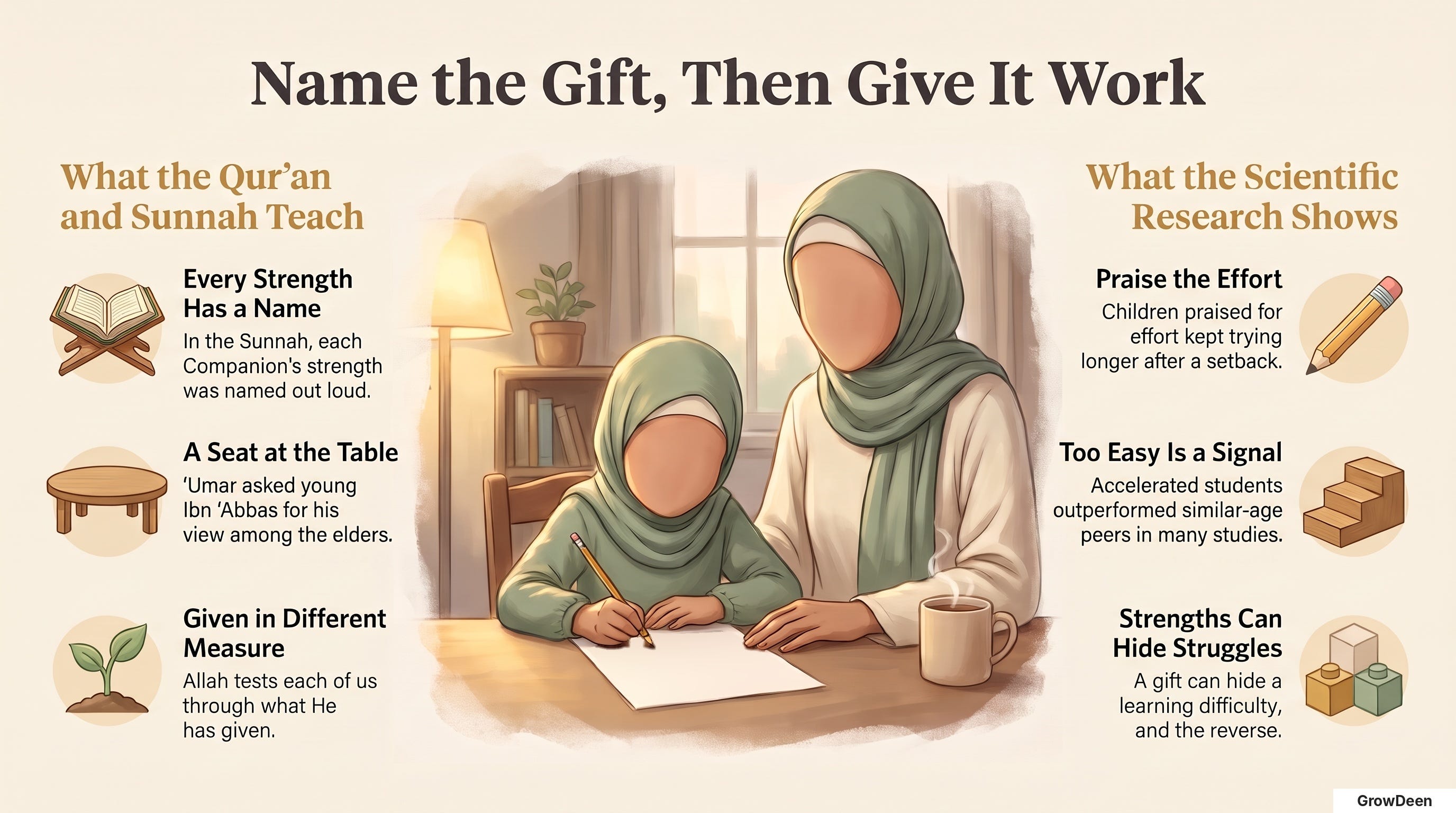
Picture a five-year-old at masjid class who already knows every surah (chapter of the Qur'an) on the board. The scientist Françoys Gagné would call that a gift: natural ability well above average for her age. A talent is the skill built from that gift through years of learning and practice, with support around it. [4] What turns one into the other sits partly inside the child, such as motivation, and partly outside: family, school and opportunity. [4]
Gifted children turn up in every culture and kind of household, and high ability often runs in families. [5] It usually shows early. [6] Signs you may recognize:
Ages 3–5: early speech with surprising words, teaching themselves letters or numbers, deep questions about Allah or death, and choosing older playmates.
Ages 5–8: grasping new ideas fast, drifting off on repetition, or remembering the stories of the Prophets in fine detail.
Gifts can also sit in relationships, technology, calligraphy, business or sport. No sign settles it alone, and nobody knows your child the way you do.
"This Is Boring."
He finished the worksheet in four minutes, then folded it into a paper airplane. The teacher's note says he "won't stay on task."
When lessons cover what a child already knows, some switch off. In one New Zealand study, parents described gifted children who did not "fit" mainstream settings. [7] Schools can offer more than patience: extension work, an older class for one subject, or moving ahead a year. The right fit depends on the child. [8,9]
"I'm Bad at This."
This is where the girl with the math sheet comes back in.
Children praised for being smart can start to read a hard problem as proof they are not smart after all. In the studies above, they also cared more about looking smart than about learning. [2] A gifted child often hears "you're so smart", so the label can weigh more on them.
Effort needs somewhere to go, too. Studies of talent describe it growing where ability meets opportunity and steady practice, alongside persistence and recovering from mistakes. [10] A child who builds all day needs a corner of cardboard. A few focused minutes most days is easier to keep up than one long burst a month.
"Why Do I Have To?"
A child who reasons well may question every rule at home. Often they want the reason, not a way out. Give the reason once, keep the rule, and invite their better idea on another day.
"Nobody Gets Me."
Your six-year-old explains the water cycle to her uncle at dinner, word perfect. Ten minutes later she cries because her sandwich was cut into squares, not triangles.
People who work with gifted children call this asynchronous development. Reasoning can run years ahead, while emotional control and social skills move at the pace of their real age. [11] It helps explain why gifted children often seek older company, and feel few children their age share their interests. The tears over the sandwich still need the comfort you'd give any six-year-old.
"I'm Stupid."
He builds a working marble run from paper-towel tubes, with a loop in it. He still can't spell "because," and he has started calling himself stupid.
Some gifted children also have a disability, such as ADHD, dyslexia or autism. Educators call them twice-exceptional. [12] Each side can hide the other. A strong mind can cover a learning difficulty in the early grades, and a disability can hide the strengths. [13] The National Association for Gifted Children recommends a strengths-based approach that supports both together. [13]
"What If the World Ends?"
It's bedtime, and your eight-year-old wants to know whether the oceans will run out of fish before she grows up.
Some gifted children carry big worries about war or harm to the planet. They may understand more than they can yet carry. Being gifted is not in itself a mental health risk. A 2024 review pooling 27 studies on anxiety and 15 on depression found no significant difference between gifted people and others. [14] Reassurance alone may not settle a worry like this; a small action can help.
"You Always Pay Attention to Him."
The quieter sister has stopped asking to show you her drawings. Dinner always comes back to her brother's coding club.
A gifted child can absorb most of a family's time without anyone deciding it should. The sister who is wonderful with the baby has a gift too, and she should hear you say so. The gifted child also needs free play and rest.
When everything has come easily, a hard page can feel like proof she was never smart at all.
What the Scientific Research Shows
The clearest finding comes from six studies of praise. More than 400 fifth graders (about ages 10–11) solved puzzles and did well. One group then heard, "You must be smart at this." Another was told they must have worked hard. [2,15] On harder problems, the children praised for intelligence persisted less and enjoyed the work less. They also performed worse than the children praised for effort. [2]
Who was studied: children in a Midwestern town and a large Eastern city in the US, from varied ethnic, racial and income backgrounds. Children with additional needs were not reported. [15] No study has yet tested this with Muslim families.
How strong this is: Suggestive. The studies were well designed and repeated within the paper. A later team tried them again in three experiments: one clearly matched the original, one only weakly, and scientists still debate the results. [16]
Younger children: 64 kindergartners (ages 5–6) at a US public school role-played tasks with dolls. Some were praised as a whole person ("You are a good boy/girl"). Others were praised for how they worked ("You found a good way to do it"). After a mistake, the first group showed more helpless responses. [1] A smaller study of 24 four-year-olds at a US university nursery school compared two phrases. "You are a good drawer" led to more giving up after a mistake than "You did a good job drawing." [3] Early for this age group: small samples, not yet tested at home.
School pace: one review combined earlier reviews from about 100 years of studies. Accelerated students outperformed similar-age peers who were not accelerated. They did about as well as the older students they joined. [8] Strong.
Wellbeing: the 2024 review above found no significant difference in anxiety or depression between gifted people and others, though results varied widely between studies. [14] Strong, with that caution.
What we do not know yet: whether swapping praise words at home, over months, changes how long a gifted child keeps trying.
What this means for you: praise what your child did, not what your child is.
What the Qur'an and Sunnah Teach
وَهُوَ ٱلَّذِى جَعَلَكُمْ خَلَـٰٓئِفَ ٱلْأَرْضِ وَرَفَعَ بَعْضَكُمْ فَوْقَ بَعْضٍ دَرَجَـٰتٍ لِّيَبْلُوَكُمْ فِى مَآ ءَاتَىٰكُمْ ۗ
And it is He who has made you successors upon the earth and has raised some of you above others in degrees [of rank] that He may try you through what He has given you.
Al-An'am 6:165 · Sahih International [17]
Text. Allah raises some above others in degrees, to test them through what He has given. [17] Tafsir Ibn Kathir, a classical explanation of the Qur'an, says Allah made people differ in provision, conduct and qualities, with perfect wisdom. He tests each in what He granted: the rich in how they appreciated it, the poor in their patience. [18] The Prophet ﷺ also said people are of different natures, and the best stay the best "if they comprehend religious knowledge" (Sahih al-Bukhari 3493). [19]
Our reflection. Ibn Kathir does not name talent. His principle still reaches the child at your table: a starting nature is given, and what it becomes depends on learning.
Text. The Prophet ﷺ named the particular strengths of his Companions out loud:
The Messenger of Allah (ﷺ) said: "The most merciful of my nation to my nation is Abu Bakr, … The most knowledgeable of them concerning the lawful and unlawful is Mu'adh Bin Jabal, the most knowledgeable of them concerning (the laws of) inheritance is Zaid bin Thabit, the best reciter (of the Qur'an) among them is Ubayy bin Ka'b…"
Jami' at-Tirmidhi 3790 · Sahih (Darussalam) · sunnah.com [20]
Text. 'Umar honored a young mind among the elders. Ibn 'Abbas said:
"'Umar used to make me sit with the elderly men who had fought in the Battle of Badr. … On that 'Umar said, 'I do not know anything about it other than what you have said.'"
Sahih al-Bukhari 4970 · sunnah.com [21]
When some elders objected, 'Umar asked the gathering what Surah an-Nasr meant, heard their answers, then asked Ibn 'Abbas. [21]
Text. 'Abdullah ibn Umm Maktum was blind, yet he called the dawn adhan (the call to prayer) in Madinah. He "would not pronounce the Adhan unless he was told that the day had dawned" (Sahih al-Bukhari 617). [22] His blindness did not keep him from a task the community relied on.
Text. For the child who worries about the planet, the Sunnah honors planting. The Prophet ﷺ said a tree a Muslim plants "is regarded as a charitable gift for him" when a bird, a person or an animal eats from it (Sahih al-Bukhari 2320). [23]
Our reflection. The Sunnah gives the gifted child a place: named, seated among the elders, and given work that counts.
The Prophet ﷺ named each Companion's strength out loud. Every child at our table deserves to hear theirs too.
Name the gift, then give it work.
The Lab Verdict
The science: children praised for effort tend to keep trying after a setback more than children praised for being smart. (Suggestive)
The Qur'an and authentic Sunnah: ability is given in different measure as a test, and the Prophet ﷺ named each Companion's particular strength.
Where they meet: the science shows which words keep a child trying; the Sunnah gives the purpose of the gift. Together, they ask the same of us: name the gift, then give it work.
So at home: name the effort you saw, and give your child something a little too hard most days.
Knowledge in Practice: Name the Gift, Then Give It Work
Knowing why your child gives up is half the work. Knowledge bears fruit only when it reaches the kitchen table.
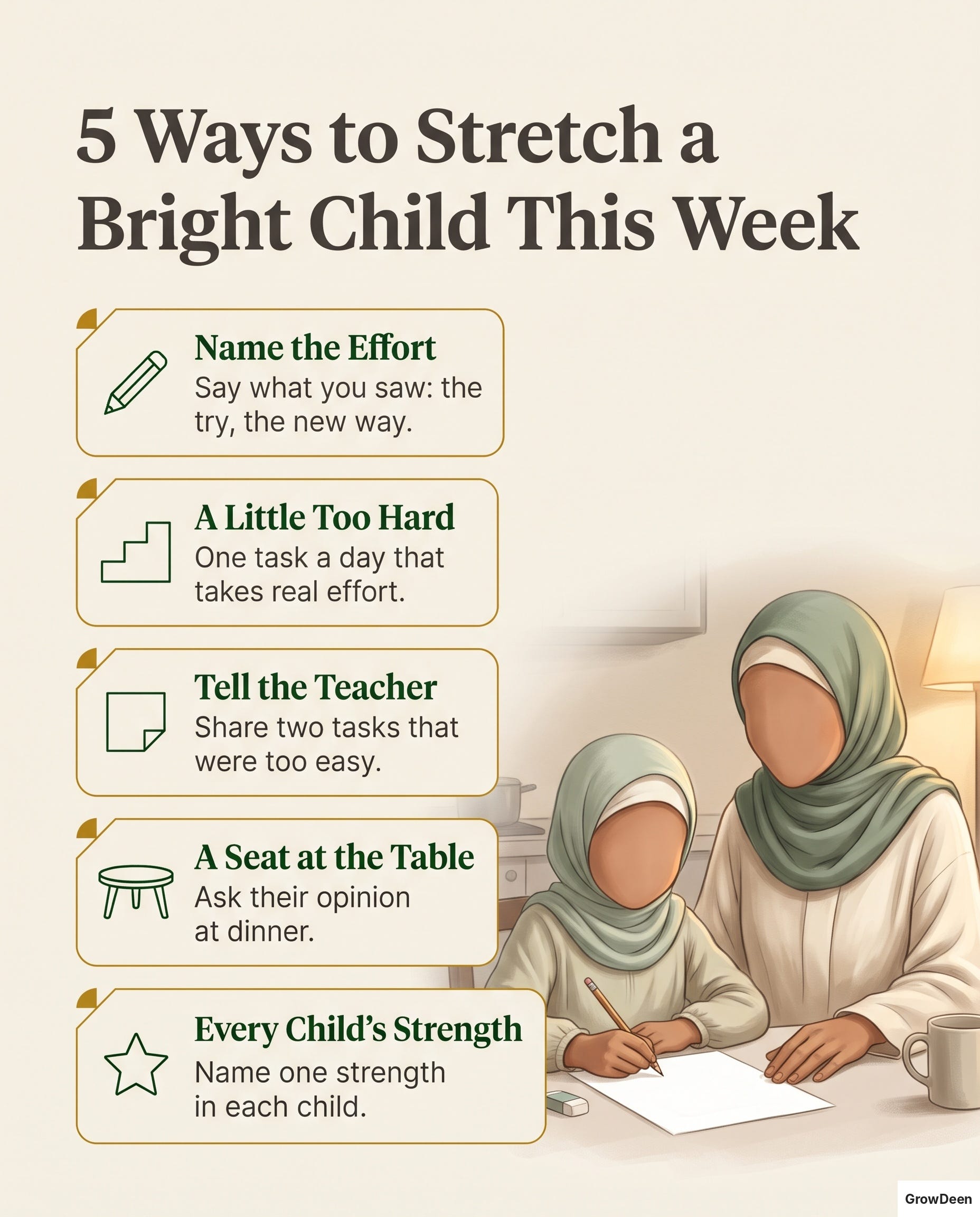
If you can only do one thing, do step 1. It is enough.
1. Name the effort, not the brain (1 minute). Specific words about effort help a child read a hard moment as part of learning. [1,2]
Say this: "You tried three different ways before that verse stuck." (Say it in the language your child knows best.)
More lines to borrow:
"You kept stacking, even when the tower fell."
"You sounded that word out slowly. That was careful."
"You checked your answer a second way."
Instead of: "You're so smart." Try: "You stuck with that, even when it got hard."
When relatives praise your child's brain, many families say mashaAllah (what Allah has willed), which hands the credit back to Allah.
2. Give one task a little too hard (10 minutes, most days). A child who never meets hard work never gets to practice effort. Choose one thing a step past what comes easily.
Say this, when they get stuck: "This is the stretchy part. Let's try one more way together."
3–5: a puzzle with a few more pieces, or a longer surah to listen to.
6–8: one problem from the next workbook page, or a new library book.
No money for classes? Use the library, the masjid and a box of cardboard.
3. Tell the teacher what is too easy (once this week, 10 minutes). Write down two tasks your child finished with no effort this week, and take the list to the teacher.
Say this to the teacher: "Thank you for all you do for her. These two tasks came easily this week. Could she try something a little harder in that subject?"
3–5: ask the preschool teacher about a harder puzzle or books for older children.
6–8: ask what extension work or ability groups the school offers. [9]
4. Make a seat at the grown-up table (dinner, 5 minutes). Ask your child's opinion, and let the adults listen to the whole answer.
Say this: "What do you think? I want to hear all of it."
When questions run past what you know, say so. Look it up together, at the library or with the imam after Jumu'ah (Friday prayer). When they ask "Why do I have to?", give the reason once and keep the rule.
5. Name a strength in every child, and guard the rest (once a week). Tell each of your children, by name, one strength you noticed this week.
Say this: "Maryam, you were so patient with the baby today. That's a gift."
Then check the week holds free play and rest. A crammed timetable can tire a child and teach them their worth lives in performing.
Make It Work in Your Home
On your own, or working nights? Steps 1 and 4 fit into moments you already have, such as the ride home or bedtime.
Several children? Give each one ten minutes alone with you each week, even a walk to the store.
A spouse who sees it differently? Say this to your spouse: "You see her gifts so clearly. Could we both try one thing this week: name what she did, not how smart she is?"
Grandparents who gush? Say this to Grandma: "Mama, she lights up when you notice her. Could we say mashaAllah, then tell her what she worked hard on?"
The family question: ask your own parent, "What were you praised for as a child, and how did it feel?"
Try It Seven Times
Any seven times in the next week or two, name the effort instead of the brain. Seven is a starting goal, with nothing special about the number. Put one tick and one word in the planner's "stuck moment" row each time. Tell us in the comments what your child said. We'd love to know.
Name the gift, then give it work: a little too hard, and named out loud.
If Things Don't Go to Plan
If they still say "I'm bad at this": make the next task a little smaller, and name the effort again. Old words take time to fade.
If it only improves a little: a few more seconds before giving up is real progress.
If you start doubting yourself: Did all that praise ruin her? No. You were doing your best with what you were told, and your noticing was love. The swap starts with the next sentence you say.
If big worries keep them awake ("What if the world ends?"): choose one small action together, such as planting a seed. Make du'a (supplication, asking Allah) together, then leave the outcome with Allah.
If they are far ahead but reading stays hard ("I can't read it, but I can build it"): note what is hard. Ask the school and your child's doctor about an assessment, rather than waiting.
If you lose your patience: it happens to every parent. Sit back down and say, "I'm sorry I snapped. Let's look at it together."
And you? Keeping pace with a gifted child takes time, energy and often money. Protect your own sleep and a little time for worship. Nobody expects you to fund every class.
Speak to someone if:
you'd like a formal assessment to plan schooling;
your child is far ahead in some areas but struggles to read, write, hear or concentrate; [13]
worry or low mood lasts for weeks, or your child refuses school or pulls away from friends;
perfectionism stops them starting or finishing work;
loneliness is making them unhappy.
Signs are clearer looking back. Seeing them late is not neglect. For questions of deen, ask your local imam or a local scholar, and share the details with him.
Who to turn to: your child's doctor or pediatrician, and for learning, the school's learning support staff or a child psychologist. In an emergency, including any talk of self-harm, call your local emergency number.
Support Muslim Parenting Lab ❤️
Would you like the most rewarded kind of charity there is? Use the button below now, while you are well, rather than later.
Asked which charity is best, the Prophet ﷺ said the one given while you are healthy, not deferred until death is near. (Sahih al-Bukhari 1419)
Your Companion Pack: Gift to Talent Kit
Free to download: one PDF, three pages, made for the fridge.
Page 1, The Weekly Stretch Planner: a seven-day grid to fill in with a pencil after dinner. Its rows: a little too hard, the stuck moment, practice minutes, a grown-up table moment, a sibling spotlight, and free play or rest.
Page 2, When a Bright Child Gets Stuck: six things bright children say, from "This is boring" to "I can't read it, but I can build it." Each comes with what may be going on and one thing to try tonight.
Page 3, Two Moments That Honored a Gift: the Prophet ﷺ naming his Companions' strengths, and 'Umar seating young Ibn 'Abbas among the elders. Each card ends with one thing to try this week.
Parents Also Ask
What are the signs of a gifted child?
Common early signs include advanced speech, self-taught letters or numbers, deep questions, a strong memory and a liking for older company. [6] Why This Happens lists signs by age.
Should I tell my child they are smart?
In studies, children praised for being smart kept trying less after a setback than children praised for effort. [2] Describe what they did instead: the new way they tried, or the time they put in.
Why does my gifted child give up so easily?
Often because hard work is new to them. A child who has rarely needed effort can read a hard task as proof they are not smart. A task a little too hard, most days, and effort named out loud, can help.
Can a child be gifted and have ADHD, autism or dyslexia?
Yes. These children are called twice-exceptional, and each side can hide the other. [12,13] A strengths-based approach that supports both is recommended. [13] Ask the school and your child's doctor about an assessment.
Is skipping a grade good for gifted children?
A review of about a century of studies found accelerated students did better than similar-age peers who were not accelerated. [8] Whether it suits your child depends on their maturity and on what else the school offers, so talk it through with the teacher. [9]
Are gifted children more likely to have anxiety or depression?
A 2024 review found no significant difference between gifted people and others, though results varied between studies. [14] Lasting worry or low mood still deserves a talk with your child's doctor.
What does Islam say about gifted children?
Text: Allah raises some above others in degrees, to test them through what He has given [17], and the Prophet ﷺ named his Companions' strengths. [20] Our reflection: a child's gift is something the family is entrusted with, to notice and to put to good use. For a question about your own family, ask your local imam or a local scholar, and share the details with him.
Final Reflection
Dear parent,
You noticed your child's gift early. You read to the end of a long guide to help it grow. That care shows.
Go back to the seven-year-old at the table. She was not short of ability. For years she heard she was smart, and she rarely met work that needed effort. So when a problem didn't open straight away, she drew the only conclusion she had. If smart means easy, then hard must mean not smart.
That was never a failure of your love. Your child doesn't have to represent anyone. They can be ordinary on a lazy afternoon.
Start with step 1 tomorrow. Name one effort you see, out loud, with the intention of honoring what Allah gave.
Often, a bright child doesn't quit because the work is hard, but because hard was never part of "smart."
A Du'a for This
For you:
رَبِّ أَوْزِعْنِىٓ أَنْ أَشْكُرَ نِعْمَتَكَ ٱلَّتِىٓ أَنْعَمْتَ عَلَىَّ وَعَلَىٰ وَٰلِدَىَّ وَأَنْ أَعْمَلَ صَـٰلِحًا تَرْضَىٰهُ وَأَصْلِحْ لِى فِى ذُرِّيَّتِىٓ ۖ
Rabbi awzi'nī an ashkura ni'mataka allatī an'amta 'alayya wa 'alā wālidayya wa an a'mala ṣāliḥan tarḍāhu wa aṣliḥ lī fī dhurriyyatī.
"My Lord, enable me to be grateful for Your favor which You have bestowed upon me and upon my parents and to work righteousness of which You will approve and make righteous for me my offspring."
Al-Ahqaf 46:15 · Sahih International [24]
With your child: Rabbi zidnī 'ilmā, "My Lord, increase me in knowledge." (Ta-Ha 20:114) [25] Say it together before homework or a new, hard task. It suits ages 3–8; a younger child can echo one word at a time.
Share the Khayr
Think of one parent who needs this. Maybe the mother whose son finishes early and is now in trouble for being "disruptive." Or the uncle who calls his daughter a genius at every gathering. Send this to them. The Prophet ﷺ said that whoever guides to something good has a reward like the one who does it. [26]
Tell us in the comments: what did your child say the first time you named the effort instead? We'd love to know.
Parents Also Read
Parents who read this guide also found these helpful.


References
[1] Kamins, M. L., & Dweck, C. S. (1999). Person versus process praise and criticism: Implications for contingent self-worth and coping. Developmental Psychology, 35(3), 835–847.
[2] Mueller, C. M., & Dweck, C. S. (1998). Praise for intelligence can undermine children's motivation and performance. Journal of Personality and Social Psychology, 75(1), 33–52.
[3] Cimpian, A., Arce, H.-M. C., Markman, E. M., & Dweck, C. S. (2007). Subtle linguistic cues affect children's motivation. Psychological Science, 18(4), 314–316.
[4] Gagné, F. (2020). Differentiating giftedness from talent: The DMGT perspective on talent development (1st ed.). Routledge.
[5] Clark, B. (2012). Growing up gifted: Developing the potential of children at school and at home (8th ed.). Pearson.
[6] Porter, L. (2005). Gifted young children: A guide for teachers and parents (2nd ed.). Routledge.
[7] Ballam, N., & Sturgess, A. (2019). Meeting the needs of gifted learners who just don't 'fit': Parent perspectives. Australasian Journal of Gifted Education, 28(2), 6–16.
[8] Steenbergen-Hu, S., Makel, M. C., & Olszewski-Kubilius, P. (2016). What one hundred years of research says about the effects of ability grouping and acceleration on K–12 students' academic achievement: Findings of two second-order meta-analyses. Review of Educational Research, 86(4), 849–899.
[9] Callahan, C. M., & Hertberg-Davis, H. L. (Eds.). (2017). Fundamentals of gifted education: Considering multiple perspectives (2nd ed.). Routledge.
[10] Olszewski-Kubilius, P., Subotnik, R. F., & Worrell, F. C. (Eds.). (2018). Talent development as a framework for gifted education: Implications for best practices and applications in schools (1st ed.). Routledge.
[11] Silverman, L. K. (Ed.). (2002). Counseling the gifted and talented. Love Publishing Company.
[12] National Association for Gifted Children. (n.d.). Celebrating twice-exceptional (2e) learners on International Day of Persons with Disabilities. National Association for Gifted Children.
[13] National Association for Gifted Children. (2026). Identifying and serving gifted children who are twice exceptional. National Association for Gifted Children.
[14] Duplenne, L., Bourdin, B., Fernandez, D. N., Blondelle, G., & Aubry, A. (2024). Anxiety and depression in gifted individuals: A systematic and meta-analytic review. Gifted Child Quarterly, 68(1), 65–83.
[15] Dweck, C. S. (1999). Caution: Praise can be dangerous. American Educator, Spring 1999. American Federation of Teachers.
[16] Yeager, D. S., & Dweck, C. S. (2020). What can be learned from growth mindset controversies? American Psychologist, 75(9), 1269–1284.
[17] Qur'an, Al-An'am 6:165. Translation: Sahih International.
[18] Tafsir Ibn Kathir on Al-An'am 6:165.
[19] Sahih al-Bukhari 3493.
[20] Jami' at-Tirmidhi 3790. Graded: Sahih, by Darussalam.
[21] Sahih al-Bukhari 4970.
[22] Sahih al-Bukhari 617.
[23] Sahih al-Bukhari 2320.
[24] Qur'an, Al-Ahqaf 46:15. Translation: Sahih International.
[25] Qur'an, Ta-Ha 20:114. Translation: Sahih International.
[26] Sahih Muslim 1893a.
We combine scientific research with Qur’an and authentic Sunnah, and we cite our sources. Even so, this is general guidance and no substitute for a doctor who can examine your child.
Sources & confidence
The hadith in this guide are from Sahih al-Bukhari, Sahih Muslim and Jami' at-Tirmidhi (graded Sahih by Darussalam on sunnah.com). The Qur'an translation is Sahih International. Checked November 2026. Found a source that looks wrong? Email us at info@growdeen.com.
Words in this guide
effort praise (process praise) · scientific term: praise for what a child did, such as the way they tried or the time they put in.
ability praise (person praise, "you're so smart") · scientific term: praise that labels the whole child as clever or good.
gifted (high potential, advanced) · scientific term: natural ability well above average for a child's age.
talent · scientific term: a skill built from a gift through learning and practice.
asynchronous development · scientific term: thinking that runs ahead of a child's age while feelings and social skills keep pace with it.
twice-exceptional (2e) · scientific term: a gifted child who also has a disability, such as ADHD, dyslexia or autism.
acceleration (skipping a grade) · scientific term: moving a child ahead a year, or into an older class for one subject.
meta-analysis · scientific term: a study that pools the results of many earlier studies.
persistence · scientific term: keeping going when a task gets hard.
bright child · everyday term: a child who learns fast; parents often use it for a gifted child.
extension work · everyday term: harder tasks on the same topic the class is learning.
amanah · Islamic term: a trust from Allah, to be cared for.
du'a (doa) · Islamic term: supplication, asking Allah.
mashaAllah · Islamic term: "what Allah has willed," said to give the credit to Allah.
Sunnah · Islamic term: the example of the Prophet ﷺ in what he said and did.
surah · Islamic term: a chapter of the Qur'an.
tafsir · Islamic term: an explanation of the meaning of the Qur'an.
adhan · Islamic term: the call to prayer.
Jumu'ah · Islamic term: the Friday congregational prayer.
Companions (Sahabah) · Islamic term: the Muslims who met the Prophet ﷺ in his lifetime.
deen · Islamic term: the way of life Islam teaches.
khayr · Islamic term: good.
math (maths) · country word: the school subject of numbers.
pediatrician (paediatrician) · country word: a doctor for children.
grade (year) · country word: a year of school; fifth grade is about ages 10–11.
preschool (nursery) · country word: early education before school starts.
kindergarten (Reception, prep) · country word: the first year of school, around ages 5–6.
airplane (aeroplane) · country word: a plane.
paper-towel tube (kitchen-roll tube) · country word: the cardboard tube inside a roll of paper towels.
The sandwich cut into squares is the scene parents of early readers most need to see. A child who reads at three gets treated as seven in every room, and then everyone is surprised when the four-year-old shows up at the kitchen table. Reasoning and self-control grow on different schedules, and the second one won't be hurried by praise. Your "you tried a new way, and it worked" works because it's a report, not a grade. A child can argue with a grade. She can't argue with what you saw.