

Your child gave up and said she’s bad at everything? The free Hard Moment Pack helps you decide when to step in, and gives her a place to keep proof she can do hard things.
AGES 3–8 YEARS · 16 MIN READ
The picture tore. Or the tower fell. Or the shoelace won again.
A child who was happy four minutes ago is now face down on the rug. “I’m bad at everything,” she says into the carpet. Her father puts down his keys and stands in the doorway.
She was fine all day, and now one torn picture undoes her. Did we make her this fragile?
You are not watching a flaw in your child. You are watching her meet a hard moment, with you close by. What happens in the next ten minutes is small. It is also where the lesson lives.
This guide brings together scientific research and the Qur'an and authentic Sunnah. You’ll see why small things undo children, what Prophet Ya'qub told his sons, and what to say tonight.
The Short Answer
Right for your child? Ages 3–8 who give up or say “I’m bad at everything” after a small setback.
What’s probably happening: a tired child has hit the gap between trying and succeeding, and can’t think for now.
Try tonight (2 minutes): sit close, name the feeling (“That was so disappointing”), then ask, “What do you want to try next?”
You’ll know it’s working when: she comes back to the task, or to you, a little sooner. A few more tears along the way is not failure.
Get help if: big reactions last for weeks, stop her enjoying play, food or sleep, or skills she had are lost. Start with your child’s doctor or pediatrician.
The rest of this guide explains why, and what to do if it does not work.
How to Read This Guide
3 minutes: The Short Answer above is enough for tonight.
7 minutes: The Short Answer, then Knowledge in Practice and If Things Don't Go to Plan.
The whole guide: read on for the scientific research, the Qur'an and Sunnah, and the References.
To share: the bold lines and the pull quotes are made to be shared.
To listen: open this guide in the free Substack app and tap Listen.
Inside This Guide
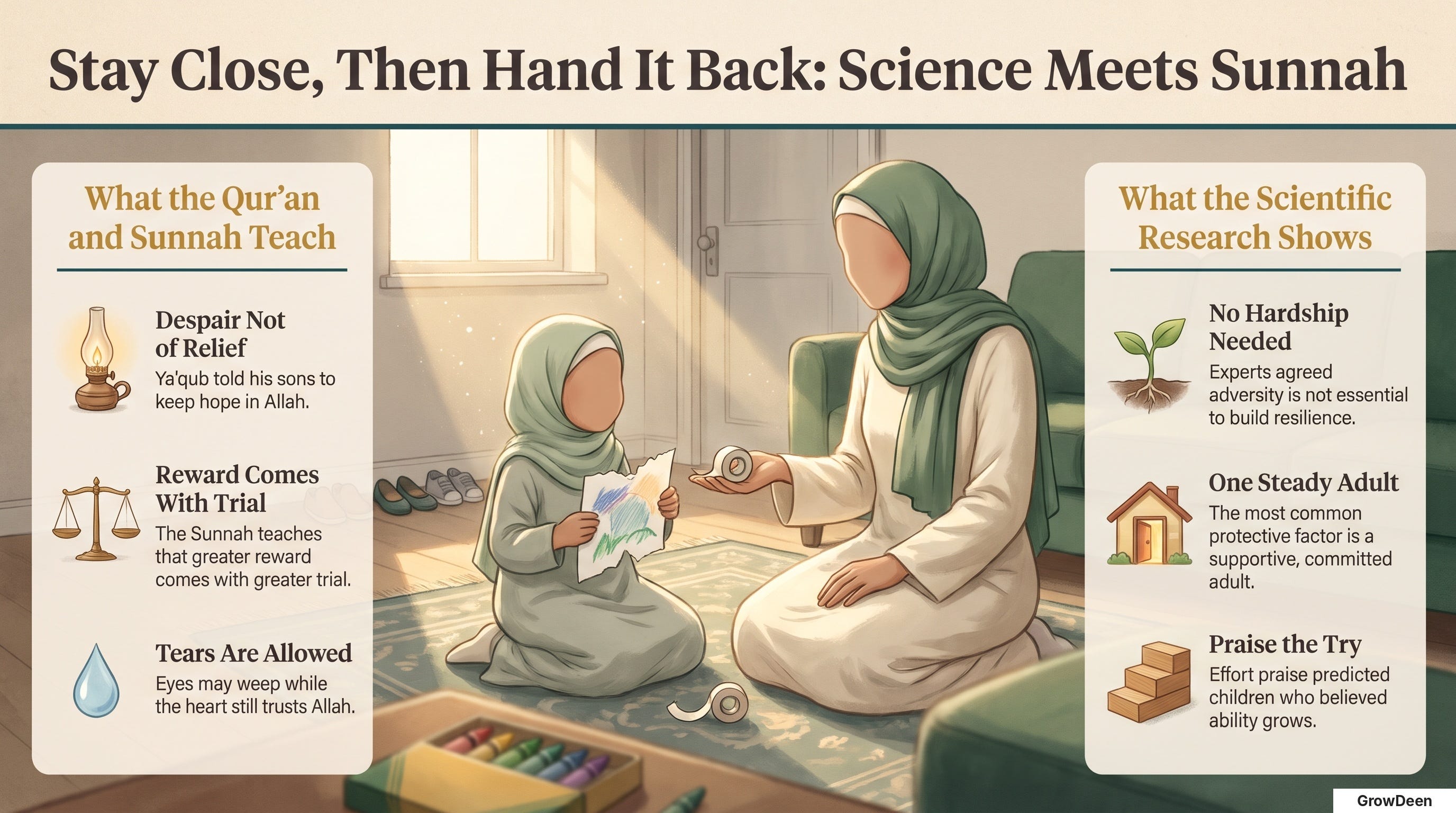
When your child falls apart over small things, she is practicing. The skill is still in progress.
Myth Check: “Children Need Hard Times to Become Tough”
Many of us were raised on this idea: leave them to struggle, and they will learn.
What it gets right. Children do grow by meeting hard things. Not all stress is harmful, and manageable stress, met with the help of supportive adults, can promote growth. [1]
What the evidence says. When 32 child development experts worked through a formal consensus process, they agreed on two points. Resilience is a process by which a child develops the capacity to adapt. And experiencing adversity is not essential to developing it. [2]
Harvard’s Center on the Developing Child pictures resilience as a balance scale: hard experiences on one side, protective experiences and coping skills on the other. [1] Your job is to load the protective side.
So: life will bring your child enough hard moments. You do not need to make more.
Why This Happens
Why does she cope with big things and fall apart over small ones?
A child can take a new baby in stride, then come undone over a torn picture. It is easy to read the small collapse as drama. More often, she is a tired child with nothing left in reserve.
Coping also shifts from one situation to the next. A child who copes well with one kind of hard thing may not cope the same way with another. [1] The experts who defined resilience described it as a process, one that keeps developing. [2]
There is a plainer reason, too. Big events often come with warning, explanation and extra adult attention. A torn picture comes with none of these, often at the end of a long day.
When should I step in, and when should I stay back?
One question does most of the sorting: can my child still think while this is happening? This is MPL’s working test, built on the idea of manageable stress. [1]
A child who is still trying is learning. A stuck puzzle or a shoe that won’t go on often sits inside the range where she can keep going. Stay close and say little.
A child who has gone rigid, is screaming, or has shut down has stopped learning for now. No lesson lands from there. That is the moment to help first and teach later.
So most hard moments sort into three groups. She handles it alone. She handles it with you nearby. Or you step in now. Things move between the groups as she grows.
Children show “I can’t think right now” in different ways. An autistic child, or a child who has lived through upheaval, may go silent instead of loud. Learn your own child’s signs.
The size of the problem matters less than one question: can your child still think right now?
What the Scientific Research Shows
The clearest finding is also the kindest. In a formal consensus study, 32 child development experts agreed that a child does not need to experience adversity to develop resilience. [2]
Who was studied: 32 experts in child development, not children; their countries are not given in the study summary. How strong this is: Suggestive (expert consensus).
What protects a child. Harvard’s Center on the Developing Child names the single most common factor among children who develop resilience. It is at least one stable and committed relationship with a supportive parent, caregiver or other adult. [1] These relationships give responsiveness, scaffolding and protection. They also build skills such as the ability to plan, monitor and regulate behavior. [1] Strong ties with other important adults in the family and community help too. [1]
How strong this is: Suggestive (expert summaries, much of it about children facing serious hardship).
Am I making my child anxious by protecting her? A meta-analysis of 47 studies found that parenting as a whole accounted for about 4% of the variation in children’s anxiety. [3] In the 7 studies that measured it, how much age-appropriate independence parents allowed (autonomy granting) accounted for 18%. Warmth accounted for under 1%. [3]
The studies were correlational, and the evidence fits both directions: parenting shaping anxiety, and anxious children drawing more protection from parents. [3]
Who was studied: 12,879 children aged 2 to 18, in the US and other countries. Where ethnicity was reported, samples were mostly white. Some children had anxiety disorders, and results did not differ by family income or country. How strong this is: Strong that the overall link is small; the 18% figure rests on 7 studies.
How you answer the feeling. A meta-analysis of 49 studies with 6,270 children looked at how parents respond to emotions. It found a small link with children’s conduct problems, stronger at younger ages. [4] A 2025 meta-analysis found that supportive responses had a tiny link with fewer anxious or low moods. Dismissing or punishing responses had a medium link with more. [5] Who was studied: children from birth to 18 across many studies; countries, income and additional needs are not given in the study summaries. How strong this is: Strong for these links, though they show association only.
What we do not know yet: no study has yet tested this with Muslim families.
What this means for you: stay close, keep the feeling safe to show, and let her make the next try herself.
What the Qur'an and Sunnah Teach
Islam does not read a hard day as proof that a life has gone off course.
أَحَسِبَ ٱلنَّاسُ أَن يُتْرَكُوٓا۟ أَن يَقُولُوٓا۟ ءَامَنَّا وَهُمْ لَا يُفْتَنُونَ
Do the people think that they will be left to say, "We believe" and they will not be tried?
Al-'Ankabut 29:2 · Sahih International [6]
Text. Ibn Kathir explains that Allah will test His believing servants, and that the testing makes known who is sincere. [7]
The Qur'an also records a father speaking to his children in the middle of a loss. Having lost one son and then another, Prophet Ya'qub sends his sons out again.
يَـٰبَنِىَّ ٱذْهَبُوا۟ فَتَحَسَّسُوا۟ مِن يُوسُفَ وَأَخِيهِ وَلَا تَا۟يْـَٔسُوا۟ مِن رَّوْحِ ٱللَّهِ ۖ إِنَّهُۥ لَا يَا۟يْـَٔسُ مِن رَّوْحِ ٱللَّهِ إِلَّا ٱلْقَوْمُ ٱلْكَـٰفِرُونَ
O my sons, go and find out about Joseph and his brother and despair not of relief from Allah. Indeed, no one despairs of relief from Allah except the disbelieving people.
Yusuf 12:87 · Sahih International [8]
Text. Ibn Kathir explains that Ya'qub encouraged his sons and ordered them not to despair of Allah’s mercy. He told them never to stop trusting in Him for what they seek. [9]
The Prophet ﷺ gave this the shape of reward:
"Indeed greater reward comes with greater trial. And indeed, when Allah loves a people He subjects them to trials, so whoever is content, then for him is pleasure, and whoever is discontent, then for him is wrath."
Jami' at-Tirmidhi 2396 · Hasan (Darussalam) · sunnah.com [10]
Our reflection. Contentment here is the heart’s trust in Allah, and it leaves room for tears. When his young son Ibrahim was dying, the Prophet ﷺ wept. He said, "The eyes are shedding tears and the heart is grieved, and we will not say except what pleases our Lord" (Sahih al-Bukhari 1303). [11] A crying child is not a discontented child. She is a child who needs you close.
Our reflection. Notice what is missing from all three texts: nobody is told to make the trials. They come from Allah, in His time. Your part is to stay steady when they come, and point your child back to hope.
Hard things come from Allah, in His time. Your job is to stay steady when they come.
The Lab Verdict
The science: children do not need hardship to build resilience, and one steady, supportive adult is the most common protective factor. (Suggestive)
The Qur'an and authentic Sunnah: trials come from Allah, in His time. A father’s words point his children to hope in Allah’s relief, and reward comes with trial.
Where they meet: the science shows that a steady adult and small practice build coping; the Sunnah gives the spirit of hope and patience. They meet in presence: staying close, then handing it back.
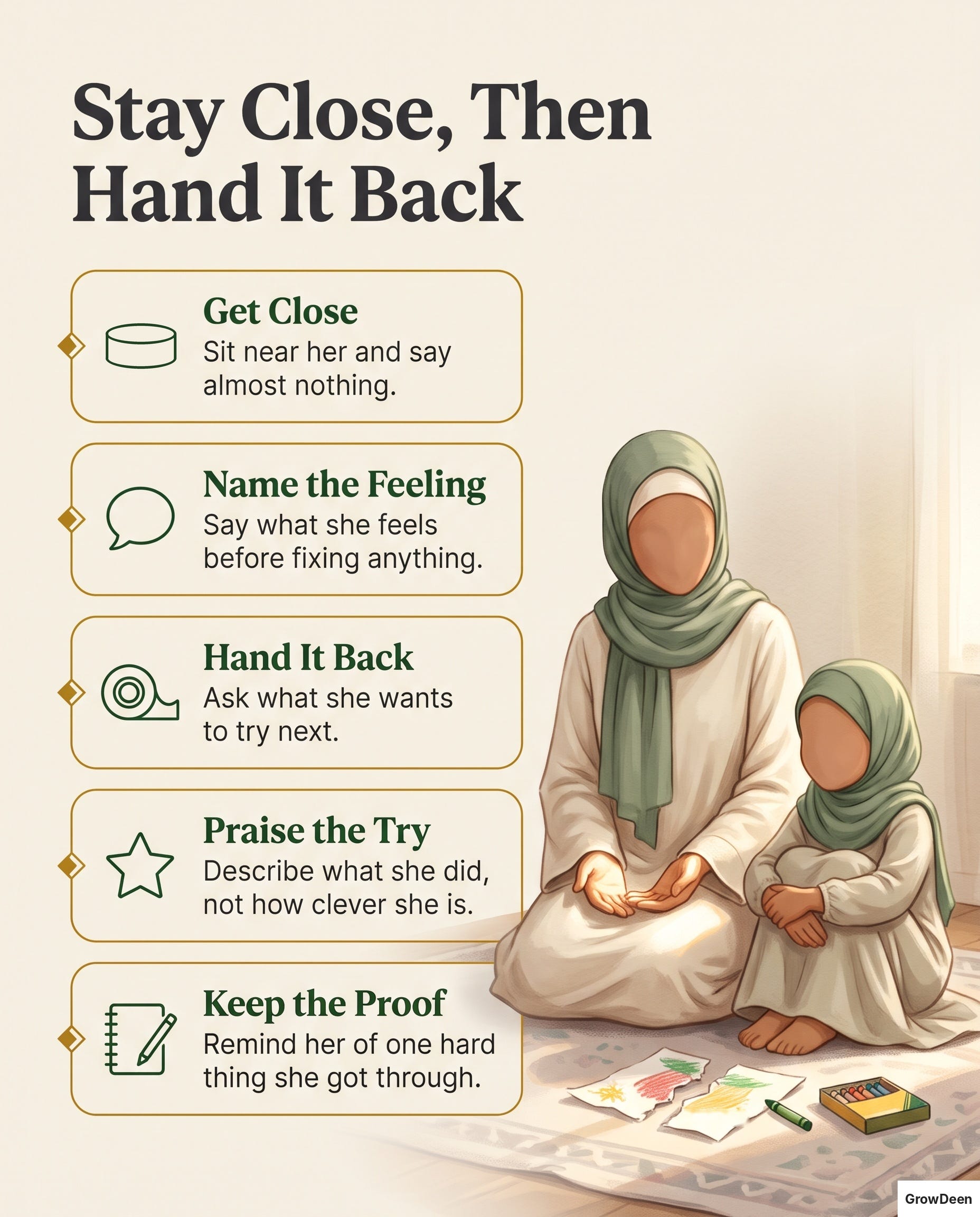
So at home: stay close, name the feeling, and hand the next try back to your child.
Knowledge in Practice: Stay Close, Then Hand It Back
Knowing why this happens is half the work. Knowledge bears fruit only when it reaches the rug.
If you can only do one thing, do step 1. It is enough.
1. Get close and say almost nothing (1 minute). Your calm body tells her she is safe before any words can.
Say this: “I’m here.” (Say it in the language your child knows best.)
Let the crying run for a minute with no correction on top of it.
3–5: sit on the floor at her level, and keep your hand open near hers. 6–8: sit beside her and wait for her to look up.
2. Name the feeling before you fix anything (30 seconds). In a brain-imaging study of adults, putting feelings into words lowered activity in the amygdala, a brain area that reacts to emotional images. [12] Naming may help the settling start. How strong this is: Suggestive, and tested only in adults.
Instead of: “Don’t be silly, you’re good at lots of things.” Try: “That was so disappointing. You wanted it to work.”
More lines to choose from:
“You’re frustrated. It tore right when you were nearly done.”
“That felt so hard.”
“You wanted the tower to stay up.”
For older children: “It’s annoying when your hands won’t do what your head pictured.”
You do not need the perfect sentence. Not dismissing the feeling matters more than the best words. [5]
3. Hand the problem back (2 minutes). Use the one question: can she still think? If yes, give her the next move. The American Academy of Pediatrics advises letting children make decisions, and treating discipline as teaching, so a child sees that her actions lead somewhere. [13] How strong this is: Suggestive (expert guidance).
Say this: “What do you want to try next?” If nothing comes, offer two choices: “Tape, or a new sheet?”
If she cannot think yet, go back to step 1. Help first. Teach later.
Then say Bismillah together before the next try (3 seconds). Our reflection: she learns that beginning again is done in Allah’s name.
4. Praise the try, and describe it (10 seconds). One study recorded the praise parents gave toddlers aged 14 to 38 months. More praise for effort predicted children who, at 7 to 8, believed ability grows with work. [14] How strong this is: Suggestive (one study of 53 families; their country and background are not given in the study summary).
Instead of: “You’re so clever.” Try: “You started again after it tore, and you held the corner this time.”
5. Keep the proof (30 seconds, once she is calm). Remind her out loud of one hard thing she got through. “You didn’t want to go into the new class. You went in anyway.” Write it down or let her draw it, so next time you have something real to point to.
Then let practice stay small. A review of programs for children aged 4 to 12 found that the ones that worked used repeated practice and a challenge that kept rising. Children with the weakest starting skills gained the most. [15] How strong this is: Suggestive (a review). At home, that can be pouring her own water or carrying her own plate.
Make It Work in Your Home
On your own most evenings, or working the night shift? Do step 5 at breakfast instead. Thirty seconds over cereal counts.
Several children? An older sibling may laugh at the meltdown. Give the older one a job: “Can you find the tape for your sister?” Helping is easier than teasing.
A grandparent who rescues, or one who says “toughen up”? Both come from love. Keep the request small.
Say this to Grandma: “Mama, she trusts you so much. When she gets stuck, could you sit with her and ask what she wants to try next? She tries harder when you’re near.”
Say this to your spouse: “Can we both try one thing this week? We name the feeling first and fix nothing for a minute.”
The family question: ask your own parent, “What did you do when I gave up as a child? What do you wish someone had said to you?”
Try It Seven Times
Any seven times in the next week or two, when a small thing goes wrong, try steps 1 to 3. Seven is only a starting goal. Make one mark and one word for what you noticed. Count how often you nearly fixed it for her. Tell us in the comments what changed.
Stay close. Then hand it back.
If Things Don't Go to Plan
If she shouts “Go away”: move back a little, and stay in the room. “I’ll be right here when you want me.”
If she won’t try again today: that is allowed. Keep the torn picture safe and offer the next try tomorrow. Returning a little sooner is real progress.
If you start doubting yourself: Have I already made her fragile? The evidence is gentler than that fear: parenting explains only a small share of children’s anxiety. [3] Work on safe independence, and let go of blaming yourself for her temperament.
If you lose your patience: it happens to every parent. Come back and say, “I’m sorry I snapped. That was hard for both of us. Want to try it together?” Repair is part of the lesson.
If the hard thing cannot be fixed: an illness in the family, a move, a loss. Do not rush to make it disappear, and do not leave her alone with the part that frightens her most. Sit with her, and ease what can be eased.
Speak to someone if: big reactions last weeks, or she stops enjoying things she loved. The same goes if sleep or eating change, worry keeps her from preschool or friends, or skills she had slip away. If she talks about hurting herself, call your child’s doctor the same day. For questions of deen, ask your local imam or a local scholar, and share the details with him.
Who to turn to: your child’s doctor or pediatrician, who may suggest a counselor or family therapist. In an emergency, call your local emergency number.
Support Muslim Parenting Lab ❤️
Is there something in your record you would like wiped? Give any amount today with the button below.
The Prophet ﷺ said charity extinguishes sin as water extinguishes fire. (Jami' at-Tirmidhi 2616, hasan)
Your Companion Pack: The Hard Moment Pack
Free to download: one PDF, three printable pages, made for the fridge.
Page 1, The Stretch Zone Sorter: write down what your child is facing this week. Sort each one into “They handle it alone”, “They handle it with me nearby” or “I step in now”. The one question (can my child still think?) is printed on the page. Re-sort it every Sunday.
Page 2, I Got Through It: a child-facing chart with twelve boxes. Each time she gets through something hard, she writes or draws it, and a grown-up adds the date. When the next hard thing comes, read box 1 out loud.
Page 3, When Nothing Can Be Fixed: Prophet Ya'qub’s words to his sons (Yusuf 12:87) and the hadith on reward and trial. Three short lines to hold for the nights the hard thing has no solution.
Parents Also Ask
Why does my child say “I’m bad at everything” after one small mistake?
Often she is tired, the setback came with no warning, and she has run out of room to think. It is usually a feeling about this moment. Why This Happens explains more.
Do children need to go through hardship to become resilient?
No. Child development experts agreed in a formal consensus study that experiencing adversity is not essential to developing resilience. [2] Manageable difficulty with you nearby is useful practice. Hardship you create on purpose is not a stronger version of it.
How do I know when to step in and when to let my child struggle?
Ask whether she can still think. A child who is still trying is in the useful range, so stay close and say little. A child who has gone rigid, is screaming or has shut down has left it, and that is the moment to help.
Is it bad to tell my child they’re clever?
It has not been shown to be harmful. In the study most people cite, early praise of traits was not linked with later fixed beliefs. Early praise for effort was linked with believing ability grows. [14] Describing what she did is still the stronger habit.
What should I do when the hard thing cannot be fixed, like a serious illness in the family?
Respect your child’s endurance, and ease what can be eased. A woman with epilepsy came to the Prophet ﷺ; he offered her patience with Paradise, or his du'a for a cure. She chose patience, then asked him to pray that she would not become uncovered, and he did. [16]
At what age can you start building resilience in a child?
Early. The capacities behind resilience can be strengthened at any age, and the brain is most adaptable early in life. [1] At 3, it looks like you naming the feeling and keeping practice tiny.
When should I talk to a doctor about my child’s big reactions?
When it lasts weeks rather than days, or changes her sleep, eating or enjoyment. Also if worry keeps her from preschool or friends, or skills she had slip away. Start with your child’s doctor or pediatrician.
Final Reflection
Dear parent,
You stopped what you were doing for a torn picture. Everything in this guide works through that care.
Maybe you have been fixing things fast, or telling her to toughen up. You were doing your best with what you were taught. Years of ordinary afternoons shape your child more than one hard evening.
You don’t need to change everything this week. Next time something tears, do step 1. Sit close and say almost nothing. Make your intention that she feels Allah’s mercy through you, and let that be enough.
Often, what she needs after “I’m bad at everything” isn’t a fix. It’s you close, then the problem handed back.
A Du'a for This
For you:
رَبِّ ٱشْرَحْ لِى صَدْرِى وَيَسِّرْ لِىٓ أَمْرِى
Rabbi-shraḥ lī ṣadrī, wa yassir lī amrī.
"My Lord, expand for me my breast [with assurance] and ease for me my task."
Ta-Ha 20:25–26 · Sahih International [17]
With your child: Inna ma'al-'usri yusrā, "Indeed, with hardship [will be] ease." (Ash-Sharh 94:6) [18]
Say it together, ages 3 and up, before the next try or at bedtime after a hard day.
Share the Khayr
Think of one parent. Maybe the mother at the school gate whose child “falls apart over nothing”, or a brother whose son keeps saying he is bad at everything. Send this to them today. The Prophet ﷺ said that whoever guides to something good has a reward like the one who does it. [19]
Tell us in the comments: what did your child try next, the first time you handed it back? We’d love to know.
Parents Also Read
Parents who read this guide also found these helpful.


References
[1] Center on the Developing Child at Harvard University. Resilience. Harvard University.
[2] Avdagic, E., Wade, C., McDonald, M., McCormack, D., Dakin, P., Macvean, M. L., Hayes, L., & Phan, T. (2020). Resilience in young children: A Delphi study to reach consensus on definitions, measurement and interventions to build resilience. Early Child Development and Care, 190(13), 2066–2077.
[3] McLeod, B. D., Wood, J. J., & Weisz, J. R. (2007). Examining the association between parenting and childhood anxiety: A meta-analysis. Clinical Psychology Review, 27(2), 155–172.
[4] Johnson, A. M., Hawes, D. J., Eisenberg, N., Kohlhoff, J., & Dudeney, J. (2017). Emotion socialization and child conduct problems: A comprehensive review and meta-analysis. Clinical Psychology Review, 54, 65–80.
[5] Brumariu, L. E., Nair, T. K., Waslin, S. M., Rodrigues, G. A., Moore, M. T., & Kerns, K. A. (2025). Parental emotion socialization and internalizing problems in childhood and adolescence: A meta-analytic review. Development and Psychopathology, 37(5), 2806–2826.
[6] Qur'an, Al-'Ankabut 29:2. Translation: Sahih International.
[7] Tafsir Ibn Kathir on Al-'Ankabut 29:2.
[8] Qur'an, Yusuf 12:87. Translation: Sahih International.
[9] Tafsir Ibn Kathir on Yusuf 12:87.
[10] Jami' at-Tirmidhi 2396. Graded: Hasan, by Darussalam.
[11] Sahih al-Bukhari 1303.
[12] Lieberman, M. D., Eisenberger, N. I., Crockett, M. J., Tom, S. M., Pfeifer, J. H., & Way, B. M. (2007). Putting feelings into words: Affect labeling disrupts amygdala activity in response to affective stimuli. Psychological Science, 18(5), 421–428.
[13] American Academy of Pediatrics. (2014). Building resilience in children. HealthyChildren.org.
[14] Gunderson, E. A., Gripshover, S. J., Romero, C., Dweck, C. S., Goldin-Meadow, S., & Levine, S. C. (2013). Parent praise to 1- to 3-year-olds predicts children’s motivational frameworks 5 years later. Child Development, 84(5), 1526–1541.
[15] Diamond, A., & Lee, K. (2011). Interventions shown to aid executive function development in children 4 to 12 years old. Science, 333(6045), 959–964.
[16] Sahih al-Bukhari 5652.
[17] Qur'an, Ta-Ha 20:25–26. Translation: Sahih International.
[18] Qur'an, Ash-Sharh 94:6. Translation: Sahih International.
[19] Sahih Muslim 1893a.
We combine scientific research with Qur’an and authentic Sunnah, and we cite our sources. Even so, this is general guidance and no substitute for a doctor who can examine your child.
Sources & confidence
The hadith in this guide are from Sahih al-Bukhari, Sahih Muslim and Jami' at-Tirmidhi (graded Hasan by Darussalam). Qur'an translations are Sahih International. Checked November 2026. Found a source that looks wrong? Email us at info@growdeen.com.
Words in this guide
resilience (bouncing back) · scientific term: the process by which a child builds the capacity to adapt when things are hard.
manageable stress (positive stress) · scientific term: a short, bearable difficulty, met with a supportive adult nearby, that can help a child grow.
affect labeling (naming feelings) · scientific term: putting a feeling into words, such as “That was disappointing.”
autonomy granting (age-appropriate independence) · scientific term: letting a child make choices and solve problems that suit her age.
process praise (effort praise) · scientific term: praise that describes what a child did, such as effort or strategy, rather than who she is.
meta-analysis · scientific term: a study that combines the results of many studies on one question.
amygdala · scientific term: a part of the brain that reacts to emotional and alarming things.
meltdown · everyday term: a moment when a child is too upset to think, talk or listen.
giving up easily (low frustration tolerance) · everyday term: stopping a task as soon as it goes wrong.
Bismillah · Islamic term: “in the name of Allah”, said before beginning something.
du'a (doa) · Islamic term: supplication, asking Allah.
deen · Islamic term: the way of life of Islam.
khayr · Islamic term: good.
Ya'qub · Islamic term: the Prophet Jacob, father of the Prophet Yusuf (Joseph).
pediatrician (paediatrician) · country word: a doctor for babies and children.
behavior (behaviour) · country word: the way a person acts.