

Your child's game falls apart the moment you join in?
The free Play Talk Pack gives you twelve swaps that keep the game going.
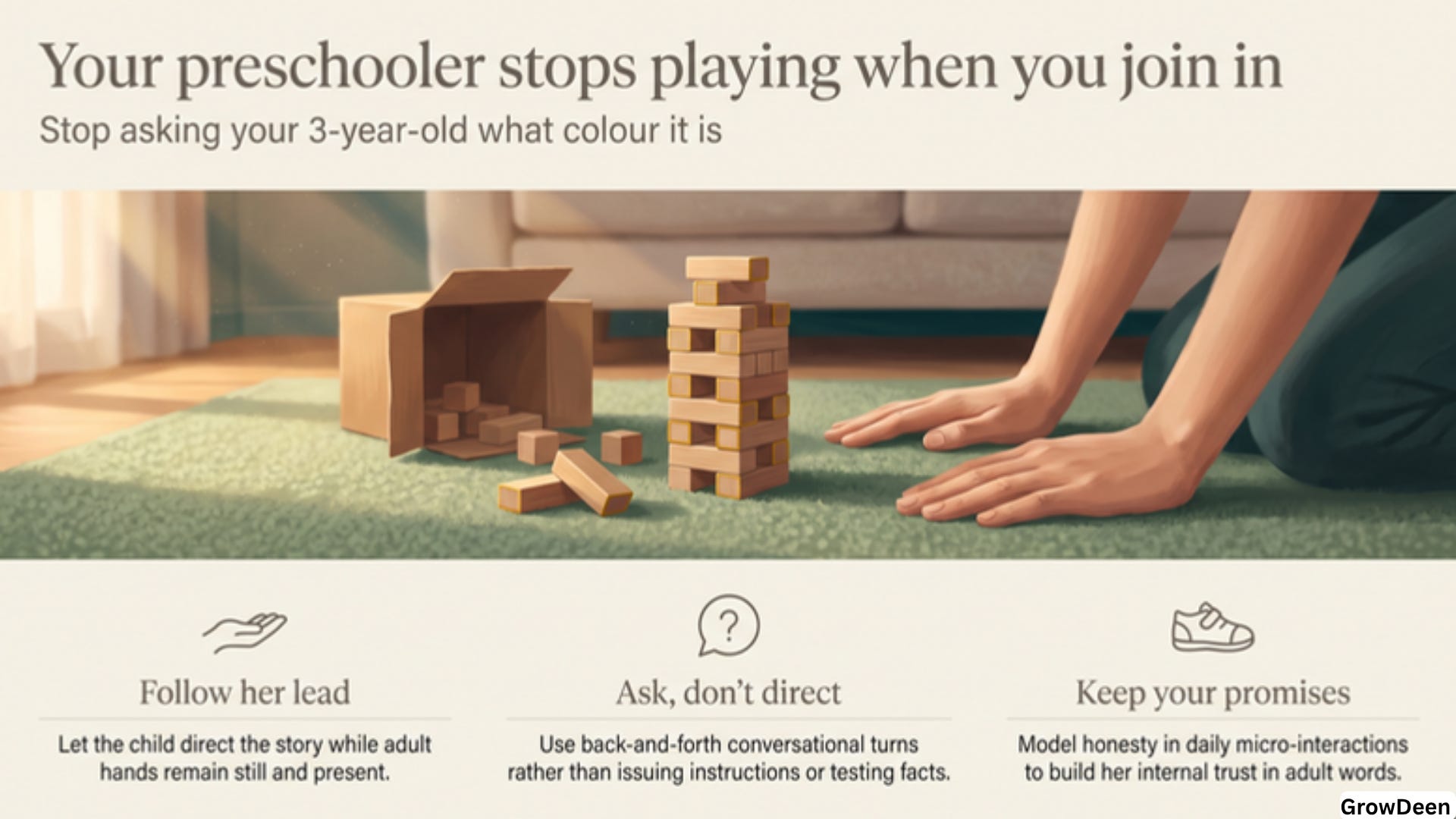
AGES 3–5 YEARS · 14 MIN READ
It is late afternoon. Your daughter has been playing the same game for twenty minutes.
The toy bus is broken. She has explained why to a cushion, four times.
You sit down to join in. You ask, "What color is the bus?"
She looks at you as if you walked into the wrong room. The game stops.
Am I supposed to be teaching her? Why does she stop when I help?
You were trying to help, and that is a good instinct. It only needs a different question.
This guide brings together scientific research and the Qur'an and authentic Sunnah. You'll see why your words matter more than the toy, and what to say instead.
The Short Answer
Right for your child? Children around ages 3 to 5 who play pretend, build or tell stories with toys.
What's probably happening: a question with one right answer turns play into a test. The game ends.
Try tonight (1 minute): ask one question about something not in the room. "What happened to the bus before it broke down?"
You'll know it's working when: your child answers with a story, and keeps playing.
Get help if: your child rarely talks, seems far behind the age-4 milestones, or loses skills. Start with your child's doctor or pediatrician.
The rest of this guide explains why, and what to do next.
How to Read This Guide
3 minutes: The Short Answer above is enough for tonight.
7 minutes: The Short Answer, then Knowledge in Practice and If Things Don't Go to Plan.
The whole guide: read on for the scientific research, the Qur'an and Sunnah, and the References.
To share: the bold lines and the pull quotes are made to be shared.
To listen: open this guide in the free Substack app and tap Listen.
Inside This Guide
The blocks were never the lesson. What you say over them is.
Myth Check: "Play Time Should Be Teaching Time"
Many parents feel that every minute of play should teach something: colors, numbers, shapes.
What this belief gets right. Children do learn through play, and your involvement matters. Sitting on the floor with your child is time well spent.
What the evidence says. How you join in matters more than what you teach. A 2022 review compared guided play, where an adult supports a game the child leads, with direct teaching. [1]
Guided play did better on early math, shape knowledge and switching between tasks. For the other outcomes measured, no difference was found. [1]
So stay in the game, but let your child lead it. Your job is to follow, ask and wait.
Why This Happens
Why does my child stop playing when I ask questions?
"What color is the bus?" has one right answer. It is about what is in front of you. Once it is answered, there is nothing more to say.
To a child in the middle of a story, it can feel like a quiz. The game she was running gets replaced by yours.
A question about what is not in the room works differently. "What happened before it broke down?" has no right answer. It hands the game back to her.
What is my preschooler's brain building right now?
Three skills grow fast from about ages 3 to 5. They are holding a plan in mind, stopping an impulse, and switching when the old way fails. [2]
You see them in play. A child building a tower holds her plan in her head. When it falls for the third time, she widens the base instead of rebuilding it the same way.
By about age 4, most children name a few colors and tell what comes next in a story they know. Most draw a person with three or more body parts. [3] Your child is likely learning colors already, without a quiz.
Why does the kind of talk matter?
Some talk is about what you can see: the red bus, the tall tower. Some is about what you can't: what happened yesterday, what might happen next, why something works.
The second kind is called decontextualized talk. Pretend play is full of it. It asks a child to hold a whole world in her mind.
Ask about what isn't in the room. A question with no right answer keeps the game going.
What the Scientific Research Shows
The strongest finding is about the kind of talk, not the amount. In a US study, parents' talk about the past, the future, pretend and explanations was recorded when children were 30 months old. [4]
That talk predicted the children's vocabulary, sentence building and storytelling in kindergarten. This held beyond the children's own early language and their family background. [4]
It mattered most for children who started with weaker language skills. [4]
Who was studied: US families, including children with early brain injury and typically developing children · ethnicity and additional needs: not given in the study summary.
How strong this is: Suggestive. One long-running study. It shows a link, not a cause.
A second US study recorded 36 children aged 4 to 6 at home. Children who had more back-and-forth turns with adults showed more activity in a language area of the brain. [5]
This held regardless of family income and of how many words the children heard. Back-and-forth mattered more than the number of words. [5]
Who was studied: 36 children from families with a wide range of incomes · ethnicity and additional needs: not given in the study summary.
How strong this is: Early. One small study.
A third study followed 447 children from age 2 to age 4½. Mothers' warmth and responsiveness at age 2 predicted greater growth in the children's ability to stay focused. [6]
Who was studied: 447 US children from a larger long-term study · ethnicity and additional needs: not given in the study summary.
How strong this is: Suggestive. A large study that followed children for years. It shows a link, not a cause.
What we do not know yet: these studies were not done with Muslim families. The talk swaps in Knowledge in Practice come from this work and from everyday practice. They have not been tested as a program.
What this means for you: ask about what isn't in front of you, answer what your child offers, and stay warm. No class or toy is needed.
What the Qur'an and Sunnah Teach
A preschooler spends much of her day looking closely: at a beetle, a lid turned forty times, rain on a window. That looking has a place in Islam.
قُلِ ٱنظُرُوا۟ مَاذَا فِى ٱلسَّمَـٰوَٰتِ وَٱلْأَرْضِ
Say, "Observe what is in the heavens and the earth."
Yunus 10:101 · Sahih International [7]
Text. Ibn Kathir explains that Allah guides His servants to reflect on His blessings. He lists the sun and moon, night and day, and rain that brings dead earth to life. He adds fruits and crops, animals of different colors, and the sea. These are signs for those with correct understanding. [8]
The verse speaks to adults, not to children at play. We take a principle from it.
Our reflection. When you help your child notice what Allah has made, you are building an early habit of reflection. It does not take time away from her tarbiyah. It is part of it.
I am just a distributor, but the grant is from Allah.
Sahih al-Bukhari 71 · sunnah.com [9]
Text. Imam al-Bukhari placed this hadith in his Book of Knowledge. Its chapter is "If Allah wants to do good to a person, He makes him comprehend the religion." [9]
Our reflection. You arrange the conditions, offer the materials, answer the questions and make du'a. What grows in her understanding is from Allah. That is not a smaller job. It is a lighter one.
There is one more teaching that belongs in play: keep your word. Abdullah ibn Amir reported that his mother called him and promised him something. The Prophet ﷺ asked what she meant to give. She said dates. He told her that if she had given him nothing, a lie would have been recorded against her. [10]
Our reflection. "One more minute" and "We'll come back tomorrow" are promises too. Pretend play is different: you both know the sand is not soup. Promise only what you will do.
You arrange the conditions. What grows in her understanding is from Allah.
The Lab Verdict
The science: talk about what isn't in the room, back-and-forth turns and a warm, responsive parent are linked with stronger language and focus. Guided play beats direct teaching for some skills. (Suggestive; Early for brain findings)
The Qur'an and authentic Sunnah: Allah commands us to observe His creation; understanding is His gift; and a promise to a child is a promise.
Where they meet: the science shows that how you join in matters. The Qur'an and Sunnah give the reason to notice together, and the limit of truthfulness. Neither proves the other.
So at home: follow your child's lead, ask about what isn't in the room, wait for the answer, and keep your word.
Knowledge in Practice: Talk That Keeps the Game Going
Knowing why the game stops is half the work. Knowledge bears fruit only when it reaches your kitchen table.
If you can only do one thing, do step 1. It is enough.
1. Ask one question about something not in the room (1 minute). Pick a moment in her game. Ask about the past, the future or the reason. Then stop talking.
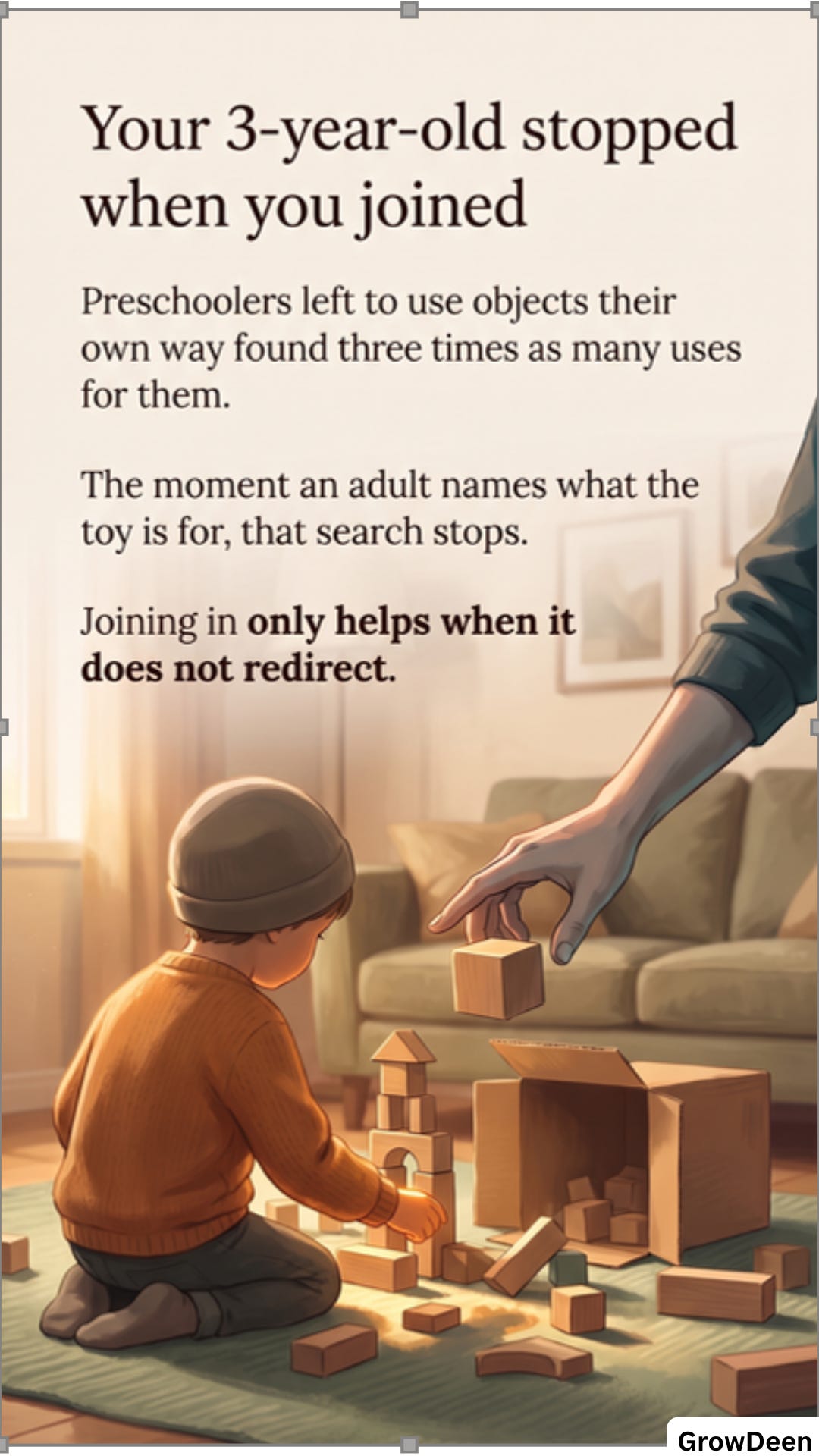
Say this: "What happened to the bus before it broke down?" (Say it in the language your child knows best.)
More questions you can use:
"Where is the bus going after it's fixed?"
"What do you think will happen if we put that on top?"
"What was different about yesterday's tower?"
"Who lives in that house?"
Instead of: "What color is the bus?" Try: "What happened to the bus before it broke down?"
Age 3: one short question is plenty. Accept any answer. Ages 4–5: ask "why" or "what if", and let the story grow.
2. Wait before you help (2 minutes). When her tower falls, count slowly to five in your head. She will often try something new. If she wants help, she will ask.
Say this: "I'll wait. Tell me if you want help."
3. Answer what she offers, not what you planned (5 minutes). If she holds up a block and says "cake", it is cake. Take a bite. Ask what flavor it is.
Answering what your child offers is sometimes called serve and return. She serves; you return.
Say this: "Mmm, cake. What kind is it? Who is it for?"
Instead of: "That's not how it works." Try: "Show me how it works in your game."
4. Notice one created thing together (10 minutes, once this week). Go for a short walk with no destination. Let her set the pace and stop where she wants. Find something smaller than a fingernail, or two leaves that are not the same.
Say this: "Look what Allah made. What do you notice about it?"
5. Keep every play promise small and true (all week). Before you say "one more minute", check you mean it. Count turns instead of minutes, then stop when you said you would.
Say this: "Two more turns, then we pack away."
Make It Work in Your Home
Working long hours? Step 1 fits into bath time or the drive home. One question, then wait.
More than one child? Give each child a turn to lead the game. The others follow, and you ask the questions.
Small home or no spare money? Pots, cushions, boxes and spoons are enough. Open-ended things invite more stories than toys with one use.
A grandparent helps with the children? Grandparents are often wonderful at stories. Ask them to tell your child what they played as a child.
Say this to your spouse: "Can we try asking one 'what happened next' question at playtime this week? Let's see what stories she tells."
Say this to Grandma: "Mama, she loves your stories. When you play with her, could you ask her what happens next in her game?"
The family question: ask an elder, "What did you play with when you were small, and who played with you?"
Try It Seven Times
Any seven times in the next week or two, ask one question about something not in the room, then wait. Seven is a starting goal, not a magic number.
Tell us in the comments what your child's answer was. We'd love to know.
Follow her game, ask about what isn't there, and wait: that is the whole practice.
If Things Don't Go to Plan
If she ignores your question: that's fine. She may be busy inside the story. Try again later, and keep it short.
If she wants you to play her way exactly: follow along. Being directed by a 4-year-old is part of the game.
If you feel silly pretending: most parents do. You don't need a voice or a costume. One question and a smile are enough.
If you start doubting yourself: Am I doing enough? Warmth and attention are linked with growth in focus. [6] Twenty unhurried minutes on the floor count.
If you made a promise you couldn't keep: say so. "You're right. I said that, and it didn't happen. That was my mistake."
Speak to someone if: your child rarely talks, seems far behind the age-4 milestones, or loses skills she once had. [3]
Signs are clearer looking back. Seeing them late is not neglect.
For questions of deen (the way of life of Islam), ask your local imam or a local scholar, and share the details with him.
Who to turn to: your child's doctor or pediatrician, or your child's preschool teacher. In an emergency, call your local emergency number.
Support Muslim Parenting Lab ❤️
Would you rather give a small amount that never stops than a large one you keep postponing? Set a monthly amount you are comfortable with, in a few seconds, using the button below.
The Prophet ﷺ said the deed most beloved to Allah is the most constant, even if little. (Sahih al-Bukhari 6464)
Your Companion Pack: The Play Talk Pack
Free to download. One PDF, three printable pages, made for the floor where the playing happens:
The Play Talk Swap Card: twelve things parents often say during play, each with what to try instead and what the swap builds.
The Hard Questions Script Sheet: truthful words for four questions preschoolers ask, about babies, death, sad news and broken promises, with what to avoid.
The Noticing Card: a reflection on Yunus 10:101 and Sahih al-Bukhari 71, with a ten-minute noticing walk for once a week.
Parents Also Ask
How do I play with my 3-year-old?
Let your child lead, and follow. Ask questions about what happens next or why, answer what they offer, and wait before helping. [1] Knowledge in Practice has the steps.
Is it bad to let my preschooler play alone?
No. Play alone gives children room for their own ideas. The scientific research on adult involvement compares guided play with direct teaching, not with play alone. [1]
What questions should I ask my child during play?
Ask questions with no right answer, about what isn't in the room: what happened before, what happens next, and why. Talk like this at 30 months predicted stronger language in kindergarten. [4]
How much screen time is okay for a 3- to 5-year-old?
For ages 3 to 4, the World Health Organization advises no more than 1 hour of sedentary screen time a day. Less is better. [11]
How much active play does a preschooler need?
For ages 3 to 4, WHO recommends at least 180 minutes of physical activity a day, with at least 60 minutes moderate to vigorous. [11]
Does reading with my child help their language?
Yes. In a review of 19 trials, programs that taught parents to share picture books improved children's language. The effect was small and depended on how much reading children got. [12]
What does Islam say about play and children's curiosity?
Text and our reflection. The Qur'an commands us to observe what is in the heavens and the earth (Yunus 10:101). [7] Helping your child notice creation builds that habit early. Keep your promises to your child: the Prophet ﷺ warned that a false promise to a child is a lie (Sunan Abi Dawud 4991). [10]
Final Reflection
Dear parent,
You sat down on the floor because you wanted to help your child learn. That instinct is a good one.
If you have been asking "what color is it?", you were doing what most of us were taught. You were trying to teach. Nothing was lost.
You don't need a new toy or a class. Tonight, ask one question about something that isn't in the room, and wait for the answer. Let that be enough.
Allah gives the understanding. You make the space for it.
The expensive version of play was never the necessary one. Your attention is.
A Du'a for This
For you:
وَقُل رَّبِّ زِدْنِى عِلْمًا
Wa qur-rabbi zidnī ʿilmā
"And say, 'My Lord, increase me in knowledge.'"
Ta-Ha 20:114 · Sahih International [13]
With your child: Rabbi zidnī ʿilmā, "My Lord, increase me in knowledge" (Ta-Ha 20:114). [13] Say it together before you open a book, from about age 3.
Share the Khayr
If you know a parent who feels guilty that they can't afford the classes others go to, send this to them. It is also for the friend who says she doesn't know how to play. The Prophet ﷺ said that one who guides to something good has a reward similar to that of its doer (Sahih Muslim 1893a). [14]
Tell us in the comments: what story did your child tell you this week? We'd love to know.
Parents Also Read
Parents who read this guide also found these helpful.


References
[1] Skene, K., O'Farrelly, C. M., Byrne, E. M., Kirby, N., Stevens, E. C., & Ramchandani, P. G. (2022). Can guidance during play enhance children's learning and development in educational contexts? A systematic review and meta-analysis. Child Development, 93(4), 1162–1180. (Review · Strong)
[2] Center on the Developing Child at Harvard University (n.d.). InBrief: Executive Function: Skills for Life and Learning. (US · Suggestive)
[3] Centers for Disease Control and Prevention (n.d.). Milestones by 4 Years. Learn the Signs. Act Early. (US · Strong)
[4] Demir, Ö. E., Rowe, M. L., Heller, G., Goldin-Meadow, S., & Levine, S. C. (2015). Vocabulary, syntax, and narrative development in typically developing children and children with early unilateral brain injury: Early parental talk about the "there-and-then" matters. Developmental Psychology, 51(2), 161–175. (US · Suggestive)
[5] Romeo, R. R., Leonard, J. A., Robinson, S. T., West, M. R., Mackey, A. P., Rowe, M. L., & Gabrieli, J. D. E. (2018). Beyond the 30-Million-Word Gap: Children's Conversational Exposure Is Associated With Language-Related Brain Function. Psychological Science, 29(5), 700–710. (US · Early)
[6] Graziano, P. A., Calkins, S. D., & Keane, S. P. (2011). Sustained attention development during the toddlerhood to preschool period: Associations with toddlers' emotion regulation strategies and maternal behavior. Infant and Child Development, 20(6), 389–408. (US · Suggestive)
[7] Qur'an, Yunus 10:101. Translation: Sahih International.
[8] Tafsir Ibn Kathir on Yunus 10:101.
[9] Sahih al-Bukhari 71.
[10] Sunan Abi Dawud 4991. Graded Hasan (Al-Albani).
[11] World Health Organization (2019). Guidelines on physical activity, sedentary behaviour and sleep for children under 5 years of age. (International · Strong)
[12] Dowdall, N., Melendez-Torres, G. J., Murray, L., Gardner, F., Hartford, L., & Cooper, P. J. (2020). Shared Picture Book Reading Interventions for Child Language Development: A Systematic Review and Meta-Analysis. Child Development, 91(2), e383–e399. (Review · Strong)
[13] Qur'an, Ta-Ha 20:114. Translation: Sahih International.
[14] Sahih Muslim 1893a.
We combine scientific research with Qur’an and authentic Sunnah, and we cite our sources. Even so, this is general guidance and no substitute for a doctor who can examine your child.
Sources & confidence
The hadith in this guide are from Sahih al-Bukhari, Sahih Muslim and Sunan Abi Dawud (graded Hasan). The Qur'an verses are quoted from Sahih International. Checked October 2026. Found a source that looks wrong? Email us at info@growdeen.com.
Words in this guide
du'a (doa): supplication
deen: the way of life of Islam
khayr: good
tarbiyah: raising and nurturing a child in Islam
Sunnah: the teachings and practice of the Prophet ﷺ
guided play: play the child leads, with an adult who supports it
decontextualized talk: talk about what is not here and now, such as the past, the future, pretend or reasons
serve and return: a child offers something, and the adult answers it
executive function: the skills of planning, self-control and switching between ideas
preschooler: a child aged about 3 to 5
pediatrician (paediatrician)
color (colour)