

Still sitting beside the bed until she falls asleep, every night? The free Chair Move Card shows where your chair goes next, and when.
AGES 6 MONTHS–5 YEARS · 16 MIN READ
It is 9:04pm and your arm has gone numb.
Bath at seven. Lights down. The protective du'a said quietly over the crib (cot). She was calm. She was almost gone.
Then you shifted your weight toward the door. She was upright and crying within two seconds.
If I stand up now, we start again from zero. How long can I keep doing this?
Needing you there is a learned habit, not a flaw in her or in you. Habits can change, slowly and kindly, with you still in the room.
This guide brings together scientific research and the Qur'an and authentic Sunnah. You'll see why she needs you there, and a gentle plan to step back.
The Short Answer
Right for your child? Ages 6 months to 5 years who need you beside them to fall asleep, and who are well, fed and comfortable. [1]
What's probably happening: she has learned that sleep arrives with you there, so she looks for you at bedtime and when she wakes. [2]
Try tonight (2 minutes to set up): put a chair beside her bed and settle her exactly as usual. Change nothing else yet.
You'll know it's working when: she falls asleep with a little less help at each step, over about three weeks. [3] Crying when the chair moves is part of the change, not failure.
Get help if: nothing improves after a few nights, she gets more upset, or she snores or pauses in her breathing. Start with your child's doctor or pediatrician.
The rest of this guide explains why, and what to do if it does not work.
How to Read This Guide
3 minutes: The Short Answer above is enough for tonight.
7 minutes: The Short Answer, then Knowledge in Practice and If Things Don't Go to Plan.
The whole guide: read on for the scientific research, the Qur'an and Sunnah, and the References.
To share: the bold lines and the pull quotes are made to be shared.
To listen: open this guide in the free Substack app and tap Listen.
Inside This Guide
You can stay close and still help her need you a little less each night.
Myth Check: "The Only Way Out Is to Let Her Cry Alone"
Many parents believe there are two choices. Stay every night until she sleeps, or close the door and let her cry it out.
What this belief gets right. Leaving a small child to cry alone feels hard, and plenty of loving parents will not do it. That instinct deserves respect.
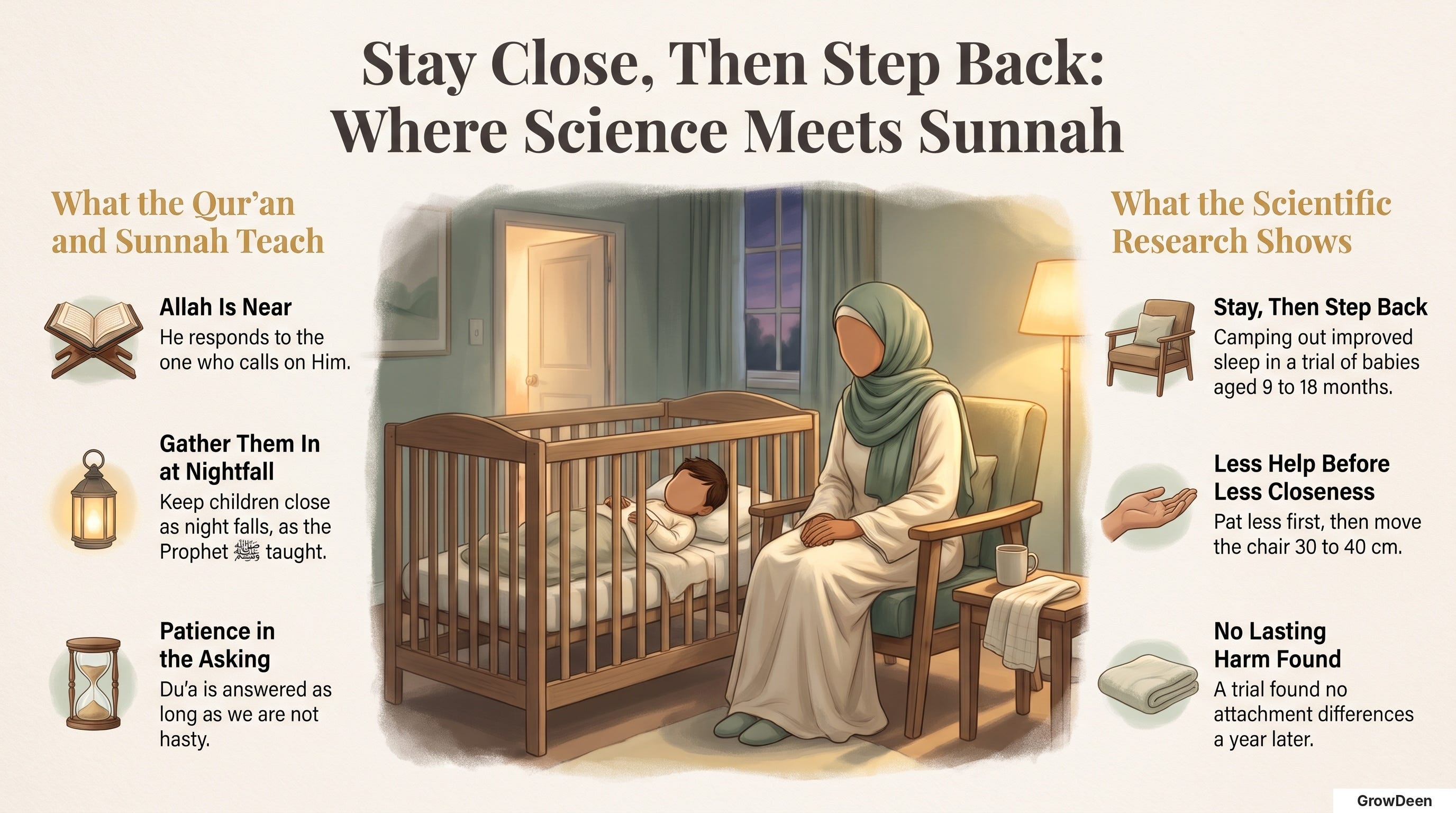
What the evidence says. There is a middle path. It is called camping out (also known as the chair method or gradual withdrawal). You stay in the room the whole time, keep comforting her, and slowly give less help from further away. In an Australian trial with babies of 7 months, parents sat with their baby until she fell asleep and gradually withdrew over three weeks. [3] In a trial of babies aged 9 to 18 months, sleep improved with camping out and with a check-in method where the parent gradually leaves. Babies with high separation anxiety did better with camping out. [4]
So the real choice is not "stay forever or leave her crying". It is how slowly you want to move.
Why This Happens
Why does she wake the second I stand up?
Think about how she falls asleep in the car. No patting, no chair, no negotiation. Only motion, then quiet from the back seat.
Young children learn the conditions that come with falling asleep. The way a child falls asleep at bedtime is the way she will expect to go back to sleep overnight. [2] So if your hand on her back is part of how sleep arrives, she will look for your hand again.
That also explains the 1am wake-ups. Babies and toddlers can wake many times in a night, often briefly. [2] A child who fell asleep with you there surfaces, notices the conditions have changed, and calls for them back.
One review of the evidence links more parental involvement at bedtime with more broken sleep in babies. [5] That is a link, not proof that your help causes the waking. The same review notes the effect runs both ways: poor sleep also changes what parents do.
She is not asking you to stay forever. She is asking for sleep to arrive the way it always has.
Is she getting enough sleep, or is this a sleep problem?
Check the sleep itself before you change anything. The American Academy of Sleep Medicine sets healthy ranges, and the American Academy of Pediatrics endorses them. [6] Babies aged 4 to 12 months need 12 to 16 hours per 24 hours, naps included. Children need 11 to 14 hours at ages 1 to 2, and 10 to 13 hours at ages 3 to 5. [6]
A child inside her range who wants company at the start of the night has a settling habit, not a sleep disorder. The plan below is for that habit.
Children differ, and one method does not suit every child. [4] Some settle in days, and some take longer. If your child is autistic or has other additional needs, ask your child's doctor or pediatrician about adapting the plan for her.
She needs you there because you have been part of how sleep arrives. The work is to change that slowly.
What the Scientific Research Shows
The most direct evidence comes from a trial of the method itself. In Israel, 91 babies aged 9 to 18 months with ongoing sleep problems took part. [4] They were randomly given camping out, where a parent stays, or a check-in method, where the parent gradually leaves.
Who was studied: families in Israel. Ethnicity, culture, family income and additional needs are not given in the study summary.
What was measured: sleep, recorded by a movement watch and by parents, plus each baby's separation anxiety, observed in a lab.
What changed: sleep improved with both methods and stayed better six months later. Babies with high separation anxiety did better with camping out than with the check-in method. The study's authors suggest gentler approaches such as camping out for highly anxious babies. [4]
How strong this is: Suggestive. One good randomized trial.
A second trial looked at the worry most parents carry: does changing how a baby falls asleep cause stress or harm? In Australia, 43 babies aged 6 to 16 months were randomly given graduated extinction (often called controlled crying), bedtime fading, or sleep education only. [7]
Who was studied: families in South Australia. Ethnicity, culture, family income and additional needs are not given in the study summary.
What changed: both active methods helped babies fall asleep faster, compared with education alone. Saliva tests of the stress hormone cortisol showed small-to-moderate drops in both groups compared with controls. Mothers' stress also eased in the first month. Twelve months later, there were no differences in emotional or behavioral problems, and no differences in secure attachment, between the groups. [7]
How strong this is: Suggestive. One small, well-designed trial. It tested two other methods, not camping out, which keeps a parent present the whole time.
Wider reviews agree on the broad picture. A 2024 systematic review found that treatment for behavioral insomnia (trouble settling or staying asleep) in children under 6 rests mainly on behavioral approaches. [1] Another systematic review found modest, short-term benefits, and called for more studies, including with fathers and across cultures. [8]
How strong this is: Suggestive. These are systematic reviews, but the trials they found were few, and the benefits modest and mostly short term.
What we do not know yet: how camping out compares with other methods over years, and how it works in different family set-ups. No study has yet tested this with Muslim families.
What this means for you: stepping back slowly while you stay in the room is a studied method. A trial of related methods found no lasting harm.
What the Qur'an and Sunnah Teach
Every step of this plan moves you further from a child who would rather you stayed. That deserves a moment before night one.
وَإِذَا سَأَلَكَ عِبَادِى عَنِّى فَإِنِّى قَرِيبٌ ۖ أُجِيبُ دَعْوَةَ ٱلدَّاعِ إِذَا دَعَانِ
And when My servants ask you, [O Muḥammad], concerning Me - indeed I am near. I respond to the invocation of the supplicant when he calls upon Me.
Al-Baqarah 2:186 · Sahih International [9]
Text. Under this verse, Ibn Kathir's tafsir (explanation of the Qur'an) reports what the Prophet ﷺ told his Companions. They were not calling one who is deaf or absent. "The One Whom you call is closer to one of you than the neck of his animal." [10]
Text. The Prophet ﷺ also said that a person's du'a is answered as long as he is not hasty. Being hasty means saying, "I invoked Allah but my request has not been granted." [11]
Our reflection. Both texts land on this plan. A room is not empty of Allah's nearness the moment a parent steps out of it. And a plan of about three weeks asks for the patience the hadith describes. Night four is too early to decide nothing is working.
When you step out of her doorway, she is not alone. Allah hears, and Allah is near.
The evening itself has a Sunnah shape.
The Prophet ﷺ said, "When night falls (or it is evening), keep your children close to you for the devils spread out at that time."
Sahih al-Bukhari 3304 · sunnah.com [12]
Our reflection. In many Muslim homes, the wind-down starts at maghrib (the sunset prayer) rather than at a clock time. Bring the children in, pray, lower the lights, and let the evening narrow toward sleep. A calm, predictable bedtime routine is also linked with better sleep in young children. [13] The two point the same way. Neither proves the other.
The Prophet ﷺ also sought Allah's protection for his grandsons, Al-Hasan and Al-Husain, with these words: "I seek Refuge with Your Perfect Words from every devil and from poisonous pests and from every evil, harmful, envious eye." [14] Said quietly over a crib, these words are tarbiyah (raising a child toward good) arriving years before she understands them.
The Lab Verdict
The science: in a trial, staying in the room while giving less help improved sleep. A trial of related methods found no lasting harm. (Suggestive)
The Qur'an and authentic Sunnah: Allah is near and hears, and du'a is answered as long as we are not hasty. The Prophet ﷺ taught us to gather children in at nightfall.
Where they meet: the science explains why slow, steady steps work; the Sunnah gives the patience and the evening rhythm to carry them. Neither proves the other.
So at home: settle her the same calm way each night, then shrink your help before you shrink the distance.
Knowledge in Practice: The Chair, Moved Slowly
Knowing why she needs you there is half the work. The rest happens in a dim bedroom, one night at a time.
If you can only do one thing, do step 1. It is enough.
Pick a dull fortnight first: no travel, no new teeth flaring, no house move, no new baby, no big change to the evening. And check she is well, fed and comfortable before each bedtime.
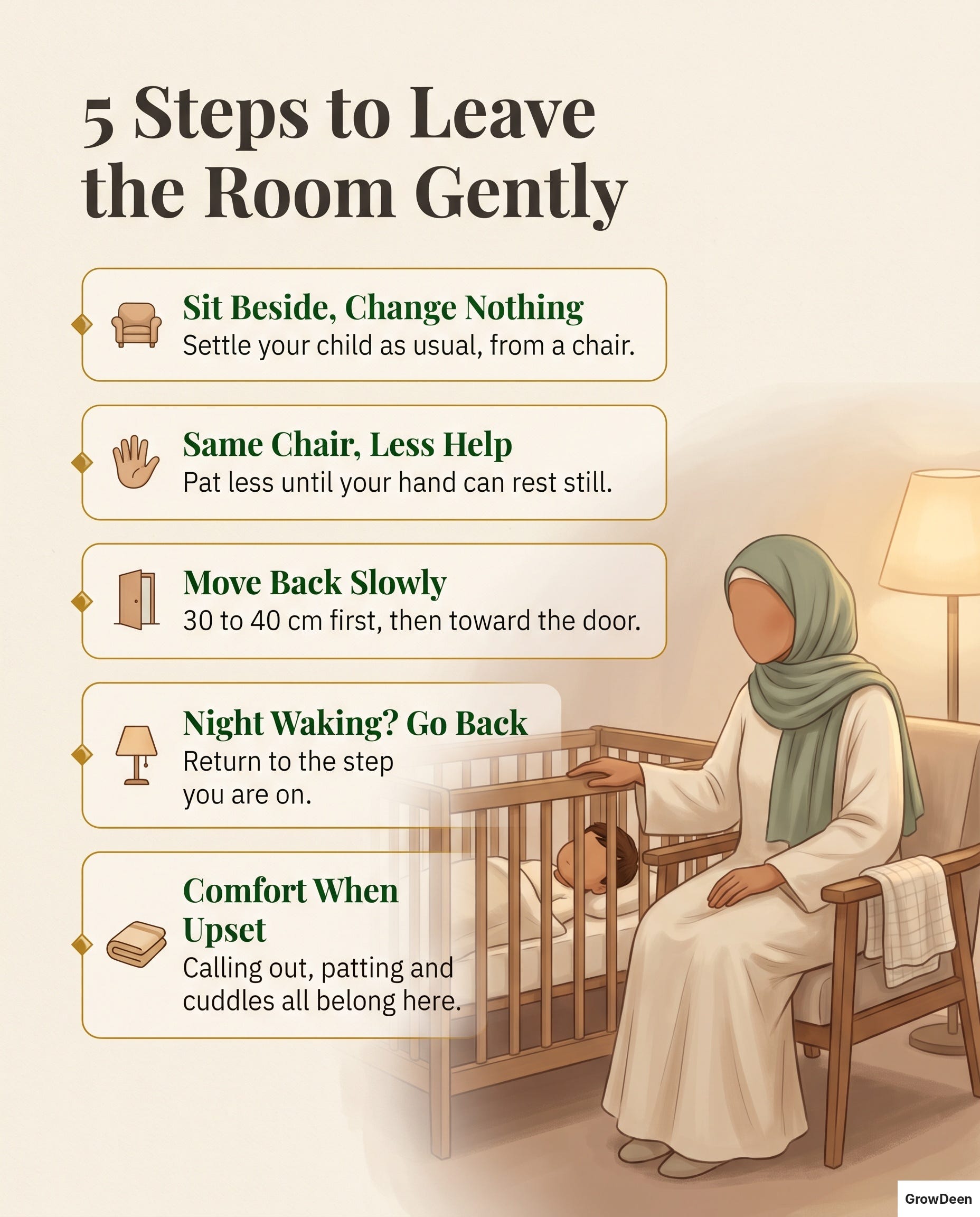
1. Set up the chair and change nothing else (nights 1 to 3, about 2 minutes to set up). Put a chair, folding bed or mattress beside her bed. Sit there and pat or stroke her to sleep exactly as before, then leave once she is asleep. [3] The only new thing is where you sit.
Say this: "Shh, it's sleep time. I'm staying until you're asleep." (Say it in the language your child knows best.)
Instead of: "Okay, one more story, then sleep." Try: "Shh, it's sleep time. I'm right here."
Keep your eyes soft and away from hers, so she knows it is not playtime. Keep the room quiet and dim, and do the same things in the same way each night. A calm, consistent bedtime routine helps young children sleep. [13]
Under 1: your hand and your quiet voice carry the message. Words matter less than sameness. 1–3: use the exact same short line every night. 3–5: tell her the plan at breakfast, in a few words: "Tonight my chair stays, and I stay till you sleep."
2. Same chair, less help (about 3 more nights, a few minutes a night). Pat for a shorter time each night until she can fall asleep with you sitting beside her and your hand still. Shrink the help before you shrink the distance.
3. Move the chair back, a little at a time (every 2 to 3 settled nights, about 3 weeks in all). First, move about 30 to 40 cm away and stay until she sleeps. Then move gradually toward the door: halfway there, then the doorway where she can still see you. [3] Last comes out of sight, with the door as you normally leave it.
Move on only when she has fallen asleep at the current spot for two or three nights without needing extra help. Slower is fine. Going back a step for a few nights is fine too.
A one-minute note at breakfast helps. Write the spot you used, roughly how many minutes she took, and anything unusual: teeth, illness, travel or guests. Over a week, the trend is easier to see on paper than in your tired memory.
4. When she wakes in the night, go back to your step (a few minutes each time). Return to the chair at whatever step you have reached, and stay until she is asleep again. The way she falls asleep at bedtime is the way she will expect to fall back asleep in the night. [2] Not the step before. Not her bed.
5. When she cries, go up slowly (minutes, as needed). Expect some crying: she is used to falling asleep the old way, and this is a change. Listen first, because grizzling often fades. Call out gently: "I'm here. Time to sleep now." If grizzling becomes crying, go in and pat her until she is quiet. [2] If she is badly upset, pick her up and cuddle her, then settle her back in bed once she is calm.
Say this when she is crying: "I'm here. You're safe. It's sleep time."
Picking her up when she is badly upset is part of this method. It does not undo your progress.
Make It Work in Your Home
You and your spouse share bedtimes? Agree on the same chair spot, the same words and the same 2am rule. Doing the same things the same way each time helps. [13]
One of you works nights or travels? The parent at home runs the plan alone, and that is fine. Hand over in the morning with one line about where the chair is.
She shares a room with a sibling, or with you? The steps get shorter: beside the bed, an arm's length, the far side of the room, then outside the door.
No spare chair or folding bed? A floor cushion or a folded blanket works. Nothing in this plan needs buying.
Say this to your spouse: "You're so good with her at night. Can we do bedtime the same way for two weeks? Same spot, same words, same rule if she wakes."
Say this to a grandparent who settles her: "Mama, she loves it when you put her down. For the next two weeks, could you sit in the chair where I've left it? That way she gets the same message from all of us."
The family question: at breakfast, ask each other, "What did bedtime look like in the house you grew up in?" The answers often explain why this feels so hard.
Settle her the same calm way each night, then shrink your help before you shrink the distance.
If Things Don't Go to Plan
If she cries hardest when the chair leaves the room: stay at the doorway step for a few more nights, then try again.
If one night goes badly: one bad night is weather. Look at the week, not the night. Teeth, illness and travel all set things back for a while.
If she gets out of bed: walk her back, settle her, and return to your step. If she starts climbing out of her crib, pause the plan and make her sleep space safe first.
If you start doubting yourself: Am I making her feel abandoned? No. You are in the room and you keep comforting her. A trial found no attachment harm, even from a method that leaves the room. [7]
If you lose your patience: it happens. Sit back down and say, "I'm sorry I was cross. I'm here, and it's sleep time." Repair is part of the lesson.
Speak to someone if:
nothing improves after a few nights, or she gets more upset as the plan goes on;
she snores, breathes through her mouth, or pauses in her breathing while asleep. The American Academy of Pediatrics asks doctors to screen every child for snoring; [15]
her fears at night are intense, or come with a lot of daytime worry. In one study of 4- to 6-year-olds, night fears went together with daytime anxiety; [16]
pain, poor weight gain or feeding trouble seems to be waking her.
Signs are clearer looking back. Seeing them late is not neglect.
And you? A parent on four broken hours has little patience left at 3am. Caring for her is an amanah (a trust), and so is your own health. If exhaustion or low mood is heavy, tell your own doctor.
Who to turn to: your child's doctor or pediatrician. For questions of deen, ask your local imam or a local scholar, and share the details with him. In an emergency, call your local emergency number.
Support Muslim Parenting Lab ❤️
Would you like the reward of every parent who acts on what they read here? Fund it with the button below and it is yours.
The Prophet ﷺ said whoever guides to good has a reward like the one who does it. (Sahih Muslim 1893a)
Your Companion Pack: The Chair Move Card
Knowing the plan at 9am is different from following it at 9pm with a crying toddler. The free Chair Move Card puts the plan where you can see it in the dark. It is one PDF of 3 pages:
The Six Chair Positions: a floor map from touching the crib to out of sight, with the move-on rule beside each position.
Your Fourteen Nights: a tick grid for the chair position, minutes to asleep, who settled her and anything unusual, plus what to look for.
The Room You Leave Is Not Empty: Al-Baqarah 2:186 and the words of the Prophet ﷺ about nightfall, each with a line for the doorway.
Tape page 1 inside the bedroom door, and keep page 2 on the fridge.
Parents Also Ask
How long does the chair method take to work?
About three weeks from the first night to the chair being out of the room. In the Australian trial that tested camping out, parents withdrew gradually over three weeks. [3] Some families take longer, and that does not mean it is failing.
What age can you start the camping out method?
The trials tested it with babies from 7 months. [3] A systematic review found too little evidence for sleep methods under 6 months, so wait until then. [8] Before that, frequent waking is common and responding is the answer. Speak to your baby's doctor if you are worried.
Is the chair method the same as controlled crying?
No. With camping out you stay in the room and keep comforting her. Controlled crying (graduated extinction) means leaving the room and coming back at set times. [4]
Does sleep training damage attachment?
In a randomized trial of babies aged 6 to 16 months, there were no differences in secure attachment between groups twelve months later. [7] What the Scientific Research Shows explains more.
What do I do if my child wakes in the night during camping out?
Go back to the chair at the step you have reached, and stay until she is asleep again. She will expect to fall back asleep the way she fell asleep at bedtime. [2]
Can I do the chair method if we share a room?
Yes. The steps are shorter: beside the bed, an arm's length, the far side of the room, then outside the door.
Should I talk to my toddler during the chair method?
Keep it short and calm, such as "Shh, it's sleep time." Avoiding eye contact helps her know it is not playtime. A review of infant sleep studies lists arousing activity at bedtime among the factors linked to sleep problems. [17]
Final Reflection
Dear parent,
You have read this far about a problem most people would shrug off. That care is already in every night you spent beside her bed.
You did not create a bad habit. You comforted your child, and she learned that sleep comes with you.
You do not need to fix the whole fortnight tonight. Start with step 1: put the chair beside her bed, and change nothing else. Make your niyyah (intention) the comfort of your child, and that hour is not wasted.
Often, your toddler needs you there because you are how sleep has always arrived. Move the chair slowly.
A Du'a for This
For you:
رَبِّ ٱشْرَحْ لِى صَدْرِى وَيَسِّرْ لِىٓ أَمْرِى
Rabbi-shraḥ lī ṣadrī, wa yassir lī amrī
"My Lord, expand [i.e., relax] for me my breast [with assurance] And ease for me my task"
Ta-Ha 20:25–26 · Sahih International [18]
With your child: Bismika Allāhumma amūtu wa aḥyā, "With Your name, O Allah, I die and I live." The Prophet ﷺ said it whenever he went to bed. [19] Say it over her at lights out, or together once she can repeat it, from about age 3.
Share the Khayr
Think of one parent right now. Maybe the friend whose messages arrive at 10pm because she is still sitting by a crib. Maybe the cousin who has not had an evening to herself in months. Send this to her today. The Prophet ﷺ said that whoever guides someone to good has a reward like the one who does it. [20]
Tell us in the comments: which step was hardest for your child, and what helped? We'd love to know.
Parents Also Read
Parents who read this guide also found these helpful.


References
[1] Lecuelle, F., Leslie, W., Gustin, M.P., Franco, P., & Putois, B. (2024). Treatment for behavioral insomnia in young children with neurotypical development under 6 years of age: A systematic review. Sleep Medicine Reviews, 74, 101909.
[2] Centre for Community Child Health, The Royal Children's Hospital Melbourne. (2015). Sleep and the early years. Community Paediatric Review, 23(4).
[3] Hiscock, H., Bayer, J., Gold, L., Hampton, A., Ukoumunne, O.C., & Wake, M. (2007). Improving infant sleep and maternal mental health: a cluster randomised trial. Archives of Disease in Childhood, 92(11), 952–958.
[4] Kahn, M., Juda-Hanael, M., Livne-Karp, E., Tikotzky, L., Anders, T.F., & Sadeh, A. (2020). Behavioral interventions for pediatric insomnia: one treatment may not fit all. Sleep, 43(4), zsz268.
[5] Sadeh, A., Tikotzky, L., & Scher, A. (2010). Parenting and infant sleep. Sleep Medicine Reviews, 14(2), 89–96.
[6] Paruthi, S., Brooks, L.J., D'Ambrosio, C., et al. (2016). Recommended Amount of Sleep for Pediatric Populations: A Consensus Statement of the American Academy of Sleep Medicine. Journal of Clinical Sleep Medicine, 12(6), 785–786. Endorsed by the American Academy of Pediatrics.
[7] Gradisar, M., Jackson, K., Spurrier, N.J., Gibson, J., Whitham, J., Williams, A.S., Dolby, R., & Kennaway, D.J. (2016). Behavioral Interventions for Infant Sleep Problems: A Randomized Controlled Trial. Pediatrics, 137(6), e20151486.
[8] Reuter, A., Silfverdal, S.A., Lindblom, K., & Hjern, A. (2020). A systematic review of prevention and treatment of infant behavioural sleep problems. Acta Paediatrica, 109(9), 1717–1732.
[9] Qur'an, Al-Baqarah 2:186. Translation: Sahih International.
[10] Tafsir Ibn Kathir on Al-Baqarah 2:186.
[11] Sahih al-Bukhari 6340.
[12] Sahih al-Bukhari 3304.
[13] Mindell, J.A., & Williamson, A.A. (2018). Benefits of a bedtime routine in young children: Sleep, development, and beyond. Sleep Medicine Reviews, 40, 93–108. (US · Suggestive: a narrative review)
[14] Sahih al-Bukhari 3371.
[15] Marcus, C.L., Brooks, L.J., Draper, K.A., et al.; American Academy of Pediatrics. (2012). Diagnosis and Management of Childhood Obstructive Sleep Apnea Syndrome. Pediatrics, 130(3), 576–584.
[16] El Rafihi-Ferreira, R., Lewis, K.M., McFayden, T., & Ollendick, T.H. (2019). Predictors of nighttime fears and sleep problems in young children. Journal of Child and Family Studies, 28(4), 941–949.
[17] Field, T. (2017). Infant sleep problems and interventions: A review. Infant Behavior and Development, 47, 40–53.
[18] Qur'an, Ta-Ha 20:25–26. Translation: Sahih International.
[19] Sahih al-Bukhari 6324.
[20] Sahih Muslim 1893a.
We combine scientific research with Qur’an and authentic Sunnah, and we cite our sources. Even so, this is general guidance and no substitute for a doctor who can examine your child.
Sources & confidence
The hadith in this guide are from Sahih al-Bukhari and Sahih Muslim. Qur'an translations are Sahih International. Checked October 2026. Found a source that looks wrong? Email us at info@growdeen.com.
Words in this guide
camping out (chair method, gradual withdrawal): a settling plan where a parent stays in the room and slowly moves further away · settling: helping a child fall asleep · sleep association: something a child links with falling asleep, such as patting or a parent nearby · controlled crying (graduated extinction): leaving the room and returning at set times · bedtime fading: moving bedtime later for a while so a child falls asleep faster · separation anxiety: distress when a parent leaves · crib (cot): a baby's bed with high sides · du'a (doa): supplication · maghrib: the sunset prayer · tafsir: explanation of the Qur'an · tarbiyah: raising a child toward good · amanah: a trust · niyyah: intention · khayr: good.