

Does your child freeze at the masjid door, or another door she once walked through? The free Next Rung Pack helps you plan her next small step and see progress.
AGES 3–8 YEARS · 18 MIN READ
Friday. The shoe rack. Her hand goes stiff in yours.
Six weeks ago she ran into the masjid ahead of you. Now every Friday starts with a negotiation at the door. By the third round, carrying her in feels faster than arguing.
I carried her in again tonight. Am I helping her, or am I the reason this keeps happening?
You were being kind. Loving her this much is not the mistake. This kind of fear is common, and it often shrinks with small, planned steps.
This guide brings together scientific research and the Qur'an and authentic Sunnah. You'll see why fear grows, the small steps that shrink it, and the words for the door.
The Short Answer
Right for your child? Ages 3 to 8 scared of new places, or avoiding an everyday place, person or thing, like a doorway, a dog or a store counter.
What's probably happening: she predicts something terrible. Each time she avoids it, that prediction never gets tested.
Try tonight (5 minutes): while you are both calm, pick the smallest version of the feared thing. Make it a step she can picture finishing.
You'll know it's working when: a step that once took coaxing starts to feel boring. Tears on a hard day are not failure.
Get help if: the fear is severe, lasting or growing, or it disrupts sleep, eating, preschool, school or friendships. Start with your child's doctor or pediatrician.
The rest of this guide explains why, and what to do if it does not work.
How to Read This Guide
3 minutes: The Short Answer above is enough for tonight.
7 minutes: The Short Answer, then Knowledge in Practice and If Things Don't Go to Plan.
The whole guide: read on for the scientific research, the Qur'an and Sunnah, and the References.
To share: the bold lines and the pull quotes are made to be shared.
To listen: open this guide in the free Substack app and tap Listen.
Inside This Guide
Feeling scared and being stuck are different things. A child can feel afraid and still take one small step.
Myth Check: "She's Shy. She'll Grow Out of It."
What this gets right. Some children are slow to warm up. That is a temperament, and it needs no fixing. Some early fears do fade on their own.
What changes the picture. Shyness is a way of being. Avoidance is a pattern, and its list tends to grow: first the masjid door, later the dog next door. A shy child may hang back for a minute and then join in. An avoiding child often needs the scary thing removed before she can calm down.
What the evidence says. Anxiety can start early. In a review of 192 studies, the age at which anxiety and fear-related disorders most often began was about 5 and a half. [1] Waiting is fine for a passing fear. When the list keeps growing, treatment that includes facing fears helps far more children than waiting does. [2]
Why This Happens
Why does she look at my face, not the door?
Watch her at the shoe rack. Her eyes often go to your face first. She is asking a question she has no words for: is this dangerous?
In that moment, what you do can speak louder than what you say. If you say "there's nothing to worry about" while lifting her past the door, your arms give the louder answer.
Why does carrying her in keep the fear alive?
A frightened child is running a prediction: if I go in there, something terrible happens. A prediction like that changes when it is tested and turns out wrong. Lift her past the test, and the prediction waits, untouched, for next Friday.
The relief of escaping also comes fast, and she feels it in her body. So escape can start to feel like the thing that works.
Scientists call the family side of this family accommodation: the changes parents make so a child can avoid what scares her. Ordering for her at the counter. Saying no to the house with the dog. Lying beside her every night, because it takes eleven minutes that way and fifty the other way. Each one is love. Studies have linked family accommodation with anxiety that keeps going over time. [3]
The hidden belief behind all of it is that a child must feel ready before she acts. With fear, readiness often comes afterwards. It is built from steps she took while still scared.
Why is her cousin's house easy?
The same child walks into her cousin's house without a second thought. Same noise, same crowd of adults. The difference is often history. She has been there dozens of times, many of them before she was old enough to worry. Each visit was a step taken without anyone calling it that.
Readiness often comes after the step, not before it. Courage is built from small things already done.
What the Scientific Research Shows
The strongest evidence is about therapy that includes facing fears step by step. A Cochrane review pooled 87 studies with 5,964 children and young people. [2] Thirty-nine of those studies compared cognitive behavioral therapy (CBT) with waiting or no treatment. After CBT, 49.4% no longer had their main anxiety diagnosis, against 17.8% of those who waited. [2]
Who was studied: children and young people in many countries. Ethnicity, family income and additional needs are not given in the study summary.
What was measured: whether the main anxiety diagnosis was still present after treatment.
How strong this is: Strong. A systematic review, with this result rated moderate quality. Comparisons with other active treatments were less clear.
Facing seems to do more of the work than calming. A meta-analysis found that more facing practice in sessions was linked with larger benefits. Programs that also taught relaxation showed smaller improvements. [4] The authors say direct tests of this are still needed. How strong this is: Suggestive.
An analysis from a large US trial of 7- to 17-year-olds looked at the facing tasks themselves. Features of those tasks, as therapists reported them, predicted how well young people did. [5] How strong this is: Suggestive.
Parents can lead the change. In a trial at Yale, 124 children aged 7 to 14 with anxiety disorders were randomly assigned to one of two treatments. [3] One group had standard CBT. In the other, only the parents were coached, mainly to reduce accommodation, and the children had no direct contact with a therapist. Parent-only treatment was found to work about as well as CBT. [3]
Who was studied: children in the US; 83% white; family income and additional needs not given in the study summary. How strong this is: Suggestive. One well-designed trial.
Younger children. For 3- to 6-year-olds with an inhibited (highly cautious) temperament, a group parenting program called Cool Little Kids has helped prevent anxiety disorders. [6] A trial then tested an online version with 433 parents. It taught them to manage avoidant coping, reduce overprotection and encourage independence. [6]
Who was studied: parents of inhibited 3- to 6-year-olds; country, background and additional needs not given in the study summary. How strong this is: Suggestive.
How common it is. About 8.5% of children aged 1 to 7 meet criteria for an anxiety disorder. That figure pools ten studies of 18,282 children in eight countries. [7] Anxiety and fear-related disorders most often begin around age 5 and a half, though the median age of onset is 17. [1] How strong this is: Strong for both.
What we do not know yet: no study has yet tested these methods with Muslim families. Several trials above studied children aged 7 and older, so the preschool picture rests more on parent programs.
What this means for you: small, repeated steps toward the fear, with you changing what you do at home, are the best-supported path.
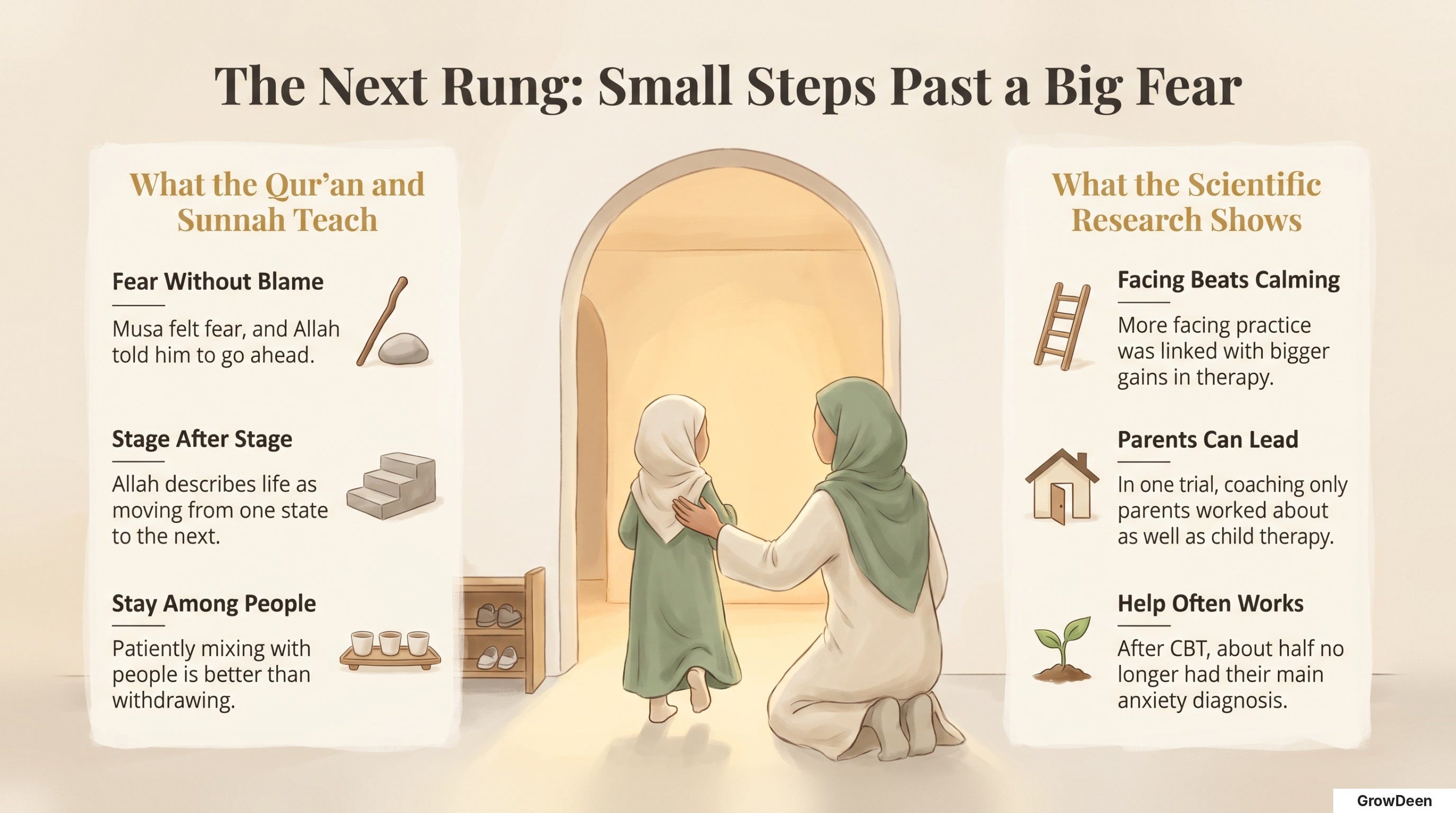
What the Qur'an and Sunnah Teach
Underneath the practical worry sits a quieter one. If she were closer to Allah, would she be this afraid? Have I failed to teach her tawakkul? (Tawakkul means trusting Allah.)
فَأَوۡجَسَ فِي نَفۡسِهِۦ خِيفَةٗ مُّوسَىٰ قُلۡنَا لَا تَخَفۡ إِنَّكَ أَنتَ ٱلۡأَعۡلَىٰ
And he sensed within himself apprehension, did Moses. We [i.e., Allāh] said, "Fear not. Indeed, it is you who are superior."
Ta-Ha 20:67–68 · Sahih International [8]
Text. Prophet Musa felt fear as he faced Pharaoh's magicians. Allah answered with reassurance and told him to go ahead. Ibn Kathir explains that Musa feared for the people, that they would be deceived by the magic before he could throw his staff. [9]
Our reflection. The Qur'an records a Prophet's fear with no word of blame. Tell your child the same in her own words. Being scared is something her body does, and she can take the step while it is still happening.
لَتَرۡكَبُنَّ طَبَقًا عَن طَبَقٖ
[That] you will surely embark upon [i.e., experience] state after state.
Al-Inshiqaq 84:19 · Sahih International [10]
Text. In his tafsir (explanation of the Qur'an), Ibn Kathir records what earlier scholars said. Ibn 'Abbas said, "Stage after stage." 'Ikrimah described being weaned after nursing, and growing old after youth. Al-Hasan al-Basri described ease after hardship and hardship after ease. [11]
Our reflection. This verse describes human life in general, and we should not claim it speaks of a frightened child. It shows that Allah made human life a movement from one state into the next. Tarbiyah (raising a child toward good) has always worked that way, one small stage at a time. A fear broken into small steps fits that pattern.
A Companion reported that the Prophet ﷺ said: "The Muslim who mixes with the people and he is patient with their harm is better than the Muslim who does not mix with the people and is not patient with their harm."
Jami` at-Tirmidhi 2507 · Sahih (Darussalam) · sunnah.com [12]
Text. This narration is about adults and the ordinary friction of living among people.
Our reflection. A 4-year-old at a masjid door is a different case. Still, the narration points the same way: Islam does not treat withdrawal as the safer, more pious choice. Every rung your child climbs is a small step toward staying among people.
Musa felt fear, and Allah told him to go ahead. Fear and the next step can share one moment.
The Lab Verdict
The science: facing fears in small, repeated steps helps many anxious children (Strong). Coaching parents to reduce accommodation can work about as well (Suggestive).
The Qur'an and authentic Sunnah: a Prophet's fear is recorded without blame, human life moves stage after stage, and staying among people is praised.
Where they meet: the science shows how fear shrinks; the Sunnah gives the spirit to face it gently. Two kinds of knowledge, pointing the same way.
So at home: plan one small rung, stay on it until it is boring, and drop one rescue.
Knowledge in Practice: The Next Rung
Knowing why fear grows is half the work. Knowledge bears fruit only when it reaches the shoe rack.
If you can only do one thing, do step 1. It is enough.
1. Find rung one, while you are both calm (5 minutes). Most parents aim too high. The first rung should look almost too small. "Be braver at the masjid" is too big. "Walk from the shoe rack to the back row holding my hand, stay two minutes, leave" is the right size. She should be able to picture finishing before she starts.
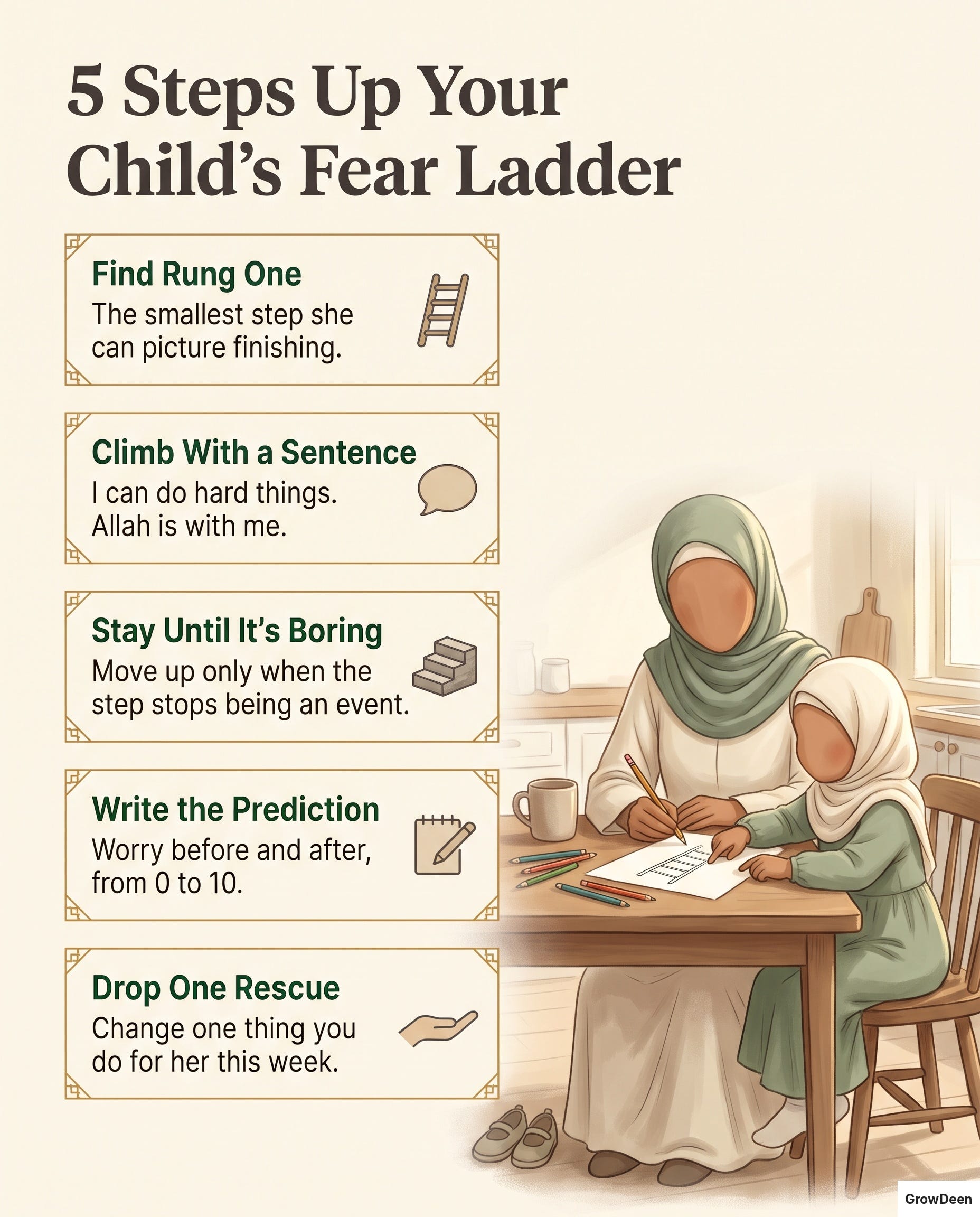
A usable rung is an action that someone watching could see her do. It is agreed in advance, on a calm afternoon, never sprung on her at the door. A surprise push can teach a child to watch you for ambushes. It also sits one rung above where she already is. If the gap feels like a cliff to her, add a rung in between. A ladder of eleven small rungs often works better than four big ones.
Say this: "Let's make a ladder together. Rung one is tiny, and you can choose the day." (Say it in the language your child knows best.)
Rung one might be:
"Look at a photo of the masjid door with me."
"Stand by the shoe rack for one minute, then we leave."
"Say salaam to one auntie you already know."
"Hand the money to the cashier while I hold your other hand."
3–5: you design the ladder and run it as a game. Counting the dogs in an Islamic picture book can be rung one for a child afraid of dogs. 6–8: ask her to suggest her own rungs. She often knows where the real edges are.
2. Climb it, with a sentence for the door (2 to 10 minutes). Left alone, she will narrate the moment to herself, often with the scariest sentence she can find. Give her a short, true one.
Say this, together (ages 3 to 6): "I can do hard things. Mama comes back. Allah is with me." (Swap in Baba, or whoever is with her.)
Rehearse it on a quiet afternoon, so it is worn in before she needs it. Say it with her for the first several tries. Then tie a du'a to the step: a whispered Ḥasbunallāh in the car before madrasah, and a warm Alhamdulillah on the way home. Shukr (gratitude) takes root most easily in the minutes after something hard went well.
Instead of: "There's nothing to be scared of." Try: "You feel scared, and you can still do this step. I'm right here."
If she starts to panic at the door, keep your voice low and even. Say this: "This is hard. We'll do the part we planned, and then we're done."
3. Stay on the rung until it is boring (30 seconds to decide). Most families promote too soon. A rung is finished when it is boring, not when she survives it once while shaking. Decide with three columns:
Stay on this rung if she has done it only once or twice, or needed a lot of coaxing. Stay, too, if she cried afterwards or asked you to stay closer than last time.
Move up one rung if she has done it several times and started without coaxing. Her worry number before the step has dropped, and it has become boring.
Step back one rung if she refused twice running, or the distress was much bigger than last time. Step back, too, if she is avoiding the rung below, is unwell, traveling or short of sleep, or you skipped a rung to get here.
Praise the try in the same breath as the result, and name exactly what she did: "You walked to the back row and stayed. That was brave."
4. Let her see the evidence (2 minutes, before and after). Before a step, write down what she thinks will happen and her worry from 0 to 10. Afterwards, write what happened and her worry again.
3–5: you write, and she shows her worry on her fingers. 6–8: she writes it herself and asks two questions every time: "What happened last time?" and "How likely is that to happen?"
An example: the step is saying salaam to the man at the store checkout. Before: "He won't hear me, and everyone will look." Worry 8. After: "He said salaam back and smiled." Worry 3.
5. Drop one rescue this week (once this week). Look at your week with honest eyes. Notice what you do that she could do, and what you say no to so she never has to face it. Change one thing. One. A household that tries to drop six rescues at once often keeps none of them by Thursday.
Say this: "I know ordering feels scary. I'll stand right next to you while you ask for your juice."
She is also studying you. A shriek at a spider is a lesson. So is an even "That's a spider. It lives outside. Let's put it back out there."
Make It Work in Your Home
On your own, or working nights? One rung a week is enough. Choose a step that fits a trip you already make.
Several children? Let the brave step ride along on an ordinary errand, with siblings doing their own thing. Keep praise for this child quiet, so it never turns into a contest.
A grandparent or the other parent still rescues her? That is love too. Ask for one change at a time.
Say this to Grandma: "Mama, she feels so safe with you. She's learning small brave steps. Could you let her ask for her own snack, even if it takes a minute?"
Say this to your spouse: "Can we pick one thing we stop doing for her this week? I'd rather we change it together."
Say this to the teacher: "She's practicing small steps with joining in. Could she start by handing out the cups before group time?"
The family question: ask the adults at home, "What were you scared of as a child, and what helped you?"
Try It Seven Times
Any seven tries of the same rung, over the next week or two. Seven is a starting goal, not a magic number. Write one worry number before and one after each try. Count how often you nearly stepped in. Tell us in the comments what changed. We'd love to know.
Plan the rung, stay until it is boring, drop one rescue: that is the whole method.
If Things Don't Go to Plan
If she refuses at the door: don't force it, and don't cancel. Do the rung below today, and plan the missed one again while you are both calm.
If an attempt goes badly: step back one rung. Stepping back is not failure. Canceling the whole ladder is the real setback, because it teaches her that enough distress ends the plan.
If it only improves a little: a rung that needs less coaxing is real progress. Stay on it longer.
If you start doubting yourself: Have I failed to teach her tawakkul? No. A Prophet felt fear, and Allah answered him with reassurance. Her fear is not a sign of weak Islam, in her or in you.
If you lose your patience: it happens to every parent. Later, sit with her and say, "I'm sorry I rushed you. Let's pick a smaller step together." Repair is part of the lesson.
And you? If you carry worry of your own, and it feels heavy, tell your own doctor.
Speak to someone if:
the anxiety is severe, lasting or getting worse
it disrupts sleep, eating, preschool, school or friendships
she avoids ordinary things, like seeing friends or leaving the house
she has stopped enjoying what she used to
the fear began after a frightening event, a loss, an accident or a hospital stay
weeks of patient steps bring no change
Signs are clearer looking back. Seeing them late is not neglect.
If her fear involves religious ideas, ask your local imam or a local scholar, and share the details with him. Keep her doctor in the conversation too.
Who to turn to: your child's doctor or pediatrician first. They can refer you to a counselor or family therapist who works with anxious children.
Support Muslim Parenting Lab ❤️
Would you like a share in every good thing that comes from what you fund? Support it with the button below, at any level you choose.
The Prophet ﷺ said whoever sets a good precedent earns its reward and the reward of everyone who follows it. (Sahih Muslim 1017a)
Your Companion Pack: The Next Rung Pack
Free to download: three printable pages for the steps above.
Page 1, The Promotion Test. Three columns, Stay on This Rung, Move Up One Rung and Step Back One Rung, with the signals from step 3. It helps you decide in about thirty seconds, and it carries the rule: a rung is finished when it is boring.
Page 2, The Prediction Log. Four rows for what she thinks will happen and what happened. Each row has her worry from 0 to 10, before and after, and the salaam example from step 4 shows how.
Page 3, Stage After Stage. The verse on moving state after state, with the early explanations Ibn Kathir records. It also carries the hadith on mixing with people, from What the Qur'an and Sunnah Teach.
Parents Also Ask
How do I help my child face her fears without forcing her?
Agree each step in advance, on a calm afternoon. Make it small enough that she can picture finishing it, and never spring it on her at the door. Knowledge in Practice has the full method.
Is my child shy or anxious?
Shyness is a temperament: a shy child often hangs back, then joins in. Anxiety looks more like a growing list of things she won't do, or needs removed before she can calm down. If the list keeps growing or blocks daily life, talk to your child's doctor or pediatrician.
At what age does childhood anxiety usually start?
Earlier than many parents expect. In a review of 192 studies, anxiety and fear-related disorders most often began around age 5 and a half. For 38.1% of people with them, they began before age 14. [1]
How do I know if my preschooler has anxiety?
Look for a pattern of avoidance; one hard day on its own says little. Anxiety often shows as a list of places, people or things she won't face, and the list tends to grow. If the fear is severe, lasting or growing, or it disrupts sleep, eating, preschool or friendships, talk to your child's doctor or pediatrician. If Things Don't Go to Plan lists the signs.
Does therapy work for anxious children?
Often, yes. In a Cochrane review, about half of children and young people who had CBT no longer had their main anxiety diagnosis. About 18% of those who waited were also free of it. [2]
Can I help my child's anxiety without therapy?
Often you can start at home. In one trial of children aged 7 to 14, coaching only the parents to reduce accommodation worked about as well as CBT for the child. [3] Severe, growing or limiting anxiety still needs an assessment.
How long should we stay on one step before moving up?
Until it is boring: several tries with only mild worry. One brave survival is too soon to move up. Moving up too fast is a common way a ladder stalls. The Promotion Test in step 3 helps you decide.
Final Reflection
Dear parent,
You read this far because you want her to feel brave. That care shows in every Friday you stood at that door.
If you carried her in, you were doing what love told you. Fear in a small child is common. It is not a verdict on her, or on you. Allah sees every small step you take beside her.
You don't need to build the whole ladder this week. Take step 1. Write rung one on your phone tonight. Let it be enough, with a good intention behind it.
Often, the kindest thing at the door is not carrying her through. It is one small step beside her.
A Du'a for This
For you:
رَبِّ ٱشۡرَحۡ لِي صَدۡرِي وَيَسِّرۡ لِيٓ أَمۡرِي
Rabbi-shraḥ lī ṣadrī, wa yassir lī amrī
"My Lord, expand [i.e., relax] for me my breast [with assurance] and ease for me my task."
Ta-Ha 20:25–26 · Sahih International [13]
With your child: Ḥasbunallāhu wa ni'mal-wakīl, "Sufficient for us is Allah, and [He is] the best Disposer of affairs." (Al 'Imran 3:173) [14]
Say it together in the car before a rung, from about age 3. A younger child can join in on the opening, Ḥasbunallāh.
Share the Khayr
If you know a parent who stands outside with her child for the whole of Maghrib, send this to her. The Prophet ﷺ said, "One who guides to something good has a reward similar to that of its doer." [15]
Tell us in the comments: what is rung one for your child? We'd love to know.
Parents Also Read
Parents who read this guide also found these helpful.


References
[1] Solmi, M., Radua, J., Olivola, M., Croce, E., Soardo, L., Salazar de Pablo, G., et al. (2022). Age at onset of mental disorders worldwide: large-scale meta-analysis of 192 epidemiological studies. Molecular Psychiatry, 27(1), 281–295.
[2] James, A.C., Reardon, T., Soler, A., James, G., & Creswell, C. (2020). Cognitive behavioural therapy for anxiety disorders in children and adolescents. Cochrane Database of Systematic Reviews, Issue 11, Art. No. CD013162.
[3] Lebowitz, E.R., Marin, C., Martino, A., Shimshoni, Y., & Silverman, W.K. (2020). Parent-based treatment as efficacious as cognitive behavioral therapy for childhood anxiety: A randomized noninferiority study of Supportive Parenting for Anxious Childhood Emotions. Journal of the American Academy of Child and Adolescent Psychiatry, 59(3), 362–372.
[4] Whiteside, S.P.H., Sim, L.A., Morrow, A.S., Farah, W.H., Hilliker, D.R., Murad, M.H., & Wang, Z. (2020). A meta-analysis to guide the enhancement of CBT for childhood anxiety: Exposure over anxiety management. Clinical Child and Family Psychology Review, 23(1), 102–121.
[5] Peris, T.S., Caporino, N.E., O’Rourke, S., Kendall, P.C., Walkup, J.T., Albano, A.M., Bergman, R.L., McCracken, J.T., Birmaher, B., Ginsburg, G.S., Sakolsky, D., Piacentini, J., & Compton, S.N. (2017). Therapist-reported features of exposure tasks that predict differential treatment outcomes for youth with anxiety. Journal of the American Academy of Child and Adolescent Psychiatry, 56(12), 1043–1052.
[6] Morgan, A.J., Rapee, R.M., Salim, A., Goharpey, N., Tamir, E., McLellan, L.F., & Bayer, J.K. (2017). Internet-delivered parenting program for prevention and early intervention of anxiety problems in young children: Randomized controlled trial. Journal of the American Academy of Child and Adolescent Psychiatry, 56(5), 417–425.e1.
[7] Vasileva, M., Graf, R.K., Reinelt, T., Petermann, U., & Petermann, F. (2021). Research review: A meta-analysis of the international prevalence and comorbidity of mental disorders in children between 1 and 7 years. Journal of Child Psychology and Psychiatry, 62(4), 372–381.
[8] Qur'an, Ta-Ha 20:67–68. Translation: Sahih International.
[9] Tafsir Ibn Kathir on Ta-Ha 20:67.
[10] Qur'an, Al-Inshiqaq 84:19. Translation: Sahih International.
[11] Tafsir Ibn Kathir on Al-Inshiqaq 84:19.
[12] Jami` at-Tirmidhi 2507. Graded: Sahih, by Darussalam.
[13] Qur'an, Ta-Ha 20:25–26. Translation: Sahih International.
[14] Qur'an, Al 'Imran 3:173. Translation: Sahih International.
[15] Sahih Muslim 1893a.
We combine scientific research with Qur’an and authentic Sunnah, and we cite our sources. Even so, this is general guidance and no substitute for a doctor who can examine your child.
Sources & confidence
The hadith in this guide are from Jami` at-Tirmidhi (graded Sahih by Darussalam) and Sahih Muslim. The Qur'an translation is Sahih International. Checked October 2026. Found a source that looks wrong? Email us at info@growdeen.com.
Words in this guide
anxiety disorder: worry or fear strong and lasting enough to get in the way of daily life.
avoidance: staying away from what scares you, which keeps the fear from being tested.
family accommodation: changes parents make so a child can avoid what scares her.
graded exposure (fear ladder, stepladder approach): facing a fear in small, planned steps, one rung at a time.
cognitive behavioral therapy (CBT): a talking and practice therapy that often includes graded exposure.
inhibited temperament: a child who is highly cautious with new people and places.
slow to warm up: a shy temperament where a child hangs back, then joins in.
counselor, family therapist: trained professionals your child's doctor can refer you to.
tawakkul: trusting Allah.
shukr: gratitude to Allah.
tarbiyah: raising a child toward good.
tafsir: explanation of the Qur'an.
du'a (doa): supplication.
Ḥasbunallāh: "Allah is sufficient for us."
Alhamdulillah: all praise is for Allah.
salaam: the Islamic greeting of peace.
masjid: mosque.
madrasah: a class or school for Islamic learning.
Maghrib: the sunset prayer.
khayr: good.
Sunnah: the way of the Prophet ﷺ.
preschool (nursery): a group setting for children under school age.
store checkout (shop till): where you pay in a store.
pediatrician (paediatrician): a children's doctor.