

Breakfast refused at 7:10, eaten at 9? The free Morning Build Card puts the whole plan on your cupboard door.
AGES 1–8 YEARS · 15 MIN READ
The oatmeal was ready on time. You made exactly what she asked for yesterday. She looked into the bowl like it was gravel.
Then the clock took over. Shoes went on over an empty stomach.
I made her favorite, and she wouldn't touch it. Then on Saturday she eats the same bowl at nine.
You are not doing this badly. You are racing a twenty-minute window against a hunger that often hasn't woken up yet.
This guide brings together scientific research and the Qur'an and authentic Sunnah. You'll see why the bowl comes back, what the Sunnah teaches at the table, and what to set out tonight.
The Short Answer
Right for your child? Ages 1–8 who refuse breakfast on busy mornings but eat later. A highly selective eater, or autistic? Look for "Show this" in the steps.
What's probably happening: your child may not be hungry yet so soon after waking. The rush adds pressure.
Keep safe: no honey before 12 months, and cut food to half an inch (1.3 cm) or smaller before age 4.
Try tonight (5 minutes): set tomorrow's bowls out with dry oats in them, so the morning job is only milk.
You'll know it's working when: mornings start calmer, even if she eats a little. A few spoons now and a snack later still count.
Get help if: your child is losing weight, eats only a few foods, or seems unusually tired or pale. The same applies if your child has choked or may have a food allergy. Start with your child's doctor or pediatrician.
The rest of this guide explains why, and what to do if it does not work.
How to Read This Guide
3 minutes: The Short Answer above is enough for tonight.
7 minutes: The Short Answer, then Knowledge in Practice and If Things Don't Go to Plan.
The whole guide: read on for the scientific research, the Qur'an and Sunnah, and the References.
To share: the bold lines and the pull quotes are made to be shared.
To listen: open this guide in the free Substack app and tap Listen.
Inside This Guide
A calm table at 7:10 can matter more than an empty bowl.
Myth Check: "She'll Make It Up at Lunch"
What this belief gets right. One missed breakfast is not an emergency, and a calm parent is worth more than a cleared bowl.
What the evidence says. In a national survey of 689 Norwegian 12- to 14-year-olds, days without breakfast had lower overall diet quality than days with it. [1] Days with breakfast or lunch had more fiber, and more fruit and berries. [1]
That study was in young teens. No study has yet tested this in children under 8, so hold it loosely: a skipped breakfast may not be fully made up later.
What to do instead. Plan for the gap: a small breakfast at home, then a planned snack later. Step 3 shows how.
Why This Happens
Why does she refuse at 7:10 and eat at 9?
Look at what is different about Saturday. Nobody is watching the clock or saying "three more spoons". She has been awake for a while, and the food is still there when her hunger arrives.
On a school or nursery morning, the bowl appears minutes after she wakes. Many children are not hungry that early. Then the rush adds pressure.
Does pushing her to eat help?
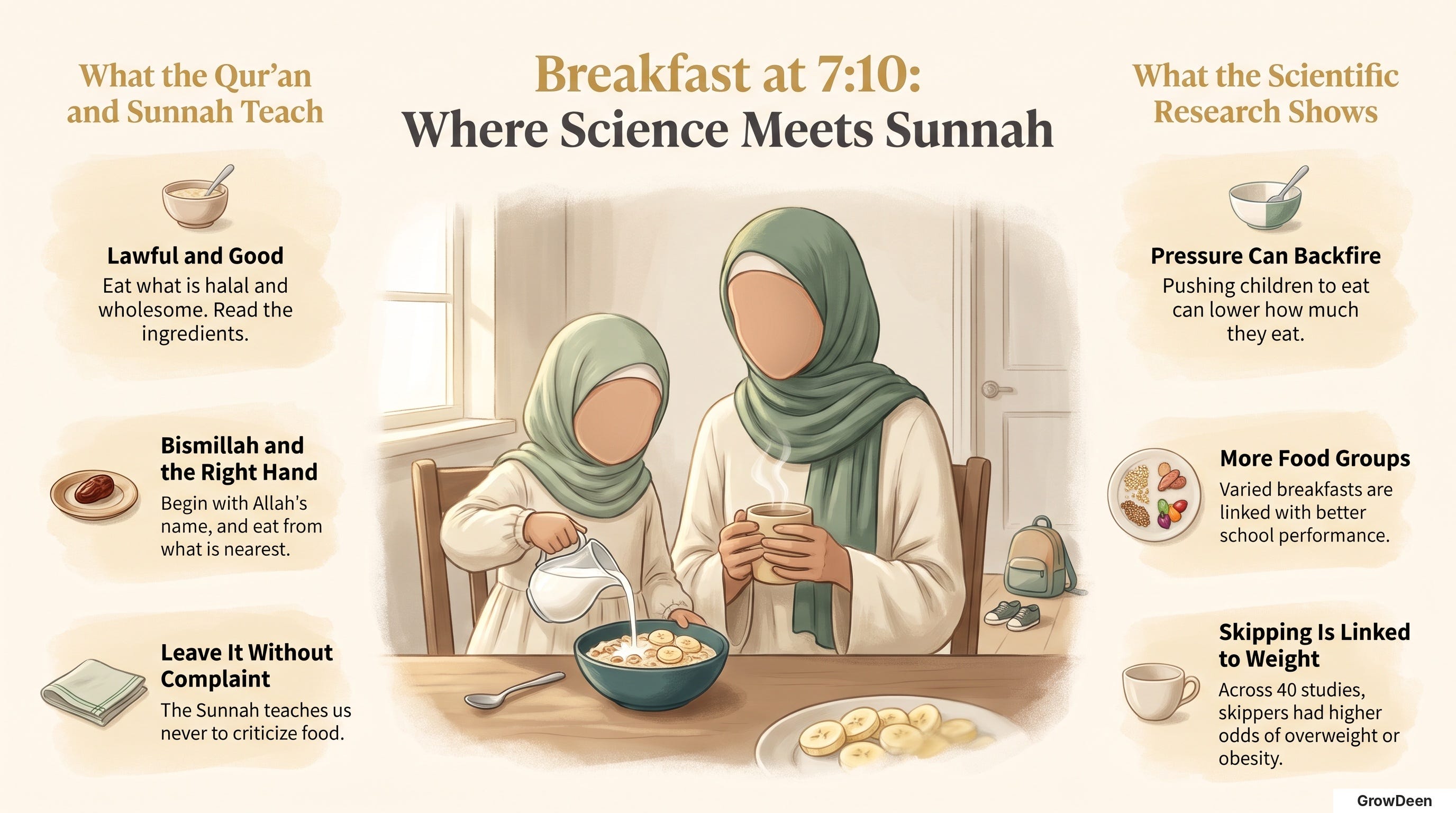
Usually not. In a US experiment, pressure to eat had negative effects on how children felt about a food and how much they ate. [2] The authors say this supports earlier observational studies. [2]
So the 7:10 standoff has two parts: timing, which you can plan around, and pressure, which you can drop.
What is established, and what varies
One experiment, backed by earlier observational studies, suggests pressure backfires. [2] How long a child takes to feel hungry after waking varies, and no study has yet measured it in young children. An autistic child, or a child who has lived through upheaval, may need an even slower, more predictable morning.
Often it isn't the oatmeal she's refusing. It's the clock, and the hurry that comes with it.
What the Scientific Research Shows
The strongest finding is about skipping. A 2023 review pooled 40 studies of 323,244 children and teens aged 2 to 20. Those who skipped breakfast had higher odds of overweight or obesity: an odds ratio of 1.59. [3]
Who was studied: children and teens; country, ethnicity, family income and additional needs were not given in the study summary. How strong this is: Strong for the link, from a meta-analysis. Every study was observational, so it shows a link and cannot show cause.
What goes in the bowl matters too. A review of 36 studies found some evidence that breakfasts with more food groups and adequate energy were linked with better school performance. [4] A second review found breakfast was the eating habit most often linked with better school achievement. [5]
How strong this is: Suggestive. Family income may explain part of these links, the first review notes. [4] The second calls them moderate. [5]
On whole grains, a review of trials in adults found whole grain foods modestly reduced hunger and increased fullness compared with refined grains. [6] How strong this is: Strong in adults. No trial in it tested young children.
Eating together may help as well. In US families with preschoolers, more family breakfasts were linked with healthier diets for non-Hispanic children, though not for Hispanic children. [7] By design, about half the children were in the overweight range. How strong this is: Suggestive.
What we do not know yet: no study has yet tested this with Muslim families, and most breakfast studies were done in older children.
What this means for you: breakfast is worth protecting. Build it from a few food groups, and drop the pressure. It matters, but it guarantees nothing.
What the Qur'an and Sunnah Teach
يَـٰٓأَيُّهَا ٱلنَّاسُ كُلُوا۟ مِمَّا فِى ٱلْأَرْضِ حَلَـٰلًا طَيِّبًا وَلَا تَتَّبِعُوا۟ خُطُوَٰتِ ٱلشَّيْطَـٰنِ ۚ إِنَّهُۥ لَكُمْ عَدُوٌّ مُّبِينٌ
O mankind, eat from whatever is on earth [that is] lawful and good and do not follow the footsteps of Satan. Indeed, he is to you a clear enemy.
Al-Baqarah 2:168 · Sahih International [8]
Text. Food is to be halal (lawful) and tayyib (good and wholesome).
Our reflection. A cereal can be fully lawful and still be mostly sugar. The second word sends us to the ingredients list.
Narrated Anas bin Malik: The Prophet (ﷺ) said, "Take Suhur as there is a blessing in it."
Sahih al-Bukhari 1923 · sunnah.com [9]
Text. Al-Bukhari places this in the Book of Fasting, under the chapter "Sahur is a blessing but it is not compulsory". [9] Its subject is suhoor, the pre-dawn meal of someone intending to fast.
Our reflection. What it tells a parent is narrower than a rule about breakfast, and it is still worth holding. The Prophet ﷺ attached barakah (blessing) to a meal taken at the start of the day. He urged it on people who were free to skip it. The early meal was something to seek out, not something to squeeze in.
Narrated 'Umar bin Abi Salama: I was a boy under the care of Allah's Messenger (ﷺ) and my hand used to go around the dish while I was eating. So Allah's Messenger (ﷺ) said to me, 'O boy! Mention the Name of Allah and eat with your right hand, and eat of the dish what is nearer to you.' Since then I have applied those instructions when eating.
Sahih al-Bukhari 5376 · sunnah.com [10]
Text. Three table manners in one gentle sentence: Bismillah, the right hand, and eating from what is nearest. The Prophet ﷺ also said that Allah is pleased with a servant who eats and praises Him for it. [11] So Alhamdulillah closes the meal.
Text. Abu Huraira reported that the Prophet ﷺ never criticized any food. If he liked it, he ate it, and if he disliked it, he left it. [12]
Our reflection. There is mercy in that for a breakfast standoff. A child may leave food without complaining, and a parent may let it be left without a fight.
Custom. Anchoring breakfast to Fajr is a family custom.
Four seconds of Bismillah and Alhamdulillah, repeated across a childhood, can make remembrance ordinary.
The Lab Verdict
The science: breakfasts with more food groups are linked with better outcomes, and pressure to eat tends to backfire. (Suggestive)
The Qur'an and authentic Sunnah: eat what is lawful and good, and begin with Allah's name. Eat from what is near, praise Allah after, and never criticize food.
Where they meet: the science shows what makes breakfast work; the Sunnah gives the gentle manner of offering it. They meet in calm, unhurried care at the table.
So at home: build the bowl the night before and offer it without pressure. On hard mornings, let the meal split.
Knowledge in Practice: A Breakfast Built the Night Before
Knowing why the bowl comes back is half the work. The other half happens in your kitchen, the evening before.
If you can only do one thing, do step 1. It is enough.
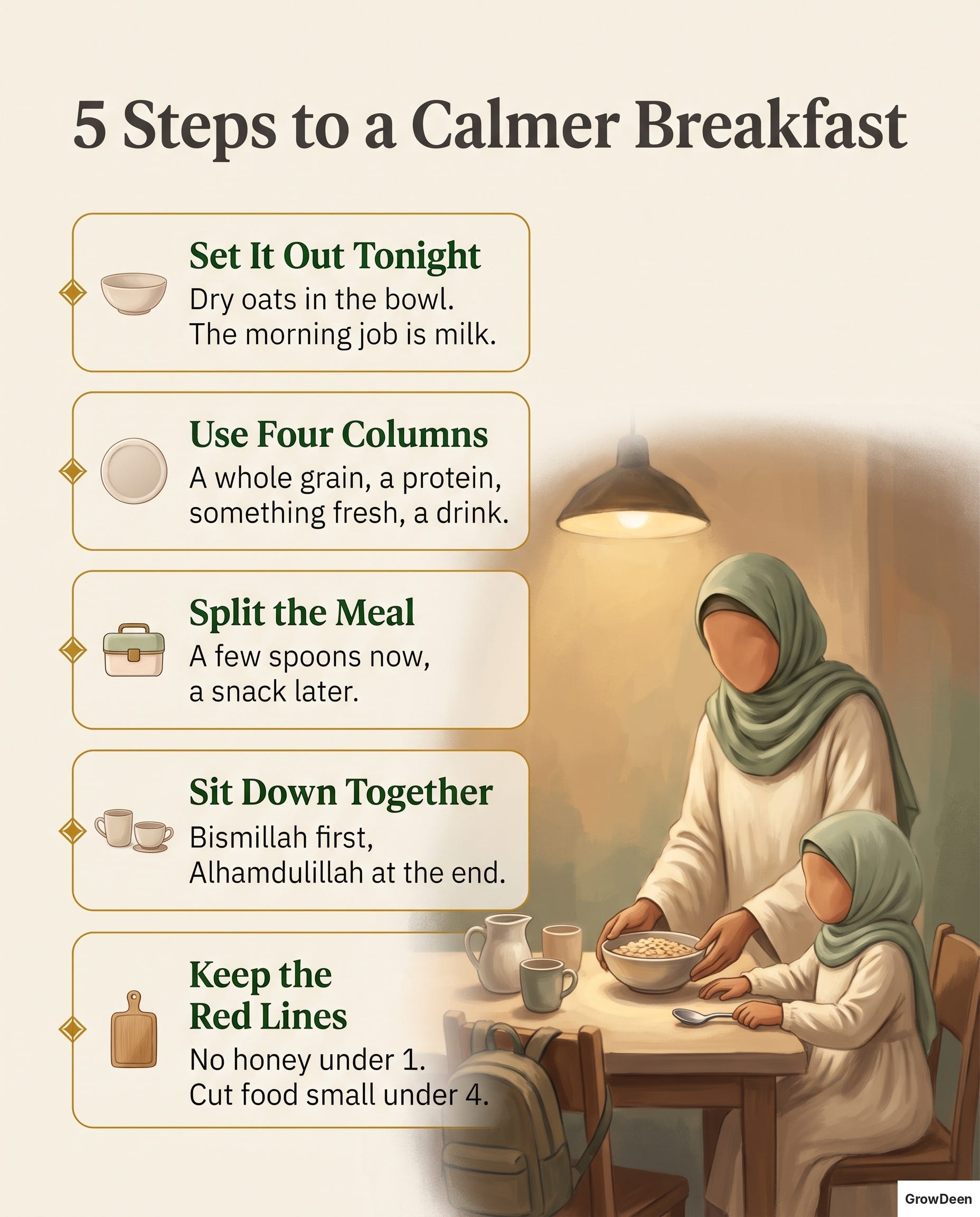
1. Set out tomorrow's breakfast tonight (5 minutes). Breakfast is built the night before. Put dry oats in the bowls and the cups on the table. Wash the fruit, too. In the morning, the only job left is pouring milk.
Say this: "Your bowl is ready for the morning. You get to pour the milk." (Say it in the language your child knows best.)
Under 3: you pour, and let her stir. 3–5: a small jug she can pour herself. 6–8: let her set the table the night before.
Then set your alarm ten minutes earlier. Ten minutes can be the difference between a child who sits down and a child handed toast at the door. Where your household's rhythm allows it, start from Fajr.
Small kitchen? A tray on the counter works as well as a table.
2. Build the bowl from four columns (2 minutes, once). Pick one from each column, and that is breakfast. Breakfasts with more food groups are linked with better school outcomes. [4]
One whole grain: oatmeal (porridge), whole wheat toast, brown rice, whole wheat flatbread, a low-sugar whole grain cereal, rice porridge.
One protein: a boiled egg, an omelet, baked beans, plain yogurt, soft lentils, finely ground meat.
Something fresh: sliced banana, soft pear, quartered berries, soft-cooked carrot sticks, tomato chopped small, cucumber peeled and cut small.
Something to drink: milk or water. Under 1, the milk is breast milk or formula, and there is no juice at all. From 1 to 3, no more than 4 ounces of 100% juice a day. [13]
How much, by age: under 1, small tastes alongside breast milk or formula, following your baby's lead. From 1 to 3, small portions; appetite swings from day to day, and that is normal. From 3 to 5, start small and let her ask for seconds. From 6 to 8, a fuller plate, with seconds on request.
Some mornings come already decided: oatmeal with yogurt and banana; toast with a boiled egg; last night's brown rice warmed with vegetables. The Morning Build Card has six.
3. If it comes back untouched, split the meal (any morning). A few spoons of oats or a piece of fruit at home, then yogurt or a boiled egg before school or nursery starts. One small UK study in that review looked at 9-year-olds. Those who ate under 150 calories at breakfast spent more time on task in class when they also had a mid-morning snack. [4]
Instead of: "You're not leaving this table until that bowl is empty." Try: "Eat what your tummy wants now. The rest comes with us."
Say this (pick one that fits your child):
"Your bowl will wait for you."
"Three spoons now, the banana in the car."
"Not hungry yet? That's okay. Your snack is packed."
"Want it in a cup today?" (milk, yogurt and a banana blended together)
An older child who refuses may be asking for independence. Offer fruit or toast to carry, and let her choose wholesome options at the store.
Show this: a picture card with three boxes: bowl, snack, cup. Point to the one she can manage today.
4. Sit down with them when you can (10 minutes). Eat your own breakfast at the same table, even a small one. Family breakfasts were linked with healthier diets in preschoolers. [7] Say Bismillah together before the first bite, and Alhamdulillah together at the end. [10][11] Start with the mornings you can.
5. Check the three red lines (once, then it becomes habit). Everything else in this guide is a preference. These three are firm.
No honey before 12 months. Honey can carry spores that make babies under one ill with infant botulism. [14] That includes honey spread on toast, stirred into food or mixed into a drink. Health officials also advise against foods made with honey, such as baked goods, for babies under one. [15] After age one, children are less likely to get sick from it. [14]
No choking shapes before age 4. Keep high-risk foods from children until at least age 4. [16] These include whole nuts, seeds, popcorn, hard candy, thick chunks of nut butter, whole grapes and raw carrot sticks. Cut food into pieces no larger than half an inch (1.3 cm), spread nut butter thinly, and keep your child sitting down to eat. [16] Cut grapes, berries and cherry tomatoes lengthwise, then in half again, into quarters. [17] Most children who die from choking are under age 5, and two-thirds are babies under one. [16]
No added sugar before 2. Under 2, avoid foods and drinks with added sugar. From 2, aim for less than 25 grams (about 6 teaspoons) a day. [13] About half of children's added sugar comes from sweetened drinks, so check the ingredients list, not the front of the box. [13]
Say this to Grandma: "Mama, the children love your breakfasts. Could we keep honey away from the baby until she's one, and cut the little ones' grapes into quarters? The safety advice is firm on both."
Make It Work in Your Home
On your own, or one of you leaves before dawn for work? Do step 1 after the children's bedtime. It takes five minutes.
Several children? Give each one a job: the oldest pours milk, the youngest puts out spoons.
A grandparent or caregiver does mornings? Show them the four columns and the three red lines once.
No printer? Write the four column headings on paper. That is the whole card.
Say this to your spouse: "Can we take turns setting out breakfast at night? Two minutes, and the mornings go calmer for everyone."
The family question: ask your own mother or father, "What did breakfast look like when you were small, and who sat with you?"
Try It Seven Times
Set out breakfast the night before, any seven times in the next week or two. Seven is a starting goal. One tick and one word for how the morning felt. Tell us in the comments what changed.
Bowl out tonight, milk in the morning, no pressure at the table: that is the whole practice.
If Things Don't Go to Plan
If she still won't touch it: pack the protein and the fruit for later, and count it as breakfast.
If it only improves a little: three spoons instead of none is real progress. Keep the night-before setup.
If you start doubting yourself: Everyone else's children eat breakfast. What am I doing wrong? Many families have this exact morning. A child who eats later still eats.
If you lose your patience: it happens. Sit back down and say, "I'm sorry I rushed you. Your bowl can wait." Repair is part of the lesson.
Speak to someone if: your child is losing weight or not growing as expected, or eats only a few foods. The same goes if she seems unusually tired or pale, has choked, or may have a food allergy. Signs are clearer looking back. Seeing them late is not neglect. For questions of deen, ask your local imam or a local scholar, and share the details with him.
Who to turn to: your child's doctor or pediatrician. In an emergency, call your local emergency number.
Support Muslim Parenting Lab ❤️
Would you like a small amount of yours grown into something enormous? Give what you can spare with the button below.
The Prophet ﷺ said Allah grows a charity the size of a date until it is like a mountain. (Sahih al-Bukhari 1410)
Your Companion Pack: The Morning Build Card
Free to download. Three printable pages, made so the thinking is done before you stand in the kitchen at 7:10:
Page 1, The Four-Column Build: the four columns from step 2 and how much to offer at each age, from 6 months to 8 years. It adds six mornings already decided, for the inside of a cupboard door.
Page 2, The Three Red Lines: the honey, choking and sugar rules from step 5. A printed half-inch square and a grape cut into quarters let you check a plate in seconds.
Page 3, The Blessed Start: the suhoor hadith in English, with its source and its fasting context. Below it, four table manners a three-year-old can learn: Bismillah, the right hand, eating from what is nearest, and Alhamdulillah.
Parents Also Ask
What should a toddler eat for breakfast?
One whole grain, one protein and something fresh, with milk or water: oatmeal with yogurt and banana, or toast with an egg. Keep added sugar out until age 2. [13]
Is it bad if my child skips breakfast?
Skipping is linked with higher odds of overweight or obesity across 40 studies. [3] Those studies show a link only, so treat breakfast as worth protecting, without panic. What the Scientific Research Shows explains more.
My child is never hungry in the morning. What do I do?
Split the meal: a few spoons at home, then yogurt or an egg mid-morning. Keep the tone light, since pressure tends to backfire. [2] Step 3 has the words.
Should I make my child finish breakfast?
Usually not. In one experiment, pressure to eat had negative effects on how children felt about a food and how much they ate. [2] Offer the food, then let her decide how much.
When can my baby have honey?
Not before 12 months, in any form, including honey stirred into food or a drink. [14] Foods made with honey, such as baked goods, are also best avoided before age one. [15]
How much sugar should a child have a day?
None added under age 2. From age 2, the American Academy of Pediatrics advises less than 25 grams (about 6 teaspoons) of added sugar a day. [13]
Does eating breakfast together matter?
It may. In US families with preschoolers, more family breakfasts were linked with healthier diets for some children. [7] Your own bowl at the table also shows her what breakfast looks like.
Final Reflection
Dear parent,
You read a long guide about twenty minutes of your child's day. That says how much you care.
If breakfast has been a battle, you were doing what made sense. You wanted her to start the day fed. That intention was never wasted, and Allah sees the mornings nobody else does.
You don't need to fix every morning this week. Set out one bowl tonight, with the oats already in it. Let that be enough, with the niyyah (intention) that it is for her and for Allah.
Often, the 7:10 bowl isn't refused for the food. By nine, her hunger has caught up.
A Du'a for This
For you:
…وَٱرْزُقْهُم مِّنَ ٱلثَّمَرَٰتِ لَعَلَّهُمْ يَشْكُرُونَ
…wa-rzuqhum mina th-thamarāti la'allahum yashkurūn
"…and provide for them from the fruits that they might be grateful."
Ibrahim 14:37 · Sahih International [18]
Prophet Ibrahim made this du'a for his family. Say it for yours.
With your child: Bismillah, "In the name of Allah," before the first bite, and Alhamdulillah, "All praise is for Allah," after the last. [10][11] Say them together from about age 2, or say them over a baby who doesn't speak yet.
Share the Khayr
If you know a parent who stands in the hallway every morning holding an untouched bowl, send this to her.
Tell us in the comments: what does your child happily eat at 9am that she refused at 7:10? We'd love to know.
Parents Also Read
Parents who read this guide also found these helpful.


References
[1] Medin, A.C., Myhre, J.B., Diep, L.M., & Andersen, L.F. (2019). Diet quality on days without breakfast or lunch: Identifying targets to improve adolescents' diet. Appetite, 135, 123–130.
[2] Galloway, A.T., Fiorito, L.M., Francis, L.A., & Birch, L.L. (2006). 'Finish your soup': Counterproductive effects of pressuring children to eat on intake and affect. Appetite, 46(3), 318–323.
[3] Wang, K., Niu, Y., Lu, Z., Duo, B., Effah, C.Y., & Guan, L. (2023). The effect of breakfast on childhood obesity: A systematic review and meta-analysis. Frontiers in Nutrition, 10, 1222536.
[4] Adolphus, K., Lawton, C.L., & Dye, L. (2013). The effects of breakfast on behavior and academic performance in children and adolescents. Frontiers in Human Neuroscience, 7, 425.
[5] Burrows, T., Goldman, S., Pursey, K., & Lim, R. (2017). Is there an association between dietary intake and academic achievement: A systematic review. Journal of Human Nutrition and Dietetics, 30(2), 117–140.
[6] Sanders, L.M., Zhu, Y., Wilcox, M.L., Koecher, K., & Maki, K.C. (2021). Effects of whole grain intake, compared with refined grain, on appetite and energy intake: A systematic review and meta-analysis. Advances in Nutrition, 12(4), 1177–1195.
[7] Berge, J.M., Truesdale, K.P., Sherwood, N.E., Mitchell, N., Heerman, W.J., Barkin, S., Matheson, D., Levers-Landis, C.E., & French, S.A. (2017). Beyond the dinner table: Who's having breakfast, lunch and dinner family meals and which meals are associated with better diet quality and BMI in pre-school children? Public Health Nutrition, 20(18), 3275–3284.
[8] Qur'an, Al-Baqarah 2:168. Translation: Sahih International.
[10] Sahih al-Bukhari 5376.
[11] Sahih Muslim 2734a.
[12] Sahih al-Bukhari 5409.
[13] American Academy of Pediatrics. (2024). How to reduce added sugar in your child's diet: AAP tips. HealthyChildren.org.
[14] California Department of Public Health, Infant Botulism Treatment and Prevention Program. For parents and families. California Department of Public Health.
[15] California Department of Public Health. (2022). Frequently asked questions (FAQs) about infant botulism. California Department of Public Health.
[16] American Academy of Pediatrics. Choking prevention for babies and children. HealthyChildren.org.
[17] Foundation Years. (2021). Early years food choking hazards. Foundation Years.
[18] Qur'an, Ibrahim 14:37. Translation: Sahih International.
We combine scientific research with Qur’an and authentic Sunnah, and we cite our sources. Even so, this is general guidance and no substitute for a doctor who can examine your child.
Sources & confidence
The hadith in this guide are from Sahih al-Bukhari and Sahih Muslim. Checked November 2026. Found a source that looks wrong? Email us at info@growdeen.com.
Words in this guide
observational study · scientific term: a study that watches what people already do, so it shows links, not causes.
meta-analysis · scientific term: a study that pools the results of many earlier studies.
odds ratio · scientific term: how much more common an outcome is in one group than another; 1.59 means higher odds, not certainty.
whole grain (wholegrain, wholemeal) · scientific term: grain eaten with all its parts, such as oats or brown rice.
added sugar · scientific term: sugar or syrup put into food or drink when it is made, not the sugar found naturally in fruit or milk.
infant botulism · scientific term: a rare illness in babies under one, caused by spores that can be found in honey.
choking hazard · scientific term: a food whose size, shape or texture can block a young child's airway.
split breakfast · everyday term: a few bites at home, then the rest of the meal later in the morning.
picky eater (fussy eater) · everyday term: a child who eats only a narrow range of foods.
halal · Islamic term: lawful to eat.
tayyib · Islamic term: good and wholesome.
barakah · Islamic term: blessing from Allah that makes a little go far.
suhoor (sahur, suhur) · Islamic term: the pre-dawn meal before a day of fasting.
Bismillah · Islamic term: "In the name of Allah", said before eating.
Alhamdulillah · Islamic term: all praise is for Allah.
Fajr · Islamic term: the dawn prayer.
niyyah · Islamic term: intention.
du'a (doa) · Islamic term: supplication, asking Allah.
khayr · Islamic term: good.
deen · Islamic term: religion, the way of life of Islam.
sadaqah jariyah · Islamic term: ongoing charity whose reward continues.
oatmeal (porridge) · country word: oats cooked in milk or water.
yogurt (yoghurt) · country word: a thick fermented milk food.
candy (sweets) · country word: sugary treats such as hard boiled sweets.
whole wheat (wholemeal) · country word: bread or flatbread made from whole grain flour.
nursery (daycare, preschool) · country word: childcare or early education before school.
pediatrician (paediatrician) · country word: a doctor for children.
favorite (favourite) · country word: the one liked best.