

Your toddler drinks from the cup at lunch, then cries for the bottle at bedtime? The free Bottle Swap Pack gives you the cup chart, a 14-night plan and the words to say.
AGES 1–3 YEARS · 17 MIN READ
She hands the bottle back. Again.
It is 9:40pm, the fourth time tonight. The new cup sits on the drying rack. It has lived there for three weeks. She took two sips at dinner. Then she looked at you and asked for her bottle by name.
She drinks from the cup at lunch. Why does it all fall apart at bedtime?
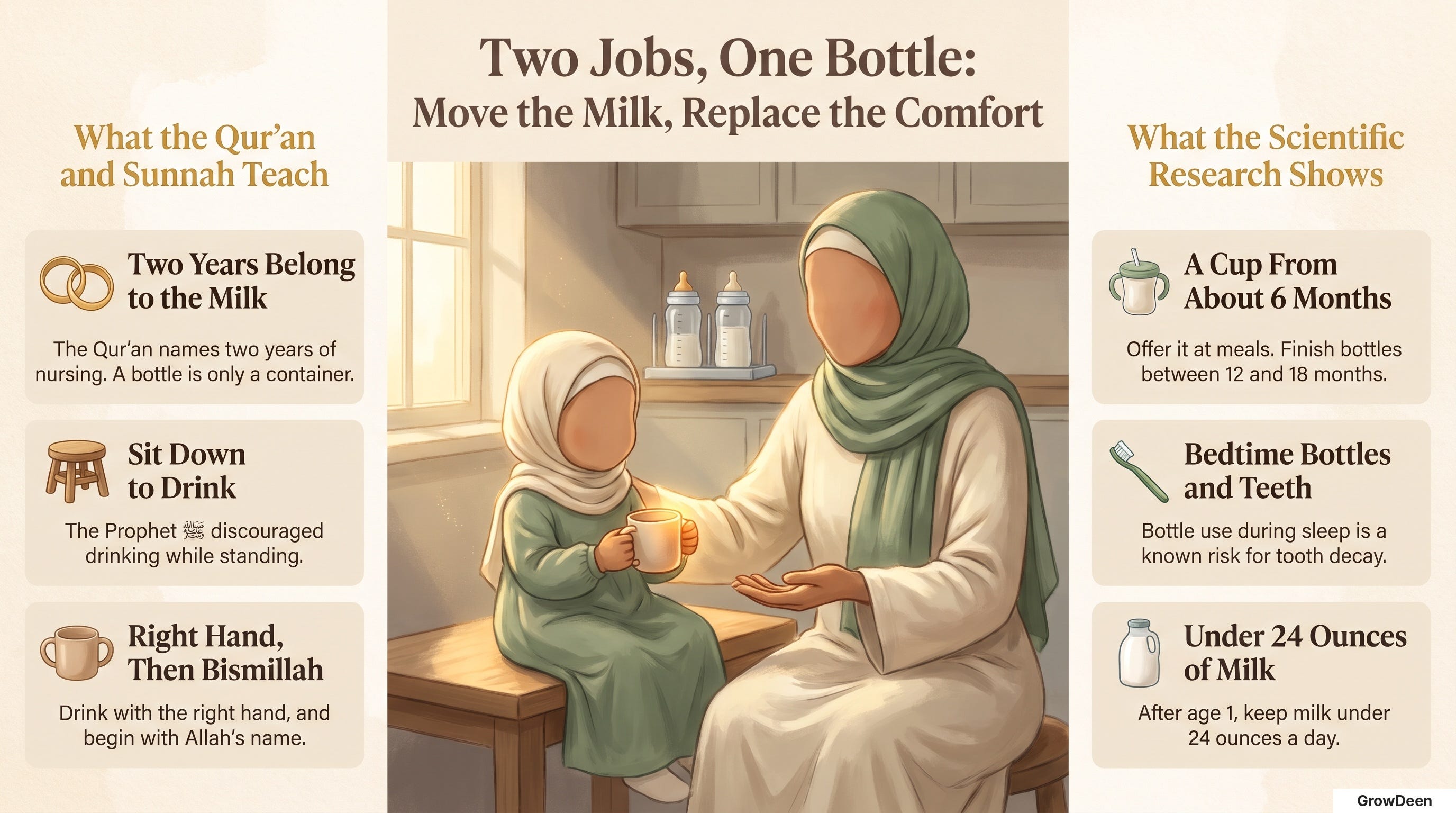
Nothing about this means your method failed. Much of the advice treats the bottle as a feeding. At bedtime, the bottle was doing a second job.
This guide brings together scientific research and the Qur'an and authentic Sunnah. You'll see why the cup fails at night, what Allah's two-year term covers, and a 14-night swap.
The Short Answer
Right for your child? Ages 12 months to 3 years, still using bottles daily, especially at bedtime. Under 12 months? Offer a cup at meals, beside the bottle.
What's probably happening: the bottle does two jobs, food and comfort. A cup can take over the food. Nothing has taken over the comfort yet.
Keep safe: no bottle in the crib, no juice before 12 months, and no juice in a bottle at any age.
Try tonight (1 minute): put a clean cup beside the bottles, and offer it at the next meal. Drop no bottle yet.
You'll know it's working when: she takes a few sips from the cup at meals. Bedtime protest is expected. It is the comfort job asking to be replaced.
Get help if: she refuses all drinks from a cup for more than a day or two. The same goes if she wets far fewer diapers, or seems pale, tired or unwell. Start with your child's doctor or pediatrician.
The rest of this guide explains why, and what to do if it does not work.
How to Read This Guide
3 minutes: The Short Answer above is enough for tonight.
7 minutes: The Short Answer, then Knowledge in Practice and If Things Don't Go to Plan.
The whole guide: read on for the scientific research, the Qur'an and Sunnah, and the References.
To share: the bold lines and the pull quotes are made to be shared.
To listen: open this guide in the free Substack app and tap Listen.
Inside This Guide
A child who cries for the bottle at night is often asking for you, not the milk.
Myth Check: "The Bedtime Bottle Is About Hunger"
What this belief gets right. Some evening asking is hunger or thirst, and a small snack with a drink from a cup answers it.
What the evidence adds. The American Academy of Pediatrics (AAP) names the comfort a child gets from sucking on a warm bottle, which can be hard to give up. It suggests extra snuggles and bedtime stories when the bottle goes. [1]
So the bedtime bottle is often food and comfort at once. Replace only the food, and the comfort is left asking.
Why This Happens
Why does the cup work at lunch and fail at 7pm?
At lunch, the bottle is mostly food. The meal is on the table, she is hungry, and the cup is close. Swap the bottle for a cup there, and the job is done.
At bedtime, the same bottle is doing a second job. It is warm and sucked slowly. It comes with your lap, the dim light and the same few minutes every night. That is a settling routine. The cup carries the milk, but none of the rest.
Think of it as a goodnight hug that comes in a bottle. Take the bottle away, and the hug goes with it, unless you give it back yourself.
Why does it get harder after the first birthday?
The AAP notes that toddlers cling to their bottles more fiercely as time goes by. [1] So earlier is often easier. If your 22-month-old takes three bottles a day, you have not failed. The hill is steeper, so the plan takes about two weeks.
Why do some children find it harder than others?
Temperament matters: some children drop bottles easily, others hold on hard. A child with a chronic illness, physical differences or a developmental delay may need a schedule built with your pediatrician. [1]
The cup can carry the milk. Only you can carry the comfort.
What the Scientific Research Shows
The clearest guidance comes from the AAP. Offer a cup when solid foods start, usually around 6 months. Then reduce bottles slowly, and finish sometime between 12 and 18 months. [1] Strong: official guidance from a national pediatric body.
Four findings explain why that window matters.
Weight. A US study followed 6,750 children born in 2001. At 24 months, 22.3 percent were still using a bottle. At 5.5 years, 22.9 percent of those children had obesity, compared with 16.1 percent of the others. [3] After adjusting for maternal obesity, breastfeeding, the start of solids, screen time and early weight, the link held (odds ratio 1.33). [3] Who was studied: US children in a national birth cohort; ethnicity, family income and additional needs are not given in the study summary. Suggestive: one large observational study. It shows a link; it cannot show cause.
Teeth. A 2021 review of bottle-feeding programs names bottle use during sleep as a risk factor for early tooth decay. It also notes that bottle use past 12 months can keep a child sipping drinks all day. [2] A 2019 systematic review for a World Health Organization (WHO) manual found low-quality evidence that sugars in bottles raise the risk. [4] Suggestive: reviews pointing the same way, built mostly on observational studies.
Iron. The AAP's 2026 report on iron deficiency advises that children over 1 drink less than 24 ounces (about 700 ml) of milk a day. [5] One US children's hospital reviewed 18 children aged 6 months to 5 years admitted with severe iron-deficiency anemia. Almost all drank more than 24 ounces of milk daily. [6] Strong for the guidance; Early for the hospital review, which is small and from one hospital.
Juice. The AAP advises no juice before 12 months, and none at bedtime. Toddlers should not get juice from bottles, or from covered cups they can sip all day. [7] Strong: official guidance.
What we do not know yet. No study has compared a gradual swap with a clean break, or tested three days between swaps. No study has yet tested this with Muslim families.
What this means for you: a cup from about 6 months, and bottles finished by 12 to 18 months, protect teeth, iron and appetite. The bedtime bottle matters most for teeth.
What the Qur'an and Sunnah Teach
Many Muslim mothers carry a quiet question. Does a 12-month bottle deadline cut across the two years of nursing Allah named?
وَٱلْوَٰلِدَٰتُ يُرْضِعْنَ أَوْلَـٰدَهُنَّ حَوْلَيْنِ كَامِلَيْنِ ۖ لِمَنْ أَرَادَ أَن يُتِمَّ ٱلرَّضَاعَةَ
Mothers may nurse [i.e., breastfeed] their children two complete years for whoever wishes to complete the nursing [period].
Al-Baqarah 2:233 · Sahih International [8]
Text. Ibn Kathir reads this verse as a direction from Allah to mothers to nurse through the complete term of two years. [9]
Our reflection. What the verse names is the milk. It says nothing about the bottle, a container that came centuries later. So moving your child onto a cup at 12 months takes nothing from the term Allah set. A nursing mother can carry on nursing as before.
Text. The same verse says that if both parents decide on weaning, by mutual consent and consultation, there is no blame on them. Ibn Kathir notes, as stated by Ath-Thawri, that one parent should not make this decision without consulting the other. [8,9]
Our reflection. Weaning in the verse means ending nursing. Even so, its shape suits any feeding change, a bottle swap included: decide together, with her benefit weighed between you.
The new vessel has its own Sunnah.
Anas reported Allah's Apostle (ﷺ) disapproved the drinking of water while standing.
Sahih Muslim 2024a · sunnah.com [10]
Text. The Prophet ﷺ is also reported to have drunk Zamzam water (from the well in Makkah) while standing (Sahih al-Bukhari 1637). [11] For how scholars weigh these reports together, ask your local imam or a local scholar, and share the details with him.
Text. He ﷺ taught drinking with the right hand (Sahih Muslim 2020a). [12] He told a boy at the dish, "Mention the Name of Allah and eat with your right hand" (Sahih al-Bukhari 5376). [13]
Our reflection. A bottle travels down the hallway, onto the sofa and around the kitchen. A cup asks her to sit. Put it in her right hand at the table, and say Bismillah ("in the name of Allah") with her. She meets her first cup the way he taught.
You are changing the vessel. You are not ending anything Allah gave her.
Where Sunnah Meets Safety: Nursing While the Bottle Goes
The practice: the Qur'an names two complete years of nursing for those who wish to complete it (Al-Baqarah 2:233). Text
What scholars say: Ibn Kathir reads it as a direction to complete the two-year term; weaning before that carries no blame when both parents agree after consultation. [9]
What health bodies say: the WHO recommends continued breastfeeding with family foods up to two years of age or beyond. [14] The AAP's 12-to-18-month target applies to bottles only. [1] A review done for a WHO manual found that breastfeeding up to 2 years did not raise the risk of tooth decay (low-quality evidence). [4]
Keep · Swap · Skip: keep nursing as long as you both wish; swap every bottle for a cup; skip juice and sweet drinks in any bottle.
Say it to the family: "We're keeping the nursing. Only the bottle is going."
The Lab Verdict
The science: a cup from 6 months and no bottles after 12 to 18 months protect teeth, iron and appetite (Strong; the weight link is Suggestive).
The Qur'an and authentic Sunnah: the two-year term belongs to the milk, and the Prophet ﷺ taught a seated drink, the right hand and Allah's name.
Where they meet: the science shows why the bottle should go and how to ease it out; the Sunnah gives the new cup its manner. They meet in patience and small steps.
So at home: move the milk to a cup, one bottle at a time, and give her the comfort yourself.
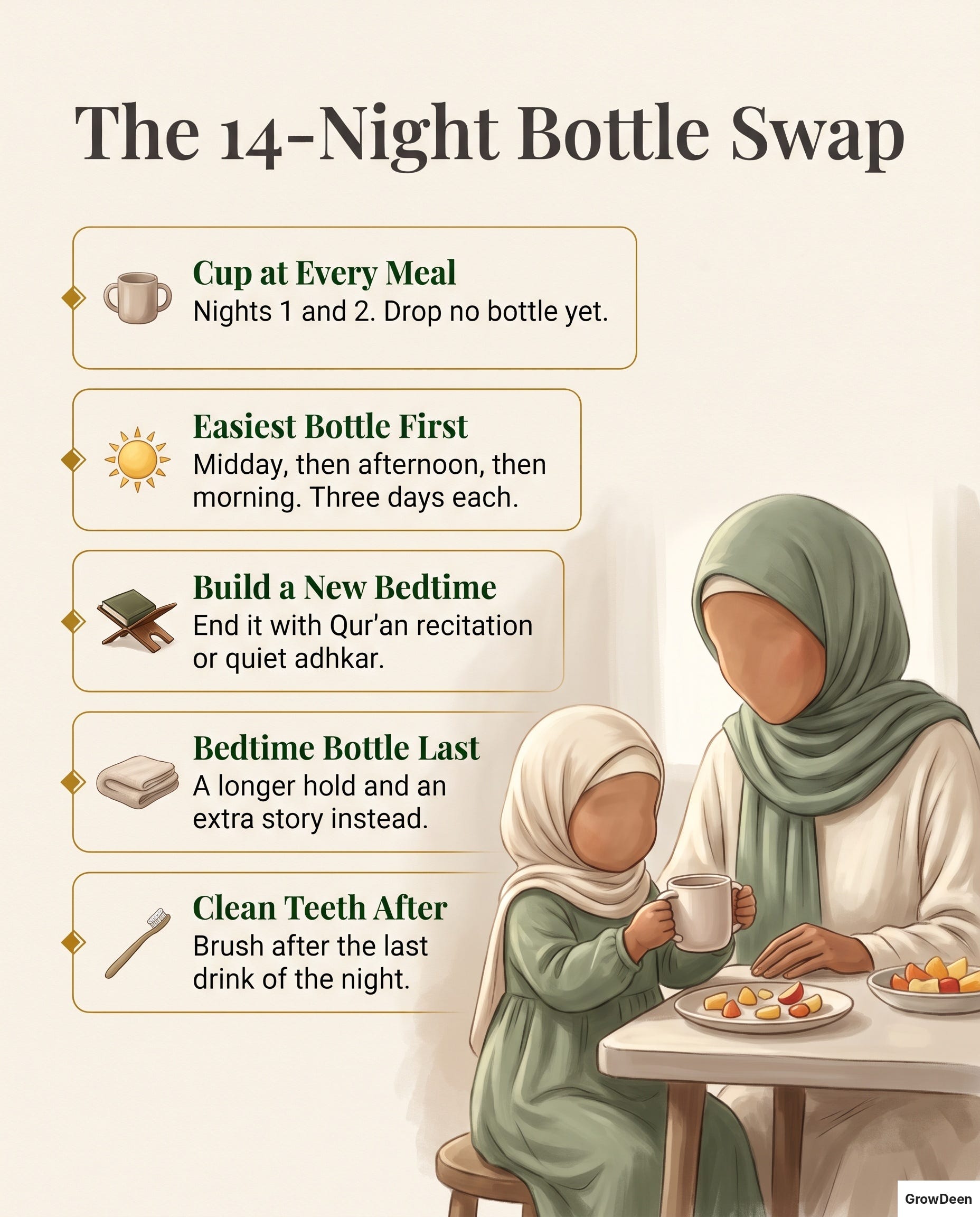
Knowledge in Practice: The Fourteen-Night Swap
Knowing why the bedtime bottle holds on is half the work. Knowledge bears fruit only when it reaches the table, and the bedside.
If you can only do one thing, do step 1. It is enough.
The plan below drops the easiest bottle first and bedtime last, with about three days between swaps. It is one way to do it. The clean break, under If Things Don't Go to Plan, is another. The AAP suggests moving away from the bottle gradually, and it names nap and bedtime bottles as ones to cut out. [1] Bottle use during sleep is a known risk factor for tooth decay. [2] If your child's doctor or dentist wants the bedtime bottle gone sooner, follow them.
1. Put the cup where the bottles live (1 minute, then nights 1 and 2). A cup she sees every day becomes ordinary. Offer it at every meal. Drop no bottle yet.
Say this: "This is your cup. It comes to the table with us." (Say it in the language your child knows best.)
Under 12 months: offer an open cup you hold, or a straw cup, at meals, beside the bottle, which stays for now. Breast milk or formula goes in, or a few sips of water. A few sips is a success.
12–18 months: cup only at meals, with whole cow's milk or water; breastfeeding carries on as before if you are nursing. [1,15]
18 months to 3 years: an open cup at the table, a straw cup for the bag. Water between meals, milk at meals.
Which cup? A sippy cup with a valve makes her suck, like a bottle. An open cup, a straw cup, or a simple spout with no valve teaches more. The AAP sees the sippy cup as an optional bridge, with an open cup by about 2 years. [1]
2. Swap the easiest bottle first: midday, on night 3 (2 minutes a day). Midday carries the least feeling, so it goes first. Then hold for three days.
Say this, when she asks for it:
"Your milk is in the cup now. Come and sit with me."
"Big girls have their milk at the table. Shall we take it together?"
"I know you want it. I'm right here. Let's have a cuddle first."
"Cup now, then the story. Which book tonight?"
Say the same few sentences each time. A new explanation every night can sound like an open negotiation to a toddler.
Instead of: "Okay, only this once." Try: "Your milk is in the cup now. I'm right here."
3. Swap the afternoon bottle on night 6, then the morning bottle on night 9 (2 minutes a day). Hold each for three days. Keep drinks to meals and named moments, and put the cup away between them. The AAP warns that a cup carried around all day can turn into a security blanket. [1]
4. Build the new bedtime before you take the old one (nights 10 and 11, 10 minutes). Keep the bottle for now, and end the routine with something new. Try quiet Qur'an recitation, or adhkar (short remembrances of Allah) said softly over her. Try a du'a (a personal prayer) in your own words while you rub her back, or a story from the lives of the Prophets. It settles her in your voice, and it leaves no sugar on her teeth.
5. Swap the bedtime bottle last (night 12, 15 minutes). Give a longer hold and an extra story. A child who asks for a bottle at night may want food, comfort or you. Hunger gets a cup and a small snack; comfort gets you. On night 13, pack the bottles away out of sight. On night 14, clean her teeth after the last drink, and keep doing it.
Make It Work in Your Home
On your own, or on night shifts? Choose the bedtime swap for a night you are home three nights in a row. A tired night is not the night to start.
A grandparent, sitter or daycare gives some bottles? The AAP says every caregiver needs to follow the same routine. [1]
No spare money? Any small plain cup you already own works. Nothing needs to be bought.
Timing: avoid starting the week daycare begins, the week a new baby comes home, or during illness or travel.
Say this to Grandma: "Mama, she trusts you so much. We're moving her milk to a cup. When she asks for the bottle, could you say, 'Your milk is in the cup now,' and give her a cuddle?"
Say this to your spouse: "Let's decide this one together. Which bottle should go first, and who takes bedtime on night 12?"
The family question: ask the grandparent who raised you, "How did you move us off the bottle, and what did you give us instead?"
Move the milk, replace the comfort: one bottle at a time, bedtime last.
If Things Don't Go to Plan
If she refuses the cup: offer it again at the next meal. Drink from your own cup beside her. Try a different cup: open, straw or a spout with no valve.
If the plan stalls at the same bottle twice: try a clean break. Put every bottle out of sight on one day. When she asks, offer a cup and a snack, and offer drinks often through the day.
If you handed the bottle back last night: it happens. Start again from the last swap that held. Handing the bottle back to end crying can teach that crying brings it back. The AAP warns that giving in to bedtime protests can turn a temporary sleep problem into a serious struggle. [1]
If you start doubting yourself: Am I being cruel to her? No. The AAP says protest is normal, and a child's resistance does not mean you are doing anything wrong. [1] Protest is information about a habit.
If the crying runs on for days and the house is fraying: stop, and try again in a few weeks. That is a decision, not a defeat.
Speak to someone if: she refuses all drinks from a cup for more than a day or two, or wets far fewer diapers. Speak up too if she is pale, unusually tired or off her food. The same goes if the nights have become a full-blown power struggle. [1] Ask a dentist to check her teeth as well. Signs are clearer looking back. Seeing them late is not neglect.
And you? Two weeks of protest wear a parent thin. If you feel low most days, tell your own doctor.
Who to turn to: your child's doctor or pediatrician, or a child health nurse. A dentist for her teeth. For questions of deen (Islamic practice), ask your local imam or a local scholar, and share the details with him.
Support Muslim Parenting Lab ❤️
Would you like one parent, somewhere, to be guided because of you? Fund the articles that reach them, with the button below.
The Prophet ﷺ said one person guided through you is better for you than red camels, the greatest wealth of that time. (Sahih al-Bukhari 3701)
Your Companion Pack: The Bottle Swap Pack
Free to download. One PDF, three pages, made to sit on the fridge door while you run the plan:
Page 1, The Cup and Drink Chart: which cup, what goes in it and how much, in four age bands from 6 months to 3 years. It ends with the four things that never go in a bottle.
Page 2, The Fourteen-Night Swap Tracker: a night-by-night grid with the four swap nights marked and a line for what replaced each bottle. It adds what to say when she asks, four rules for the plan, and when to stop or call her doctor.
Page 3, Two Reflections for the Hard Nights: the Qur'an's two-year term and why it belongs to the milk. Then the Sunnah of sitting down to drink, with Bismillah before the first sip.
Parents Also Ask
At what age should a baby stop using a bottle?
The AAP advises offering a cup when solids start, around 6 months, and finishing bottles sometime between 12 and 18 months. [1] Earlier is often easier, because toddlers tend to cling harder as the months pass. What the Scientific Research Shows explains more.
Is it bad for a 2-year-old to still have a bottle?
It is worth changing now, one bottle at a time. Bottle use at 2 has been linked with obesity at 5.5 years, and bottles in bed are a known risk for tooth decay. [2,3] Start with the midday bottle this week.
Does weaning off the bottle mean I have to stop breastfeeding?
No. The bottle and nursing are separate. The Qur'an names two complete years of nursing for those who wish to complete it. The WHO supports breastfeeding up to two years or beyond. [8,14] Only the container changes at 12 to 18 months.
How do I get my toddler to stop the bedtime bottle?
Swap it last, after the daytime bottles are gone, and build a new bedtime ending first. Give the comfort directly: a longer hold, an extra story, Qur'an recitation or quiet adhkar. Knowledge in Practice has the full plan.
Should I use a sippy cup or an open cup?
An open cup, or a straw cup, teaches a more grown-up way to drink. A sippy cup with a valve makes a child suck, like a bottle. The AAP treats it as an optional bridge, with an open cup by about 2 years. [1]
How much milk should a 1-year-old drink?
The AAP suggests about 16 ounces (2 cups) of whole milk a day from 12 to 24 months, plus water. [15] Its 2026 iron report advises keeping milk under 24 ounces (about 700 ml) a day after age 1. [5]
Can I dilute the milk in the bottle until she loses interest?
Some families try it. It does little for a bedtime bottle that is doing comfort work, and a bottle in bed still bathes the teeth. Swapping the vessel and replacing the comfort is the cleaner fix.
Final Reflection
Dear parent,
You read this far at the end of a long day. That says you want to do this gently, and do it once.
If the bottle stayed past the leaflet's date, you did what got everyone to sleep. That made sense. This is a season, and small steps are enough.
You don't need all fourteen nights tonight. Put the cup beside the bottles, and offer it at breakfast. Let your intention be care for the amanah (trust) Allah gave you.
Often, the bottle she cries for at night is doing a job only you can take over. Move the milk, replace the comfort.
A Du'a for This
For you:
رَبِّ ٱشْرَحْ لِى صَدْرِى وَيَسِّرْ لِىٓ أَمْرِى
Rabbi-shrah lī ṣadrī, wa yassir lī amrī.
"My Lord, expand [i.e., relax] for me my breast [with assurance] And ease for me my task."
Ta-Ha 20:25–26 · Sahih International [16]
With your child: Bismillah, "In the name of Allah." Say it with her before the first sip of every cup, from about 12 months. Before she can say it, say it over her. The Prophet ﷺ taught a boy to mention Allah's name before he ate (Sahih al-Bukhari 5376). [13]
Share the Khayr
If you know a parent whose two-year-old still takes a bottle to bed, send this to her. The Prophet ﷺ said that whoever guides someone to good has a reward like the one who does it. [17]
Tell us in the comments: which bottle was hardest to swap in your home? We'd love to know.
Parents Also Read
Parents who read this guide also found these helpful.


References
[1] Shu, J. (2023). From Bottle to Cup: Helping Your Child Make a Healthy Transition. HealthyChildren.org, American Academy of Pediatrics.
[2] Cheng, H., Chen, R., Milosevic, M., Rossiter, C., Arora, A., & Denney-Wilson, E. (2021). Interventions targeting bottle and formula feeding in the prevention and treatment of early childhood caries, overweight and obesity: An integrative review. International Journal of Environmental Research and Public Health, 18(23), 12304.
[3] Gooze, R.A., Anderson, S.E., & Whitaker, R.C. (2011). Prolonged bottle use and obesity at 5.5 years of age in US children. The Journal of Pediatrics, 159(3), 431–436.
[4] Moynihan, P., Tanner, L.M., Holmes, R.D., Hillier-Brown, F., Mashayekhi, A., Kelly, S.A.M., & Craig, D. (2019). Systematic review of evidence pertaining to factors that modify risk of early childhood caries. JDR Clinical & Translational Research, 4(3), 202–216.
[5] Powers, J.M., Heeney, M.M., Hord, J., Lehmann, C.U., Abrams, S.A., Buchanan, G.R., et al. (2026). Prevention, screening, diagnosis, and treatment of iron deficiency and iron deficiency anemia in infants, children, and adolescents: Clinical report. Pediatrics, 158(1), e2026077414.
[6] Lundblad, K., Rosenberg, J., Mangurten, H., & Angst, D.B. (2016). Severe iron deficiency anemia in infants and young children, requiring hospital admission. Global Pediatric Health, 3, 2333794X15623244.
[7] Heyman, M.B., & Abrams, S.A.; Section on Gastroenterology, Hepatology, and Nutrition, Committee on Nutrition. (2017). Fruit juice in infants, children, and adolescents: Current recommendations. Pediatrics, 139(6), e20170967.
[8] Qur'an, Al-Baqarah 2:233. Translation: Sahih International.
[9] Tafsir Ibn Kathir on Al-Baqarah 2:233.
[10] Sahih Muslim 2024a.
[11] Sahih al-Bukhari 1637.
[12] Sahih Muslim 2020a.
[13] Sahih al-Bukhari 5376.
[14] World Health Organization. (n.d.). Breastfeeding. WHO.
[15] American Academy of Pediatrics. (n.d.). Recommended Drinks for Children Age 5 & Younger. HealthyChildren.org.
[16] Qur'an, Ta-Ha 20:25–26. Translation: Sahih International.
[17] Sahih Muslim 1893a.
We combine scientific research with Qur’an and authentic Sunnah, and we cite our sources. Even so, this is general guidance and no substitute for a doctor who can examine your child.
Sources & confidence
The hadith in this guide are from Sahih al-Bukhari and Sahih Muslim. Checked November 2026. For a ruling on your own situation, ask your local imam or a local scholar, and share the details with him. Found a source that looks wrong? Email us at info@growdeen.com.
Words in this guide
early childhood caries (tooth decay, baby bottle tooth decay) · scientific term: decay in a young child's baby teeth.
iron-deficiency anemia (anaemia) · scientific term: too few healthy red blood cells because the body is short of iron.
odds ratio · scientific term: a way a study compares how often something happens in two groups; above 1 means higher odds, not certainty.
observational study · scientific term: a study that watches what families already do, so it shows links, not causes.
systematic review · scientific term: a study that gathers and grades all the studies on one question.
bottle weaning (stopping the bottle) · everyday term: moving a child from bottles to a cup.
sippy cup (training cup) · everyday term: a lidded cup with a spout; one with a valve makes a child suck like a bottle.
straw cup · everyday term: a cup a child drinks from through a built-in straw.
clean break (cold turkey) · everyday term: putting every bottle away on one day.
Bismillah · Islamic term: "in the name of Allah", said before eating or drinking.
du'a (doa) · Islamic term: a personal prayer, asking Allah.
adhkar (dhikr) · Islamic term: short words said in remembrance of Allah.
Sunnah · Islamic term: the teaching and example of the Prophet ﷺ.
tafsir · Islamic term: a scholar's explanation of the Qur'an.
Zamzam · Islamic term: the water of the well in Makkah.
amanah · Islamic term: a trust given by Allah.
deen · Islamic term: Islam as a way of life and practice.
khayr · Islamic term: good.
crib (cot) · country word: a baby's bed with high sides.
diaper (nappy) · country word: what a baby wears to catch urine and stool.
pediatrician (paediatrician) · country word: a doctor for children.
ounce (oz) · country word: a US measure of liquid; 24 ounces is about 700 ml.