

Doorbell mid-bath, or a toddler screaming at the drain? The free Bath Night Pack puts the bath plan, the fear fixes and three Sunnah reflections on your bathroom door.
AGES 1–5 YEARS · 20 MIN READ
6:40pm. You got in from work twenty minutes ago. Your 2-year-old sits in warm water, pouring from one cup into another.
The doorbell goes.
It's a parcel. He's sitting down. I'll be ten seconds, and the water's barely up to his belly.
You check car-seat straps twice. You hold a hand at every curb.
And still, leaving the bathroom feels reasonable. The bath is the calmest room in the house.
You are not a careless parent for thinking it. Many of us have felt that pull. The quiet of bath time is what makes it so hard to read.
This guide brings together scientific research and the Qur'an and authentic Sunnah. You'll see why a bath is quieter than it looks, and what to do when the doorbell rings.
The Short Answer
Right for your child? Toddlers and preschoolers, 1 to 5 years, who can sit up in the bath. Babies who can't sit yet need a different setup.
What's probably happening: The bath feels like the calmest room in the house. But a child slipping under the water may make no noise or splash. [1]
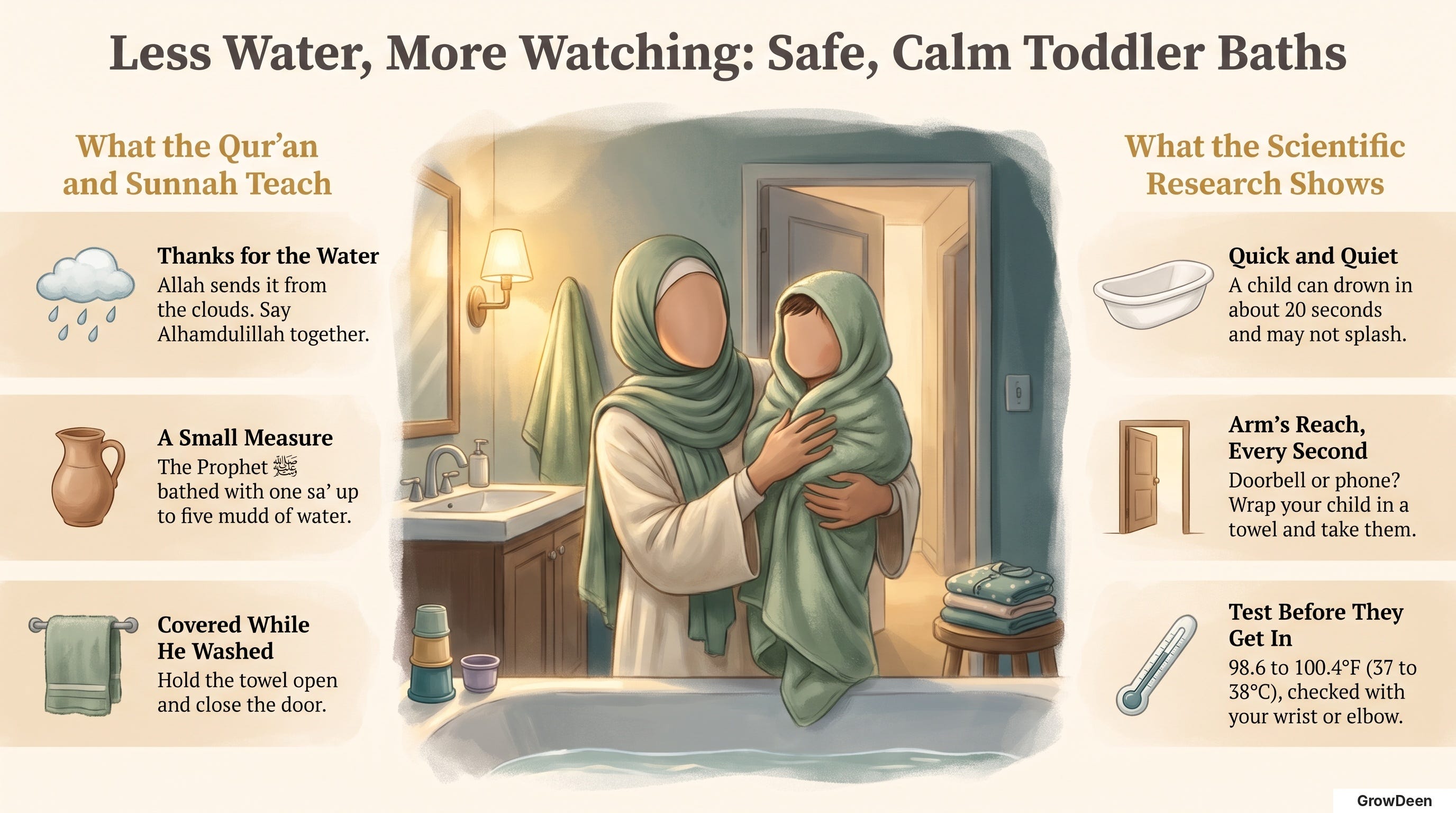
Keep safe: Stay within arm's reach and keep watching for the whole bath. If the door or phone needs you, take your child, wrapped in a towel. [1,2]
Try tonight (2 minutes): Before the tap runs, lay out the towel and put your phone away. Run water belly-button deep and test it with your wrist. [3]
You'll know it's working when: You never have to leave the room mid-bath. Fewer baths are fine: two or three a week is enough for most toddlers. [4]
Get help if: Your child's skin stays badly dry, red or itchy, or peeing stings. Start with your child's doctor or pediatrician. In an emergency, call your local emergency number.
The rest of this guide explains why, and what to do if it does not work.
How to Read This Guide
3 minutes: The Short Answer above is enough for tonight.
7 minutes: The Short Answer, then Knowledge in Practice and If Things Don't Go to Plan.
The whole guide: read on for the scientific research, the Qur'an and Sunnah, and the References.
To share: the bold lines and the pull quotes are made to be shared.
To listen: open this guide in the free Substack app and tap Listen.
Inside This Guide
Skipping a bath tonight is fine. Stepping away from one is not.
Myth Check: "It's Only Ten Seconds"
What the belief gets right. Your toddler is sitting down in low water, and a parcel takes seconds. On any other evening, ten seconds is nothing, and a parent who thinks this way is usually a careful one.
What the evidence says. A child can drown in about 20 seconds, in a few centimeters of water. [1] Toddlers are at higher risk because they are top-heavy: after a slip, they cannot always lift themselves out of the water. [1] So ten seconds at the door is not as small as it feels, and there may be nothing to hear.
What works instead. If you can't ignore the doorbell or the phone, wrap your child in a towel and take them with you. [2] The parcel can wait on the step.
Why This Happens
Why does a careful parent step away?
Look at what the bath asks of you. Your child is busy and happy in a warm room, and nothing is making noise.
A parent's alarm is tuned to noise, like a cry or a crash. A quiet bath sets none of it off.
There is often a rush under bath time, too, to get them washed and out. That rush makes "one second" sound harmless.
What does it look like when a toddler slips?
Not like the films. A drowning child may make no noise or splash. [1]
That is why every official source we checked gives one plain rule. Stay within arm's reach for the whole bath, and never leave your child alone for any reason. [3,1,5]
A child slipping under the water may make no sound. Quiet is not the same as safe.
Why is my toddler suddenly scared of the bath?
Some evenings the problem is the opposite: a 2-year-old gripping the door frame and screaming at the sight of the tub.
The triggers tend to be specific. It might be the gurgle of the drain, or water running into their eyes or over their face. A full tub can also look huge from a small child's height.
Some children remember a slip from weeks ago far better than you do. For many, hair washing is the worst part of all.
To your child the fear is real, so treat it as real. Dragging a frightened child into the water can make tomorrow's bath harder. Patience and small steps are kinder, and step 3 of Knowledge in Practice matches each fear to a fix.
Whether the bath is silent or screaming, the answer starts with you close by.
What the Scientific Research Shows
Start with the strongest finding. The CDC states that more children aged 1 to 4 die from drowning than from any other cause. [5] For bathtubs, it advises close, constant supervision, with no reading or phone to distract the adult. [5]
Who wrote it: the Centers for Disease Control and Prevention, US, page last reviewed September 2025. How strong this is: Strong. An official guideline.
The American Academy of Pediatrics (AAP) reports that most infant drowning deaths happen in bathtubs and large buckets. [6] About 15% to 30% of caregivers have reported leaving a child younger than 2 unsupervised in the bath. [6] Bath seats do not make up for it: they can tip over, and children can slip out of them. [6]
Who wrote it: the AAP, US, 2021, summarizing its technical report on drowning prevention. How strong this is: Strong. An official body's guidance.
Children's hospitals add the practical numbers. Bath water should sit between 98.6 and 100.4°F (37 and 38°C). [1] A child's skin burns at a lower temperature than an adult's. [7]
Tap water at 140°F (60°C) can give a young child a third-degree burn in about three seconds. [8] The AAP advises setting the water heater so the hottest water at the faucet is no more than 120°F (49°C). [2]
Who wrote it: the Royal Children's Hospital Melbourne (Australia, 2024), Shriners Children's (US, 2023), the Children's Hospital of Philadelphia (US) and the AAP (US, 2017). How strong this is: Strong for the heater setting, an AAP guideline. Suggestive for the rest, including the 20 seconds in the Myth Check: children's hospital guidance.
On how often to bathe, the Sydney Children's Hospitals Network says most toddlers need a bath only 2 to 3 times a week. [4] How strong this is: Suggestive. Expert guidance, Australia, 2026.
One trial looked at the bath as part of bedtime. It included 405 mothers and their children, aged 7 months to 3 years. [9]
The routine was a bath, then a massage for infants or lotion for toddlers, then quiet activities such as cuddling. Lights went out within 30 minutes of the bath. [10]
After two weeks, the children fell asleep faster and had fewer and shorter night wakings, and the mothers' mood improved. [9,10] The study's authors could not tell exactly how the routine helped, or whether all three steps were needed. [10]
Who was studied: the study summary gives no country, ethnicity or culture, family type or income, or whether children with additional needs took part. The trial was funded by Johnson & Johnson Consumer Companies. [9]
How strong this is: Suggestive. One good randomized trial.
What we do not know yet: whether the bath itself helps sleep, or any calm routine would do the same. No study has yet tested this with Muslim families.
What this means for you: a bath is a short, close-watch activity. It does not need to happen every night, but every second of it needs an adult within reach.
What the Qur'an and Sunnah Teach
Have you ever looked at the bath water itself? The tub fills, and the only question anyone asks is whether it's too hot. The Qur'an asks you to look again.
أَفَرَءَيْتُمُ ٱلْمَآءَ ٱلَّذِى تَشْرَبُونَ
ءَأَنتُمْ أَنزَلْتُمُوهُ مِنَ ٱلْمُزْنِ أَمْ نَحْنُ ٱلْمُنزِلُونَ
لَوْ نَشَآءُ جَعَلْنَـٰهُ أُجَاجًا فَلَوْلَا تَشْكُرُونَ
And have you seen the water that you drink? Is it you who brought it down from the clouds, or is it We who bring it down? If We willed, We could make it bitter, so why are you not grateful?
Al-Waqi'ah 56:68–70 · Sahih International [11]
Text. These verses speak of drinking water. Ibn Kathir explains that Allah is the One who causes the rain to fall from the clouds. He could have made it salty and undrinkable, and people are asked to appreciate the favor of fresh rain. [12]
Our reflection. The water in your child's tub fell from the same clouds. Every bath is a small, ordinary chance to say Alhamdulillah (all praise is for Allah).
Text. The Prophet ﷺ used to take a bath with one sa' up to five mudd of water, a small measure. [13] And Umm Hani bint Abi Talib described finding him at his bath in the year Makkah was opened:
"I went to Allah's Messenger (ﷺ) in the year of the conquest of Mecca and found him taking a bath while Fatima was screening him."
Sahih al-Bukhari 280 · sunnah.com [14]
Our reflection. So little water, used with care, and privacy kept even at home. A towel held open and a closed door can teach the same modesty before your toddler knows the word.
Text. The Prophet ﷺ said that it is a duty on every Muslim to bathe once in seven days, washing the head and body. [15] Children are not held accountable for religious duties before puberty (Sunan Abi Dawud 4403 · Sahih (Al-Albani)). [16]
Our reflection. For a toddler, the weekly bath works as a gentle pattern: one full wash a week as a floor, with lighter washing in between. Two or three baths a week fits it well.
Scholars differ on the details of saying Allah's name aloud in a room that has a toilet. Parents Also Ask sets out the views, and step 5 gives a simple habit for bath night.
Little water, a screen held up, and thanks to the One who sent the rain.
Where Sunnah Meets Safety: The Small Bath
The practice: the Sunnah reports that the Prophet ﷺ bathed with one sa' up to five mudd of water, a small measure. [13] Sunnah.
What health bodies say: for a child who can sit up freely, water to about belly-button height is plenty. [3] Shallow water is not a safety device: children can drown quickly and quietly in a few centimeters, so an adult stays within arm's reach. [3,1]
Keep · Swap · Skip: keep the small bath and the thanks. Swap a full tub for belly-button-deep water. Skip any thought that low water makes it safe to step away.
Say it to the family: "We keep the water low, like the Sunnah, and we stay right beside him."
The Lab Verdict
The science: drowning is the leading cause of death for children aged 1 to 4, and in a bath it can be quick and quiet. Constant, arm's-reach supervision is the official rule. (Strong)
The Qur'an and authentic Sunnah: the Prophet ﷺ bathed with a small measure of water and was screened while he washed. The Qur'an asks us to be grateful for the water Allah sends.
Where they meet: the science shows what keeps a child safe in the water. The Sunnah gives the manner: little water, modesty and thanks. Together, they ask the same of us: less water, more watching.
So at home: run it shallow, lay everything out first, and stay within arm's reach until the towel is around your child.
Knowledge in Practice: Two Minutes Before, Every Second During
Knowing why the bath is quiet is half the work. Knowledge bears fruit only when it reaches the bathroom floor. Step 1 takes two minutes and costs nothing.
If you can only do one thing, do step 1. It is enough.
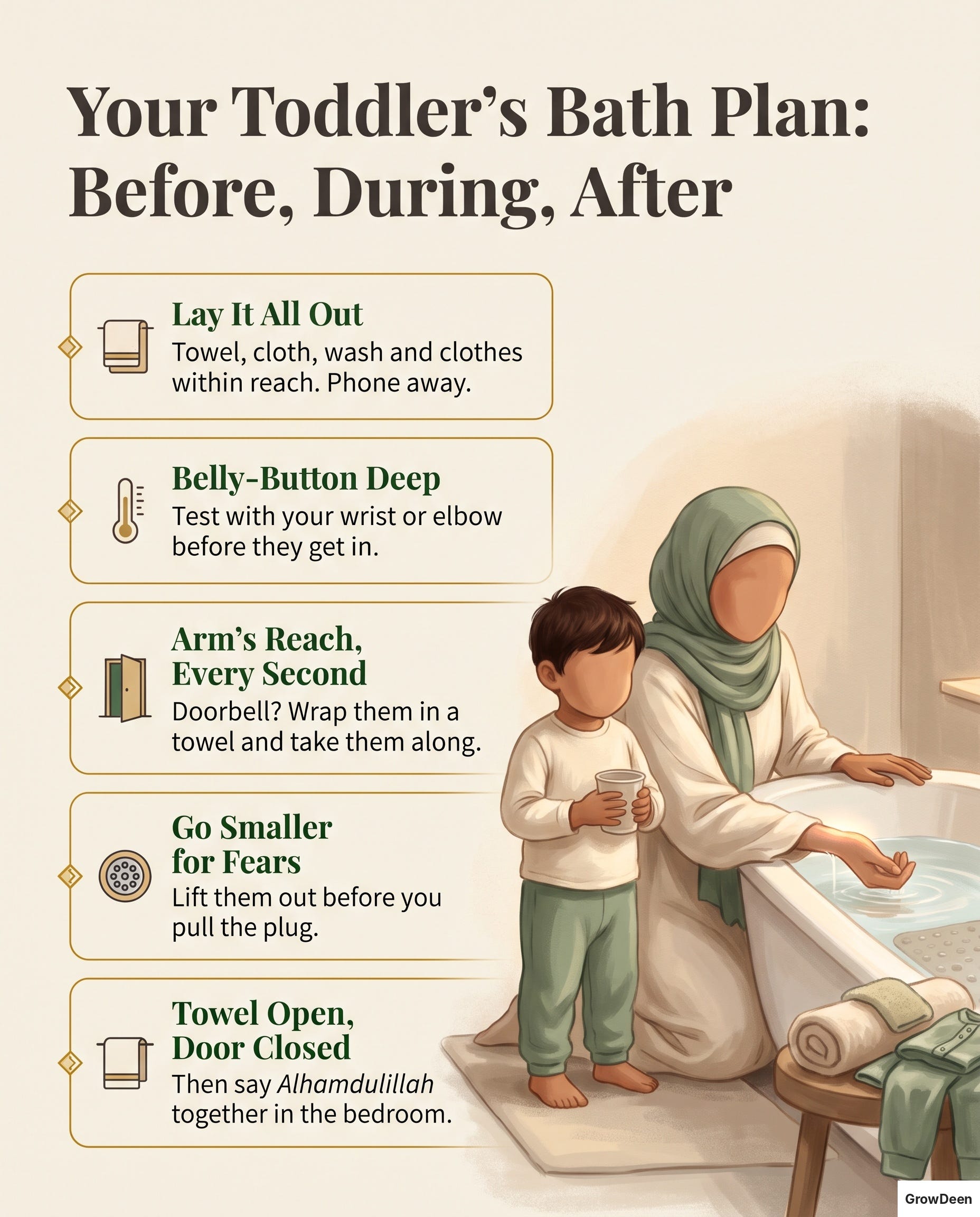
1. Set up so you never have to step away (2 minutes, before the tap runs). Once your child is in the water, you can't fetch anything. So take it all in first: a towel, a washcloth, a mild wash, clean clothes and a diaper (nappy) if needed. [3]
Put a non-slip mat in the tub. [3] Put your phone out of reach: the CDC asks anyone watching a child in water to avoid using the phone. [5] If your child's skin is dry or has eczema, open the moisturizer now.
Then stay within arm's reach, and keep watching, until your child is out. [3,1] If you can't ignore the doorbell or the phone, wrap your child in a towel and take them with you. [2] Never leave an older brother or sister in charge. [3,1]
Say this: "Towel, cloth, pajamas, all ready. Now we can start." (Say it in the language your child knows best.)
Instead of: "Stay there, I'll be one second." Try: "Up you come. We'll answer the door together."
Choose the wash before you need it. Harsh soaps can dry or irritate young skin [4], so pick a mild, pH-neutral, soap-free wash, free from fragrance, botanicals and antibacterial agents. [17]
2. Run it shallow, test it, and play inside the circle (1 minute to run, 10 minutes or less in the water). For a child who can sit up freely, water to about belly-button height is plenty to wash and play. [3] Mix hot and cold as the bath fills, and stay in the room while it runs. [1]
Aim for 98.6 to 100.4°F (37 to 38°C), checked with a thermometer, your wrist or your elbow. [3,1] Water that feels fine to your hand can be too hot for your child's skin. [7] Once this week, check the water heater: the hottest water at the faucet should be no more than 120°F (49°C). [2]
Never top up the bath with your child in it. Lift them out and away from the taps first, because the scald risk stays high even when you only meant to run the cold. [3]
A bath for a young child shouldn't need to last longer than 10 minutes. [3] Inside that circle, the tub makes a good playroom, with toys from your kitchen: plastic cups, old tubs, a washcloth. Count the cups out loud, or make up a spoken rhyme about a fish who won't get out.
Pick sealed toys, or squeeze hollow ones out and let them dry after every bath, because water trapped inside can grow mold and bacteria. [1] Treat a bath seat as seating, never as safety: it can tip over, and children can slip out of it. [6]
Say this: "Let's check with my elbow. Warm, not hot. In you go."
3. If the bath brings tears, go smaller (a few minutes a night, for a few weeks). Find your child's trigger, then try the matching fix tonight.
The drain noise: lift your child out and wrap them in the towel before you pull the plug. [18] Later, let them watch the water drain from the doorway, holding your hand.
Water on their face: keep it off. Rinse hair with a damp cloth tipped back from the forehead. [18] Later, let them hold the cloth and wipe their own face.
The size of the tub: run only a few centimeters of water, or wash them in a basin beside the bath. Later, let them sit beside the tub and play with the water from outside first.
A slip they remember: put the non-slip mat down where they can see it, and keep your hand close. Keep baths short, and end them before your child gets upset.
Having their hair washed: skip it this time. Hair usually needs washing only once or twice a week, more often if it's dirty, oily or your child is always active. [4] Let them pour water over a doll's hair first, so they control the water.
On the days with no full bath, a face, hands and bottom wash keeps them clean. [4] Some children need weeks of short, uneventful baths before the tub feels ordinary again.
Say this: "The water stays low. My hand stays here. You tell me when."
Under 3: fewer words, more showing. Pour over the doll while they watch. 3–5: let them choose the cup or the cloth, and name the step before you do it.
4. End with the towel open and the door closed (1 minute). Have the towel open before your child stands up, and close the bathroom door. Drain the water straight away, and keep the toilet lid closed. [3,2]
If the skin is dry or eczema-prone, keep the bath lukewarm and 5 to 10 minutes long. Pat the skin dry so it stays slightly damp, and put a thick moisturizer all over within three minutes. [19,20]
This is also where body safety begins. Teach the correct names for all body parts, and which parts are private. Teach that their private parts are their own, and to speak up if anything feels uncomfortable. [4]
As your child gets older, hand over more of the washing. [4]
Say this: "Towel's ready. Arms out. Your body belongs to you."
Around 1 to 2: you do all the washing, with the water shallow, the bath short and your hand close. Around 2 to 3: let them hold the cloth, pour and wash their own tummy, and start the towel-ready, door-closed habit. Around 3 to 5: they wash more of themselves while you guide and watch, and you keep building on the private-parts talk. [4] From 5: they can lead more of the washing, but keep watching any child under 8 near water. [3]
5. Carry the calm into the bedroom (5 minutes). Pajamas, a short recitation, the bedtime du'as (supplications).
If your bathroom has a toilet, keep spoken Qur'an and du'as for the bedroom. Many scholars regard saying Allah's name aloud there as disliked, though remembering Him silently is not. [21]
While you dry their hair, ask where the water came from, and thank Allah for it together. [11] The families in the bedtime trial shared one thing: a consistent nightly routine. [9]
Say this: "Where did your bath water come from? Allah sent it down from the clouds. Alhamdulillah."
Make It Work in Your Home
On your own with two children? Bring the older one into the bathroom with a book or a cup to fill. Never leave the toddler to fetch the older one, and never hand the toddler to the older one. [3,1]
A grandparent or the other parent does bath night? Hand over the routine, not only the child: the towel first, the low water, the elbow test and the doorbell rule.
Say this to Grandma: "Mama, you've bathed more children than I have. Can we keep the water low and one hand close, even if the door goes? He's at the slippery age."
No bath thermometer? Your wrist or your elbow works. [3,2] Sharing a shower with your little one? Our reflection: stay covered with a swimsuit or a wrap. It keeps the moment modest and teaches the lesson without a word.
The family question: "When the doorbell goes at bath time, who answers it in our house?"
Try It Seven Times
Any seven baths in the next couple of weeks. Seven is a starting goal, not a magic number.
Each time, check one box on the planner, or make a mark on any scrap of paper: towel out, phone away, never left the room. Count the times you nearly stepped out.
Tell us in the comments what changed.
Two minutes before the tap, every second beside it: that is the whole practice.
If Things Don't Go to Plan
If the doorbell or the phone goes anyway: let it ring, or lift your child out, wrap them in the towel and go together. [2]
If your child refuses to get in: go smaller still. A basin beside the bath, plus the daily face, hands and bottom wash, is enough for now. [4]
If it only improves a little: small changes are the real progress, and some children need weeks.
If you start doubting yourself: I've stepped out of the bathroom before. Did I put him in danger? You were doing your best with what you knew, and many careful caregivers have done the same. [6]
Risks are clearer looking back. Seeing them late is not neglect. What matters is the bath you give tonight.
If you lose your patience: it happens. Kneel back down and say, "I'm sorry I rushed you. Let's start again, slowly." Repair is part of the lesson.
Speak to someone if: your child's skin is badly dry and red, which may be eczema. The same goes for a rash that lasts and comes with your child being unwell, or for itchy skin. [17]
Pain, burning or stinging when your child pees can be a sign of a urinary infection. Ask your child's doctor or pediatrician, and skip bubble bath. [22,4] Call the doctor right away if your child has an unexplained fever with shaking chills. [22]
A first aid course can teach you infant and child CPR. [1] For questions of deen, ask your local imam or a local scholar, and share the details with him.
Who to turn to: your child's doctor or pediatrician. In a drowning or near-drowning emergency, call your local emergency number straight away. [1]
Support Muslim Parenting Lab ❤️
Worried that giving will leave you with less? Give an amount you will not feel, with the button below.
The Prophet ﷺ said charity does not decrease wealth. (Sahih Muslim 2588)
Your Companion Pack: Bath Night Pack
Free to download: one PDF, three pages, made for the bathroom door. Inside:
The Bath Week Planner: a Monday-to-Sunday grid for bath nights, the daily face, hands and bottom wash, and hair-wash nights. Along the top: water temperature, depth, arm's reach and the heater setting. Below: a "Before the tap runs" checklist.
The Bath Fear Matcher: five common fears, from the drain noise to a remembered slip. Each has a fix to try tonight and a next step.
Water, Cover, Thanks: three short reflections: the small measure of water, the Prophet ﷺ screened while he bathed, and the Qur'an's question about the rain. Plus a bedtime question for while you dry their hair.
Parents Also Ask
How often should a toddler have a bath?
Most toddlers need a bath only 2 to 3 times a week. [4] Clean their face and genitals every day, and wash hands after the toilet, before and after eating, and after playing outside or with pets. [4] Some families enjoy more regular baths as part of a bedtime routine or for water play. [4]
What temperature should a toddler's bath water be?
About 98.6 to 100.4°F (37 to 38°C). [1] Check it with a thermometer, your wrist or your elbow before your child gets in. [3] A child's skin burns at a lower temperature than an adult's, so test it every time, even when it feels fine to your hand. [7]
Can I leave my toddler in the bath for a minute?
No. A child can drown in about 20 seconds, in a few centimeters of water, and may make no noise or splash. [1] If you must answer the door or the phone, wrap your child in a towel and take them with you. [2]
Are baby bath seats safe?
Treat them as seating, never as a safety device. Bath seats can tip over, and children can slip out of them, so an adult still stays within arm's reach. [6,1]
Why is my toddler suddenly scared of the bath?
Common triggers are the drain noise, water on the face, the size of the tub, a slip they remember, or hair washing. Rinse hair with a damp washcloth, and lift your child out before you pull the plug. [18] Step 3 of Knowledge in Practice has a fix for each fear.
Is bubble bath bad for toddlers, and can it cause a UTI?
It's best skipped. Bubble bath may strip natural oils from the skin [17], and it can raise the risk of a urinary tract infection in some children. [4] A mild, soap-free wash on the parts that need it does the job. [17]
Can I say Bismillah or recite Qur'an in the bathroom?
Scholars differ on the details. Many scholars regard it as disliked to say Allah's name aloud in a room used for relieving oneself. Remembering Allah silently in the heart is not disliked. [21]
Shaykh Ibn Baz made an exception for saying Bismillah when beginning wudu (the washing before prayer). [21] For your own home, ask your local imam or a local scholar, and share the details with him.
Final Reflection
Dear parent,
You read a whole guide about bath time. That shows how much you care about the small, messy parts of the day.
You may have stepped out of the bathroom before. You were doing your best with what you knew.
Tonight you know more. That is enough to begin.
Start with step 1. Lay out the towel and put your phone in another room.
Make the intention that this bath is care for an amanah (a trust) from Allah. Let two minutes be enough.
The doorbell was never the mistake. Leaving the bath to answer it was. Next time, bring your child.
A Du'a for This
For you:
رَبِّ أَوْزِعْنِىٓ أَنْ أَشْكُرَ نِعْمَتَكَ ٱلَّتِىٓ أَنْعَمْتَ عَلَىَّ وَعَلَىٰ وَٰلِدَىَّ وَأَنْ أَعْمَلَ صَـٰلِحًا تَرْضَىٰهُ وَأَصْلِحْ لِى فِى ذُرِّيَّتِىٓ
Rabbi awzi'ni an ashkura ni'matakal-lati an'amta 'alayya wa 'ala walidayya, wa an a'mala salihan tardahu, wa aslih li fi dhurriyyati.
"My Lord, enable me to be grateful for Your favor which You have bestowed upon me and upon my parents and to work righteousness of which You will approve and make righteous for me my offspring."
Al-Ahqaf 46:15 · Sahih International [23]
With your child: say it together after the bath, in the bedroom, as you finish drying their hair. Children from about 2 can join in; over a younger child, say it for them.
ٱلْحَمْدُ لِلَّهِ رَبِّ ٱلْعَـٰلَمِينَ
Al-hamdu lillahi rabbil-'alamin.
"[All] praise is [due] to Allāh, Lord of the worlds."
Al-Fatihah 1:2 · Sahih International [24]
Share the Khayr
Do you know a parent whose toddler screams at the drain, or a new father who asked if bath seats are safe? Send this guide to them. The Prophet ﷺ said that one who guides to something good has a reward similar to that of its doer. [25]
Tell us in the comments: which bath fear does your child have, and what helped? We'd love to know.
Parents Also Read
Parents who read this guide also found these helpful.


References
[1] The Royal Children's Hospital Melbourne. (2024). Water safety. Kids Health Info.
[2] American Academy of Pediatrics. (2017). 5 Bathroom Safety Tips for Infants & Young Children. HealthyChildren.org.
[3] The Sydney Children's Hospitals Network. (2026). Bath time. SCHN Kids Health Hub.
[4] The Sydney Children's Hospitals Network. (2026). Hygiene for toddlers. SCHN Kids Health Hub.
[5] Centers for Disease Control and Prevention. (2025). Preventing Drowning. CDC.
[6] American Academy of Pediatrics. (2021). Child Drownings: AAP Finds Layers of Protection Key to Prevent Tragedies. HealthyChildren.org.
[7] Shriners Children's. (2023). Shriners Children's helps families prevent scald burns at home. Shriners Children's.
[8] Children's Hospital of Philadelphia. Burn Prevention. Injury Prevention Program.
[9] Mindell JA, Telofski LS, Wiegand B, Kurtz ES. (2009). A nightly bedtime routine: impact on sleep in young children and maternal mood. Sleep, 32(5), 599–606.
[10] American Academy of Sleep Medicine. (2009). Help your infant or toddler sleep with this simple bedtime routine. SleepEducation.org.
[11] Qur'an, Al-Waqi'ah 56:68–70. Translation: Sahih International.
[12] Tafsir Ibn Kathir on Al-Waqi'ah 56:68–70.
[13] Sahih al-Bukhari 201.
[14] Sahih al-Bukhari 280.
[15] Sahih al-Bukhari 897.
[16] Sunan Abi Dawud 4403. Graded: Sahih, by Al-Albani.
[17] The Royal Children's Hospital Melbourne. (2022). Skincare for babies. Kids Health Info.
[18] Akron Children's. (2024). My toddler hates bathing. What should I do? Akron Children's.
[19] National Eczema Association. Wet wrap therapy for eczema. National Eczema Association.
[20] Stein S, Maguiness S. (2025). How to Treat & Control Eczema (Atopic Dermatitis) Rashes in Children. HealthyChildren.org, American Academy of Pediatrics.
[21] IslamQA. Can You Take Allah's Name in the Bathroom? Question 9286.
[22] Nemours KidsHealth. (2026). Urinary Tract Infections (UTIs) in Kids. Nemours KidsHealth.
[23] Qur'an, Al-Ahqaf 46:15. Translation: Sahih International.
[24] Qur'an, Al-Fatihah 1:2. Translation: Sahih International.
[25] Sahih Muslim 1893a.
We combine scientific research with Qur’an and authentic Sunnah, and we cite our sources. Even so, this is general guidance and no substitute for a doctor who can examine your child.
Sources & confidence
The hadith in this guide are from Sahih al-Bukhari, Sahih Muslim and Sunan Abi Dawud (graded Sahih by Al-Albani). Qur'an translations are Sahih International. The health guidance comes from the CDC, the American Academy of Pediatrics and children's hospitals in the US and Australia. Checked November 2026. Found a source that looks wrong? Email us at info@growdeen.com.
Words in this guide
drowning · scientific term: breathing in water so that air cannot get to the lungs; in young children it is often quick and quiet.
scald · scientific term: a burn from hot liquid or steam, such as hot tap water.
third-degree burn (full-thickness burn) · scientific term: a burn that goes through every layer of the skin.
eczema (atopic dermatitis) · scientific term: a skin condition that makes the skin dry, red and itchy.
urinary tract infection (UTI) · scientific term: an infection in the bladder or the tubes that carry pee.
bedtime routine · scientific term: the same short, calm steps before sleep each night.
arm's reach · everyday term: close enough to touch your child at any moment.
bath seat (bath ring) · everyday term: a seat that holds a young child upright in the tub; it is not a safety device.
bath fear (bath refusal) · everyday term: a young child's fear of the bath, often of the drain or of water on the face.
belly-button deep · everyday term: bath water no higher than a sitting child's belly button.
Alhamdulillah · Islamic term: all praise is for Allah.
Bismillah · Islamic term: in the name of Allah.
du'a (doa) · Islamic term: supplication, asking Allah.
wudu (ablution) · Islamic term: the washing before prayer.
sa' · Islamic term: a measure of volume from the Prophet's ﷺ time; a small amount of water for a full bath.
mudd · Islamic term: a smaller measure of volume than a sa'.
amanah · Islamic term: a trust.
deen · Islamic term: the way of life of Islam.
khayr · Islamic term: good.
diaper (nappy) · country word: the pad a young child wears before toilet training.
pajamas (pyjamas) · country word: clothes for sleeping.
moisturizer (moisturiser) · country word: a cream or lotion that keeps skin from drying out.
faucet (tap) · country word: the fitting the water comes out of.
centimeter (centimetre) · country word: a small unit of length; 2.5 centimeters is about 1 inch.
curb (kerb) · country word: the raised edge between the road and the sidewalk.
pediatrician (paediatrician) · country word: a doctor who cares for children.