


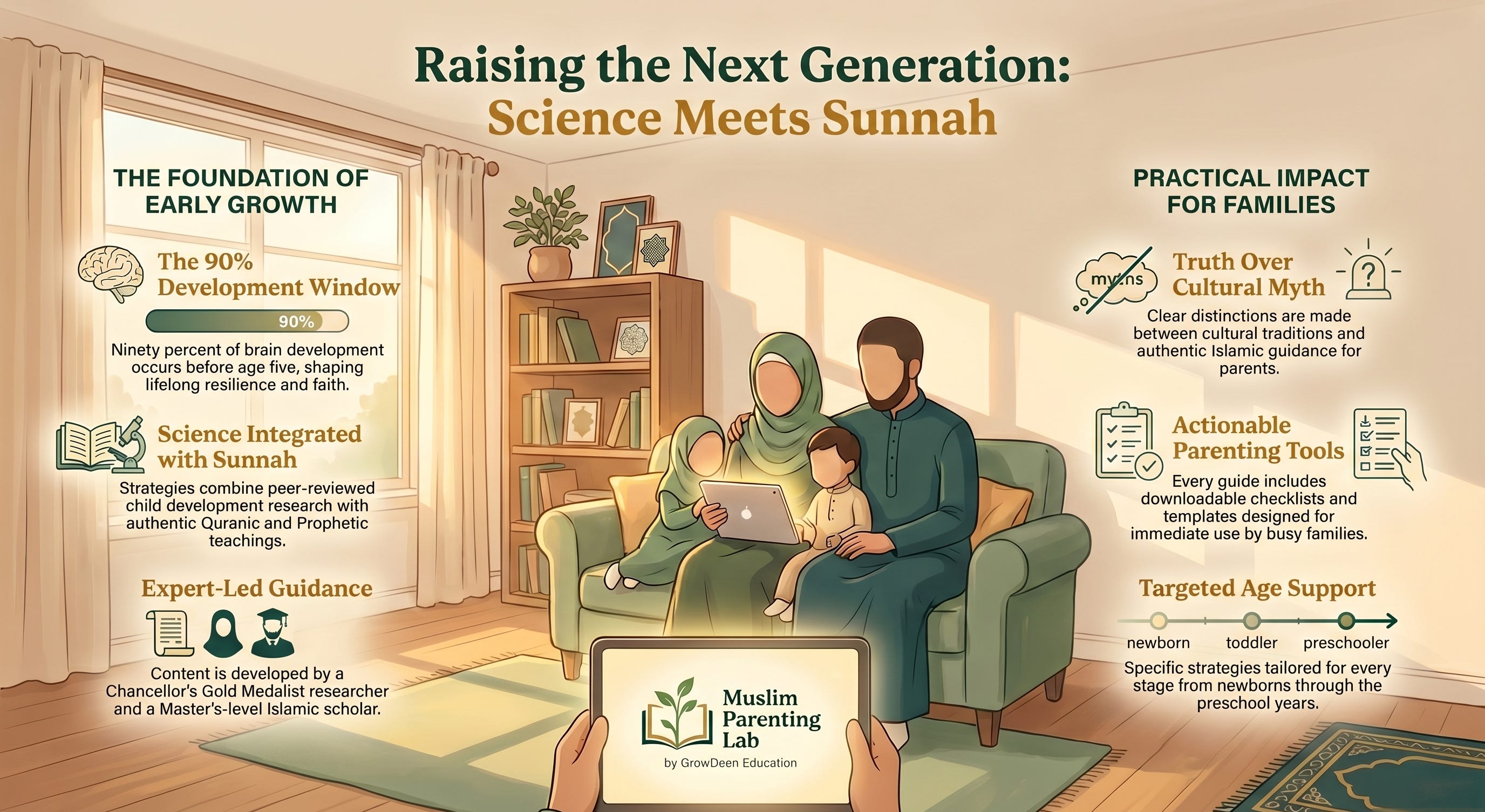
The First 3 Years Shape Almost Everything. Most Muslim Parents Are Left to Figure Them Out Alone.
Every article is free. Every article comes with a free printable Companion Pack. Subscribe today and your free Welcome Pack arrives instantly.
For Muslim parents of children aged 0–3 who want clarity, confidence, Sunnah-rooted and science-backed guidance, without the guilt, confusion, or endless scrolling.
Last night, a mother sat on her bathroom floor after Isha, crying.
Not because her child was sick. Because her toddler screamed through salah again. Because her mother-in-law told her she was “too soft.” Because the pediatrician said one thing, Instagram said another, and every “Islamic parenting” post seemed to contradict the next.
Because at 1:17 AM, she searched:
“How do I discipline my toddler Islamically?”
And instead of clarity, she found noise.
Then she whispered the sentence so many Muslim parents carry silently:
“I don’t know if I’m doing this right.”
If that sentence has ever lived inside your chest, you are in the right place. You are not failing. You are not behind. You are not a bad parent.
You are trying to raise an amanah in a world full of conflicting advice — and you were never meant to do it alone.
Join Muslim parents around the world raising the next generation with both clarity and care. No spam. No clutter.
The 0–3 Window Is Not “Just the Baby Years”
Most people treat the first three years like a waiting room. Wait until they can talk. Wait until they can understand. Wait until school starts. Wait until they are “old enough” for Islamic teaching.
But the first three years are not a waiting room.
They are the foundation.
Research from UNICEF and the University of Minnesota’s Masonic Institute for the Developing Brain highlights that around 80% of a child’s brain development happens within the first 1,000 days of life — the first three years. [1][2]
In these years, one million new neural connections can form every second.
That means your everyday moments are not small. The bedtime routine. The words you repeat. The way you respond when your toddler throws food across the room. The du’as you whisper over them. The calm you try to return to after losing your patience. The way your home sounds, feels, and moves.
All of it is shaping how your child experiences safety, love, discipline, trust, attachment, language, identity — and eventually, their relationship with Allah subhanahu wa ta’ala.
Islam taught us this long before neuroscience gave it language. Children are an amanah — a sacred trust. And these first years carry a weight most parents are never clearly taught until the window is already closing.
So the real question is not only: “How do I survive bedtime tonight?”
The deeper question is: “What kind of foundation am I building for my child’s heart, mind, body, and Deen?”
That is why Muslim Parenting Lab exists.
The Problem Muslim Parents Keep Facing
Most Muslim parents are not struggling because they do not care. They are struggling because they are surrounded by too many voices and not enough clarity.
You are told to follow the Sunnah — but nobody explains what is actually Sunnah and what is simply culture.
You are told to trust the research — but most parenting research ignores faith, fitrah, salah, Qur’an, modesty, family structure, and Islamic identity.
You are told to listen to elders — but sometimes the advice you receive creates guilt, fear, or confusion.
You are told to “just be consistent” — but nobody shows you how to stay consistent when you are sleep-deprived, overstimulated, touched-out, and carrying a hundred invisible responsibilities.
You are told to discipline your child — but you are not always told the difference between discipline, punishment, emotional control, and tarbiyah.
So you end up stitching together advice from your parents, your in-laws, your pediatrician, Instagram, Islamic lectures, parenting books, WhatsApp groups, and late-night Google searches.
And somehow, after all that information, you still feel unsure.
That is not your fault.
It is the reason this resource had to exist.
What Muslim Parenting Lab Does Differently
Muslim Parenting Lab is built for Muslim parents raising children in the most important developmental window: birth to age three.
We combine authentic Islamic guidance with peer-reviewed child development research and turn it into practical tools you can actually use at home.
Not vague motivation. Not guilt-heavy reminders. Not cultural myths dressed up as religion. Not secular parenting advice with Islam added at the end.
Every article is designed to help you answer one simple question:
“What should I actually do with my child today?”
And every answer is built on three commitments:
1. Sunnah and science, together. You should not have to choose between your Deen and credible research. Where the Qur’an and Sunnah give guidance, we honour it. Where modern research helps us understand child development, we use it carefully. Where culture is being confused with Islam, we say so clearly.
2. Clarity without guilt. You will not be shamed here. You will not be told that one mistake has ruined your child. You will not be made to feel like a failure for struggling. Muslim Parenting Lab is here to give you calm, sourced, practical guidance — so you can parent with more confidence and less fear.
3. Tools, not just information. Every article comes with a free printable Companion Pack — a checklist, a du’a card, a bedtime guide, a tantrum response plan, a screen-time decision tool, a wall chart, a routine template, or a one-page framework you can use immediately. You do not just read and forget. You read, print, apply, and return to it when life gets loud.
Why Subscribing Matters If Everything Is Free
Let’s be completely honest. You can read the articles without subscribing. You can access the Companion Packs without subscribing. This resource is free because we want as many Muslim families as possible to benefit.
So why subscribe?
Because subscribing is the difference between finding guidance when you remember and receiving guidance when you need it.
When you subscribe, you do not have to keep checking back. You do not have to scroll through 150+ articles at midnight. You do not have to remember where you saw that du’a, chart, or checklist. The guidance comes to you.
When a new article is published, it arrives in your inbox. When a new Companion Pack is released, you get it. When a new research-backed Islamic parenting tool is created, you are first to receive it.
And the moment you subscribe, your free Welcome Pack arrives instantly.
No payment. No spam. No pressure. Just practical, Sunnah-rooted, science-backed parenting guidance in your inbox.
It takes less than 10 seconds.
🎁 What You Get Immediately
The moment you subscribe, you receive the free Welcome Resource Pack — a 3-page printable PDF built to help you understand the 0–3 window and start using the resource straight away.
Page 1: The 0–3 Brain Development Timeline. A simple visual guide showing what is developing at each stage of the first three years — and what to focus on in each phase. Print it. Put it on your fridge, nursery wall, or planner. Use it when you feel lost and need to remember what matters most right now.
Page 2: The Conflicting Advice Decoder. A practical framework for judging parenting advice in under 60 seconds. Use it when your mother-in-law says one thing, your pediatrician says another, Instagram says something completely different, and you are left wondering what is actually Islamic, cultural, medical, or personal opinion. This page helps you slow down, sort the advice, and make a calmer decision.
Page 3: Du’as for the Early Years. Seven authenticated du’as from the Qur’an and Sunnah, with Arabic text, transliteration, English meaning, and suggested moments to use them — for waking, for sleep, for protection, for calm, for difficult days, and for the moments when you do not have the perfect parenting words but you still want your child’s life wrapped in remembrance of Allah.

Who This Is For
Muslim parents with a child aged 0–3 — you want to raise your child with love, confidence, and Deen, but you are tired of conflicting advice.
Expecting parents and newly married couples — you want to start right. Not scramble later. This gives you the foundation before the baby arrives, before habits, routines, and assumptions form.
Grandparents helping raise grandchildren — you want to support the next generation with wisdom, but also understand what has changed in modern child development.
Muslim parents in the West — you are navigating two worlds: modern parenting culture and Islamic identity. You want your child to grow up confident, emotionally secure, and connected to Allah.
Parents who want to do things differently this time — maybe you already have older children. Maybe you look back and wish you had known more. This is not about regret. It is about beginning again with more clarity.
Muslim educators, creators, and community workers — you need credible, sourced, practical parenting content you can confidently share. Every article is built to be source-transparent and useful.
If you have ever thought: “I wish someone would just tell me what the research says and what Islam actually teaches…”
This was built for you.
What Makes This Different From Other Parenting Content?
There is a lot of parenting advice online. Some of it is useful. Some of it is confusing. Some of it sounds Islamic but is actually cultural. Some of it is evidence-based but spiritually empty.
Muslim Parenting Lab sits in the gap. We are not here to give you more noise. We are here to give you clarity.
Every article is built around a simple structure:
The parenting problem — what Muslim parents are actually facing at home. The research — what credible child development evidence says. The Islamic guidance — what we can root in Qur’an, Sunnah, and sound scholarship. The practical action — what you can do today, tonight, or this week. The Companion Pack — a printable tool that helps you apply it.
That is the difference. Not inspiration only. Implementation.
“If It’s Free, Is It Really Valuable?”
Yes. Free does not mean low-quality. It means we made a choice.
Our team spends long hours reading child-development research, checking sources, reviewing Islamic guidance, separating culture from Deen, and turning complex material into something a busy Muslim parent can read quickly and use immediately.
We made it free because the families who need clarity most should not be blocked by a paywall. A tired mother at 1 AM should not need a credit card to know how to respond to her toddler. A new father should not need a paid course to understand the first 1,000 days. A grandparent should not need a premium membership to find a du’a or a practical framework.
Free does not mean careless. It means accessible. It means more Muslim homes can benefit. It means more children can be raised with parents who feel less confused, less alone, and more grounded.
Who Is Behind Muslim Parenting Lab?
We are parents first. We built the resource we were searching for ourselves.
Our scientific researcher holds the Chancellor’s Gold Medal — the highest academic honour in their country — with more than 30 peer-reviewed publications across over a decade of research.
Our Islamic scholar holds a Master’s in Da’wah and Islamic Studies, with published work on Islamic parenting and child tarbiyah.
But credentials are only part of the story. We also live this. The sleepless nights. The toddler meltdowns. The guilt after raising your voice. The worry that you are not doing enough. The feeling of wanting to raise children who love Allah, love the Prophet ﷺ, and feel safe in their own home.
We are not claiming perfection. We are promising sincerity, careful research, and practical guidance — insha’Allah.
📖 Start With These Three Articles
If you want to understand what Muslim Parenting Lab is about, begin here:
The Shocking Truth: 90% of Brain Development Happens Before School Starts

Research from Harvard’s Center on the Developing Child confirms that 90% of brain development happens before age 5 [1] and the most powerful learning tool isn’t an app or curriculum, it’s you.
This Screen Time Mistake Can Harm Your Baby's Brain for Years!

Research from multiple authoritative sources shows infants need zero routine screen time before age 2, with WHO recommending 180+ minutes of physical activity daily for ages 1-2 and less than 1 hour of screen time maximum at age 2 if used at all. [1][2][3] More critically, recent longitudinal studies tracking children for over a decade found that high s…
What 15 Years of Sleep Research Reveals About Newborns, Toddlers, and Teens

Research shows over 90% of adolescents don’t get enough sleep on school nights, and one-third of parents report infant sleep struggles. [1] This guide walks you through what’s actually normal at every age — from newborn night wakings to teenage circadian shifts — so you can stop second-guessing and start supporting your child’s rest with confidence.
Each article is free. Each comes with a free Companion Pack. And if you subscribe, new articles and tools come straight to your inbox.
The One Click That Makes This Easier
You already have enough to remember — appointments, meals, sleep schedules, laundry, work, salah, family expectations, your child’s needs, your own needs.
The last thing you need is another resource you have to remember to check.
That is why subscribing matters. One free click means the guidance comes to you. You save time. You reduce second-guessing. You stop relying on random late-night searches. You receive tools before the next difficult phase catches you off guard. You begin building your child’s foundation with more clarity, more confidence, and more connection to Allah.
No payment. No spam. No pressure. Just free guidance for the years that matter most.
Subscribe now and your Welcome Pack will arrive instantly.
Share This With Someone Who Needs It
You probably know someone who needs this today. The new mother who has not slept properly in months. The father who wants to be more involved but does not know where to start. The grandmother helping raise grandchildren between two cultures. The pregnant friend already overwhelmed by advice. The Muslim parent who keeps asking, “Is this actually Islamic or just culture?”
Send this to them. It may be exactly what they needed to find tonight.
Quick Questions
Is it really free? Yes. Completely free. No payment information, no premium tier, and no hidden paywall.
What ages is this for? The main focus is birth to age three, because the first 1,000 days are such a critical developmental window. Many principles can also help with older children.
How often will I receive emails? Only when there is something valuable to send. This is not a daily newsletter. Quality matters more than frequency.
What if I do not like it? You can unsubscribe at the bottom of any email with one click. No pressure and no hard feelings.
Can I share this with my Islamic school, masjid, parenting group, or community? Yes. Please do. The goal is to benefit as many Muslim families as possible.
Can creators or educators cite Muslim Parenting Lab? Yes. Every article is designed to be source-transparent. You are welcome to cite and share appropriately.
Begin Here
If you are trying to raise a young child with love, confidence, and Islam at the centre, you do not need more noise. You need clarity. You need guidance you can trust. You need tools you can use when the house is loud, the baby is crying, the toddler is melting down, and you are trying to remember the kind of parent you want to be.
That is what Muslim Parenting Lab is here for.
Sunnah-rooted. Science-backed. Built for Muslim parents of 0–3s.
Your free Welcome Pack is ready.
May Allah subhanahu wa ta’ala bless your family, ease your parenting journey, place barakah in your home, and make your children a source of joy in this life and the next. Ameen.
References
[1] UNICEF. Early Childhood Development. unicefusa.org/what-unicef-does/childrens-education/early-childhood-development
[2] University of Minnesota, Masonic Institute for the Developing Brain. First 1,000 Days — A Critical Time for Children’s Brain Development. midb.umn.edu