

32 child development experts agreed on one surprising point. [1] Children do not need hardship in order to become resilient, and the capacity can be built long before any of it arrives. [1]
Printable. For the next ten difficult minutes.
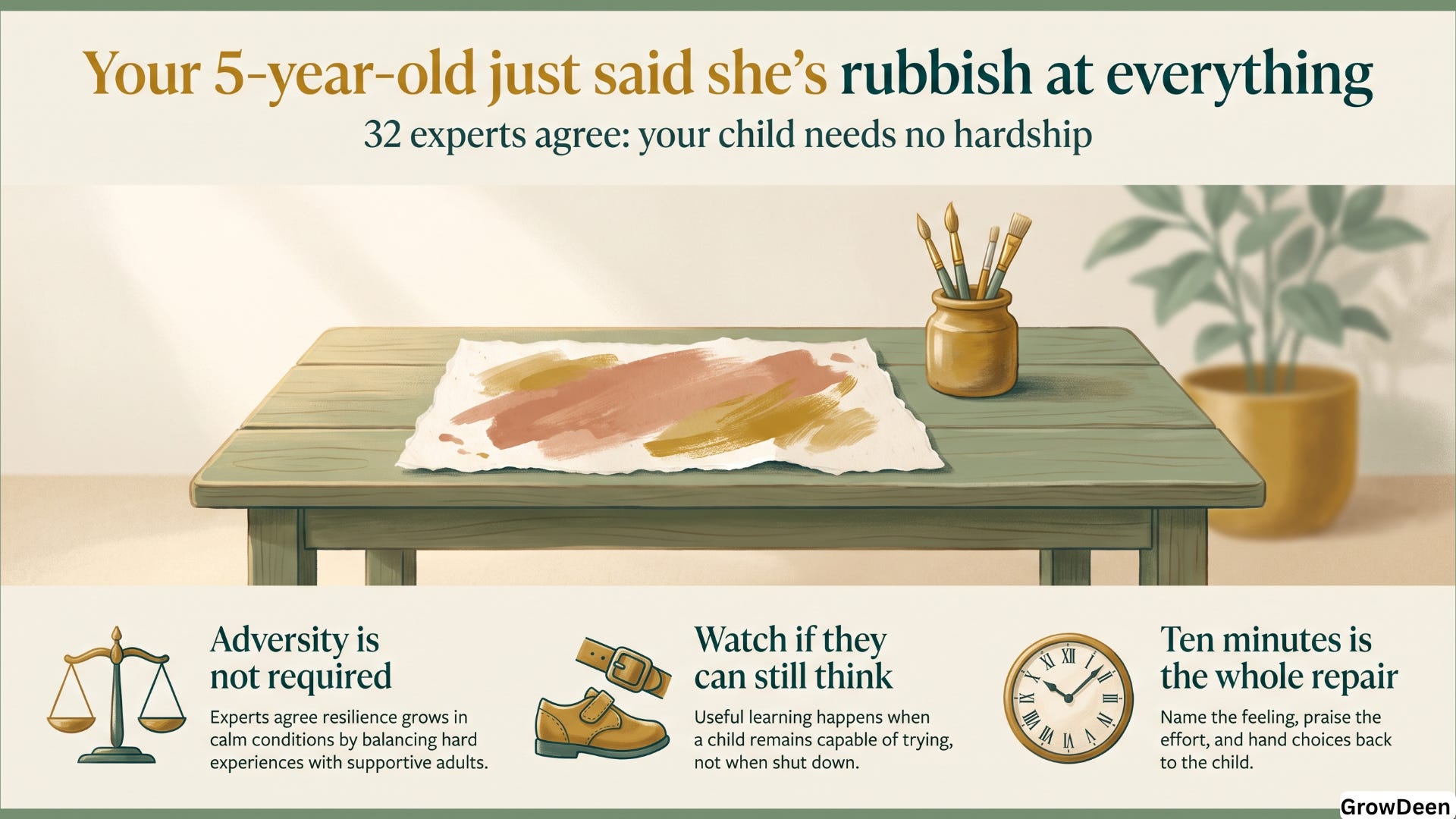
Your child just gave up on themselves.
Not over anything serious. The picture tore, or the tower fell, or the shoelace won again, and a child who was happy four minutes ago has announced that they are rubbish at everything and gone to lie face down somewhere.
You are not watching a character flaw. You are watching a child meet the gap between effort and outcome for roughly the two hundredth time, and you are standing at the exact point where the lesson gets taught. What happens next is small. It is also the whole thing.
What Makes This Guide Different
Why you can trust this one
It uses what the field actually agreed on. The definition here comes from a formal 32-expert consensus study, not from the usual talk about bouncing back [1].
It keeps Islam and the research in the same sentence. Trial, sabr and tawakkul are treated as working tools for a five year old, not as a closing paragraph bolted onto parenting advice.
You already have the free Hard Moment Pack from the top of this page. Three printable pages, including a sorter that tells you when to step in and when to stay back.
Does my child have to suffer to become resilient?
No. This is the part most parenting advice gets backwards.
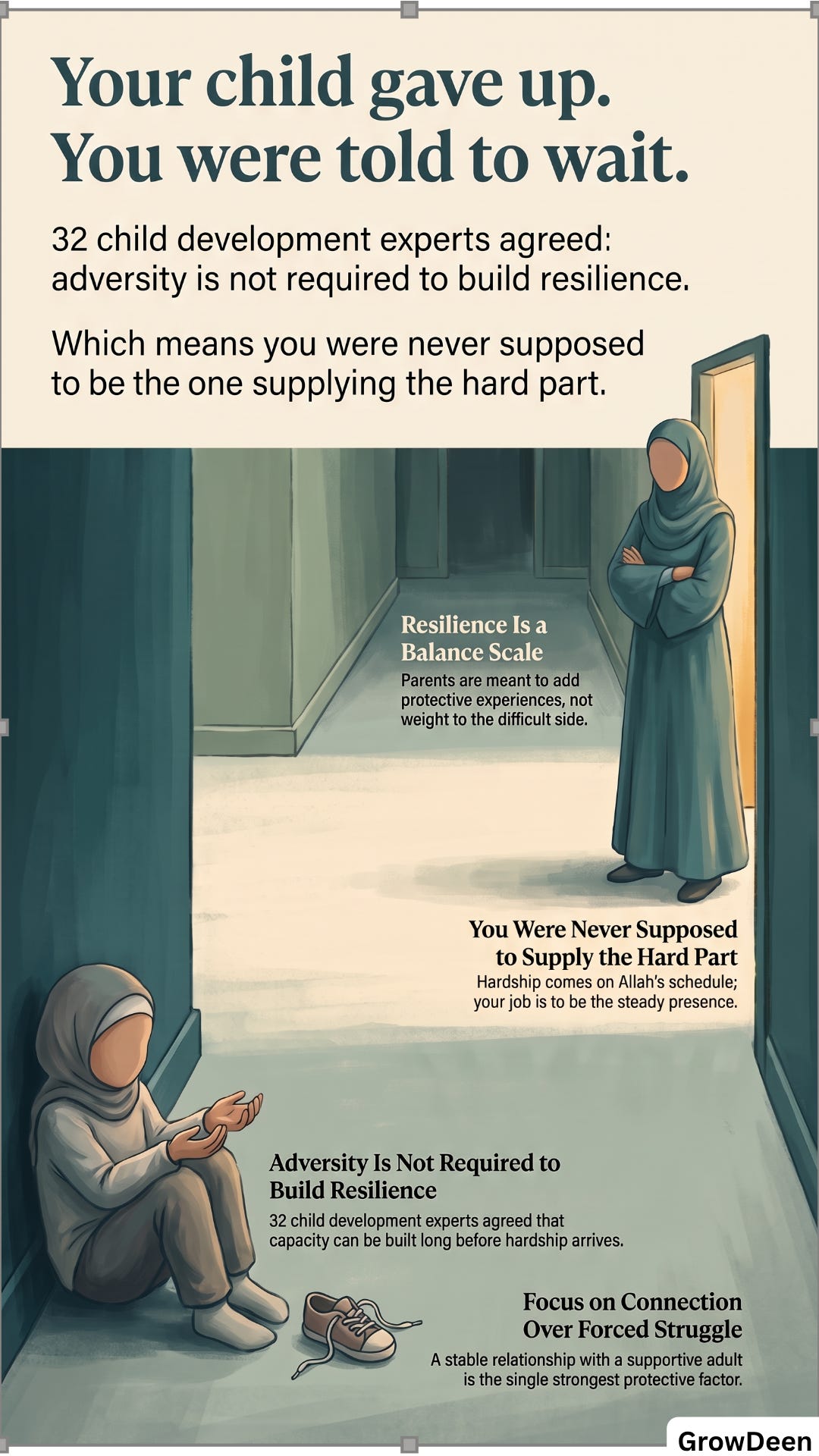
When 32 child development experts were put through a formal consensus process, they agreed that resilience is a process by which a child develops the capacity to adapt, and they agreed, explicitly, that experiencing adversity is not essential to developing it [1]. The capacity can be grown in calm conditions by ordinary parents. Nobody has to be hurt first.
So the toughen-them-up instinct, the one that says a child needs to be left to struggle so they learn, has the mechanism wrong. What the evidence supports is gentler and more specific. Harvard’s Center on the Developing Child describes resilience as a balance scale: hard experiences on one side, protective experiences and coping skills on the other, and development tips toward good outcomes when the second side carries enough weight [2]. You are not meant to add weight to the difficult side. You are meant to load the other one.
Not all stress harms children, and manageable stress met with a supportive adult nearby can promote growth [2]. The difference between useful and harmful is not the size of the problem. It is whether your child can still think while it is happening.
Which raises a question worth carrying through the rest of this.
Why does my child handle big things and fall apart over small ones?
A child can absorb a new baby in the house without blinking and then come undone over a torn picture. Parents read this as inconsistency, or worse, as evidence that the small collapses are performance.
They are not. Resilience is not one quantity a child either has or lacks. It rises and falls, and showing it in response to one kind of difficulty predicts very little about the next kind [2]. The experts who defined it called it a process, not a trait [1].
There is also a simpler explanation parents rarely consider. Big events usually arrive with warning, explanation and adult attention. The torn picture arrives with none of those, at the end of a long day, when a small nervous system has nothing left in the tank.
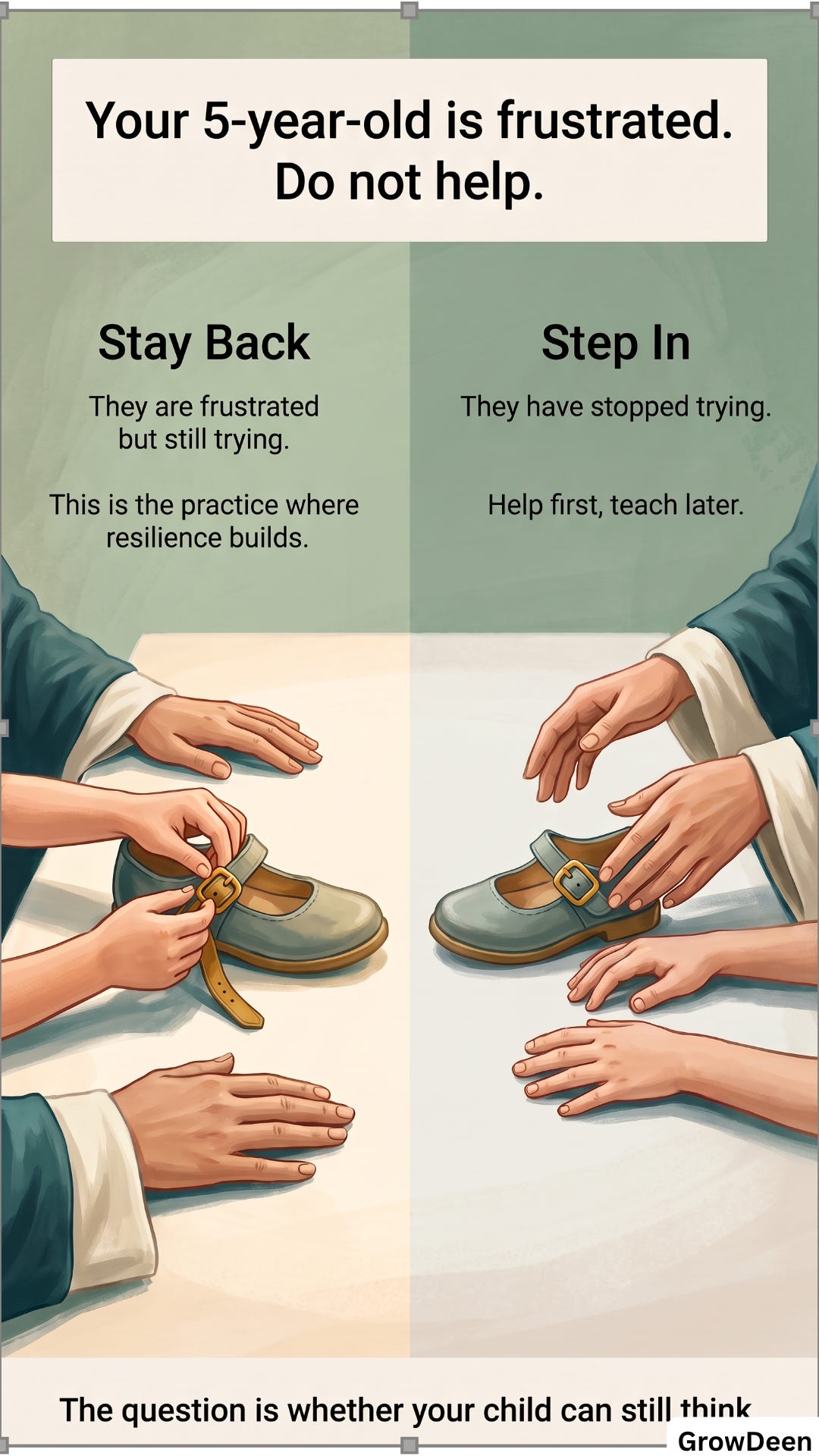
One test replaces all the guesswork. Watch whether your child can still think. A puzzle that will not come together, a shoe that will not go on, homework going in with a mistake you spotted: these sit inside the range where a child stays able to try, and that is where the useful practice happens. A child who has gone rigid, is screaming, or has shut down has left that range, and no amount of holding the line will teach them anything from inside it.
Most of what builds resilience, though, is not a technique at all.
What actually protects a child
Harvard’s summary of the evidence names one factor above all the others. Children who do well after hardship almost always have at least one stable and committed relationship with a supportive parent, carer or other adult [2].
That relationship is doing structural work, not just emotional work. It supplies responsiveness, scaffolding and protection, and it builds the capacities underneath resilience, including the ability to plan, monitor and regulate behaviour [2]. The World Health Organization describes the same mechanism from your side of it: responsive care means reading your child’s signals and answering what those signals are actually asking for, which is how secure relationships get laid down in the first place [3].
Your child benefits from the wider circle too. A grandmother who lights up when they walk in. An uncle who remembers their favourite dinosaur. A teacher at the masjid who greets them by name. Belonging to a web of adults who are pleased to see them is something a child carries into every setback.
In Islamic terms this is not separate from tarbiyah. Your child is an amanah, and the warmth is not the soft preliminary to the real work. It is the medium the work happens in.
There is one more thing worth sharing before the practical part.
I know this is a lot to hold onto at the exact moment your child is face down on the carpet. That is why the free Hard Moment Pack exists: three printable pages, including a sorter that answers the step-in-or-stay-back question in about ten seconds. The download button is at the top of this page, and there is a full description of what is inside it below.
Am I making my child anxious by protecting them?
The question underneath this one is rarely about your child’s behaviour at all. It is the quiet fear that you have already made them fragile, and that every time you step in you are making it worse.
The evidence is more forgiving than that fear. A meta-analysis of 47 studies found that parenting as a whole accounted for about 4% of the variance in childhood anxiety, and the authors said plainly that explaining anxiety will require looking well beyond parenting [4].
Inside that modest picture, one thing did stand out. Parental control was more strongly associated with child anxiety than parental rejection was, and the sub-dimension of autonomy granting, meaning how much age-appropriate independence a parent allows, accounted for around 18% of the variance in the studies that measured it [4]. Warmth accounted for under 1%.
Two cautions belong with that number. The 18% comes from a smaller set of studies than the 4% headline, and the whole analysis is correlational. The authors state that they cannot tell whether controlling parenting comes before a child’s anxiety or is drawn out of parents by an already anxious child [4]. An anxious child recruits protection from loving parents very efficiently.
So: granting independence where it is safe to do so is worth taking seriously. Blaming yourself for your child’s temperament is not supported by the numbers.
Support Muslim Parenting Lab ❤️
Is there something in your record you would like wiped? Give any amount today with the button below.
The Prophet ﷺ said charity extinguishes sin as water extinguishes fire. (Jami' at-Tirmidhi 2616, hasan)
What to do in the ten minutes after it goes wrong
Get close and say almost nothing. Let the crying run for a minute without a correction riding on top of it.
Name the feeling before fixing it. “That was disappointing.” Brain imaging research found that putting a feeling into words reduces activity in the amygdala, the structure that drives the alarm response [5]. The naming does part of the settling by itself.
Worry less about getting the warm response perfect. A meta-analysis of 49 studies covering 6,270 children found that how parents respond to children’s emotions is reliably but weakly related to conduct problems, with the association stronger at younger ages [6]. A 2025 meta-analysis found the asymmetry that matters: supportive responses carried only a very small association with internalising problems, while dismissing and punishing responses carried a considerably stronger one [7]. Not mocking the feeling matters more than finding the perfect sentence.
Hand the problem back. “What do you want to try next?” If nothing comes, offer two options and let them pick one. The American Academy of Pediatrics puts this near the centre of its resilience guidance: help a child see the link between the choices they make and what follows, and treat discipline as teaching rather than punishment [9].
Praise the attempt, and describe it. A longitudinal study coded the praise 53 children received between 14 and 38 months and measured their beliefs about ability five years later. Early process praise, the kind that names effort and strategy, predicted children who believed ability grows with work [8]. So: “you started again after it tore, and you held the corner this time.”
Say Bismillah before the next attempt. Three seconds, and a child learns that beginning again is something you do in Allah’s name.
Then let it be small. Reviewing six families of intervention for children aged four to twelve, Diamond and Lee found that the programmes that worked shared two features: repeated practice, and difficulty that climbed as the child improved [10]. The children with the weakest starting skills gained the most. That is a research description of ordinary family life done on purpose: pouring their own water, carrying their own plate, owning the shoes by the door.
Stay close. Then hand it back.
But none of this answers the question a parent asks at 11pm, which is why any of it has to be hard at all.
The Islamic Framework For A Hard Day
Islam does not read difficulty as evidence that a life has gone off course. Allah asks, “Do the people think that they will be left to say, ‘We believe’ and they will not be tried?” [12]. According to Tafsir Ibn Kathir, testing is described here as settled practice with those who claim belief, and its purpose is to make evident who is truthful. A child raised inside that understanding meets a bad afternoon without the extra weight of thinking something has gone wrong with them.
The Qur’an also records a father saying almost exactly what a child needs to hear. Having lost one son and then another, Ya’qub tells his children, “despair not of relief from Allah” [13]. Ibn Kathir explains that he is turning them away from hopelessness and toward continued trust in Allah for what they are seeking. A parent, speaking to children, in the middle of a loss that had not yet resolved.
The Prophet ﷺ gave that frame its emotional shape: “Indeed greater reward comes with greater trial. And indeed, when Allah loves a people He subjects them to trials, so whoever is content, then for him is pleasure, and whoever is discontent, then for him is wrath” [14].
Notice what is absent from all three. Nobody is told to manufacture the trial. The hard things come from Allah on His schedule, which means your job was never to supply them. Your job is to be the steady thing in the room when they arrive.
The Hard Moment Pack
If you have read this far, you are the kind of parent who takes a small collapse seriously, not as drama but as something your child is learning from. That tells me something about you.
Inside the Hard Moment Pack (one comprehensive PDF, 3 pages):
Page 1: The Stretch Zone Sorter — A three-zone grid where you write down the difficulties your child is actually meeting this week and sort each one into handle alone, handle with you nearby, or step in now, with the printed decision rule on the page. Designed as a fridge sheet you can re-sort every Sunday in about five minutes.
Page 2: The I Got Through It Chart — A child-facing wall chart with twelve numbered slots your child fills in themselves, so that when the next hard thing arrives you have written evidence to point at. So you can answer “I can’t do anything” with something concrete in under a minute.
Page 3: When Nothing Can Be Fixed — An Islamic reflection card built around Ya’qub’s instruction to his children not to despair of relief from Allah, and the Prophet’s ﷺ teaching on reward and trial, with three short reflection lines for the nights when the hard thing has no solution.
This isn’t just a PDF to download and forget. It’s a tool designed to stay on your fridge, where you’ll actually use it when you need it most.
This Hard Moment Pack is what every subscriber receives with each article. We cover the whole span of raising Muslim children, all backed by scientific research and rooted in Islamic wisdom.
One Small Thing, Tonight
Tonight, when your child is calm, remind them out loud of one time they got through something hard. “You didn’t want to go into the new class. You went in anyway.” Thirty seconds. That is the whole exercise.
May Allah place barakah in your patience, accept it from you, and put ease on the other side of every hard thing your children meet.
Someone Else Needs This Today
Think of one person right now: the mother at the school gate who said her five year old “falls apart over nothing”, or a sister whose son has started saying he is bad at everything, or a friend who keeps apologising for a child who cries too easily.
Send this to her today. Not as advice, and not as correction. Sometimes the kindest thing is to tell someone that the thing she is worried about has a name, a method, and a very short list of things to do about it.
Frequently Asked Questions
Q: At what age can you start building resilience in a child? A: From toddlerhood, and the capacity can be strengthened at any age after that [2]. For a three or four year old it looks like doing the naming for them and keeping the practice tiny: carrying their own cup, waiting two minutes for a turn.
Q: Do children need to experience hardship to become resilient? A: No. A 32-expert consensus study agreed explicitly that experiencing adversity is not essential to developing resilience [1]. Manageable difficulty with you nearby is useful practice; manufactured hardship is not a stronger version of the same thing.
Q: How do I know when to step in and when to let my child struggle? A: Watch whether they can still think. A child who is still trying is in the useful range. A child who has gone rigid, is screaming, or has shut down has left it, and that is the moment to help. See “Why does my child handle big things and fall apart over small ones?” above.
Q: Is it bad to tell my child they’re clever? A: Not established as harmful. The study most people cite found that early effort praise predicted children who believed ability grows with work, but it did not find that person praise significantly predicted fixed beliefs [8]. Describing what they did is still the stronger habit.
Q: What should I do when the hard thing cannot be fixed, like a serious illness in the family? A: Do not rush to make it disappear, and do not leave your child alone with the part that frightens them most. A woman once came to the Prophet ﷺ describing seizures that left her uncovered; he offered her patience with Paradise or his supplication for a cure, and when she chose patience he still supplicated about the part that distressed her [15]. Hold both: respect their endurance, and ease what can be eased.
Q: When should I speak to a doctor about my child’s reactions? A: Speak with your doctor, a paediatrician or a qualified counsellor if the difficulty lasts weeks rather than days, if your child stops enjoying things they used to enjoy, if sleep or appetite shifts noticeably, if worry keeps them from school or other children, or if skills they had mastered slip away. Children can also build self-kindness as a protective habit; a meta-analysis in adolescents found a consistent inverse relationship between self-compassion and psychological distress [11]. None of this replaces medical advice.
References
[1] Avdagic, E., Wade, C., McDonald, M., McCormack, D., Dakin, P., Macvean, M. L., Hayes, L., & Phan, T. (2020). Resilience in young children: A Delphi study to reach consensus on definitions, measurement and interventions to build resilience. Early Child Development and Care, 190(13), 2066-2077.
[2] Center on the Developing Child at Harvard University. Resilience.
[3] World Health Organization. (2020, March 5). Helping children learn, be happy and thrive
[4] McLeod, B. D., Wood, J. J., & Weisz, J. R. (2007). Examining the association between parenting and childhood anxiety: A meta-analysis. Clinical Psychology Review, 27(2), 155-172.
[5] Lieberman, M. D., Eisenberger, N. I., Crockett, M. J., Tom, S. M., Pfeifer, J. H., & Way, B. M. (2007). Putting feelings into words: Affect labeling disrupts amygdala activity in response to affective stimuli. Psychological Science, 18(5), 421-428.
[6] Johnson, A. M., Hawes, D. J., Eisenberg, N., Kohlhoff, J., & Dudeney, J. (2017). Emotion socialization and child conduct problems: A comprehensive review and meta-analysis. Clinical Psychology Review, 54, 65-80.
[7] Brumariu, L. E., Nair, T. K., Waslin, S. M., Rodrigues, G. A., Moore, M. T., & Kerns, K. A. (2025). Parental emotion socialization and internalizing problems in childhood and adolescence: A meta-analytic review. Development and Psychopathology, 37(5), 2806-2826.
[8] Gunderson, E. A., Gripshover, S. J., Romero, C., Dweck, C. S., Goldin-Meadow, S., & Levine, S. C. (2013). Parent praise to 1- to 3-year-olds predicts children’s motivational frameworks 5 years later. Child Development, 84(5), 1526-1541.
[9] Ginsburg, K. R., & American Academy of Pediatrics. (2014, September 4). Building resilience in children. HealthyChildren.org.
[10] Diamond, A., & Lee, K. (2011). Interventions shown to aid executive function development in children 4 to 12 years old. Science, 333(6045), 959-964.
[11] Marsh, I. C., Chan, S. W. Y., & MacBeth, A. (2018). Self-compassion and psychological distress in adolescents: a meta-analysis. Mindfulness, 9(4), 1011-1027.
[12] Qur’an, Surah Al-Ankabut 29:2 (Saheeh International)
[13] Qur’an, Surah Yusuf 12:87 (Saheeh International)
[14] Jami’ at-Tirmidhi 2396 — Graded: Hasan
[15] Sahih al-Bukhari 5652 — Graded: Sahih
We combine scientific research with Qur’an and authentic Sunnah, and we cite our sources. Even so, this is general guidance and no substitute for a doctor who can examine your child.