

Said "lovely" without looking up? Most parents have.
The free Face First Pack shows what your child reads in your body. It offers small fixes to close the gap.
AGES 1–8 YEARS · 15 MIN READ
Your toddler holds up a drawing. You are on a work call. You glance over, nod, and turn back to the screen.
The paper comes down slowly. It goes face down on the table.
I said "lovely," and I meant it. So why did he walk away?
You did nothing cruel. This happens in every busy home, and small moves can change it. He was reading more than one word. He was reading your shoulders and your phone.
This guide brings together scientific research and the Qur'an and authentic Sunnah. You'll see what your child reads in your body, a frown the Qur'an speaks of, and tonight's four moves.
The Short Answer
Right for your child? Ages 1–8. Any child who shows you things, asks you things or tests a rule.
What's probably happening: your child reads your eyes and body along with your words. A turned-away body tells its own story.
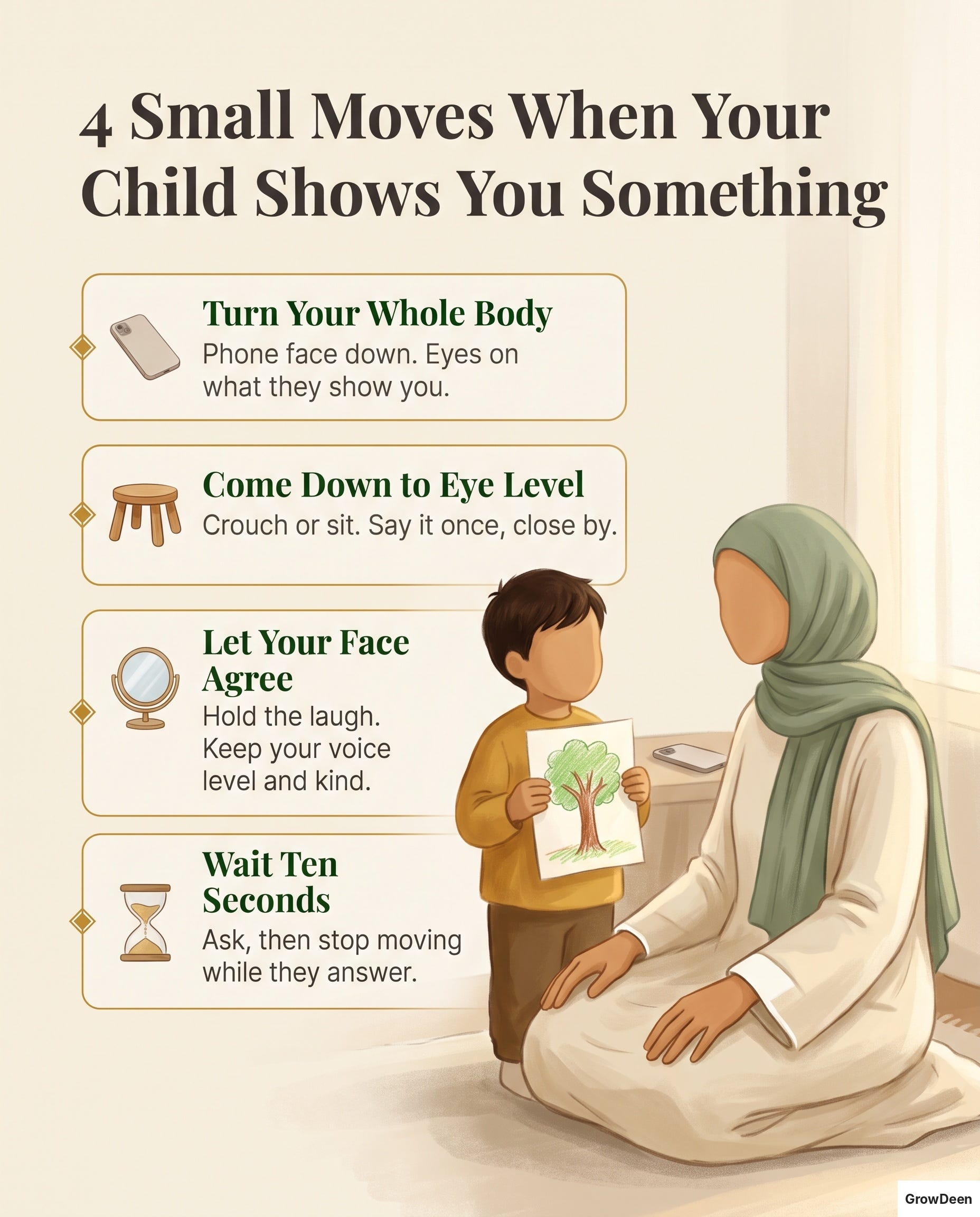
Try tonight (1 minute): when your child shows you something, turn your whole body. Come down to eye level. Wait ten seconds.
You'll know it's working when: your child talks a little longer, or shows you a second thing. A quiet child is not failure. Some children need more time.
Get help if: no pointing to ask for things by about 15 months, or any lost skill. Start with your child's doctor or pediatrician.
The rest of this guide explains why, and what to do if it does not work.
How to Read This Guide
3 minutes: The Short Answer above is enough for tonight.
7 minutes: The Short Answer, then Knowledge in Practice and If Things Don't Go to Plan.
The whole guide: read on for the scientific research, the Qur'an and Sunnah, and the References.
To share: the bold lines and the pull quotes are made to be shared.
To listen: open this guide in the free Substack app and tap Listen.
Inside This Guide
One distracted afternoon is not the problem. Your child learns from what happens most days.
Myth Check: "93 Percent of Communication Is Body Language"
You have probably met this figure: 7 percent of communication is words, 38 percent is tone, and 55 percent is body language. It turns up in workshops and reels as if it settles everything.
What it gets right. Your voice and your body carry a lot. Anyone who has heard "fine" said through clenched teeth knows that.
Where it came from. The figure is usually traced to two small laboratory studies from 1967. [1,2] One looked at how listeners decoded messages whose parts did not match. [1] The other paired faces showing an attitude with a tone of voice laid over one neutral word. [2] Neither measured everyday talk or studied children.
What a study of children found. A later study tested 165 people, children aged 4 to 10 and adults. [3] In some sentences, the words and the tone of voice clashed. The children went mostly by the words. The adults went mostly by the tone. [3] At every age, people took longer to answer when the two clashed, so they were taking in both. [3]
So what does this mean at home? Your words matter a great deal to a young child. When your body says something else, your child may have to work harder to know which one you mean. Let your words and your body say the same thing.
Why This Happens
Why does my child keep checking my face?
Long before full sentences, children talk with their bodies. They point, hold things up and watch your eyes. CDC guidance notes that toddlers and preschoolers with limited words often communicate nonverbally. [4]
A review of parent and child communication describes nonverbal processes as central to it. The same review found they are seldom the focus of support once a child is over 12 months. [5]
Harvard's Center on the Developing Child calls the back and forth serve and return. [6] A child babbles, gestures or cries, and an adult answers with eye contact, words or a hug. [6] Each exchange helps build the brain connections a child uses for communication and social skills. [6] The Center compares it to a lively game of tennis. [6]
What happens when the return doesn't come?
In a classic 1978 study, mothers faced their babies but kept their faces still and unresponsive. [7] The babies grew wary, and then they withdrew. [7]
Before you worry: the Harvard Center's concern is the persistent absence of these exchanges. [6] That means a pattern over time, and one call during one drawing is something else. Every parent checks a phone mid-sentence sometimes.
Children show this in different ways. Some look at faces less and still listen closely, so watch for your own child's signals.
A drawing held up is a serve. Your eyes, your body and your words are the return.
What the Scientific Research Shows
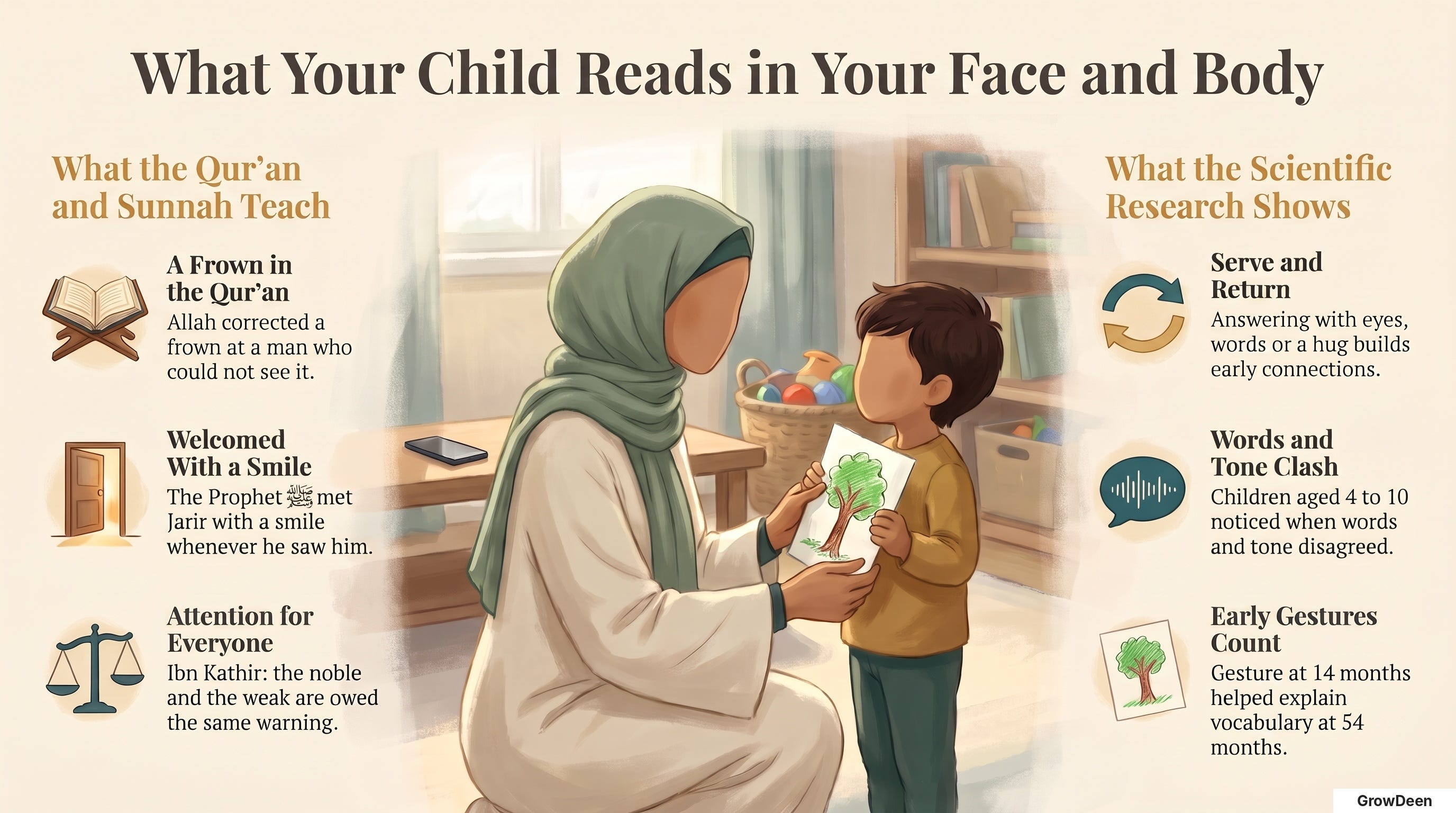
In a study of 50 families, scientists filmed parents and children together at 14 months and measured vocabulary again at 54 months. [8] Differences in how much children gestured at 14 months helped explain differences in their vocabulary at 54 months, including gaps linked to family income. [8] Children's gesture use was itself linked with how much their parents gestured. [8]
Who was studied: 50 families in the US (Chicago area), from a range of family incomes and education. Ethnicity and children with additional needs were not given in the study summary.
What was measured: gestures and speech at 14 months, and vocabulary at 54 months.
How strong this is: Suggestive. One well-designed study that follows children over time. It shows a link and cannot prove cause.
The Myth Check study adds a second finding: children notice when words and tone clash, and young ones lean on the words. [3]
Who was studied: 165 people, children aged 4 to 10 and adults. Country, ethnicity, family income and additional needs were not given in the study summary.
How strong this is: Suggestive. One laboratory study, and it tested tone of voice only.
The CDC (US, page dated April 2026) advises using eye contact and body language together with your words. It says this shows you are listening and helps a child feel safe and calm. [4] It also suggests getting down on your child's level and making eye contact. [4]
How strong this is: Suggestive. This is expert guidance.
What we do not know yet: how young children weigh a face or a posture against words. The children's study above tested tone of voice only. No study has yet tested this with Muslim families.
What this means for you: answer your child with your eyes and body as well as your words. Keep all three saying the same thing.
What the Qur'an and Sunnah Teach
Islam treats a facial expression as something that matters. Surah 'Abasa opens with words addressed to the Prophet ﷺ about a frown.
عَبَسَ وَتَوَلَّىٰٓ ١ أَن جَآءَهُ ٱلْأَعْمَىٰ ٢
He [i.e., the Prophet (ﷺ)] frowned and turned away. Because there came to him the blind man, [interrupting].
'Abasa 80:1–2 · Sahih International [9]
Text. Tafsir Ibn Kathir is a classical commentary on the Qur'an. It reports that the Prophet ﷺ was speaking with a leader of Quraysh, hoping he would accept Islam. [10] Ibn Umm Maktum, a blind man and one of the earliest Muslims, came and urgently asked him about something. [10] The Prophet ﷺ frowned and turned away to face the other man, and these verses came down. [10] Ibn Kathir explains that Allah commands the warning to be given equally to the noble and the weak, the poor and the rich. [10]
Our reflection. Ibn Umm Maktum could not see the frown. It was answered anyway. The Prophet ﷺ was busy with a good hope, the guidance of another man. A frown can come from a full heart and a busy moment, and it still matters to the person in front of us.
The warm half of the picture is how the Prophet ﷺ met people.
Narrated Jarir: Allah's Messenger (ﷺ) did not screen himself from me since my embracing Islam, and whenever he saw me he would receive me with a smile.
Sahih al-Bukhari 3035 · sunnah.com [11]
Our reflection. A face that opens when someone walks in is a welcome. A three-year-old reads it without a single word.
Ibn Umm Maktum could not see the frown. Your child can see yours.
The Lab Verdict
The science: children use gestures and faces from early on, and a parent's eyes and body help them feel heard. When words and tone clash, children notice. (Suggestive)
The Qur'an and authentic Sunnah: Allah corrected a frown and a turned-away face toward a man who could not see it. The Prophet ﷺ met Jarir with a smile.
Where they meet: the science explains why a turned-away body weighs on a young child. The Qur'an shows that a face is something we answer for. Together, they ask the same of us: turn toward whoever comes to you.
So at home: turn your body, bring your eyes level, and let your face agree with your words.
Knowledge in Practice: Turn, Come Down, Match, Wait
Knowing what your child reads is half the work. The other half happens at the door and on the rug.
If you can only do one thing, do step 1. It is enough.
1. Turn your whole body toward your child (10 seconds). A half-turned body with eyes on a screen answers before your words do.
Picture five positions, from closed to open. Standing over them. Half turned, eyes elsewhere. Facing them, still standing. Bent at the waist. Crouched, eyes level, body square. The Face First Pack draws all five as the Posture Map.
Say this: "Show me. I'm looking now." (Say it in the language your child knows best.)
More lines for the same moment: "Tell me about this part." · "You used so much blue." · "Let me put my phone down. Now show me." · "What happens next in your picture?"
Instead of: "That's lovely," eyes still on the screen. Try: phone face down, look at the paper for three full seconds, then "Tell me about the blue part."
Under 3: look where they point, then name it. 6–8: ask them to talk you through it, start to finish.
2. Come down to their eye level (5 seconds). Crouch or sit before you speak. CDC guidance suggests getting down on your child's level and making eye contact. [4]
This is the fix for the correction across the room. "Stop that, please" from the doorway often tells a child it is not serious. Walk over, crouch, and say it once.
Say this: "I'm right here. The blocks stay on the floor."
Under 3: kneel and gently hold the hand that is throwing. 3–5: crouch and say it once, quietly. 6–8: sit beside them, shoulder to shoulder, if face-to-face feels like a telling-off.
3. Let your face agree with your words (the moment it happens). Your four-year-old says something rude with perfect comic timing. The laugh comes before your judgment does. A laugh and a rule at the same moment are two messages.
Hold the laugh. Keep your voice level. Say the rule in plain words, because young children lean on words. [3] Then let your face agree, so there is nothing to sort out.
Say this: "In our family, we speak to each other kindly."
Smile back at a smile. Soften when they are sad, and name what you see: "You look proud of that." Naming a feeling gives your child a word for it. [4]
4. Wait after you ask or answer (10 seconds). The question at the door is the classic gap. You ask "How was your day?" while your coat is half on, and the answer has nowhere to land.
Ask, then stop moving. With a young child, CDC guidance suggests naming what they point to, then waiting a few seconds for a sound before you hand it over. [12] Ten seconds is only a starting point.
Say this: "How was your day? I'm listening." Then stand still.
Make It Work in Your Home
On your own with several children? Choose one moment a day for each child, like the drawing or the door. One full turn is worth more than ten half turns.
A child who does not like hugs? Some children find touch uncomfortable. The CDC suggests asking first, "Would you like a hug?", and offering a thumbs up, a smile or a wink instead. [4] Sitting shoulder to shoulder, or a hand signal that belongs to the two of you, works too.
If you work from home, say, "Two minutes for this call, then I'll look properly." Then keep the promise.
Say this to your spouse or the other parent: "Can we both try one thing this week? When he shows us something, we put the phone down and look first."
Say this to Grandma: "He lights up when you come down to his level. Would you sit with him while he shows you his drawing?"
The family question: ask your spouse or your own parent, "Who looked up when you walked into the room as a child?"
Try It Seven Times
Any seven times in the next week or two. Seven is a starting goal, not a magic number. Each time your child shows you something, turn, come down and wait. Make one tick and one word for what you noticed. Count how often you nearly answered from across the room. Tell us in the comments what changed.
Turn, come down, match and wait: that is the whole practice.
If Things Don't Go to Plan
If your child does not look back at you: that is fine. Some children listen best side by side. Sit next to them and talk about the thing in their hands.
If it only improves a little: a second story or one more question is real progress. Keep going.
If you start doubting yourself: I'm on my phone so much. Have I already done the damage? No single evening decides this. The concern in the evidence is a long pattern of missing returns, and you are already changing yours. [6]
If you laugh anyway, or snap from across the room: it happens to every parent. Go over, crouch, and repair: "I laughed, and that wasn't fair to you. In our family, we speak kindly."
Speak to someone if: by about 15 months your child does not point to ask for something or to get help. The same goes if they do not show you an object they like. [12] Also speak up if a skill your child had is lost, or if something worries you. The CDC's advice is not to wait. [12] Signs are clearer looking back. Seeing them late is not neglect.
And you? If you are too drained to look up most days, that matters too. Tell your own doctor how you are feeling.
Who to turn to: your child's doctor or pediatrician. For questions of deen, ask your local imam or a local scholar, and share the details with him.
Support Muslim Parenting Lab ❤️
Worried that giving will leave you with less? Give an amount you will not feel, with the button below.
The Prophet ﷺ said charity does not decrease wealth. (Sahih Muslim 2588)
Your Companion Pack: The Face First Pack
Free to download: one PDF of three printable pages, made for the shelf or the inside of a cupboard door.
Page 1, The Posture Map: five adult positions drawn side by side. Each shows what your child may read from it, from standing over them to crouched, eyes level, body square.
Page 2, What Your Face Said Instead: four everyday scenes. They are the drawing, the correction across the room, the rude word and the question at the door. Each shows what you say, what your body says and the one small fix.
Page 3, The Frown That Reached the Qur'an: Surah 'Abasa 80:1–2 and what Ibn Kathir says about it. It adds what it asks of a parent tonight, and the hadith of the Prophet ﷺ greeting Jarir with a smile.
Parents Also Ask
What is nonverbal communication with a toddler?
It is everything you send without words: your face, your eyes, your posture, touch and your tone of voice. Toddlers with few words often communicate this way themselves. [4] A review of parent and child communication describes these processes as central to the relationship. [5]
Why does my toddler ignore me when I ask from across the room?
From a distance, a request is easy to miss. Walk over, get down to their eye level, make eye contact and say it once. [4] Knowledge in Practice, step 2, has the words.
Is it true that 93 percent of communication is nonverbal?
No. The figure is usually traced to two small laboratory studies from 1967. [1,2] They looked at mismatched messages, and at face and tone laid over a single word. They did not measure everyday talk or study children. The Myth Check explains more.
Do young children believe my words or my tone of voice?
In one study, children aged 4 to 10 went mostly by the words when words and tone clashed, while adults went by the tone. [3] Everyone took longer to answer when the two clashed. So say what you mean plainly, and let your face and voice agree with it.
My child doesn't like hugs. How else can I show warmth?
Some children find touch uncomfortable, and that is not a verdict on you. The CDC suggests asking first and offering a thumbs up, a smile or a wink instead. [4] Notice which signal your child settles into, and use that one.
When should I worry about my child's gestures or eye contact?
By about 15 months, most children point to ask for something or to get help, and show you an object they like. [12] If these are not appearing, a skill has been lost, or something worries you, talk with your child's doctor or pediatrician. The CDC's advice is not to wait. [12]
Final Reflection
Dear parent,
You read a whole guide about a glance. That shows the care you bring home.
Maybe you answered from across the room, or with half your attention. Busy days ask a lot. Your child does not need a perfect parent. They need one who turns toward them often.
You don't need to change every moment this week. Choose one. The next time your child holds something up, turn your whole body. Make your intention to honor the child Allah entrusted to you. May Allah put barakah (blessing) in it.
Your child often notices the gap between your words and your body. Tonight, close it once.
A Du'a for This
For you:
رَبِّ ٱشْرَحْ لِى صَدْرِى ٢٥ وَيَسِّرْ لِىٓ أَمْرِى ٢٦ وَٱحْلُلْ عُقْدَةً مِّن لِّسَانِى ٢٧ يَفْقَهُوا۟ قَوْلِى ٢٨
Rabbi-shraḥ lī ṣadrī, wa yassir lī amrī, waḥlul ʿuqdatan min lisānī, yafqahū qawlī.
"My Lord, expand [i.e., relax] for me my breast [with assurance] / And ease for me my task / And untie the knot from my tongue / That they may understand my speech."
Ta-Ha 20:25–28 · Sahih International [13]
This is the du'a (supplication) of Prophet Musa before a hard conversation. Say it before the talks that matter at home.
With your child: Rabbi zidnī ʿilmā, "My Lord, increase me in knowledge." (Ta-Ha 20:114) [14] Say it together when your child shows you something new. For a child who doesn't speak yet, say it over them. It suits ages 2 and up as a line to repeat.
Share the Khayr
If you know a parent who answers from the kitchen and wonders why the stories stopped, send this to them. The Prophet ﷺ said that one who guides to something good has a reward similar to that of its doer. [15]
Tell us in the comments: what did your child show you when you turned all the way around? We'd love to know.
Parents Also Read
Parents who read this guide also found these helpful.


References
[1] Mehrabian, A., & Wiener, M. (1967). Decoding of inconsistent communications. Journal of Personality and Social Psychology, 6(1), 109–114.
[2] Mehrabian, A., & Ferris, S.R. (1967). Inference of attitudes from nonverbal communication in two channels. Journal of Consulting Psychology, 31(3), 248–252.
[3] Morton, J.B., & Trehub, S.E. (2001). Children's understanding of emotion in speech. Child Development, 72(3), 834–843.
[4] Centers for Disease Control and Prevention. (2026). Tips for Connecting and Communicating. CDC.
[5] Colegrove, V., & Havighurst, S. (2017). Review of nonverbal communication in parent–child relationships: Assessment and intervention. Journal of Child and Family Studies, 26(2), 574–590.
[6] Center on the Developing Child, Harvard University. (2026). Serve and Return. Center on the Developing Child.
[7] Tronick, E., Als, H., Adamson, L., Wise, S., & Brazelton, T.B. (1978). The infant's response to entrapment between contradictory messages in face-to-face interaction. Journal of the American Academy of Child Psychiatry, 17(1), 1–13.
[8] Rowe, M.L., & Goldin-Meadow, S. (2009). Differences in early gesture explain SES disparities in child vocabulary size at school entry. Science, 323(5916), 951–953.
[9] Qur'an, 'Abasa 80:1–2. Translation: Sahih International.
[10] Tafsir Ibn Kathir on 'Abasa 80:1.
[11] Sahih al-Bukhari 3035.
[12] Centers for Disease Control and Prevention. (2026). Milestones by 15 Months. CDC, Learn the Signs. Act Early.
[13] Qur'an, Ta-Ha 20:25–28. Translation: Sahih International.
[14] Qur'an, Ta-Ha 20:114. Translation: Sahih International.
[15] Sahih Muslim 1893a.
We combine scientific research with Qur’an and authentic Sunnah, and we cite our sources. Even so, this is general guidance and no substitute for a doctor who can examine your child.
Sources & confidence
The hadith in this guide are from Sahih al-Bukhari and Sahih Muslim. The Qur'an translation is Sahih International. Checked October 2026. Found a source that looks wrong? Email us at info@growdeen.com.
Words in this guide
nonverbal communication (scientific): everything sent without words, such as the face, eyes, posture, touch and tone of voice.
serve and return (scientific): the back and forth when a child signals and an adult answers with eye contact, words or a hug.
still-face study (scientific): a study in which a parent keeps a still, unresponsive face to see how a baby reacts.
tone of voice, or paralanguage (scientific): how something is said, apart from the words themselves.
gesture (scientific): a meaningful body movement, such as pointing, waving or holding something up to show you.
developmental milestones (scientific): skills most children show by a certain age, used by doctors to follow development.
tafsir (Islamic): a scholar's explanation of the meaning of the Qur'an.
du'a, also doa (Islamic): a supplication, a personal prayer to Allah.
barakah (Islamic): blessing and increase from Allah.
khayr (Islamic): good.
deen (Islamic): the religion of Islam as a way of life.
ﷺ (Islamic): a prayer of peace and blessings said after the Prophet Muhammad's name.
السلام عليكم ورحمة الله وبركاته
I love your newsletter updates and the community you’ve built. I am running a LaunchGood campaign to support a Quran School in Egypt that provides classroom shelter and memorization programs for children.
We are looking to buy a featured or dedicated text sponsorship slot in an upcoming edition of your newsletter
Could you send over your current availability and a quick brief on your audience sizes? https://www.launchgood.com/v4/campaign/quran_school_in_egypt?src=6984080