

Your toddler melts down in the store and your mind goes blank?
The free Calm in the Storm Companion Pack puts the steps on your fridge.
AGES 1–5 YEARS · 19 MIN READ
Your son is on the floor of the cereal aisle. He wanted the box with the bright picture. You said no.
Now he is crying, and the cart (trolley) is still beside you. Someone turns to look. You can feel your face getting warm.
Everyone is staring at me. Do I scoop him up and run, or hand him the box?
Your child is having a hard moment, and so are you. You do not have to settle this under the eyes of strangers. There is a calmer way through.
The question is not “How do I stop this?” It is “What does my child need, and what can I do next?”
This guide brings together scientific research and the Qur’an and authentic Sunnah. You’ll see why tantrums happen, what strength means in Islam, and five steps for tonight.
The Short Answer
Right for your child? Toddlers aged 1–3 who melt down at a no, plus a sequence for ages 4–6. Autistic child? See the meltdown question in Parents Also Ask.
What’s probably happening: a big feeling has arrived before the skills to manage it. Young children rarely do this on purpose.
Try tonight (one breath, then a few minutes): make it safe, get close, and name the feeling. Then keep your no, calmly.
You’ll know it’s working when: you stay steadier, and your child settles with you close by. A tantrum that still runs its course is not failure.
Get help if: outbursts are persistently intense, your child hurts themselves or others, or something worries you. You don’t have to wait for a set number of minutes. Start with your child’s doctor or pediatrician.
The rest of this guide explains why, and what to do if it does not work.
How to Read This Guide
3 minutes: The Short Answer above is enough for tonight.
7 minutes: The Short Answer, then Knowledge in Practice and If Things Don’t Go to Plan.
The whole guide: read on for the scientific research, the Qur’an and Sunnah, and the References.
To share: the bold lines and the pull quotes are made to be shared.
To listen: open this guide in the free Substack app and tap Listen.
Inside This Guide
Your child is having a hard moment. So are you. Both of you deserve gentleness.
Myth Check: “My Toddler Is Testing Me”
Many of us were told that a screaming toddler is checking how far they can push. It is an easy story to believe at 7am, with breakfast on the wall.
What the belief gets right. Tantrums can repeat when they work. If a no turns into a yes mid-scream, a child may learn that screaming gets results. So staying consistent about not giving in helps your child learn that tantrums don’t get them what they want. [1]
What the evidence says. Australia’s Raising Children Network explains that children don’t have tantrums deliberately. They are stuck, or don’t yet have the skills to cope with the situation. [1]
So the cereal aisle is a hard moment for both of you. The strength it calls for belongs to the adult, and that is where this guide begins.
Why This Happens
Why does a small no cause such a big storm?
Strong feelings arrive before reliable ways to manage them. A two-year-old may want something fiercely and have few ways to handle being told no. Words are growing, but frustration can arrive faster than your child can describe it or choose what to do.
Self-regulation is the ability to understand and manage reactions. Children start developing it from around 12 months, and it grows for years. [1] Tantrums are common between ages 1 and 3, while these skills are at an early stage. [1]
So a small disappointment can look enormous. You might see crying, screaming, shouting, dropping to the floor, kicking, hitting, a stiff body or pushing away. [2] Some children hold their breath, vomit, break things, or hurt themselves or others as part of a tantrum. [1] None of this means your child is spoiled or scheming.
Not every outburst has the same cause
Fatigue, hunger, illness, injury and frustration are common triggers. [3] Pain or feeling unwell can change what you are seeing. Stress and overstimulation make it harder for a child to stay calm. [1] Some situations are beyond a child’s skills for now, such as an older sibling taking a toy. [1] Worry, fear, shame and anger can all feel too big to hold. [1]
Communication matters too. Children with language difficulties, or autistic children, may have more frequent and intense tantrums, likely because of the added frustration. [3] One child may recover quickly from an interruption; another needs more warning or a quieter place.
Why do two children in the same home react so differently?
Temperament is a large part of the answer. It shapes how quickly and strongly a child reacts to frustrating events or changes, and some children are more easily upset. [1] In a study of preschoolers, children’s emotional reactivity was linked with the anger and distress in their tantrums. [4]
So two siblings, raised in the same home with the same rules, can have such different storms. Their temperaments differ, and that is no verdict on your parenting.
What this means for how you respond
Understanding the feeling and guiding the behavior are two parts of the same job. This does not mean behavior has no limits. During a big outburst, keep your language simple, and save explanations and problem-solving for when your child can listen again.
A toddler is still learning the skills that make disappointment bearable. Your presence and consistent limits give them chances to practice.
A tantrum is often a feeling bigger than your child's skills. It is rarely a plan to beat you.
What the Scientific Research Shows
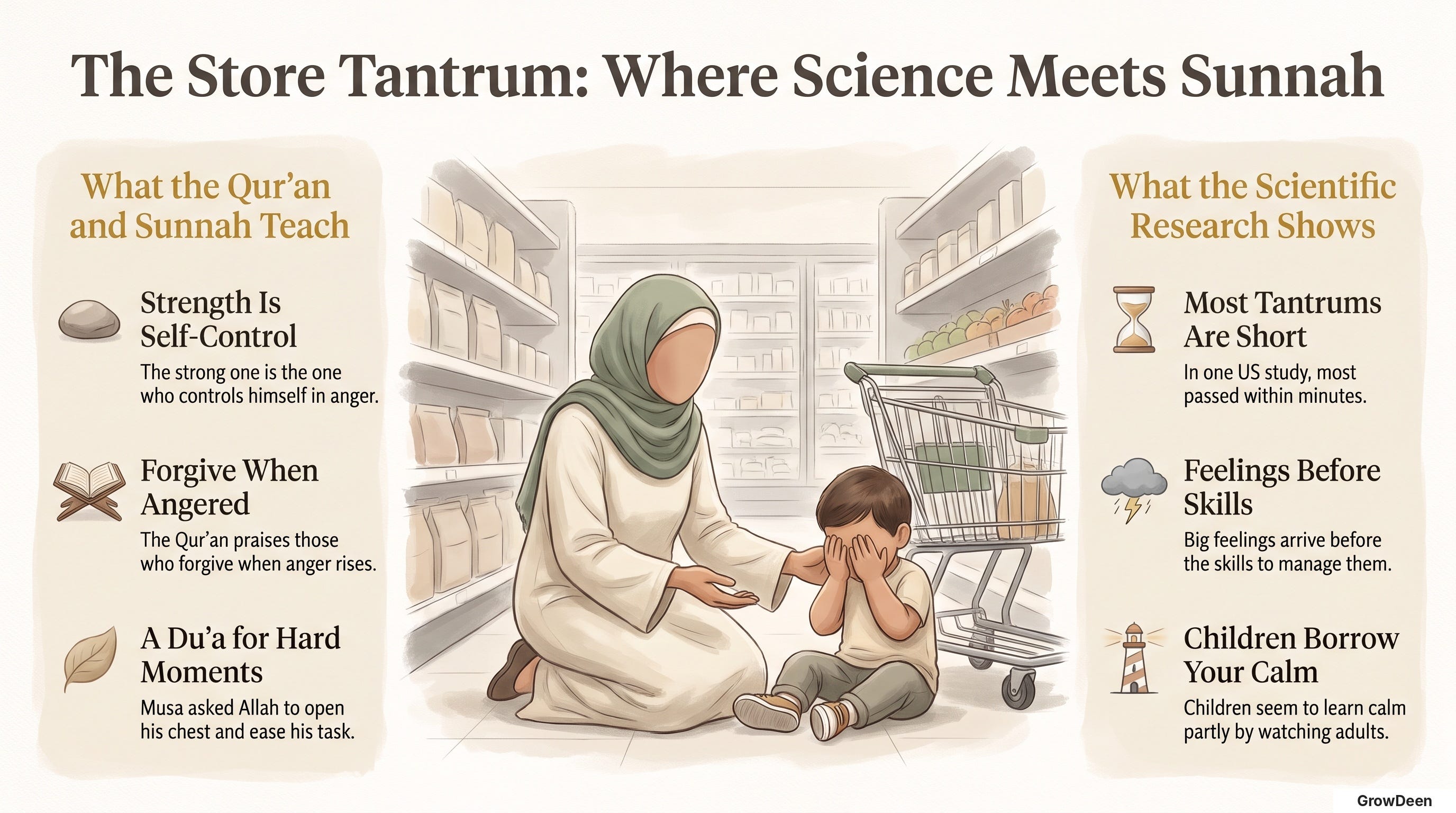
Most tantrums are short. In a US study of 335 children aged 18 months to 5 years, the most common tantrum lasted 30 to 60 seconds. About 75% were over in 5 minutes or less. [3,5] For the youngest group, 18 to 24 months, the most common tantrum lasted under a minute. [2]
Who was studied: 335 children in Wisconsin, US · mostly white families · college-educated, largely middle-class parents · children with additional needs were not reported. Parents wrote accounts of real tantrums soon after they happened. [2]
How strong this is: Suggestive. One careful set of studies from 2003, built on parent reports from one kind of family.
A wider picture. A Dutch study of 861 children aged 1 to 5 found tantrums became less frequent, but longer, with age. [6] An earlier, smaller study that included children up to 13 found that about half of tantrums lasted 5 to 10 minutes. [3,6] Who was studied: the Netherlands · ethnicity not given · mostly two-parent families with college-educated parents · children with severe disabilities or developmental delays were left out. (Suggestive)
How children learn calm. A review of family studies proposes that children learn to manage emotions partly by watching. It names observational learning, modeling and social referencing, which means checking an adult’s reaction. [7] It also points to how parents respond to feelings. (Suggestive: a narrative review.)
Naming feelings. In a small pilot study of a toddler parenting program, mothers coached emotions more and dismissed them less afterward. [8] Who was studied: not given in the study summary. (Early)
When to look closer. A US study of 279 children aged 3 to 6 compared healthy preschoolers with those who had a diagnosed problem. [9] Some tantrum patterns were linked with a diagnosis:
hurting themselves on purpose during tantrums;
aggression toward a caregiver, or breaking things, in most recent tantrums;
tantrums at home on 10 to 20 separate days in a month, or more than 5 a day on several days outside home;
tantrums lasting about 25 minutes or more on average;
usually needing an adult’s help to calm down.
Who was studied: St. Louis, US · White, Black and mixed-race children · a range of education levels · children with developmental, language or cognitive delays were left out. The authors note these cutoffs are not yet proven as markers of a disorder. They are not a waiting rule: you can ask for help at any point. (Suggestive)
What we do not know yet. No study has yet tested this with Muslim families. These studies also did not test whether a parent’s calm makes one tantrum shorter.
What this means for you: most tantrums pass within minutes. Inside them, your job is to keep everyone safe and stay steady nearby.
What the Qur’an and Sunnah Teach
وَٱلَّذِينَ يَجۡتَنِبُونَ كَبَٰٓئِرَ ٱلۡإِثۡمِ وَٱلۡفَوَٰحِشَ وَإِذَا مَا غَضِبُواْ هُمۡ يَغۡفِرُونَ
who avoid major sins and shameful deeds, and forgive when angered;
Ash-Shura 42:37 · The Clear Quran (Dr Mustafa Khattab) [10]
Text. The verse describes the believers for whom what is with Allah is better and more lasting. Tafsir Ibn Kathir explains that their nature is to forgive people and be tolerant, and that vengeance is not in their nature. [11]
Our reflection. The verse praises forgiveness when anger arises. Its purpose is moral and spiritual. It is not a description of a toddler’s nervous system. It speaks to the adult in the aisle, who may feel anger and still choose to let it go.
Narrated Abu Huraira: Allah’s Messenger (ﷺ) said, “The strong is not the one who overcomes the people by his strength, but the strong is the one who controls himself while in anger.”
Sahih al-Bukhari 6114 · sunnah.com [12]
Text. Sahih Muslim reports the same teaching from Abu Huraira. [13] Al-Bukhari places it in a chapter on being cautious of anger; Muslim, in a chapter on the virtue of controlling yourself when angry.
Our reflection. We are told to “stay calm” as if calm were a switch. The Prophet ﷺ named it as strength, something practiced.
Restraint still holds limits. It means protecting people, keeping the boundaries that matter, and choosing words that do not humiliate. Before you answer an outburst, take a breath and remember the kind of strength you want to practice. You may need to try again after an imperfect moment.
What developmental guidance adds. Young children often need help naming feelings, staying safe and finding workable responses. Emotion coaching can acknowledge a feeling while keeping the limit. [1] The texts and the science are different kinds of guidance, and a parent can draw on both.
The strength the Prophet ﷺ praised is quiet. Often it looks like a parent who stays steady.
The Lab Verdict
The science: most tantrums pass within minutes, and children seem to learn calm partly by watching adults. (Suggestive)
The Qur’an and authentic Sunnah: the Qur’an praises those who forgive when angered, and the Prophet ﷺ named self-control in anger as true strength.
Where they meet: the science explains why a tantrum is a feeling bigger than a child’s skills, and the Sunnah shows the strength a parent can offer in that moment. Neither proves the other.
So at home: make it safe, stay close and steady, keep your no, and teach once the storm has passed.
Knowledge in Practice: Five Steps, in Order
Knowing why tantrums happen is half the work. The other half happens in the cereal aisle.
Calm is something we lend. A child may borrow steadiness from a trusted adult: a low voice, a predictable response, and not adding to the alarm. This is often called co-regulation. It is support, not a performance of perfect patience.
If you can only do one thing, do step 1. It is enough.
Before you respond: One breath. Bismillah. Say it silently before you speak.
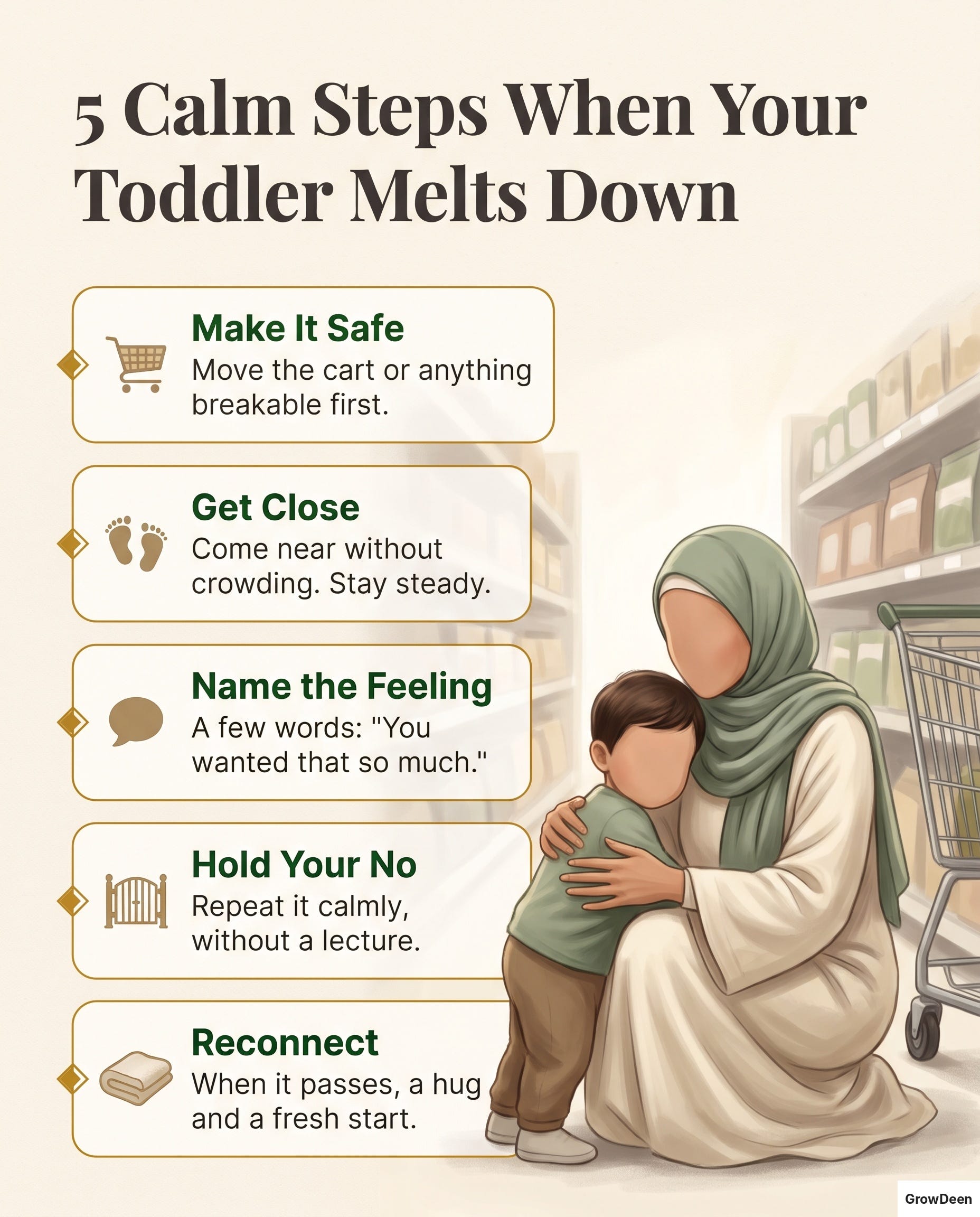
1. Make it safe (10 seconds). Move the cart, or anything breakable, out of reach. Stay between your child and traffic, sharp edges, or anyone they might hurt. If other children are with you, keep them safe too, or ask another adult to watch them. [1] Get help if you need it.
Say this: “I’m here. I’m keeping you safe.” (Say it in the language your child knows best.)
2. Get close, without crowding (as long as it takes). Come to their level if it is safe. Use a low, slow voice rather than competing with the noise. Offer touch only if they want it; give safe space if they pull away. [1] Some children need less sound and less eye contact while they recover.
Say this: “I’m here. You’re upset.”
Ages 1–3, stay close: stay physically near and don’t step back. Keep your voice low and slow. Don’t try to reason yet; the logic can wait. [1]
3. Name the feeling briefly (5 seconds). You do not need to agree with the demand to acknowledge the disappointment. Pick one line and stop there:
“You wanted that so much.”
“That was a big no.”
“You wanted to choose the box yourself.”
“It’s hard to leave the toy aisle.”
“You seem so frustrated right now.” (ages 4–6)
Instead of: “Stop crying, it’s only cereal.” Try: “You wanted that cereal so much.”
4. Hold the boundary (repeat as needed). Repeat your no in a few words, and don’t bargain in the middle of the outburst. Being consistent helps your child learn that tantrums don’t get them what they want. [1] Comfort does not have to mean changing the answer.
Say this: “We’re not buying it.” Or, for the cereal: “We are not buying that cereal.”
Say this if your child hits or throws: “I won’t let you hit. I’m keeping us safe.” Stop it gently and firmly, then lower your voice again.
5. Wait, then reconnect (a few minutes). Stay available while the intensity passes. When your child can listen again, offer comfort; a tantrum is distressing for everyone. [1] The teaching conversation can wait.
Ages 4–6: use the five-step sequence on the pack’s response card. Notice the emotion, name it out loud, and pause without rushing to fix it. Stay with them while they settle, then address what sparked it once everyone is calm. [1]
Treat these steps as a guide you can adapt for danger, sensory needs and your child’s developmental abilities. Never laugh at a tantrum, even when part of it looks comical; it may upset your child more. [1]
After the storm: the conversation comes later. Once your child has settled, begin with reconnection. A drink of water, a quiet minute, or sitting together may matter more than a speech.
Later, describe the moment without shame. Say this: “You wanted that cereal so much. I said no, and you felt disappointed.” Then practice one alternative: “Next time, you can tell me, ‘I’m upset,’ and ask for help.”
If you shouted, repair your part. Say this: “I raised my voice. I am sorry. I will try speaking more gently.” You can apologize and keep the original boundary. When the moment passes, reconnect. Children learn over many ordinary repetitions, not from a parent who never struggles.
When things are calm, notice small efforts too: a child asking for help, accepting comfort, or trying again after frustration.
Between tantrums: five small habits (a minute here and there).
Name feelings from the start. Even with a baby, label what you see: “happy”, “cross”, “tired”, “hungry”. [1]
Plan around triggers. Shop after a nap or a snack. [1] A warning before screen time ends can help too.
Point out the wins. “You didn’t throw the blocks when the tower fell again. How did that feel?” [1]
Talk it through when calm, never mid-storm. “Were you upset because the tower kept falling? What else could we try?” [1]
Narrate your own coping. “This traffic is making us late, and I’m frustrated. I’m going to take a deep breath.” Children seem to learn to manage feelings partly by watching the adults around them. [1,7]
The Before, During, After note (2 minutes a day, for a week). Hunger, tiredness, overstimulation, sudden changes and a child’s own sensitivities can all play a part. The reason is not always obvious, and the useful clue may appear an hour earlier. Was lunch late? Was the store noisy? Had your toddler already managed three hard transitions? Did they expect to choose the cereal themselves?
Before: what happened right before?
During: what did your child seem to need, and what was unsafe?
After: what helped them recover?
Keep a few notes across the week, without blaming yourself or promising that every tantrum can be prevented. A pattern might suggest a snack before shopping, a shorter errand, or a clearer transition. The pack’s Trigger Pattern Log gives you seven rows for this.
Use the notes to make tomorrow a little easier, never to collect evidence against your child.
Make It Work in Your Home
On your own with more than one child? Safety first: buckle the baby into the cart seat or stroller (pram), then kneel by the toddler.
Close to losing your temper? You can be frustrated and still choose your next action. If you feel close to losing control, secure your child in a safe place and ask another trusted adult to take over when possible.
A grandparent who hands over the treat? Give them the words and a role, so the no holds in every room.
Say this to Grandma: “Mama, you calmed so many storms when we were small. Will you help me stay steady with her? We’re keeping the no, and staying close.”
Say this to your spouse: “Can we use the same words when she melts down? One calm voice from both of us helps her settle.”
The family question: ask your mother or father, “What did you do when we melted down as children? What do you wish someone had told you?”
Try It Seven Times
Any seven hard moments in the next week or two. Seven is a starting goal, not a magic number.
Pick one recurring trigger: tiredness before dinner, a transition, sharing, or the end of screen time. Name it to yourself now.
Add one feeling check-in during a calm moment each day: “How did that feel?”
Before the next tantrum, take one breath and say Bismillah silently before you speak.
Once things are calm, talk through what happened in two or three short sentences.
Notice one thing that went better than last time, even if it is small.
Skills grow through repetition. Tell us in the comments what changed.
Safe, close, named, held, then reconnected: five steps, in order, every time you can.
If Things Don’t Go to Plan
If people stare: anyone who has raised a toddler has stood where you are standing. Those who give you a look have either never had children, or have forgotten. [1]
If you start doubting yourself: Is she doing this to me on purpose? No. She is stuck in a feeling too big for her skills right now. [1] The behavior is not personal, even when it feels deeply personal.
If you lose your patience: it happens to most parents. Come back, lower your voice and repair: “I’m sorry I shouted. I’m here now.” Repair is part of the lesson.
If your plan fell apart: you cannot control your child’s emotions directly. You can keep your child safe and guide their behavior over time, and that is the whole job. [1] Self-regulation is a lifelong task, so expect progress over years. [1]
If it might not be a tantrum: an autistic child’s meltdown is different, and Parents Also Ask explains how.
Speak to someone if: outbursts are persistently intense, involve repeated injury or serious aggression, or disrupt daily life. Ask too if you have concerns about communication, sensory needs, development, or your ability to keep everyone safe. Sudden changes, possible illness or pain deserve attention. You do not have to wait for a fixed number of minutes or tantrums to ask. Signs are clearer looking back. Seeing them late is not neglect.
For questions of deen, ask your local imam or a local scholar, and share the details with him.
And you? Your own steadiness runs on sleep, food and help. If anger or low mood feels heavy most days, tell your own doctor.
Who to turn to: your child’s doctor or pediatrician. If anyone is hurt in an emergency, call your local emergency number.
Support Muslim Parenting Lab ❤️
Would you rather give a small amount that never stops than a large one you keep postponing? Set a monthly amount you are comfortable with, in a few seconds, using the button below.
The Prophet ﷺ said the deed most beloved to Allah is the most constant, even if little. (Sahih al-Bukhari 6464)
Your Companion Pack: The Calm in the Storm Companion Pack
The middle of a tantrum is the worst time to remember a five-step plan. This free pack keeps the plan where you will see it. One PDF, three printable pages:
Page 1, The In-the-Moment Response Card. For ages 1–3: stay close, keep a quiet voice, offer wanted touch or space, and hold the boundary. For ages 4–6: the five-step sequence. It ends with “Before you respond: one breath. Bismillah.”
Page 2, The Trigger Pattern Log. Seven daily rows for the time, the likely trigger (hunger, tiredness, overstimulation, a transition, or other) and what helped. Look for patterns, not a guaranteed answer.
Page 3, The Harder Half of the Tantrum. A parent reflection on Qur’an 42:37 and the Prophetic teaching that strength includes self-control in anger.
Keep the card on the fridge or in your bag, and the reflection near your Qur’an.
Parents Also Ask
What should I do when my toddler has a tantrum in public?
Make it safe first, then stay close and steady. Name the feeling in a few words, keep your no calmly, and reconnect once the storm has passed. Knowledge in Practice walks through these five steps, with the words to say. In that moment, your child matters more than the people watching.
Why might two children in the same home react so differently to frustration?
Temperament shapes how fast and how strongly a child reacts to frustration or change, and some children are more easily upset. [1] In a study of preschoolers, emotional reactivity was linked with tantrum anger and distress. [4]
How can narrating your own frustration teach a child what coping looks like?
Children seem to learn to manage feelings partly by watching the adults around them. [7] When you say, “I’m frustrated. I’m going to take a deep breath,” your child sees and hears each step of coping. Staying calm during their tantrum gives them a model of calm behavior too. [1]
How long do toddler tantrums usually last?
In one US study, the most common tantrum lasted 30 to 60 seconds, and 75% ended within 5 minutes. [3,5] Tantrums often become less frequent but longer as children grow. [6] In one study, long tantrums were one of several patterns linked with a diagnosis. [9] You do not have to wait for a fixed number of minutes to talk to your child’s doctor.
Is it normal for a 5-year-old to still have tantrums?
Occasional tantrums still happen, especially with stress or tiredness. A pattern of repeated tantrums after age 5 is unusual, so check in with your child’s doctor or pediatrician. [3] That is a reason for support, not a sign you have failed.
How can I tell a tantrum apart from an autism meltdown?
A tantrum often follows a specific want, like the cereal box. An autistic child may have a meltdown when completely overwhelmed, losing control and finding it hard to calm down. It can include yelling, rocking, crying, hitting or withdrawing. [1] Meltdowns call for a calmer, more sensory-aware response. Your child’s doctor or a developmental specialist can help you tell them apart.
Final Reflection
Dear parent,
You are reading this because you want to meet your child’s hardest moments well. That wish already matters.
Maybe you have given in, shouted or left a full cart before. You were doing your best in a hard moment.
You are not failing when your child cries in public. You are not harsh when you keep your no kindly. You are practicing a strength the Prophet ﷺ named.
You do not need to get every tantrum right this week. Choose one breath before the next no. Let that be enough. Allah sees the intention behind every hard moment you stay for.
Often, a tantrum isn’t a test. It’s a big feeling, and your toddler needs you steady and close.
A Du’a for This
For you:
رَبِّ ٱشْرَحْ لِى صَدْرِى وَيَسِّرْ لِىٓ أَمْرِى
Rabbi-shraḥ lī ṣadrī, wa yassir lī amrī
“My Lord, expand for me my breast [with assurance] And ease for me my task”
Ta-Ha 20:25–26 · Sahih International [14]
Prophet Musa made this du’a as he faced a hard task. A tantrum in a busy store is a small one, and it can still feel huge.
With your child: A’ūdhu billāhi mina sh-shayṭāni r-rajīm, “I seek refuge with Allah from Satan, the outcast.” (Sahih al-Bukhari 6115) [15] The Prophet ﷺ taught these words for a moment of anger. Practice them together at a calm time from about age 3, so they are ready when a storm comes. Over a younger toddler, say them softly yourself.
Share the Khayr
If you know a parent who froze in a store aisle this week, send this to them, as company more than advice. The Prophet ﷺ said that one who guides to something good has a reward similar to that of its doer. [16]
Tell us in the comments: what helps your child come back to you after a tantrum? We’d love to know.
Parents Also Read
Parents who read this guide also found these helpful.


References
[1] Raising Children Network (Australia). (2025). Tantrums: why they happen and how to respond. Australian Government-supported parenting resource. (Australia · Suggestive: expert guidance)
[2] Potegal, M., & Davidson, R.J. (2003). Temper tantrums in young children: 1. Behavioral composition. Journal of Developmental and Behavioral Pediatrics, 24(3), 140–147. (US · Suggestive)
[3] Sisterhen, L.L., & Daley, S.F. (2026). Temper Tantrums. StatPearls. StatPearls Publishing, last updated June 19, 2026. (US · Suggestive: clinical review)
[4] Giesbrecht, G.F., Miller, M.R., & Müller, U. (2010). The anger–distress model of temper tantrums: associations with emotional reactivity and emotional competence. Infant and Child Development, 19(5), 478–497. (Community sample, country not given in the study summary · Suggestive · abstract only)
[5] Potegal, M., Kosorok, M.R., & Davidson, R.J. (2003). Temper tantrums in young children: 2. Tantrum duration and temporal organization. Journal of Developmental and Behavioral Pediatrics, 24(3), 148–154. (US · Suggestive)
[6] Van den Akker, A.L., Hoffenaar, P., & Overbeek, G. (2022). Temper tantrums in toddlers and preschoolers: Longitudinal associations with adjustment problems. Journal of Developmental and Behavioral Pediatrics, 43(7), 409–417. (Netherlands · Suggestive)
[7] Morris, A.S., Silk, J.S., Steinberg, L., Myers, S.S., & Robinson, L.R. (2007). The role of the family context in the development of emotion regulation. Social Development, 16(2), 361–388. (US authors · Suggestive: narrative review · abstract only)
[8] Lauw, M.S.M., Havighurst, S.S., Wilson, K.R., Harley, A.E., & Northam, E.A. (2014). Improving parenting of toddlers’ emotions using an emotion coaching parenting program: A pilot study of Tuning in to Toddlers. Journal of Community Psychology, 42(2), 169–175. (Country not given in the study summary · Early · abstract only)
[9] Belden, A.C., Thomson, N.R., & Luby, J.L. (2008). Temper tantrums in healthy versus depressed and disruptive preschoolers: defining tantrum behaviors associated with clinical problems. Journal of Pediatrics, 152(1), 117–122. (US · Suggestive)
[10] Qur’an, Ash-Shura 42:37. Translation: The Clear Quran (Dr Mustafa Khattab).
[11] Tafsir Ibn Kathir on Ash-Shura 42:37.
[12] Sahih al-Bukhari 6114.
[13] Sahih Muslim 2609a.
[14] Qur’an, Ta-Ha 20:25–26. Translation: Sahih International.
[15] Sahih al-Bukhari 6115.
[16] Sahih Muslim 1893a.
We combine scientific research with Qur’an and authentic Sunnah, and we cite our sources. Even so, this is general guidance and no substitute for a doctor who can examine your child.
Sources & confidence
The hadith in this guide are from Sahih al-Bukhari and Sahih Muslim. Qur’an 42:37 is quoted in The Clear Quran, to match MPL’s printed magazine; Ta-Ha 20:25–26 is in Sahih International. Checked October 2026. Found a source that looks wrong? Email us at info@growdeen.com.
Words in this guide
Bismillah: “In the name of Allah”
du’a (doa): supplication
deen: the way of life of Islam
khayr: good
Sunnah: the Prophet’s ﷺ example
tafsir: explanation of the Qur’an
cart (trolley): a store’s shopping cart
stroller (pram): a baby’s pushchair
pediatrician (paediatrician): a children’s doctor
tantrum: an outburst of crying, shouting or flailing when a feeling is bigger than a child’s skills.
meltdown: a response to overwhelm, rather than to a specific want.
self-regulation: the ability to understand and manage feelings and reactions.
co-regulation: a child calming with the help of a steady adult.