

Your children fight every day, and you wonder if they will ever be close?
The free Sibling Warmth Kit helps you build warm moments between them, day by day.
AGES 3–8 YEARS · 16 MIN READ
One of them is crying before you reach the door. The other is already explaining.
You did not see what happened. You are about to judge it anyway.
You separate them. Someone says sorry. The house goes quiet for a while.
Later, in bed, a different worry keeps you awake.
I can stop their fights. But will they still call each other when they grow up?
You are not the only parent asking this. Fights between siblings are common. Closeness is something you can help build.
This guide brings together scientific research and the Qur'an and authentic Sunnah. You'll see why fewer fights don't always mean more warmth, and the small steps that help.
The Short Answer
Right for your child? Brothers and sisters around ages 3 to 8 who argue or fight often at home.
What's probably happening: fighting and closeness are separate. Stopping fights alone may not build warmth.
Try tonight (1 minute): tell one child one true, kind thing their sibling did today. Then stop.
You'll know it's working when: they mention each other kindly, even once. A fight tomorrow is not failure.
Get help if: one child is often frightened, hurt, threatened or humiliated by the other. Start with your child's doctor or pediatrician.
The rest of this guide explains why, and what to do if it does not work.
How to Read This Guide
3 minutes: The Short Answer above is enough for tonight.
7 minutes: The Short Answer, then Knowledge in Practice and If Things Don't Go to Plan.
The whole guide: read on for the scientific research, the Qur'an and Sunnah, and the References.
To share: the bold lines and the pull quotes are made to be shared.
To listen: open this guide in the free Substack app and tap Listen.
Inside This Guide
A quieter house is not always a closer one. Warmth needs its own care.
Myth Check: "Less Fighting Means More Closeness"
When siblings fight every day, the goal seems clear. Stop the fights, and closeness will follow.
What this belief gets right. Calm matters. Stepping in fast when someone is hurt is right, and a calmer home is easier on everyone.
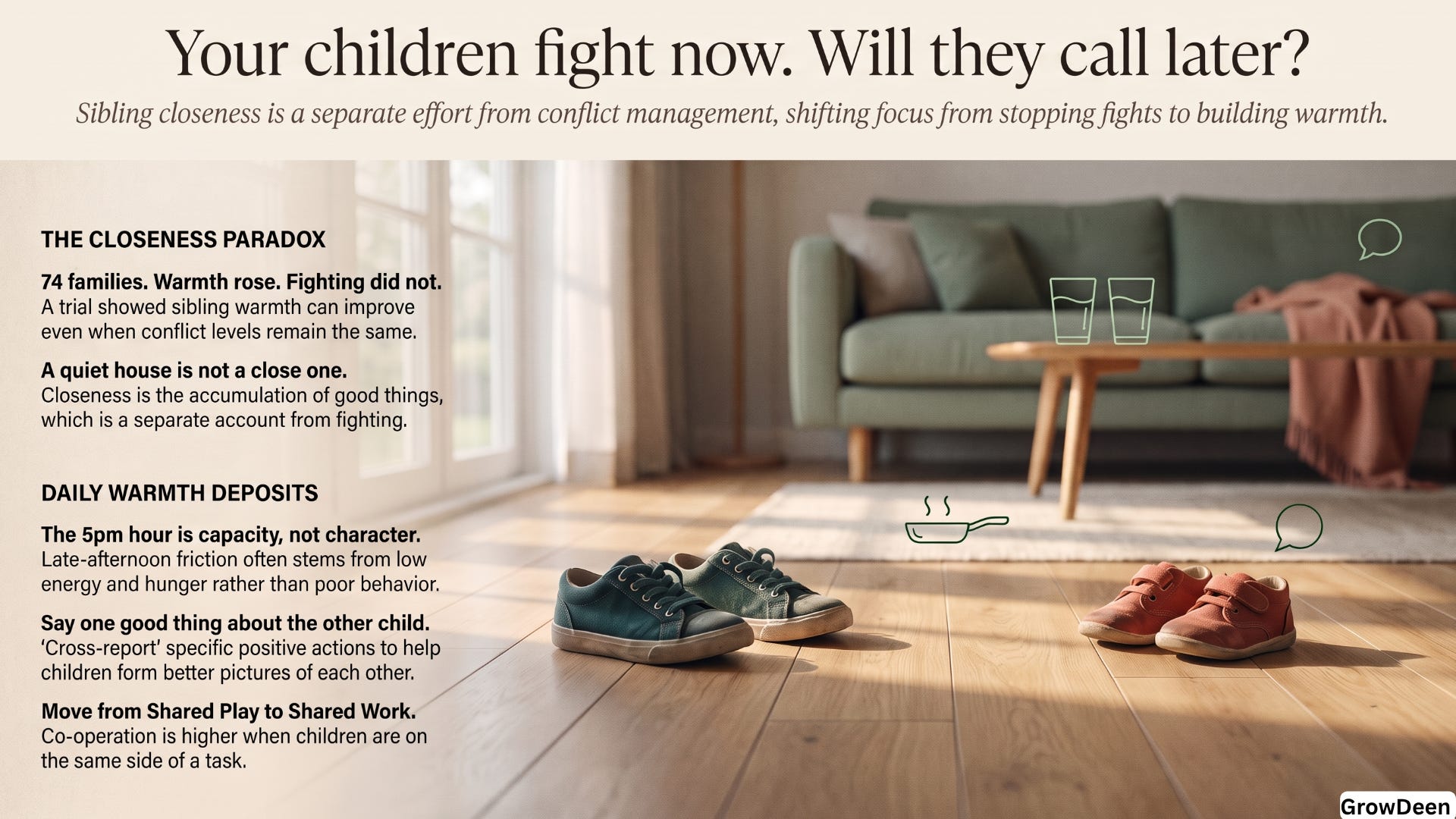
What the evidence says. In an Australian trial, parents of children aged 3 to 10 attended one 2-hour group session on sibling relationships. Afterward, those parents reported a small gain in warmth between their children. [1]
Fighting eased over time in both groups, so the session itself did not reduce it. The study's authors concluded that the positive and negative sides of a sibling relationship need separate attention. [1]
So the work has two parts. Calm the fights. Then add the good, on purpose.
Why This Happens
Why do my children fight so often?
Young children are still building the skills that settle a disagreement. Fights often start when a child sees a situation as unfair. A child may also feel their sibling doesn't see their side, or want to stand up for what is theirs. [2]
At 3 to 4, children are starting to share and take turns. They are still learning to manage strong feelings, and they may push when frustrated. By 5 to 7, most are better at sharing, compromising and talking through options. [2]
Self-control, holding information in mind and switching between ideas grow fast from about ages 3 to 5. They keep developing into early adulthood. [3]
Why does each child react so differently?
Children are born with their own temperaments. One shrugs off a grabbed toy. Another holds the hurt until bedtime. [2]
The same moment can feel small to one child and huge to the other. Neither child is choosing their temperament.
Why does fairness feel so big to them?
Children watch closely how each of them is treated: who was served first, whose story was believed. Sometimes a parent is warmer with one child, or harsher with another. That difference has been linked with more behavior problems in the child who gets less warmth. [4]
Fairness does not mean identical treatment. It means each child feels seen and safe with you.
Why don't fewer fights mean more closeness?
Picture two jars in your kitchen. One fills up with the hard moments between your children. The other fills with the good ones: a shared joke, a saved seat, a hand held at the door.
Most of our effort goes into emptying the first jar. But an empty first jar does not fill the second. The good moments have to be added.
Often, fewer fights don't mean more warmth. The good moments need adding on purpose.
What the Scientific Research Shows
The strongest evidence is a 2024 meta-analysis that pooled 13 groups of families and more than 14,000 children. Children who received less warmth and more harshness from a parent than their sibling did had more behavior problems. [4]
The link was small. It was stronger for harshness than for warmth, and stronger for outward behavior, such as aggression, than for worry or sadness. [4]
Who was studied: the US, UK, Canada, the Netherlands and Belgium · ethnicity, family income and additional needs: not given in the study summary.
How strong this is: Strong. A meta-analysis of many studies pointing the same way. It shows a link, not a cause.
The Australian trial in the Myth Check is the clearest test of a program. Seventy-four parents attended one 2-hour session or joined a waitlist. The session was linked with a small gain in parent-reported warmth, but not with less conflict. [1]
Who was studied: Brisbane, Australia · mostly white, female, middle-income parents. Their children were aged 3 to 10, no more than 4 years apart · additional needs: not given in the study summary.
How strong this is: Early. One small trial of a single session, based on parents' reports.
A third study answers the question in the title. It followed brothers and sisters in 201 families from about age 7 to age 30. [5]
Closeness often dipped from middle childhood into early adolescence, then grew again through the mid-20s. Conflict eased across adolescence. Mothers' warmth went with closer sibling relationships. [5]
Who was studied: 201 families, mostly white and working- or middle-class · country and additional needs: not given in the study summary.
How strong this is: Suggestive. One long-running study that followed the same families for years.
What we do not know yet: no study has yet tested these ideas with Muslim families. The small warmth steps in Knowledge in Practice come from everyday practice. They have not been tested as a program.
What this means for you: calm the fights, but add warmth on purpose. Try to keep your own warmth and firmness even between your children.
What the Qur'an and Sunnah Teach
There is a limit every parent meets in this work. You can coach the apology and praise every kind act. You cannot reach inside one child and place love for the other there.
وَأَلَّفَ بَيْنَ قُلُوبِهِمْ ۚ لَوْ أَنفَقْتَ مَا فِى ٱلْأَرْضِ جَمِيعًا مَّآ أَلَّفْتَ بَيْنَ قُلُوبِهِمْ وَلَـٰكِنَّ ٱللَّهَ أَلَّفَ بَيْنَهُمْ ۚ إِنَّهُۥ عَزِيزٌ حَكِيمٌ
And brought together their hearts. If you had spent all that is in the earth, you could not have brought their hearts together; but Allāh brought them together. Indeed, He is Exalted in Might and Wise.
Al-Anfal 8:63 · Sahih International [6]
Text. Ibn Kathir explains that this verse speaks of the believers of Madinah. Before Islam, there were many wars between the Aws and the Khazraj. The wealth of the earth could not have joined their hearts, because of the enmity between them, but Allah united them. [7]
The verse is about the believers of that community, not about siblings. We take a principle from it, not a promise about your children.
Our reflection. You can build the conditions for closeness. Joining two hearts belongs to Allah. So do your half, and ask Him for the rest.
He who makes peace between the people by inventing good information or saying good things, is not a liar.
Sahih al-Bukhari 2692 · sunnah.com [8]
Text. Imam al-Bukhari placed this hadith in his Book of Peacemaking, under the chapter "He who makes peace between the people is not a liar". [8]
Our reflection. When you tell one child something kind their sibling did, you carry good across a gap. Keep it true. The Warmth Log in your Kit asks for real, specific moments, so there is never a need to make one up.
Bear in mind, Abu Mas'ud; verily Allah has more dominance upon you than you have upon your slave.
Sahih Muslim 1659a · sunnah.com [9]
Text. Abu Mas'ud al-Badri was beating his slave when he heard these words behind him. It was the Prophet ﷺ. Abu Mas'ud dropped the whip and said he would never beat his servant again. [9]
Our reflection. This narration is about a slave, not a child, so we take its principle and do not stretch the text. It speaks to power held over someone who cannot push back. Children who are hit are more likely to be physically aggressive with their siblings, and the American Academy of Pediatrics advises against spanking. [2,10]
You can build the conditions for closeness. Joining two hearts belongs to Allah.
The Lab Verdict
The science: warmth and fighting are separate sides of a sibling relationship, and uneven warmth from parents is linked with more problems. (Strong for the link; Early for programs)
The Qur'an and authentic Sunnah: Allah joins hearts, and carrying good between people in conflict is praised as peacemaking.
Where they meet: the science shows that warmth needs its own attention, and the Sunnah shows who gives it and how to carry it. Neither proves the other.
So at home: calm the fights, add small, true moments of warmth, and ask Allah for the rest.
Knowledge in Practice: Small Deposits of Warmth
Knowing why your children fight is half the work. Knowledge bears fruit only when it reaches your kitchen table.
If you can only do one thing, do step 1. It is enough.
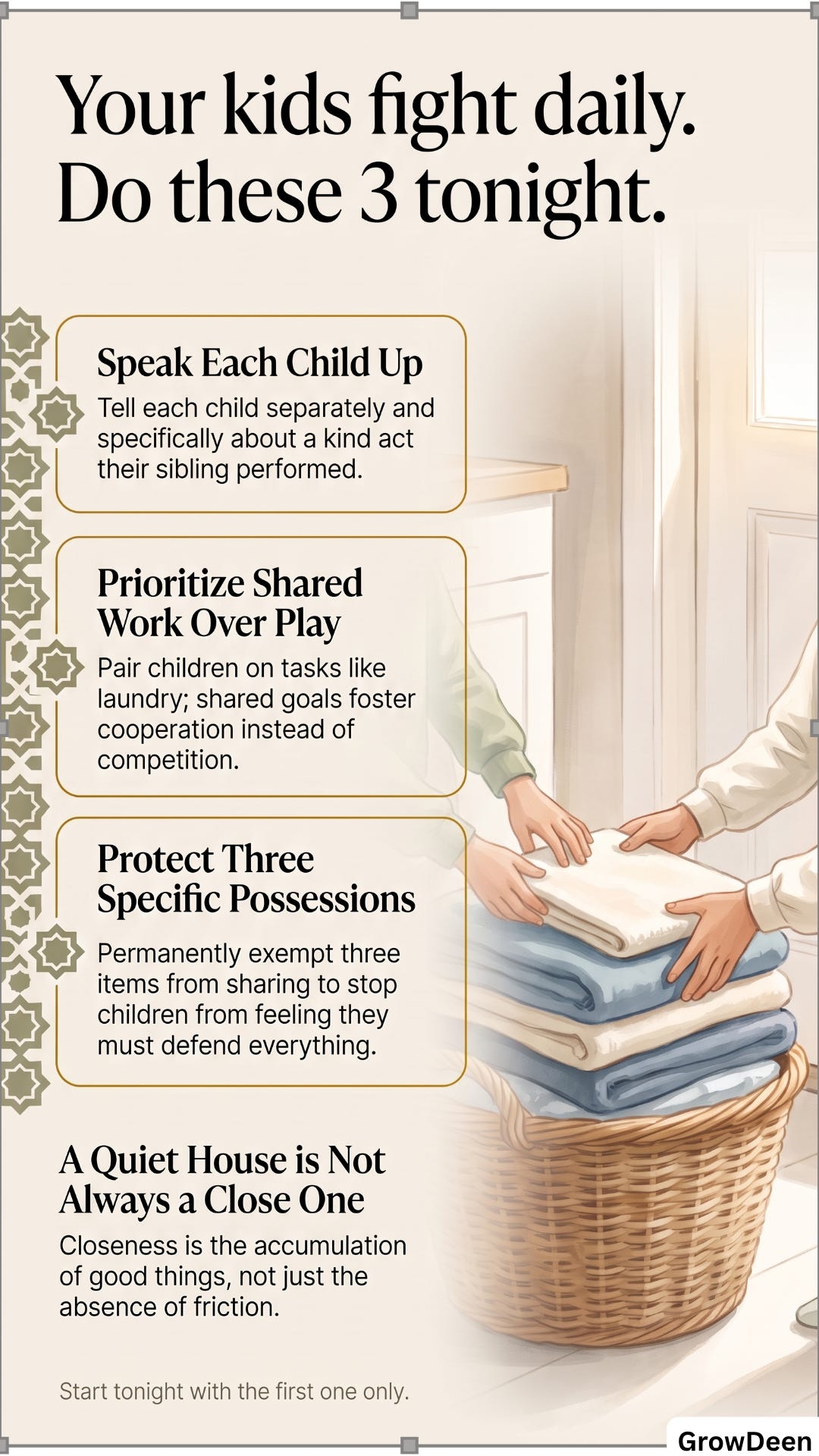
1. Tell each child one true, kind thing their sibling did (1 minute a day). If most of what you say about a sibling is a correction, this adds the other side. Say it to the sibling, not to the child who did it. Be specific, then stop. Do not explain why you said it.
Say this: "Your brother waited for you at the gate, even though his friends went ahead." (Say it in the language your child knows best.)
More lines you can use:
"Your sister saved you the last piece of bread."
"Your brother picked up your shoe when it fell off in the car."
"Your sister laughed so much at your story at dinner."
"Your brother asked where you were when you were at Grandma's."
Instead of: "Why can't you be kind like your sister?" Try: "Your sister saved you the last piece. That was kind."
3–5: keep it to one short sentence while they are nearby. 6–8: at bedtime, ask, "What is one kind thing your sibling did today?"
The Seven-Day Warmth Log in your Kit gives you a place to write each one down.
2. Find your flashpoints and fix them before they start (15 minutes, once this week). Fights tend to repeat at the same times. Change the setting before the hard hour, not during it.
For one week, note the time whenever a fight starts. Do not change anything yet. Then look for the times that repeat.
For each one, ask what is running low: food, energy, space or something to do. Write the fix you will try before it starts.
For example: fights from 5:00 to 5:45pm, when food and your attention are low. The fix: fruit on the table at 4:45, and one job each, in different rooms.
Say this: "Snack first. Then one job each. You set the cups, and you fold the cloths."
Prevention is dull. It also tends to work better than anything you can do once the shouting has started.
3. Give them shared jobs, not only shared toys (10 minutes). Two children with one toy are often in competition. Two children setting the table or folding laundry are on the same side of a task.
Say this: "You two are the table team tonight. Plates and spoons, then tell me when you're done."
In a small home: jobs need no extra space. Sorting socks on the sofa works too.
4. Protect a few things each child never has to share (5 minutes, once). Let each child choose two or three treasured things that are theirs alone. Then hold that line every time.
Say this: "These three things are yours. Nobody takes them without asking you."
5. Swap "Who started it?" for "What did each of you want?" (1 minute, in the moment). Safety comes first: if anyone is hurt or unsafe, separate them before you talk.
Then hand the problem back. In a Canadian trial, children whose parents learned to mediate used more constructive ways to settle their fights. [11]
Instead of: "Who started it?" Try: "What did each of you want? What would be fair here?"
Make It Work in Your Home
On your own, or working late shifts? Do step 1 only. One kind sentence on the way to school is enough.
Three or more children? Rotate whose good news you share each day, and keep a quick tick on the fridge.
A small home or no spare money? None of this costs anything. Jobs, kind words and a short planner are free.
A grandparent helps with the children? Share step 1 with them. Grandparents are often the best at noticing small kindnesses.
Say this to your spouse: "Can we both tell the kids one kind thing about each other this week? Let's see who notices more."
Say this to Grandma: "Mama, the children love it when you talk to them. When you see one being kind, would you tell the other one about it?"
The family question: ask an elder, "When you were small and fought with your brothers or sisters, what made you close later?"
Try It Seven Times
Any seven times in the next week or two, tell one child a true, kind thing their sibling did. Seven is a starting goal, not a magic number.
Tick it on the Warmth Log each time.
Tell us in the comments which kind thing made your child smile. We'd love to know.
Calm the fights, add the good: one true, kind sentence a day is the whole practice.
If Things Don't Go to Plan
If a child shrugs it off: keep going anyway. Say it, then walk away. Children often take in more than they show.
If it only improves a little: one kind word between them, even once, is progress. Keep step 1 going and add step 2 next week.
If you start doubting yourself: Will they ever be close? Often, yes. In one long study, closeness between siblings often grew again from the teenage years into the mid-20s. [5]
If you lose your patience: it happens to most parents. Say, "I shouted. That was not how I wanted to speak. I'm sorry." Repair is part of the lesson.
If one child is always the target: step in every time, and protect the child being targeted. Give each child some calm time alone with you.
Speak to someone if: you see repeated physical aggression, threats, intimidation or deliberate humiliation. The same goes for damaged belongings, or anything that makes one child afraid of the other. This is not typical sibling conflict. [2]
Signs are clearer looking back. Seeing them late is not neglect.
For questions of deen (the way of life of Islam), ask your local imam or a local scholar, and share the details with him.
Who to turn to: your child's doctor or pediatrician, or a family therapist or counselor. In an emergency, call your local emergency number.
Support Muslim Parenting Lab ❤️
Would you like the reward of every parent who acts on what they read here? Fund it with the button below and it is yours.
The Prophet ﷺ said whoever guides to good has a reward like the one who does it. (Sahih Muslim 1893a)
Your Companion Pack: The Sibling Warmth Kit
Free to download. One PDF, three printable pages, made for the fridge door and the hour before dinner:
The Seven-Day Warmth Log: a one-week grid for each child. Write one true, kind thing they did, the exact words you told their sibling, and tick it off.
Your Household Flashpoint Planner: four spaces to map when fights happen, what is running low, and the fix you will try before they start.
For the Parent Who Cannot Make Them Love Each Other: a reflection page on Al-Anfal 8:63. It has space to write your own du'a for your children, by name.
Parents Also Ask
Is it normal for siblings to fight every day?
Fights, disagreements and arguments are common among siblings. Young children are still developing the emotional, social and problem-solving skills to settle them, and siblings usually fight less as these skills grow. [2] Why This Happens explains more.
Should I step in every time my children fight?
Step in at once if anyone could get hurt, and let everyone calm down before you talk about solutions. [2] For smaller disagreements, try asking what each child wanted and what would be fair. In one trial, children whose parents mediated this way later settled fights more constructively. [11]
How do I help my children get along better?
Calming fights is only half of it. Add small, true moments of warmth. Tell each child something kind their sibling did, give them shared jobs, and protect a few things each one keeps. Knowledge in Practice has the steps.
Will my children be close when they grow up?
Often, yes. In a study that followed siblings from about age 7 to 30, closeness often dipped in the early teens, then grew again through the mid-20s. [5] Warmth from parents went with closer sibling relationships.
Does treating my children differently cause fights?
Studies cannot show cause, but there is a link. Children who received less warmth and more harshness from a parent than their sibling did had more behavior problems. [4] Fair does not mean identical: each child needs to feel seen and safe with you.
Does spanking stop siblings from fighting?
The evidence points the other way. Children who are physically punished are more likely to be physically violent with siblings or friends. [2] The American Academy of Pediatrics advises against spanking and harsh verbal punishment, such as shaming. [10]
What does Islam say about siblings who fight?
Text and our reflection. The Qur'an teaches that Allah joins hearts that wealth could never join (Al-Anfal 8:63). [6] The Prophet ﷺ praised making peace between people (Sahih al-Bukhari 2692). [8] So we do our part, carry good between our children, and ask Allah for the rest. For questions about your own family, ask your local imam or a local scholar, and share the details with him.
Final Reflection
Dear parent,
You are not only trying to stop the noise. You want your children to choose each other in twenty years. That is a good and caring thing to want.
If you have spent years ending fights, you were doing what most of us were taught. You wanted a calm home. That effort was never wasted.
You do not need to change every evening this week. Tonight, tell one child one kind thing their sibling did. Let it be enough.
Allah sees every effort, and He is the One who joins hearts.
Often, children who fight now grow closer later. The good you add today is part of it.
A Du'a for This
For you:
وَأَصْلِحْ لِى فِى ذُرِّيَّتِىٓ
Wa aṣliḥ lī fī dhurriyyatī
"And make righteous for me my offspring."
Al-Ahqaf 46:15 · Sahih International [12]
With your child: Rabbi-ghfir lī wa li-akhī, "My Lord, forgive me and my brother" (Al-A'raf 7:151). [13] Prophet Musa said this for himself and his brother Harun.
Say it together after making up, from about age 3, or say it over a younger child. A child with a sister can add a du'a for her in their own words.
Share the Khayr
If you know a parent who spends every evening breaking up fights, send this to them. It is also for the friend whose voice messages always start with an apology for the shouting. The Prophet ﷺ said that one who guides to something good has a reward similar to that of its doer (Sahih Muslim 1893a). [14]
Tell us in the comments: what kind thing did your child do for their sibling this week? We'd love to know.
Parents Also Read
Parents who read this guide also found these helpful.


References
[1] Pickering, J. A., Crane, M. E., Hong, J., Nickel, A.-K., Chainey, C., & Sanders, M. R. (2023). A Randomized Controlled Trial of a Parenting Program to Improve Sibling Relationships. Journal of Child and Family Studies, 32(5), 1438–1451. (Australia · Early)
[2] Raising Children Network (n.d.). Sibling fights: why they happen. Raising Children Network, Australia. (Australia · Suggestive)
[3] Center on the Developing Child at Harvard University (n.d.). InBrief: Executive Function: Skills for Life and Learning. (US · Suggestive)
[4] Eradus, M., Leijten, P., Melendez-Torres, G. J., Foo, X. Q., & Oliver, B. R. (2024). Parental Differential Warmth, Hostility, and Sibling Differences in Internalizing and Externalizing Behavior Problems: A Meta-Analysis. Journal of Family Psychology, 38(3), 387–399. (US, UK, Canada, Netherlands, Belgium · Strong)
[5] McHale, S. M., Sun, X., Updegraff, K. A., & Whiteman, S. D. (2024). Patterns and Correlates of Changes in Sibling Intimacy and Conflict From Middle Childhood Through Young Adulthood. Developmental Psychology. (Country not given in the study summary · Suggestive)
[6] Qur'an, Al-Anfal 8:63. Translation: Sahih International.
[7] Tafsir Ibn Kathir on Al-Anfal 8:63.
[9] Sahih Muslim 1659a.
[10] Sege, R. D., Siegel, B. S., AAP Council on Child Abuse and Neglect, & AAP Committee on Psychosocial Aspects of Child and Family Health (2018). Effective Discipline to Raise Healthy Children. Pediatrics, 142(6), e20183112. (US · Strong)
[11] Smith, J., & Ross, H. (2007). Training Parents to Mediate Sibling Disputes Affects Children's Negotiation and Conflict Understanding. Child Development, 78(3), 790–805. (Canada · Suggestive)
[12] Qur'an, Al-Ahqaf 46:15. Translation: Sahih International.
[13] Qur'an, Al-A'raf 7:151. Translation: Sahih International.
[14] Sahih Muslim 1893a.
We combine scientific research with Qur’an and authentic Sunnah, and we cite our sources. Even so, this is general guidance and no substitute for a doctor who can examine your child.
Sources & confidence
The hadith in this guide are from Sahih al-Bukhari and Sahih Muslim. The Qur'an verses are quoted from Sahih International. Checked October 2026. Found a source that looks wrong? Email us at info@growdeen.com.
Words in this guide
du'a (doa): supplication
deen: the way of life of Islam
khayr: good
Sunnah: the teachings and practice of the Prophet ﷺ
sibling rivalry: competition and conflict between brothers and sisters
temperament: the way a child is born to react to the world
mediation: a parent helping children talk through a conflict and find a fair solution
meta-analysis: a study that pools the results of many studies
pediatrician (paediatrician)
counselor (counsellor)
behavior (behaviour)