

Your breast feels empty, and you're sure your milk is running out?
The free Supply Check Pack helps you check your supply with numbers, not feelings.
PREGNANCY & POSTPARTUM · 14 MIN READ
It is 2am, and your breast feels empty.
You waited three hours, as someone told you to. The baby fed for forty minutes.
Then she unlatched, arched and cried again. You press your breast and feel almost nothing.
There is nothing left in me. Is my body failing her?
You are not failing. Nobody gave you a way to measure this. You were given a baby, a leaflet and many opinions.
This guide brings together scientific research and the Qur'an and authentic Sunnah. You'll see why a soft breast is not empty, and what to count instead.
The Short Answer
Right for you? Breastfeeding mothers who worry their milk supply is too low, especially in the first months.
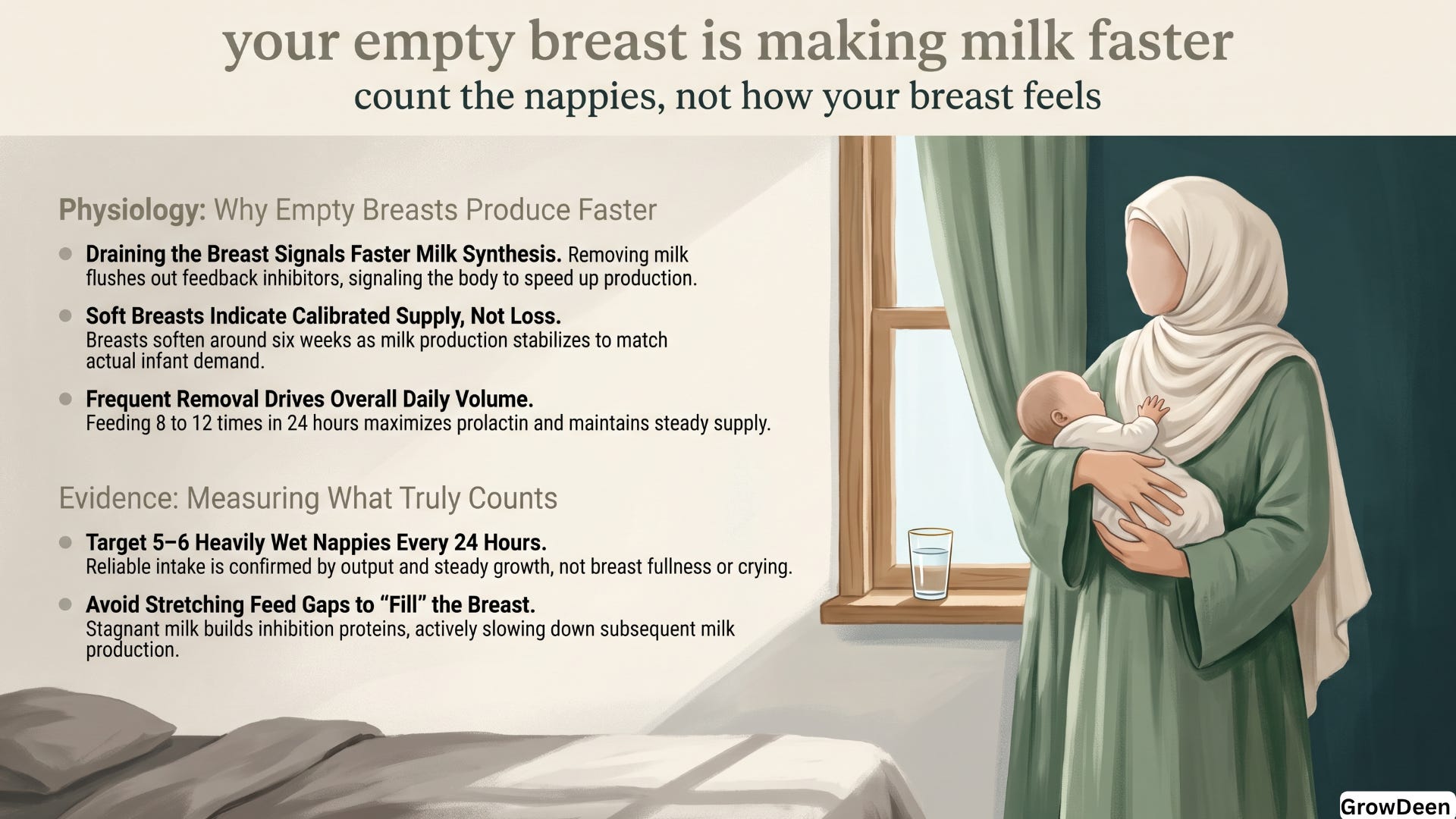
What's probably happening: a soft breast is often a working breast. Milk is made as it is removed, so the emptier breast refills.
Try tonight (1 minute): write down two numbers for the last 24 hours: wet diapers and feeds. Then compare them with the targets in this guide.
You'll know it's working when: after day 5, you count 5+ heavy wet diapers a day and steady gain.
Get help if: there are fewer wet diapers, or no return to birth weight by 2 weeks. Painful feeding counts too. Start with your baby's doctor, a child health nurse or a lactation consultant.
The rest of this guide explains why, and what to do next.
How to Read This Guide
3 minutes: The Short Answer above is enough for tonight.
7 minutes: The Short Answer, then Knowledge in Practice and If Things Don't Go to Plan.
The whole guide: read on for the scientific research, the Qur'an and Sunnah, and the References.
To share: the bold lines and the pull quotes are made to be shared.
To listen: open this guide in the free Substack app and tap Listen.
Inside This Guide
A soft breast is not an empty one. Count the diapers, not how your breast feels.
Myth Check: "Wait So the Breast Can Fill Up"
Many mothers are told to space feeds out, so the breast has time to fill.
What this belief gets right. Milk is made between feeds, and a rest can feel good. You are right to want to protect your supply.
What the evidence says. The breast is not a jug that fills on a timer. In Australian studies of how milk is made, the breast responded to how well it was emptied at each feed. [1]
Animal studies found a protein in milk that slows milk-making when milk stays in the breast. It is called the feedback inhibitor of lactation. [2] When milk is removed, more is made.
So spacing feeds can work against you. More milk out, more often, usually means more milk made.
Why This Happens
Why does my breast feel soft and empty?
After the early weeks, many mothers notice their breasts no longer feel full. This often happens because supply has settled to match what the baby takes.
A softer breast is not an empty breast. Milk is still being made, and it is made fastest when milk has been removed.
Why does my baby want to feed so often?
Breasts differ in how much milk they can store between feeds. A mother with less storage space may need to feed more often to give the same amount. [1]
In one study of 71 babies aged 1 to 6 months, feeds ranged from 6 to 18 a day. The number of feeds was not related to how much milk the mother made in 24 hours. [3]
So a baby who feeds often is not proof of low supply. It can be how your body and your baby work together.
Why do feeds get shorter as my baby grows?
Between 1 and 3 months, babies in one study fed less often, but took more at each feed. Feeds grew shorter, and the total milk taken in a day stayed the same. [4]
Babies get more efficient. Shorter feeds can look like less milk, when the baby is feeding faster.
Shorter feeds often mean a faster baby, not less milk.
What the Scientific Research Shows
The most useful finding is about worry itself. In a US study of 1,177 mothers, about 60% of those who stopped breastfeeding did so earlier than they wanted. [5]
Stopping early was linked with concerns about difficulties with breastfeeding, and about the baby's nutrition and weight. [5]
Who was studied: 1,177 US mothers aged 18 and over, surveyed monthly until their baby turned 1 · ethnicity and additional needs: not given in the study summary.
How strong this is: Suggestive. A large study that followed mothers for a year. It shows a link, not a cause.
Australian studies give a picture of normal. Babies fed 6 to 18 times a day, and night feeds were common and added a lot to the day's milk. [3] Babies became more efficient between 1 and 3 months. [4]
Who was studied: healthy, exclusively breastfed babies in Australia and their mothers · ethnicity and additional needs: not given in the study summary.
How strong this is: Suggestive. Careful measurements in small groups.
For skin-to-skin contact after birth, a Cochrane review of trials found mothers were more likely to still be breastfeeding at 1 to 4 months. The evidence was of moderate quality. [6]
How strong this is: Suggestive. A review of many trials in 21 countries, though most were small.
What does not help as much as hoped? A review of herbal and medicine galactagogues found the evidence too uncertain to rely on. [7] For drinking extra fluids, no randomized trials were found. [8]
What we do not know yet: few of these studies included Muslim mothers. None looked at fasting or extended-family support.
What this means for you: count your baby's diapers and weight. Feed often, day and night. Before buying anything, get a whole feed checked.
What the Qur'an and Sunnah Teach
A mother counting diapers at 3am is often carrying a harder belief: that her body alone has been singled out to fail.
وَإِن مِّن شَىْءٍ إِلَّا عِندَنَا خَزَآئِنُهُۥ وَمَا نُنَزِّلُهُۥٓ إِلَّا بِقَدَرٍ مَّعْلُومٍ
And there is not a thing but that with Us are its depositories, and We do not send it down except according to a known [i.e., specified] measure.
Al-Hijr 15:21 · Sahih International [9]
Text. Ibn Kathir explains that Allah owns all things and holds the supplies for them. He sends them down as He wills, out of wisdom and mercy. Ibn Kathir reports that Abdullah said no year has more rain than another, but Allah divides the rain as He wills. [10]
The verse speaks of provision in general, not of milk. We take a principle from it.
Our reflection. Your milk is provision too. It is not a verdict on you. Take the means, and trust the One who holds the stores.
All of you are hungry except for those I have fed, so seek food of Me and I shall feed you.
Sahih Muslim 2577a · sunnah.com [11]
Text. Abu Dharr reported these words from the Prophet ﷺ, who related them from Allah. [11]
Our reflection. Asking belongs inside the practical work. Feed the baby, book the appointment, and ask the One who feeds.
Allah also named the term of nursing, and the limit that comes with it. "Mothers may nurse their children two complete years for whoever wishes to complete the nursing [period]... No person is charged with more than his capacity." (Al-Baqarah 2:233) [12]
Our reflection. The same verse that names two years also names your capacity. If you need help or a supplement for your baby, you have not failed the verse. The limit is inside the instruction.
Your milk is provision. It was never a verdict on you.
The Lab Verdict
The science: milk is made as it is removed, normal feeding patterns vary widely, and worry about supply is linked with stopping early. (Suggestive; Early for the protein, from animal studies)
The Qur'an and authentic Sunnah: provision comes by a measure Allah sets, and we ask Him for it. Nursing for two years is named, and no soul is charged beyond its capacity.
Where they meet: the science tells you what to measure and do. The Qur'an and Sunnah tell you who holds the outcome. Neither proves the other.
So at home: count, feed often, get the latch checked, and ask Allah.
Knowledge in Practice: Count, Then Feed More Often
Knowing how milk is made is half the work. Knowledge bears fruit only when it reaches your kitchen table.
If you can only do one thing, do step 1. It is enough.
1. Count for one full day before you change anything (1 minute at each feed). Tick each feed, each wet diaper and each stool. After day 5, look for at least 5 heavy wet disposable diapers (or 6 to 8 cloth) in 24 hours, with pale urine. [13]
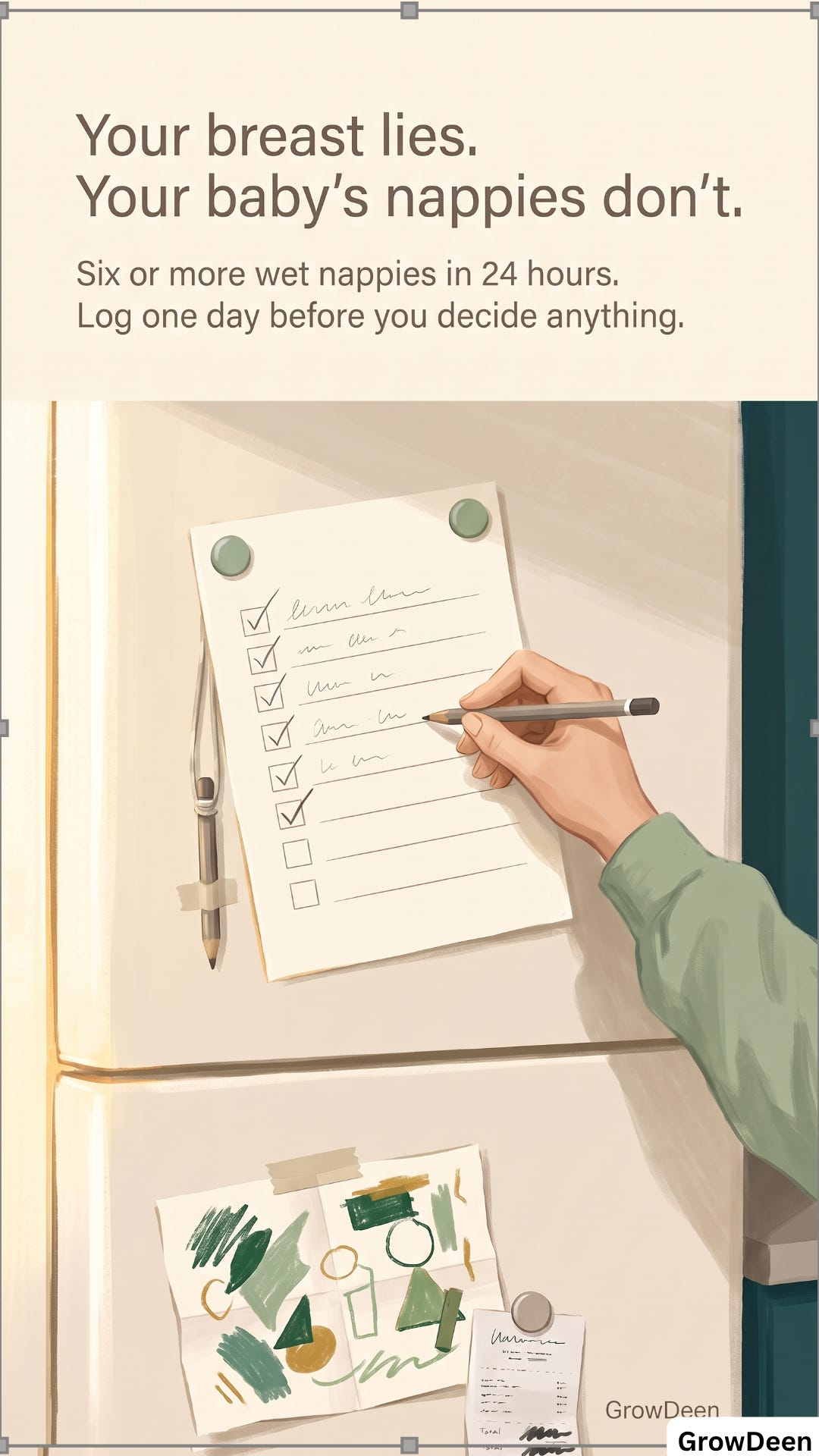
Say this to yourself: "Numbers first. I'll decide tomorrow, with a full day in front of me."
Also check: at least 3 soft yellow stools a day from day 5, with fewer after 6 weeks. Your baby should be back to birth weight by about 2 weeks, and seem alert and content between feeds. [13]
Instead of: "My breast feels empty, so she can't be getting enough." Try: "Her diapers say she is."
2. Feed 8 to 12 times in 24 hours (all day). This is a normal range for a young baby. [13] Feed when your baby shows hunger, day and night, rather than by the clock. [3]
Say this: "She's hungry again. That's normal. Let's feed."
3. Keep the night feeds (each night). Night feeds are common and add a lot to a baby's daily milk. [3] Dropping them too early removes milk your breast needs to be asked for.
4. Get a whole feed watched (once, this week). Breastfeeding difficulties are among the concerns linked with stopping early. [5] A baby who is not well attached takes less milk, and milk left in the breast slows supply. [2]
Ask a lactation consultant, a child health nurse or your midwife to watch a whole feed. Pain, cracked or bleeding nipples are a reason to ask today.
Say this to the nurse: "Can you watch a whole feed? I want to check the latch before I try anything else."
5. Hold your baby skin to skin (20 minutes, once a day). Undress your baby to the diaper and lay her on your bare chest, with a blanket over you both. Early skin-to-skin contact is linked with breastfeeding for longer. [6]
6. Make the feed calm (every feed). Sit with your back supported, water within reach and your phone face down. Many Muslim mothers say Bismillah as the baby latches. Beginning good acts with Allah's name is a widely held practice; no special du'a for feeding is required.
Make It Work in Your Home
No one to help at night? Set up water, a snack and a lamp by your feeding chair before you sleep.
Living with family? Ask one person to take over a chore, not the baby. Protect the time you feed.
Going back to work? Ask your nurse or lactation consultant about expressing before you return.
Twins, or a baby in hospital care? Ask for specialist feeding support early. These situations need a plan made with you.
Say this to your husband: "Can you take the dishes and bring me water at night feeds? It helps my milk more than anything we could buy."
Say this to your mother or mother-in-law: "Ammi, the nurse says feeding often is what makes more milk. Could you help with the cooking so I can feed her when she asks?"
The family question: ask your mother, "When you were feeding us, who helped you most, and how?"
Try It Seven Times
Any seven days in the next two weeks, fill in the day's diaper and feed count. Seven is a starting goal, not a magic number.
Tell us in the comments what surprised you about your numbers. We'd love to know.
Count first, then feed more often: numbers, not feelings, tell you about your milk.
If Things Don't Go to Plan
If your numbers are good but you still feel low: trust the numbers, and tell your nurse how you feel. Worry is real, and it deserves support.
If your numbers are low: see your baby's doctor or a child health nurse today. Keep feeding often in the meantime.
If you need to give formula or expressed milk: that is a medical decision, not a failure. Ask how to do it in a way that protects your supply.
If feeding hurts: stop and get help. Pain, cracked nipples, or a hot, red, painful area on the breast need checking soon, with or without fever.
If you start doubting yourself: Is my body failing my baby? Most often, the numbers show it isn't. If they don't, there is help, and asking for it is part of taking the means.
If you dread feeds or cry through them: tell your doctor or nurse. How you feel matters as much as your milk.
Speak to someone if: your baby still has dark green-black stools at day 5, or isn't back to birth weight by about 2 weeks. The same goes for fewer wet diapers than the targets above, or a baby who seems unwell. [13]
Signs are clearer looking back. Seeing them late is not neglect.
For questions of deen (the way of life of Islam), ask your local imam or a local scholar, and share the details with him.
Who to turn to: your baby's doctor or pediatrician, a child health nurse or midwife, or a lactation consultant. In an emergency, call your local emergency number.
Support Muslim Parenting Lab ❤️
Would you like a small amount of yours grown into something enormous? Give what you can spare with the button below.
The Prophet ﷺ said Allah grows a charity the size of a date until it is like a mountain. (Sahih al-Bukhari 1410)
Your Companion Pack: The Supply Check Pack
Free to download. One PDF, three printable pages, made for the fridge door and the chair where you feed:
The 24-Hour Supply Log: tick boxes for one day of feeds, wet diapers and stools. It shows the targets and when to book an appointment.
What Raises Supply, What Lowers It: a two-column card, with an eight-step plan for the next 72 hours.
The Measure Already Set: a reflection page on Al-Hijr 15:21 and Sahih Muslim 2577a, for the nights when counting is not the hard part.
Parents Also Ask
How do I know if my baby is getting enough breast milk?
Count diapers and check weight. From day 5, look for at least 5 heavy wet disposable diapers (6 to 8 cloth) and 3 soft stools a day. Your baby should be back to birth weight by about 2 weeks. [13]
Why do my breasts feel soft? Have I lost my milk?
Usually not. Milk is made as it is removed, so a softer breast is often a working breast. [1] Check your baby's diapers and weight to be sure.
How often should a newborn breastfeed?
Feeding 8 to 12 times in 24 hours is normal. [13] Feed on demand, day and night, rather than by the clock. [3]
Do lactation cookies, fenugreek or supplements increase milk supply?
The evidence is weak. A Cochrane review found the evidence for galactagogues too uncertain to rely on. [7] Nothing works as well as removing milk often and well.
Does drinking more water increase breast milk?
There is no good evidence that it does. A Cochrane review found no randomized trials of extra fluids. [8] Drink to thirst.
How long does Islam say to breastfeed?
Text and our reflection. The Qur'an names two complete years for those who wish to complete nursing (Al-Baqarah 2:233). It adds that no soul is charged beyond its capacity. [12] WHO and the American Academy of Pediatrics also support breastfeeding to 2 years or beyond. [14,15]
When should I see a doctor about low milk supply?
See a doctor or nurse if wet diapers are below the targets, or your baby isn't back to birth weight by 2 weeks. Painful feeding counts too. [13]
Final Reflection
Dear mother,
You are awake at 2am, counting and worrying, because you want to feed your baby well. That care is already worship when it is done for Allah.
If you have been spacing feeds or watching the clock, you were doing your best with what you were told. You can change it from tonight.
You don't need to fix everything this week. Tonight, write down two numbers. Let that be enough.
Allah holds the stores of every provision, and He knows what you carry.
An empty breast makes milk fastest. Allah already set the measure.
A Du'a for This
For you:
رَبَّنَا وَلَا تُحَمِّلْنَا مَا لَا طَاقَةَ لَنَا بِهِۦ
Rabbanā wa lā tuḥammilnā mā lā ṭāqata lanā bih
"Our Lord, and burden us not with that which we have no ability to bear."
Al-Baqarah 2:286 · Sahih International [16]
With your baby: say Bismillah softly as your baby latches, and ask Allah for barakah in what you give her, in your own words.
Share the Khayr
If you know a new mother who has gone quiet since her baby came, send this to her. It may also help the friend who said she is "topping up a bit". The Prophet ﷺ said that one who guides to something good has a reward similar to that of its doer (Sahih Muslim 1893a). [17]
Tell us in the comments: what helped you most in the early weeks of feeding? We'd love to know.
Parents Also Read
Parents who read this guide also found these helpful.


References
[1] Daly, S. E. J., & Hartmann, P. E. (1995). Infant demand and milk supply. Part 2: The short-term control of milk synthesis in lactating women. Journal of Human Lactation, 11(1), 27–37. (Australia · Suggestive)
[2] Wilde, C. J., Addey, C. V., Boddy, L. M., & Peaker, M. (1995). Autocrine regulation of milk secretion by a protein in milk. Biochemical Journal, 305(1), 51–58. (Animal study · Early)
[3] Kent, J. C., Mitoulas, L. R., Cregan, M. D., Ramsay, D. T., Doherty, D. A., & Hartmann, P. E. (2006). Volume and frequency of breastfeedings and fat content of breast milk throughout the day. Pediatrics, 117(3), e387–e395. (Australia · Suggestive)
[4] Kent, J. C., Hepworth, A. R., Sherriff, J. L., Cox, D. B., Mitoulas, L. R., & Hartmann, P. E. (2013). Longitudinal changes in breastfeeding patterns from 1 to 6 months of lactation. Breastfeeding Medicine, 8(4), 401–407. (Australia · Suggestive)
[5] Odom, E. C., Li, R., Scanlon, K. S., Perrine, C. G., & Grummer-Strawn, L. (2013). Reasons for earlier than desired cessation of breastfeeding. Pediatrics, 131(3), e726–e732. (US · Suggestive)
[6] Moore, E. R., Bergman, N., Anderson, G. C., & Medley, N. (2016). Early skin-to-skin contact for mothers and their healthy newborn infants. Cochrane Database of Systematic Reviews, 11, CD003519. (21 countries · Suggestive)
[7] Foong, S. C., Tan, M. L., Foong, W. C., Marasco, L. A., Ho, J. J., & Ong, J. H. (2020). Oral galactagogues (natural therapies or drugs) for increasing breast milk production in mothers of non-hospitalised term infants. Cochrane Database of Systematic Reviews, 5, CD011505. (At least 17 countries · Early)
[8] Ndikom, C. M., Fawole, B., & Ilesanmi, R. E. (2014). Extra fluids for breastfeeding mothers for increasing milk production. Cochrane Database of Systematic Reviews, 6, CD008758. (Review · Early)
[9] Qur'an, Al-Hijr 15:21. Translation: Sahih International.
[10] Tafsir Ibn Kathir on Al-Hijr 15:21.
[11] Sahih Muslim 2577a.
[12] Qur'an, Al-Baqarah 2:233. Translation: Sahih International.
[13] Children's Health Queensland (n.d.). Is my baby getting enough breast milk? Queensland Government, Australia. (Australia · Strong)
[14] World Health Organization (n.d.). Infant and young child feeding. Fact sheet. (International · Strong)
[15] Meek, J. Y., Noble, L., & Section on Breastfeeding (2022). Policy Statement: Breastfeeding and the Use of Human Milk. Pediatrics, 150(1), e2022057988. (US · Strong)
[16] Qur'an, Al-Baqarah 2:286. Translation: Sahih International.
[17] Sahih Muslim 1893a.
We combine scientific research with Qur’an and authentic Sunnah, and we cite our sources. Even so, this is general guidance and no substitute for a doctor who can examine your child.
Sources & confidence
The hadith in this guide are from Sahih Muslim. The Qur'an verses are quoted from Sahih International. Checked October 2026. Found a source that looks wrong? Email us at info@growdeen.com.
Words in this guide
du'a (doa): supplication
deen: the way of life of Islam
khayr: good
barakah: blessing from Allah
Bismillah: "In the name of Allah"
Sunnah: the teachings and practice of the Prophet ﷺ
milk supply: how much breast milk a mother makes
latch: how the baby attaches to the breast
galactagogue: a herb, food or medicine taken to increase milk
lactation consultant: a professional trained to help with breastfeeding
skin-to-skin contact: holding your baby, undressed, on your bare chest
diaper (nappy)
pediatrician (paediatrician)