

Doing the corrected-age sum in your head at every checkup? The free Corrected Age Card does it once. It adds the words to say before the chart comes out.

AGES 0–3 YEARS · 16 MIN READ
The nurse turns the growth chart toward you. Her finger lands on a line. Your daughter's dot sits well below it.
Six months on the calendar. Not sitting yet. You told them she came early. The word monitoring still comes.
I told them she came ten weeks early. Why does it still feel like she's failing a test?
Nobody in that room is doing anything wrong, and neither are you. The chart is accurate. The nurse is careful. One number is missing from the conversation.
This guide brings together scientific research and the Qur'an and authentic Sunnah. You'll see which date each question uses, and the words to say at the next checkup.
The Short Answer
Right for your child? Babies and toddlers born before 37 weeks, up to about age 2. Born before 32 weeks? Up to age 3 for growth.
What's probably happening: the chart is counting from the birth date. Growth and milestones are judged from the due date instead.
Keep safe: vaccines follow the birth date, on the usual schedule. Don't delay them for corrected age.
Try tonight (5 minutes): write down the due date, birth date and weeks early. Subtract those weeks from your baby's age.
You'll know it's working when: the next checkup starts with both ages on the table. Two different answers are not a failure.
Get help if: a skill disappears, or milestones lag at corrected age: see your baby's doctor or pediatrician. Breathing trouble, fever, hard waking or far less feeding: get urgent medical care.
The rest of this guide explains why, and what to do if it does not work.
How to Read This Guide
3 minutes: The Short Answer above is enough for tonight.
7 minutes: The Short Answer, then Knowledge in Practice and If Things Don't Go to Plan.
The whole guide: read on for the scientific research, the Qur'an and Sunnah, and the References.
To share: the bold lines and the pull quotes are made to be shared.
To listen: open this guide in the free Substack app and tap Listen.
Inside This Guide
A baby born early has two dates. Every chart deserves to know both.
Myth Check: "A Small Baby Should Wait for Vaccines"
What it gets right. Wanting to shield a tiny baby is a loving instinct. Many parents wonder whether a small body should wait until it looks bigger.
What the evidence says. In most cases, babies born before 37 weeks get vaccines at the same chronological age as babies born on time. [1] They follow the same schedule, whatever their birth weight. [1] Birth weight and size are not reasons to delay vaccines for a baby who is medically stable. [1]
The one common exception. It is hepatitis B, for babies under 2,000 grams (about 4.4 pounds). If the mother tested negative, the first dose comes at 1 month old or at hospital discharge, whichever is first. [1] A baby whose mother tested positive, or whose status is unknown, follows a different plan within 12 hours of birth. [1]
So: vaccines run on the birth date. Your baby's doctor will tell you about any change for your baby.
Why This Happens
Any birth before 37 completed weeks is preterm. Under 28 weeks is extremely preterm, and 32 to 37 weeks is moderate to late preterm. Births from 28 to under 32 weeks fall between the two. [2]
What is corrected age, and how do I work it out?
Corrected age, also called adjusted age, counts your baby's development from the due date instead of the birth date. Take your baby's age in weeks since birth, then subtract the weeks they came early. [3]
To find the weeks early, subtract the weeks of pregnancy at birth from 40. [3] A baby born at 32 weeks came 8 weeks early. At 16 weeks old (4 months), her corrected age is 2 months. [3] So expect the skills of a 2-month-old, such as starting to hold her head up and smile. [3]
Before the due date, the sum runs the other way. Add the weeks since birth to the weeks of pregnancy at birth. A baby born at 30 weeks who is now 8 weeks old is at 38 weeks. She has not reached her due date yet. Nothing is late.
Why can one baby look underweight and healthy at once?
A growth chart compares your baby with babies born on time. Plot a 10-week-old born at 30 weeks by her birth date. She now stands beside babies who had 10 more weeks of growing in the womb.
Plot her by her due date, and she stands beside babies at her own stage. That is why weight, length and head circumference are plotted at corrected age in the early years. [4] One baby and one weight can get two different verdicts. The only thing that changed is the date the chart started from.
Which questions use the birth date, and which use the due date?
The birth date: vaccines and the vaccine schedule [1], forms and records, and birthdays, every year. In a Muslim family, the seventh day also counts from the birth. That covers the aqiqah (the sacrifice for a newborn), the shaving of the head and the naming. [5]
The due date: milestones such as rolling, sitting, babbling and walking, the first social smiles, and growth. [3,4,6] When a professional asks whether your baby does something yet, corrected age is the fair frame. [6]
Solids use both clocks. One official guide for preterm babies says 3 months corrected age is the earliest time to consider solids. It also says to talk to your doctor if your baby shows no signs of readiness by 7 months after birth. [7] So ask your team which age and which signs they want you to watch.
Often it isn't your baby who is behind. It's the date the chart started from.
What the Scientific Research Shows
A Canadian study plotted the same measurements of 1,416 babies born before 32 weeks twice: once by corrected age and once by calendar age. [4] At term, calendar age labeled up to 72.9% of them stunted and up to 89.8% underweight. [4] Calendar-age scores stayed lower than corrected-age scores at every check, out to 36 months. [4] The authors conclude that babies born before 32 weeks need age correction for all growth measures through 36 months of corrected age. [4]
Who was studied: babies born before 32 weeks in Calgary and Regina, Canada, between 2001 and 2014, all cared for in neonatal intensive care. Babies with birth anomalies were left out. Ethnicity is not given in the study summary; parents' education was recorded. No study here has tested this with Muslim families.
How strong this is: Suggestive. One large, well-measured group of babies, followed to age 3.
How long to keep correcting. The American Academy of Pediatrics (AAP) advises using adjusted age to track development until age 2. [6] It notes that by 2, most children have caught up to the typical milestone range, and some need extra support for longer. [6] The Canadian authors describe correcting to age 2 as the most common practice. [4] Strong for age 2, as official guidance.
Testing changes the score. In one study of preterm infants assessed from 1 to 36 months, calendar-age scores flagged significantly more babies as delayed than corrected-age scores. [8] Country, income and additional needs are not given in the study summary. An analysis of published test norms, with no children studied, found a bigger drop from calendar age for babies born earlier. [9] The drop stayed large beyond age 3. [9] Suggestive.
The finding that shows the limits. A population study compared 52,662 preterm and 656,986 term children. [10] Correction closed most gaps for moderate and late preterm children. [10] For children born before 32 weeks, gaps of at least 2 months in motor skills and 1 month in language and social skills remained. [10] The authors say standard correction may underestimate delay in the earliest-born group. [10] Suggestive. Who was studied: children from what the authors call a large and diverse population; the study comes from a research institute in Israel. Income and additional needs are not given in the study summary.
What we do not know yet: whether correcting past age 3 helps, and how these findings hold in other countries and in Muslim families.
What this means for you: correct by default and ask for both scores. If your baby came before 32 weeks and something still looks off at corrected age, say so.
What the Qur'an and Sunnah Teach
The comparing often hurts more than the appointments. The group chat. The baby at the masjid born the same week who seems weeks ahead.
هُوَ ٱلَّذِى يُصَوِّرُكُمْ فِى ٱلْأَرْحَامِ كَيْفَ يَشَآءُ
It is He who forms you in the wombs however He wills.
Ali 'Imran 3:6 · Sahih International [11]
Text. Ibn Kathir links this verse to the one on creation "in three veils of darkness" (Az-Zumar 39:6). [12] His explanation reads: "He creates you in the wombs as He wills, whether male or female, handsome or otherwise, happy or miserable." [12]
Our reflection. Your child was formed where no parent could watch, by a will no parent shares. A pace given to another baby was never the measure set for yours.
The Prophet ﷺ said: "A boy is in pledge for his Aqiqah, Sacrifice is made for him on the seventh day, his head is shaved and he is given name."
Sunan Abi Dawud 2838 · Sahih (Al-Albani) · sunnah.com [5]
Text. The sacrifice, the shaving and the naming fall on the child's seventh day.
Our reflection. The seventh day is counted from the day your child arrived, not from the due date. Your child's days in Islam begin at birth, while medicine judges growth from the due date. Both can hold at once, with no contradiction.
If a hospital stay makes the seventh day hard to keep, ask your local imam or a local scholar, and share the details with him.
Islam counts your child's days from the day they arrived. Medicine counts their growing from the day they were due.
The Lab Verdict
The science: babies born early are judged most fairly when growth and milestones use corrected age. That holds to age 2 (Strong), and for growth to age 3 if born before 32 weeks (Suggestive). Correction may not close every gap for the earliest-born babies (Suggestive).
The Qur'an and authentic Sunnah: Allah forms each child in the womb as He wills. The Sunnah counts a newborn's seventh day from the birth.
Where they meet: the science gives each question its right clock, and the Sunnah gives the calm to stop measuring one child against another. They meet in patience with each child's own pace.
So at home: use the birth date for vaccines and the seventh day, and the due date for growth and milestones.
Knowledge in Practice: Two Dates, One Card
Knowing why the chart looks wrong is half the work. The other half happens at the next checkup, and at home tonight.
If you can only do one thing, do step 1. It is enough.
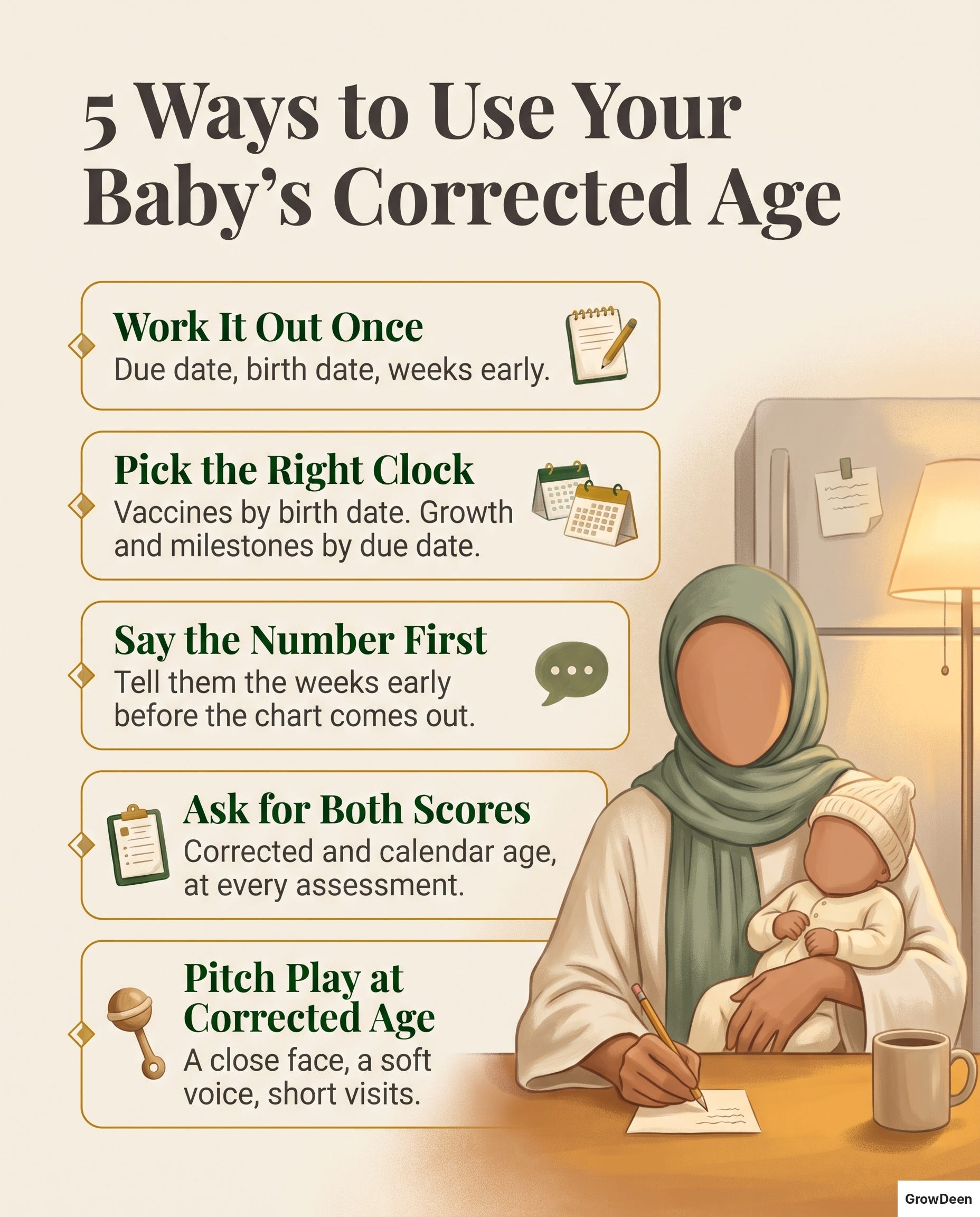
1. Work out the corrected age once (5 minutes). Write three things where you will see them: the due date, the birth date and the weeks early. The third number never changes. It is the only number you subtract.
Say this (to your spouse, or to yourself): "She came ten weeks early. Ten is our number." (Say it in the language your family speaks at home.)
Under 2 months corrected: count in weeks. After that: months are fine; the AAP's tables count a month as 4 weeks. [6]
2. Put each question on its clock (1 minute). Vaccines, forms, birthdays and the seventh day go on the birth date. Growth and milestones go on the due date. Solids: ask which age the team uses.
Instead of: "Is she behind for six months?" Try: "What should a baby of her corrected age be doing?"
3. Say the number before the chart comes out (10 seconds). Give two facts: your baby was born early, and how many weeks early. The weeks are the part people can use.
Say this to the doctor or nurse: "She was born ten weeks early, so her corrected age is four months. Could we read the chart against that?"
At every assessment, ask two questions:
"Are these results scored at her corrected age, her chronological age, or both?"
"Could I please see both scores before we decide anything?"
A result that reads as concerning on one age can read as ordinary on the other.
If someone says "delayed" and your baby is on track for corrected age: "On her corrected age she's right where she should be. We're watching it with her doctor."
4. Pitch care and play at corrected age (10 minutes). The World Health Organization (WHO) advises skin-to-skin contact for small and preterm babies immediately after birth, without a first period in an incubator. [13] Ask your team what is possible today.
A baby at 2 months corrected age wants a close face, a soft voice and short visits. Recite a little Qur'an quietly while you hold them. Say Bismillah before a feed and salaam as you walk in. When your baby looks away or goes still, let them rest.
Under 3 months corrected: short visits, often. 1 to 3 years corrected: name what your child does, and share a picture book.
Make It Work in Your Home
On your own, or on the night shift? Save the three numbers in your phone's notes. Whoever goes to the checkup can read them out.
No printer? A sticky note on the fridge with the three numbers does the same job.
Say this to Grandma: "Mama, you've raised babies, so you'll see it. He's doing exactly what a baby due in March should be doing."
Say this to the daycare or preschool teacher: "He was born twelve weeks early. It helps to know that when you're looking at what he can manage."
Preschool and school usually go by the birth date. Some families delay school entry when a child's corrected age falls a little under the cutoff. Talk it through with your child's doctor and the school first, and ask for both scores if your child is assessed.
The family question: ask your spouse or your mother, "Who will come with us to the next checkup and hold the card?"
Three numbers, two clocks and one sentence before the chart: that is the whole practice.
If Things Don't Go to Plan
If the clinician still uses calendar age: ask the two questions again, kindly. Ask for the corrected age to be noted in the record.
If your baby is behind even at corrected age: that is worth a conversation, especially if your baby came before 32 weeks. [10] Ask your baby's doctor about early intervention, the extra support some babies receive. [6]
If you start doubting yourself: Did something I did make her come early, or fall behind? Coming early is not a verdict on your care. You are doing the work by asking.
If the comparing gets loud: mute the group chat for a season. Read the verse on page 3 of the pack.
Speak to someone if:
a skill your child had disappears
milestones are not reached even at corrected age
feeding stays difficult week after week
you have any worry about hearing or vision
muscles seem unusually stiff or unusually floppy
your own instinct says something is off
Signs are clearer looking back. Seeing them late is not neglect.
And you? Weeks in neonatal care are hard on parents. If you feel low or anxious, tell your own doctor. WHO's guidance includes emotional support for families of small and preterm babies. [13]
Who to turn to: your baby's doctor or pediatrician. In an emergency, call your local emergency number.
Support Muslim Parenting Lab ❤️
Think your amount is too small to matter? Give whatever you have with the button below.
The Prophet ﷺ said to shield yourself from the Fire even with half a date. (Sahih al-Bukhari 1417)
Your Companion Pack: Corrected Age Card
Free to download. It does the sum once, so you never do it in a corridor again. Three pages:
Page 1, Your Corrected Age, Worked Out Once: a fill-in panel for the due date, birth date and weeks early. A table converts calendar age to corrected age, from 2 to 18 months and 4 to 16 weeks early. A split shows what counts from the birth date and what counts from the due date.
Page 2, What to Say, and When to Say It: four scripts, for the health check, daycare or school, relatives, and when someone says "delayed". It adds the two questions for every assessment and the signs to raise whatever the corrected age says.
Page 3, For the Days the Comparing Gets Loud: Ali 'Imran 3:6 with Ibn Kathir's explanation, and why your child has two dates. It ends with three things to do when the comparing starts.
Parents Also Ask
How do you calculate corrected age for a premature baby?
Take your baby's age in weeks since birth and subtract the weeks they were born early. [3] To find the weeks early, subtract the weeks of pregnancy at birth from 40. [3] A 4-month-old born at 32 weeks has a corrected age of 2 months. Why This Happens has more.
How long do you use corrected age?
The AAP advises using adjusted age to track development until age 2. [6] For growth, a 2025 study of babies born before 32 weeks found correction was needed through 36 months. [4] Ask your baby's doctor which age they plan to use, and until when.
Do premature babies get vaccines at their corrected age?
No. In most cases, they are vaccinated at the same chronological age and on the same schedule as babies born on time, whatever their birth weight. [1] The common exception is the first hepatitis B dose for babies under 2,000 grams. [1]
When should a premature baby sit up?
Judge it against corrected age. The AAP lists sitting briefly without support at about 6 months and sitting well at about 9 months, for adjusted age. [6] A baby born ten weeks early who sits at eight months on the calendar is sitting at about five and a half months corrected. If sitting is late even for corrected age, raise it with your baby's doctor.
When do premature babies catch up?
The AAP says most children have caught up to the typical milestone range by age 2, and some need support for longer. [6] Babies born before 32 weeks may keep small gaps even after correction. [10]
When should a premature baby start solids?
It depends on both ages and on readiness signs. One official guide gives 3 months corrected age as the earliest time to consider solids. [7] It says to talk to your doctor if there are no signs of readiness by 7 months after birth. [7] Ask your team which signs to watch for.
Do you celebrate a preemie's birthday on the birth date or the due date?
The birth date, every year. Your child's birthday, forms and vaccines all run from the day they arrived.
Final Reflection
Dear parent,
You read this far to understand a number, not to be soothed. That care is already reaching your child.
If the calendar age has worried you, you were reading the chart you were given. Coming early is not a verdict on you, or on your baby.
You don't need to fix every appointment this week. Write the three numbers down tonight, and let that be enough. Make the intention that each checkup serves your child. Allah sees the effort nobody else notices.
Often, the wrong date made your baby look underweight. Bring both dates to every checkup.
A Du'a for This
For you:
رَبَّنَا هَبْ لَنَا مِنْ أَزْوَٰجِنَا وَذُرِّيَّـٰتِنَا قُرَّةَ أَعْيُنٍ وَٱجْعَلْنَا لِلْمُتَّقِينَ إِمَامًا
Rabbanā hab lanā min azwājinā wa dhurriyyātinā qurrata a'yunin waj'alnā lil-muttaqīna imāmā
"Our Lord, grant us from among our wives and offspring comfort to our eyes and make us an example for the righteous."
Al-Furqan 25:74 · Sahih International [14]
With your child: Bismillah, "In the name of Allah." The Prophet ﷺ taught a boy in his care, "O boy! Mention the Name of Allah" before eating (Sahih al-Bukhari 5376). [15] Say it over your baby before each feed, from the first one.
Share the Khayr
If you know a parent whose baby came early, and who goes quiet when milestones come up, send this to them. The Prophet ﷺ said that one who guides to something good has a reward similar to that of its doer. [16]
Tell us in the comments: what did your baby do that suddenly made sense once you counted from the due date? We'd love to know.
Parents Also Read
Parents who read this guide also found these helpful.


References
[1] Centers for Disease Control and Prevention. (n.d.). Special Situations: General Best Practice Guidelines for Immunization. CDC.
[2] World Health Organization. (2023). Preterm birth. WHO fact sheet.
[3] American Academy of Pediatrics. (2018). Corrected Age For Preemies. HealthyChildren.org.
[4] Elmrayed, S., Dai, S., Lodha, A., Kumar, M., & Fenton, T. R. (2025). Preterm growth assessment: the latest findings on age correction. Journal of Perinatology, 45(5), 607–615.
[5] Sunan Abi Dawud 2838. Graded: Sahih, by Al-Albani.
[6] American Academy of Pediatrics. (2024). Your Preemie's Growth & Developmental Milestones. HealthyChildren.org.
[7] Queensland Health. (n.d.). Starting Solids for Preterm Babies. My Nutrition.
[8] Harel-Gadassi, A., Friedlander, E., Yaari, M., Bar-Oz, B., Eventov-Friedman, S., Mankuta, D., & Yirmiya, N. (2018). Developmental assessment of preterm infants: Chronological or corrected age? Research in Developmental Disabilities, 80, 35–43.
[9] Wilson-Ching, M., Pascoe, L., Doyle, L. W., & Anderson, P. J. (2014). Effects of correcting for prematurity on cognitive test scores in childhood. Journal of Paediatrics and Child Health, 50(3), 182–188.
[10] Goldshtein, I., Amit, G., Avgil Tsadok, M., Baruch, R., Zimmerman, D. R., Akiva, P., Yardeni, H., & Sadaka, Y. (2025). Age-corrected development of preterm children: a population-based study. Pediatric Research, 97(3), 1001–1008.
[11] Qur'an, Ali 'Imran 3:6. Translation: Sahih International.
[12] Tafsir Ibn Kathir on Ali 'Imran 3:6.
[13] World Health Organization. (2022). WHO advises immediate skin to skin care for survival of small and preterm babies. WHO news release.
[14] Qur'an, Al-Furqan 25:74. Translation: Sahih International.
[15] Sahih al-Bukhari 5376.
[16] Sahih Muslim 1893a.
We combine scientific research with Qur’an and authentic Sunnah, and we cite our sources. Even so, this is general guidance and no substitute for a doctor who can examine your child.
Sources & confidence
The hadith in this guide are from Sahih al-Bukhari, Sahih Muslim and Sunan Abi Dawud (graded Sahih by Al-Albani). Checked October 2026. Found a source that looks wrong? Email us at info@growdeen.com.
Words in this guide
corrected age (adjusted age) (scientific): your baby's age counted from the due date: age since birth minus the weeks born early.
chronological age (calendar age) (scientific): your baby's age counted from the birth date.
preterm (premature, preemie) (scientific): born before 37 completed weeks of pregnancy.
extremely preterm (scientific): born before 28 weeks.
growth chart (scientific): the chart that compares a child's weight, length and head size with other children of the same age.
milestones (scientific): skills most children reach around a certain age, such as rolling, sitting or first words.
neonatal intensive care (NICU) (scientific): the hospital unit for newborns who need extra care.
early intervention (scientific): extra support some babies and children receive to help them develop.
skin-to-skin contact (kangaroo mother care) (scientific): holding your baby bare against your chest.
hepatitis B (scientific): a liver infection; its vaccine is usually the first one a baby gets.
pediatrician (paediatrician) (scientific): a doctor who cares for children.
Allah (Islamic): God, the One Creator.
Qur'an (Islamic): the word of Allah, revealed to the Prophet Muhammad ﷺ.
tafsir (Islamic): an explanation of the meaning of the Qur'an.
Sunnah (Islamic): the teachings and practice of the Prophet Muhammad ﷺ.
hadith (Islamic): a report of what the Prophet ﷺ said or did.
Sahih (Islamic): authentic; the strongest grade scholars give a hadith.
ﷺ (Islamic): a prayer of peace and blessings said after the Prophet Muhammad's name.
aqiqah (Islamic): the sacrifice offered for a newborn, on the seventh day.
Bismillah (Islamic): "In the name of Allah", said before eating or starting something.
salaam (Islamic): the greeting of peace.
du'a (doa) (Islamic): supplication, asking Allah.
masjid (Islamic): mosque.
imam (Islamic): a person who leads the prayer at the masjid, and who can help with questions about Islam.
khayr (Islamic): good.
daycare (nursery) (everyday word): care for young children outside the home.