

Your 4-year-old gets up from quiet time still arguing? The free Quiet Time Script Card puts the exact words, in order, on one page for the fridge.
AGES 3–8 YEARS · 18 MIN READ
It is 6:40pm. You have said it four times.
Shoes off. Shoes off. I said shoes off.
Now your 4-year-old is on the step. You stand beside him and explain why hitting his sister is unkind. He explains back.
Four minutes later he gets up, still arguing. The shoes are still on.
I followed every step, and he still walked off arguing. Why does it work for his mom and not me?
You are not the only parent standing there. Often the method itself is fine. The trouble is a few small seconds inside it.
This guide brings together scientific research and the Qur'an and authentic Sunnah. You'll see where quiet time breaks, what your word is worth, and the script for tonight.
The Short Answer
Right for your child? Ages 3–8 who argue, hit or refuse after one clear instruction. Does your child hurt himself when upset? Read "When Quiet Time Is Not the Right Tool" first.
What's probably happening: quiet time often breaks in three places. Extra warnings, talking during it, or ending it too early. Each one hands your attention back.
Try tonight (2 minutes): pick the quiet spot while everyone is calm. Show your child how it works with a teddy.
You'll know it's working when: he goes with fewer protests, and quiet comes sooner. Shouting in the first few tries is not failure.
Get help if: he often hurts himself or others, or nothing improves with steady use. Start with your child's doctor or pediatrician.
The rest of this guide explains why, and what to do if it does not work.
How to Read This Guide
3 minutes: The Short Answer above is enough for tonight.
7 minutes: The Short Answer, then Knowledge in Practice and If Things Don't Go to Plan.
The whole guide: read on for the scientific research, the Qur'an and Sunnah, and the References.
To share: the bold lines and the pull quotes are made to be shared.
To listen: open this guide in the free Substack app and tap Listen.
Inside This Guide
A warning you keep is a small promise kept. Your child is learning what your word is worth.
Myth Check: "Time Out Harms the Bond With Your Child"
What the worry gets right. It comes from love. Some writers argue that sending a child away can shake his sense of safety. [1]
A child in real distress needs you close, and a consequence can wait. The CDC itself suggests "time-in", staying close and calm, when a child is upset. [2]
What the evidence says. Reviews that weighed these criticisms found time out useful when it is brief, calm and part of warm, positive parenting. [3,1] The harsh responses are the ones linked with harm.
The American Academy of Pediatrics (AAP) says yelling at or shaming children is minimally effective in the short term. In the long term, it is not effective. [4] A large meta-analysis of 160,927 children linked spanking with greater risk in 13 of the 17 outcomes it examined. [5]
So: quiet time is not the danger. The warmth around it, and the minute after it, protect the bond.
Why This Happens
A team in Oregon surveyed 401 parents about time out. The study's lead author, Andrew Riley, said the "classic mistakes" come at the beginning, the middle and the end. [6] Each one is small, and each gives back the thing quiet time takes away.
Why does my first warning stop counting?
Picture the evening. You say it once, and nothing happens. You say it again, louder, and tell yourself you are being patient.
Your child is watching which words lead to action. The CDC warns that if you forget to follow through, your child may stop believing you are serious. [2] So the early words start to feel optional, and the loud one becomes the real one.
Why does explaining make it last longer?
Quiet time works by taking away your attention for a few minutes. [2,7] Think of it as a pause button. Every word you say presses play.
In one version, you crouch by the step and explain why hitting is unkind. Your child gets four minutes of your face and your voice.
In the other, you stand at the sink, close enough to see, saying nothing. Only one of those is a consequence.
Riley told CBC News that the most common mistake was talking too much. [6]
Why does letting him up early backfire?
If he leaves while still shouting, he may learn that shouting ends it. The CDC says your child should be quiet for about five seconds before you say quiet time is over. [2] In the Oregon survey, parents who required calm before ending were more likely to rate time out as working. [8]
Children differ. A child who is ill, overtired, or living through a big change may need a different response first. If Things Don't Go to Plan covers this.
Often, quiet time doesn't fail because it's too gentle. It fails because our words hand the attention back.
What the Scientific Research Shows
The strongest evidence comes from a meta-analysis of 77 published evaluations of parent training programs for children aged 0–7. Programs had larger effects when they taught parents to increase positive time with their child, to use time out, and to be consistent. [9]
How strong this is: Strong. It pools many studies. It shows which program parts went with bigger effects, without testing each part alone.
Who was studied: families in 77 program evaluations. Country, culture, income and additional needs: not given in the study summary.
The Oregon survey shows how far home practice drifts from that evidence. Of 401 parents, about 77 in 100 used time out.
About 85 in 100 of those used it in ways that go against the evidence. Parents who found it effective differed on key steps, such as giving a single warning. [8]
Who was studied: parents at well-child visits in one US city, with children aged 15 months to 10 years. [8,6] Ethnicity, income and additional needs: not given in the study summary.
What was measured: what parents said they did, and whether they felt it worked. How strong this is: Suggestive. One large survey, based on parent reports.
Part of the drift may come from the advice parents find. A study of online guidance concluded that a parent searching the internet will find largely incomplete, inaccurate and inconsistent information on time out. [10] Suggestive.
On length, sources disagree. The CDC suggests one minute for every year of age. [2]
A review of 46 studies found that parenting books, programs and websites often gave strong advice that the evidence did not support. [11] Suggestive (a narrative review). The CDC guidance is from the US, last reviewed April 2026. [2]
What we do not know yet: no study has yet tested this with Muslim families, or with families who live with grandparents.
What this means for you: the steps matter more than the method's name. Warn once, stay silent, end after calm, and keep the warmth high.
What the Qur'an and Sunnah Teach
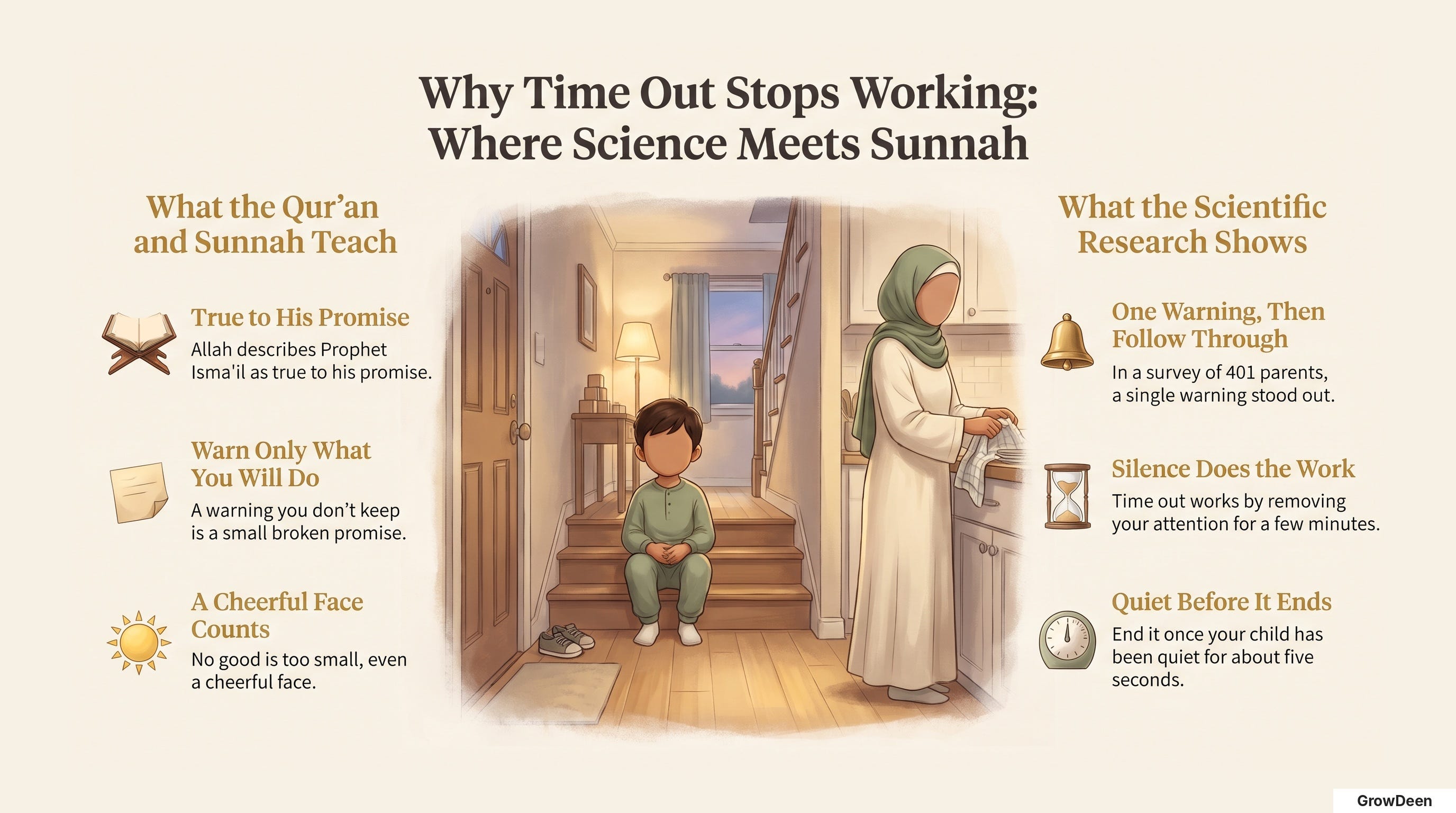
The Qur'an and Sunnah do not speak about time out. They speak, clearly, about two things this method depends on: keeping your word, and the face you show after.
وَٱذْكُرْ فِى ٱلْكِتَـٰبِ إِسْمَـٰعِيلَ ۚ إِنَّهُۥ كَانَ صَادِقَ ٱلْوَعْدِ وَكَانَ رَسُولًا نَّبِيًّا
And mention in the Book, Ishmael. Indeed, he was true to his promise, and he was a messenger and a prophet.
Maryam 19:54 · Sahih International [12]
Text. Allah introduces Prophet Isma'il as true to his promise, before naming him a messenger and a prophet.
What the tafsir (Qur'an commentary) says. Ibn Kathir reports that Ibn Jurayj said Isma'il made no promise to his Lord that he did not fulfill. Ibn Kathir writes that being true to one's promise is a praiseworthy trait, and breaking one is a detested trait. [13]
Our reflection. A warning you do not carry out is a small broken promise. It is made in front of someone who is learning from you what a person's word is worth.
Before you say it, ask whether you are willing to do it. If not, do not say it.
The Prophet ﷺ said to Abu Dharr: "Don't consider anything insignificant out of good things even if it is that you meet your brother with a cheerful countenance."
Sahih Muslim 2626 · sunnah.com [14]
Text. No good deed is too small to count, even meeting someone with a cheerful face.
Our reflection. When quiet time ends, your child may be watching your face to see if the relationship survived it. Handing it back whole is one of those small goods. It costs nothing.
When it is finished, it is finished. Give your face back first, then get on with the evening.
Nothing here asks you to be harsh. Both texts ask the same gentle thing: mean what you say, and come back warm.
A warning you don't keep is a broken promise. A face you don't give back is a bigger one.
The Lab Verdict
The science: quiet time helps most when it is brief, silent, ended after calm, and set inside warm, positive parenting. (Strong for the program parts; Suggestive for the delivery details)
The Qur'an and authentic Sunnah: Allah praises Isma'il as true to his promise, and the Prophet ﷺ taught that a cheerful face is a good deed not to belittle.
Where they meet: the science shows which steps make quiet time work; the Sunnah gives the reason to keep your word and come back warm. They meet in a word that holds and a face that stays warm.
So at home: warn once and keep your word in silence. Give your face back the moment it ends.
Knowledge in Practice: The Quiet Time Script
Knowing where quiet time breaks is half the work. Knowledge bears fruit only when it reaches the hallway.
If you can only do one thing, do step 1. It is enough.
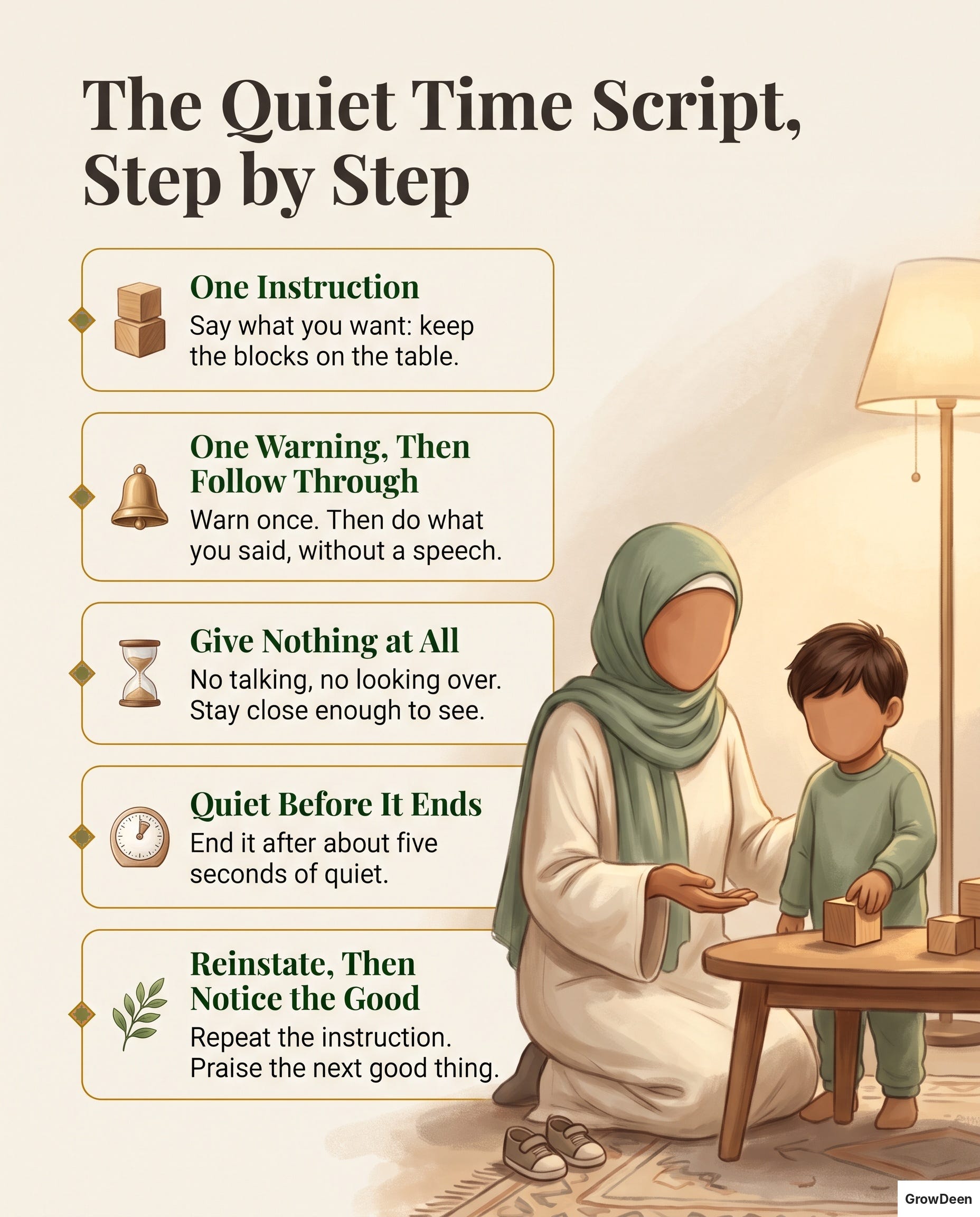
The script has six steps, the same six on page 1 of the Quiet Time Script Card. Most take seconds.
1. Give one instruction (10 seconds). Say what you want him to do, in positive words. A clear, calm instruction gives your child a fair chance to get it right. [7]
Say this: "Keep the blocks on the table." Or: "Shoes go by the door." Or: "Gentle hands with your sister."
Keep it short and positive, and say it once. (Say it in the language your child knows best.)
Instead of: "Stop throwing the blocks." Try: "Keep the blocks on the table."
3–5: one short sentence that names the object. 6–8: you can add one reason, once: "Shoes go by the door so nobody trips."
2. Give one warning (5 seconds). Say it calmly, as a statement, not a question. Then wait about five seconds. [2]
Say this: "If the blocks go on the floor again, you will have quiet time on the step." Then stop talking.
Instead of: "Last warning. I mean it this time." Try: "If the shoes stay on, you will have quiet time on the step."
This is the first slip. A warning you do not keep can teach your child that you may not mean it. [2]
3. Follow through without a speech (30 seconds). Say this: "The blocks went on the floor. Quiet time on the step now."
Walk him there and say nothing on the way. Let the protests and the promises to be good pass without a reply. [2]
If he promises to stop on the way, it is too late. Follow through anyway. [15]
4. Give nothing at all (a few minutes). No talking, no explaining, no reminding him what he did. No sighing and no looking over. Stay close enough to see him, and turn your attention to something else. [2]
This is the big one. Your attention is the thing you took away. Every word hands it straight back.
5. Quiet first, then it ends (about 5 seconds of quiet). Choose a short length and keep it the same every single time. The CDC suggests one minute per year of age: three minutes at 3, four at 4. [2]
For a young child, two to four minutes. End it only once he has been quiet for about five seconds. [2]
Say this: "Quiet time is finished."
If he is still shouting when the time is up, wait for a few seconds of quiet. Letting him up mid-shout may teach that shouting ends it. [2,15]
6–8: one minute per year gets long at this age. Programs often use other consequences with older children, such as losing a privilege. [7]
6. Reinstate, then notice the good (1 minute). Give the original instruction again, in the same words: "Keep the blocks on the table." If he still refuses, quiet time happens again. [2]
Then watch for the next thing he gets right, and say it out loud. [2] This step is the one that teaches. Do not skip it.
Say this: "You put that one back without being asked." Or: "Alhamdulillah, you shared." Or: "You waited for your turn."
Alhamdulillah means all praise is for Allah.
The ninety seconds after. When it ends, it ends. Do not bring it up at dinner or report it to the other parent within earshot. Give him your face back first.
Make It Work in Your Home
On your own with two fighting children? The CDC suggests time out for both, in two different spots, without taking sides. [2]
A small home with no hallway? A small mat or folded blanket on the floor can mark the spot. Keep it away from toys and screens. A bedroom works only with the toys taken out. [2]
Grandparents or another adult at home? Quiet time works best when nobody talks to your child during it. [2] One kind word from Grandma can restart the play.
The other parent does it differently? Agree on the spot, the length and the words. Consistency was one of the parts linked with larger effects. [9]
Say this to your spouse: "He listens to you so well at bedtime. Can we pick one spot and one length, and use the same words?"
Say this to Grandma: "Mama, he loves your attention more than anything. That is why quiet time works when we all stay quiet. Will you help me for those few minutes?"
The family question: ask your spouse, "When you were small and in trouble, what happened afterwards? How did it feel?"
Try It Seven Times
Any seven times in the next week or two, count two numbers: the warnings you gave, and the words you said during quiet time. Treat seven as a starting goal.
Tell us in the comments which number dropped first.
One instruction, one warning, then silence. The quiet does the teaching, and your face ends it.
If Things Don't Go to Plan
If he will not stay on the spot: walk him back, as many times as it takes, without conversation. With time out away from you, you may need to stand nearby in silence. [15]
If it gets louder at first: screaming or crying in the first quiet times is common. It often fades after several. [15]
If it only improves a little: fewer warnings and fewer words are the progress. Keep the script the same.
If you start doubting yourself: Am I being cold by saying nothing? No. A few silent minutes inside a warm day is a pause, and the love around it holds.
If you lose your patience: it happens. Say, "I shouted. I'm sorry. The rule is the same, and I love you." Repair is part of the lesson.
Distress or Resistance?
They can look the same from the doorway, but they need opposite things.
Some shouting in quiet time is protest at a new limit, and some is real distress. [7] Ask one question first: has my child gone past the point of being able to hear me?
Resistance: he can still hear you, and has decided not to. You may see him watching you while he does it.
He argues, bargains and negotiates terms, and stops the moment something better is offered. His voice is loud but steady, and his breathing is normal. He stops and restarts depending on who is in the room.
What to do: carry on with the script, without adding a second warning. Say nothing while it runs, and walk him back without a word if he leaves.
End it once he has been quiet for a few seconds. Reinstate the instruction, then catch the next good thing.
Distress: he has gone past hearing you. A consequence is unlikely to teach anything now.
He does not look at you at all, and his breathing has changed: gasping, hiccupping, shaking. He cannot answer a simple question, and he does not stop for anything, even things he wants.
It came on suddenly, or after illness, poor sleep or a big change at home.
What to do: stop the procedure, because this is not the moment for it. Move closer, lower yourself to his height, and say little.
Wait, and offer water. Offer your hand, but do not insist. Deal with the behavior later, briefly, once he is back.
The CDC suggests "time-in" for a child in emotional distress. [2] If this is happening often, or he is hurting himself, speak to your child's doctor or pediatrician.
If you cannot tell, treat it as distress. You can always come back to the rule. You cannot take back a consequence given to a child who had nothing left.
Signs are clearer looking back. Seeing them late is not neglect.
When Quiet Time Is Not the Right Tool
Before any consequence, ask why this is happening now. When a child is hurt, tired or hungry, meeting that need fits better than time out. [7] The same is true when he is coming down with something, a baby has arrived, or sleep has been poor for a week.
Time out is not meant for children under two. [7] A child who hurts himself when upset should never be out of your sight. Stay close and keep him safe. [2]
Some children act up to get out of a task. For them, being sent away can feel like a relief.
That is one reason step 6 brings the instruction back. A small study of four such children found time out worked better when the task was given back. [16]
Speak to someone if: nothing improves with steady use, or your child often hurts himself or others. Speak up, too, if your own stress is shaping how you respond.
Who to turn to: your child's doctor or pediatrician, who can also point you to a counselor or family therapist. In an emergency, call your local emergency number.
Support Muslim Parenting Lab ❤️
Would you like a share in every good thing that comes from what you fund? Support it with the button below, at any level you choose.
The Prophet ﷺ said whoever sets a good precedent earns its reward and the reward of everyone who follows it. (Sahih Muslim 1017a)
Your Companion Pack: Quiet Time Script Card
The moment you need these words is the moment your own head goes blank. That is why the card exists. Free to download, one PDF of three pages:
Page 1, The Script, Line by Line: every sentence you say, in order, from the first instruction to the closing praise. The three slips are marked at the step where each happens.
Page 2, Distress or Resistance: the signs of each, and the different response each one needs. You can make the call quickly instead of guessing.
Page 3, Two Reflections for the Hard Evenings: Maryam 19:54 on Prophet Isma'il's promise, and the Prophet's ﷺ teaching on a cheerful face. Each comes with what it asks of you.
Keep it on the fridge door, or as a photo on your phone.
Parents Also Ask
How long should a time out be for a 3-year-old?
The CDC suggests one minute per year of age, so about three minutes. [2] Other programs use a short, fixed length, and sources disagree on the exact number. [11]
Pick something short and keep it the same every time. End it only after a few seconds of quiet.
What is the difference between quiet time and time out?
In this guide, quiet time keeps your child near you, away from the activity, with no attention from you. Time out moves him to a separate, boring spot away from people and toys. [2] Many families use quiet time for everyday friction and keep time out for hitting or other harmful behavior.
Does time out damage a child emotionally?
Reviews that weighed the criticisms found it useful when it is brief, calm and inside warm, positive parenting. [3,1] Harsh responses are a different matter: the AAP says yelling at or shaming children is not effective in the long term. [4] Myth Check explains more.
At what age can you start time out?
Time out is not meant for children under two. Younger toddlers do better with gentle guidance through the instruction. [7] The standard procedure in one leading program starts at a developmental age of about two and a half. [7]
What do I do if my child won't stay in time out?
Walk him back quietly, as many times as it takes, without conversation. [15] Talking on the return trip is the same slip as talking during quiet time. It often gets easier after the first few times. [15]
Why does time out work for my husband and not for me?
Usually it comes down to the three slips. Count your warnings, and the words you say before it ends.
Then agree together on one spot, one length and the same words. Consistency is one of the parts linked with bigger effects. [9]
Should I explain afterwards why he was in time out?
Keep it to one short sentence, then stop. If he broke a rule, remind him of it; if he ignored an instruction, repeat it. [2] Then move on, and praise the next good thing he does.
Final Reflection
Dear parent,
You read this far to get the small details right. That care already shows.
If quiet time became long talks on the step, you were doing what felt kind. You wanted him to understand. That wish came from love, and it was not wasted.
You do not need a new system tonight. Choose the spot.
Tomorrow, give one instruction, then one warning. Make your intention to keep your word, for Allah. Let that be enough.
You are not too soft. You are not too strict. You are learning the script, like the rest of us.
Time out often stops working because of the words around it. Warn once, then let the quiet teach.
A Du'a for This
For you:
رَبِّ ٱشْرَحْ لِى صَدْرِى وَيَسِّرْ لِىٓ أَمْرِى
Rabbi-shraḥ lī ṣadrī, wa yassir lī amrī
"My Lord, expand for me my breast [with assurance]. And ease for me my task."
Ta-Ha 20:25–26 · Sahih International [17]
With your child: the Prophet ﷺ taught these words for a moment of anger. [18] Ages 3 and up: practice them together when calm, then say them together when a big feeling starts.
أَعُوذُ بِاللَّهِ مِنَ الشَّيْطَانِ
A'ūdhu billāhi min ash-shayṭān
"I seek Refuge with Allah from Satan."
Sahih al-Bukhari 3282 · sunnah.com [18]
Share the Khayr
Think of one parent who says the same thing six times, jaw tight, and then wonders why nothing changed. Send this to her. The Prophet ﷺ said that one who guides to something good has a reward similar to that of its doer. [19]
Tell us in the comments: which slip was yours: the extra warnings, the talking, or the early ending? We'd love to know.
Parents Also Read
Parents who read this guide also found these helpful.


References
[1] Dadds, M.R., & Tully, L.A. (2019). What is it to discipline a child: what should it be? A reanalysis of time-out from the perspective of child mental health, attachment, and trauma. American Psychologist, 74(7), 794-808.
[2] Centers for Disease Control and Prevention. (2026). How to Use Time-Out. Essentials for Parenting Toddlers and Preschoolers.
[3] Morawska, A., & Sanders, M. (2011). Parental use of time out revisited: a useful or harmful parenting strategy? Journal of Child and Family Studies, 20(1), 1-8.
[4] Sege, R.D., Siegel, B.S., AAP Council on Child Abuse and Neglect, & AAP Committee on Psychosocial Aspects of Child and Family Health. (2018). Effective discipline to raise healthy children. Pediatrics, 142(6), e20183112.
[5] Gershoff, E.T., & Grogan-Kaylor, A. (2016). Spanking and child outcomes: old controversies and new meta-analyses. Journal of Family Psychology, 30(4), 453-469.
[6] CBC News. (2016). Go to your room! 3 common timeout mistakes by parents and how to do it better. CBC News, Health.
[7] Woodfield, M.J., Brodd, I., & Hetrick, S.E. (2022). Time-out with young children: a Parent-Child Interaction Therapy (PCIT) practitioner review. International Journal of Environmental Research and Public Health, 19(1), 145.
[8] Riley, A.R., Wagner, D.V., Tudor, M.E., Zuckerman, K.E., & Freeman, K.A. (2017). A survey of parents' perceptions and use of time-out compared to empirical evidence. Academic Pediatrics, 17(2), 168-175.
[9] Kaminski, J.W., Valle, L.A., Filene, J.H., & Boyle, C.L. (2008). A meta-analytic review of components associated with parent training program effectiveness. Journal of Abnormal Child Psychology, 36(4), 567-589.
[10] Drayton, A.K., Andersen, M.N., Knight, R.M., Felt, B.T., Fredericks, E.M., & Dore-Stites, D.J. (2014). Internet guidance on time out: inaccuracies, omissions, and what to tell parents instead. Journal of Developmental and Behavioral Pediatrics, 35(4), 239-246.
[11] Corralejo, S.M., Jensen, S.A., Greathouse, A.D., & Ward, L.E. (2018). Parameters of time-out: research update and comparison to parenting programs, books, and online recommendations. Behavior Therapy, 49(1), 99-112.
[12] Qur'an, Maryam 19:54. Translation: Sahih International.
[13] Tafsir Ibn Kathir on Maryam 19:54.
[14] Sahih Muslim 2626.
[15] Centers for Disease Control and Prevention. (2026). Tips for Handling Time-Out Challenges. Essentials for Parenting Toddlers and Preschoolers.
[16] Everett, G.E., Olmi, D.J., Edwards, R.P., Tingstrom, D.H., Sterling-Turner, H.E., & Christ, T.J. (2007). An empirical investigation of time-out with and without escape extinction to treat escape-maintained noncompliance. Behavior Modification, 31(4), 412-434.
[17] Qur'an, Ta-Ha 20:25–26. Translation: Sahih International.
[18] Sahih al-Bukhari 3282.
[19] Sahih Muslim 1893a.
We combine scientific research with Qur’an and authentic Sunnah, and we cite our sources. Even so, this is general guidance and no substitute for a doctor who can examine your child.
Sources & confidence
The hadith in this guide are from Sahih al-Bukhari and Sahih Muslim. The Qur'an translation is Sahih International. Checked November 2026. Found a source that looks wrong? Email us at info@growdeen.com.
Words in this guide
time out (timeout) · scientific term: a short, planned break from your attention and from fun things, in a separate, boring spot, after a broken rule.
quiet time · scientific term: a short break from the activity, near you, with no attention from you.
time-in · scientific term: staying close and calm beside an upset child, and naming the feeling, instead of giving a consequence.
warning · scientific term: one calm statement of what will happen if the behavior continues.
meta-analysis · scientific term: a study that pools the results of many studies to see the overall pattern.
well-child visit · scientific term: a routine checkup with your child's doctor when your child is not sick.
Qur'an · Islamic term: the word of Allah, revealed to the Prophet Muhammad ﷺ.
Sunnah · Islamic term: the teachings and practice of the Prophet Muhammad ﷺ.
tafsir · Islamic term: a scholar's commentary explaining the meaning of the Qur'an.
du'a (doa) · Islamic term: supplication, asking Allah.
Alhamdulillah · Islamic term: all praise is for Allah.
A'ūdhu billāh · Islamic term: "I seek refuge with Allah", said to calm anger.
khayr · Islamic term: good.
sadaqah jariyah · Islamic term: ongoing charity whose reward continues.
mom (mum) · everyday word: mother.