


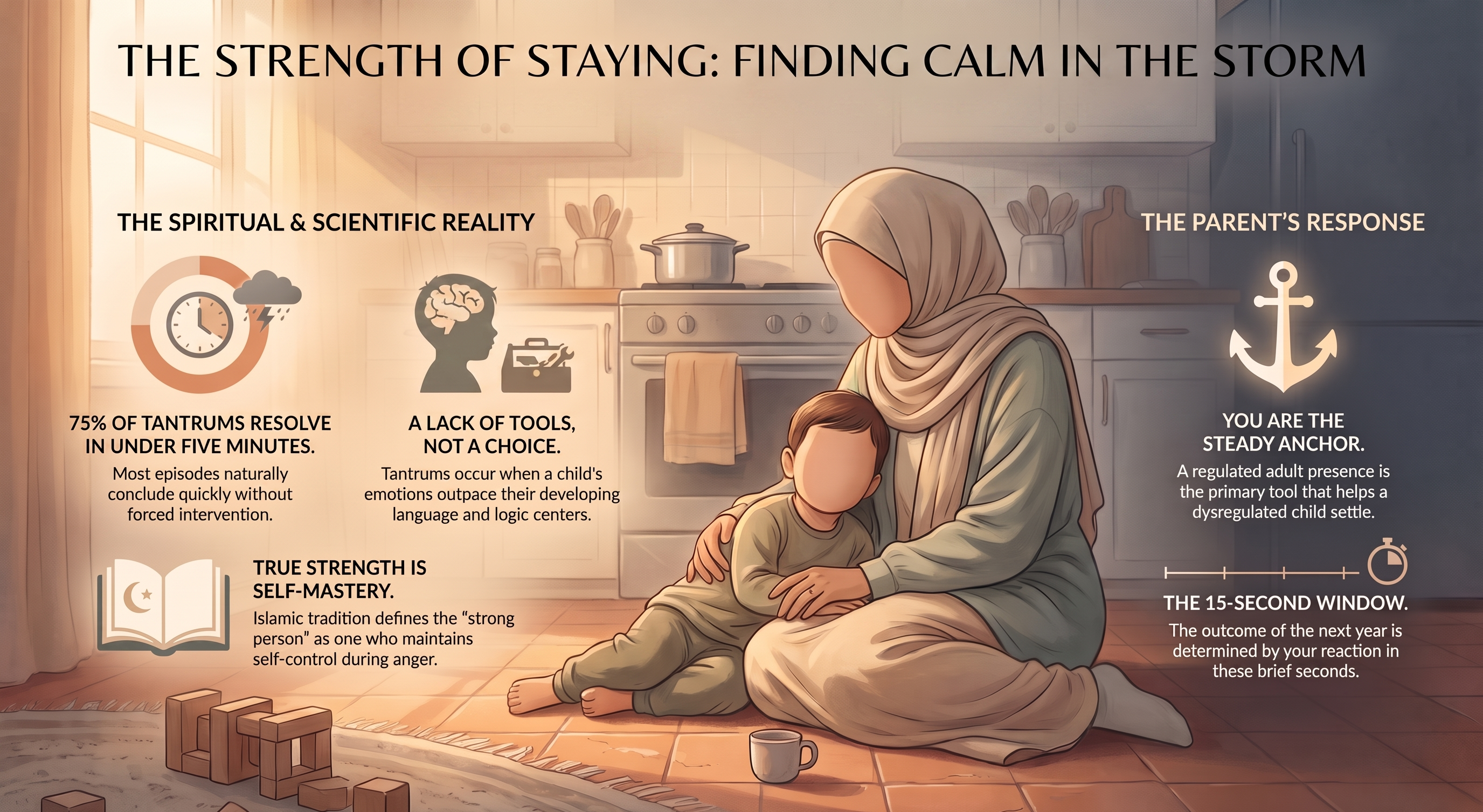
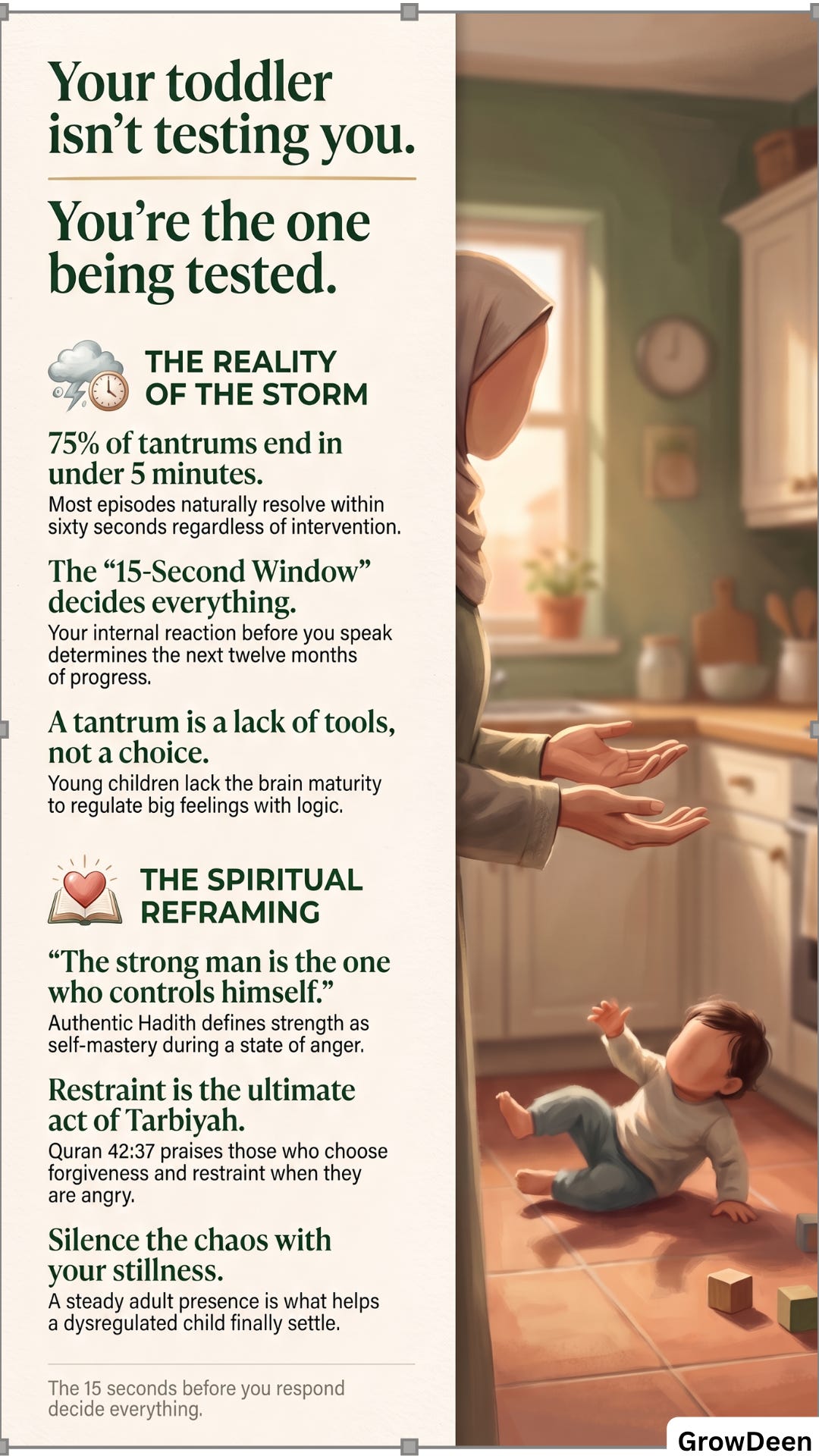
Research tracking hundreds of recorded tantrums found that 75% end within five minutes, whether you intervene or not [1]. The part that actually determines how the next twelve months go isn’t the five minutes. It’s what you do with your own reaction inside them.
Your son is on the floor of the cereal aisle. He wanted the box with the cartoon on it. You said no. Now three strangers are watching you, and some part of your brain is doing the math on how fast you can get to the car.
Here’s a sentence you won’t find in most parenting advice: you are not the one being tested for patience here. You already know how this ends for him, statistically, in about four minutes. The actual test is happening in you, right now, in the fifteen seconds before you decide how to respond.
Most articles on tantrums start with a list of what tantrums look like. This one starts somewhere else, because the truer starting point isn’t your child’s floor-kicking. It’s your own next move.
Why This Guide Is Different
It starts with you, not the checklist. Most tantrum guides open with symptoms. This one opens with the moment that actually determines the outcome: your response.
The Islamic case for staying calm isn’t a side note. Qur’an 42:37 and an authenticated hadith agreed on by Bukhari and Muslim sit at the center of the argument, not tacked onto the end.
You’ll walk away with The Calm in the Storm Companion Pack, a printable card built for the fifteen seconds before you react, not for later research.
The Test Nobody Talks About
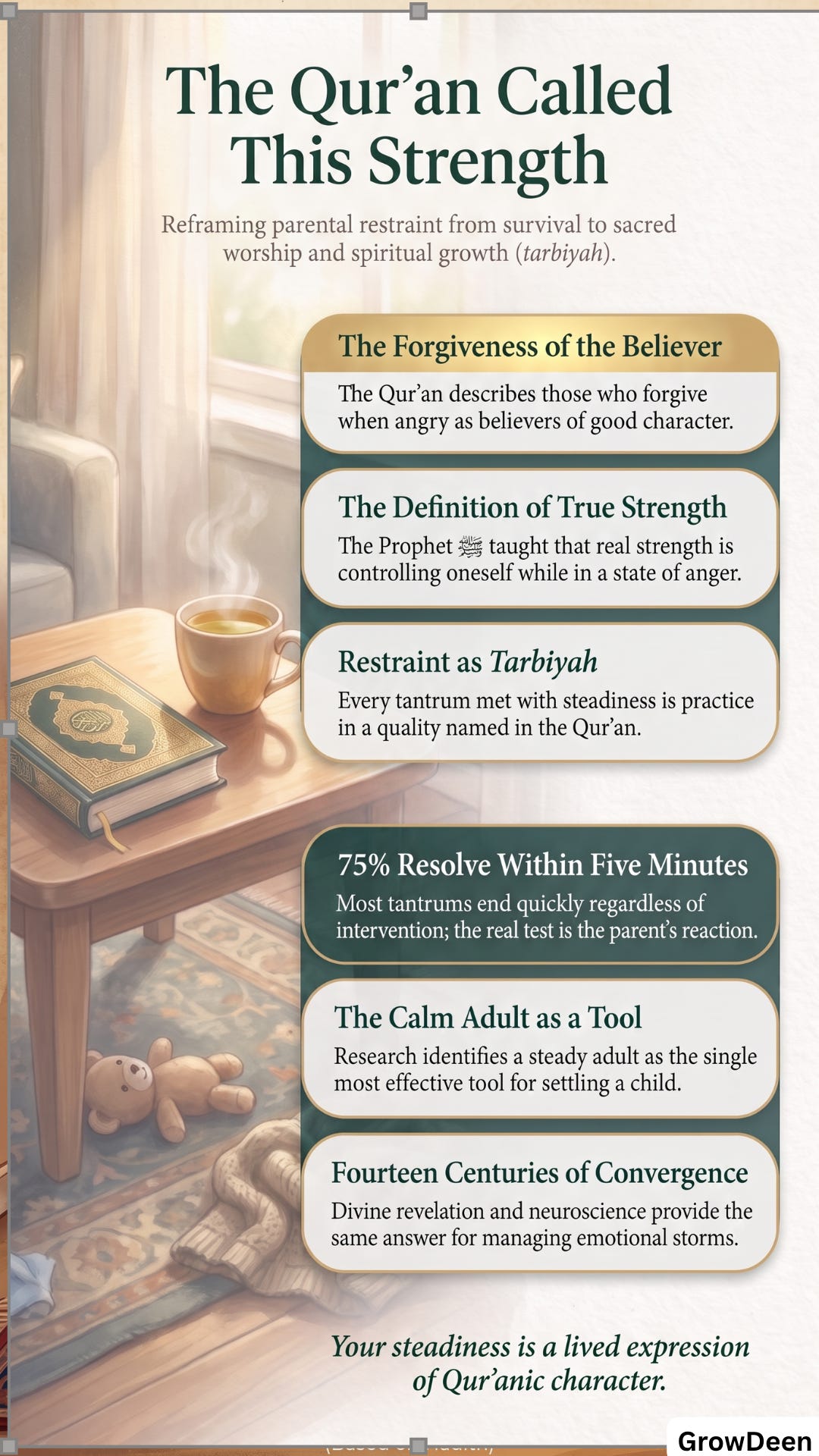
There’s a verse in the Qur’an that describes a particular kind of person: someone who “avoids the greater sins and shameful deeds, and when they are angry, they forgive” [Quran 42:37]. According to Tafsir Ibn Kathir, this isn’t describing people who never get angry. It’s describing people who get angry and choose restraint anyway, people fully capable of retaliating who simply don’t.
Read that again standing in the cereal aisle. That’s not a verse about saints in some abstract sense. It’s a verse about the parent who could raise their voice to match a screaming child, and doesn’t.
The Prophet ﷺ made the identical point from a completely different direction. Abu Huraira reported him saying: “The strong man is not the one who overcomes people by his strength. The strong man is only the one who controls himself while in a state of anger” [Sahih al-Bukhari 6114; Sahih Muslim 2609, agreed upon by both]. Not the loudest. Not the one who wins the standoff. The one who holds still.
Nobody hands new parents this framing. You get told to “stay calm” a hundred times before your child turns five, as if calm were a switch. It isn’t. It’s a discipline the Qur’an and the Prophet ﷺ both singled out as the actual mark of strength, and it turns out the developmental research is pointing at the exact same thing from an entirely different angle: a steady adult is what helps a dysregulated child settle. Two completely different sources of knowledge, converging on one answer.
That convergence is worth sitting with. The Qur’an and the Sunnah are not offering a spiritual add-on to the parenting technique. They are naming the technique itself, from a direction neuroscience arrived at fourteen hundred years later.
What’s Actually Happening Inside Your Child’s Brain
Before you can respond well, it helps to understand why no response makes the screaming stop instantly.
The part of the brain responsible for holding a feeling steady, weighing consequences, choosing words instead of a scream, doesn’t even begin serious development until around twelve months old, and it keeps maturing well into adolescence [5]. A toddler on the cereal aisle floor has run out of the only tool available: the body. The scream isn’t a choice. It’s what’s left after language, logic, and emotional regulation have all been outpaced by the size of the feeling.
Older children have tantrums for a related but slightly different reason. They may have more language than a two-year-old, but they still haven’t built a reliable, practised channel for a feeling that’s too big for the moment. Disappointment, shame, exhaustion, fear: these can still swamp the coping skills of a five- or six-year-old whose day has been long enough.
Here’s what a tantrum can look like in practice: screaming, a stiffened body, an arched back, kicking, dropping to the floor, flailing, or bolting away from you. Some children hold their breath. A smaller number vomit, hit, bite, or break something mid-episode. All of it falls under one label [2]. None of it means your child is manipulative or spoiled.
And here’s a number worth knowing before you assume something unusual is happening: detailed observational research on hundreds of recorded tantrums found that the typical duration is between thirty seconds and one minute, with roughly 75% resolving in under five minutes [1]. A separate study tracking 335 children found that when tantrums did run longer, they mostly landed between five and ten minutes [4]. The storm you’re standing in, the one that feels endless, is statistically almost over.
What Makes a Tantrum More Likely
Some days are worse than others, and that’s rarely random. A few conditions reliably raise the odds of a meltdown on any given day:
Temperament. Some children register frustration faster and more intensely than others. This is neurological wiring, not a reflection of your parenting [6]. Two children in the same household, raised the same way, can have completely different tantrum profiles because their nervous systems are built differently.
Hunger, fatigue, and overstimulation. These are the silent accelerants. A child who missed a nap, skipped a snack, or spent too long in a noisy, crowded place has a fraction of the regulation capacity they had that morning. A grocery trip right before nap time is setting the stage.
A situation genuinely beyond the child’s current skill. A toddler watching an older sibling take a toy is dealing with a problem they literally do not yet have the tools to solve. The tantrum is the only tool they have for that moment.
Emotions that feel too large to hold. Fear, shame, worry, anger: any one of these can outpace a young child’s ability to manage it, particularly when the child is already depleted by one of the factors above.
Knowing what makes a tantrum more likely is the first half of preventing it from happening as often.
Five Habits That Measurably Lower the Frequency
You cannot prevent every tantrum, and you shouldn’t try. What you can do is shift the odds, consistently, week by week.
Name feelings early and often, starting in infancy. “You seem frustrated.” “That made you happy.” “You look tired.” Children who have the words for a feeling need their whole body to express it less often. Research on emotion-coaching approaches with toddlers has found measurable improvement in how children handle difficult moments when parents consistently label emotions out loud [3].
Learn your child’s specific triggers. Most children have two or three predictable flashpoints. Maybe it’s always the transition from screen time to dinner. Maybe it’s always the car ride home from the park. Once you know the pattern, you can plan around it: a snack before the grocery run, a five-minute warning before screen time ends, a quieter afternoon after a busy morning.
Point out the wins. This is one of the most underused tools in the whole list. “You didn’t throw the blocks even though the tower fell again. How did that feel?” This teaches a child to notice their own regulation as it happens, to feel what calm-under-pressure actually feels like in their own body. Over time, they start choosing it more often.
Talk it through once things are calm, never mid-storm. “Were you upset because the tower kept falling? What else could we try next time?” A tantrum is not a teachable moment while it’s happening. It becomes one twenty minutes later, over a snack, when everyone’s nervous system is back online.
Model your own regulation out loud. “This traffic is making me late and I’m frustrated. Let me take a breath.” Children absorb far more from watching you cope than from being told to cope. When you narrate your own self-regulation in real time, you’re giving them a live template they can copy.
But even with all of this in place, tantrums will still happen. Here’s what to do when they do.
How to Respond: Two Scripts for Two Ages
The move that works for a two-year-old is close to useless for a six-year-old. Most advice doesn’t separate the two, and that’s a problem.
For Toddlers (Ages 1–3): Stay Close
Closeness beats distance at this age. Stay physically near, keep your voice low, and let your presence say “I understand this is hard” without trying to talk them out of it. A toddler mid-tantrum has no access to logic. Reasoning with them isn’t just unhelpful, it’s functionally impossible. Their prefrontal cortex is offline. The conversation you want to have can happen later, once everyone’s calm.
Offer touch if they want it. Give space if they push away. Both are acceptable responses. What matters is that you’re there, steady, not escalating. Some children settle faster when held. Others need room to move through the feeling physically. Follow their lead rather than forcing one approach.
For Older Children (Ages 4–6): The Five-Step Sequence
Older children have more language and more capacity for reflection, but they still need help getting there. This sequence tends to work:
Notice the emotion before you address the behaviour.
Name it out loud: “You seem really frustrated right now.”
Pause. Don’t rush to fix it or redirect.
Stay beside them while the feeling passes. Physical presence without a lecture.
Address what sparked it once everyone is calm, not during the storm.
This is slower than you’d like. It’s supposed to be. The pace itself is part of what teaches the child that big feelings can be moved through rather than acted out.
Things That Help at Any Age
No matter whether your child is two or six, a few things stay constant:
Safety first. Make sure everyone nearby is safe. Move your child to a calmer spot if you need to, or ask another adult to supervise other children present.
Once safe, acknowledge the feeling. Speak slowly and keep your voice low. “I can see you’re really upset right now.”
Stay close until they settle. Offer comfort if wanted, space if needed. Skip the reasoning entirely until later.
Hold the line on whatever triggered it. This is hard, but important. If you said no to the cereal box and then cave mid-tantrum, you’ve taught your child that this approach produces results. That lesson sticks.
Offer warmth once it’s over. A tantrum is exhausting for both of you. The minutes after deserve gentleness, not a debrief. The debrief comes later.
Never laugh at the tantrum, even when part of it looks comical. If your child senses mockery, it can escalate things or damage trust between you.
Don’t assume your child is doing this on purpose. A young child does not have the neural wiring to plan a manipulation this elaborate. They’re stuck, not scheming.
When It Might Not Be a Tantrum
If your child is autistic, what looks like a tantrum may actually be a meltdown: a fundamentally different experience. A meltdown is a nervous system that has gone fully past capacity and lost the ability to self-manage. It’s not connected to a specific demand or unmet want the way a tantrum usually is. Meltdowns can involve yelling, rocking, crying, hitting, or withdrawing, and they generally call for a calmer, more sensory-aware response than a typical tantrum does.
If you’re not sure which one you’re seeing, a doctor or developmental specialist can help you tell the two apart. This isn’t about labelling your child. It’s about making sure your response matches what’s actually happening.
The sheer number of things to remember in these moments, all at once, under stress, is the problem the companion pack below was built to solve.
The Calm in the Storm Companion Pack gives you the exact scripts for both age groups on a card you can keep on the fridge. More on that shortly.
When to Talk to Your Doctor
Most tantrums are a normal, temporary part of development and ease with age as language and self-regulation catch up. But a few markers are worth knowing, not so you can worry, but so you’re not guessing:
Episodes regularly running past fifteen to twenty-five minutes, even with a calm response from you
Tantrums happening multiple times a week well past the preschool years without any improvement
Consistent patterns of self-injury or injury toward others during episodes
None of these mean something has gone wrong with your parenting. They’re simply a reasonable point to bring your doctor into the conversation and make sure you’re not carrying something alone that extra support could ease [4], [7].
Holding Yourself Together During the Hard Part
Staying calm during your child’s tantrum is one of the harder things you’ll do as a parent, and it deserves its own section, not a single throwaway line at the bottom.
I know what you might be thinking: one more thing to manage on top of everything else. This isn’t that. It’s the opposite. It’s permission to stop expecting perfection from yourself in a moment that’s genuinely hard.
Decide your plan before the moment arrives. Know roughly what you’ll do in a tantrum, so that when it happens you’re executing a plan you’ve already thought through rather than improvising under stress. The companion pack below exists specifically for this purpose.
Accept what you can and can’t control. You cannot make your child’s emotions disappear on command. You can keep them safe, stay steady, and guide them toward better tools over time. That’s enough. That’s actually the whole job.
Expect this to take years, not days. Self-regulation is a lifelong skill, even for adults. Your child has a long runway ahead, and so do you. Every week is practice, not a pass-fail test.
Resist the story that your child is doing this “at” you. They’re stuck in a feeling too big for their current toolkit. The behaviour is not personal, even when it feels deeply personal at 7am with breakfast on the wall.
Let the stares roll off. This one is for the supermarket, the masjid parking lot, the airport terminal. Anyone who’s raised a toddler has stood exactly where you’re standing. And anyone who gives you a look either forgot or never had a two-year-old.
Be gentle with yourself when it doesn’t go to plan. You will lose your patience. You will raise your voice sometimes. You will handle a tantrum badly and wish you could rewind the tape. That’s not failure. That’s parenthood. The goal isn’t to never get it wrong. It’s to repair honestly and try again the next time.
A Simple Routine to Start This Week
You don’t have to do everything in this article at once. Pick one starting point and repeat it for a week before adding anything else.
Pick one recurring trigger for your child: tiredness before dinner, a specific transition, sharing, the end of screen time.
Add one feeling check-in during a calm moment each day: “How did that feel?”
Before responding to the next tantrum, take one breath and say Bismillah silently before you speak.
Once things are calm, talk through what happened in two or three sentences, not a lecture.
Notice one thing that went better than last time, even if it’s small.
Repeat this same sequence for a full week. Children build these skills through repetition, not a single conversation.
May Allah make the steadiness you’re building easier with every hard moment still ahead this week.
Something to Keep Closer Than This Article
You’ve read this far, which tells me you’re not looking for a pep talk. You want something that actually holds up in the fifteen seconds before you react.
I know the middle of a tantrum is the worst possible time to try remembering a five-step plan from an article you read once, a week ago. That’s exactly why I built something to keep somewhere you’ll actually see it, mid-storm.
Inside The Calm in the Storm Companion Pack (one PDF, 3 pages):
Page 1: The In-the-Moment Response Card — Toddler response on one side, older-child response on the other, built to be read in under five seconds, mid-crisis, designed to live on the fridge or in a bag.
Page 2: The Trigger Pattern Log — A week of simple tracking that turns “this feels random” into a visible pattern by around day three. One sheet, filled in over seven days, and you’ll see what’s causing 80% of the meltdowns.
Page 3: The Ash-Shura Reflection Card — Qur’an 42:37 and the full hadith on self-mastery in anger, reframing your restraint, not your child’s behaviour, as the real moment of tarbiyah. Built to keep near your Qur’an or by your bed for the evenings after the hardest days.
This isn’t a PDF you download once and forget. It’s built to live on your fridge or in your bag, exactly where it’s useless to have read it once and useful to have it in front of you.
This pack is what every subscriber gets with each article we publish, the whole arc of raising Muslim children, backed by research and rooted in Islamic wisdom.
If that’s what you’re after, subscribe free and future resources land in your inbox before you need them.
Free, always. No spam, no daily noise, just what’s actually useful.
One Thing You Can Do Right Now
Before you keep reading anything else today, do this: think of the one trigger that shows up most often in your house. Tiredness before dinner. A specific transition. Sharing. Just name it to yourself. That’s the entire first step of the routine above, and it takes ten seconds.
Someone You Know Needs This Today
Think of her specifically: the friend who texted you at 9pm last week asking if a two-hour meltdown was normal, your sister who went quiet at the masjid when her toddler started screaming, the mother in your group chat who apologized three times for “venting” about bedtime.
Send this to her, not as advice, as company.
Frequently Asked Questions
Q: How long do toddler tantrums usually last?
A: Most wrap up in under five minutes. Detailed tracking of recorded tantrums found roughly 75% resolve that fast, with a typical episode lasting 30 seconds to a minute [1]. When they run longer, five to ten minutes is still common and within normal range [4].
Q: When do kids usually stop having tantrums?
A: They tend to peak around ages two and three, then ease off as language and self-regulation develop, with most children showing a real shift by four or five [5]. Occasional ones can still happen after that, especially under stress, fatigue, or during big emotional moments.
Q: Is it better to ignore a tantrum?
A: For toddlers, staying close usually beats stepping away. Quiet presence without reasoning, and not caving on whatever triggered it, tends to work better than ignoring altogether. For older children, the five-step sequence in the article gives a more structured approach. Full breakdown by age is above in “How to Respond: Two Scripts for Two Ages.”
Q: Is it normal for a 5-year-old to still have tantrums?
A: Occasional ones, yes, especially under stress or fatigue. Frequent, intense episodes past this age are a reasonable reason to check in with your doctor, not a sign you’ve done something wrong [7].
Q: How can I tell a tantrum apart from an autism meltdown?
A: A tantrum usually connects to a specific unmet want and can shift with a calm, consistent response. A meltdown is a nervous system that’s gone past capacity, not tied to one demand, and needs a calmer, more sensory-aware approach. A doctor or developmental specialist can help you sort out which one you’re seeing.
Q: What does Islam say about keeping calm during a child’s tantrum?
A: The Qur’an describes believers who forgive rather than react even when angry [Quran 42:37], and the Prophet ﷺ said: “The strong man is not the one who overcomes people by his strength. The strong man is only the one who controls himself while in a state of anger” [Sahih al-Bukhari 6114; Sahih Muslim 2609]. Full reflection is above in “The Test Nobody Talks About.”
References
[1] Potegal, M., & Davidson, R.J. (2003). Temper tantrums in young children: 1. Behavioural composition. Journal of Developmental and Behavioral Pediatrics, 24, 140-148.
[2] Daniels, E., Mandleco, B., & Luthy, K.E. (2012). Assessment, management, and prevention of childhood temper tantrums. Journal of the American Association of Nurse Practitioners, 24(10), 569-573.
[3] Lauw, M.S.M., Havighurst, S.S., Wilson, K.R., Harley, A.E., & Northam, E.A. (2014). Improving parenting of toddlers’ emotions using an emotion coaching parenting program. Journal of Community Psychology, 42(2), 169-175.
[4] Potegal, M., Kosorok, M.R., & Davidson, R.J. (2003). Temper tantrums in young children: 2. Tantrum duration and temporal organization. Journal of Developmental and Behavioral Pediatrics, 24(3), 148-154.
[5] Van den Akker, A.L., Hoffenaar, P., & Overbeek, G. (2022). Temper tantrums in toddlers and preschoolers: Longitudinal associations with adjustment problems. Journal of Developmental and Behavioral Pediatrics, 43(7), 409-417.
[6] Giesbrecht, G.F., Miller, M.R., & Muller, U. (2010). The anger-distress model of temper tantrums. Infant and Child Development, 19, 478-497.
[7] Characteristics of problematic tantrums (duration, frequency, and aggression thresholds warranting clinical evaluation), as documented across pediatric behavioral research.
[8] Qur’an, Surah Ash-Shura 42:37, with Tafsir Ibn Kathir.
[9] Sahih al-Bukhari 6114; Sahih Muslim 2609. Muttafaqun Alayhi (agreed upon by both Bukhari and Muslim).