

Stopped answering the whining, and now it's louder? The free Pause & Return Kit holds the words and the plan for the wait.
AGES 1–8 YEARS · 18 MIN READ
Day three of not answering the whine, and it's louder.
You're driving to your sister's house. Your three-year-old wants his snack, now.
His voice climbs higher each time, and he watches the mirror for your eyes. You told him once, calmly, that you'll listen to his normal voice.
So why is he kicking the back of your seat?
I'm his father. I did exactly what the advice said. So why is it worse?
You are not being cold, and you have not broken anything. A louder few days is common when an old habit stops working.
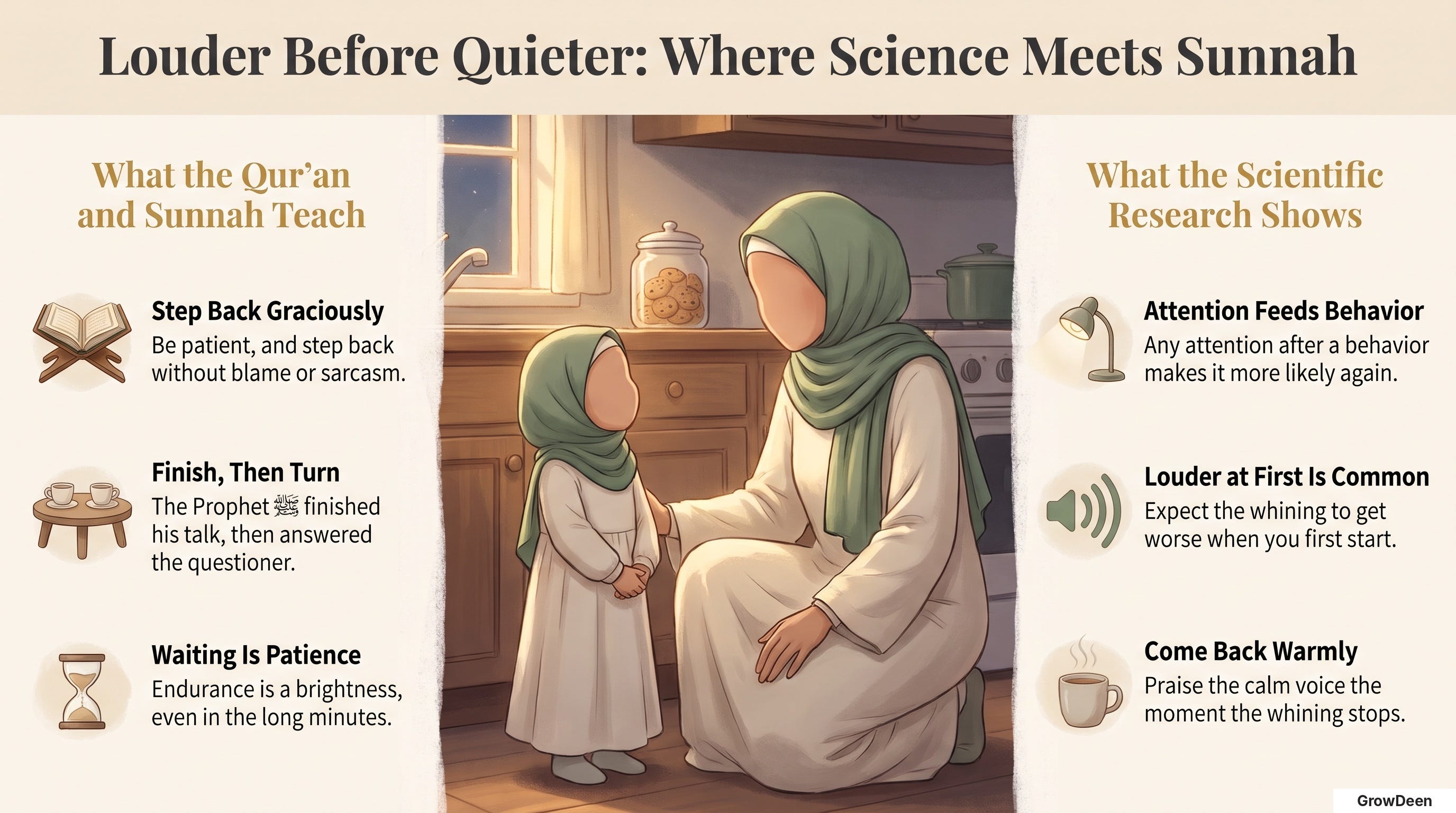
This guide brings together scientific research and the Qur'an and authentic Sunnah. You'll see why the whine gets louder, how the Prophet ﷺ finished before answering, and the words for tonight.
The Short Answer
Right for your child? Ages 1 to 8 who whine for attention. Not for babies under 1. Not for hunger, tiredness, illness or real upset.
What's probably happening: your attention was the reward. When it stops, your child often tries harder before letting the old way go.
Keep safe: never ignore hitting, biting, throwing or anything unsafe. Stay where you can see and hear your child.
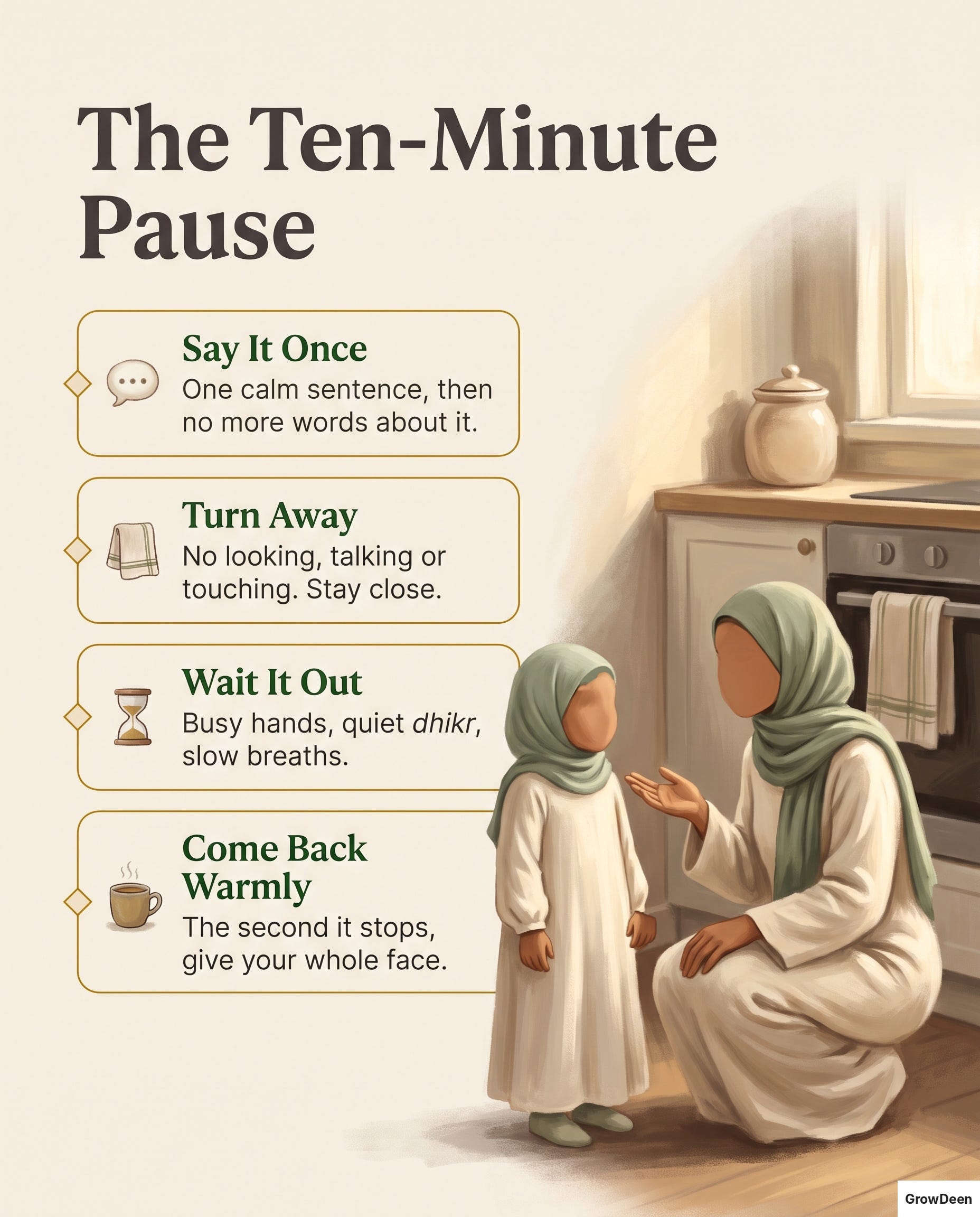
Try tonight (10 minutes): say one calm sentence. Turn away while the whine lasts. Turn back warmly the second it stops.
You'll know it's working when: your child finds the calm voice sooner. A louder few days at the start is not failure.
Get help if: the behavior seems severe, keeps going over time, or seems unusual for your child's age. Start with your child's doctor or pediatrician.
The rest of this guide explains why, and what to do if it does not work.
How to Read This Guide
3 minutes: The Short Answer above is enough for tonight.
7 minutes: The Short Answer, then Knowledge in Practice and If Things Don't Go to Plan.
The whole guide: read on for the scientific research, the Qur'an and Sunnah, and the References.
To share: the bold lines and the pull quotes are made to be shared.
To listen: open this guide in the free Substack app and tap Listen.
Inside This Guide
You can step back from one behavior and stay close to your child.
Myth Check: "Ignoring a Whining Child Is Cold"
What the worry gets right. It comes from love. Turning away from a child who is hungry, sick or truly upset would be unkind, and the CDC says ignoring is not for those moments. [1]
What the evidence says. Planned ignoring is brief, and it targets one minor behavior, never the child. The CDC calls it redirecting your attention: you remove the reward of attention for a short time. Then you return it, with praise, the moment the behavior stops. [1] The American Academy of Pediatrics says ignoring can work when a child isn't doing anything dangerous and gets plenty of attention for good behavior. [2]
Where it can turn cold. The silent treatment withdraws love from a child; planned ignoring withdraws attention from one behavior, for a few minutes. Sighs and muttered comments keep feeding the behavior, because any attention can reward it. [1,3] Announcing the ignoring in front of others can shame your child, so keep it quiet.
Why This Happens
What is my child getting from the whine?
Think back to the last long whining spell. Count how many times you answered it: a "no", an explanation, a warning, a sigh, another explanation.
Each answer was a small payment. Attention from you matters to your child, and any attention after a behavior, positive or negative, makes that behavior more likely to happen again. [3,4] A cross face still turns the spotlight on. Redirecting your attention works by removing that reward. [1]
Your attention feeds whatever it lands on.
Tonight, try counting your answers to the behavior you want less of. Many parents are surprised by the number.
We see a child as an amanah, a trust from Allah, and attention is something we hand to that trust every day, in small portions. The Prophet ﷺ said that each of us is a guardian, responsible for those in our care. [5] The question is where those portions go.
Why does it get louder the week I start?
For a long time, that whine reliably brought your eyes to the mirror. When it stops working, a child often tries the obvious fix: more of it, louder, with a kick added. The CDC tells parents to be prepared for the behavior to get worse when they first start redirecting their attention. [1] Behavior scientists call this flare-up an extinction burst.
It is also why giving in at the loudest moment backfires. The CDC explains that giving attention then risks teaching your child that the behavior needs to get worse to work. [1] Giving in at the peak teaches the peak.
A louder week often isn't the method failing. It's the old rule being tested.
Which whines can I let pass, and which need me now?
Our reflection: mercy reads a child before it judges the behavior. A whine is sometimes the only signal a small child has, so sort it into one of three piles first.
Let it pass. Behavior aimed at a reaction and nothing else. The CDC gives whining and interrupting as examples. [1] At home: moaning about bath time, fake crying over the wrong color cup, a rude word tried for effect, or one question asked eleven times.
Step in now. Hitting, biting, throwing, breaking things or anything unsafe: the CDC says dangerous and destructive behavior should not be ignored. [1] Step in at once and keep everyone safe; a calm time-out can follow. [1,3]
Meet the need first. A child who is hungry, tired or sick may whine because something is wrong. Ignoring is not for these needs, or for a child who is truly upset and needs comfort to calm down. It only helps with minor, attention-seeking behavior. [1]
If you suspect a sensory need, talk to your child's doctor or pediatrician. With toddlers and preschoolers, the CDC suggests trying distraction and redirection first. [3]
A behavior in the first pile still has to pass three checks before you commit:
Anywhere: you could let it pass in your mother-in-law's living room as well as your own.
At full volume: you could hold steady at the loudest moment without cracking.
Every adult: the other adults in your child's life can let it pass too. The CDC advises telling every caregiver which behaviors you are ignoring, and showing them how. [1]
If one check fails, pick a different behavior for now.
What the Scientific Research Shows
In an analysis of 113 sets of data from treatment studies of behavior problems, a flare-up appeared in 24% of cases. [6] It appeared in 36% of cases when withholding the usual reward was the only approach, and in 12% when it was combined with other approaches. [6] So the louder week is common but far from certain, and pairing the pause with other steps may make it less likely. In these studies the withheld reward was not always attention.
Who was studied: data sets from applied treatment studies of behavior disorders, analyzed by scientists in the US. Ethnicity, family income and additional needs are not given in the study summary. How strong this is: Suggestive (one analysis of pooled treatment data, not a study of families like yours).
A multilevel meta-analysis found that briefly ignoring a child who did not comply increased compliance. This held both when observers watched and when parents reported it, and time-out also helped. [7] The authors noted that the studies were relatively few and covered only immediate and short-term effects. [7]
Who was studied: children aged 1 to 12, most aged 3 to 8, almost all in the US and some in the Netherlands. About half were typically developing, and the rest were at risk of or referred for conduct problems. Ethnicity and income were not identified. Strong for the short term.
A meta-analysis of 77 parent training programs for children aged 0 to 7 linked larger effects with positive parent-child interaction, time-out and consistency. [8] Strong; family details not given in the study summary.
The harsher alternatives come off worse. The American Academy of Pediatrics' 2018 policy statement says yelling at or shaming children is minimally effective in the short term. It is not effective in the long term. [9] Strong (official policy, US).
A meta-analysis of 15 randomized trials found that online parenting programs reduced behavior problems by a small amount compared with a waiting list. They did about as well as in-person programs. [10] Strong, small effect; children and adolescents.
The steps here follow the CDC's guidance for parents of 2- to 4-year-olds (US, 2026 and 2024). [1,3] Strong (official guidance).
What we do not know yet: how long a louder spell usually lasts at home; no source we checked gives a set number of days. No study has yet tested this with Muslim families.
What this means for you: expect a louder few days and stay steady through them. Give the return as much care as the pause.
What the Qur'an and Sunnah Teach
A small voice cuts in while you are mid-sentence with a guest, and every instinct says drop everything. The Qur'an and Sunnah point somewhere steadier.
وَٱصْبِرْ عَلَىٰ مَا يَقُولُونَ وَٱهْجُرْهُمْ هَجْرًا جَمِيلًا
"And be patient over what they say and avoid them with gracious avoidance."
Al-Muzzammil 73:10 · Sahih International [11]
Text. Allah tells His Messenger ﷺ to be patient and to step back graciously. Ibn Kathir explains that Allah commands him to be patient with what the foolish who rejected him said. He is to keep away from them in a way that is not blameworthy. [12]
Our reflection. The verse is about those rejecters, and your child is nothing like them. What a parent can carry from it is the manner: stepping back without sarcasm and without a cold shoulder.
While the Prophet ﷺ was saying something in a gathering, a Bedouin came and asked him, "When would the Hour (Doomsday) take place?" Allah's Messenger ﷺ continued his talk, so some people said that Allah's Messenger ﷺ had heard the question, but did not like what that Bedouin had asked. Some of them said that Allah's Messenger ﷺ had not heard it. When the Prophet ﷺ finished his speech, he said, "Where is the questioner, who inquired about the Hour (Doomsday)?" …
Sahih al-Bukhari 59 · narrated by Abu Hurayrah رضي الله عنه · sunnah.com [13]
Text. Imam al-Bukhari placed this narration under a chapter. Its heading: "Whoever is asked about knowledge while he is busy in some conversation, so he finished talking and then answered the questioner". [13]
Our reflection. The talk was finished first, and then the questioner was sought out and answered. At home, that becomes: finish, then turn, and give your child your whole face.
The Prophet ﷺ also said that "endurance is a brightness" (Sahih Muslim 223). [14] Our reflection. The long minutes of waiting are sabr (patience) in its most ordinary clothes.
When two men were abusing each other and one grew angry, the Prophet ﷺ said he knew a sentence that would calm him. It fits the moment your own temper rises while you wait: [15]
أَعُوذُ بِاللَّهِ مِنَ الشَّيْطَانِ الرَّجِيمِ
A'udhu billahi minash-shaytanir-rajim
"I seek refuge with Allah from Satan, the outcast."
Sahih al-Bukhari 6115 · sunnah.com [15]
Finish your sentence first. Then turn and give your child your whole face.
The Lab Verdict
The science: a louder few days is common when attention is withdrawn (Suggestive), and a brief pause works best inside warm, consistent parenting (Strong).
The Qur'an and authentic Sunnah: step back graciously, without blame, finish before you turn, and know that patience is a brightness.
Where they meet: the science shows why a brief, steady pause works; the Sunnah gives the manner, gracious and warm. Together, they ask the same of us: step back gently, return warmly.
So at home: say it once, turn away while it lasts, and come back with your whole face.
Knowledge in Practice: The Ten-Minute Pause
Knowing why the whine gets louder is half the work. Knowledge bears fruit when it reaches the kitchen.
If you can only do one thing, do step 1. It is enough.
Picture the kitchen at 5:40pm. Maryam, who is three, wants the cookie jar (biscuit tin) and starts the high, wobbly voice that usually wins her one. Here is how the next ten minutes can go.
1. Say it once (10 seconds). One calm sentence tells her what will get your attention instead. Then no more words about it.
Say this: "Maryam, I won't answer the whiny voice. Ask me in your normal voice and I'll listen." (Say it in the language your child knows best.)
Under 3: "No whiny voice. Ask nicely and I'll help." At this age, the AAP and the CDC suggest distraction first. Keep any turning away brief. [2,3]
3–5: "I won't answer the whiny voice. Ask in your normal voice and I'll listen."
6–8: explain the rule once, at a calm moment: "When you speak to me like that, I won't answer. When you speak kindly, I'll answer straight away." Tie it to adab (good manners): "In our family, respectful words get answered."
Instead of: "What did I say? I said no. Why do you keep asking?" Try: "Ask me in your normal voice and I'll listen."
2. Turn away (while it lasts). The CDC's guidance is short: do not look at your child, talk to them or touch them. [1] That includes the half-smile you can't hide and the loud sigh; both count as attention.
Turn to the sink or the laundry, close enough to see and hear her. Never leave a young child alone to make the point. The CDC's guidance is to leave a child alone only when it is safe. [1]
Say this to yourself: "One behavior, a few minutes. My love stays where it is."
3. Wait it out (a few minutes, sometimes longer). This is where the plan wins or fails. If you turn back halfway, she learns that a longer protest is the price of your attention. [1] Decide in advance what you will do with yourself:
Hands: fold, wipe, stir or sort something.
Heart: quiet dhikr (remembrance of Allah), SubhanAllah and Alhamdulillah, and seek refuge with Allah from Shaytan: A'udhu billahi minash-shaytanir-rajim. [15]
Ears: a calm Qur'an recitation in the background.
Breath: breathe out slowly, and count each one.
A longer protest is not a sign to give in. It is a sign the old rule is being tested.
Say this to yourself: "I am being patient for the sake of Allah, not to win."
4. Come back warmly, the second it stops (1 minute). Turn your whole body back and say exactly what you liked. Return attention and praise right away, as the CDC advises. [1] The AAP calls attention the most powerful tool for effective discipline, and advises noticing good behavior and pointing it out. [2] With toddlers, praise even a brief pause.
Say this (pick any line, and say it with your face as well as your voice):
"Thank you for asking in your calm voice, Maryam. Come and help me set the table."
"That's the voice I can hear. Tell me again."
"You stopped. That took effort, mashaAllah."
"Now I can listen properly. What do you need?"
"Kind words get a quick answer. Watch this."
Instead of: handing over the cookie without a word. Try: "You asked so nicely. Yes, let's do that."
Ignoring works best when your child gets plenty of attention for good behavior. [2] Add some daily one-to-one time that does not depend on behavior at all.
Make It Work in Your Home
Several children? No speech to the older ones about why she is being ignored, and no family joke at her expense.
On your own at 5:40pm? Choose one behavior only, and keep your two sentences on a sticky note by the stove.
A grandparent, babysitter or the other parent does pickup? Every caregiver needs to respond the same way, the CDC advises. [1] Tell them the one behavior and the two sentences.
Say this to Grandma: "Mama, you raised us with so much patience. Can you help us with one thing? When she whines for cookies, we say one sentence and wait. The moment she asks nicely, we all answer her warmly."
The family question: ask your own mother or father, "When I whined as a child, what did you do?"
Try It Seven Times
Pick one behavior from the let-it-pass pile. Write it on a sticky note with the sentence for when it starts and the words for when it stops. Put it where you'll see it at the hardest time of day.
Run the pause any seven times in the next week or two. Seven is a starting goal, not a magic number. One tick and one word for what you noticed.
The Prophet ﷺ said the most beloved deed to Allah is the most regular and constant, even if little (Sahih al-Bukhari 6464). [16] Tell us in the comments what changed.
Tonight, say it once, turn away, wait it out and come back warmly.
If Things Don't Go to Plan
If it gets louder for a few days: this is the flare-up the CDC warns about. Hold steady and keep coming back warmly; your child may test the old rule again later. [1]
If you give in, or lose your patience: it happens, and you can repair it. Say, "I'm sorry I shouted. Let's try again. Ask me in your normal voice." Then start again next time with the same sentence.
If it only improves a little: shorter or fewer protests are real progress. Keep to one behavior for now.
If you start doubting yourself: Am I being cold to my own child? No. You are stepping back from one behavior for a few minutes, and your love stays exactly where it was. If relatives think you've lost control, name the guilt to yourself, then use the words for Grandma above.
If the whine turns out to be about a need: stop the pause and meet it. [1]
Speak to someone if: the behavior seems severe, keeps going over time, or seems unusual for your child's age. The CDC says the first step is to talk with a health care provider, and that behavior therapy training for parents has the strongest evidence. [17] Online parenting programs can help families far from a clinic. [10]
Signs are clearer looking back. Seeing them late is not neglect. Seeking help is part of taking the means while relying on Allah (our reflection). For questions of deen, ask your local imam or a local scholar, and share the details with him.
Who to turn to: your child's doctor or pediatrician. A counselor or family therapist can also help.
Support Muslim Parenting Lab ❤️
Would you like one parent, somewhere, to be guided because of you? Fund the articles that reach them, with the button below.
The Prophet ﷺ said one person guided through you is better for you than red camels, the greatest wealth of that time. (Sahih al-Bukhari 3701)
Your Companion Pack: Pause & Return Kit
One printable PDF, three pages, free to download. Inside:
Page 1, The Ten-Minute Pause: the four moments as one strip: say it once, turn away, wait it out, come back warmly. It holds the one-sentence scripts for three age groups, what to do with your hands, heart, ears and breath, and twelve warm return lines.
Page 2, The Burst Curve: a picture of the usual shape, often louder before it gets quieter. It adds the finding from 113 sets of treatment data and the behaviors never to ignore. Two tear-off slips let grandparents, a babysitter or your spouse know the one behavior you all let pass and the words you all use.
Page 3, Before, During and After the Pause: Qur'an 73:10 and the narration of the Prophet ﷺ finishing his talk before answering the Bedouin. Each moment gets one intention line.
Parents Also Ask
Should I ignore my toddler's whining?
Often, yes, when the whine is a bid for attention and your toddler is safe, fed and well. Say one calm sentence, take your attention away while it lasts, and turn back warmly the moment it stops. [1] With young toddlers, try distraction first. [2,3]
Why does whining get worse when I start ignoring it?
When the old reward stops, a child often tries harder first. The CDC tells parents to be prepared for the behavior to get worse when they start. [1] Scientists call this an extinction burst; Why This Happens explains more.
How long should I ignore whining, and how long does an extinction burst last?
The CDC gives no set time. Keep your attention away while the whining lasts, if everyone is safe, and turn back as soon as it stops. A child may test the behavior again later. [1] No source we checked gives a set number of days for a burst.
Is ignoring a child's behavior harmful, or good parenting?
Planned ignoring is a recommended technique when it is brief, aimed only at minor attention-seeking behavior, and paired with warm attention for good behavior. [1,2] It is different from the silent treatment, which withdraws love from the child.
Which behaviors should never be ignored?
Hitting, biting, throwing, breaking things and anything unsafe: step in at once; a calm time-out can follow. [1,3] A whine about hunger, tiredness, illness or real upset needs you too. [1]
Is it Islamic to ignore a child's behavior?
Our reflection. The pause targets one behavior for a few minutes, and the warmth that follows is part of the method. The Qur'an describes a gracious way of stepping back, which Ibn Kathir explains as not blameworthy. [11,12] Coldness and shaming have no place in it. For your family's questions, ask your local imam or a local scholar, and share the details with him.
Final Reflection
Dear parent,
You read this far on an evening that was probably hard. You want the difficult minutes to go well, not only to end.
If you have been answering every whine, you were doing what felt kind. That attention came from love. It was never wasted.
You are not being cold when you turn to the sink. You are not failing when tomorrow is louder. You are holding steady.
Start with step 1 tomorrow: one calm sentence, said once. Make your intention for Allah, and let small be enough.
Often, louder whining after you stop answering means the old rule is being tested. Finish, then turn.
A Du'a for This
For you:
رَبِّ ٱشْرَحْ لِى صَدْرِى وَيَسِّرْ لِىٓ أَمْرِى
Rabbish-rah li sadri, wa yassir li amri
"My Lord, expand [i.e., relax] for me my breast [with assurance] / And ease for me my task"
Ta-Ha 20:25–26 · Sahih International [18]
Prophet Musa عليه السلام asked this before he went to Pharaoh. Say it before the hard ten minutes.
With your child: Wahlul 'uqdatan min lisani, yafqahu qawli. It means "And untie the knot from my tongue / That they may understand my speech" (Ta-Ha 20:27–28). [18] From about age 3, say it together before they try again calmly; over a younger child, say it softly yourself.
In your own words: may Allah put gentleness in your hands while you wait, and warmth in your face when you turn back. May He accept every quiet minute of it from you.
Share the Khayr
Think of one person right now. Maybe the cousin whose four-year-old shrieks "Mama, Mama, MAMA" every time she picks up the phone. Maybe the friend at the masjid who has run out of ways to say no. Send this to her today, from one tired parent to another.
Tell us in the comments: what did your child do the first time you turned back warmly? We'd love to know.
Parents Also Read
Parents who read this guide also found these helpful.


References
[1] Centers for Disease Control and Prevention. (2026). Tips for Redirecting your Attention. Essentials for Parenting Toddlers and Preschoolers.
[2] American Academy of Pediatrics. (2018). What's the Best Way to Discipline My Child?. HealthyChildren.org.
[3] Centers for Disease Control and Prevention. (2024). Tips for Using Time-Out. Essentials for Parenting Toddlers and Preschoolers.
[4] Centers for Disease Control and Prevention. (2026). Tips for Responding to Behavior. Essentials for Parenting Toddlers and Preschoolers.
[6] Lerman, D. C., & Iwata, B. A. (1995). Prevalence of the extinction burst and its attenuation during treatment. Journal of Applied Behavior Analysis, 28(1), 93–94.
[7] Leijten, P., Gardner, F., Melendez-Torres, G. J., Knerr, W., & Overbeek, G. (2018). Parenting behaviors that shape child compliance: A multilevel meta-analysis. PLoS One, 13(10), e0204929.
[8] Kaminski, J. W., Valle, L. A., Filene, J. H., & Boyle, C. L. (2008). A meta-analytic review of components associated with parent training program effectiveness. Journal of Abnormal Child Psychology, 36(4), 567–589.
[9] Sege, R. D., Siegel, B. S., Council on Child Abuse and Neglect, & Committee on Psychosocial Aspects of Child and Family Health. (2018). Effective discipline to raise healthy children. Pediatrics, 142(6), e20183112.
[10] Florean, I. S., Dobrean, A., Păsărelu, C. R., Georgescu, R. D., & Milea, I. (2020). The efficacy of internet-based parenting programs for children and adolescents with behavior problems: A meta-analysis of randomized clinical trials. Clinical Child and Family Psychology Review, 23(4), 510–528.
[11] Qur'an, Al-Muzzammil 73:10. Translation: Sahih International.
[12] Tafsir Ibn Kathir on Al-Muzzammil 73:10.
[13] Sahih al-Bukhari 59.
[14] Sahih Muslim 223.
[15] Sahih al-Bukhari 6115.
[16] Sahih al-Bukhari 6464.
[17] Centers for Disease Control and Prevention. (2026). Behavior or Conduct Problems in Children.
[18] Qur'an, Ta-Ha 20:25–28. Translation: Sahih International.
We combine scientific research with Qur’an and authentic Sunnah, and we cite our sources. Even so, this is general guidance and no substitute for a doctor who can examine your child.
Sources & confidence
The hadith in this guide are from Sahih al-Bukhari and Sahih Muslim. The practical steps follow the CDC's guidance for parents of toddlers and preschoolers. Checked November 2026. Found a source that looks wrong? Email us at info@growdeen.com.
Words in this guide
planned ignoring (redirecting your attention, kind ignoring) · scientific term: briefly taking your attention away from one minor behavior, then returning it.
extinction burst (flare-up) · scientific term: a short spell when a behavior gets louder or stronger after its usual reward stops.
positive and negative attention · scientific term: praise and warmth, or scolding and frowns; both can make a behavior more likely.
time-out · scientific term: a short, calm break away from attention, used after dangerous or harmful behavior.
distraction and redirection · scientific term: moving a young child's attention to a different toy or activity.
meta-analysis · scientific term: a study that combines the results of many studies on one question.
whining · everyday term: a high, drawn-out, complaining voice used to ask for something.
silent treatment · everyday term: refusing to speak to someone to punish them; planned ignoring is not this.
amanah · Islamic term: a trust from Allah, something placed in your care.
sabr · Islamic term: patience and steady endurance for the sake of Allah.
dhikr · Islamic term: remembrance of Allah with short phrases of praise.
SubhanAllah · Islamic term: glory be to Allah.
Alhamdulillah · Islamic term: all praise is for Allah.
mashaAllah · Islamic term: what Allah has willed; said when admiring something good.
A'udhu billahi minash-shaytanir-rajim · Islamic term: "I seek refuge with Allah from Satan, the outcast", said when anger rises.
adab · Islamic term: good manners and respectful conduct.
deen · Islamic term: the religion of Islam as a way of life.
du'a (doa) · Islamic term: supplication, asking Allah.
khayr · Islamic term: good.
behavior (behaviour) · country word: the way a child acts.
color (colour) · country word: US spelling.
pediatrician (paediatrician) · country word: a doctor for children.
cookie jar (biscuit tin) · country word: a container for sweet snacks.
caregiver (carer) · country word: anyone who looks after your child.