

Your 4-year-old ignores the new toy and plays with its box?
The free Make-Believe Pack gives you household props, ready-made pretend games and the words to say.
AGES 3–5 YEARS · 21 MIN READ
Twenty minutes after unwrapping, the new toy sits on the rug, still blinking. It cost more than a week of groceries.
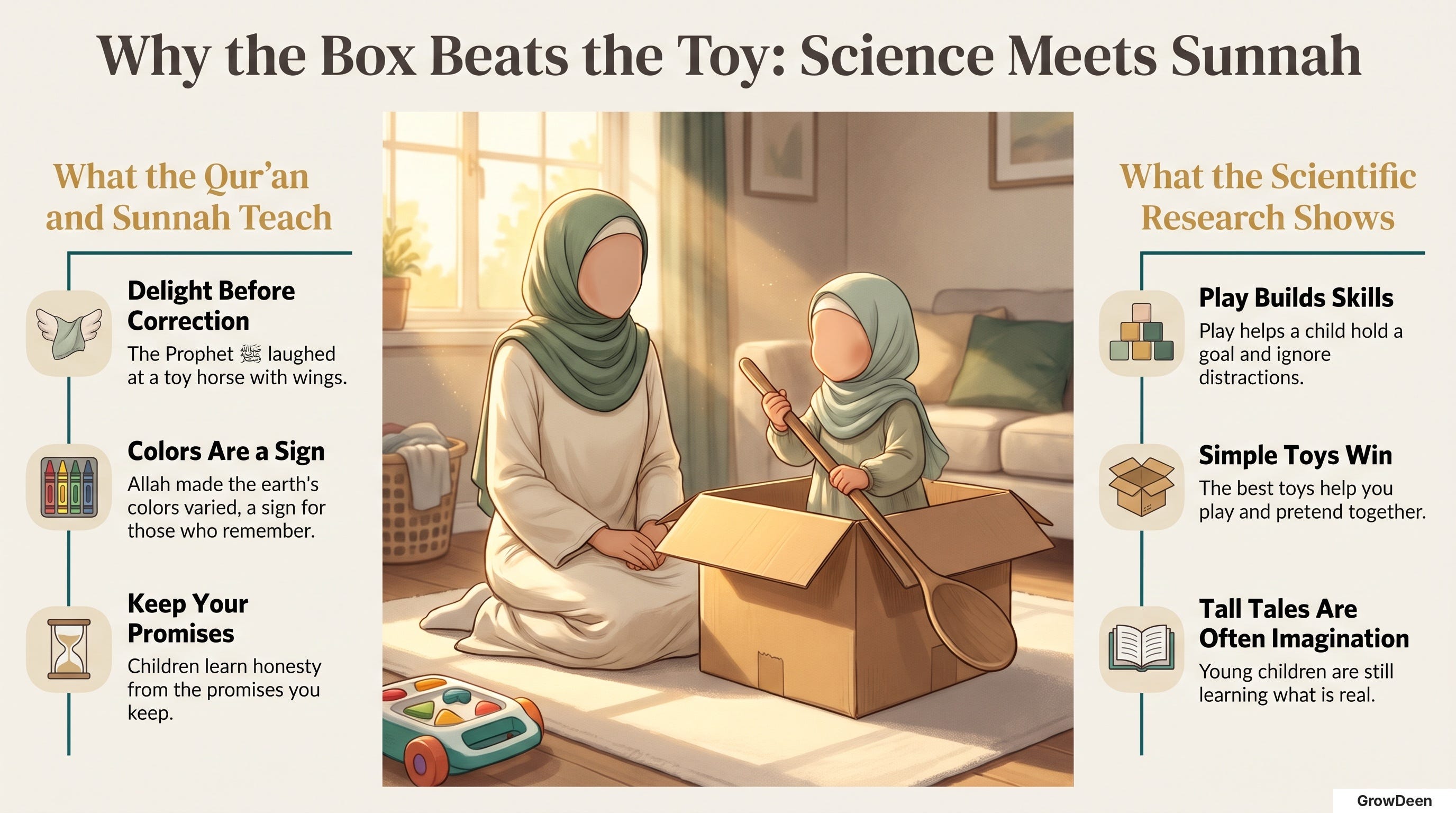
Your 4-year-old is in its box. She has named it a boat. She is rowing to her grandmother's house with a wooden spoon.
I worked an extra shift for that toy, and she wants the box. Did I get this wrong?
You chose that toy with care, and nothing about this means you got it wrong. The box often wins for a good reason. Her wild stories, like a lion at breakfast, are often imagination too.
This guide brings together scientific research and the Qur'an and authentic Sunnah. You'll see why the box wins, how the Prophet ﷺ met a child's invention, and how to join her game tonight.
The Short Answer
Right for your child? Ages 3 to 5. She plays pretend, tells tall tales or prefers the box to the toy.
What's probably happening: a box has no instructions, so she supplies them. Tall tales are mostly imagination: she is still learning what is real.
Try tonight (5 minutes): say yes to one invitation into her game. Take the part she gives you, and follow her story before you fix it.
You'll know it's working when: she hands you a part again, and the game runs on her ideas. A game that drifts off its plot is not failure.
Get help if: no pretend play by about 4, no short story by about 5, or lost skills. Start with your child's doctor or pediatrician.
The rest of this guide explains why, and what to do if it does not work.
How to Read This Guide
3 minutes: The Short Answer above is enough for tonight.
7 minutes: The Short Answer, then Knowledge in Practice and If Things Don't Go to Plan.
The whole guide: read on for the scientific research, the Qur'an and Sunnah, and the References.
To share: the bold lines and the pull quotes are made to be shared.
To listen: open this guide in the free Substack app and tap Listen.
Inside This Guide
Her game does not have to become a lesson. Being her customer is enough for tonight.
Myth Check: "Play Only Counts When It Teaches Something"
Many of us pick up this belief without noticing. It sells a great many toys. It also leaves parents feeling guilty about the hours their children spend doing what young children are built to do.
What it gets right. You want her to learn, and you chose that toy with care. Learning does matter, and the label promised letters.
What the evidence says. The American Academy of Pediatrics (AAP) says play itself can build the skills a child uses to hold a goal in mind and ignore distractions. [1] The authors of its report on toys say the best toys support parents and children playing, pretending and interacting together. They add that the best toys need not be flashy or expensive or come with an app. [2]
A game that teaches nothing on paper can still be doing good work.
Why This Happens
Why does the box beat the talking toy?
A toy built to do one thing tends to get one kind of play. A box comes with no instructions. Your child has to supply every one of them, and that supplying is imagination at work.
Early-years authors call such things "loose parts": materials children can move, change and control. They describe them as catching children's curiosity and giving their imagination free rein. [3] The talking toy does the thinking. The box asks her to do it.
What is make-believe doing inside her head?
Sitting on the floor while she runs a pretend café can feel like time off from real parenting. You order soup, pay with a button and wonder if you should be practicing letters instead.
That time counts. A child's mind and heart are part of the amanah (trust) Allah has placed with you.
In the café game she has to remember that the button is money and the cushion is a table, and keep the order straight. Then she has to cope when her little brother knocks the menu off the "counter". That is the goal-holding, distraction-ignoring work the AAP describes. [1]
Make-believe gives feelings somewhere to go as well. Some children replay a big change, such as a new baby on the way, again and again in their games.
What it looks like shifts fast. By two and a half, most children already use things to pretend, like feeding a block to a doll. [4]
Soon a dish towel (tea towel) becomes a doctor's coat. By four, most pretend to be something else during play, a teacher, a superhero or a dog. Most also draw a person with three or more body parts. [5]
By five, most can tell a story they heard or made up with at least two events, and use or recognize simple rhymes. [6] Every child keeps her own timetable, so read these as a rough map.
Is she lying, or is she imagining?
Your 4-year-old swears a lion ate breakfast with her at preschool (nursery). Something tightens in your chest, because truthfulness matters in your home, and you have heard that lying starts small.
The easy mistake is to treat that lion as a lie.
Scientists who study how children sort fantasy from reality found that young children are often skeptical, as likely to doubt as to believe. [7] But they lean too heavily on the little they know when they judge what is real. [7] This comes from a review of studies, so it is Suggestive.
Calling the lion a lie asks a small child to meet a standard her mind has not finished building.
The box doesn't win because the toy failed. It wins because it needs her ideas to work.
What the Scientific Research Shows
The strongest evidence comes from the AAP's clinical report on play. [1] It says play can promote the social-emotional, cognitive, language and self-regulation skills that build executive function. Executive function is what lets a child pursue a goal and ignore distractions. It adds that the shared joy and attunement parents and children can feel during play help regulate the body's stress response. [1]
Who wrote it: the American Academy of Pediatrics, US, 2018; no review date is stated. How strong this is: Strong, official guidance from a national body of pediatricians.
There is a limit, though. A large review of the evidence found that it does not support strong claims that pretend play is uniquely important for development. [8]
It found no compelling evidence that pretend play helps problem-solving, and mixed results for intelligence and creativity. [8] Who was studied is not given in the study summary. How strong this is: Strong, a large review.
That takes the pressure off. An afternoon of pretend shops does not need to produce something measurable to be worth it.
Imaginary friends are common. One US study followed 152 children aged 3 and 4, and saw 100 of them again three years later. About 65 in 100 had an imaginary companion at some point by age 7, either an invisible friend or a toy treated as a person. [9]
School-age children who did little or no pretending to be someone else scored lower on understanding other people's emotions. [9] That is a link, not proof of cause.
Who was studied: children in the US. Their ethnicity, family income and whether children with additional needs took part are not given in the study summary. How strong this is: Suggestive. One long-running study.
Toys and talk point the same way. A small study watched 26 families with babies aged 10 to 16 months. With electronic toys, parents spoke fewer words and took fewer conversational turns than with books or traditional toys. [10]
These were babies, younger than the children in this guide. Who was studied: country, ethnicity, income and additional needs are not given in the study summary. How strong this is: Early.
Books help too. In a small University of Oxford study, 22 parents recorded themselves at home with their 3- and 4-year-olds. With wordless picture books, they asked more open questions and added more ideas building on what the child said than with printed books. [11]
Who was studied: families in England (three London boroughs). Of the 22 children, 17 were White, 2 Asian and 3 of other or mixed background.
Most parents (77%) had education beyond secondary school, and all the children were typically developing. How strong this is: Early.
What we do not know yet: no study has yet tested this with Muslim families. None here tested parents taking a role in pretend play at home.
What this means for you: simple things and your company give her plenty to work with. No single afternoon has to prove anything.
What the Qur'an and Sunnah Teach
Should a home that takes Islam seriously leave this much room for make-believe? The Sunnah answers with a scene from the home of the Prophet ﷺ.
'A'ishah رضي الله عنها kept a cloth horse with wings among her toys. The Prophet ﷺ came home from an expedition and saw it. He asked what wings were doing on a horse. She answered that Prophet Sulayman عليه السلام had horses with wings. [12]
"Thereupon the Messenger of Allah (ﷺ) laughed so heartily that I could see his molar teeth."
Sunan Abi Dawud 4932 · Sahih (Al-Albani) · sunnah.com
Text. An invented creature, and a child's quick defense of it, were met with open delight.
Our reflection. He did not correct the invention. He enjoyed it, and he enjoyed her clever answer even more. When your child shows you a cat with six legs, let your first reply be the same: delight.
The Qur'an turns the same attention outward, toward the world itself.
وَمَا ذَرَأَ لَكُمْ فِى ٱلْأَرْضِ مُخْتَلِفًا أَلْوَٰنُهُۥٓ ۗ إِنَّ فِى ذَٰلِكَ لَـَٔايَةً لِّقَوْمٍ يَذَّكَّرُونَ
"And [He has subjected] whatever He multiplied for you on the earth of varying colors. Indeed in that is a sign for a people who remember."
An-Nahl 16:13 · Sahih International [13]
Text. Ibn Kathir explains that the earth's animals, minerals, plants and other things differ in color, shape, benefit and quality. The people who remember are those who recall Allah's blessings and give thanks for them. [14]
Our reflection. So when she hunts through the crayon tin for "the red that's nearly orange", laugh the way the Prophet ﷺ laughed. Then say, "Alhamdulillah, look how many colors Allah made." Her noticing becomes remembering.
Truthfulness matters too, and the Qur'an's standard on promises lands first on the adult.
وَأَوْفُوا۟ بِٱلْعَهْدِ ۖ إِنَّ ٱلْعَهْدَ كَانَ مَسْـُٔولًا
"…And fulfill [every] commitment. Indeed, the commitment is ever [that about which one will be] questioned."
Al-Isra 17:34 · Sahih International [15]
Text. Ibn Kathir explains that this covers every promise you make to people, and that the one who made a promise will be asked about it. [16]
Our reflection. At 3, 4 and 5, the honesty lesson runs mostly through you. "Two more slides, then home" means two. "Shop after lunch" happens after lunch. Children learn what a promise weighs by watching what yours weigh.
Family life and household work were never separate worlds in the home of the Prophet ﷺ either.
When 'A'ishah was asked what the Prophet ﷺ did in his house, she said: "He did what one of you would do in his house. … He mended sandals and patched garments and sewed."
Al-Adab Al-Mufrad 540 · Sahih (Al-Albani) · sunnah.com [17]
Our reflection. That opens a door at five o'clock. A game can ride on the jobs that need doing anyway (step 1 below).
Scholars differ on dolls with faces. Al-Qadi 'Iyad reported that most scholars allowed girls' toys, and al-Nawawi followed him in this. [18]
Others, including a Hanafi answer from Darul Iftaa Leicester, permit only dolls without a head or facial features. [19] A cloth doll or puppet with no face is acceptable on both of these views. For your own family's choice, ask your local imam or a local scholar, and share the details with him.
He met a winged horse with laughter. Our children's inventions deserve the same welcome.
The Lab Verdict
The science: play builds the skills a child uses to hold a goal and ignore distractions (Strong). The best toys help parents and children play together (Strong). Pretend play is not proven to be uniquely important, so no afternoon has to prove anything (Strong).
The Qur'an and authentic Sunnah: the Prophet ﷺ met a child's invented creature with laughter. The Qur'an calls the many colors on earth a sign for people who remember.
Where they meet: the science shows that open-ended play beside a warm adult helps a child grow; the Sunnah gives the manner, delight before correction. They meet in a warm welcome for her ideas.
So at home: say yes to one invitation, take the part she gives you, and laugh before you correct.
Knowledge in Practice: Say Yes to Her Game
Knowing why she plays this way is half the work. Knowledge bears fruit only when it reaches the living-room floor.
If you can only do one thing, do step 1. It is enough.
1. Say yes to one invitation, and take the part she gives you (5 minutes). A part inside the story keeps her in charge of it. Being the customer gets you much further than suggesting the menu.
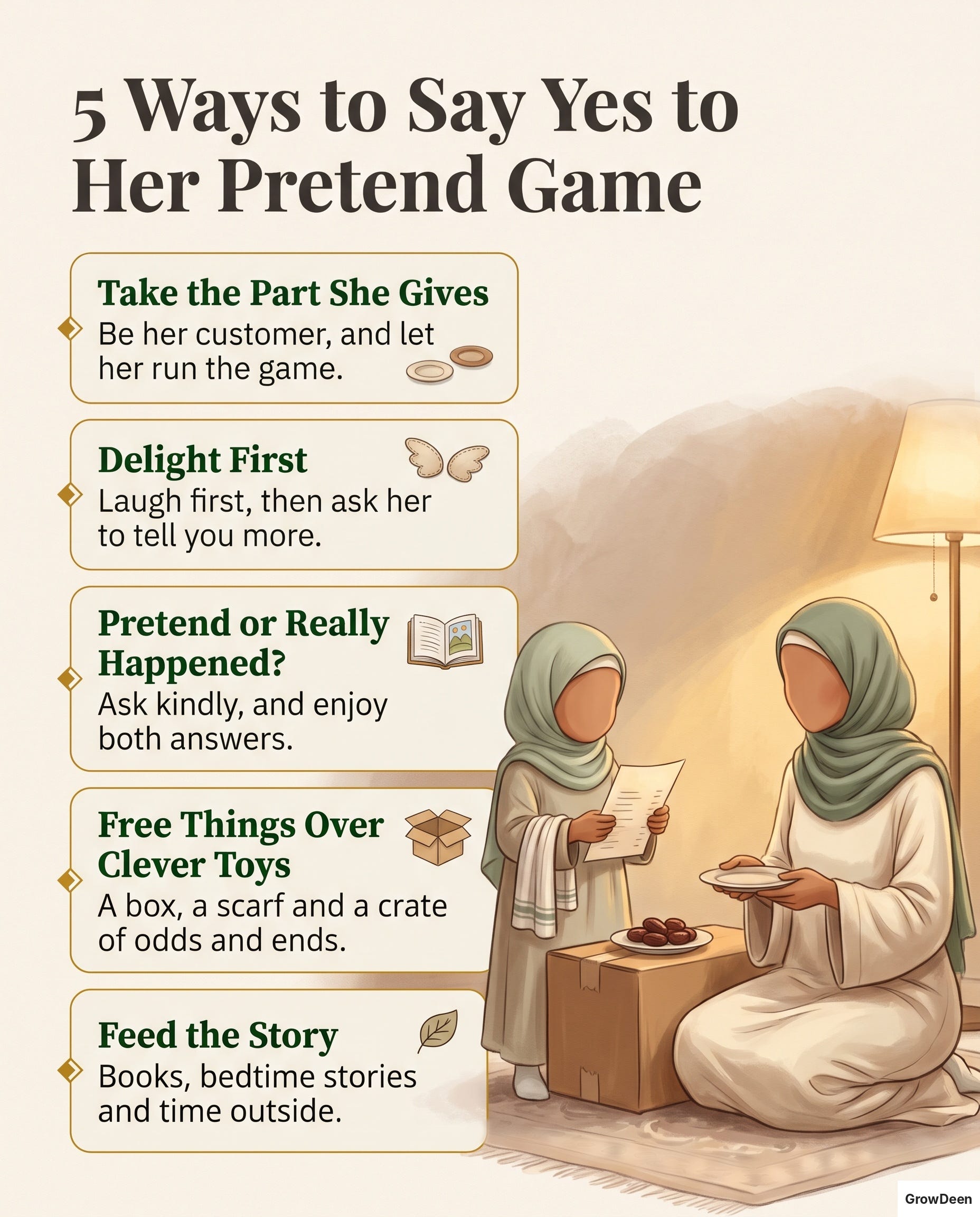
Say this: "Table for two, please. What do you recommend tonight?" (Say it in the language your child knows best.)
Other first lines, whatever game she is running:
On her bus: "Does this bus go to Grandma's house?"
At her clinic: "Doctor, my teddy hurt his paw at the park."
In her shop: "Good morning. Do you have any eggs today?"
In her masjid: "Which way is the qibla? Can you show me?"
Instead of: "Let's make the bus go to the store instead." Try: "Where is this bus going, driver?"
On a busy evening, the rice is on, the baby is grizzling, and she needs you to be a passenger on her bus right now. Let the game ride on the jobs that need doing anyway. She can run the iftar restaurant while you lay the table together, or be the shopkeeper who unpacks the groceries and stocks the shelf.
Acts of worship belong in pretend play too. For "going to the masjid", a small prayer mat and a toy compass are enough. Point the compass toward the qibla (the direction of the Ka'bah in Makkah). She can host an Eid visit with pretend sweets, and some 5-year-olds love packing a backpack for a pretend Hajj.
Age 3: she may hand you a role with few words, so copy what she does with the props. Age 5: ask her to tell you the rules before the game starts.
Follow her story before you fix it.
2. Meet each invention with delight first (1 minute). Delight before correction is the manner the Sunnah shows (What the Qur'an and Sunnah Teach).
Say this: "Tell me about it." When she picks a color: "Alhamdulillah, look how many colors Allah made."
Instead of: "Horses don't have wings." Try: "A horse with wings. Tell me about it."
3. Ask "pretend or really-happened?" kindly (1 minute). When a story grows wild, hand her a simple sorting question and enjoy both answers. Over months she learns that pretend stories belong in play, and really-happened stories get told the way they happened.
Say this: "Is that a pretend story or a really-happened story?"
Age 3: she may not answer yet, so answer for her: "That sounds like a pretend story. I love it." Keep your own promises in play too: if you say "one more round", stop after one.
4. Swap one clever toy for free materials (15 minutes, once a week). Gather loose parts from around the house. Start with these:
A busy box: a lidded crate of craft sticks (lolly sticks), card scraps, yarn (wool), a glue stick, paper towel tubes and washed yogurt pots. Top it up with acorns, leaves and feathers from walks.
A dress-up basket of old shawls, cardigans, sandals, handbags and caps, chosen to suit your household's adab (good manners).
Paper and crayons, with an invitation to map the walk from the masjid to your door.
Messy play with wet sand, dough, mud and runny paint, in the yard (garden) or on a day out by the water.
Collage from junk mail and catalogs, once you have pulled out anything immodest.
Puppets made from an odd sock or a lunch bag, which some shy children find easier to speak through.
Put six items out at a time. Hide the rest for a week, and the same box feels new again. Supervise bottle caps (bottle tops), pebbles and other small items with any child who still puts things in her mouth.
No yard or spare money? A kitchen drawer and the recycling bin hold most of this list.
5. Feed the story with books, stories and time outside (bedtime and weekends). After dinner, stop often in a book and ask what might happen next. Wordless picture books are worth hunting down (What the Scientific Research Shows). One early-childhood author suggests following a picture book about imagination with boxes or drawing materials, so your child can play the story out. [20]
The stories of the Prophets عليهم السلام give her a cast worth returning to, from Nuh عليه السلام and the ark to Yunus عليه السلام and the whale. Tell them in your own words at bedtime, and leave blocks and wooden animals out for the morning to see which story comes back.
Riddles, silly rhymes and made-up words are toys too. Rhythm does not need songs: clap the beats in everyone's names, or recite a short surah slowly and let her finish the lines she knows.
Outside, slow down. Outdoor and natural spaces give young children room to explore and to take small risks. [21,22] A systematic review found overall positive effects of risky outdoor play, such as climbing, on children's health and behavior, most often through more physical activity. [23]
Most of its studies were of low quality, so treat this as Suggestive. Stop at a snail shell or a striped stone and ask, "Who made this?"
On a clear afternoon, find shapes in the clouds together and finish with a whispered "SubhanAllah".
Make It Work in Your Home
Cooking with a baby on your hip? Let the game ride on dinner. She runs the iftar restaurant, and you order from the stove.
On your own, or working the night shift? One game a day is plenty. Five minutes on the floor before bed counts.
No spare money? Every prop in this guide and in the pack is already in your home or your recycling.
A grandparent who loves buying toys? Say this to Grandma (or Grandpa): "Mama, she loves the time you give her more than any toy. Next time, could you play shop with her? She would love to sell you something."
A spouse who wants her ready for school? Say this to your spouse: "I know you want her ready for school. Can we try one pretend game a night this week and see what she does with it?"
The family question: ask a grandparent, "What did you pretend with when you were small?" Let your child hear the answer.
Try It Seven Times
Any seven times in the next week or two, say yes to one invitation and take the part she gives you. Seven is a starting goal, not a magic number.
Keep one tick and one word for who she turned you into: a passenger, a patient, a customer. Tell us in the comments what part she gave you.
Take the part she gives you, and laugh before you correct. That is the whole practice.
If Things Don't Go to Plan
If she won't let you in: stay near, watch and describe what you see. Being close is still joining. Try again tomorrow.
If she wants you to run the whole game: play the part she asked for, then hand a choice back: "What happens next, driver?"
If you start doubting yourself: Shouldn't I be teaching her letters instead? The AAP counts play as one of the ways children build skills. [1] Letters can share the day with it.
If you lose patience: most parents do at times. Sit back down and say, "I'm sorry I took over your game. Can I be the customer again?" Repair is part of the lesson.
If the screen is the only thing holding the afternoon together: some days it is, and you are not the only one. In a Muslim home, content comes first: Islamically suitable, music-free, parent-approved programs, ideally watched with you. Some programs may even hand her an idea she then builds with real blocks.
For ages 2 to 5, the AAP advises no more than 1 hour a day of high-quality programs, watched together. [25] The World Health Organization (WHO) sets no more than 1 hour of sedentary screen time at ages 3 and 4, and says less is better. [26]
When she is sitting still, the WHO encourages reading and storytelling with a caregiver. [26] Both are official guidance (Strong).
If make-believe turns into a nightmare: at two in the morning, the dragon from yesterday's library book turns up in her sleep. She arrives at your bedside shaking. Sit close, keep your voice low and tell her it was a dream: creatures from stories cannot come into her room.
The Prophet ﷺ taught that a person who sees a dream he dislikes should seek refuge with Allah. [24] Say "A'udhu billah" (I seek refuge with Allah) together, a short way for a small child to do that. Keep a hand on her back until she settles.
Children this age are still learning how to judge what is real, so a story creature can seem possible at night. [7] Keep frightening books and shows out of the hour before bed.
Speak to someone if: there is no pretend play by about 4, or no short story by about 5. The same goes if she loses play or language skills she once had. Do the same if fears or nightmares keep disrupting daily life.
Milestone checklists help, but they are not a developmental screening, so ask your child's doctor about one. [5,6] Signs are clearer looking back. Seeing them late is not neglect.
For questions of deen, ask your local imam or a local scholar, and share the details with him.
Who to turn to: your child's doctor or pediatrician. Her preschool teacher can also tell you what they notice.
Support Muslim Parenting Lab ❤️
Is there something in your record you would like wiped? Give any amount today with the button below.
The Prophet ﷺ said charity extinguishes sin as water extinguishes fire. (Jami' at-Tirmidhi 2616, hasan)
Your Companion Pack: The Make-Believe Pack
You have read this far on a busy evening. You want her childhood to have room for wonder, and you want it to be a Muslim childhood too.
The Make-Believe Pack is free to download: one 3-page PDF made for the fridge. Inside:
Page 1, The Free Materials Map: a checklist of 24 everyday things from your kitchen, bathroom, recycling and garden (yard). Each one says what it can become in a game. The six-at-a-time tip sits at the bottom.
Page 2, Seven Everyday Role-Play Scenes: from the Iftar Restaurant to Packing for Hajj and the Grandma Bus. Each has props from around the house, your first line in character and one small adab moment. Start a game fast when she says "play with me" at five o'clock.
Page 3, The Winged Horse Reflection: the story of the cloth horse with wings that made the Prophet ﷺ laugh. Beside it is An-Nahl 16:13 on the colors Allah spread across the earth, with two lines to say when she shows you something she made.
Parents Also Ask
Why does my child play with the box instead of the toy?
A box has no instructions, so your child supplies every one of them, and that is imagination at work. The authors of the AAP's report on toys say the best toys support parents and children playing and pretending together. [2] Why This Happens explains more.
Is my 4-year-old lying or imagining?
A fantastic story at this age is usually imagination. Young children are as likely to doubt as to believe, but they lean on the little they know when they judge what is real. [7] Ask kindly, "Is that a pretend story or a really-happened story?" And keep your own promises, which Al-Isra 17:34 asks of every adult. [15]
Is it normal for a 4-year-old to have an imaginary friend?
Yes, it is common. In one US study, about 65 in 100 children had an imaginary companion at some point by age 7. It could be an invisible friend or a toy treated as a person. [9] If an imaginary friend comes with fears that disrupt daily life, talk to your child's doctor or pediatrician.
Should I join in my child's pretend play?
When she invites you, yes: take the part she gives you and follow her lead. The AAP says the shared joy of playing together helps regulate the body's stress response. [1] If pretend play is not your favorite thing, five minutes as her customer still counts.
How much screen time should a 3- to 5-year-old have?
The AAP advises no more than 1 hour a day of high-quality programs for ages 2 to 5, watched with a parent. [25] The WHO sets no more than 1 hour of sedentary screen time at ages 3 and 4, and says less is better. [26] In a Muslim home, choose Islamically suitable, music-free, parent-approved programs.
Are dolls allowed in Islam?
Scholars differ. Al-Qadi 'Iyad reported that most scholars allowed girls' toys, and al-Nawawi followed him in this. [18] Others, including a Hanafi answer from Darul Iftaa Leicester, permit only dolls without a head or facial features. [19] A cloth doll with no face is acceptable on both of these views. For your family's choice, ask your local imam or a local scholar, and share the details with him.
Final Reflection
Dear parent,
You read a whole guide about a cardboard box. That shows how much you care about her mind and her deen.
If you have steered her games until now, you did it out of love. You wanted her to learn. Allah sees the care behind the toy you chose.
You do not need to change every evening. Start with step 1 tonight. Say yes to one invitation, and let her decide who you are. We ask Allah to make each afternoon beside her heavy on your scale.
Often, the box beats the expensive toy because it leaves room for her ideas, and for yours.
A Du'a for This
For you:
رَبَّنَا هَبْ لَنَا مِنْ أَزْوَٰجِنَا وَذُرِّيَّـٰتِنَا قُرَّةَ أَعْيُنٍ وَٱجْعَلْنَا لِلْمُتَّقِينَ إِمَامًا
Rabbanā hab lanā min azwājinā wa dhurriyyātinā qurrata a'yunin waj'alnā lil-muttaqīna imāmā
"Our Lord, grant us from among our wives and offspring comfort to our eyes and make us a leader [i.e., example] for the righteous."
Al-Furqan 25:74 · Sahih International [27]
With your child: Rabbi zidnī 'ilmā, "My Lord, increase me in knowledge." (Ta-Ha 20:114) [28]
From about age 3, say it together before a bedtime story, or say it over her while she plays.
In your own words: ask Allah to bless the small mind He has placed in your care.
Share the Khayr
Think of one person: the sister who has spent too much on a talking toy for Eid. Or the friend after Jumu'ah who worries her daughter's stories are lies. Send this to her. The Prophet ﷺ said that whoever guides someone to good has a reward like the one who does it. [29]
Tell us in the comments: what did your child's last cardboard box turn into? We'd love to know.
Parents Also Read
Parents who read this guide also found these helpful.


References
[1] Yogman, M., Garner, A., Hutchinson, J., Hirsh-Pasek, K., Golinkoff, R.M., et al. (2018). The power of play: A pediatric role in enhancing development in young children. Pediatrics, 142(3), e20182058.
[2] Healey, A., Mendelsohn, A., & AAP Council on Early Childhood. (2019). Selecting appropriate toys for young children in the digital era. Pediatrics, 143(1), e20183348.
[3] Daly, L., & Beloglovsky, M. (2014). Loose parts: Inspiring play in young children. St. Paul, MN: Redleaf Press.
[4] Centers for Disease Control and Prevention. Milestones by 30 Months. Learn the Signs. Act Early.
[5] Centers for Disease Control and Prevention. Milestones by 4 Years. Learn the Signs. Act Early.
[6] Centers for Disease Control and Prevention. Milestones by 5 Years. Learn the Signs. Act Early.
[7] Woolley, J.D., & Ghossainy, M.E. (2013). Revisiting the fantasy-reality distinction: Children as naïve skeptics. Child Development, 84(5), 1496–1510.
[8] Lillard, A.S., Lerner, M.D., Hopkins, E.J., Dore, R.A., Smith, E.D., & Palmquist, C.M. (2013). The impact of pretend play on children's development: A review of the evidence. Psychological Bulletin, 139(1), 1–34.
[9] Taylor, M., Carlson, S.M., Maring, B.L., Gerow, L., & Charley, C.M. (2004). The characteristics and correlates of fantasy in school-age children: Imaginary companions, impersonation, and social understanding. Developmental Psychology, 40(6), 1173–1187.
[10] Sosa, A.V. (2016). Association of the type of toy used during play with the quantity and quality of parent-infant communication. JAMA Pediatrics, 170(2), 132–137.
[11] Mathers, S.J., Hodgkiss, A., Kolancali, P., Booton, S.A., Wang, Z., & Murphy, V.A. (2025). Comparing parent-child interaction during wordless book reading, print book reading and imaginative play. Journal of Child Language, 52(2), 399–424.
[12] Sunan Abi Dawud 4932. Graded: Sahih, by Al-Albani.
[13] Qur'an, An-Nahl 16:13. Translation: Sahih International.
[14] Tafsir Ibn Kathir on An-Nahl 16:13.
[15] Qur'an, Al-Isra 17:34. Translation: Sahih International.
[16] Tafsir Ibn Kathir on Al-Isra 17:34.
[17] Al-Adab Al-Mufrad 540. Graded: Sahih, by Al-Albani.
[18] Islam Question & Answer. Exemption of (baby) dolls from the ruling on haram images. Question 9473.
[19] Darul Iftaa Leicester (Mufti Muhammad ibn Adam). Dolls for Children. IslamQA.org.
[20] Niland, A. (2023). Picture books, imagination and play: Pathways to positive reading identities for young children. Education Sciences, 13(5), 511.
[21] Little, H., Elliott, S., & Wyver, S. (Eds.). (2017). Outdoor learning environments: Spaces for exploration, discovery and risk-taking in the early years. London: Routledge.
[22] Wilson, R. (2018). Nature and young children: Encouraging creative play and learning in natural environments (3rd ed.). London: Routledge.
[23] Brussoni, M., Gibbons, R., Gray, C., Ishikawa, T., Sandseter, E.B.H., Bienenstock, A., et al. (2015). What is the relationship between risky outdoor play and health in children? A systematic review. International Journal of Environmental Research and Public Health, 12(6), 6423–6454.
[24] Sahih Muslim 2262.
[25] American Academy of Pediatrics Council on Communications and Media. (2016). Media and young minds. Pediatrics, 138(5), e20162591.
[26] World Health Organization. (2019). Guidelines on physical activity, sedentary behaviour and sleep for children under 5 years of age. Geneva: World Health Organization.
[27] Qur'an, Al-Furqan 25:74. Translation: Sahih International.
[28] Qur'an, Ta-Ha 20:114. Translation: Sahih International.
[29] Sahih Muslim 1893a.
We combine scientific research with Qur’an and authentic Sunnah, and we cite our sources. Even so, this is general guidance and no substitute for a doctor who can examine your child.
Sources & confidence
The hadith in this guide are from Sahih Muslim, Sunan Abi Dawud and Al-Adab Al-Mufrad. The two outside Sahih Muslim are graded Sahih by Al-Albani, as sunnah.com shows. Qur'an translations are Sahih International. Checked November 2026. For a ruling on your own situation, ask your local imam or a local scholar, and share the details with him. Found a source that looks wrong? Email us at info@growdeen.com.
Words in this guide
pretend play (make-believe, imaginative play, dramatic play) · scientific term: play in which a child treats one thing as another or acts out a role.
executive function · scientific term: the skills a child uses to hold a goal in mind, plan and ignore distractions.
imaginary companion (imaginary friend, invisible friend) · scientific term: a pretend friend, invisible or a toy treated as a person.
loose parts (open-ended toys, open-ended materials) · scientific term: everyday materials a child can move, change and turn into anything.
conversational turn (back-and-forth) · scientific term: one thing a person says, then a reply that answers it.
developmental screening · scientific term: a short, standard check a doctor uses to see whether a child's development needs a closer look.
fantasy-reality distinction · scientific term: a child's growing skill at telling what is real from what is made up.
tall tale · everyday term: a wildly made-up story told as if it happened.
role-play · everyday term: acting out a part, like a shopkeeper, a doctor or a bus driver.
amanah · Islamic term: a trust Allah has placed in your care.
adab · Islamic term: good manners and right conduct.
qibla · Islamic term: the direction of the Ka'bah in Makkah, faced in prayer.
iftar · Islamic term: the meal that breaks the fast at sunset.
Hajj · Islamic term: the pilgrimage to Makkah.
Eid · Islamic term: the two festival days of the Muslim year.
masjid · Islamic term: a mosque.
Jumu'ah · Islamic term: the Friday congregational prayer.
deen · Islamic term: the way of life of Islam.
tafsir · Islamic term: an explanation of the Qur'an by a scholar.
du'a (doa) · Islamic term: supplication, asking Allah.
Alhamdulillah · Islamic term: all praise is for Allah.
SubhanAllah · Islamic term: glory be to Allah.
A'udhu billah · Islamic term: I seek refuge with Allah.
alayhi as-salam (عليه السلام), alayhim as-salam (عليهم السلام) · Islamic term: peace be upon him, peace be upon them, said after a prophet's name, or after naming them all together.
sadaqah jariyah · Islamic term: ongoing charity whose reward continues.
khayr · Islamic term: good.
preschool (nursery) · country word: a school or class for children before kindergarten.
yard (garden) · country word: the outdoor space at a home.
dish towel (tea towel) · country word: a cloth for drying dishes.
craft sticks (lolly sticks) · country word: flat wooden sticks used for crafts.
paper towel tube (kitchen-roll tube) · country word: the cardboard tube inside a roll of paper towels.
yarn (wool) · country word: thread for knitting or crafts.
bottle caps (bottle tops) · country word: the lids of bottles.
store (shop) · country word: a place that sells things.
color, behavior, favorite, program (colour, behaviour, favourite, programme) · country word: US spellings used in this guide.